Friday, July 03, 2020

Rav Kook's Ein Ayah: The Symbiotic Relationship of the Needy and the Philanthropists

(condensed from Ein Ayah, Shabbat 12:13-15)

Gemara: [We continue with profound “word games,” focusing on the letters of the alphabet in pairs, with relevant words they can form and their physical characteristics.] Gimmel dalet – g’mol dalim ­(be kind to the poor). Why does the leg of the gimmel extend toward the dalet? It is because it is the nature of the philanthropist to run after the poor. Why does the leg of the dalet reach back toward the gimmel? It is so that the needy should make himself available to the philanthropist?

Ein Ayah: We should understand that the value of philanthropy in the world is not just when it comes from the churnings of the heart when one is agitated by the suffering of the poor person and empathizes with him. If that were the case, the philanthropist’s help is in effect to calm his own pain. Nor is the value of philanthropy a mere result of the intellectual realization that it is correct to have mercy on one’s counterpart.

Rather, Hashem created an order in the world that includes the poor and the rich. The poor have a known function to play in the world, for if they were missing, the world would be incomplete, missing part of its character. It would not be able to reach the lofty goal that its Creator set for it.

It turns out, then, that the needy, whose poverty enables the world to be complete and put up with painful lives, receive their donations as an earned portion. This secret is the most internal part of the mitzva of tzedaka in its highest form and removes from the recipient the lowliness of spirit that people mistakenly attribute to one who might be seen as receiving that which he does not deserve.

The philanthropist who already reached the level of recognizing that he should not give because he is squeamish about the suffering of the poor has an advantage in his philanthropy. If it were a reaction, then he would not give when he was not witness to the great suffering of the needy. But if he knows the great purpose that philanthropy has in the world and the holy satisfaction that the community and the individual are blessed with through tzedaka and acts of kindness, then he will always seek opportunities to expand his philanthropic activities. This is represented by the leg of the gimmel facing toward the dalet.

The idea of tzedaka in the Jewish world stands above the difficulties of life; it transcends the necessity to fill the needs. The great role that philanthropy plays in the world influences not only the moral standing of the philanthropists, who provide the tzedaka, but spiritually impacts the recipients. The Jewish destitute person, who is forced to receive donations, can be uplifted by the notion of his spiritual role to the point that it removes the pain of his physical lacking. He can revel in his part in improving the world and the souls of those who are involved in philanthropy.

Then he can request donations, but not to solve his physical tribulations. He will not need to be pushed by need to present himself to eager philanthropists. Rather, he will come himself like the letter dalet reminds us. He needs to come forward to facilitate bringing the goodness of acts of kindness from the potential to the actual. In this way, he enriches with the gifts of generosity and love, in which both sides of the philanthropic process are equal. The feeling of pain can then be absent even when the need is great, because “the blessing of Hashem is enriching, and sadness will not continue to exist with it” (Mishlei 10:22).

Living G-d’s Life

by Rabbi David Aaron

Quite frankly, I don’t believe in G-d. The word spelled G-O-D does nothing for me; in fact, it interferes with my true belief.

I am not alone. Jews don’t believe in G-d. Indeed, the word “G-d” is not found in the Torah or the rest of the Hebrew Bible. Moses never heard of G-d nor heard from G-d.

The name in the Torah that has been translated as G-d or Lord is Adonai. The word Adonai means “Master.” In Jewish law, whatever a servant owns actually belongs to his master; the servant has no possessions whatsoever. This law also governs our spirituality: G-d is our Master, and in essence we own nothing. For example, it is incorrect to say “my” life because it is really G-d’s life. We do not own the life force within us.

This is a difficult concept to accept for many people because it is not a concept—it is a self-evident experience. Consider this: If we are the master and owners of our lives, then we could stop our life and start it whenever we wanted. We could stop our heart beating and then start it again at will. So too, our thoughts are not really our own. If we were the masters of thinking, then we could stop thinking and start whenever we please. But we cannot; we are constantly thinking. The same goes with feeling; we are constantly feeling and cannot make ourselves stop. We can choose what to think, what to feel and what to do with our lives, but the actual act of thinking, feeling and living are G-d’s powers that He shares with us. To take our life is to commit suicide. All we can do is humbly and gratefully receive the power of life that G-d, the Master of life, shares with us.

Even our will is not our own. We did not invent will; we are not the source of will. We do not have the choice to have a will. What we do with our will—how we direct it and invest it—is our choice. What to choose is our choice, but the fact that we are able to choose is not our choice. Even our motor skills are not ours. We did not create the knowledge or the skills required to open our mouths. To open our mouths, we tap into a wisdom that is clearly not ours.

Therefore, when I call to “Adonai” and want to feel His presence in my life I try to contemplate the miraculous mechanism of all my facial muscles and the wondrous ability to speak. I focus especially on the 17 muscles that mysteriously work with perfect coordination, shaping my lips to express every letter and syllable. Take a moment right now to simply open and close your mouth. Who taught you how to do that? Who empowers you to do that? Whoever that is, that is who we call Adonai. He is our Master Self who benevolently shares Himself—His life, will, wisdom, etc. with us and offers us to be His partners.

Aristotle taught that everything in existence could be defined in terms of substance and form. There is no such thing as form without substance, or substance without form. This is true of everything we do. Our daily life is a partnership with G-d. G-d provides the raw materials—the substance—and we determine the form. We don’t have the choice to want, think and feel—we are always wanting, thinking and feeling—but we can choose what we are going to want, think and feel. We didn’t choose to be born, but we can choose what to make of our lives. And our goal according to Judaism is to take the powers G-d shares with us and turn them into praise.

What is praise — tehilla? Rabbi S. R. Hirsh says that the word hallel means to reflect. In other words, to praise G-d means to become a living manifestation of His truth and reflect His greatness. Created in the image of G-d we are meant to mirror His splendor and glory; that His presence reverberate in everything we think, say and do.

What does it mean to be the chosen people?

by Rav Binny Freedman

Years ago, about to exit the doors of LaGuardia airport after a long flight, I suddenly realized I had forgotten my tefillin on the plane.

I rushed back to the gates only to discover I could not get through without a valid boarding pass, which I no longer had. Personnel at lost and found (in baggage control) patiently explained they only dealt with items lost in the airport or in baggage, and sent me to the check in counters, where they explained I had no boarding pass and could not get back on the plane, which was now being cleaned, and did I have identification?

Finally, a supervisor with a security guard came out to see what was going on and asked me to describe the lost object. And so, a few months after September 11th, with all of the heightened security, I explained it was a small velvet pouch, with two leather boxes and straps inside. Although my name was on the bag, it was only my Hebrew name, written in ancient Hebrew letters….

“Well, what exactly are these boxes, sir?” the woman asked, and what is it that you do with them? And if you don’t even have your name on them why are you so concerned about them?”

How could I explain the concept of Tefillin before the plane took off with my Tefillin to its next destination, especially as the security guard was by now eyeing me very curiously?

“Well, we wear these as a sign that we are the chosen people….”


What does it mean to be the chosen people? Are we somehow better than everyone else?

Three thousand years ago, a non-Jewish prophet named Balaam forced us to confront this very question.

Balak, the king of Moab, finally realized that the Jewish people in the desert were not going to be defeated on the battlefield.

Having somehow miraculously escaped Egypt leaving the mighty Egyptian army floundering in the Red Sea, and after vanquishing the Amalekites in open battle, clearly the Jews and their G-d would not be conquered in the conventional manner.

So Balak hires Balaam to curse the Jewish people, hoping to somehow undermine them on the spiritual battlefield.

Yet a non-Jewish prophet as intent on wickedness as Balaam could only offer the words G-d put in his mouth and what comes forth from Balaam’s mouth is some of the most beautiful poetry in the bible.

“Mah Tovu O’halecha’ Ya’akov, Mishke’notecha’ Yisrael! …Yizal mayim Mi’Dalyav,Ve’Zar’o’ be’mayim Rabim…Ve’Tinaseh’ malchuto’”

“How goodly are your tents oh Jacob, Your dwellings, Oh Israel!… Water shall flow from his branches, and his seed shall be in many waters, and his kingdom shall be exalted.” (Bamidbar 24:5-7)

Are we really exalted above all other peoples? Are we chosen and therefore somehow better than everyone else?

And yet, every Friday night we make Kiddush over a cup of wine and bless G-d: “Ki Vanu’ Vacharta, Ve’Otanu Kidashta’” “Because you chose us and sanctified us…”.

Are we really the chosen people? Are we better than everyone else?

I recall once, when our son Yair was three years old, he came over to hug me and said, taking my face in his hands: “Aba, you’re the best!” then he asked me: “Aba, am I the best?” With his five year old sister standing a few feet away, I realized this was a political minefield, so I simply said, in the tradition of centuries of clever parents: “You’re the best three year old in the family!”

Because it is uncomfortable to assume anyone is really the best, isn’t it?

So, what does it mean to be chosen?

It is interesting to note that Jews come in all shapes and sizes, with no reference anywhere in Jewish law and tradition to any difference whatsoever regarding a Jew’s status be he black or white, or of African, Mexican, Chinese, European or any other racial origin. So obviously this idea of being chosen cannot be a racist concept.

Indeed, Jewish tradition even has a place in the world to come for the righteous amongst the nations, (see ToseftaSanhedrin 13) and it is actually a lot easier for a non-Jew to get into ‘heaven’ and certainly to keep his or her place there, than it is for a Jew!

Indeed, the entire portion in which we receive the Torah is named after a non-Jew, Yitro, and it is from him that we receive the basics of our system of courts and judges, something the Torah makes quite clear. And there are many sources in which it is quite clear that a person can reach the highest spiritual levels, even having the Divine Presence (the Shechinah) descend upon oneself be they Jew or non-Jew (Tana De’Bei Elihau Rabbah 9).

And of course, anyone, regardless of race or nationality, wishing to become Jewish can do so, through a process known as Giyur (conversion). Obviously, then, we are not ‘better’ in the normal sense of that word. So, what is this idea of being chosen, or even exalted, which Balaam alluded to, so long ago?

It is interesting to note that on Shabbat, that same Shabbat which begins by suggesting that we are chosen, mentioned as well in the Friday night services, reaches its crescendo on Shabbat afternoon when we describe the Jewish people as “Goy Echad Ba’Aretz” “One nation”. It seems, then that we are indeed ‘The one, the only one’, which again seems to leave a very bad taste.

The truth is, we are all, in a sense, chosen; Born, each of us as individuals, with our own special gifts. The real question is not whether I am chosen. The real question is what am I chosen for? What do I choose to do with the gifts I have been given?

There is a statement in the Talmud that relates to the story of Balaam.

When the emissaries of Balak, the king of Moab, come to entice him to come and curse the Jewish people, he seems to do the right thing.

“Stay this night and I will respond to your request based on however G-d

instructs me….” (22:8)

And ultimately, G-d tells Balaam (verse 12) not to go with the emissaries of Balak, so Balaam tells the messengers to go home.

But Balak refuses to take no for an answer, and the messengers return, and again Balaam tells them G-d decides these things. Only this time, (v.20) G-d says:

“If these men have come to call on you, then by all means, go with them…”

And incredibly, when Balaam goes, G-d gets very angry with him! (v.21-22)

Why is G-d angry with Balaam, when Balaam clearly said he could not go without G-d’s permission, and G-d basically gave him the go-ahead?

So the Talmud (Makkot 10b) gives us a fascinating insight into the psychology of our relationship with G-d, and ultimately with ourselves.

“Rabbah Bar Rav Huna said: This teaches that a person is led in the path that he wishes to travel.”

Ultimately, G-d allows us to do what it is that we want to do. G-d’s problem with Balaam, was that despite the fact that G-d had already expressed to Balaam that this was not the right path, Balaam still wanted to go.

Who I am, ultimately, is a result of the choices I make.

The concept of being ‘chosen’ as a people does not mean we are better than anyone else. What it means is that we, (like any other nation) have our own special gifts and therefore our own special purpose. And this different (and not better) relationship with G-d is a result of the choices we have made. All of which now present us with the challenge of living up to the responsibilities those gifts and that different relationship entail.

Three thousand years ago in the desert, as a people, we made a choice to be different. To stand up to a higher moral standard; to refuse to become what those who wish us destroyed long for us to be.

And even in these challenging times, we can still hear the echo of those words ringing out in the barren mountains of Arvot Moav, on the banks of the Jordan river: “Mah Tovu O’halecha’ Ya’akov”, “How goodly are your tents oh Jacob”.

We live in a time of blessing, when we can walk again the alleyways of the old city of Jerusalem, stand on the top of Masada and experience the breathtaking vista of the Sea of Galilee from atop the Golan Heights….

May Hashem bless us all to discover the beauty of the gifts we have been given, and to live up to the challenge of what we can do with them.

Shabbat Shalom from Jerusalem.

The Yishai Fleisher Show: Donkey Talk, Surviving Terror, & Celebrating Sovereignty Day


First, Yishai is joined by Rav Mike Feuer to feel the burden of the Biblical she-donkey ridden by the evil wizard Balaam who wanted to curse the nation that God had blessed. Then, terror on the eighth night of Chanukah: Chaim Silberstein's daughter and son in lawn survived miraculously - but the baby, and other victims, did not make it. The Jihadist murderer now received four life sentences - but has justice been fully served? Finally, get ready to laugh with Malkah Fleisher: thumbs down on Boris Johnson, and the announcement of Sovereignty Day!

Rabbi Ari Kahn on Parashat Balak: The First Political Strategist

The Blessing of Isolation for Israel

“Hen Am L’Vadad Y’Shkone...” (from the root BaDaD*). “Behold, it is a nation that shall dwell alone, and not be reckoned among the nations.” *More on this later.

And so, Balaam’s attempted curse comes out of his foul mouth, as one of the biggest blessings in the Torah. Only with historical/messianic hindsight will the people of Israel fully understand it. But, let’s see what we can understand even now.

In this week’s Torah reading, the king of Moab frightened by Am Yisrael’s movement into the region, wants to hire a “prophet,” the renowned professional curser Balaam. Balak sends messengers and makes him an offer.

Balaam tells them, that he can only say what God wants him to say. He tells them to stay the night and “let’s see what God wants.”

God comes to Balaam and says, “You shall not go with them! You shall not curse the people because they are blessed,” (Numbers 22:12).

After rebuffing Balak’s messengers a few times, God comes to Balaam and tells him, “If these men come to call for you again, go with them, but only speak the words I tell to you say...” (Numbers 22:20).

Knowing that Balaam intended to flout His command, the God of Israel then puts an obstacle in his way. An angel with a drawn sword that his donkey can see, but he can’t, to impress upon him, his lowly stature as a “prophet.”

Finally he gets to the mountaintop, overlooking the Israeli encampment, sets up shop and begins.

He [Balaam] took up his parable and said, “Balak the king of Moab has brought me from Aram, from the mountains of the east [saying], ‘Come, curse Jacob for me and come invoke wrath against Israel.’

How can I curse whom God has not cursed, and how can I invoke wrath if the Lord has not been angered?

For from their beginning, I see them as mountain peaks, and I behold them as hills; it is a nation that will dwell alone, and will not be reckoned among the nations,” (Numbers 23:7-9).

Rashi explains, “It is a nation that shall dwell alone.” To dwell alone (BaDaD*), is in the merit of their forefathers – as the Targum [Onkelos] renders it [it is a nation that is alone/in solitude, destined to inherit the world]. *More on this later.

“...and not be reckoned among the nations.” As Targum [Onkelos] paraphrases, they will not perish along with the other nations, [when God finally judges the nations] as it says, “for I shall make an end of all the nations...” (Jeremiah 30:11); but Israel will be safe.

We have seen this in our time, with Israel’s early closure of it’s borders, and low CoronaVirus fatalities.

The Midrash HaGadol explains the verse a little differently, this refers to Israel’s mission to remain separate and distinct from the nations. From this blessing, that Balaam gave against his will, we understand what he really intended (see Sanhedrin 105a and the end of the parsha, where Balaam later sends in Moabite prostitutes to de-moral-ize the Jews, Numbers 25:1-9), so that the Jewish people assimilate into the nations, and be stripped of their religious values.

*I want to look at the word BaDaD, (to be alone/isolated/separate) further, through two dimensions. Starting with the Prat (individual/specific) level, and then moving toward the Klal (national/general) level.

1. The word BaDaD is related to the word BeDuD, which is the Isolation Ward in a hospital. A hint to our times?

2. The word BaDaD is related to the word BaD, a pole or staff. The carrying poles for the Aron HaKodesh (Ark of the Covenant), were called BaDim (pl.). Once inserted into the rings on the Ark, they were forbidden to be removed. They were separated from every other use, and dedicated to one purpose, carrying the Ark. So too, the Jewish people are separated from the nations and dedicated to the service of God.

3. The most common word for Jewish meditation is HitBoDeDut, from the root BaDaD. Popularized by Breslover Hasidim, Rabbi Nachman of Breslov, taught the importance of going out to the fields, or in some other manner, to isolate yourself, to be alone to talk to God. HitBoDeDut, is commonly understood that way.

But as Rabbi Aryeh Kaplan (in Jewish Meditation, Meditation and the Bible, and elsewhere) explains, HitBoDeDut, is the reflexive form of the verb, really meaning, to isolate yourself internally (from your sense of self, so that you can tune into God). Jewish meditation was an integral part of preparation to receive prophecy, something that will return to the Jewish people in messianic times, (Maimonides – Rambam, Igeret Taiman/The Epistle to Yemen).

4. This meditative process, it is said, is what led Avraham Avinu (Abraham our father) to discover and connect to God. It gave him the courage of his convictions, to stand up to Nimrod and the entire world, to declare there is only one God. He was BaDaD, alone in the world.

5. In discussing the newly founded State of Israel, Yisrael Eldad, Jewish philosopher and former ideologist of the pre-state LECHI underground, wrote in his book, “The Jewish Revolution,” about Abraham, and then described his decendents, the Jewish people, as a “nation of non-conformists.” This Eldad argued, is what kept them (BaDaD) separated from the nations, preserved their identity over the millennia, and gave them the ability, through their single minded dedication, to stand up to the world and declare independence.

6. I wrote in, “Israel, Stay Out of Entangling Alliances,” “Jews really don’t need to look beyond their own tradition for policy guidelines that warn not to get into “entangling alliances.” Traditional Jewish commentaries to these verses [about Balaam] explain that the Jewish people get their strength and prosperity not from alliances with other nations and cultures, but from their single-minded adherence [BaDaD – dedication] to their own unique Torah culture – Judaism, their single-minded worship of the God of Israel, their single-minded control over their own land and lives, and their single-minded defense of their own interests. In a nutshell, liberty, freedom and national independence.”

7. Rabbi Meir Kahane, used to always teach this parsha, through the Yalkut Shimoni (Balak 23), emphasizing, the halachic injunction to national isolation [BeDuD]. “Not only must the Jew not be afraid to be isolated [BaDaD], he is commanded to choose isolation. That is why all Jews must live in Eretz Yisrael (the Land of Israel), so as to be isolated from the nations and their cultures.”

He stressed that “...the Jew is not allowed to seek allies, that the very act of seeking allies is one of faithlessness to God. Thus we find the prophet Isaiah condemning the Jews of his time for turning to Egypt for aid against the Assyrians who were threatening them, “Woe to rebellious children,” says the Lord, who take counsel but not from Me; and who prepare a plan [MaSeCHa*], but not of My spirit, in order to add sin upon sin. Who go down to Egypt, but did not inquire of My mouth, to seek strength in Pharaoh’s stronghold and to take shelter in the shade of Egypt (Isaiah 30:1-2),” (Seek No Allies, Jewish Press, 1989).

*Interestingly, the word MaSeCHa, is also the word for mask in Hebrew, like those being used today during the CoronaVirus pandemic. So the Jews were covering themselves, protecting themselves, by allying with Egypt against Assyria, so they thought, and today against viruses.

Rabbi Kahane was known to always ask during speeches, “Who’s stronger HaShem (the God of Israel) or Ronald Reagan?” Today one could ask, “Who’s stronger HaShem or Trump?”

8. Which brings us to the issue of Sovereignty and the Trump Plan. According to polls, a clear majority of Israeli Jews support extending sovereignty to at least parts of Judea and Samaria. But the religious public is divided, even the “settler” public is divided. Opinions diverge, whether to accept the Trump Plan and apply sovereignty to towns in Judea and Samaria, even though that implicitly accepts the idea of a Palestinian state; or, to apply sovereignty to towns in Judea and Samaria but reject the Palestinian state part of the plan; or to reject the Trump Plan entirely and apply sovereignty over all of Judea and Samaria, ignoring the American plan completely.

PM Netanyahu has said he will bring up the sovereignty issue to the Knesset after July 1st. But what, is his plan? All of Eretz Yisrael belongs to God, and He gave it to the Jews to to live in and rule over.

HaShem through Balaam blessed the Jewish people, “Behold, it is a nation that shall dwell alone, and pay no attention to the nations.”

So I ask you, who’s stronger HaShem, or Trump, Johnson, the EU and UN?

Ariel Natan Pasko, an independent analyst and consultant, has a Master's Degree specializing in International Relations, Political Economy & Policy Analysis. His articles appear regularly on numerous news/views and think-tank websites and in newspapers. His latest articles can also be read on his archive: The Think Tank by Ariel Natan Pasko.

(c) 2020/5780 Pasko

Corona Days in Israel

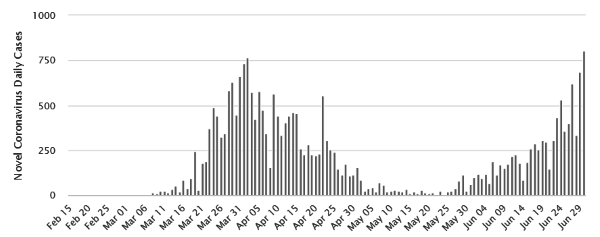
Recently the European Union announced that it would reopen its borders to visitors from some other countries. Israel was not on the list (neither was the US). Many Israelis reacted indignantly, but objectively our Coronavirus situation is not good.

On June 30, Israel marked the highest number of new cases of Coronavirus since the beginning of the pandemic, with 803 reported. After suceeding to extinguish the first wave with an economy-crushing lockdown, the re-opening was marred by some strategic mistakes, for which we are beginning to pay the price. Here is a graph of new cases per day:


Although there has been a recent increase in the daily number of tests done, a Health Ministry employee said on 16 June that “the proportion of positive tests was higher than before,” and therefore the increase in reported new cases was indicative of a new wave of infection.

I don’t pretend to be an expert, but some of the reasons were obvious. In the educational system: it was necessary to reopen the schools, because Israelis have a lot of children, and it’s very difficult to get people back to work when there’s no solution for child care. The usual safety valve for parents, retired grandparents, was not available due to the danger to them from the disease. The first mistake was to open all grades almost at once. It would have been possible to open the lower grades first, which would have freed the parents to work, while reducing the risk. What followed was a sharp spike in the 10-19 year age group and a smaller one in the 0-9 group at the start of the second wave in early June.

The Education Ministry devised a plan that would separate students and teachers in the schools into “capsules” which would be isolated from one another, students would sit 2 meters apart, masks would be required for students and teachers, and so on. The second mistake was not following the plan. I am not sure if it proved unworkable, or if teachers and administrators didn’t take it seriously enough, as some said. But in many schools, compliance was lax. Schools in which cases of Corona occurred were closed, but the damage was done.

Coronavirus transmission is believed to be primarily by droplets released when an infected person sneezes, coughs, talks, or sings. These droplets may remain in the air for a few minutes. It is also thought that the more viral particles a person ingests, the more likely they are to become sick, although it is not clear if this affects the severity of the illness. Transmission outdoors where droplets may be blown away or dehydrated by breezes and diluted in a larger volume of air, is much less likely than in a confined indoor space. Masks may not be fine enough to prevent viral particles from passing through, but they do greatly impede the much larger droplets; they are useful both when worn by the person who is infected and by others nearby. There is also the possibility of droplets impinging on a person’s eyes, so a face shield is useful in addition to a mask.

Israelis love “life cycle events” like circumcisions, bar mitzvahs, weddings, and so forth. Big weddings are the rule, often held in large event halls. There are even websites that help you decide how much money to give according to the type of event, your relationship to the principals, and so on. These events are often held indoors, and the Health Ministryallowed event halls to reopen when the first wave subsided. There are guidelines on the number of people allowed at an event, but they were liberal. Religious services, which were initially sharply restricted, were reopened with more relaxed guidelines. These actions may have been premature, and some restrictions have been re-imposed.

What everyone wants to do is to find ways to protect the population without destroying the economy. The best way to do that (at least, until a vaccine or effective treatment is developed) is to identify each and every sick person and isolate them before they can infect others. This requires a) the ability to do enough tests, b) a rapid turnaround of test results so that it is possible to identify someone as a carrier of the disease before they can infect others, and c) trained people to investigate the sources of infection so that those exposed can be tested.

While the number of tests has been increasing, the turnaround time has been poor. In the early part of the second wave, when many cases were detected in schools, the labs wereunable to keep up with the tests. As far as investigations are concerned the Health Ministry reports a serious shortage of personnel trained to do this; and it has been accused of poor management as well. They have just hired several hundred medical students and paramedics for this function; it’s mysterious why this took so long.

The public, which was relatively disciplined during the first wave, seems to have decided that “the Corona is over,” and that masks are best worn around the chin, to be moved up when a police officer, who might give them a ticket worth 500 Shekels ($146), is nearby. The latest news is that specific cities and neighborhoods will be placed on lockdown in order to try to break the chain of infection.

PM Netanyahu got good marks for his handling of the crisis during the first wave, when he made good decisions such as closing the country’s borders quickly. The removal of restrictions, however, has not been handled so well. Employment has not snapped back – unemployment stands at near 21% – and the epidemic has moved into a second wave, which could be as bad or worse than the first one. Some industries, like tourism and performing arts, have been devastated and little has been done to help them. Of course, everything isn’t his responsibility, but he is known for micromanaging what he believes are areas of importance, and many Israelis feel that he doesn’t believe that they are of importance.

It isn’t helping that after the scandal of the obscenely bloated unity government of 36 ministers and 9 deputy ministers, and after the unity negotiations produced unprecedented perks for the Prime Minister and his alternate, Bibi got the Knesset to pass legislation toexempt him from taxes on work done on his private residence by the government. He did not improve his image when he remarked that although he deserved the tax break, his “timing was wrong.” No kidding.

Statue of Limitations

by Rabbi Steven Pruzansky

The mass destruction wrought to historical statues and venues across America by the privileged and protected modern Philistines engenders the following question: Is there a difference between the demolition of Buddhist shrines by the Taliban, the destruction of Terach’s idols by Avraham and the tearing down of statues bearing the likenesses of flawed human beings taking place now?

The question remains even if we adopt the reasonable approach that the Midrash was not necessarily depicting a literal act on Abraham’s part but rather conveying the idea that Abraham shattered his father’s intellectual idols. Nevertheless, we have to clarify why is it that most civilized people were horrified by the Taliban‘s wanton acts, why we Jews from a young age are taught to applaud Avraham’s zealotry, and why so many people are ambivalent or even supportive of the brutal erasure of America’s history – including some of its secular saints, sinners and founding fathers.

How do we distinguish one from the other?

It is first worth noting that if Jews wanted to enter the grievance competition, we could be very fierce competitors. Any self-respecting Jew should take umbrage at a highway be named for Franklin Roosevelt, whose administration, after all, did a little or nothing to save Jews during the holocaust and even thwarted efforts at refugee relief or disabling crematoria. Forget the statues; the FDR drive is an affront. Stuyvesant town and high school would have to be renamed because Peter Stuyvesant was a known Jew hater who banned Jews from his new settlement in lower Manhattan. The statues of Hadrian and Titus in Rome, like the statue of Bogdan Chmielnicki in Kiev, should cause profound pain and offense to any Jew. All were tyrants and mass murderers of Jews. As unseemly as the grotesque victimhood sweepstakes is, whatever evil was performed by Robert E. Lee or Stonewall Jackson doesn’t compare to what the Roman emperors and the Ukrainian desperate did to the Jews. But we don’t go around seeking the destruction of their images because, to me at least, they serve as a constant reminder that we survived and prevailed. We won. It’s Hadrian and Titus and Chmielnicki and a host of others who have essentially disappeared from history.

There is even a better reason why we can take a more tolerant approach to these statues, and perhaps it takes a Canadian safely ensconced north of the border to offer a way forward and provide us with helpful distinctions. Jeffrey Collins, a professor in Ontario, suggested in the WSJ the other day that the first question to ask in evaluating any statue is why? Why was it erected in the first place? Whom was it intended to honor and for what?

Asked that way it is clear that Washington, Lincoln, Jefferson, Andrew Jackson, TR and FDR and others were honored not for their flaws or misconduct but for their accomplishments. The question really is do their flaws and imperfections outweigh the accomplishments? By any reasonable standard, the answer is of course not. If people were to be judged only by their sins and misdeeds, then no one will be deserving of honor. Washington and Jefferson are not being honored because they were slaveholders but rather because of their roles in the founding of America. Any rational person should realize that if we choose to honor only those without sin then no one will be honored, and that includes Martin Luther King, Malcolm X and George Floyd.

Thus, we can distinguish between a Washington, a Roosevelt, or a Columbus, and, as Professor Collins noted, a Stalin, whose evil dwarfed any nationalistic achievement. (Visiting Russia once, I personally witnessed the reverence some Russian still have for him, notwithstanding the Holomodor, the Jew hatred, and the Gulag, and found it quite shocking.) But even in the case of a scoundrel, it could very well be that a given locality would seek to pay him tribute (for example, in Russia or Georgia) where such would be horrific in any other place. Indeed, there are more statues of Stalin in Russia or Georgia today then there are of Lincoln in the south or Lee in the north.

Context is important, as well as a true evaluation of a person’s life and his essential pursuits and just not his imperfections. It should be obvious to reasonable observers that homage is paid to people not because they are perfect but because of their greatness in a variety of spheres that made a difference in the world in spite of their flawed humanity.

Professor Collins noted that the “why” question is not asked today and so all context and perspective is lost. Instead, the question asked is “how does make me feel right now?” That question is most in line with the narcissism of the protesters and many others today, whose sole barometer of anything is its momentary impact on their feelings. If so, the world is aflame because, among the rioters, there is a dearth of moral instinct and an abundance of faux outrage.

The Confederate statues present a sticky problem. Robert E. Lee was an American hero, who fought in the Mexican War and was commandant at West Point. Lincoln offered him command of the Union Army, which he turned down so as not to show disloyalty to his home state of Virginia. He was a professional who was instrumental in the post-war reconciliation – but since he is most known for waging war in the unjust cause of the South, a new generation that has not known slavery but only opportunity, is outraged at his existence and the reverence paid to him. As the respect paid him is largely owed to his military leadership of the Confederacy, he is a ripe target for the wrath of the disgruntled, and such wrath is inescapable.

Of course, the modern Visigoths would have a point if their only complaint was with the Confederate statutes. It seems their real complaint is with the United States, and such grievances cannot be assuaged in any rational way. They are enraged that Columbus “discovered” America. Mix in politics, power, money and elections, and it is a most combustible time.

Along these lines, if a statue reflected perverse and depraved ideas, then that statue as well would be a fair target. Hence, the adoration of Avraham, even if, again, it is unknown whether that tale is literal or metaphorical. And the Taliban, and their destruction of the ancient Buddhas in the Bamiyan Valley?

Certainly, we have no tolerance for idolatry. Its attendant philosophies devastated and corrupted ancient man, and its consequences are still felt today. But these statues were more historical than ideological, and their obliteration in 2001 were expressions of raw power, sheer ruthlessness and cruel conquest. Their destroyer, Mullah Omar, is now dead. His sole point was to destroy the shrines of an ancient religion to prove the superiority of his own corrupt philosophy. That is not Avraham. That is evil.

The modern demolishers have little in common with Avraham and much in common with Mullah Omar and the Taliban. What is especially troubling is that rather than recoil from the comparison, they probably welcome it. Ideas and values have been overwhelmed by chaos and anarchy. The wanton and gratuitous devastation (Ulysses S. Grant? Really?) has taken on a life of its own. Nihilism reigns supreme. The destroyers are intellectually limited and ethically stunted. The political class either encourages it or can’t stop it.

What can?

Wednesday, July 01, 2020

“To you will I give the Land of Canaan, the lot of your inheritance.”

by HaRav Dov Begon
Rosh HaYeshiva, Machon Meir


Balak, King of Moab and his people were so afraid of the Israelites that they grew sick of living: “The Moabites became deathly afraid because the Israelite people were so numerous. The Israelites made them sick of living” (Numbers 22:3). What was it that frightened them so much?

The sefer “Maor VaShemesh” explains that once they saw the Israelites united as one man, with love and brotherhood reigning amongst them, they understood that when Israel are united, no one can withstand them -- just as the Amorites and Og, King of Bashan, could not withstand Israel and were decisively defeated.

The solution found by Balak and Moab was therefore to enlist Bilam, the evil-eye incarnate, whose whole talent was in cursing people and in creating dissension between them. It was their hope that he would be able to create dissension amongst the Israelites and to weaken them. Indeed, Balak brought Bilam to look-out points from which he could expect to view examples of divisiveness and evil among the Israelites: “Balak took Bilam and brought him to the High Altars of Ba’al, where he could see as far as the outer edges of the Israelite people” (Numbers 22:41) -- but not the whole people.

Afterwards he brought him to another spot: “There you will be able to see only a small section of the Israelite camp, and you will not have to see them all.... He took Bilam to Lookout Field at the top of the cliff” (23:13-14). Rashi comments, “Balak foresaw that at some time a breach in Israel would originate from there -- in fact, Moses died there -- hence he believed that there the curse would certainly be effective.”

Ultimately Balak brought Bilam to a third spot as well: “Balak took Bilam to the top of Pe’or, overlooking the Waste-land” (23:28). He saw that Israel were destined to be smitten by Pe’or.

As is known, however, Balak and Bilam’s goal of creating dissension amongst Israel did not succeed. To the contrary, Bilam came to curse, and he ended up blessing them: “How good are your tents, Jacob, your tabernacles, Israel.... A star shall go forth from Jacob, and a staff shall arise in Israel, crushing all of Moab’s princes” (24:5,17).

Today, even our enemies who set out to drive us out of our land and to destroy us understand what Balak and Bilam understood -- that as long as Israel are united, they cannot be defeated. Our enemies therefore strive greatly to drive a wedge between us and to cause dissension amongst us, by various means:

They engage in dialogue with those Jews whose faith regarding our rights to Eretz Yisrael has become weak, thereby creating a rift between them and their brethren in Judea and Samaria who are risking their lives for the sake of our hold on Eretz Yisrael. They also provide financial and other types of support, openly and in secret, to organizations and movements that cause dissension in Israeli society.

Yet all their thoughts are nonsense, for “many are the thoughts in a man’s heart, but it is G-d’s counsel that shall endure” (Proverbs 19:21). Without a doubt, only G-d’s covenant with the Patriarchs and His oath to them, both of which we must constantly remember, will endure.

“Be mindful always of His covenant with Abraham, which He commanded to a thousand generations, and of his oath to Isaac. He confirmed them to Jacob for a law, and to Israel for an everlasting covenant, saying, ‘To you will I give the land of Canaan, the lot of your inheritance.’” (I Chronicles 16:15-18).

Looking forward to complete salvation,
Shabbat Shalom.

The Identity Politics Rebellion

by Victor Rosenthal

Identity politics is simple.

You associate yourself with others with whom you share a religion or ethnicity. You believe that the government and other authorities ought to be dominated by your group. In a democracy, you vote for them exclusively. In a non-democracy, every group tries to install its own people in positions of power, by force if need be.

When you have identity politics, the in-group gets protektziya. If you are a member of the in-group you get government jobs, your business gets lucrative government contracts, and you get your parking tickets fixed. If not – well, it depends on how bad your regime is. In a place like Syria, you stand a good chance of being murdered.

Identity politics can be democratic in the sense that there can be elections. But it is inconsistent with what we know as “liberal democracy,” which includes the rule of law, separation of powers, respect for human and civil rights for all, economic fairness, and so on. That is because the division of power, wealth, and rights in identity politics is based on group membership rather than ability, work ethic, or moral standing.

The only politics that exists in most Middle Eastern and African countries is identity politics. This is why the attempt to establish liberal democracy in Iraq after the fall of Saddam was pointless. The outcome of elections there is determined by the size of the various ethnic factions, not policies or ideology. This is why Lebanon is a basket case, why Jordan is unstable, and why Syria is hell. This is why Africa, with all its resources, consistently suffers from wars and famines.

Take Nigeria, for example. The most populous country in Africa, blessed with oil and gas, fertile soil, and mineral resources, it should have a thriving economy. Instead, it’s wracked by civil war, terrorism, and environmental disasters. Millions of its residents have fled to other countries (including the US). Some blame colonialism, but Nigeria has been independent since 1960. I blame the identity politics practiced by the more than 250 ethnic groups in Nigeria – and by the Christians and Muslims who almost equally divide the population.

One of the characteristics of identity politics is the belief that only a member of your own group can represent you, or even understand your needs.

Does this sound familiar, Americans? It should. Right now your country is undergoing a rebellion by those who wish to replace an establishment that at least pays lip service to liberal democracy with one that is committed to identity politics.

The rebels say that the present arrangement actually does function according to identity politics, and that the group in charge is made up of “white” people (I prefer the expression “colorless” because skin color actually has little to do with it). They are explicit in their desire to kick them out and put “people of color” (POC) on top. This they justify with the argument that POC have been mistreated and disenfranchised, and now it is their turn to rule. What they don’t want is a society that functions according to the principles expressed by Martin Luther King Jr., in which everyone is treated equally regardless of color or ethnicity.

What is interesting is that the colorless establishment (at least, part of it) is falling all over itself to placate the rebels, apologizing abjectly for “white privilege,” removing statues (before they are toppled or covered with graffiti by the rebels), changing the names of institutions that are named after unsavory characters like Woodrow Wilson or Theodore Roosevelt, and so on (it remains to be seen how they will react when asked to give up their jobs or wealth).

The founders of the USA, while they certainly had their blind spots, were concerned to create a structure that would be a liberal democracy not subject to identity politics. From their day through the 1960s, the country struggled to approach the ideal of a fair society. The abolitionist movement, the Civil War, the women’s suffrage movement, and the civil rights movement all were mileposts in that journey.

The argument of the rebels is that America has failed in the attempt to create liberal democracy, and that this failure is systemic, perhaps even stemming from an essential flaw in the idea of liberal democracy. Some important voices in the media agree with them. The premise of the New York Times’ “1619 project” is that the history of the US should start with the arrival of the first slave ship to North America, and not with the Declaration of Independence in 1776. Racism is everywhere, part of the fabric of society, they insist. The implication is that fixing it would require more than incremental improvements. Radical change is needed. The rebels believe that racism can’t be expunged by continuing the processes begun by the civil rights movement; the only remedy is to smash the system and start over.

This is not a small demand. History shows that revolutions (viz., France 1789 and Russia 1917) can be enormously bloody and painful. Often, control of revolutions that are begun in the name of lofty ideals is seized by the most brutal and ruthless groups, because they are the ones that can take control. And it isn’t as if the rebels in this case have a rational blueprint for improving the society, other than the feeling that things would be better if they were in charge. That is unlikely.

In the case of America today, there is the complication that the chaos is fed to some extent by outside forces, traditional enemies of the USA who are making use of the moment – and maybe even helped create it – to sow dissent. There are documented cases of foreign actors supporting the most extreme elements, the extreme Right and the extreme Left, on social media. What they want is not to improve American society, but to weaken it.

If the rebels get what they want, the 244-year history of the American republic will be over. The revolution will replace the present establishment with a different one. Perhaps property in the hands of rich people and institutions will be expropriated “for the benefit of all” as happened in newly-Soviet Russia. Perhaps a new constitution will be written, or amendments added to the existing one to provide for reparations for the descendants of slaves, for compensatory admissions to universities for POC, for quotas for government jobs. The striving for equality of opportunity will be replaced by the provision of benefits to favored ethnic groups, to “pay them back” for historical mistreatment. The US, in the best case, will become less just, less well governed, less economically successful, and a less pleasant place to live for most Americans.

More likely, it will end up like Syria or Nigeria.

The Power of Fear

BS”D
Parashat Balak 5780
by HaRav Nachman Kahana


Balak, the would-be Hitler of the time, and Bil’am, his Goebbels, can be compared to the proverbial masochist and sadist; that when the masochist begged the sadist to hit him the sadist said “no”.

Balak gets trampled at a place called Bamot Ba’al when Bil’am blesses the Jewish nation. But instead of dismissing him in anger and shame, Balak invites the sorcerer to Sedeh Tzofim from where he will be able to observe the Jewish nation from a different angle. Bil’am again frustrates Balak by blessing the Jews, who then for the third time asks Bil’am to see the encampment from yet another vantage point at Ba’al Pe’or. Here, once again HaShem uses Bil’am’s venomous mouth to bless the chosen nation.

On the premise that these two anti-Semites in the framework of their depravity are still somewhat rational, why did Balak continue with the Bil’am fiasco after his initial failure?

Answer:
Balak was a very shrewd, calculating, and devious goy. At station number one Bil’am instructs Balak to erect seven alters, upon which they offered up 7 bulls and 7 rams. During this ceremony Bil’am raises his arms and goes through several ‘magical’ contortions which in the past succeeded in bringing a curse upon his adversaries, but which on this occasion produced only blessings.

Balak quickly concluded that his situation was desperate and decided to make the best of it. At the time, the evil entourage was standing at a vantage point high on the summit of the Moabite mountain range (due east of the city of Bet Lechem on the western side of the Jordan) while the Jewish encampment was down on the Plains of Shitim near the Jordan river. The cursers could see the Jews from their perch on the mountain and the Jews could see the royal entourage high above; but the Jews could not hear what they were saying. Nevertheless, they were able to deduce that something meaningful was happening because of the large number of sacrifices and the strange gyrations of a familiar figure, Bil’am. They concluded that they were being cursed by some spiritual incarnation or bewitchment.

Then fear began to seep into their hearts and minds, and they began questioning HaShem’s ability to protect them.

Balak assessed that this was the situation below in the Israelite camp and concluded that if he could not kill the Jews at this time, he would fill them with fear, weaken their self-confidence, and then attack.

So, he took Bil’am to a second and third place where the Jews could see the strange movements of this man and each time the fear would engulf the Jews. After the third time Balak decided that three doses of Bil’am were sufficient to paralyze the Jews and sent the vindictive Bil’am home in disgrace. But not before Bil’am gave Balak a piece of advice. That for the first time in the history of those “civilized” nations they should use their daughters as weapons of war, to entice the Jewish fighters and thereby arouse HaShem’s anger, which would lead to a Moabite military victory.

Balak understood that fear is a powerful weapon. It destroys men and nations, annihilates, and devastates a nation’s courage to defend itself and eventually arouses in them the need to flee in panic.

The fact is, that the more intelligent the individual, the more susceptible he is to fear, because of his innate ability to see the dangers lurking right around the corner.

Do Not Falter in Fear
Eighty percent of the Jewish nation refused to leave Egypt with Moshe for fear of what is awaiting them in the treacherous desert, and they died in Egypt.

Goliath put fear into the hearts of the most courageous of Shaul’s soldiers, so that not even one Jew was willing to battle it out with the Philistine giant. Until one young man named David appeared without fright and felled the ominous Goliath.

In Devarim (chapter 20) the Torah directs our military officers to announce to the troops lined up before going into battle (Milchemet Reshut):

1 When you go to war against your enemies and see horses and chariots and an army greater than yours, do not be afraid of them, because the Lord your God, who brought you up out of Egypt, will be with you. 2 When you are about to go into battle, the Kohen (Mashuach Milchama) shall come forward and address the army. 3 He shall say: Hear, Israel: Today you are going into battle against your enemies. Do not be fainthearted or afraid; do not panic or be terrified by them. 4 For the Lord your God is the one who goes with you to fight for you against your enemies to give you victory (when the Kohen finishes the officers continue) 5 The officers shall say to the army: has anyone built a new house and not yet begun to live in it? Let him go home, or he may die in battle and someone else may begin to live in it. 6 Has anyone planted a vineyard and not begun to enjoy it? Let him go home, or he may die in battle and someone else enjoy it. 7 Has anyone become pledged to a woman and not married her? Let him go home, or he may die in battle and someone else marry her. 8 Then the officers shall add, is anyone afraid or fainthearted? Let him go home so that his fellow soldiers will not become disheartened too.

I suggest that the essential part of the officers’ “pep talk” is the sentence, “Is anyone afraid or fainthearted? Let him go home”, because fear is contagious; so better he should remove himself from the battle. And when the officers mention building a home or planting a vineyard or making a pledge to a woman, it is to disguise the real reason a soldier should leave, which is his fear, but could be understood as being in one of the above mentioned reasons, therefore saving anyone who left from embarrassment.

Medinat Yisrael is now on a crossroads of our future: annex or not? And if yes, how much and where? Many of the world’s leaders, each in his own manner of speech and threats, seek to instill fear in the hearts of our civilian and military personnel, that to annex would be suicidal.

It is a test by HaShem. Pressure was brought to bear on David ben Gurion not to declare independence in 1948. The US threatened and kept their word that they would place an arms embargo on the nascent State if he declared independence. But Ben Gurion and the majority of the yishuv’s heads voted for independence, and now we are 72 years old and standing tall among the leading nations of the world.

Menachem Begin was pressured to call off the air strike to destroy the Iraqi nuclear facility in Bagdad. He did not cave in, but during the long nerve-wracking hours that our planes were over the areas where the Talmud was written, he sat in isolation saying Tehillim. And when all the planes returned safely after completing their precarious mission, the whole nation and the sane part of humanity rejoiced because this man did not falter in fear.

At this time, I turn to our Prime Minister: “Bibi, from the courageous tribe of Levi, turn your face toward history. It is always easier to retreat and to escape into mediocrity and self-delusion; but it takes the character of a Ben Gurion or Menachem Begin and all our forefathers and mothers to push the limits of courage and belief in HaShem ever further.

Do not fear nor tarry! Declare sovereignty over all of Yehuda and Shomron without extending Israeli citizenship to the foreigners and strangers occupying our lands.

HaShem, the Master of history, is holding the celestial quill ready to record for posterity your place in Jewish history – as redeemer or retreater. If you forge ahead, men of belief in HaShem will follow. If you retreat you will walk alone.”

Dear friends always remember the three Bs:
B careful, B healthy, B HERE

Shabbat Shalom,
Nachman Kahana
Copyright © 5780/2020 Nachman Kahana

The Shamrak Report: Remember - Israel is a Sovereign State!

by Y Rabinovitz
Responding to a letter signed by over 1,000 EU politicians, Yesha Council condemns EU "meddling" & calls on PM to honour promises. The Yesha Council has issued its official response to a letter published earlier last Wednesday by over a thousand lawmakers from European countries, urging their leaders to block any Israeli attempt to apply sovereignty to regions they define as the Occupied Territories.
Politicians from more than 25 countries signed the letter, which was published in multiple media outlets, calling application of sovereignty, fatal to the prospects of Israeli-Palestinian peace.
Prime Minister Binyamin Netanyahu has stated that he intends to begin the process of applying sovereignty to parts of Judea, Samaria, and the Jordan Valley next week.
This is not the first time that the European Union has meddled in the internal affairs of the State of Israel, the Council s statement reads. We would like to remind the European Union that the State of Israel is a sovereign state that is quite capable of reaching its own decisions without third-party intervention.
We request of the Prime Minister to honour the promise he made before the latest round of elections, and to apply sovereignty over Judea, Samaria, and the Jordan Valley. Mr. Prime Minister, do not submit to international pressure. Do the right thing, with no (construction) freezes, no communities left isolated (within Palestinian enclaves), and with no terror state established in the heart of the State of Israel.
Food for Thought. by Steven Shamrak
Quite often, when I argue Israel s case with non-Jews or self-hating Jews, they play Yes, but game . They brush off any factual pro-Israel argument and come with emotional statements, like poor Palestinians& etc. In a climate of modern political correctness any form of discrimination - be it racism, homophobia and even Islamophobia are vigorously confronted by public and even prosecutable by law in many countries. Anti-Semitism, often hiding as anti-Zionism/Israel, is the only ugly tradition international Jew-hating bigots and governments are unwilling to get rid of!
United Nations Secretary-General António Guterres called Israel s US-backed plans to annex parts of the West Bank a water shed moment and urged Israel to reconsider undermining the two-state solution and destabilizing the area. If implemented, annexation would constitute a most serious violation of international law, grievously harm the prospect of a two-State solution and undercut the possibilities of a renewal of negotiations. (What "international law"? Create another enemy state on Jewish land? What "negotiations"? They are only interested in the destruction of Israel!)
Prime Minister Benjamin Netanyahu has brought down the hammer on Defense Minister Benny Gantz, telling him if he doesn t support his push for sovereignty then he can expect a fourth election. Gantz and Gabi Ashkenaz objected to applying sovereignty in the Jewish settlements of Judea and Samaria, with American approval. Gantz went ahead and lied to President Trump himself during their meeting in Washington. Behind closed doors, apparently, Blue & White is determined to do everything in its power to sabotage the move.
Two rockets fired towards southern Israel on Friday night just a day after Hamas warned Jerusalem against annexation. IAF jets struck a rocket manufacturing workshop and a weapons manufacturing facility belonging to Hamas in the coastal enclave, strikes which will impede the Hamas terror organization s future capabilities. ( Nothing will change until all enemies are removed from Jewish land!)
Following our obligations and responsibilities under international law (which one?) , annexation would have consequences for our close relationship with Israel and will not be recognized by us, the French Ambassador to the UN said. This includes the five European countries who are now members of the UNSC: France, the United Kingdom, Belgium, Germany, Estonia. Also signed onto the statement were the new incoming European UNSC members, Ireland and Norway. He spoke warmly of the ties between those countries and Israel at present. (Warm ties - since when? Obviously, he is delusional!)
Israeli regulators announced they ordered a US-based evangelical broadcaster taken off the air, saying the channel hid its missionary agenda when it applied for a license. God TV is dedicated to preaching the Christian gospel and the task of the Great Commission, a doctrine in Christian theology to gain disciples for Christianity and to preach the religion. Freedom of religion is enshrined in Israeli law, and proselytizing is allowed as long as missionary activities are not directed at minors and do not involve economic coercion.
LGBTQ+ banner removed from US embassy building by Jerusalem municipality! The sign was displayed on the property of the US Embassy's Palestinian Affairs Unit because the embassy had not received permission to display the banner.
Ahmed Erekat, the terrorist killed last Tuesday while carrying out an attack in the outskirts of Jerusalem (who sped with his vehicle towards the checkpoint, while straying from the lane and hitting inspection post, lightly injuring a policewoman) was the nephew of Saeb Erekat, Secretary-General of PLO and chief negotiator with Israel. ( Love for hate runs in the family!)
European MPs signed a sharp letter of opposition to Israel s plan to extend sovereignty over parts of Judea and Samaria and the Jordan Valley, saying it could undermine stability in the region and went against the most basic principles of international relations between states. The letter was signed by 1,080 EU parliament members from 25 countries. The letter was the brainchild of former Israeli MK Avraham Burg. Burg, who once served as speaker of the Knesset and head of the World Zionist Organization and the Jewish Agency. (What "stability"? There has never been a state of fake Palestinians! It is said that often some Jews are our worst enemies!)
Quote of the Week:
The decisions about Israel extending sovereignty towards these places are decisions for the Israelis to make... I regret only that the Palestinian Authority has refused to participate. They simply have rejected this out of hand. We simply ask that they come to the negotiating table based on what s outlined in that vision for peace..." - Mike Pompeo, the US Secretary of State - It has never been about the peace - it is Jewish land and desire of enemies of Israel, including 'nice' European anti-Semites, to destroy the only Jewish state!
The Mandate - Story of Legalised Robbery!
by Steven Shamrak.
From the moment of recognising the right of Jewish people to live on the land of their ancestors the international community, represented by the League of Nations and the United Nations, have made all possible efforts to deny the Jewish people this right. Lead and controlled by the Great Britain and France, those institutions rubberstamped and authorised the greatest legalised robbery in modern history. Any conceivable shady and disgusting deals were made to prevent the creation of the state of Israel on Eretz Israel (Land of Israel)!
In July 1922 the League of Nations entrusted the Great Britain with the Palestine Mandate. Recognizing "the historical connection of the Jewish people with Palestine,"  Great Britain was called upon to facilitate the establishment of a Jewish national home in Palestine - Eretz Israel (Land of Israel).
Preamble.  Whereas the Principal Allied Powers have also agreed that the Mandatory should be responsible for putting into effect the declaration originally made on November 2nd, 1917, by the Government of His Britannic Majesty, and adopted by the said Powers, in favour of the establishment in Palestine of a national home for the Jewish people &
Article 2. The Mandatory shall be responsible for placing the country under such political, administrative and economic conditions as  will secure the establishment of the Jewish national home, as laid down in the preamble...
Article 5. The Mandatory shall be responsible for seeing that  no Palestine territory shall be ceded or leased to, or in any way placed under the control of the Government of any foreign Power...
Three months later, in order to obtain full control over the Suez Canal, Great Britain made a deal with Hashemite Kingdom, Egypt and France. The trans-Jordan (77% of the Mandate) was given to the king's brother in exchange for the Sinai, which was given to Egypt. Golan Heights (5% of the Palestinian Mandate) was ceded to the French controlled Syrian Mandate. This robbery was legalised immediately by the puppet of the Great Britain and France, the League of Nations! It was a clear violation of Article 5 of the Palestinian Mandate. Our 'friends' are still quite generous in giving away the Jewish land!
Between 1922 and 1948, Jews were not allowed to move and live in the Trans-Jordan, but Great Britain and the Arab sheikhs facilitated the transfer of tens of thousands of Muslims to the Western side of the Palestinian Mandate. They were brought by truck loads from Syria, Iraq, Iran and Egypt to the remaining part of the Mandate. At the same time, the immigration of the Jews was restricted and continuously hindered by Great Britain, the governing authority.
At the end, in its 'generosity', the United Nations divided the remaining 18% of the Palestinian Mandate into a maze of six ugly triangles. Three of them were given to Jews, Jerusalem was not included!
The Jewish people have been systematically robbed by the International community of their land rights. Our rights and inspirations have being ignored and crushed by the cruelty of International anti-Semitism! Why do Jewish leaders subscribe to the anti-Israel lies of our enemies? Why are Israeli political leaders not demanding the return of the Jewish land? We have all legal, historical, moral and spiritual rights to reclaim the Palestine Mandated lands as - Eretz Israel!