by Rabbi Steven Pruzansky
For all the government hype, spin, and bluster since October 8, 2023, in the end, has anything changed? The current hostage deal would seem to indicate that the conceptziya is alive and well. This is not the agreement of either a victorious nation or a nation poised for victory in six weeks. Hamas is not defeated. Gaza will continue to pose a security threat to Israeli citizens, and all the hostages will likely not be released. For why would Hamas release all of them? Hamas is evil but not foolish. The hostages are Hamas’ best asset, because Hamas knows its incarceration of Israeli hostages leads our people and government to act emotionally, which is to say self-destructively and recklessly.
There will be joy at the release of the freed hostages, at least by the families of those released. I will feel relief, not joy. The joy will appear on the faces of the Arabs who have once again seen their psychopath-terrorists murder Jews and literally get away with it., They will be whooping it up, handing out sweets, and plotting their next massacre of an “unwise and foolish people” (Devarim 32:6). Indeed, I imagine this is the same feeling that Jews had after the Holocaust when the survivors were liberated – not joy but relief. How can there have been joy, knowing what they suffered in captivity, knowing how many did not survive?
Relief, not joy, but at least when the Holocaust survivors were freed, the Nazis were defeated. Here, in our case, we have empowered these Nazis to fight and murder us another day, we have even emptied our prisons of more homicidal Nazis so they should be able to resume their life's work of murdering Jews. Imagine winning the release of survivors by granting freedom to Goebbels, Goring, Hoess and Eichmann. That is our choice, and our fate.
Today, ours is not the face of victory. Have we squandered the lives of our precious soldiers just to restore the status quo of October 6, 2023? Have we elated our enemies just because we think that now Trump and the Americans will give us a free hand to destroy Iran’s nuclear facilities? Most importantly, if the war resumes after the end of the cease fire, how many our soldiers will be killed once again conquering the same swaths of Gaza, now fully booby-trapped and mined? Why would any soldier want to go back there, especially knowing how ephemeral are any gains we make and how permanent is their loss of life?
For all the talk, we will still be prolonging the war and strengthening our enemies by lavishing even more provisions on these “innocent civilians,” not one of whom embraced Israel’s offer of $5,000,000 and free passage in exchange for information leading to the return of our hostages. The war is still managed by defeatists in the General Staff and the intelligence services, who still want to mow the lawn and prepare for another battle in this endless war, despite Hamas now on the brink of defeat. Just like in the Second Lebanon War, we are still sending our soldiers – our finest youth – to be killed and maimed seizing territory on Monday that we will surrender to the enemy on Thursday. For what? For what did they die? And we wonder why Haredim refuse to serve in an army that, too often – it is painful to say – is cavalier about the lives of our soldiers, refusing to bomb from the air buildings where no civilians should be, forcing our soldiers to serve as sitting ducks for the enemy, and still refusing to cut off food, water, electricity, and internet from our enemies.
We are still being lied to by our government. As I wrote during the first week of the war, defeating Hamas and freeing all our hostages are both worthy objectives but they are incompatible absent a miracle, and yet those goals are still being trumpeted as realistic and impending. The opposition, meanwhile, is still focused on toppling Netanyahu, with victory over our foes and freedom for the hostages merely secondary considerations. The streets are still filled with protesters who contrive fears of a Netanyahu dictatorship while obviously, and vehemently, preferring an actual judicial dictatorship, notwithstanding that the former is subject to elections while the latter is not and wishes simply to perpetuate its power by any means necessary.
After all the promises of “absolute victory,” and after PM Netanyahu demonstrated resilience and resolve such as he had never exhibited before as prime minister, he reverted to form, caved under pressure, and snatched defeat from the jaws of victory. Certainly, we were – and are – traumatized by the invasion and massacre of October 7, but few lessons have been learned. Pressure from Biden or Trump should be meaningless if they weaken our core values and interests. That is how independent nations act: they define their interests and do everything to achieve them. True resolve causes even the most intense pressure to dissipate. Israel has never learned that lesson, which is why we have suffered consistent diplomatic defeats for more than fifty years, and time and again, we rehabilitate and strengthen our enemies.
We still fall for Hamas’ psychological mind games – dangling hostage videos, murdering some, threatening others – all to achieve their aims, which they do. We know these are their tactics – and yet we still succumb to them. (Hamas demanded the release of more than one thousand of their terrorists? Why aren’t some of them being returned in body bags, like too many of our hostages?) We are easily manipulated, our enemies know it, and so they do it repeatedly. We learned nothing from the disastrous Shalit deal – nothing. That lopsided and immoral exchange not only murdered hundreds of us in the ensuing years but also guaranteed that the enemy would try to seize more hostages again, because, why not? It works. And it will work again in the future because the release of murderers in exchange for innocent civilians incentivizes the enemy to do it again. And again. The prattle about not releasing any of the murderers from the October 7 massacre in this round only guarantees that there will be future hostage-taking to win their freedom. Has anything changed?
It would be more plausible if many of those who disseminate the canard that “pidyon shvuyim,” the ransoming of captives, is the most important mitzvah in the Torah actually understood the concept, and perhaps even observed some of the other mitzvot in the Torah. (What the Sages meant is that “ransoming captives” is the highest form of tzedakah because it encompasses all dimensions of that mitzvah.) And as is well known to those who open a Gemara, we do not ransom hostages “for more than their value, for the betterment of the world” (Gittin 45a) because “overpaying” will ultimately bankrupt the community and encourage more hostage-taking. We do exactly what the Gemara says not to do, and obviously to our detriment.
Releasing bloodthirsty murderers is not just the “difficult price” we must pay, as the senseless and repetitive cliché uttered by numerous commentators and politicians puts it. It is not moral; it is immoral, because it has, does, and will put many others at risk. We do not endanger the entire community to save a small group. It is well meaning but also flat out stupid. And we need not speculate that this release might endanger the rest of us. It will! It always has. Terrorists leave our prisons more hardened and more hateful of Jews than they entered, and even more contemptuous of us because they know our weaknesses and how we cannot overcome them. More of us will be murdered, and still others of us will be taken hostage in the future. The only thing we don’t know are the names of the future victims.
Have we learned anything? Aryeh Deri announced that he would support “any deal.” And what if Hamas demanded that Yeshiva students must serve in the IDF? Would he pay that “difficult price”? Haredim should be embarrassed that they largely shirk army service but what is almost as embarrassing, this refusal has compromised their ability to present a true Torah view on “ransoming captives.” They lack any credibility, as they necessarily must prefer any option that does not involve the military in which they do not serve. That means you, Degel HaTorah, which has been forced to furl that flag and, in the process, muted the voice of Torah.
We are still tormented by a legal and judicial establishment that prioritizes the lives of our enemies over our own and which fetishizes the chimera known as “international law,” all progressive doctrines that favor the evildoers in any conflict and render victory impossible for those foolish enough to be guided by it. We are supposed to be the “light unto the nations.” We are the ones who should be teaching the true ethics of war to the world – not vice versa. We should be proudly and unabashedly disseminating the Torah’s ethic of war and not constraining ourselves by absurd moral notions concocted by human beings that cannot produce a better, more just world. Indeed, since the first Geneva Conventions were adopted in 1864, the world has experienced in the last 160 years unprecedented carnage and brutality. We have learned nothing from the evildoers’ exploitation of “international law,” that has effectively deprived the West of winning any war since World War II.
We have learned nothing from the Oslo debacle, from the Gaza Expulsion catastrophe, from the half-hearted waging of the Second Lebanon War and the various eruptions in Gaza, from the “hostages for terrorists” exchanges now four decades old, and from our reluctance, even fear, of acknowledging the true character of our enemies and dealing with that reality. When the next attack comes – and it will – and we suffer again, and go to war again, we will be accompanied yet again by the same false promises, the same lofty words, the same “together we will win!” – even as we disdain any plan for real victory.
We are victims of a terrible failure of vision, and of leadership, in the government and the opposition, in the upper echelons of the military and legal establishments. This deal is a classic example of “stage one thinking,” a visceral reaction that does not consider “stage two,” the real-world consequences of that emotional decision. Watch the glee on the faces of our enemies – and the agony on ours – and determine who thinks they won, and who thinks they lost.
It is especially galling that we take pride in our humiliation. Our enemies have not been deterred. They have been emboldened, inspired, and heartened by our surrender. They do not care about life – even their own. They care about murdering Jews and destroying the State of Israel, and we – wittingly or unwittingly – are abetting them.
Sadly, nothing has really changed. As a nation, we have been repeatedly let down by our leaders. The only redeeming value of the current government is that any potential replacement would be far worse. That is our fate – and a good reason we pray daily for judges and counsellors as of old, those who can hasten the coming of Moshiach and the kingdom of G-d on earth. May Moshiach come soon and may Hashem in His mercy spare us the harshest consequences of our folly.
Tuesday, January 21, 2025
Rav Kook's Ein Ayah: Who May Criticize Great People
Gemara: We saw in the gemara how Akavya ben Mehalalel accused Shmaya and Avtalyon of ruling based on personal feelings, causing the rabbis to censor him. Now, we will see an opinion that rejects the possibility this occurred. R. Yehuda said: Heaven forbid that Akavya ben Mehalalel was put in cherem, for when the gates of the azara (Beit Hamikdash’s courtyard) were closed, there was no one in Israel inside with his level of Torah, purity, and fear of sin.
Ein Ayah: Regarding how to view one who criticizes talmidei chachamim (Torah scholars) and their ideas in a manner that seems to be an affront to their honor, one should consider the criticizer’s standing, particularly in three broad areas that include all of a person’s shleimut (completeness).
One area where the criticizer should be tested is wisdom. If he is a very wise man, then he is one who can stand among great people and say that he argues with his peers, even those who preceded him. However, when a person of simple intellect has the gall to speak down on the ideas of those much greater than he, speaking in a manner that is appropriate only for the accomplished, he will be punished for brazenness and removing morality from the world.
Another area where the criticizer must be worthy is purity of his heart. If he criticizes a great person for having been swayed by imperfect motivations, he himself must have the purest of hearts, so as not to be influenced. Otherwise, one who feels he can judge righteous people, although, they, as humans, may have erred, is one who harms the world and will be punished.
Even these two important attributes do not suffice. He must also have the highest level of fear of sin, so that we can be sure that if he were not absolutely convinced, with his great wisdom, that the criticism was correct and necessary, he would be afraid to utter it. If someone who we know is crowned with greatness in all of these positive qualities still feels the need to criticize a great person harshly, then we should not, Heaven forbid, think badly of him, nor should lowlier people try to copy his willingness to criticize.
These three attributes: wisdom, purity of the heart (the source of the emotion upon which the world of proper actions and service of Hashem is built), and fear of Hashem, which helps avoid bad things, are the basis of shleimut. These attributes are dispersed through the nation so that some people excel in great Torah wisdom, others in purity and service of the heart, and others excel in keeping away from actual sin. The confluence of these different people builds the House of Israel. Only the select of the select, a generation’s pillar of Torah, enjoys the highest levels of each of these attributes.
One of the nation’s unifying events was the bringing of the Korban Pesach. All of Israel would enter in one gateway and join into unifying groups to partake in the sacrifice. The nation entered the Temple in three groups (see Mishna, Pesachim 5:5). They were referred to as kahal (congregation), eida (community), and Israel, corresponding to wisdom of the intellect, purity of the heart, and fear relating to the actions. Kahal relates to shared physical actions. Eida relates more to the heart’s emotional connection within the nation. Whoever combines the positive elements of kahal, eida, and Israel, is fit to be a criticizer. If criticism emanates from someone like that, we know that it is based on seeking truth. It will not bring fundamental deterioration to the nation, as the criticism comes to build, not destroy. People can learn from the matter that even scholars are accountable, just that it should be done in a way that takes their honor into account. The idea of talmidei chachamim spreading peace in the world can be preserved, as this one declares that something is pure and the other declares it is impure, but the opinions come from one shepherd (based on Chagiga 3b). Thus when criticism came from someone like Akavya ben Mehalalel, who combined the attributes that relate to the three groupings in the Temple, we know that he could not have been censored, for they were words of rebuke that emanated from his lips of Torah.
Ein Ayah: Regarding how to view one who criticizes talmidei chachamim (Torah scholars) and their ideas in a manner that seems to be an affront to their honor, one should consider the criticizer’s standing, particularly in three broad areas that include all of a person’s shleimut (completeness).
One area where the criticizer should be tested is wisdom. If he is a very wise man, then he is one who can stand among great people and say that he argues with his peers, even those who preceded him. However, when a person of simple intellect has the gall to speak down on the ideas of those much greater than he, speaking in a manner that is appropriate only for the accomplished, he will be punished for brazenness and removing morality from the world.
Another area where the criticizer must be worthy is purity of his heart. If he criticizes a great person for having been swayed by imperfect motivations, he himself must have the purest of hearts, so as not to be influenced. Otherwise, one who feels he can judge righteous people, although, they, as humans, may have erred, is one who harms the world and will be punished.
Even these two important attributes do not suffice. He must also have the highest level of fear of sin, so that we can be sure that if he were not absolutely convinced, with his great wisdom, that the criticism was correct and necessary, he would be afraid to utter it. If someone who we know is crowned with greatness in all of these positive qualities still feels the need to criticize a great person harshly, then we should not, Heaven forbid, think badly of him, nor should lowlier people try to copy his willingness to criticize.
These three attributes: wisdom, purity of the heart (the source of the emotion upon which the world of proper actions and service of Hashem is built), and fear of Hashem, which helps avoid bad things, are the basis of shleimut. These attributes are dispersed through the nation so that some people excel in great Torah wisdom, others in purity and service of the heart, and others excel in keeping away from actual sin. The confluence of these different people builds the House of Israel. Only the select of the select, a generation’s pillar of Torah, enjoys the highest levels of each of these attributes.
One of the nation’s unifying events was the bringing of the Korban Pesach. All of Israel would enter in one gateway and join into unifying groups to partake in the sacrifice. The nation entered the Temple in three groups (see Mishna, Pesachim 5:5). They were referred to as kahal (congregation), eida (community), and Israel, corresponding to wisdom of the intellect, purity of the heart, and fear relating to the actions. Kahal relates to shared physical actions. Eida relates more to the heart’s emotional connection within the nation. Whoever combines the positive elements of kahal, eida, and Israel, is fit to be a criticizer. If criticism emanates from someone like that, we know that it is based on seeking truth. It will not bring fundamental deterioration to the nation, as the criticism comes to build, not destroy. People can learn from the matter that even scholars are accountable, just that it should be done in a way that takes their honor into account. The idea of talmidei chachamim spreading peace in the world can be preserved, as this one declares that something is pure and the other declares it is impure, but the opinions come from one shepherd (based on Chagiga 3b). Thus when criticism came from someone like Akavya ben Mehalalel, who combined the attributes that relate to the three groupings in the Temple, we know that he could not have been censored, for they were words of rebuke that emanated from his lips of Torah.
Public Pressure
by Rabbi Dov Berel Wein
Many of the Torah commentaries point out that unlike our forefathers, Moshe, in this week's opening verses to the Parsha, did not accept that God's promises of redemption for the Jewish people had not yet been fulfilled. In God's response to this, we sense a veiled criticism of our great teacher and leader Moshe.
Heaven responded to Moshe by saying that he enjoyed a higher and different relationship to the Revelation from God than those original founders of the Jewish people. Because of this state of elevated Revelation, Moshe's complaint was unnecessary. Moshe should have realized that Heaven has its own timetable, and that its promises will always be fulfilled, but not necessarily according to the time schedule established by human beings.
It is difficult to understand the attitude in Moshe's statement to Heaven that it had not yet freed the Jewish people from Egyptian bondage. Moshe certainly realized through his powers of Revelation that he had experienced, and through the commitments made to him and to the Jewish people about redemption, that Heaven was aware of the promises, and that there was no need to be prompted by Moshe to fulfill its commitments.
However, Moshe, like all leaders, was subject to public pressure, complaints and hostility directed towards him by the Jewish taskmasters after the decree of the Pharaoh to withhold straw from them, while demanding the same number of bricks to be produced. These complaints by the people were deeply disturbing to Moshe. He deflects the criticism directed towards him and, instead, holds Heaven accountable for the situation.
Moshe, himself, has no doubt as to the eventual outcome and the inevitable redemption of Israel from Egyptian bondage. Unlike Abraham, Isaac, and Jacob though, he was subject to popular opinion in the mood of the Jewish people, whom he had to convince that redemption would in fact take place.
According to the Midrash, many, if not most, of the Jewish people in Egypt did not believe Moshe’s promises that they would soon be delivered from Egyptian slavery. Even after the series of plagues and punishments visited upon the Egyptians, most of the Jews still did not believe in their coming redemption. In contending with this psychological and emotional state of mind by a large part of the Jewish people, Moshe necessarily turns the Heaven for help. He has no doubt that the redemption from Egyptian slavery will shortly take place. However, he must bring the masses of Israel along with him in this belief and faith.
Because of his great modesty and humility, Moshe does not rely upon his own powers of persuasion to accomplish this task, and he turns to Heaven in an almost provocative fashion. He implores God to hasten the process of the delivery of the Jewish people from Egyptian bondage. His courageous words to Heaven, which seem like a complaint, are, indeed, but an expression of the greatness of his character and the forcefulness of Moshe's leadership.
Many of the Torah commentaries point out that unlike our forefathers, Moshe, in this week's opening verses to the Parsha, did not accept that God's promises of redemption for the Jewish people had not yet been fulfilled. In God's response to this, we sense a veiled criticism of our great teacher and leader Moshe.
Heaven responded to Moshe by saying that he enjoyed a higher and different relationship to the Revelation from God than those original founders of the Jewish people. Because of this state of elevated Revelation, Moshe's complaint was unnecessary. Moshe should have realized that Heaven has its own timetable, and that its promises will always be fulfilled, but not necessarily according to the time schedule established by human beings.
It is difficult to understand the attitude in Moshe's statement to Heaven that it had not yet freed the Jewish people from Egyptian bondage. Moshe certainly realized through his powers of Revelation that he had experienced, and through the commitments made to him and to the Jewish people about redemption, that Heaven was aware of the promises, and that there was no need to be prompted by Moshe to fulfill its commitments.
However, Moshe, like all leaders, was subject to public pressure, complaints and hostility directed towards him by the Jewish taskmasters after the decree of the Pharaoh to withhold straw from them, while demanding the same number of bricks to be produced. These complaints by the people were deeply disturbing to Moshe. He deflects the criticism directed towards him and, instead, holds Heaven accountable for the situation.
Moshe, himself, has no doubt as to the eventual outcome and the inevitable redemption of Israel from Egyptian bondage. Unlike Abraham, Isaac, and Jacob though, he was subject to popular opinion in the mood of the Jewish people, whom he had to convince that redemption would in fact take place.
According to the Midrash, many, if not most, of the Jewish people in Egypt did not believe Moshe’s promises that they would soon be delivered from Egyptian slavery. Even after the series of plagues and punishments visited upon the Egyptians, most of the Jews still did not believe in their coming redemption. In contending with this psychological and emotional state of mind by a large part of the Jewish people, Moshe necessarily turns the Heaven for help. He has no doubt that the redemption from Egyptian slavery will shortly take place. However, he must bring the masses of Israel along with him in this belief and faith.
Because of his great modesty and humility, Moshe does not rely upon his own powers of persuasion to accomplish this task, and he turns to Heaven in an almost provocative fashion. He implores God to hasten the process of the delivery of the Jewish people from Egyptian bondage. His courageous words to Heaven, which seem like a complaint, are, indeed, but an expression of the greatness of his character and the forcefulness of Moshe's leadership.
Rav Kook on Parashat Va'eira: Order in Miracles
Presenting his ‘credentials’ before Paroh, Moshe threw down his staff before the Egyptian king, and it transformed into a viper. When the magicians of Egypt did the same with their magic, “the staff of Aharon swallowed up their staffs” (Shemot 7:12).
Chazal in Shabbat 97a noted that the Torah does not say that Aharon’s snake swallowed up the magicians’ staffs. It says Aharon’s staff did the swallowing. A double miracle, a “miracle within a miracle” occurred. The viper became a staff once again, and only then — as a staff — did it swallow up the other staffs. What is the significance of this double miracle?
Levels of Miracles
Just as there is an underlying order in the world of nature, so too there is order and structure in the realm of miracles. We may distinguish between two types of laws of the natural world: those of a fundamental nature, and those that have a detailed and specific function. The extent to which a miracle defies natural law depends on the purpose of that divine intervention.
Sometimes it is sufficient to have a minor disruption, and still remain within the overall system of natural law. For example, when the prophet Elisha advised the widow in debt how to miraculously produce oil (Melachim 2, 4:1-7), the oil was not created ex nihilo. Rather, the miracle was based on an existing jar of oil. There occurred no blatant abrogation of the laws of nature; they were merely ‘extended,’ as the small cruse of oil sufficed to fill up many large pots. But the basic framework of natural law was left undisturbed.

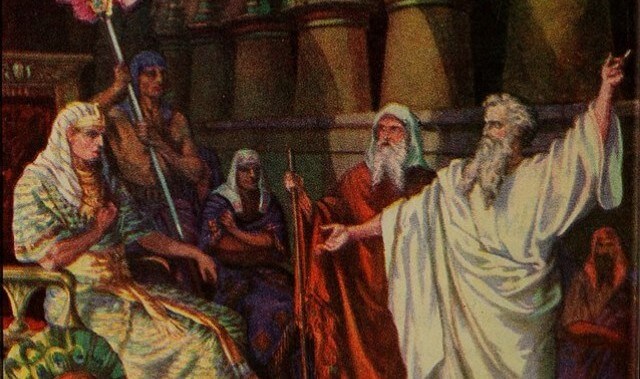
Illustration image: ‘Moses Before Pharoah’ (1919)
The purpose of Elisha’s miracle was to help out a poor woman in need. The goal of Moshe’s miraculous signs in Egypt, on the other hand, was far more grandiose. These wonders were meant to demonstrate the power and greatness of the Creator, “so that you will know that I am God here on earth” (Shemot, 8:18).
In Egypt, God willed to demonstrate His ability to overrule any law and limitation of the natural world. Therefore, it was necessary to have a “miracle within a miracle.” This exhibited independence and autonomy at all levels of natural law, both specific and fundamental. The miracle of the staff occurred not only as a minor disruption of nature — a level at which the Egyptian magicians could also function — but also at the level of total disregard for the most basic laws of nature, so that one staff could “swallow up” other staffs.
(Gold from the Land of Israel pp. 108-109. Adapted from Ein Eyah vol. IV, pp. 243-244 by Rav Chanan Morrison)
Chazal in Shabbat 97a noted that the Torah does not say that Aharon’s snake swallowed up the magicians’ staffs. It says Aharon’s staff did the swallowing. A double miracle, a “miracle within a miracle” occurred. The viper became a staff once again, and only then — as a staff — did it swallow up the other staffs. What is the significance of this double miracle?
Levels of Miracles
Just as there is an underlying order in the world of nature, so too there is order and structure in the realm of miracles. We may distinguish between two types of laws of the natural world: those of a fundamental nature, and those that have a detailed and specific function. The extent to which a miracle defies natural law depends on the purpose of that divine intervention.
Sometimes it is sufficient to have a minor disruption, and still remain within the overall system of natural law. For example, when the prophet Elisha advised the widow in debt how to miraculously produce oil (Melachim 2, 4:1-7), the oil was not created ex nihilo. Rather, the miracle was based on an existing jar of oil. There occurred no blatant abrogation of the laws of nature; they were merely ‘extended,’ as the small cruse of oil sufficed to fill up many large pots. But the basic framework of natural law was left undisturbed.

Illustration image: ‘Moses Before Pharoah’ (1919)
The purpose of Elisha’s miracle was to help out a poor woman in need. The goal of Moshe’s miraculous signs in Egypt, on the other hand, was far more grandiose. These wonders were meant to demonstrate the power and greatness of the Creator, “so that you will know that I am God here on earth” (Shemot, 8:18).
In Egypt, God willed to demonstrate His ability to overrule any law and limitation of the natural world. Therefore, it was necessary to have a “miracle within a miracle.” This exhibited independence and autonomy at all levels of natural law, both specific and fundamental. The miracle of the staff occurred not only as a minor disruption of nature — a level at which the Egyptian magicians could also function — but also at the level of total disregard for the most basic laws of nature, so that one staff could “swallow up” other staffs.
(Gold from the Land of Israel pp. 108-109. Adapted from Ein Eyah vol. IV, pp. 243-244 by Rav Chanan Morrison)
The Chartumim did the Same with their Incantations
by HaRav Mordechai Greenberg
Nasi HaYeshiva, Kerem B'Yavneh
Rav Yaakov Kaminetzky zt"l writes that because the world was created in spiritual balance, the magicians and devils of ancient times that are mentioned in the Torah are not encountered today. In order for freedom of choice to exist, the forces of tumah have to be allowed to oppose the forces of holiness. If Moshe had been the only one with the ability to perform wonders, Pharaoh would have had no choice but to listen to him. Therefore the chartumim (necromancers) of Egypt were given similar powers in order to balance the miracles' impact on Pharaoh. If the spiritual leadership of Israel has the power to act in miraculous ways, then the "sitra achra" (demonic force) has to be given the same ability. As the generation decline and miracle workers have ceased, since the world was created in balance – the devils and magic have also disappeared.
Chazal write on the pasuk: "Never again has there arisen in Israel a prophet like Moshe" (Devarim 34:10) – but among the nations someone arose: Bilam b. Beor. Opposite Moshe, someone from the sitra achra had to be appointed, who would have similar abilities.
The Rambam writes in his commentary on the Mishna in Avoda Zara (ch. 4), that devils or ghosts are not real, and that all the stories about them are false. However, the Gra writes in Yoreh Deah (#179) that the Rambam was attacked on this point, because we find many stories in the Gemara about magic and devils. Rav Kaminetsky's explanation resolves this difficulty. The Rambam does not intend to totally deny the existence of devils. He is saying that they existed only during the time of the Tannaim and Amoraim. Nowadays, though, when the spiritual forces have faded, the world needs to remain in balance, so they do not exist.
Rav Tzadok already mentioned this idea, and writes in his book, Resisei Laila, that during the First Temple period the Written Torah, prophecy and open miracles were the norm. During the Second Temple period, the Written Torah was replaced with the Oral Torah, prophecy was replaced with wisdom, and miracles became concealed. During the First Temple period these three elements could be felt tangibly, which explains the existence of idol worship, as the recognition of the Divine also sought a tangible expression. During the Second Temple period, when prophecy and open miracles had already disappeared, the inclination to worship idols was conquered and defeated.
This is what it says in the beginning of our Parsha: "I appeared to Avraham..." (Shemot 6:3) R. Tzadok writes (Resisei Laila):
Also in the prophetic influence He appeared to the patriarchs in the Divine manner spreading through the world. Therefore their prophecy was with image and vision, according to the cloaks and veils with which the Divine garbs itself in this world ... Hashem created the world in balance, so that always according to the Torah's manner with Am Yisrael is Hashem's guidance with all the other worlds. Even the nations act this way, with balance, so that the increase of idol worship, chartumim and magicians was only so long as the Shechina was revealed with Am Yisrael. When the Shechina departed and the Oral Torah began, Greek wisdom – which is also human wisdom – appeared among them."
Rav Kook zt"l writes about the relationship between idol worship and prophecy: "The imaginative power was banished from its widespread domination in Israel, and the inclination for idol worship was contained in a lead tank. (The members of the Knesset Hagedola sealed it in a lead tank; cf. Yoma 69b) ... In parallel, we no longer have a prophet" (Orot, pg. 36)
Nasi HaYeshiva, Kerem B'Yavneh
Rav Yaakov Kaminetzky zt"l writes that because the world was created in spiritual balance, the magicians and devils of ancient times that are mentioned in the Torah are not encountered today. In order for freedom of choice to exist, the forces of tumah have to be allowed to oppose the forces of holiness. If Moshe had been the only one with the ability to perform wonders, Pharaoh would have had no choice but to listen to him. Therefore the chartumim (necromancers) of Egypt were given similar powers in order to balance the miracles' impact on Pharaoh. If the spiritual leadership of Israel has the power to act in miraculous ways, then the "sitra achra" (demonic force) has to be given the same ability. As the generation decline and miracle workers have ceased, since the world was created in balance – the devils and magic have also disappeared.
Chazal write on the pasuk: "Never again has there arisen in Israel a prophet like Moshe" (Devarim 34:10) – but among the nations someone arose: Bilam b. Beor. Opposite Moshe, someone from the sitra achra had to be appointed, who would have similar abilities.
The Rambam writes in his commentary on the Mishna in Avoda Zara (ch. 4), that devils or ghosts are not real, and that all the stories about them are false. However, the Gra writes in Yoreh Deah (#179) that the Rambam was attacked on this point, because we find many stories in the Gemara about magic and devils. Rav Kaminetsky's explanation resolves this difficulty. The Rambam does not intend to totally deny the existence of devils. He is saying that they existed only during the time of the Tannaim and Amoraim. Nowadays, though, when the spiritual forces have faded, the world needs to remain in balance, so they do not exist.
Rav Tzadok already mentioned this idea, and writes in his book, Resisei Laila, that during the First Temple period the Written Torah, prophecy and open miracles were the norm. During the Second Temple period, the Written Torah was replaced with the Oral Torah, prophecy was replaced with wisdom, and miracles became concealed. During the First Temple period these three elements could be felt tangibly, which explains the existence of idol worship, as the recognition of the Divine also sought a tangible expression. During the Second Temple period, when prophecy and open miracles had already disappeared, the inclination to worship idols was conquered and defeated.
This is what it says in the beginning of our Parsha: "I appeared to Avraham..." (Shemot 6:3) R. Tzadok writes (Resisei Laila):
Also in the prophetic influence He appeared to the patriarchs in the Divine manner spreading through the world. Therefore their prophecy was with image and vision, according to the cloaks and veils with which the Divine garbs itself in this world ... Hashem created the world in balance, so that always according to the Torah's manner with Am Yisrael is Hashem's guidance with all the other worlds. Even the nations act this way, with balance, so that the increase of idol worship, chartumim and magicians was only so long as the Shechina was revealed with Am Yisrael. When the Shechina departed and the Oral Torah began, Greek wisdom – which is also human wisdom – appeared among them."
Rav Kook zt"l writes about the relationship between idol worship and prophecy: "The imaginative power was banished from its widespread domination in Israel, and the inclination for idol worship was contained in a lead tank. (The members of the Knesset Hagedola sealed it in a lead tank; cf. Yoma 69b) ... In parallel, we no longer have a prophet" (Orot, pg. 36)
Monday, January 20, 2025
Prepare
BS”D
Parashat Va’eira 5785
by HaRav Nachman Kahana
A wise rabbi once said: “Though we cannot understand why things happen to us, but at least we can prepare for their eventuality”.
Pure Truth
In a previous message, I related the following story about pure truth, which is often distressful, bitter and at times intolerable.
A man traversed the globe in search of the hidden truths of life. It was his habit in every place he visited to ask if anyone there knew the truths of life. At his last juncture, a townsman told him that it’s rumored that on the adjoining mountain lives a woman of absolute truth.
He ascended the mountain and indeed before him stood the ugliest woman he had ever seen. She could have easily been over 120, with any beauty which might have been hers long ago lost. She was a pitiful sight.
He asked if she was the woman who knew truth. She replied that she was the personification of truth in the world. The young man could not look at her, but he was so enraptured by her wisdom and revelations on every subject that he stayed. After several weeks, he informed her that he had to return to civilization. When he was just about to leave, she said, “Young man. Remember! Tell everyone that I am young and beautiful“.
The moral of this story is that we seek to sweeten and beautify the truth, even when the facts are schlecht (bad) and bitter.
The Pre-Mashiach Period
The Gemara (Sanhedrin 98b) while discussing the pre-Mashiach period which will be very challenging, relates that three great rabbis Ula, Raba and Rabbi Yochanan declared that they would prefer not to see it, while Rabbi Yosef said that he wished to experience that period even though it entails great challenges.
This exchange of ideas was not a matter for halachic decision. The rabbis were expressing their personal fortitude and willingness to endure physical and emotional tests which are not measures of Torah erudition but the emotional make-up of the individual. But one thing is clear, the rabbis agreed that the pre-Mashiach period, the length of which we do not know, will be challenging and demanding.
We are now in that period. It includes the two world wars, the Shoah and up to our present struggle to fully return to Eretz Yisrael.
I would like to air my thoughts on what, I believe, will be the last and most difficult challenge of our time.
Parashat Va’eira 5785
by HaRav Nachman Kahana
A wise rabbi once said: “Though we cannot understand why things happen to us, but at least we can prepare for their eventuality”.
Pure Truth
In a previous message, I related the following story about pure truth, which is often distressful, bitter and at times intolerable.
A man traversed the globe in search of the hidden truths of life. It was his habit in every place he visited to ask if anyone there knew the truths of life. At his last juncture, a townsman told him that it’s rumored that on the adjoining mountain lives a woman of absolute truth.
He ascended the mountain and indeed before him stood the ugliest woman he had ever seen. She could have easily been over 120, with any beauty which might have been hers long ago lost. She was a pitiful sight.
He asked if she was the woman who knew truth. She replied that she was the personification of truth in the world. The young man could not look at her, but he was so enraptured by her wisdom and revelations on every subject that he stayed. After several weeks, he informed her that he had to return to civilization. When he was just about to leave, she said, “Young man. Remember! Tell everyone that I am young and beautiful“.
The moral of this story is that we seek to sweeten and beautify the truth, even when the facts are schlecht (bad) and bitter.
The Pre-Mashiach Period
The Gemara (Sanhedrin 98b) while discussing the pre-Mashiach period which will be very challenging, relates that three great rabbis Ula, Raba and Rabbi Yochanan declared that they would prefer not to see it, while Rabbi Yosef said that he wished to experience that period even though it entails great challenges.
This exchange of ideas was not a matter for halachic decision. The rabbis were expressing their personal fortitude and willingness to endure physical and emotional tests which are not measures of Torah erudition but the emotional make-up of the individual. But one thing is clear, the rabbis agreed that the pre-Mashiach period, the length of which we do not know, will be challenging and demanding.
We are now in that period. It includes the two world wars, the Shoah and up to our present struggle to fully return to Eretz Yisrael.
I would like to air my thoughts on what, I believe, will be the last and most difficult challenge of our time.
Remember the Exodus from Egypt
After the destruction of the second Bet Hamikdash, the Sanhedrin moved to the town of Yavne, where among other activities, they codified the texts of our prayers.
They prioritized the exodus from Egypt, so that we would recall the bitter memories of that period. We recall the Exodus in Kiddush of Shabbat and Festivals, in Birkat HaMazon (grace after meals), in the siddur between the end of kriyat shema and Amida; not to mention the Pesach Seder. Why?
These many referrals to the Exodus are all the more problematic in light of the Gemara (Brachot 12b) that quotes the prophet Yirmiyahu 16,15:
“הנה ימים באים נאם ה’ ולא יאמרו עוד חי ה’ אשר העלה את בני ישראל מארץ מצרים, כי אם חי ה’ אשר העלה ואשר הביא את זרע בית ישראל מארץ צפונה ומכל הארצות אשר הדחתים שם”… לא שתעקר יציאת מצרים ממקומה, אלא שתהא שעבוד מלכיות עיקר, ויציאת מצרים טפל לו.
Here, the days are coming (our days) declares the Lord, when it will no longer be said “as surely as the Lord lives, who brought the Israelites up out of Egypt, but it will be said, surely as the Lord lives, who brought the Israelites up out of the land of the north and out of all the countries where he had banished them.
Meaning: The prophet is informing us that in the future, the exodus will be cast in the shadows, in light of the enormous miracles of redemption that we will experience in the days of Mashiach.
So, the question: Why are there so many references of the Egyptian exodus which is destined to be sidelined in our collective memories?
I submit:
The rabbis of Yavne knew the secret. The last and biggest war in pre-Mashiach times will be an expounded repetition of the original Egyptian exodus, but enormously bigger and more impressive, and will include the major features of the first Egyptian experience.
The Egyptians will again attack with an army many times larger than ours. We will be gripped by fear and call out to HaShem to save us. And just as in ancient times when the entire Egyptian army was drowned under hundreds of meters of sea water, so too, will contemporary Egypt be annihilated when the great Dam in Aswan collapses and oceans of water come roaring down the Nile Valley where all Egyptians live.
The re-enacting of the ancient Exodus step-by-step will be further proof of the authenticity of our historic Biblical description of the event, and since that is true then all the other episodes in the Torah are true.
Egypt Today
There are serious reasons to suspect that the Egyptians are preparing for war, although they are not seriously threatened by any enemy.
Egypt outnumbers Israel in almost every military category, they have:
After the destruction of the second Bet Hamikdash, the Sanhedrin moved to the town of Yavne, where among other activities, they codified the texts of our prayers.
They prioritized the exodus from Egypt, so that we would recall the bitter memories of that period. We recall the Exodus in Kiddush of Shabbat and Festivals, in Birkat HaMazon (grace after meals), in the siddur between the end of kriyat shema and Amida; not to mention the Pesach Seder. Why?
These many referrals to the Exodus are all the more problematic in light of the Gemara (Brachot 12b) that quotes the prophet Yirmiyahu 16,15:
“הנה ימים באים נאם ה’ ולא יאמרו עוד חי ה’ אשר העלה את בני ישראל מארץ מצרים, כי אם חי ה’ אשר העלה ואשר הביא את זרע בית ישראל מארץ צפונה ומכל הארצות אשר הדחתים שם”… לא שתעקר יציאת מצרים ממקומה, אלא שתהא שעבוד מלכיות עיקר, ויציאת מצרים טפל לו.
Here, the days are coming (our days) declares the Lord, when it will no longer be said “as surely as the Lord lives, who brought the Israelites up out of Egypt, but it will be said, surely as the Lord lives, who brought the Israelites up out of the land of the north and out of all the countries where he had banished them.
Meaning: The prophet is informing us that in the future, the exodus will be cast in the shadows, in light of the enormous miracles of redemption that we will experience in the days of Mashiach.
So, the question: Why are there so many references of the Egyptian exodus which is destined to be sidelined in our collective memories?
I submit:
The rabbis of Yavne knew the secret. The last and biggest war in pre-Mashiach times will be an expounded repetition of the original Egyptian exodus, but enormously bigger and more impressive, and will include the major features of the first Egyptian experience.
The Egyptians will again attack with an army many times larger than ours. We will be gripped by fear and call out to HaShem to save us. And just as in ancient times when the entire Egyptian army was drowned under hundreds of meters of sea water, so too, will contemporary Egypt be annihilated when the great Dam in Aswan collapses and oceans of water come roaring down the Nile Valley where all Egyptians live.
The re-enacting of the ancient Exodus step-by-step will be further proof of the authenticity of our historic Biblical description of the event, and since that is true then all the other episodes in the Torah are true.
Egypt Today
There are serious reasons to suspect that the Egyptians are preparing for war, although they are not seriously threatened by any enemy.
Egypt outnumbers Israel in almost every military category, they have:
Army: approximately 310,000 regular army personnel
Air Force: approximately 27,000 personnel
Navy: approximately 32,000 personnel
Air Defense Forces: approximately 85,000 personnel
In addition to the active-duty personnel, they have an estimated 479,000 reservists.
The IDF has:
Air Force: approximately 27,000 personnel
Navy: approximately 32,000 personnel
Air Defense Forces: approximately 85,000 personnel
In addition to the active-duty personnel, they have an estimated 479,000 reservists.
The IDF has:
Army: approximately 135,000 personnel
Air Force: approximately 25,000 personnel
Navy: approximately 10,000 personnel
And an estimated 465,000 reservists.
The size and role of the Egyptian military is too excessive for its economic interests and capabilities. Yet we see a continuous buildup of their forces and their placement in the Sinai desert which divides our two countries.
Conclusion
To reveal the future is to prepare for it, not to grip people with fear.
The finale of the pre-Mashiah period will be a colossal repetition of the first Biblical salvation of Am YIsrael from Egyptian bondage, proving the authenticity of its Biblical narrative, and hence all other Biblical narratives; and HaShem’s choice of Am Yisrael from out of all the other peoples of the world is indisputable.
And then the world will be prepared for the Mashiach.
Shabbat Shalom,
Nachman Kahana
Copyright © 5785/2025 Nachman Kahana
Air Force: approximately 25,000 personnel
Navy: approximately 10,000 personnel
And an estimated 465,000 reservists.
The size and role of the Egyptian military is too excessive for its economic interests and capabilities. Yet we see a continuous buildup of their forces and their placement in the Sinai desert which divides our two countries.
Conclusion
To reveal the future is to prepare for it, not to grip people with fear.
The finale of the pre-Mashiah period will be a colossal repetition of the first Biblical salvation of Am YIsrael from Egyptian bondage, proving the authenticity of its Biblical narrative, and hence all other Biblical narratives; and HaShem’s choice of Am Yisrael from out of all the other peoples of the world is indisputable.
And then the world will be prepared for the Mashiach.
Shabbat Shalom,
Nachman Kahana
Copyright © 5785/2025 Nachman Kahana
Sunday, January 19, 2025
A Deal That Keeps Hamas In Power Is Meaningless
by Khaled Abu Toameh

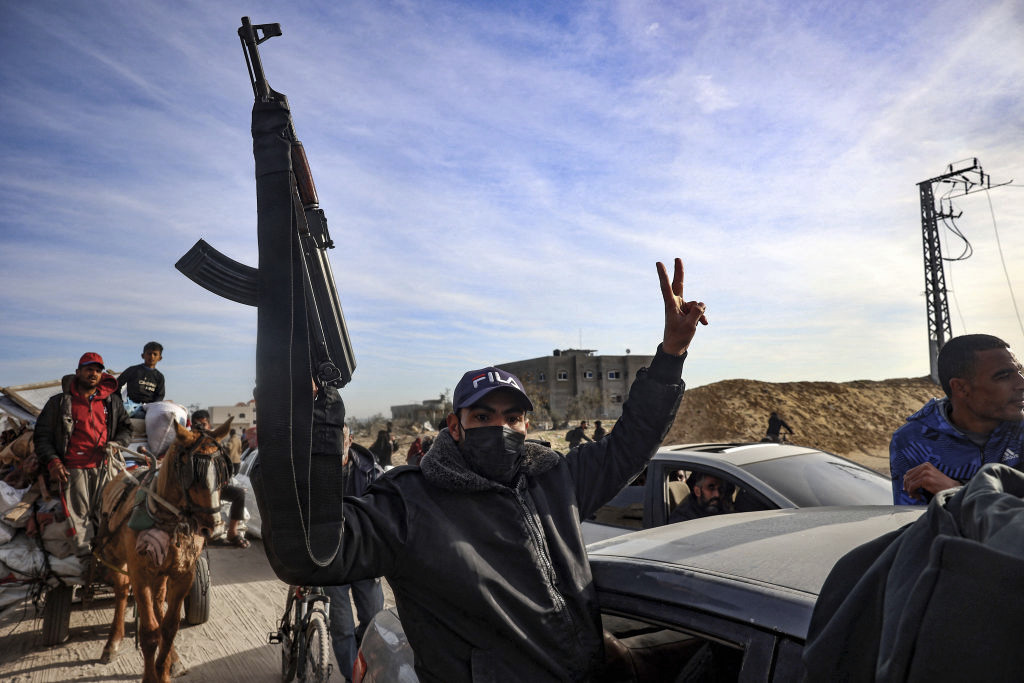
The ceasefire-hostage deal does not require Hamas to disarm or cede control over the Gaza Strip. The terrorist group seems to be convinced that the deal will enable it to keep control of the Gaza Strip and prepare for more massacres of Jews. Pictured: A terrorist flashes a "V for victory" sign to celebrate the ceasefire agreement, near Rafah in the southern Gaza Strip on January 19, 2025. (Photo by Eyad Baba/AFP via Getty Images)
Those who think that the Iran-backed Palestinian terrorist group Hamas will abandon its Jihad (holy war) to murder more Jews and destroy Israel in the aftermath of the recent ceasefire-hostage agreement are mistaken.
Although the agreement may put an end to the current conflict between Israel and Hamas, it does not, in any way, reflect a shift in the radical and dangerous ideology of the Islamist group, as outlined in its 1988 Covenant. The document quotes Hassan al-Banna, the founder of the Muslim Brotherhood organization (of which Hamas is an offshoot), as saying: "Israel will arise and continue to exist until Islam abolishes it, as it abolished what went before."
The main points of the Hamas Covenant state:
Continue Reading Article
- The ceasefire-hostage deal does not require Hamas to disarm or cede control over the Gaza Strip.... The terrorist group seems to be convinced that the deal will enable it to keep control of the Gaza Strip and prepare for more massacres of Jews.
- Shortly after the ceasefire-hostage deal was announced on January 15, Hamas leader Khalil al-Hayya made it clear that his group intends to pursue its Jihad against Israel.
- The new US administration, to avoid more violence and bloodshed, must insist that Hamas be removed from power.
- This can only be accomplished by applying pressure and sanctions on Hamas's Qatari and and Iranian sponsors.

The ceasefire-hostage deal does not require Hamas to disarm or cede control over the Gaza Strip. The terrorist group seems to be convinced that the deal will enable it to keep control of the Gaza Strip and prepare for more massacres of Jews. Pictured: A terrorist flashes a "V for victory" sign to celebrate the ceasefire agreement, near Rafah in the southern Gaza Strip on January 19, 2025. (Photo by Eyad Baba/AFP via Getty Images)
Those who think that the Iran-backed Palestinian terrorist group Hamas will abandon its Jihad (holy war) to murder more Jews and destroy Israel in the aftermath of the recent ceasefire-hostage agreement are mistaken.
Although the agreement may put an end to the current conflict between Israel and Hamas, it does not, in any way, reflect a shift in the radical and dangerous ideology of the Islamist group, as outlined in its 1988 Covenant. The document quotes Hassan al-Banna, the founder of the Muslim Brotherhood organization (of which Hamas is an offshoot), as saying: "Israel will arise and continue to exist until Islam abolishes it, as it abolished what went before."
The main points of the Hamas Covenant state:
Continue Reading Article

Friday, January 17, 2025
Igrot Hare’aya – Letters of Rav Kook: The Importance of Vocational Training
#289
Date and Place: 6 Nisan 5670 (1910), Yafo
Recipient and Background: Rav Yonatan Binyamin Horowitz. Rav Horowitz was a product of the Chatam Sofer community, and originally served as a rabbi in Slovakia. After moving to Eretz Yisrael, he served as an administrator of communal funds (Kollels) and as a representative of Agudat Yisrael. He was, mainly later, a confidante of Rav Kook, who had a major part in organizing and documenting the trip of rabbis, including Rav Kook and Rav Zonnenfeld, through the New Yishuv.
Body: I have received your dear letter and impressive pamphlet (apparently about a vocational project with which he was involved). You, my friend, deserve a yasher koach for the contribution you are making for those who live in Zion. May it be His will that all will soon realize and know that we must follow the path of life with truth and leave the path of darkness (opposition to people working for a living). That path is the opposite of the path that Hashem commanded us to follow, which is to choose a life of honor and [vocational] skills.
Who is influential enough [in the eyes of Heaven] (see Moed Katan 28a) that he can create a prohibition against this great mitzva[of teaching a trade]?! After all, it is permitted to speak, due to this mitzva, about financial arrangements [for vocational training] on Shabbat (Shabbat 150a). [Let us look at] the simple language of the Talmudic passage. Rav Shmuel ben Nachmani says that it is permitted to go to a variety of mundane, public venues to inspect communal activities on Shabbat. The gemara then brings a Baraitathat one can make shidduchim for his child on Shabbat and can arrange his learning a craft. It would seem that the former opinion agrees with the latter (that it is permitted to arrange vocational training on Shabbat). The Yerushalmi (Shabbat 15:3) brings in the former’s name that Shabbat is specifically for eating and drinking, and because the mouth may start to smell, they allowed him to take part in Torah study. We see that even though he was so strict about speaking on Shabbat, to the extent he felt a need to find special justification to allow speaking divrei Torah on Shabbat, still he said that one can make monetary arrangements regarding vocations. We see that it is equivalent to Torah. Certainly, we cannot compare many involved in Torah to individuals doing so (apparently, group vocational training). Therefore, how is it possible to create prohibitions [against vocational training]? This is especially true in a time like this when it is necessary to take steps on Hashem’s behalf, to strengthen those who believe in Hashem in all ways they can be strengthened, such as in creating power in the ways of life.
I also wrote a few ideas about Shemitta; because of my preoccupation with various matters, I was compelled to be brief, and I ask your forgiveness.
Date and Place: 6 Nisan 5670 (1910), Yafo
Recipient and Background: Rav Yonatan Binyamin Horowitz. Rav Horowitz was a product of the Chatam Sofer community, and originally served as a rabbi in Slovakia. After moving to Eretz Yisrael, he served as an administrator of communal funds (Kollels) and as a representative of Agudat Yisrael. He was, mainly later, a confidante of Rav Kook, who had a major part in organizing and documenting the trip of rabbis, including Rav Kook and Rav Zonnenfeld, through the New Yishuv.
Body: I have received your dear letter and impressive pamphlet (apparently about a vocational project with which he was involved). You, my friend, deserve a yasher koach for the contribution you are making for those who live in Zion. May it be His will that all will soon realize and know that we must follow the path of life with truth and leave the path of darkness (opposition to people working for a living). That path is the opposite of the path that Hashem commanded us to follow, which is to choose a life of honor and [vocational] skills.
Who is influential enough [in the eyes of Heaven] (see Moed Katan 28a) that he can create a prohibition against this great mitzva[of teaching a trade]?! After all, it is permitted to speak, due to this mitzva, about financial arrangements [for vocational training] on Shabbat (Shabbat 150a). [Let us look at] the simple language of the Talmudic passage. Rav Shmuel ben Nachmani says that it is permitted to go to a variety of mundane, public venues to inspect communal activities on Shabbat. The gemara then brings a Baraitathat one can make shidduchim for his child on Shabbat and can arrange his learning a craft. It would seem that the former opinion agrees with the latter (that it is permitted to arrange vocational training on Shabbat). The Yerushalmi (Shabbat 15:3) brings in the former’s name that Shabbat is specifically for eating and drinking, and because the mouth may start to smell, they allowed him to take part in Torah study. We see that even though he was so strict about speaking on Shabbat, to the extent he felt a need to find special justification to allow speaking divrei Torah on Shabbat, still he said that one can make monetary arrangements regarding vocations. We see that it is equivalent to Torah. Certainly, we cannot compare many involved in Torah to individuals doing so (apparently, group vocational training). Therefore, how is it possible to create prohibitions [against vocational training]? This is especially true in a time like this when it is necessary to take steps on Hashem’s behalf, to strengthen those who believe in Hashem in all ways they can be strengthened, such as in creating power in the ways of life.
I also wrote a few ideas about Shemitta; because of my preoccupation with various matters, I was compelled to be brief, and I ask your forgiveness.
What we are meant to do based on what we think Hashem wants of us in that moment
by Rav Binny Freedman
Zvika had just been given two weeks leave; Having been accepted to the prestigious Company Commanders course, he had been given two weeks leave and was at home on his Kibbutz Lochamei Hageta’ot near Haifa when, at exactly 2pm on the afternoon of October 6th, 1973, the Yom Kippur War began. Nearly two thousand Syrian tanks poured across the border in the Golan Heights while hundreds of thousands of Egyptian troops crossed the Suez Canal in the Sinai, and Israeli troops, suffering unspeakable losses, scrambled to try and hold back the onslaught.
Twenty-one year old Captain Zvika Greengold, a tank officer, sensed how bad things were and frantically started making his way across the country to the Golan Heights where he understood the situation was dire; Syrian tanks were just a few hours away from Tel Aviv and there was not much standing in their way.
Arriving at the IDF Command center in Nafach on the Golan, a couple of hours before Syrian tanks burst through the gates , he found the army in disarray; tank crewmen who had managed to get to the Golan to try and help had no idea what to do or where to go. Commandeering two tanks he hurriedly grabbed whatever tank crewmen he could find and within a few minutes was rolling out of the base with two tanks.
Not officially a unit with no assigned frequency, he called his unit ‘Koach Tzvika’ (Force Tzvika) and managed to make contact with troops fighting in the Southern Golan. As night fell, he set out on the tap-line route, the same road used by the Syrians to cross the border and enter Israeli territory.
Almost immediately he encountered an entire company of Syrian tanks advancing towards the Command center. Understanding that if the Golan fell, the entire coastal plain of Israel would soon follow, he advanced in the darkness towards the vastly superior Syrian force and by deft maneuvering and firing from multiple positions, was able to convince the Syrians that they were facing a far larger force of Israelis.
At one point, seeing a Syrian tank ten yards away he fired at point-blank range exploding the enemy tank just in time, but the blast hit his own tank knocking out his radio. So, he jumped off his tank in the midst of battle and commandeered the second tank in his unit to continue fighting. Sending the second tank’s commander back to his original tank with no communications he ordered him to simply follow him and fire at his own discretion. But in the darkness the second tank lost its way and Tzvika now faced the entire Syrian force all alone.
Moments later he saw an entire column of hundreds of Syrian tanks headed across the Golan along the road. Despite being outnumbered, he moved in and out of the darkness, firing on the Syrian tanks while remaining undetected. As the battle raged, he changed his position constantly, firing from different directions to give the perception of a much larger force. In an attempt to uncover the Israeli forces, the Syrian tanks turned on their searchlights but discovered nothing. The beams of light only helped Tzvika and his tank crew identify more Syrian tanks and inflict greater losses. The Syrian forces, stunned by the attacks, retreated to avoid further casualties.
All night long, as more Syrian tanks continued to pour over the northern border, Tzvika continued to attack the Syrians from various positions. At one point, a Syrian tank lit his tank on fire, badly burning his crew. Although he suffered from burns and shock, he ran to another tank and took command over its crew. He continued in this way for hours, striking at Syrian tanks and changing vehicles whenever his tank was disabled. When his gunner was wounded and overcome with shock and fatigue Tzvika simply took his place in the gunner’s position continuing to fire shells at the Syrian tanks.
All that night and into the next day, the Zvika Force continued with other troops along the Tapline Route to confront the Syrians, refusing to retreat lest the Syrians press their advantage and discover they had really already won. Eventually, Israeli forces gained the upper hand, repelling the Syrian forces just as they were on the verge of breaking Israel’s defenses.
After more than 20 hours of battle, Captain Greengold got off his tank in the middle of the Nafah base. Exhausted, he fell to the ground. An intelligence officer brought him to an IDF medical center, where he was finally treated for his injuries. It is estimated that during the course of that fateful night, he and his crew destroyed twenty tanks and many more armored vehicles; some say as many as sixty. At one point joined by eight tanks commanded by Lt. Colonel Uzi More they charged an entire Syrian Divison (three hundred and sixty tanks!).
Through the night, Tzvika would not say on the radio how bad things were nor even hint to the fact that he was only commanding one tank, afraid the Syrians might intercept his frequency and figure out he was all alone. Even his own superior Officers were fooled: Colonel Yitzchak ben Shoham commanding the 188th and later killed in the fighting, assumed he was commanding a force of at least a company of tanks…
After the Yom Kippur War, the IDF awarded Captain Greengold with a Medal of Valor for his extraordinary heroism. Sometimes, one man at the right place at the right time, can make all the difference.
This week’s portion of Shemot contains one of the most painful episodes in Jewish History as an entire people falls from grace in Egypt eventually finding itself enslaved, its children murdered with no end in sight. Then, when it seems as though there must be no hope left, G-d finally tells Moshe, after two hundred years, that it is time for the Jewish people to be redeemed; time for them to come home.
Moshe, in his famous encounter with G-d at the burning bush, is not at all sure he is the right man for the job, but eventually acquiesces to G-d’s command and leaves the safety and comfort of his home and family in Midian to journey back down to Egypt and confront Paroh.
Armed with a miraculous staff and the word of G-d, one would imagine Moshe must be sure their redemption will occur almost immediately, but it does not quite work out that way: Paroh refuses to accept Moshe’s demand to free the Jewish people, instead withholding the straw they desperately need to fulfill their quota of bricks, causing them to sink deeper into despair until they groan under the burden of their misery. Eventually the Jews turn on their would-be saviors Moshe and Aharon (ibid. 5:20-21) castigating them for making their situation even worse and doing nothing to hasten their redemption.
At this point, a most curious dialogue ensues between Moshe and Paroh, which concludes the portion of Shemot in what seems to be the middle of the story. Moshe seems to challenge G-d:
“… Why have you made things worse for this people, and why did you send me?”
And Hashem responds to Moshe (ibid. 6:1):
“…now you will see that which I will do to Paroh, for with a strong hand I will send them forth (free them from Egypt)…”
Rashi (ibid. 6:1) notes that Jewish tradition suggest that Moshe is being castigated by G-d:
“You questioned my ways? Says G-d: now you will see (the miracles I will do to Paroh when setting the Jews free) but later ( when I bring the Jewish people home to Israel ) you will not see ( i.e. :You will not enter the land.”
So, on the one hand, there must be some legitimacy to Moshe’s claim that the Jewish people are suffering, for G-d says the redemption will begin, and you will see it. But he must have also said something wrong seeing as tradition here alludes to the fact Moshe will be punished and not allowed to enter the land of Israel.
So what part of Moshe’s claim was right, and what was wrong? Interestingly, Moshe actually asks G-d two challenging questions:Why have you, G-d, made things worse for the Jewish people? And:
Why, if things are worse for them, did you send me here?
At first glance, if we had to pick one of these questions which might be considered inappropriate we would probably assume the first question is a good question; after all a true leader is in pain when his people suffer, so perhaps it is good Moshe challenges even G-d: How can you cause even more suffering to this enslaved people?
But the second question might bother us, suggesting a certain presumptuousness above Moshe’s pay grade: Moshe is questioning why Hashem sent him to Egypt? Who are we to question G-d’s ways? Yet in fact it is this question which is praised in Jewish tradition and the first question, for which Moshe is taken to task: it is not for us to question why some people suffer and some don’t…
So, what then, is the nature of this second question? What is Moshe suggesting by asking why he was sent?
Rav Avigdor Nevehnsahl in his Sichot Le’Sefer Shemot suggests that while the end result is always in Hashem’s hands, our own role in it is another thing entirely.
As an example, when Moshe resists Hashem’s urgings to redeem the Jewish people (ibid. chapter 3) at the burning bush, one wonders how he could cause the redemption to be delayed, even for a moment.
After all, if he had not argued with G-d he would have begun the redemption that much sooner, so how could he cause the Jewish people to continue to suffer even for a day? But in truth, the redemption of the Jewish people was always meant to happen on the day it happened; the only question was what role Moshe would play. And if his hesitation was because he worried about whether his being chosen would cause pain to his older brother Aharon who had remained in Egypt all the many years Moshe was in Midian, ( see Rashi ibid. 4:13) then he was right to suggest that he wanted to be a force for redemption and not for pain.
What a powerful message: Moshe was willing to give up perhaps the most important role in history; the redemption of the Jewish people from Egypt and the receiving of the Torah at Sinai, simply to avoid causing pain to his brother! Because in the end we have to do the best we can to be doing the right thing at the right time and then we can leave it to G-d to ensure the result is as it should be.
Just like Captain Tzvika Gringold, who could not imagine, that with one tank, he would stop an entire Syrian Division. And indeed that was not his job; his job was to fight with every ounce of strength he had, in every moment, to stop the one tank in front of him, and leave it to Hashem to decide what the actual result of it would all be.
In whatever moment we find ourselves, we need only decide what we are meant to do based on what we think Hashem wants of us in that moment and be sure we do our best. After that we can trust that Hashem will make sure the result will happen as it was always meant to be…
Ultimately, the Jewish people will be redeemed, and they will come home to the land of Israel, just as it was always meant to be. And the only question is what role we get to play on that journey…
Shabbat Shalom from Yerushalayim.
Twenty-one year old Captain Zvika Greengold, a tank officer, sensed how bad things were and frantically started making his way across the country to the Golan Heights where he understood the situation was dire; Syrian tanks were just a few hours away from Tel Aviv and there was not much standing in their way.
Arriving at the IDF Command center in Nafach on the Golan, a couple of hours before Syrian tanks burst through the gates , he found the army in disarray; tank crewmen who had managed to get to the Golan to try and help had no idea what to do or where to go. Commandeering two tanks he hurriedly grabbed whatever tank crewmen he could find and within a few minutes was rolling out of the base with two tanks.
Not officially a unit with no assigned frequency, he called his unit ‘Koach Tzvika’ (Force Tzvika) and managed to make contact with troops fighting in the Southern Golan. As night fell, he set out on the tap-line route, the same road used by the Syrians to cross the border and enter Israeli territory.
Almost immediately he encountered an entire company of Syrian tanks advancing towards the Command center. Understanding that if the Golan fell, the entire coastal plain of Israel would soon follow, he advanced in the darkness towards the vastly superior Syrian force and by deft maneuvering and firing from multiple positions, was able to convince the Syrians that they were facing a far larger force of Israelis.
At one point, seeing a Syrian tank ten yards away he fired at point-blank range exploding the enemy tank just in time, but the blast hit his own tank knocking out his radio. So, he jumped off his tank in the midst of battle and commandeered the second tank in his unit to continue fighting. Sending the second tank’s commander back to his original tank with no communications he ordered him to simply follow him and fire at his own discretion. But in the darkness the second tank lost its way and Tzvika now faced the entire Syrian force all alone.
Moments later he saw an entire column of hundreds of Syrian tanks headed across the Golan along the road. Despite being outnumbered, he moved in and out of the darkness, firing on the Syrian tanks while remaining undetected. As the battle raged, he changed his position constantly, firing from different directions to give the perception of a much larger force. In an attempt to uncover the Israeli forces, the Syrian tanks turned on their searchlights but discovered nothing. The beams of light only helped Tzvika and his tank crew identify more Syrian tanks and inflict greater losses. The Syrian forces, stunned by the attacks, retreated to avoid further casualties.
All night long, as more Syrian tanks continued to pour over the northern border, Tzvika continued to attack the Syrians from various positions. At one point, a Syrian tank lit his tank on fire, badly burning his crew. Although he suffered from burns and shock, he ran to another tank and took command over its crew. He continued in this way for hours, striking at Syrian tanks and changing vehicles whenever his tank was disabled. When his gunner was wounded and overcome with shock and fatigue Tzvika simply took his place in the gunner’s position continuing to fire shells at the Syrian tanks.
All that night and into the next day, the Zvika Force continued with other troops along the Tapline Route to confront the Syrians, refusing to retreat lest the Syrians press their advantage and discover they had really already won. Eventually, Israeli forces gained the upper hand, repelling the Syrian forces just as they were on the verge of breaking Israel’s defenses.
After more than 20 hours of battle, Captain Greengold got off his tank in the middle of the Nafah base. Exhausted, he fell to the ground. An intelligence officer brought him to an IDF medical center, where he was finally treated for his injuries. It is estimated that during the course of that fateful night, he and his crew destroyed twenty tanks and many more armored vehicles; some say as many as sixty. At one point joined by eight tanks commanded by Lt. Colonel Uzi More they charged an entire Syrian Divison (three hundred and sixty tanks!).
Through the night, Tzvika would not say on the radio how bad things were nor even hint to the fact that he was only commanding one tank, afraid the Syrians might intercept his frequency and figure out he was all alone. Even his own superior Officers were fooled: Colonel Yitzchak ben Shoham commanding the 188th and later killed in the fighting, assumed he was commanding a force of at least a company of tanks…
After the Yom Kippur War, the IDF awarded Captain Greengold with a Medal of Valor for his extraordinary heroism. Sometimes, one man at the right place at the right time, can make all the difference.
This week’s portion of Shemot contains one of the most painful episodes in Jewish History as an entire people falls from grace in Egypt eventually finding itself enslaved, its children murdered with no end in sight. Then, when it seems as though there must be no hope left, G-d finally tells Moshe, after two hundred years, that it is time for the Jewish people to be redeemed; time for them to come home.
Moshe, in his famous encounter with G-d at the burning bush, is not at all sure he is the right man for the job, but eventually acquiesces to G-d’s command and leaves the safety and comfort of his home and family in Midian to journey back down to Egypt and confront Paroh.
Armed with a miraculous staff and the word of G-d, one would imagine Moshe must be sure their redemption will occur almost immediately, but it does not quite work out that way: Paroh refuses to accept Moshe’s demand to free the Jewish people, instead withholding the straw they desperately need to fulfill their quota of bricks, causing them to sink deeper into despair until they groan under the burden of their misery. Eventually the Jews turn on their would-be saviors Moshe and Aharon (ibid. 5:20-21) castigating them for making their situation even worse and doing nothing to hasten their redemption.
At this point, a most curious dialogue ensues between Moshe and Paroh, which concludes the portion of Shemot in what seems to be the middle of the story. Moshe seems to challenge G-d:
“… Why have you made things worse for this people, and why did you send me?”
And Hashem responds to Moshe (ibid. 6:1):
“…now you will see that which I will do to Paroh, for with a strong hand I will send them forth (free them from Egypt)…”
Rashi (ibid. 6:1) notes that Jewish tradition suggest that Moshe is being castigated by G-d:
“You questioned my ways? Says G-d: now you will see (the miracles I will do to Paroh when setting the Jews free) but later ( when I bring the Jewish people home to Israel ) you will not see ( i.e. :You will not enter the land.”
So, on the one hand, there must be some legitimacy to Moshe’s claim that the Jewish people are suffering, for G-d says the redemption will begin, and you will see it. But he must have also said something wrong seeing as tradition here alludes to the fact Moshe will be punished and not allowed to enter the land of Israel.
So what part of Moshe’s claim was right, and what was wrong? Interestingly, Moshe actually asks G-d two challenging questions:Why have you, G-d, made things worse for the Jewish people? And:
Why, if things are worse for them, did you send me here?
At first glance, if we had to pick one of these questions which might be considered inappropriate we would probably assume the first question is a good question; after all a true leader is in pain when his people suffer, so perhaps it is good Moshe challenges even G-d: How can you cause even more suffering to this enslaved people?
But the second question might bother us, suggesting a certain presumptuousness above Moshe’s pay grade: Moshe is questioning why Hashem sent him to Egypt? Who are we to question G-d’s ways? Yet in fact it is this question which is praised in Jewish tradition and the first question, for which Moshe is taken to task: it is not for us to question why some people suffer and some don’t…
So, what then, is the nature of this second question? What is Moshe suggesting by asking why he was sent?
Rav Avigdor Nevehnsahl in his Sichot Le’Sefer Shemot suggests that while the end result is always in Hashem’s hands, our own role in it is another thing entirely.
As an example, when Moshe resists Hashem’s urgings to redeem the Jewish people (ibid. chapter 3) at the burning bush, one wonders how he could cause the redemption to be delayed, even for a moment.
After all, if he had not argued with G-d he would have begun the redemption that much sooner, so how could he cause the Jewish people to continue to suffer even for a day? But in truth, the redemption of the Jewish people was always meant to happen on the day it happened; the only question was what role Moshe would play. And if his hesitation was because he worried about whether his being chosen would cause pain to his older brother Aharon who had remained in Egypt all the many years Moshe was in Midian, ( see Rashi ibid. 4:13) then he was right to suggest that he wanted to be a force for redemption and not for pain.
What a powerful message: Moshe was willing to give up perhaps the most important role in history; the redemption of the Jewish people from Egypt and the receiving of the Torah at Sinai, simply to avoid causing pain to his brother! Because in the end we have to do the best we can to be doing the right thing at the right time and then we can leave it to G-d to ensure the result is as it should be.
Just like Captain Tzvika Gringold, who could not imagine, that with one tank, he would stop an entire Syrian Division. And indeed that was not his job; his job was to fight with every ounce of strength he had, in every moment, to stop the one tank in front of him, and leave it to Hashem to decide what the actual result of it would all be.
In whatever moment we find ourselves, we need only decide what we are meant to do based on what we think Hashem wants of us in that moment and be sure we do our best. After that we can trust that Hashem will make sure the result will happen as it was always meant to be…
Ultimately, the Jewish people will be redeemed, and they will come home to the land of Israel, just as it was always meant to be. And the only question is what role we get to play on that journey…
Shabbat Shalom from Yerushalayim.
The Yishai Fleisher Israel Podcast: HOW TO DEAL WITH A BAD DEAL
SEASON 2024 EPISODE 47: Yishai and Malkah contemplate Israel's hostage deal with Hamas and see much weakness which needs to be overcome. Then, Congressman Brian Mast fights the ICC. And two men in Gaza lay out a vision for the future. Finally, Ben Bresky on Aliyah missions from Yemen. Plus: Torah Time on the Light of Moses.
It Wasn't a Deal – It Was a Crime
by Alan M. Dershowitz

The decision by the Israeli government to make significant concessions to the Hamas kidnappers should never be called a "deal." It was an extortion. Would you call it a deal if somebody kidnapped your child and you "agreed" to pay ransom to get her back? Of course not. The kidnapping was a crime. And the extortionate demand was an additional crime. Pictured: A Hamas terrorist holds two of the many Israeli children that Hamas murdered, or abducted and brought as captives to the Gaza Strip, on October 7, 2023. (Image source: Hamas/X [Twitter])
The decision by the Israeli government to make significant concessions to the Hamas kidnappers should never be called a "deal." It was an extortion. Would you call it a deal if somebody kidnapped your child and you "agreed" to pay ransom to get her back? Of course not. The kidnapping was a crime. And the extortionate demand was an additional crime.
So the proper description of what occurred is that Israel, pressured by the United States, capitulated to the unlawful and extortionate demands of Hamas as the only way of saving the lives of kidnapped babies, mothers and other innocent, mostly civilian, hostages.
This was not the result of a negotiation between equals. If an armed robber puts a gun to your head and says, "your money or your life," your decision to give him your money would not be described as a deal. Nor should the extorted arrangement agreed to by Israel be considered a deal. So let's stop using that term.
Continue Reading Article
- The decision by the Israeli government to make significant concessions to the Hamas kidnappers should never be called a "deal." It was an extortion.... The kidnapping was a crime. And the extortionate demand was an additional crime.
- When a terrorist group "negotiates" with a democracy, it always has the upper hand. The terrorists are not constrained by morality, law or truth. They can murder at will, rape at will, torture at will and threaten to do worse. The democracy, on the other hand, must comply with the rules of law and must listen to the pleas of the hostage families.
- Especially complicit, with blood on their hands, are supporters of Hamas on university campuses who chant for intifada and revolution. Also complicit are international organizations, such as the International Criminal Court, that treat Israel and Hamas as equals.
- [L]et us put the blame for ALL the deaths in Gaza where it belongs: on Hamas and the useful idiots and useless bigots who support murderous terrorists.

The decision by the Israeli government to make significant concessions to the Hamas kidnappers should never be called a "deal." It was an extortion. Would you call it a deal if somebody kidnapped your child and you "agreed" to pay ransom to get her back? Of course not. The kidnapping was a crime. And the extortionate demand was an additional crime. Pictured: A Hamas terrorist holds two of the many Israeli children that Hamas murdered, or abducted and brought as captives to the Gaza Strip, on October 7, 2023. (Image source: Hamas/X [Twitter])
The decision by the Israeli government to make significant concessions to the Hamas kidnappers should never be called a "deal." It was an extortion. Would you call it a deal if somebody kidnapped your child and you "agreed" to pay ransom to get her back? Of course not. The kidnapping was a crime. And the extortionate demand was an additional crime.
So the proper description of what occurred is that Israel, pressured by the United States, capitulated to the unlawful and extortionate demands of Hamas as the only way of saving the lives of kidnapped babies, mothers and other innocent, mostly civilian, hostages.
This was not the result of a negotiation between equals. If an armed robber puts a gun to your head and says, "your money or your life," your decision to give him your money would not be described as a deal. Nor should the extorted arrangement agreed to by Israel be considered a deal. So let's stop using that term.
Continue Reading Article

And A New King Arose In Egypt - Israel, D.C. And The Hamas Surrender Deal
by Daniel Greenfield
"And a new king arose over Egypt who did not know Joseph." Exodus 1:8
Every country fights Islamic terrorism alone. What should have been a world war against a common enemy has become a lonely battle in which each country strives separately against a global threat. And within each country, individuals have been abandoned by their governments to face sudden death.
This is not just Israel's story. It is all our stories. But it is most clearly seen in Israel.
Jews tend to view this as antisemitism and it's often in the mix. But it's not just antisemitism. It's cowardice. The world powers, old and new, recruit their own Jihadists, form their dirty deals for oil and blood, and sell each other out. That they sell out Israel is a given. What else would you expect of people who sell out their own children to grooming gangs and let mosques rise in every one of their cities?
The blood was hardly dry on the streets of the French Quarter before we had all officially moved on for the hundredth time. And there is every reason to think that we will go on moving on for the foreseeable future. People wait for some fundamental wake-up call that will break with the old corrupt blindness.
For now at least they have waited in vain.
Insurgent politicians arise, talking big, but offer only differences of style not substance.
The Surrender to Hamas Deal is a bipartisan betrayal of Israel in which the outgoing Biden administration and the incoming Trump administration got together to throttle Israel and demand that it accept a Hamas deal, overseen by its state sponsor Qatar, trading thousands of terrorists for hostages, live or dead, abandoning Gaza, and allowing Hamas under a fake 'technocratic' government to take it over again. Followed by an extended reconstruction that the United States will be paying for.
This is not "peace through strength", it's "war through weakness". It demonstrates once again that if Islamic terrorists take hostages, keep fighting and have their allies run information campaigns, they will win even if they lose. The Surrender to Hamas Deal sells out American interests along with Israeli ones. The next step is the Hamas-PLO unity government put together under Chinese and Russian aegis in Beijing and Moscow since Oct 7 which the United States will now have to arm, fund and recognize.
America has once again sold out allies and empowered enemies. The message once more is that it's better to be our enemies than our friends. And that the best possible strategy is to be a terrorist.
The old boys and the new boys in D.C. got together to carry out the same policy. When it came down to it, the only differences were style, not substance. And the policy is surrendering to Islamic terrorism. That has implications beyond Israel. And those implications are catastrophically bad for America.
"Well, the chances are against it, and the odds are slim/That he'll live by the rules that the world makes for him/'Cause there's a noose at his neck and a gun at his back/And a license to kill him is given out to every maniac," Bob Dylan sang a long time ago in Neighborhood Bully.
That may have been the old Israel. The one that dismissed the UN as 'Oom Shmoom.' The new Israel, the one of Netanyahu and Start-Up Nation. The one that sees Hasbara as an existential strategy cares very much. It waits around for someone to take its side and to see that truth that Dylan sang. It spends so much time arguing with the world that eventually it loses its belief in its own rightness. And gives in.
Then it waits once more for global support that will never come.
The old Israel understood that leaders who sell out their own countries to Saudi Arabia, Qatar and that ilk can hardly be expected not sell out Israel. It isn't that they're antisemites. They can hardly be expected to do for Israel what they will not do for America, England and France.
The old Israel understood that it had to stand alone because no one would stand with it. Knew that it had to believe in itself because no government, whatever promises were made during election campaigns at rubber chicken dinners, would stand with it.
The new Israel keeps winning wars and losing faith. It waits for a better day, but no better day is coming. And unless the world wakes up and fights back, the demographic trends and political radicalization will not make the western world any friendlier to Israel.
The early days of January should have made it finally clear that there is nothing to wait for. Perhaps the day will come when an American government wakes up and takes a stand against Islamic terrorism.
And perhaps the L-rd and all His angels will sweep the enemy from the field.
It is difficult to know which day will come sooner.
This Shabbat, Jews all over the world will read the story of Exodus or Shemos which begins with the rise of a new Pharaoh who does not know Joseph. That Pharaoh dies and the Jews welcome the news of a new ruler. But when their enslavement does not change, they cry out to G-d as they never had before because now they know not to put their trust in any prince. Now they know that their one king is G-d.
And then G-d hears. And then G-d acts.
For now Israel stands alone. It stands faced with a crisis caused by a generation of giving in to pressure from D.C. politicians. The process that began with Prime Minister Shamir agreeing to take back Hamas terrorists and negotiate, however indirectly, with the PLO over a Palestinian State, that continued with the Oslo Accords, the withdrawals from Lebanon and Gaza, negotiation after negotiation, that has nurtured, armed and created an enemy state inside Israel is the greatest threat to its survival.
'Palestinianism', not Iran, is the greatest threat to Israel. The answer is not geopolitics of regional accords, it's the defense of the land and its borders against an enemy that lies within them.
Israel, like America and Europe, has fallen for the absurd internationalist nonsense that the primary problem is to cope with international affairs in international forums rather than to clean house.
In America and Europe that means mobs of migrants flooding across the border while their governments are concerned about geopolitical problems. In Israel that meant treating the Abraham Accords like the greatest thing since Sinai while ignoring the enemy armies preparing across the border in Gaza.
Israeli leaders have spent too long looking to America for hope when they should have looked to their own people. The future of Israel does not lie in making apps or in lobbying D.C., but in the settlements where armed family men stand watch against the enemy. And if there is any hope to be found for confronting Islamic terror, it will not be in D.C., but in those small settlements.
And perhaps out of those small villages will come the hope of not only Israel, but the world.
Every country fights Islamic terrorism alone. What should have been a world war against a common enemy has become a lonely battle in which each country strives separately against a global threat. And within each country, individuals have been abandoned by their governments to face sudden death.
This is not just Israel's story. It is all our stories. But it is most clearly seen in Israel.
Jews tend to view this as antisemitism and it's often in the mix. But it's not just antisemitism. It's cowardice. The world powers, old and new, recruit their own Jihadists, form their dirty deals for oil and blood, and sell each other out. That they sell out Israel is a given. What else would you expect of people who sell out their own children to grooming gangs and let mosques rise in every one of their cities?
The blood was hardly dry on the streets of the French Quarter before we had all officially moved on for the hundredth time. And there is every reason to think that we will go on moving on for the foreseeable future. People wait for some fundamental wake-up call that will break with the old corrupt blindness.
For now at least they have waited in vain.
Insurgent politicians arise, talking big, but offer only differences of style not substance.
The Surrender to Hamas Deal is a bipartisan betrayal of Israel in which the outgoing Biden administration and the incoming Trump administration got together to throttle Israel and demand that it accept a Hamas deal, overseen by its state sponsor Qatar, trading thousands of terrorists for hostages, live or dead, abandoning Gaza, and allowing Hamas under a fake 'technocratic' government to take it over again. Followed by an extended reconstruction that the United States will be paying for.
This is not "peace through strength", it's "war through weakness". It demonstrates once again that if Islamic terrorists take hostages, keep fighting and have their allies run information campaigns, they will win even if they lose. The Surrender to Hamas Deal sells out American interests along with Israeli ones. The next step is the Hamas-PLO unity government put together under Chinese and Russian aegis in Beijing and Moscow since Oct 7 which the United States will now have to arm, fund and recognize.
America has once again sold out allies and empowered enemies. The message once more is that it's better to be our enemies than our friends. And that the best possible strategy is to be a terrorist.
The old boys and the new boys in D.C. got together to carry out the same policy. When it came down to it, the only differences were style, not substance. And the policy is surrendering to Islamic terrorism. That has implications beyond Israel. And those implications are catastrophically bad for America.
"Well, the chances are against it, and the odds are slim/That he'll live by the rules that the world makes for him/'Cause there's a noose at his neck and a gun at his back/And a license to kill him is given out to every maniac," Bob Dylan sang a long time ago in Neighborhood Bully.
That may have been the old Israel. The one that dismissed the UN as 'Oom Shmoom.' The new Israel, the one of Netanyahu and Start-Up Nation. The one that sees Hasbara as an existential strategy cares very much. It waits around for someone to take its side and to see that truth that Dylan sang. It spends so much time arguing with the world that eventually it loses its belief in its own rightness. And gives in.
Then it waits once more for global support that will never come.
The old Israel understood that leaders who sell out their own countries to Saudi Arabia, Qatar and that ilk can hardly be expected not sell out Israel. It isn't that they're antisemites. They can hardly be expected to do for Israel what they will not do for America, England and France.
The old Israel understood that it had to stand alone because no one would stand with it. Knew that it had to believe in itself because no government, whatever promises were made during election campaigns at rubber chicken dinners, would stand with it.
The new Israel keeps winning wars and losing faith. It waits for a better day, but no better day is coming. And unless the world wakes up and fights back, the demographic trends and political radicalization will not make the western world any friendlier to Israel.
The early days of January should have made it finally clear that there is nothing to wait for. Perhaps the day will come when an American government wakes up and takes a stand against Islamic terrorism.
And perhaps the L-rd and all His angels will sweep the enemy from the field.
It is difficult to know which day will come sooner.
This Shabbat, Jews all over the world will read the story of Exodus or Shemos which begins with the rise of a new Pharaoh who does not know Joseph. That Pharaoh dies and the Jews welcome the news of a new ruler. But when their enslavement does not change, they cry out to G-d as they never had before because now they know not to put their trust in any prince. Now they know that their one king is G-d.
And then G-d hears. And then G-d acts.
For now Israel stands alone. It stands faced with a crisis caused by a generation of giving in to pressure from D.C. politicians. The process that began with Prime Minister Shamir agreeing to take back Hamas terrorists and negotiate, however indirectly, with the PLO over a Palestinian State, that continued with the Oslo Accords, the withdrawals from Lebanon and Gaza, negotiation after negotiation, that has nurtured, armed and created an enemy state inside Israel is the greatest threat to its survival.
'Palestinianism', not Iran, is the greatest threat to Israel. The answer is not geopolitics of regional accords, it's the defense of the land and its borders against an enemy that lies within them.
Israel, like America and Europe, has fallen for the absurd internationalist nonsense that the primary problem is to cope with international affairs in international forums rather than to clean house.
In America and Europe that means mobs of migrants flooding across the border while their governments are concerned about geopolitical problems. In Israel that meant treating the Abraham Accords like the greatest thing since Sinai while ignoring the enemy armies preparing across the border in Gaza.
Israeli leaders have spent too long looking to America for hope when they should have looked to their own people. The future of Israel does not lie in making apps or in lobbying D.C., but in the settlements where armed family men stand watch against the enemy. And if there is any hope to be found for confronting Islamic terror, it will not be in D.C., but in those small settlements.
And perhaps out of those small villages will come the hope of not only Israel, but the world.
Thursday, January 16, 2025
210 Years
by Rabbi Pinchas Winston
WHY 210 YEARS? That’s what my chavrusa asked me recently. He understood why there had to be slavery, especially kabbalistically. He just hadn’t seen any explanation for the length of the exile, and wanted one.
Fortunately, I have. The Arizal addressed this issue in Sha’ar HaPesukim in Parashas Shemos. He says:
The duration of the Egyptian Exile, from the time the Jewish people arrived there, was 210 years. During the first 130 years, the “branches” began to reincarnate into the Jewish people and the Erev Rav. They were refined and cleansed, good separated from the bad. Their separation was not complete until the end of the 130 years…After they completed their reincarnations and separations, Moshe Rabbeinu was born. As known, Moshe was 80 years old when they left Egypt, and 130 plus 80 is 210. It was not possible for Moshe, who was the Da’as itself, the good to come, [to be born] until his sparks were separated out, good from the bad. When their separation was complete, he was born. This is the reason for what our rabbis z”l write (Sotah 12b) that on the day Moshe was thrown [into the Nile] the decree to throw the males into the river was annulled. They (the rectified souls) had finished coming [into the world]. (Sha’ar HaPesukim, Shemos, q.v. A Kew King)
It is always amazing how something on a Pshat level can seem so random and on a Sod level be so specific. The Torah does not even mention the 210 years in any direct manner, though it really is the key to why the exile had to occur in the first place, and had to be so harsh. The origin goes back to Adam HaRishon’s 130 years of teshuvah after leaving Gan Aiden (Eruvin 18b), the generation of the Flood, the tower, and of those born into both the Jews and Egyptians. It was all part of a major historic rectification of mankind on the way to making the Jewish people who would eventually lead it.
But that’s not all. There is additional significance to the 210 years:
The Da’as of Zehr Anpin has ten Hovayos from the level of the Da’as of the Yesod of Abba, which has a gematria of 260, and ten names of Eheyeh from the Yesod of Imma have a gematria of 210. The reason for the exile of the Jewish people in Egypt has already been explained on the verse, “A new king rose up” (Shemos 1:8), that the entire generation was sparks of the destroyed seed of Adam which flowed through the brain of the Da’as literally, and were very elevated souls. Since they came from there, they needed to be in exile for 210 years, which is ten times the name of the Eheyeh in the Da’as from the side of Imma, as mentioned. This is what Ya’akov hinted to his sons, “Go down—Raish-Dalet-Vav (200+4+6)—there” (Bereishis 42:2). (Sha’ar HaPesukim, Shemos, q.v. An Angel of God Appeared to Him).
Da’as is a sefirah, which you can read about online these days. The word itself means knowledge, but it refers to a particular kind of Divine light that acts as the soul of the six sefiros of Chesed, Gevurah, Tifferes, Netzach, Hod, and Yesod, otherwise known as Zehr Anpin. That may mean absolutely nothing to you, but you should know that all that has happened through the last 5,785 years, and what will happen until 6,000, is because of the light of these six sefiros with the Da’as inside of them. They represent the Divine script for human history.
A Hovayah is one four-letter Name of God. It is too holy to say these days as written, so we shuffled the letters to produce the word Hovayah instead to refer to it. Just as everything physical is made up of elements, everything in all of existence (including the elements themselves) is made up of Hovayos, spiritual packets of Divine light. They are the means by which God shares His light and implements His will.
Just as there are ten sefiros in general, each of the sefiros have ten sefiros, each one being a Hovayah-unit of spiritual light. Just like Hovayah is a Name of God, so is Eheyeh, which we are introduced to in this week’s parsha (Shemos 3:14). Its gematria is equal to 1+5+10+5, or 21.
All of this may still mean very little to you, unless you take the time to more fully understand what the Arizal has written above, but it isn’t the point I was trying to make. The only point I am making is, that the 210 years we spent in Egypt, 116 of which were the years of slavery, were not incidental. Nothing ever is. On the contrary, they were precise for the sake of levels of world rectification we may not know about but we are nevertheless a part of.
The complete will of God is so unfathomable, and even what we’re able to grasp is only revealed to us in stages and over time. Torah gives us insight into that will and mitzvos help us to work with it even when we don’t understand it. The only thing we know for sure is that everything that God does is for the good because He can do no evil, no how much history seems to argue the opposite.
Figure out what you can about whatever it is that bothers you. But where you fall short, use trust and faith in God’s goodness to carry you through life. This is what has carried us as a nation throughout history until today.
I have just published my new Haggadah, b”H, called “The Wise Son Says.” You can see it here: https://www.shaarnunproductions.org/lwise-son-says-haggadah.html, and take advantage of the special offers available at this time. Pesach is closing in on us fast, b”H, so please check out my new Haggadah while the specials lasts. It’s Torah for the entire year…and possibly life-altering.
WHY 210 YEARS? That’s what my chavrusa asked me recently. He understood why there had to be slavery, especially kabbalistically. He just hadn’t seen any explanation for the length of the exile, and wanted one.
Fortunately, I have. The Arizal addressed this issue in Sha’ar HaPesukim in Parashas Shemos. He says:
The duration of the Egyptian Exile, from the time the Jewish people arrived there, was 210 years. During the first 130 years, the “branches” began to reincarnate into the Jewish people and the Erev Rav. They were refined and cleansed, good separated from the bad. Their separation was not complete until the end of the 130 years…After they completed their reincarnations and separations, Moshe Rabbeinu was born. As known, Moshe was 80 years old when they left Egypt, and 130 plus 80 is 210. It was not possible for Moshe, who was the Da’as itself, the good to come, [to be born] until his sparks were separated out, good from the bad. When their separation was complete, he was born. This is the reason for what our rabbis z”l write (Sotah 12b) that on the day Moshe was thrown [into the Nile] the decree to throw the males into the river was annulled. They (the rectified souls) had finished coming [into the world]. (Sha’ar HaPesukim, Shemos, q.v. A Kew King)
It is always amazing how something on a Pshat level can seem so random and on a Sod level be so specific. The Torah does not even mention the 210 years in any direct manner, though it really is the key to why the exile had to occur in the first place, and had to be so harsh. The origin goes back to Adam HaRishon’s 130 years of teshuvah after leaving Gan Aiden (Eruvin 18b), the generation of the Flood, the tower, and of those born into both the Jews and Egyptians. It was all part of a major historic rectification of mankind on the way to making the Jewish people who would eventually lead it.
But that’s not all. There is additional significance to the 210 years:
The Da’as of Zehr Anpin has ten Hovayos from the level of the Da’as of the Yesod of Abba, which has a gematria of 260, and ten names of Eheyeh from the Yesod of Imma have a gematria of 210. The reason for the exile of the Jewish people in Egypt has already been explained on the verse, “A new king rose up” (Shemos 1:8), that the entire generation was sparks of the destroyed seed of Adam which flowed through the brain of the Da’as literally, and were very elevated souls. Since they came from there, they needed to be in exile for 210 years, which is ten times the name of the Eheyeh in the Da’as from the side of Imma, as mentioned. This is what Ya’akov hinted to his sons, “Go down—Raish-Dalet-Vav (200+4+6)—there” (Bereishis 42:2). (Sha’ar HaPesukim, Shemos, q.v. An Angel of God Appeared to Him).
Da’as is a sefirah, which you can read about online these days. The word itself means knowledge, but it refers to a particular kind of Divine light that acts as the soul of the six sefiros of Chesed, Gevurah, Tifferes, Netzach, Hod, and Yesod, otherwise known as Zehr Anpin. That may mean absolutely nothing to you, but you should know that all that has happened through the last 5,785 years, and what will happen until 6,000, is because of the light of these six sefiros with the Da’as inside of them. They represent the Divine script for human history.
A Hovayah is one four-letter Name of God. It is too holy to say these days as written, so we shuffled the letters to produce the word Hovayah instead to refer to it. Just as everything physical is made up of elements, everything in all of existence (including the elements themselves) is made up of Hovayos, spiritual packets of Divine light. They are the means by which God shares His light and implements His will.
Just as there are ten sefiros in general, each of the sefiros have ten sefiros, each one being a Hovayah-unit of spiritual light. Just like Hovayah is a Name of God, so is Eheyeh, which we are introduced to in this week’s parsha (Shemos 3:14). Its gematria is equal to 1+5+10+5, or 21.
All of this may still mean very little to you, unless you take the time to more fully understand what the Arizal has written above, but it isn’t the point I was trying to make. The only point I am making is, that the 210 years we spent in Egypt, 116 of which were the years of slavery, were not incidental. Nothing ever is. On the contrary, they were precise for the sake of levels of world rectification we may not know about but we are nevertheless a part of.
The complete will of God is so unfathomable, and even what we’re able to grasp is only revealed to us in stages and over time. Torah gives us insight into that will and mitzvos help us to work with it even when we don’t understand it. The only thing we know for sure is that everything that God does is for the good because He can do no evil, no how much history seems to argue the opposite.
Figure out what you can about whatever it is that bothers you. But where you fall short, use trust and faith in God’s goodness to carry you through life. This is what has carried us as a nation throughout history until today.
I have just published my new Haggadah, b”H, called “The Wise Son Says.” You can see it here: https://www.shaarnunproductions.org/lwise-son-says-haggadah.html, and take advantage of the special offers available at this time. Pesach is closing in on us fast, b”H, so please check out my new Haggadah while the specials lasts. It’s Torah for the entire year…and possibly life-altering.
Iran’s Ayatollahs Expand Encroachment on US Hemisphere (the Caribbean Sea)
by Ambassador (ret.) Yoram Ettinger
Will the Monroe Doctrine be revitalized in the face of the growing military, economic and diplomatic entrenchment of Iran’s Ayatollahs throughout Latin America?! The Ayatollahs aim to undermine the strategic posture of the US in its own “soft underbelly,” and bring “The Great American Satan” to submission. Against this alarming background, can the US afford to persist in its diplomatic option toward Iran, or revert to President Trump’s maximum pressure economic sanctions, which were proven reversible, while refraining from the irreversible regime-change?!
*”After more than four decades of systematic penetration of Latin America, Iran is reaching its full geopolitical potential in the Western Hemisphere, prepositioning military assets and armaments in the region. Tehran’s goal is to bring the fight to the United States.... Venezuela’s Armed Forces is the first Latin American military to have armed drones in its inventory, courtesy of Iran. In 2021, Venezuela began receiving shipments of Iran-made precision-guided short-range missiles that will likely be used to arm the drones...."
*The Warsaw, Poland-based Defense Industry Europe reports that “Iran’s supply of military systems to Venezuela creates grave concerns in South America. Iranian-made Zolfaghar-class missile boats (a modified version of the North Korean IPS-16) armed with Nasr-1 anti-ship missiles were observed during a July 24, 2023 naval parade in Venezuela [Do the Ayatollahs intend to export the Houthi piracy in the Red Sea to the Caribbean Sea and the Venezuela-Guyana territorial conflict?]. The Iranian defense industry is using straw companies to obtain dual-use components used in their locally manufactured military systems.... Iran is using Venezuela as its front base in South America, intending to target American interests....”
*The Riyadh-based Journal for Iranian Studies indicates that “Iran’s significant and growing presence in Latin America, [is noticed] among governments with adversarial relationships with the United States. [There is] a progression of Iran-Latin American cooperation from diplomatic, cultural and commercial ties to the signing of military agreements and the export of Iranian military technology, notably drones.... to Latin America, which represents a critical region for US national interests and security.... A drone production factory was established [in Venezuela] over a decade ago during Hugo Chavez’s tenure.... These commercial and military agreements help Iran circumvent international sanctions and the 2007 UN arms embargo, providing a venue for Iranian companies affiliated with the [US State Department terror-designated] Islamic Revolutionary Guard Corps to establish a presence beyond Iranian borders, notwithstanding the sanctions.... Bolivian Defense Minister, Edmundo Novillo, disclosed that the [Iran-Bolivia] agreement entailed provisions for acquiring drones and boats aimed at monitoring regional borders.... [He] underscored Bolivia’s need for maintenance services for its aircraft and helicopters [paid for by lithium], acknowledging the technical expertise offered by Iran in this regard....”
*According to the NYC-based The Latin Times, “Iran is increasing its military presence in Venezuela…., establishing a [predator] drone development base at the El Libertador Air Base, where training is carried out for Venezuelan military personnel…. Iran’s Mahan Air, makes direct flights between Caracas and Tehran, violating international sanctions by transporting Venezuelan gold in exchange for Iranian oil….”
*Iran’s Ayatollahs have expanded their Latin American footprint toward the Caribbean Sea in collaboration with Venezuela’s Nicolas Maduro, militarily, economically and diplomatically, supporting Maduro’s territorial claim in Guyana (in defiance of an 1899 US-led arbitration agreement), which Maduro considers as a US proxy. In fact, the accelerated US-Guyana military cooperation, has been in response to Venezuela’s growing military presence along the border with Guyana, which includes Iranian assistance with the construction of an airstrip and training ground next to the Guyana border.
*Iranian (as well as Russian and Chinese) support has bolstered Maduro’s military threat to occupy Guyana’s Essequibo region, which is the size of Florida (2/3 of Guyana’s area). Essequibo’s territorial waters have a bearing on the access from the Caribbean Sea to the Atlantic Ocean, and the illicit maritime trade conducted there with the involvement of Iran’s Ayatollahs and Hezbollah.
*Essequibo is rich in off-shore oil and natural gas deposits (mostly discovered in the mid-2010s), gold, bauxite, diamonds and additional natural resources. As reported by a 2023 report of the UN Economic Commission for Latin America and the Caribbean, significant ExxonMobile’s oil discoveries are projected to make Guyana the world’s 4th largest offshore oil producer by 2035, surpassing countries like the US, Mexico and Norway. In addition, Guyana’s oil has a major competitive advantage in the hydrocarbon market, with most of its oil resources being light crude with lower-than-average carbon emissions and low extraction cost.
*46 years of the self-destructive US diplomatic option toward Iran’s Ayatollahs, and 40 years of reversible economic sanctions against Iran, including President Trump’s maximum pressure crippling sanctions, have failed to moderate Iran’s Ayatollahs. This failure has demonstrated that the only way to end the Ayatollahs’ rogue conduct, and thus minimizing the level of wars and terrorism, is through an irreversible regime-change.
Will the Monroe Doctrine be revitalized in the face of the growing military, economic and diplomatic entrenchment of Iran’s Ayatollahs throughout Latin America?! The Ayatollahs aim to undermine the strategic posture of the US in its own “soft underbelly,” and bring “The Great American Satan” to submission. Against this alarming background, can the US afford to persist in its diplomatic option toward Iran, or revert to President Trump’s maximum pressure economic sanctions, which were proven reversible, while refraining from the irreversible regime-change?!
*”After more than four decades of systematic penetration of Latin America, Iran is reaching its full geopolitical potential in the Western Hemisphere, prepositioning military assets and armaments in the region. Tehran’s goal is to bring the fight to the United States.... Venezuela’s Armed Forces is the first Latin American military to have armed drones in its inventory, courtesy of Iran. In 2021, Venezuela began receiving shipments of Iran-made precision-guided short-range missiles that will likely be used to arm the drones...."
*The Warsaw, Poland-based Defense Industry Europe reports that “Iran’s supply of military systems to Venezuela creates grave concerns in South America. Iranian-made Zolfaghar-class missile boats (a modified version of the North Korean IPS-16) armed with Nasr-1 anti-ship missiles were observed during a July 24, 2023 naval parade in Venezuela [Do the Ayatollahs intend to export the Houthi piracy in the Red Sea to the Caribbean Sea and the Venezuela-Guyana territorial conflict?]. The Iranian defense industry is using straw companies to obtain dual-use components used in their locally manufactured military systems.... Iran is using Venezuela as its front base in South America, intending to target American interests....”
*The Riyadh-based Journal for Iranian Studies indicates that “Iran’s significant and growing presence in Latin America, [is noticed] among governments with adversarial relationships with the United States. [There is] a progression of Iran-Latin American cooperation from diplomatic, cultural and commercial ties to the signing of military agreements and the export of Iranian military technology, notably drones.... to Latin America, which represents a critical region for US national interests and security.... A drone production factory was established [in Venezuela] over a decade ago during Hugo Chavez’s tenure.... These commercial and military agreements help Iran circumvent international sanctions and the 2007 UN arms embargo, providing a venue for Iranian companies affiliated with the [US State Department terror-designated] Islamic Revolutionary Guard Corps to establish a presence beyond Iranian borders, notwithstanding the sanctions.... Bolivian Defense Minister, Edmundo Novillo, disclosed that the [Iran-Bolivia] agreement entailed provisions for acquiring drones and boats aimed at monitoring regional borders.... [He] underscored Bolivia’s need for maintenance services for its aircraft and helicopters [paid for by lithium], acknowledging the technical expertise offered by Iran in this regard....”
*According to the NYC-based The Latin Times, “Iran is increasing its military presence in Venezuela…., establishing a [predator] drone development base at the El Libertador Air Base, where training is carried out for Venezuelan military personnel…. Iran’s Mahan Air, makes direct flights between Caracas and Tehran, violating international sanctions by transporting Venezuelan gold in exchange for Iranian oil….”
*Iran’s Ayatollahs have expanded their Latin American footprint toward the Caribbean Sea in collaboration with Venezuela’s Nicolas Maduro, militarily, economically and diplomatically, supporting Maduro’s territorial claim in Guyana (in defiance of an 1899 US-led arbitration agreement), which Maduro considers as a US proxy. In fact, the accelerated US-Guyana military cooperation, has been in response to Venezuela’s growing military presence along the border with Guyana, which includes Iranian assistance with the construction of an airstrip and training ground next to the Guyana border.
*Iranian (as well as Russian and Chinese) support has bolstered Maduro’s military threat to occupy Guyana’s Essequibo region, which is the size of Florida (2/3 of Guyana’s area). Essequibo’s territorial waters have a bearing on the access from the Caribbean Sea to the Atlantic Ocean, and the illicit maritime trade conducted there with the involvement of Iran’s Ayatollahs and Hezbollah.
*Essequibo is rich in off-shore oil and natural gas deposits (mostly discovered in the mid-2010s), gold, bauxite, diamonds and additional natural resources. As reported by a 2023 report of the UN Economic Commission for Latin America and the Caribbean, significant ExxonMobile’s oil discoveries are projected to make Guyana the world’s 4th largest offshore oil producer by 2035, surpassing countries like the US, Mexico and Norway. In addition, Guyana’s oil has a major competitive advantage in the hydrocarbon market, with most of its oil resources being light crude with lower-than-average carbon emissions and low extraction cost.
*46 years of the self-destructive US diplomatic option toward Iran’s Ayatollahs, and 40 years of reversible economic sanctions against Iran, including President Trump’s maximum pressure crippling sanctions, have failed to moderate Iran’s Ayatollahs. This failure has demonstrated that the only way to end the Ayatollahs’ rogue conduct, and thus minimizing the level of wars and terrorism, is through an irreversible regime-change.
Wednesday, January 15, 2025
Jihad Must Have No Place in the West
by Guy Millière

The jihadist attack in New Orleans on January 1, in which 14 people were murdered by an American convert to Islam, should come as no surprise. In many US universities, professors have openly supported radical Islam for years, described Hamas as a liberation movement, supported terrorism, shown their hatred of the US and brainwashed students. Radical imams in many US mosques have incited their followers to hate and even murder Jews, and appear to be trying to legitimize jihad. Pictured: Police investigators surround the truck used by the terrorist in New Orleans, on January 1, 2025. (Photo by Matthew Hinton/AFP via Getty Images)
The jihadist attack on Bourbon Street in New Orleans on January 1, 2025, in which 14 people were murdered by an American who converted to Islam and became an Islamist, should come as no surprise.
This was not the first time that a jihadist in the United States or Europe had attacked in "vehicular jihad." The Islamic State (ISIS) appears to have "encouraged" it in 2010. ISIS even recommended that to cause "maximum carnage," it be used preferably in "pedestrian only" sites.
In the US, jihadist attacks, vehicular and other, include 9/11/2001, the Boston Marathon bombing, the Fort Hood slayings and the New Orleans attack (for more, see Appendix 1).
Continue Reading Article
- That the attacks are jihadist is rarely mentioned, or only briefly. Then everything gets forgotten until the next jihadist attack.
- In many American universities, tenured professors have openly supported radical Islam for years, described Hamas as a liberation movement, supported terrorism, shown their hatred of the United States and brainwashed students. Radical imams in many US mosques have incited their followers to hate and even murder Jews, and appear to be trying to legitimize jihad.
- Political Islam, support for Islamic terrorism and incitement to jihad -- Islamic holy war -- need to be squarely faced and defeated.
- It is hoped that the Trump administration will allow no place for jihad in the US or the West.

The jihadist attack in New Orleans on January 1, in which 14 people were murdered by an American convert to Islam, should come as no surprise. In many US universities, professors have openly supported radical Islam for years, described Hamas as a liberation movement, supported terrorism, shown their hatred of the US and brainwashed students. Radical imams in many US mosques have incited their followers to hate and even murder Jews, and appear to be trying to legitimize jihad. Pictured: Police investigators surround the truck used by the terrorist in New Orleans, on January 1, 2025. (Photo by Matthew Hinton/AFP via Getty Images)
The jihadist attack on Bourbon Street in New Orleans on January 1, 2025, in which 14 people were murdered by an American who converted to Islam and became an Islamist, should come as no surprise.
This was not the first time that a jihadist in the United States or Europe had attacked in "vehicular jihad." The Islamic State (ISIS) appears to have "encouraged" it in 2010. ISIS even recommended that to cause "maximum carnage," it be used preferably in "pedestrian only" sites.
In the US, jihadist attacks, vehicular and other, include 9/11/2001, the Boston Marathon bombing, the Fort Hood slayings and the New Orleans attack (for more, see Appendix 1).
Continue Reading Article

Tuesday, January 14, 2025
Qatar's Al-Jazeera, Bullhorn for the Muslim Brotherhood, Promotes Jihad, Radical Islam, Terrorism. Even Israelis and Palestinians Agree!
by Khaled Abu Toameh

They Israelis and Palestinians have both come to the conclusion that Al-Jazeera's goal is to promote radical Islam and terrorism. It now remains to be seen whether the US and other countries will follow suit and stop the Qatari-owned TV station from supporting terrorism, poisoning the hearts and minds of millions worldwide, and ravaging global security.Pictured: The headquarters of Al Jazeera in Doha, Qatar. (Photo by Karim Jaafar/AFP via Getty Images)
The Palestinians have finally discovered that Qatar's Al-Jazeera television network -- which has long been serving as a mouthpiece for the Muslim Brotherhood, Hamas, and virtually all other Islamic terrorist groups -- is "broadcasting inciteful content, spreading misinformation, and interfering in internal Palestinian affairs, which [the Palestinian Authority Ministerial Committee] claimed stirred division and instability."
On January 1, the Palestinian Authority (PA) announced the suspension of Al-Jazeera's broadcast operations in the West Bank, ordering the temporary suspension of work by all journalists, staff and associated channels affiliated with Al-Jazeera, adding:
"The decision will remain in effect until the network resolves its legal status, which was deemed in violation of applicable laws and regulations in Palestine.
Continue Reading Article
- ""Among the Islamist terrorist organizations that Qatar and Al-Jazeera have supported over the years are the Muslim Brotherhood, Al-Qaeda, the Taliban, Hizbullah, the Al-Nusrah Front/ Hay'at Tahrir Al-Sham, ISIS, Hamas, and even the Shiite Iranian proxies in Yemen, Ansar Allah (the Houthis)..." — MEMRI, May 6, 2024.
- "The Al-Jazeera TV network is an arm of the Qatari regime. It is owned by the government and carries out its foreign policy by means of indoctrination of the Arabic-speaking masses worldwide. Al-Jazeera, therefore, should not be discussed as a means of telecommunications, but instead as an unyielding and forceful political tool of Qatari foreign policy under the guise of a mass media network." — MEMRI, May 6, 2024.
- "Al-Jazeera was the prime power for toppling the secular authoritarian regime in Egypt, when Qatar, by means of Al-Jazeera, supported the Muslim Brotherhood in ousting then Egyptian president Hosni Mubarak. Al-Jazeera, the single most significant platform for mainstreaming jihadi and Muslim Brotherhood ideology, was the power that accorded [Muslim Brotherhood member] Mohamed Morsi his victory [in Egypt's 2012 presidential election]." — MEMRI, May 6, 2024.
- Al-Jazeera's role in providing a platform for promoting extremist Islamist ideologies goes back decades: "The case of promoting Al-Qaeda is of particular interest.... Al-Jazeera's official role in the current Israel-Hamas war is nowhere more evident that its exclusive broadcast of Hamas military commander Mohammed Deif... at the very time that Hamas terrorists were carrying out their mega-terror attack in Israel... Deif declared the launch of 'Operation Al-Aqsa Flood' and incited all Palestinians to join the war, using all means in their possession – guns, knives, Molotov cocktails, and vehicles." — MEMRI, May 6, 2024.
- They [Israelis and Palestinians] have both come to the conclusion that Al-Jazeera's goal is to promote radical Islam and terrorism. It now remains to be seen whether the US and other countries will follow suit and stop the Qatari-owned TV station from supporting terrorism, poisoning the hearts and minds of millions worldwide, and ravaging global security.

They Israelis and Palestinians have both come to the conclusion that Al-Jazeera's goal is to promote radical Islam and terrorism. It now remains to be seen whether the US and other countries will follow suit and stop the Qatari-owned TV station from supporting terrorism, poisoning the hearts and minds of millions worldwide, and ravaging global security.Pictured: The headquarters of Al Jazeera in Doha, Qatar. (Photo by Karim Jaafar/AFP via Getty Images)
The Palestinians have finally discovered that Qatar's Al-Jazeera television network -- which has long been serving as a mouthpiece for the Muslim Brotherhood, Hamas, and virtually all other Islamic terrorist groups -- is "broadcasting inciteful content, spreading misinformation, and interfering in internal Palestinian affairs, which [the Palestinian Authority Ministerial Committee] claimed stirred division and instability."
On January 1, the Palestinian Authority (PA) announced the suspension of Al-Jazeera's broadcast operations in the West Bank, ordering the temporary suspension of work by all journalists, staff and associated channels affiliated with Al-Jazeera, adding:
"The decision will remain in effect until the network resolves its legal status, which was deemed in violation of applicable laws and regulations in Palestine.
Continue Reading Article

Rav Kook's Ein Ayah: The Danger of Accusing Scholars of Ulterior Motives
(based on Berachot 3:28)
Gemara: What is an example of one who speaks negatively about a talmid chacham (Torah scholar) after his death? It is as is found in a mishna: He [Akavya ben Mehalalel] said: The special sota waters are not administered to a convert or a freed slave. The Rabbis said that they are administered. They brought a proof from the story whereby a freed maid servant from Karakamit had sota waters administered to her by Shmaya and Avtalyon. Akavya answered: doogma they gave her to drink. They placed a ban on him, and he died with the ban upon him.
Ein Ayah: Rashi explains that doogma means that they gave her to drink because they were similar to her (they were from the families of converts).
The idea of speaking negatively about deceased talmidei chachamim refers to cases where someone assumes a suspicion that certain rulings of rabbis were motivated not by the depth of their understanding of the Torah’s laws or the true traditions they received but by personal interests, Heaven forbid. Actually, even if the critics were right, we would still be obligated to follow their rulings, for the Torah was not given to angels. Once someone is a decisor of Torah and his words were accepted by the rabbinical courts of the time, the Torah law to not stray from the words of the Rabbis applies. It is not for us to decide whether their intentions were pure from the outset regarding the case and whether the ruling was purely to get to the truth, which is certainly the case, or whether there was a matter of interest that sways the intellect. In any case, once the halacha is set, it becomes an entire element of Torah and woe unto us if we destroy it and weaken the hands of those who hold the tree of life [that the Torah is]. Rather we must fulfill with love and with holy trepidation all the words of the Rabbis and the fine inferences that the scholars make.
However, in the area of general morals, this bad [critical approach toward the Rabbis] makes many breaches by removing the foundation of the element of respect and honor for great people according to their holy and exalted value. This is along the situation that the prophet bemoans: “the youngster will be insolent to the elder” (Yeshaya 3:5).
Any society in which this phenomenon exists stands to be ruined even in the short term. This is certainly the case for the “vineyard of the house of Israel,” which is totally “planted” and reliant upon the foundations of Torah and wisdom, and the spirit of Hashem is forever its strength. The only source from which one can draw knowledge and fear of G-d is the wellspring of wisdom that comes from the scholars, who explained the Torah in a literal and in an expansive manner to set the path of life base on wisdom and fear of Hashem. Thus, one who attributes their words to personal inclinations or self-interest weakens the recognition of the lofty value and honor that should be attributed to the Rabbis and their rulings and sayings. Doing so will bring on an immediate moral loss and a weakening in practice and action over time as well.
This is why the gemara explains the foundation of speaking negatively about a deceased scholar by giving the case of accusing Shmaya and Avtalyon of giving a woman sota water to drink because she was similar to them. This would be an example of mixing in concern for their own dignity [by not distinguishing between their lineage and that of standard Jews] into their Torah rulings.
How out of hand is our generation in this regard of accusing the Rabbis of ulterior motives! May Hashem purify our wayward impulses and see to it that Hashem sees to our salvation, so that we will recognize the greatness of the fathers of our national goals, as the pasuk says: “Eating too much honey is not good, but the more one uncovers the honor [of the wise] is honorable” (Mishlei 25:27).
Gemara: What is an example of one who speaks negatively about a talmid chacham (Torah scholar) after his death? It is as is found in a mishna: He [Akavya ben Mehalalel] said: The special sota waters are not administered to a convert or a freed slave. The Rabbis said that they are administered. They brought a proof from the story whereby a freed maid servant from Karakamit had sota waters administered to her by Shmaya and Avtalyon. Akavya answered: doogma they gave her to drink. They placed a ban on him, and he died with the ban upon him.
Ein Ayah: Rashi explains that doogma means that they gave her to drink because they were similar to her (they were from the families of converts).
The idea of speaking negatively about deceased talmidei chachamim refers to cases where someone assumes a suspicion that certain rulings of rabbis were motivated not by the depth of their understanding of the Torah’s laws or the true traditions they received but by personal interests, Heaven forbid. Actually, even if the critics were right, we would still be obligated to follow their rulings, for the Torah was not given to angels. Once someone is a decisor of Torah and his words were accepted by the rabbinical courts of the time, the Torah law to not stray from the words of the Rabbis applies. It is not for us to decide whether their intentions were pure from the outset regarding the case and whether the ruling was purely to get to the truth, which is certainly the case, or whether there was a matter of interest that sways the intellect. In any case, once the halacha is set, it becomes an entire element of Torah and woe unto us if we destroy it and weaken the hands of those who hold the tree of life [that the Torah is]. Rather we must fulfill with love and with holy trepidation all the words of the Rabbis and the fine inferences that the scholars make.
However, in the area of general morals, this bad [critical approach toward the Rabbis] makes many breaches by removing the foundation of the element of respect and honor for great people according to their holy and exalted value. This is along the situation that the prophet bemoans: “the youngster will be insolent to the elder” (Yeshaya 3:5).
Any society in which this phenomenon exists stands to be ruined even in the short term. This is certainly the case for the “vineyard of the house of Israel,” which is totally “planted” and reliant upon the foundations of Torah and wisdom, and the spirit of Hashem is forever its strength. The only source from which one can draw knowledge and fear of G-d is the wellspring of wisdom that comes from the scholars, who explained the Torah in a literal and in an expansive manner to set the path of life base on wisdom and fear of Hashem. Thus, one who attributes their words to personal inclinations or self-interest weakens the recognition of the lofty value and honor that should be attributed to the Rabbis and their rulings and sayings. Doing so will bring on an immediate moral loss and a weakening in practice and action over time as well.
This is why the gemara explains the foundation of speaking negatively about a deceased scholar by giving the case of accusing Shmaya and Avtalyon of giving a woman sota water to drink because she was similar to them. This would be an example of mixing in concern for their own dignity [by not distinguishing between their lineage and that of standard Jews] into their Torah rulings.
How out of hand is our generation in this regard of accusing the Rabbis of ulterior motives! May Hashem purify our wayward impulses and see to it that Hashem sees to our salvation, so that we will recognize the greatness of the fathers of our national goals, as the pasuk says: “Eating too much honey is not good, but the more one uncovers the honor [of the wise] is honorable” (Mishlei 25:27).
Three "Beliefs"
by HaRav Mordechai Greenberg
Nasi HaYeshiva, Kerem B'Yavneh
At the beginning of his mission to Bnei Yisrael, Moshe argues: "But they will not believe me." (Shemot 4:1) Hashem responds: "My children are believers, sons of believers," as it says: "The people believed, and they heard that Hashem had remembered Bnei Yisrael and that He saw their affliction, and they bowed their heads and prostrated themselves." (Shemot 4:31) Am Yisrael's faith repeats itself on the shores of the Red Sea: "They believed in Hashem and in Moshe, His servant." Their belief appears again a third time at the time of Matan Torah: "Behold! I come to you in thickness of the cloud so that the people will hear as I speak to you, and they will also believe in you forever." (Shemot 19:9)
Why was there a need for belief at Mt. Sinai after the Torah already states that Bnei Yisrael believed in Egypt and at the Red Sea? The Rambam (Hil. Yesodei HaTorah 8:1) writes that the initial belief was not absolute because it was based only on the miracles that occurred in Egypt and at the Red Sea:
Someone who believes because of miracles, there is doubt in his heart ... When did they believe in Him? At the Revelation at Sinai, where our own eyes saw, and our own ears heard ...From where do we know that the Revelation at Sinai is the only proof that [Moshe's] prophecy is true, that it holds no doubt? Because it says: "Behold! I come to you in the thickness of the cloud, so that the people will hear as I speak to you, and they will also believe in you forever." This implies that before this they did not believe in him with a trust that could last forever, but a trust that leaves room for consideration and thought.
The Maharal, on the other hand, writes (Gevurot Hashem ch. 47) that these events are not different levels of belief; they are three foundations of belief:
1. The belief in Providence, as opposed to the denial that argues: "High above all nations is Hashem, above the heavens is His glory" (Tehillim 113:4), that Hashem does not know and is not interested in what occurs on the earth below.
2. The belief in Hashem's existence, that not only does he exist, but also that he is the Creator and Omnipotent, and that there is no existence without Him. He is not dependent on anything, whereas everything else cannot exist on it's own and is dependent upon Him.
3. The belief in G-d's connection with man, that He spoke to him and gave him the Torah.
In Egypt Bnei Yisrael believed in Providence after they realized that Hashem saw their misery and remembered them. At the Red Sea they believed in Hashem's existence after He changed the sea to land, and they realized that the entire existence is dependent upon Him, and that He changes creation as he wishes. Rachav said: "For we have heard how Hashem dried up the waters of the Sea of Reeds ... For Hashem, your G-d, He is G-d in the heavens above and in the earth below." (Yehoshua 2:10-11) During Matan Torah they saw the voices and believed in prophecy and Matan Torah, as they said: "This day we saw that Hashem will speak to a person and he can live." (Devarim 5:21)
This is symbolized by the holidays, the three regalim (lit., feet). They are called regalim because "They are the feet of the religion, upon which the religion stands." Pesach indicates Hashem's ultimate existence and His ability to change the laws of nature. Shavuot corresponds, obviously, to the belief in Matan Torah. Succot, meanwhile, teaches about Divine Providence, as a reminder that Bnei Yisrael dwelled under the clouds of glory while Hashem guarded over them.
According to Sefer Ha'ikarim, Judaism is built on these three foundations, as opposed to the Rambam who mentions thirteen principles. Sefer Ha'ikarim writes:
What seems to me the correct path in counting the principles, which are the roots and foundations of the Divine Torah, is that the crucial and encompassing principles to the divine faith are three, and they are: Hashem's existence, Providence regarding reward and punishment, and that the Torah is from Heaven. These three are fathers to all the other principles of the Divine teachings.
Nasi HaYeshiva, Kerem B'Yavneh
At the beginning of his mission to Bnei Yisrael, Moshe argues: "But they will not believe me." (Shemot 4:1) Hashem responds: "My children are believers, sons of believers," as it says: "The people believed, and they heard that Hashem had remembered Bnei Yisrael and that He saw their affliction, and they bowed their heads and prostrated themselves." (Shemot 4:31) Am Yisrael's faith repeats itself on the shores of the Red Sea: "They believed in Hashem and in Moshe, His servant." Their belief appears again a third time at the time of Matan Torah: "Behold! I come to you in thickness of the cloud so that the people will hear as I speak to you, and they will also believe in you forever." (Shemot 19:9)
Why was there a need for belief at Mt. Sinai after the Torah already states that Bnei Yisrael believed in Egypt and at the Red Sea? The Rambam (Hil. Yesodei HaTorah 8:1) writes that the initial belief was not absolute because it was based only on the miracles that occurred in Egypt and at the Red Sea:
Someone who believes because of miracles, there is doubt in his heart ... When did they believe in Him? At the Revelation at Sinai, where our own eyes saw, and our own ears heard ...From where do we know that the Revelation at Sinai is the only proof that [Moshe's] prophecy is true, that it holds no doubt? Because it says: "Behold! I come to you in the thickness of the cloud, so that the people will hear as I speak to you, and they will also believe in you forever." This implies that before this they did not believe in him with a trust that could last forever, but a trust that leaves room for consideration and thought.
The Maharal, on the other hand, writes (Gevurot Hashem ch. 47) that these events are not different levels of belief; they are three foundations of belief:
1. The belief in Providence, as opposed to the denial that argues: "High above all nations is Hashem, above the heavens is His glory" (Tehillim 113:4), that Hashem does not know and is not interested in what occurs on the earth below.
2. The belief in Hashem's existence, that not only does he exist, but also that he is the Creator and Omnipotent, and that there is no existence without Him. He is not dependent on anything, whereas everything else cannot exist on it's own and is dependent upon Him.
3. The belief in G-d's connection with man, that He spoke to him and gave him the Torah.
In Egypt Bnei Yisrael believed in Providence after they realized that Hashem saw their misery and remembered them. At the Red Sea they believed in Hashem's existence after He changed the sea to land, and they realized that the entire existence is dependent upon Him, and that He changes creation as he wishes. Rachav said: "For we have heard how Hashem dried up the waters of the Sea of Reeds ... For Hashem, your G-d, He is G-d in the heavens above and in the earth below." (Yehoshua 2:10-11) During Matan Torah they saw the voices and believed in prophecy and Matan Torah, as they said: "This day we saw that Hashem will speak to a person and he can live." (Devarim 5:21)
This is symbolized by the holidays, the three regalim (lit., feet). They are called regalim because "They are the feet of the religion, upon which the religion stands." Pesach indicates Hashem's ultimate existence and His ability to change the laws of nature. Shavuot corresponds, obviously, to the belief in Matan Torah. Succot, meanwhile, teaches about Divine Providence, as a reminder that Bnei Yisrael dwelled under the clouds of glory while Hashem guarded over them.
According to Sefer Ha'ikarim, Judaism is built on these three foundations, as opposed to the Rambam who mentions thirteen principles. Sefer Ha'ikarim writes:
What seems to me the correct path in counting the principles, which are the roots and foundations of the Divine Torah, is that the crucial and encompassing principles to the divine faith are three, and they are: Hashem's existence, Providence regarding reward and punishment, and that the Torah is from Heaven. These three are fathers to all the other principles of the Divine teachings.
Rav Kook on Parashat Shemot: Moshe's Love for Am Yisrael
Was Moshe's complaint appropriate?
When his initial efforts to free the Jewish slaves only resulted in Paroh issuing even harsher decrees, Moshe complained bitterly to God:
“God, why do You mistreat Your people? Why did You send me? From when I came to Paroh to speak in Your name, he made things even worse for these people. You have not rescued Your people!” (Shemot 5:22-23)
The Midrash says that the Middat haDin, sought to punish Moshe for his harsh words. But God saw that Moshe only spoke for the sake of the Jewish people, and he was not punished (Shemot Rabbah 5:27).
What exactly was Moshe's’ sin that he deserved to be punished? And what did God ’see’ that determined Moshe was not in the wrong?
The Sick Friend
Rav Kook explained the incident with the following parable:
Once there were two good friends, but one friend was seriously ill. His doctor determined that he could only save his life by performing a very painful operation.
During surgery, the doctor did not hold it against the patient when he moaned and wept. The poor man was in great pain, and his response was to be expected.
But when his healthy friend also wailed and cried out — the doctor ordered him to quiet down. The doctor interpreted his cries as a lack of faith in his medical skill, and even questioning the need for the painful procedure.

Feeling Their Pain
The Jewish slaves, Rav Kook explained, were like the ill patient. Divine providence decreed that the Jewish people needed to undergo Paroh’s harsh decrees in order to be redeemed, like a painful operation necessary to save the patient’s life. When the Jews cried out under the oppression and persecution of Egypt, that was understandable.
But Moshe — why was he complaining? Did he not have faith in God’s ability to redeem Am Yisrael? The Middat HaDin objected to Moshe’s complaints; this lack of faith should be rebuked and punished.
But the One who “searches the heart and examines the mind” saw into the depths of Moshe’s heart. Moshe was like a dear friend who cannot help but share in his friend’s pain. When the doctor operated on his friend, he felt as if the knife was slicing his own flesh.
“ Moshe is speaking for the Jewish people,” God pronounced. He did not deserve to be punished. The “faithful shepherd” cried out spontaneously, in his great love for his people.
This is the model for a true leader. The people are not a stepping stone to attain high office. They are the goal of public service.
As chief rabbi, Rav Kook was keenly aware of his duty to serve the people. Often he would sign his letters, עבד לעם קדוש — “servant to a holy nation.”
(Adapted from Mo'adei HaRe’iyah, pp. 233-234 by Rav Chanan Morrison)
When his initial efforts to free the Jewish slaves only resulted in Paroh issuing even harsher decrees, Moshe complained bitterly to God:
“God, why do You mistreat Your people? Why did You send me? From when I came to Paroh to speak in Your name, he made things even worse for these people. You have not rescued Your people!” (Shemot 5:22-23)
The Midrash says that the Middat haDin, sought to punish Moshe for his harsh words. But God saw that Moshe only spoke for the sake of the Jewish people, and he was not punished (Shemot Rabbah 5:27).
What exactly was Moshe's’ sin that he deserved to be punished? And what did God ’see’ that determined Moshe was not in the wrong?
The Sick Friend
Rav Kook explained the incident with the following parable:
Once there were two good friends, but one friend was seriously ill. His doctor determined that he could only save his life by performing a very painful operation.
During surgery, the doctor did not hold it against the patient when he moaned and wept. The poor man was in great pain, and his response was to be expected.
But when his healthy friend also wailed and cried out — the doctor ordered him to quiet down. The doctor interpreted his cries as a lack of faith in his medical skill, and even questioning the need for the painful procedure.

Feeling Their Pain
The Jewish slaves, Rav Kook explained, were like the ill patient. Divine providence decreed that the Jewish people needed to undergo Paroh’s harsh decrees in order to be redeemed, like a painful operation necessary to save the patient’s life. When the Jews cried out under the oppression and persecution of Egypt, that was understandable.
But Moshe — why was he complaining? Did he not have faith in God’s ability to redeem Am Yisrael? The Middat HaDin objected to Moshe’s complaints; this lack of faith should be rebuked and punished.
But the One who “searches the heart and examines the mind” saw into the depths of Moshe’s heart. Moshe was like a dear friend who cannot help but share in his friend’s pain. When the doctor operated on his friend, he felt as if the knife was slicing his own flesh.
“ Moshe is speaking for the Jewish people,” God pronounced. He did not deserve to be punished. The “faithful shepherd” cried out spontaneously, in his great love for his people.
This is the model for a true leader. The people are not a stepping stone to attain high office. They are the goal of public service.
As chief rabbi, Rav Kook was keenly aware of his duty to serve the people. Often he would sign his letters, עבד לעם קדוש — “servant to a holy nation.”
(Adapted from Mo'adei HaRe’iyah, pp. 233-234 by Rav Chanan Morrison)
The Divine Hand
by Rabbi Dov Berel Wein
The Torah leaves us basically unprepared for its description of the events that are recorded for us in this week’s parsha. When we last left the family of Israel at the conclusion of last week’s parsha of Vayechi, the Jews found themselves comfortable, affluent, protected and settled well in the land of Goshen.
The Torah does not describe to us the process by which this situation so radically changed into becoming a slave state for the Jews. It only tells us of a new king who didn’t know Yosef and, for reasons not explicitly mentioned in the Torah, became a hater and persecutor of the Jews.
The Torah seems to indicate that this is almost a natural state of affairs – to be expected. The Egyptian exile begins on a high note, deteriorates into abject sorrow and attempted genocide and ends with miraculous redemption. The Torah does not dwell upon any motives for the occurrence of this pattern of events. What did the Jews do wrong? Why was the Pharaoh such a hater? What were the economic or social factors of the time that allowed for such a dramatic worsening of the Jewish position in Egypt?
The Torah addresses none of these issues. It is almost as if the Torah wishes us to understand that these things happen blindly in human history. And, particularly in Jewish history, that the attempts of historians and sociologists to explain these irrational events and behavior patterns are really useless.
As has been often pointed out, all subsequent Jewish exiles – Babylonia, Spain, France, Germany, Eastern Europe, the Moslem Middle East – all seem to eerily conform to this original Egyptian template. As usual the Torah leaves us with more questions than it provides answers for. In effect, that is why the Torah is called the book of human life.
We are also unprepared to recognize the savior of Israel in the person of Moses. We are told how he was miraculously saved from the crocodiles of the Nile by the daughter of the Pharaoh and raised in the royal court. He sympathizes with the brutalized Jewish slaves, defends them, and is forced to flee from Egypt.
We hear nothing regarding Moses for the next sixty years until he reemerges as a shepherd in Midian, married to the daughter of Yitro, the local religious chief who, at this time, is still a pagan. Hardly the resume’ that one would expect for the leader of Israel, the greatest of all prophets and the teacher of all human kind.
Where did his holiness and greatness stem from, how was it developed, who were his mentors and what were his experiences over those long decades of separation from his people? The Torah gives us no clue or answer to these questions. It effectively points out that greatness oftentimes comes from unexpected sources and from people and leaders who operate outside of the usual establishment circles.
All of life is a mystery and certainly the Jewish story remains in its base an inexplicable one. This sets the stage for everything else that will now follow in the Torah. It is why the Jewish people, when accepting the Torah pledge to God that "we will do and then perhaps try to understand," if we wish to understand first we will never come to do. The Divine hand guides us but it is never subject to our rational thoughts and explanations.
The Torah leaves us basically unprepared for its description of the events that are recorded for us in this week’s parsha. When we last left the family of Israel at the conclusion of last week’s parsha of Vayechi, the Jews found themselves comfortable, affluent, protected and settled well in the land of Goshen.
The Torah does not describe to us the process by which this situation so radically changed into becoming a slave state for the Jews. It only tells us of a new king who didn’t know Yosef and, for reasons not explicitly mentioned in the Torah, became a hater and persecutor of the Jews.
The Torah seems to indicate that this is almost a natural state of affairs – to be expected. The Egyptian exile begins on a high note, deteriorates into abject sorrow and attempted genocide and ends with miraculous redemption. The Torah does not dwell upon any motives for the occurrence of this pattern of events. What did the Jews do wrong? Why was the Pharaoh such a hater? What were the economic or social factors of the time that allowed for such a dramatic worsening of the Jewish position in Egypt?
The Torah addresses none of these issues. It is almost as if the Torah wishes us to understand that these things happen blindly in human history. And, particularly in Jewish history, that the attempts of historians and sociologists to explain these irrational events and behavior patterns are really useless.
As has been often pointed out, all subsequent Jewish exiles – Babylonia, Spain, France, Germany, Eastern Europe, the Moslem Middle East – all seem to eerily conform to this original Egyptian template. As usual the Torah leaves us with more questions than it provides answers for. In effect, that is why the Torah is called the book of human life.
We are also unprepared to recognize the savior of Israel in the person of Moses. We are told how he was miraculously saved from the crocodiles of the Nile by the daughter of the Pharaoh and raised in the royal court. He sympathizes with the brutalized Jewish slaves, defends them, and is forced to flee from Egypt.
We hear nothing regarding Moses for the next sixty years until he reemerges as a shepherd in Midian, married to the daughter of Yitro, the local religious chief who, at this time, is still a pagan. Hardly the resume’ that one would expect for the leader of Israel, the greatest of all prophets and the teacher of all human kind.
Where did his holiness and greatness stem from, how was it developed, who were his mentors and what were his experiences over those long decades of separation from his people? The Torah gives us no clue or answer to these questions. It effectively points out that greatness oftentimes comes from unexpected sources and from people and leaders who operate outside of the usual establishment circles.
All of life is a mystery and certainly the Jewish story remains in its base an inexplicable one. This sets the stage for everything else that will now follow in the Torah. It is why the Jewish people, when accepting the Torah pledge to God that "we will do and then perhaps try to understand," if we wish to understand first we will never come to do. The Divine hand guides us but it is never subject to our rational thoughts and explanations.
Subscribe to:
Posts (Atom)