Monday, January 29, 2024

The Treasured Nation

by HaRav Mordechai Greenberg
Nasi HaYeshiva, Kerem B'Yavneh


Two fundamental values of Judaism are expressed in the Parsha: the giving of the Torah and the selection of Am Yisrael as the chosen nation, "You shall be to Me the most beloved treasure of all peoples." (Shemot 19:5) The question arises, was God's choice of Yisrael a result of their acceptance of the Torah, "Na'aseh venishma - We will do and we will listen," as opposed to the other nations who rejected the Torah? Or, just the opposite, was Hashem's choice of Yisrael the foundation for their receiving the Torah? The text that Chazal established for the bracha on the Torah shows that Yisrael was chosen first, and the selection is not contingent on our initiative or actions. We bless God, "Who selected us from all the peoples, and," -- as a result -- "gave us His Torah." Similarly, we say in Shacharit, "Blessed is He, our God, Who created us for His glory, separated us from those who stray, and," -- as such -- "gave us the Torah of truth."

This idea is explicit in Tana D'vei Eliyahu:

He said to me: Rebbe, "There are two things in this world which I love completely, and they are the Torah and Yisrael, but I do not know which one to prefer." I said to him: My son, generally people say that the Torah is first, as it says, "Hashem made me [the Torah] as the beginning of His way." (Mishlei 8:22) But I say Yisrael is first, as it says, "Israel is holy to Hashem, the first of His crop." (Yirmiya 2:3)

This perspective is the foundation of the maxim of Chazal, "A Jew, even when he sins, is still a Jew." If the selection of Yisrael were to depend on their deeds, then when one sins, he would remove himself from the holiness of Israel. But, since the selection of Bnei Yisrael does not depend on their deeds, it remains even if a Jew sins. Conversely, when a gentile performs mitzvot, he does not acquire the status of Yisrael, as his actions are merely insignificant movements, since he is lacking the inherent, special nature of Yisrael.

This same concept applies to Klal Yisrael as a whole. "Hashem has distinguished you today to be for Him a treasured people." (Devarim 26:18) The Ohr Hachaim explains that Hashem declared Yisrael to be the chosen nation, so that even if another nation improves its deeds, and attempts to join with the Shechina (Divine Presence), they will not achieve the status of Yisrael. Conversely, even if there will be a time that Yisrael angers the Creator, Hashem will not replace them with another nation.

This concept is reflected in the Tanach, as well, as Rabah b. Rav Huna comments (Yalkut Shimoni II:312): This is the distinction between Yisrael and non-Jews. Regarding Yisrael it says, "I will be a God to them, and they will be a people to Me" (Yechezkel 37:27), whereas regarding non-Jews, it says, "For who then would embolden his heart to approach Me ... You will be a people unto Me, and I will be a God unto you." (Yirmiya 30:21?22) The Maharal explains (Netzach Yisrael, ch. 11) that Hashem chose Yisrael for their essence and not for their good deeds, and naturally seeks after them. But, regarding non-Jews, it first says, "You will be a people unto Me," that when their deeds will be good, then Hashem will bring them close to Him.

The same idea is alluded to in the pasuk, "He perceived ("hibit") no iniquity in Yaakov and saw ("ra'ah") no perversity in Yisrael." (Bamidbar 23:21) The Netziv explains: The name, "Yisrael," connotes the great people of the nation, where sin is not found even with an external look (ra'ah). However, regarding "Yaakov," the common Jew, even though exterior flaws are sometimes evident, after looking deeper (hibit) into their essence, iniquity is not perceived.

We, who follow the ways of Hashem, must not search for the sins of others, but rather we must look deeply to seek merits and positive traits. The Chazon Ish (Yoreh De'ah 12), writes about the wicked people of our generation that the law of "moridim" (that certain sinners are eliminated by Beit Din) only applies when Divine Providence is evident to all, through miracles and Bat Kol (Heavenly voice). When Hashem's Presence is more hidden, though, and faith in Hashem is not present among the general public, this law does not apply. Our responsibility is to draw Am Yisrael to the light of Torah with chains of love to the best of our ability.

Rav Kook on Parashat Yitro: A Pure Revelation

“Moshe awoke early in the morning and climbed Har Sinai.” (Shemot 34:4)

The text emphasizes that Moses ascended the mountain at daybreak to receive the Torah. The Sages taught that Moshe's  subsequent descent from Sinai to transmit the Torah to the people also took place at first light. “Just as his ascent was at daybreak, so, too, his descent was at daybreak” (Shabbat 86a). Why is the hour of these events so significant?

Crystal Clear
The quality of Moshe’s prophecy was without equal. The Sages compared the unique clarity of his prophetic vision to an aspaklariahme'irah, a clear, transparent lens. This metaphor expresses the unique authenticity of the Divine revelation to Moses, to whom God spoke “face to face, in a vision and not in allegories” (Bamidbar 12:8).

What made Moshe's vision so uniquely accurate? His prophesy was true to its original Divine source; it was not influenced by societal needs or political considerations. On the contrary, it is this pristine Divine revelation that dictates the proper path for society, the nation, and the entire world.

For this reason, the Torah stresses the hour of this historic event. Moshe began his ascent to Sinai at first light — before the day’s social interactions — thus indicating that the revelation at Sinai was independent of all social, political, and practical accommodations. It is precisely due to the Torah’s absolute integrity that it has the power to vitiate life and renew creation, to refine humanity and uplift the world to the heights of purity and holiness. 


Precise Transmission
The Sages added an important corollary to this insight. It was not just Moshe's original revelation that was free of worldly influences. The Torah’s transmission to the people also retained its original authenticity. “Just as his ascent was at daybreak, so, too, his descent was at daybreak.” The Torah’s laws do not reflect the influence of social and political necessities. The Torah is the light of the Creator, the Divine Will giving life to the world, propelling the universe to advance in all aspects, material and spiritual.

The Torah that Moshe brought down to the people of Israel was the exact same Torah that he received on Sinai — a complete Torah of absolute truth, transcending the limitations of our flawed world. “His descent was at daybreak,” unaffected by the day’s social interactions. The Torah remained pure, brought down to the world through the spiritual genius of the master prophet.

(Silver from the Land of Israel. Adapted from Ein Eyah vol. IV on Shabbat 86a (9:16) by Rav Chanan Morrison)

Great Responses

by Rabbi Dov Berel Wein

A literal reading of the Parsha tells us that Yitro, who was the high priest of Midian and the father-in-law of Moshe, saw of the events of the Exodus from Egypt and, according to Rashi based on Midrash, saw the battle the Jewish people fought against Amalek.

The Torah implies, and Rashi states openly, that upon hearing of these events, Yitro was propelled to leave his home, and to come into the desert to accompany the Jewish people, at least initially, on their travels through the Sinai desert. The Torah does not tell us how he heard about these events, but, apparently, they were of such earth-shattering proportions, that the news spread rapidly throughout the Middle East.

From the verses in the song of Moshe and the Jewish people, at the splitting of the waters of Yam Suf, it is obvious that Yitro was not alone in hearing about these wonderous events. The verse says that all the nations of the area were also astounded to hear of these miracles, and to realize that a new nation had been born from the slavery of Egypt. Yet, the reaction of the people in those countries and especially that of Amalek certainly differed greatly from the response of Yitro to the very same news.

The nations of the world chose either to oppose the news by attacking the Jewish people, or, mostly, to simply ignore it as not being worthy of their concern. People are so confirmed in their inertia that even when there is an event that obviously is historic and earth-shattering, but which would, at the same time, cause a reassessment of their own lives, attitudes, and policies, they will, in the main, either deny the news, besmirch the miracle, or ignore the matter completely.

It is to the credit of Yitro that he chose to act positively upon hearing of the events that occurred to the Jewish people in their exodus from Egypt. Of course, being the father-in-law of Moshe, he also had a personal vested interest in visiting his family, but, nevertheless, it must be recorded to his credit, that he uprooted himself to join the Jewish people in their travels through the desert.

One of the great tests in life is how one responds to news that is momentous and unexpected, that makes it necessary to change one's habits and life direction. Jews often piously – and I do not doubt their sincerity when they say it – put off momentous decisions until the Messiah arrives. But the little I know of human nature teaches me that even when the Messiah arrives, there will be many who will not be willing to change their life pattern, sell everything to join the Jewish people in the land of Israel, with all the accompanying hardships that inevitably will be involved. People hear many things, many times very important things, but this knowledge does not necessarily imply that they are willing to act upon them in a positive and productive manner. Yitro is eternally privileged to have a portion of the Torah on his name because he heard and shortly thereafter, he acted.

South Africa's ties to Hamas, Iran exposed amid financial troubles, genocide case against Israel

By Madeleine Hubbard

With the International Court of Justice having ruled Friday on South Africa's accusations that Israel is committing genocide in Gaza, the case is bringing to light questions regarding Pretoria's relations with Hamas and Iran, as well as the country's serious financial troubles and corruption allegations.

The entire country of South Africa struggles with financial difficulties, with an estimated poverty rate of 62.6% in 2022, according to the World Bank. Additionally, due to a lack of maintenance on coal-fired power plants, residents were left without power for up to 10 hours a day in the first few months of 2023, according to the U.S. State Department. Rolling blackouts decreased to six hours a day by April, per The Associated Press, but some U.S. analysts have predicted that South Africa is still at risk of suffering an energy grid collapse and service failure, including water treatment.

On Friday, the United Nations’ top court decided to allow the genocide case brought by South Africa to proceed against Israel for its military actions in Gaza. The decision in the Hague was made by 17 judges of the International Court of Justice, who also demanded Israel try to contain death and damage in the offensive but did not call for a cease-fire.

South Africa's ruling party, the African National Congress, has been plagued by threats of bankruptcy and allegations of corruption for years. Most recently, the party has turned to crowdfunding in an attempt to stabilize its finances.

Nelson Mandela's ANC is set to face its most competitive election since apartheid ended in 1994. Surveys suggest that the ANC may, for the first time ever, receive less than 50% of the national vote in April's elections, according to the Africa Center for Strategic Studies.

South Africa's constitution prohibits "unrehabilitated insolvents," or people who are bankrupt from running for office, but it is mum on whether a bankrupt party can run candidates. However, that does not appear to be an issue at this time, as the ANC said earlier this month that it was able to stabilize its finances, according to The Sunday Times. It did not give specifics as to how this was accomplished.

The same week that the ANC got its finances in a better state, South Africa brought the genocide case against Israel in the International Court of Justice, according to South Africa's Daily Maverick news outlet.

High-profile South African activists such as former Institute of Race Relations CEO Frans Cronje and Accountability Now Director Paul Hoffman both said earlier this month that reports are emerging that Iran fixed the ANC's finance problem.

"The South African government is the same thing as Hamas. It's an Iranian proxy, and its role in the war is to fight the ideological and ideas war to stigmatize Jews around the world," Cronje during an interview on Chai FM Radio.

Former Trump deputy national security adviser Victoria Coates told the "Just the News, No Noise" TV show this week that "one has to at least wonder" whether Iran is funding the ANC. "This sort of unholy alliance is emerging in a deeply, deeply dangerous way."

Iran's benefits of a close relationship with South Africa include the ability of the African nation to provide Tehran with nuclear support, as the Islamic Republic has been attempting to build a nuclear weapon. Additionally, the Iran-backed Houthis have been attempting to shut down shipping in the Red Sea. The alternative shipping route in the region is South Africa's Cape of Good Hope, so if Iran were to put pressure to shut it down as well, it would be catastrophic for the global economy, Coates also said.

Although South Africa's News24 reported that the Iran funding allegations "don't hold up" because there is "no substantive proof" for it, the outlet is owned by the holding company Naspers Limited, which donated at least 3 million rand, or more than $158,000, to the ANC in 2022 and 2021, according to political finance records.

While ANC spokesperson Mahlengi Bhengu told the Maverick that her party "does declare where its funding is derived" and the idea of receiving funding from Iran is "preposterous," it is impossible to fully refute the allegations without accessing the party's balance sheets, which Just the News has no way of doing.

Regardless, Iran has been bolstering South Africa's economy for years.

Iranian Chamber of Commerce official Mohammadreza Karbasi said in 2019 that Iran's Foreign Direct Investment in South Africa was more than $135 billion in South Africa in 2018. Shortly before Karbasi's announcement, South African Ambassador to Iran Vika Mazwi Khumalo said his nation is ready to exchange tourists with Iran, per the Mehr News Agency, an outlet affiliated with the Iranian government's Islamic Ideology Dissemination Organization.

More recently, Iran and South Africa signed a joint economic cooperation agreement in August, two months before the Oct. 7 attack on Israel, when terrorists, led by the Iran-funded Hamas, killed about 1,200 people in Israel and kidnapped 250 others. The same month as the agreement, Tehran reached a deal with Pretoria to develop five oil refineries in South Africa, according to China state-run outlet Xinhua.

As South Africa cozied up to Iran, whose government for years has sought the destruction of what it has called the "Zionist regime," South Africa's tense relations with Israel dramatically worsened after the Oct. 7 attack.

One day after Oct. 7, South Africa blamed Israel, saying: "The new conflagration has arisen from the continued illegal occupation of Palestine land, continued settlement expansion, desecration of the Al Aqsa mosque and Christian holy sites, and ongoing oppression of the Palestinian people."

Just 10 days after Hamas' brutal Oct. 7, 2023, attack on Israel, South African Foreign Minister Naledi Pandor spoke on the phone with the leader of Hamas, which is a U.S.-designated Foreign Terrorist Organization backed by Iran.

During the Oct. 17 call with Hamas Leader Ismail Haniyeh, Pandor "reiterated South Africa’s solidarity and support for the people of Palestine and expressed sadness and regret for the loss of innocent lives both Palestinians and Israelis" and "discussed how to get the necessary Humanitarian Aid to Gaza and other parts of the Palestinian Territories," according to a summary of the conversation published by the South African government.

The following week, Pandor spent a day in Iran. In Tehran, Pandor met with Iranian President Ayatollah Seyyed Ebrahim Raisi "to convey a message" from South African President Cyril Ramaphosa, according to the South African government. The exact contents of that message were not disclosed.

South Africa cut ties with Israel in November over the war, and earlier this month, it presented its case before the United Nations International Court of Justice, accusing Israel of committing genocide in Gaza.

If Iran did donate money to the ANC, it would not be the first time the party has received contributions from controversial actors.

The ANC received about $1.6 million in monetary and in-kind donations from 2021 through 2022 from a mining company linked to U.S.-sanctioned Russian oligarch Viktor Vekselberg. The money came from United Manganese of Kalahari Ltd, of which Vekselberg owns a significant stake in, per Cyprus business records cited by CNN. Although the U.S. Treasury has sanctioned Vekselberg multiple times, United Manganese has been able to avoid sanctions because he has less than a 50% stake in the company.

One of the other shareholders in United Manganese is Chancellor House, which admitted in 2021 to serving as a funding vehicle for the ANC. The Chancellor House Trust gave more than $1.4 million to the ANC from 2021 through 2023, records show.

Beyond interactions with Iran, the heightened tensions between South Africa and Israel began long before Oct. 7, however.

Israel was one of the earliest countries to criticize South Africa's apartheid system starting in the 1950s. Following the Yom Kippur War, Israel developed what journalist Thomas Friedman called a "realpolitik" attitude towards South Africa in the 1970s, and the two nations deepened ties at a time when most African nations severed relations with Israel over the Organization of Petroleum Exporting Countries' oil embargo. Israel eventually issued sanctions against South Africa in 1987 in response to its apartheid policies.

However, the countries' relationship greatly changed in the post-apartheid era, when Nelson Mandela was elected president under the African National Congress political party.

Mandela had close ties with Palestinian leaders, including Yasser Arafat, who met the South African leader with literal hugs and kisses days after he was released from prison in 1990.

Coates said Mandela "was good friends with Yasser Arafat, and created this kind of affinity with the Palestinians for South Africa."

The Embassy of South Africa in the U.S. did not respond to Just the News' request for comment, nor did the Johannesburg-based think tank the South African Institute of International Affairs or the Carnegie Endowment for International Peace.

Israel’s War on Hamas is the Least Deadly War in the Region

by Daniel Greenfield

The Associated Press recently made headlines by falsely claiming that the Israeli campaign against Hamas “sits among the deadliest and most destructive in recent history” and was even worse than “the Allied bombing of Germany in World War II”.

The Washington Post argued that “Israel has waged one of this century’s most destructive wars in Gaza” while The Wall Street Journal contended that it was “generating destruction comparable in scale to the most devastating urban warfare in the modern record.”

That’s all the more impressive since even accepting the Hamas casualty figures (tainted and inflated numbers in which there are no terrorists, only civilians, and fighting age men are really children) as the media does, this is still probably one of the least violent conflicts in the region.

In 2016, the Washington Post described the Syrian Civil War, with a possible 250,000 deaths, as “the most destructive conflict in the region”. In 2020, the UN had called the Yemeni Civil War, with 150,000 deaths, “the most destructive conflict since the end of the Cold War”.


And then there’s the current phase of the war in Sudan (which the media is currently uninterested in) in which 15,000 people have been killed over the course of last year, as part of a larger conflict that may have claimed as many as 2 million lives.

The Tigray War in Ethiopia over the last three years (which you may have missed because the media chose not to hysterically cover every single bomb dropped and protesters stayed home knitting instead of blocking traffic) may have cost the lives of between 80,000 to 600,000 people.

(El Pais, Spain’s newspaper, which did report on Ethiopia’s civil war, described it as “the deadliest of the 21st century” and then had to pivot to argue later that Israel was worse in, “25,000 deaths in Gaza: Why the destruction of this war exceeds that of other major conflicts”.)

In reality, every significant war and civil war in the region had a much higher death toll than the Hamas war: including the Iraq-Iran War with an estimated 500,000 to 2 million deaths. And in nearby Africa, the Congo War has been blamed for 6 million deaths since 1996.

How does the media justify arguing that 25,000 is more than 2 million?

There are plenty of statistical gimmicks available to anyone who wants to argue that 2 + 2 is really 5. Media “analyses” that claim that Israel’s campaign against Hamas is the deadliest and most destructive, and might even be worse than WWII, adjust their claims accordingly.

As the author of every dubious research study knows, to get the results you want, you manipulate your parameters. Media analyses selectively compare Israel’s campaign to battles, rather than wars, they narrowly focus on very specific timetables, they try to estimate per capita rather than gross figures. But drawing a circle around a particular area and going per capita works both ways. The Hamas attack of Oct 7 killed 10% of the population of Kibbutz Be’eri making it far worse per capita than anything in Israel’s response to those atrocities.

But statistical fudging is all in where the line is drawn to achieve a particular agenda.

For example, the New York Times declares that, “Gaza Deaths Surpass Any Arab Loss in Wars With Israel in Past 40 Years”. Of course the last major Arab-Israeli war took place 50 years ago.

The 40 year figure is based on the Lebanon War, but the actual numbers for that war vary wildly from the thousands according to Israel, 10,000 according to the CIA, 18,000 according to Lebanon and 30,000 according to Arafat and the PLO.

While the media at the time emphasized the highest estimates, in order to criticize the Israeli campaign against the PLO, they now use lower estimates to attack the Gaza campaign.

Similarly, the AP cites its own claim that battles against ISIS in the Iraqi city of Mosul “killed around 10,000 civilians” to indict Israel. Some Iraqi estimates however peg it as high as 40,000. PBS headlined its coverage by warning that “the human toll of the battle for Mosul may never be known.”

The New York Times, after using the shaky Lebanon numbers to prop up the shaky Gaza numbers, admits that “as in Gaza today, researchers say the number killed in Lebanon may never be known with confidence because of the fog of war, even four decades later.”

That much is true.

The Times cites its own claim that, “numbering the dead correctly is virtually impossible”.

That’s why the death toll for everything from the Syrian and Yemeni civil wars to the mass deaths in Sudan and the Iran-Iraq War are broad estimates with vast differences between them.

Aeschylus, the Greek playwright, warned that truth is the first casualty of war. And accurate casualty counts are the first and final casualty of every conflict.

The Lancet, the British medical journal, once courted controversy with its claims that the Iraq War had killed, first 98,000 Iraqis and then over half a million or 2.5% of the country. By 2007, a British data company, claimed that 1 million Iraqis had been killed. These claims were quickly debunked and the claims are in the rearview mirror now that the debate over the war is over.

During the Iraq War it was politically convenient to inflate the death toll just as it’s now politically convenient to deflate the death toll while unthinkingly accepting casualty figures from a terrorist group whose main hope of survival lies in inflating civilian deaths while minimizing its own casualties.

The most troubling thing about the universal acceptance of the Hamas numbers is just that.

Estimated death tolls in the Syrian Civil War have varied wildly from the low six figures to over 600,000. Different organizations with different agendas have produced very different sets of numbers. And while many of those may be unreliable, there is at least a healthy debate.

When it comes to Gaza, the media cites no figures other than those of Hamas. And it insists at the same time that most of Gaza has been destroyed, its medical centers pulverized and its government shattered, and that this same system can not only be trusted, but is also somehow capable of producing infallible statistics that don’t exist in any other regional conflict.

The numbers for the Iran-Iraq War vary by 1.5 million, those of the Syrian Civil War and Tigray War by half a million, and yet somehow Gaza is the place where the numbers never vary and where a terrorist group got it just right. That’s something even America can’t do.

On September 11, 2023, DNA testing identified two more victims of the original 9/11 attacks. After 20 years, 1,000 human remains are still unknown. The exact number of deaths from when Hurricane Maria hit Puerto Rico in 2017 is still being debated and it took months to nail down the death toll from the Maui wildfires. And yet somehow the medical experts at Hamas can produce better numbers in a shorter timespan in a war zone than we can while at peace.

Casualty figures have always been the subject of propaganda and the most obvious symptom of propaganda is the lack of meaningful debate. Why does every regional war, including the Iraq War, have a wide range of estimated deaths, but not in Gaza? Because there is no dissent.

There is no dissent in Gaza or in the media which publishes absurd claims that a few months of fighting have somehow been more brutal than WWII or regional conflicts which claimed millions.

How many died in Gaza? The real answer is that, like the other wars, nobody knows.

After the fighting there will be studies that will pump up the estimated total even higher by using excess death statistics. Surveys of empty houses, heat maps or satellite images will be used to estimate even higher losses without regard as to whether they reflect deaths or evacuations. Local research based on anecdotal accounts and statistical legerdemain will be used to bake a variety of faulty figures into a far more grandiose number than the current 25,000. Expect claims that will go as high as the low six figures to be reported on and treated as fact and history.

Techniques like these account for the wide range of reported deaths from other conflicts. And then we can expect debates over the X curve and the correct readings of genealogical records. The end results will be deeply dubious but there will at least be some room for debate. There is little point in even debating the current numbers coming out of an arm of a terrorist organization.

But what the debates will reveal is that, agenda or no agenda, we don’t really know. Wars and natural disasters are messy. People disappear, some uproot themselves and some it will turn out never existed but were a mistake in the records of an unreliable part of the world.

Palestinian Authority and Hamas numbers, including population figures and birth rates, have reflected political agendas, rather than reality. As have those of UNRWA, the UN agency dedicated to serving the ‘Palestinians’ but locally staffed by Hamas, so there will be plenty of bad numbers to drown out the good ones.

“There are three kinds of lies: Lies, Damned Lies, and Statistics,” Prime Minister Benjamin Disraeli once reportedly quipped. The media’s coverage has offered plenty of all three.

But numbers in war mainly matter when it comes to outcomes of victory or defeat. The obsession with numbers in conflicts is an unhealthy distraction from the real issues.

The moral calculus between the Allies and the Nazis did not change based on how many German civilians were killed in the bombings and artillery shelling on the road to Berlin. The morality of the Civil War was not measured in civilian deaths and neither is any other.

A nation is actively evil when it sets out to exterminate a civilian population. Whether it is WWII or the Hamas war: only one of the two sides was engaged in a total war of extermination.

The morality of a war is not measured in civilian casualties, but in deliberate civilian killings.

On Oct 7 and in the months since, Hamas has engaged in the deliberate killings of civilians. Israel has not. The number games are meant to be a distraction from that simple fact.

Morality is defined by intent, not statistics.

Time to End UNRWA's Jihad against Israel

by Bassam Tawil
  • "Hamas is involved in everything. Hamas has their hands on UNRWA administration workers. Hamas manages UNRWA. They are those in charge in the agency. From the day Hamas came to power, they took control of everything. The UNRWA employees are from Hamas. The heads of the departments and the senior staff are Hamas members." —Palestinian from the Gaza Strip to an Israeli officer in a recorded call, X (Twitter) December 27, 2023.
  • It is now clear that the UN heads were lying when they said they were unaware of the involvement of their employees with terror groups. In fact, they knew but did their utmost to appease Hamas.
  • In a moment of rare honesty, in 2021 the UN acknowledged that UNRWA's school curriculum referred to Israel as "the enemy," taught children mathematics by counting "martyred terrorists," and included the phrase "Jihad is one of the doors to paradise" in Arabic grammar lessons.
  • "Before UNRWA, this terrorist accomplice [Abdallah Mehjez] worked for the BBC..." — Hillel Neuer, executive director of UN Watch.
  • "Now is the time for reform. Reform for rehabilitation - so that the minds of Palestinian children can no longer be poisoned. So that there can be a shared vision of peace in this land." — Lt. Col. (res.) Peter Lerner, X (Twitter), January 27, 2024.
  • Western taxpayers should not be funding terror groups disguised as humanitarian organizations.
  • UNRWA was established to support the relief and human development of Palestinian refugees, not to support the development of terrorism.
  • It is time to dismantle UNRWA and end the farce of Palestinian "refugees." There are no real refugees. There are millions of Palestinians living -- often in unspeakable conditions (so that Israel can be blamed) -- under the control of the Palestinian Authority and Hamas, and in Lebanon, Syria and Jordan.
  • It is the UN that enables and perpetuates this human rights abuse. These Palestinians live under Palestinian and Arab regimes that should long ago have absorbed them instead of keeping them in "refugee camps" with the cheery "humanitarian" promise that they will one day flood Israel, turn the Jews into a persecuted minority in their own country, then bring about its demise.

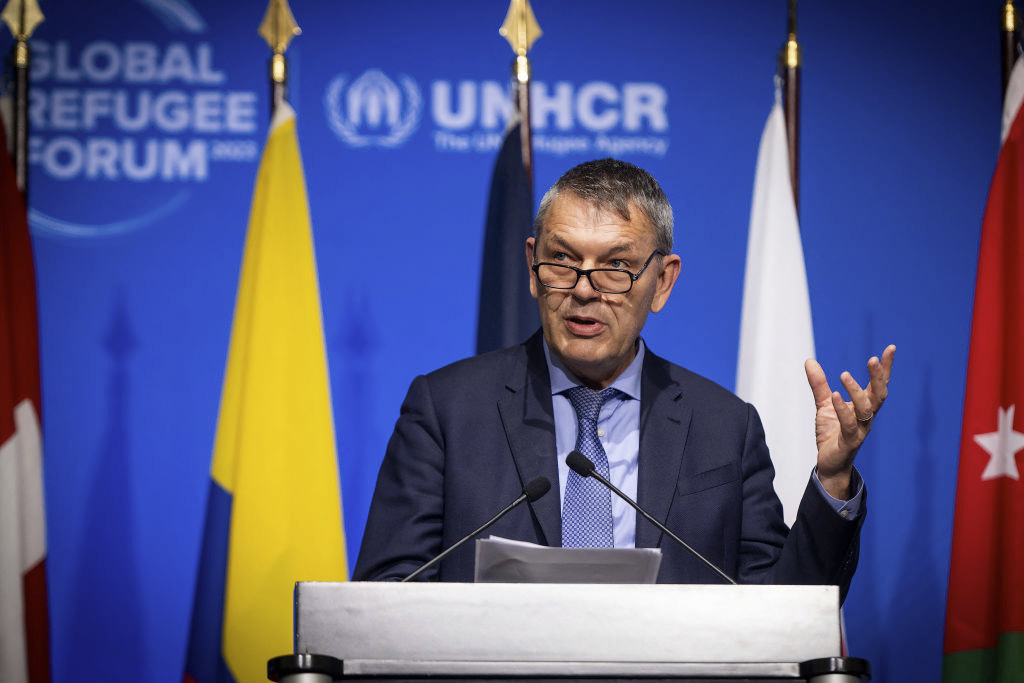
It is now clear that the UN heads were lying when they said they were unaware of the involvement of their employees with terror groups. In fact, they knew but did their utmost to appease Hamas. Pictured: UNRWA Commissioner General Philippe Lazzarini speaks at the Global Refugee Forum, in Geneva, Switzerland on December 13, 2023. (Photo by Jean-Guy Python/Pool/AFP via Getty Images)

Philippe Lazzarini, Commissioner-General of the United Nations Relief and Works Agency for Palestine Refugees in the Near East (UNRWA), has announced that he decided to fire several employees of his agency after Israeli authorities provided information about their "alleged" involvement in Hamas's massacre of Israelis on October 7, 2023.

"To protect the Agency's ability to deliver humanitarian assistance, I have taken the decision to immediately terminate the contracts of these staff members and launch an investigation in order to establish the truth without delay," Lazzarini said. "Any UNRWA employee who was involved in acts of terror will be held accountable, including through criminal prosecution."

UN Secretary-General Antonio Guterres said he was "horrified" by the Israeli accusations.

Continue Reading Article

Saturday, January 27, 2024

Innocents Abroad

by Rabbi Steven Pruzansky

There is something abnormal about the “innocent civilians” of Gaza that we would do well to recognize, especially since the blood libel at The Hague is premised on their suffering brought about by the war they and their elected representatives launched against us.

When G-d informed Moshe of the consequences of the tenth and final plague - the death of each Egyptian first born - He noted that there will be a “great outcry” in Egypt at that time that will lead to liberation for the Jewish people. The great biblical commentator Malbim (1809-1879) explained that “outcry” as the “outcry of rebellion” (Shemot 11:6) as the Egyptian people, horrified at their fate and their Pharaoh’s obstinacy “wanted to kill Pharaoh.” They had endured enough suffering, blamed Pharaoh and not the Jews, and wanted relief. That got Pharaoh’s attention and he searched for Moshe and Aharon to inform them that they and the people of Israel should all leave, and immediately.

How is it that there is no indigenous rebellion in Gaza? After all, we are told that there are some 40,000 Hamas fighters in a population of “innocents” that number well over a million people? The “innocents,” apparently, outnumber the terrorists some 25-1, or even 30-1. How is it that aside from a few scattered voices blaming Hamas - often terrorists in captivity conveniently changing their tune or some random Gazan found by the media - there is no movement to displace Hamas?

A few better questions: how is it that Israel lacks informants among the Gazan population? How is it that not one Gazan has revealed the location of any of the hostages (indeed, many Gazan “civilians,” as we now know, have held our capitives hostage in their own homes)? How is it that not one Gazan has revealed the location of the tunnel entrances, sparing our soldiers the hazardous task of finding them? After all, those entrances are usually located in their own homes, or in the schools to which they send their children, or in the mosques in which they pray, or in the hospitals where they presumably seek medical care. If they were as innocent as the world portrays them to be, why the reticence?

There are several inevitable conclusions to be drawn from this. It is the way of the world that people suffering under the yoke of a brutal, deadly, and unwanted leadership try to overthrow those leaders and replace them with leaders who better share the society’s values. Most of the United States’ Declaration of Independence is devoted to articulating the basis of that right. For a society that suffers under despotic rule, “it is their right, it is their duty, to throw off such Government.” That the civilians of Gaza are so docile means that they are either cowardly - or complicit.

Cowardice is a state of mind and difficult to prove conclusively. Even though the “innocent civilians” far outnumber their terrorist leaders, it requires great courage to begin a frontal battle against well armed and evil fighters. But it requires less courage to surreptitiously help Israel, reveal the entrances to bunkers and tunnels, even reveal the location of any of the hostages. That none of this is happening means that the second possibility - complicity - is the more likely reason why Gazans accept the Hamas regime, rejoice in the war against the Jews and the torture they inflicted and are inflicting on our civilians, even participated in the atrocities of October 7 - and would vote for Hamas again given the chance.

That the world has accepted this false dichotomy between Hamas and Gazans is partly mendacity, bias, and insincerity - but it is also partly our government’s fault as it has made little effort to accentuate the complicity of civilian Gazans in the current conflict. Worse, our leaders’ vain boast the day after the massacre that “not one drop of water or fuel will enter Gaza until all the hostages are released” dissipated almost instantly under pressure. Nothing projects weakness more than making promises you can’t keep and threats that you will not carry out. It was a missed opportunity to expose the myth of the “innocent civilians.”

We are now dealing with those consequences in many ways, not least of which is the continued captivity for the hostages. As our soldiers have reported, Hamas routinely sends out young children and mothers wheeling carriages to ascertain where Israeli soldiers are bivouacked. It presents an almost incomprehensible dilemma for our military. You can’t shoot them - even though their presence and mission endangers our soldier’s lives. I dare all the self-appointed faux moralists across the West to present a solution to that dilemma. Yet, whose Jewish father, husband, son or brother must die in order to protect the lives of these “innocents” who report the location of our forces to Hamas which then shoots RPG’s or other projectiles at our forces? At the very least, this presents an opportunity for our government to dispel the myth of the “innocent civilian,” call for the immediate relocation of anyone who wants to leave, and stop pretending that the future of Gaza is the restoration of the past. For complicity does not only mean that they are actively engaged in terrorism. Complicity also means that they have been educated on hatred of Jews and the illegitimacy of Israel. That cannot be changed, and we should stop pretending that it can change. Let the innocents go abroad and make better lives for themselves; to the extent that they wish to stay only demonstrates how complicit they are.

It is sobering to think that Pharaoh’s Egyptians were more normal, more sophisticated, cared for their children more, had greater respect for life, and feared Pharaoh less (notwithstanding his claim of divinity) than modern Gazans who acquiesce in their suffering, are accomplices in a cult of death, and far from seeking Hamas’ overthrow, voted them into power in 2006 and still support them. We choose to avert our eyes but they have signed on to a cult which declares (Article 8 of the Hamas Charter) “Jihad is its path and death for the sake of Allah is the loftiest of its wishes.” This death wish is embodied in the oft-quoted statement of radical Muslims that “we love death like you love life,” which they perceive as Jewish weakness and not - as normal people perceive such an assertion - as pathological.

It is not too late for our leaders to reverse the perception of the “innocent civilians” that is leading us directly back to the past, as if we have learned nothing. That the world assumes that “Gazans” should and will control Gaza on the day after makes a mockery of our suffering and sacrifices. Jewish pride, candor forcefully but rationally expressed, and a clear sense of our strategy for the future are the demands of the hour, if we want to salvage something positive from the catastrophe imposed upon us. Innocent? Hardly. And that point must be hammered repeatedly by all who speak in Israel’s name.

Friday, January 26, 2024

Igrot Hare’aya – Letters of Rav Kook: Work on Religious Papers

#185

Date and Place: 11 Shevat 5669 (1909), Yafo

Recipient: Rav Yonason Binyamin Horowitz. We have seen some letters between Rav Kook and this rabbinic administrator (for Agudas Yisroel) of funds for various projects in the Old and New Yishuv.

Body: May Hashem see to it that there will be agreement on the terms of the rent, so that we can start the critical work for saving the moshava and shining the light of Hashem in its midst. (I am unaware of what project, in which moshava, Rav Kook referred to.) Many great things will come out of this concerning generally raising the stature of reliable Judaism in the Holy Land, with Hashem’s help.

Regarding “The Nir” periodical, I repeat what I have said – we should battle evil specifically from the top of the highest peak of knowledge. We must not give up on this principle, as it will produce new “warriors” from among the most outstanding Torah scholars of the Holy Land, through whom the Name of Hashem and the name of Israel and Eretz Yisrael can be sanctified. This in turn is the most elevated benefit of all our actions in the Holy Land.

The only thing to add is that in order for the paper to have broad appeal, I think that in the future we should include popular items. However, we should not, Heaven forbid, create a publication that is primarily along the lines of “The Peles” (a more populistic and anti-Zionist monthly magazine). That would not have any true value, but rather would just fleetingly arouse the hearts in a way that would create animosity and agitation, not light, calmness, and love of service on behalf of Hashem, His nation, and His lot.

Of course, in order to expand The Nir, we will need proper material support. It will be worthwhile to work on this, as it will be a “good result for the community,” elevating the community from its low way in thinking and in standing. When people will realize that we care to raise their knowledge and standing, then with Hashem’s grace, we will raise the number of subscribers.

I would be very happy if we could put together a daily newspaper or one that is published at least twice a week. I, of course, would be willing to work toward that, bli neder, to the extent that my feeble abilities would accomplish. However, about the prospect of my being the editor-in-chief, I doubt that would work out with my difficult schedule of responsibilities. Also, in order to accomplish this, the office would have to be here (in Yafo), and I do not know if our brethren could agree on that.

When I know from you, my respected friend, that the matter is ready to be put into motion, I plan to suggest a program of actions, to the best of my limited ability. I hope that you and I can together sanctify His name; may Hashem’s “desire” succeed.

P.S. I also think we should work hard to found schools of the Sha’arei Torah organization [in the New Yishuv]. Although it needs to be improved, still, based on its founding goals, there is a basis to get to developments that sanctify Hashem.

The War Against Amalek

by HaRav Dov Begon
Rosh HaYeshiva, Machon Meir

The first war in history forced upon Israel was the one against Amalek: “Amalek came and fought with Israel at Rephidim” (Shemot 17:8). There is a special mitzvah to recall this war, as it says, “Remember what Amalek did to you on your way out of Egypt” (Devarim 25:17). We are likewise commanded “to obliterate the memory of Amalek from under the heavens” (verse 19), and the verse concludes, “You must not forget.”

Why is it that must we “remember and not forget” this battle? It is because of the divine oath of Shemot 17:16: “The L-rd shall be at war with Amalek for all generations.” Amalek was the first nation to attack the Israelites for no discernible cause other than their being Jews, and their being caught in a moment of weakness, as it says, “When you were tired and exhausted, they cut off all those lagging to your rear” (Devarim 25:18). Just like a wild beast that attacks its prey when it discerns that it is weak, so was Amalek the first to attack Israel, thereby showing all the nations and anti-Semites down through the generations that the Jews are attackable.

At first, the nations were afraid to fight us. At the Geulah, it was revealed for all to see that Israel is G-d’s beloved, chosen son, His “firstborn” (Shemot 4:22), and that whoever harms Israel is smitten by G-d as with the plagues of Egypt and the splitting of the sea. Even so, because Amalek was undeterred by this, Israel’s whole power of deterrence was weakened.

Today, we are at the height of a war that was forced upon us by the Arabs, whose goal is to drive us out of Eretz Yisrael - it will never be! Unfortunately, this war is accompanied by some of the worst anti-Semitic propaganda we have seen since the Holocaust. With G-d’s help we shall win this war, just as all of Israel’s enemies were defeated down through the generations - from Amalek, on through Haman, and the enemy of the Jews from Germany - may his name be blotted out.

If we hope to become stronger spiritually and to strengthen the spirit of Israel’s fighters, then we must learn from Moshe: “As long as Moshe held his hands up, Israel would be winning, but as soon as he let his hands down, the battle would go in Amalek’s favor” (Shemot 17:11). Our sages ask: “Did the hands of Moshe make or break the battle? Rather, the Torah is teaching us that as long as the Israelites looked upward and subjugated their hearts to their Father in Heaven, they would be winning” (Rosh Hashanah 29a).

Nefesh HaChaim (Sha’ar 2:11) further explains that “When Israel would only look heavenward, that is - when their cries of entreaty to G-d were not focused on their own suffering but only on the profanation of G-d’s name - they would be winning.”

This too holds true in our own day. We must recognize that any harm done to Jews or to the Jewish People constitutes a profanation of G-d’s name, and furthermore, that the battles of Israel’s Defense Forces against the enemies of Israel constitute a war over the sanctification of G-d’s name. It is a war between the nation that is setting out to spread the light of G-d on earth, and between those forces whose aim is to spread darkness.

Through our winning this war, G-d’s oath will be fulfilled. Neither G-d’s name nor His throne will be complete until we emerge victorious, as it says, “The L-rd shall endure forever. He has prepared His throne for judgment” (Tehilim 9:8. See Rashi on Exodus 17:16).

BeSorot Tovot,
Looking forward to complete salvation, 
With the Love of Am Yisrael and Eretz Yisrael,
Shabbat Shalom.

Yeshivat Machon Meir: Did G-d Trick the Egyptians? (video)

Rabbi Ari Kahn on Parashat Bshalach - The Dance of Faith

Each of us has our own ‘Egypt’ that constricts us

by Rav Binny Freedman

May 1948; tough times for the Jewish people, and particularly for the Jews struggling to claw out a place for themselves in a land they hoped to claim as their own.

A few months after the United Nations voted to partition the remaining territory in the British Mandate for Palestine and allow finally, the creation of a modern Jewish state, six Arab armies were poised to attack.

They were waiting for the British to leave, so as not to find themselves in the position of attacking British sovereign territory. The Arabs who were already in country however, had no such dilemma, which was why the Jordanian legion was on the offensive. Even as the Jews were still celebrating the partition plan vote, the Jordanians were already on the march.

The Jordanian Legion, commanded by Abdullah Tell, was without a doubt the best fighting force in the Middle East. Thirty-two hundred strong at three full brigades, they were British-trained and French-armed, and they had no equal at the time.

Though strategically insignificant, they had set their sights on the heart of the Jewish people: the old City of Jerusalem. For six bitter months the Jordanian legionnaires surrounded and laid siege to the Jewishh Quarter. There were fourteen hundred Jewish civilians trapped inside Jerusalem’s old city walls, and despite how hopeless it was, the Jewish command felt they had to do something.

And so it was, in the middle of the night of May 3-4th 1948, that Twenty-two fighters of the Palmach (Jewish fighting brigade) found themselves slowly climbing up the hill below the old city walls under the noses of the Jordanian soldiers.

Taking cover behind a wall remaining from the ruins of a Crusader fortress the irony was not lost on the fighters: These same crusaders who had massacred the Jewish communities of Europe in their path a thousand years earlier, had built a wall which was protecting these Jewish fighters in their quest to redeem this same ancient city for the modern State of Israel.

As they neared the final stretch of path that would bring them to their objective of the Zion gate, they were literally right under the guards positions on the walls, they had to advance the last hundred yards one at a time so as to minimize the noise and avoid detection. And as they all waited, each fighter advanced a hundred yards, one at a time, all alone it must have been terrifying. It was nearly 3am and they had to maintain total silence; if even one Jordanian soldier just happened to look down, they would have had nowhere to run and nowhere to hide.

There is a comfort to being part of a unit; moving with men with whom you have become one; having each other’s backs. But be all alone?


This week we read the portion of Beshalach, most famous for the dramatic splitting of the sea and destruction of the Egyptian Army. And amidst the powerful spectacle we often miss the details.

The Torah tells us (Shemot 14:22) that:

“ … the water was a wall for them on their right and on their left.”

And the Talmud (Tractate Yoma 4b) explains that the water did not simply recede leaving dry land; rather the water literally split, leaving a narrow path for them to go through. One wonders why this happened in this way and more, why the Torah takes the time to share this detail with us?

Rav Baruch Halevy Epstein, in his Torah Temimah, suggests that in this way the miracle was even greater, and no-one would say the miracle was simply a coincidence that the sea dried up….

But that does not really seem to answer the question. Besides, the fact that the sea suddenly dried up just when the Jewish people needed it most, and then came crashing down again just as the Egyptians were closing in on the Jews was not a big enough miracle? Really?

Perhaps there is a deeper idea here. Interestingly, the Talmud compares the Jews entering a path into the sea with walls on both sides to when Moshe enters the cloud at Mt. Sinai, suggesting that the identical language implies that Moshe forged a path through the cloud; he wasn’t just walking through the cloud; he was walking on a path through the cloud. Because to receive the Torah; to discover meaning; to be imbued with a sense of purpose; is to be on a journey; to see the path one has to take.

Indeed, the redemption really begins when Moshe, all alone in the desert (Shemot chap. 3) sees a burning bush and turns off the path to see… he recognizes that he needs to change direction.

Perhaps a path signifies a direction, and a journey. In fact, one opinion in the Midrash suggests each Tribe had its own path so that there were thirteen paths (Yosef had two sons who both became tribes; hence thirteen tribes even though Yaakov only had twelve sons…) through the sea, and another Midrash suggests each Jew walked single file and possibly each Jew had his or her own path!

Redemption, it seems, comes when a person is ready to take his or her own journey; when a person sees the path they are meant to take.

Just before the sea splits Moshe holds out his staff over the sea pointing forward. Think about it: The Torah tells us there are six hundred thousand men, and they are terrified by the sight of six hundred chariots! A thousand men are afraid of a chariot? They are stuck; and when the sea splits they finally realize they need to take their own steps in order to leave Egypt behind.

Over three thousand years later a small band of Jewish fighters, carrying the Jewish people on their shoulders, each alone with his or her thoughts, steps out on a path, all alone, determined to bring us home.

Many of those fighters did not survive that battle; indeed, the Jewish quarter fell to the Jordanian legion some four weeks later (on May 28, 1948). But walk through the Zion gate (Shaar Tzion) today and you will see a monument to the memory of those fighters and the courage with which they carried themselves on that day.

The words are inspiring: “… with no armor nor artillery, with their own bodies, they sacrificed themselves on the walls of the ancient city of Yerushalayim. Let he who walks through this gate remember them…”

Each of us has our own ‘Egypt’ that constricts us, and the question is whether we are ready to forge the path that will leave that Egypt behind forever….

Shabbat Shalom from Yerushalayim.

The Yishai Fleisher Israel Podcast: FIGHTING IN LIGHT OF A VISION

SEASON 2024 EPISODE 4: Yishai Fleisher celebrates Tu B'Shvat - Jewish Arbor Day - on IDF Reserves and discusses Israel's war efforts in light of a vision for what the Jewish State should look like. Then: Ben Bresky on Israeli drip irrigation technology, and David Tahar on his mission to retrieve his son's remains from the hands of Hamas. Finally, why the Two State Solution is flawed from inception, and how Moses' hands connected Heaven and Earth.

Thursday, January 25, 2024

"Like...wtf": Israel's Arab Citizens Feel Lucky

by Bassam Tawil
  • "It's disheartening to know that among the fallen heroes are Bedouin and Druze soldiers, Muslims, and Christians who courageously defended our country. The Bedouin community mourns all civilian victims, regardless of their background — Jews, Christians, or Muslims. This brings me to a crucial point: we all share the same destiny, and our strength lies in unity. Unfortunately, there are those who seek to undermine cooperation between different sectors, sowing seeds of mistrust. I urge you not to be swayed by such attempts and to stand strong in our shared commitment to unity." — IDF Sergeant First Class (reserve) Ahmed Abu Latif, 26, a husband and father to a one-year-old baby, who was killed on January 22 during the fighting between Israel and Hamas in the Gaza Strip. Facebook, November 13, 2023,
  • Hamas's October 7 atrocities did not distinguish between Jew and Arab, old and young, male and female, black and white. At least 20 Arab Israeli citizens were murdered by Hamas terrorists during the attack on that day or by Hamas rocket attacks in the ensuing days. Most of the victims were Bedouin residents living in the south of Israel. Moreover, several Bedouin men and women were abducted by Hamas.
  • It is no wonder, then, that an overwhelming majority of the Israeli-Arab public opposed the Hamas attack. A study conducted by Nimrod Nir of the Adam Institute and Dr. Mohammed Khalaily among the Arab public showed that most Arabs support Israel's right to defend itself and even expressed a willingness to volunteer to help civilians who were harmed during the Hamas attack. The study showed that almost 80% of Israeli Arabs opposed the Hamas attack, and 85% opposed the kidnapping of civilians.
  • "For the longest time, I struggled with my identity. A Palestinian kid born inside Israel. Like...wtf. Many of my friends refuse to this day to say the word 'Israel' and call themselves 'Palestinian' only. But since I was 12, that did not make sense to me. So, I decided to mix the two and become a 'Palestinian-Israeli.' I thought this term reflected who I was. Palestinian first. Israeli second. But after recent events, I started to think. And think. And think. And then my thoughts turned to anger. I realized that if Israel were to be 'invaded' like that again, we would not be safe... And I do not want to live under a Palestinian government. Which means I only have one home, even if I'm not Jewish: Israel." — Nuseir Yassin ("Nas Daily"), Israeli Arab blogger, October 9, 2023.
  • "I'm an Israeli Arab... I'm embarrassed. And Hamas is to blame... "This [Arabs identifying with Israel] demonstrates that the Arab community in Israel aspires to further integrate into society and distance itself from bad faith actors like Hamas... Israeli Arabs and Jews are like salt and pepper: They both belong on the table, and once they're sprinkled into a dish it's almost impossible to distinguish between them." — Prof. Mouna Maroun, Vice President and Dean of Research at University of Haifa and the former Head of the Sagol Department of Neurobiology, the first Arab woman to hold a senior faculty position in natural sciences; newsweek.com, November 21, 2023.
  • Hamas was undoubtedly hoping that the massacre its members committed on October 7 would sabotage relations not only between Israel and the Palestinians, but also between Jews and Arabs inside Israel. Fortunately, however, Hamas has been unsuccessful in pitting Israeli Jews and Israeli Arabs against each other. Despite the Israel-Hamas war, the vast majority of Jews and Arabs inside Israel continue to work together and live in peace and security next to each other, and often in the same neighborhoods...
  • The Palestinians living under the corrupt Palestinian Authority in the West Bank and the Hamas terrorist group in the Gaza Strip can only envy Israeli-Arab citizens for living in Israel, where they enjoy democracy, freedom of expression, access to superb healthcare and educational institutions and careers, as well as a thriving economy.


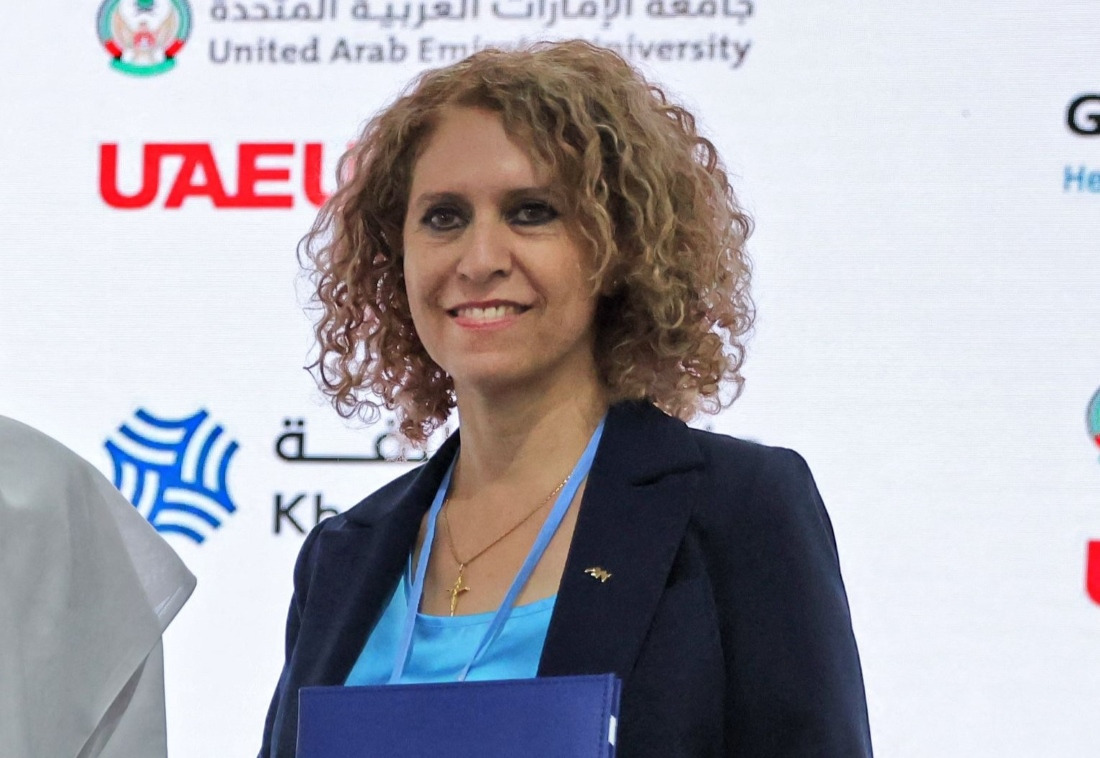
"Israeli Arabs and Jews are like salt and pepper: They both belong on the table, and once they're sprinkled into a dish it's almost impossible to distinguish between them." — Prof. Mouna Maroun (pictured), Vice President and Dean of Research at University of Haifa. (Photo by Ahmad Gharbali/AFP via Getty Images)

IDF Sergeant First Class (reserve) Ahmed Abu Latif, 26, a husband and father to a one-year-old baby, was killed on January 22 during the fighting between Israel and Hamas in the Gaza Strip. Abu Latif, a Muslim citizen of Israel, embodied the spirit of unity and patriotism in Israel in the aftermath of Hamas's October 7 massacre of Israelis. He also represented a shining example of coexistence and unwavering love for Israel.

In a message on Facebook at the beginning of the war, Abu Latif, who was working as a security guard at Ben-Gurion University of the Negev, wrote:


"As a Bedouin-Israeli, serving in the IDF Bedouin Gadsar (Desert Reconnaissance Battalion) was an honor that revealed my strengths and introduced me to lifelong friends. I love connecting with people and bridging cultures, whether it's hosting friends for a meal or visiting friends from Kibbutz Shovel and playing guitar songs by Yehudit Ravitz.

Continue Reading Article

Wednesday, January 24, 2024

On Confronting the Iranian Regime

by Majid Rafizadeh 
  • Any evaluation of the Biden administration's policy towards the Iranian regime (and towards the Palestinians) reveals a failure: the deadly Western miscalculation that "being nice" will be reciprocated. In the culture of the Middle East, that simply does not work. Instead, one is looked on as a gullible sucker or juicy "mark," like a jolly drunk at a strip club.
  • As Osama bin Laden pointed out, especially for his region, "When people see a strong horse and a weak horse, by nature they will like the strong horse."
  • Former U.S. Army General Jack Keane recently noted that many possible targets are already on "the list" and suggested taking out the military installations that have been launching such attacks. Other possible responses floated include sinking Iran's spy ship currently in the Red Sea and taking out Iran's military communications systems.
  • If Iran itself is not made to pay a price, it will simply continue using its proxies to escalate aggression and take the hits. After all, that is why Iran has proxies in the first place.

The Biden administration's reluctance to robustly respond to the rogue Islamist regime of Iran apparently only reinforces the inclination of Iran's political and military leadership to inflict more harm. In 1988, President Reagan launched Operation Praying Mantis, which retaliated against Iran for its attack on a U.S. Navy ship, sent a strong message to Iran, and reduced the threat posed by Iranian naval forces in the Persian Gulf. Pictured: The USS Enterprise, which played a key role in Operation Praying Mantis, is shown in the Persian Gulf on December 15, 1998. (U.S. Navy photo by Michael W. Pendergrass)

The Biden administration's reluctance to robustly respond to the rogue Islamist regime of Iran apparently only reinforces the inclination of Iran's political and military leadership to inflict more harm.

When US responses lack decisiveness, the Islamic Republic interprets this "restraint" as a failure of nerve on the part of the US and the international community. Such leniency, it seems, simply invigorates the regime to persist in disrupting regional and global stability, and escalate its assertive military maneuvers and support for terrorist activities.

As Osama bin Laden pointed out, especially for his region, "When people see a strong horse and a weak horse, by nature they will like the strong horse."

Continue Reading Article

Wanted: Palestinian Leaders Who Will Condemn Terrorism

by Bassam Tawil 
  • If the Biden administration thinks that the Palestinian Authority leaders will cease inciting Palestinians against Israel, they need to think again.
  • How can Palestinian leaders, who are terrified of Hamas and even more terrified of their own people, be expected to prevent the terrorists from attacking Israel in the event that these leaders were handed a state?
  • In addition, why would Israel – or anyone else – trust any Palestinian leader who considers Islamist murderers, rapists and baby-killers as "part of the Palestinian national, social and political fabric"?

Palestinian Authority President Mahmoud Abbas has refrained from publicly denouncing the Iran-backed Hamas terror group for its barbaric attacks on Israelis. In fact, Abbas and the Palestinian Authority have stepped up their anti-Israel rhetoric since the beginning of the Israel-Hamas war. Pictured: Abbas (L) meets with Hamas leader Khaled Maashal (R) and Qatar's Emir, Sheikh Tamim ibn Hamad Al Thani (C) on August 21, 2014 in Doha, Qatar. (Photo by Thaer Ghanaim/PPO via Getty Images)


More than three months have passed since Hamas's October 7 attack on Israel, during which hundreds of Israelis were murdered, beheaded, raped, mutilated, and kidnapped -- and it is still hard to find any senior Palestinian Authority official who is prepared to condemn the atrocities.

Palestinian Authority President Mahmoud Abbas, who has held a number of meetings over the past few weeks with senior US administration officials, including Secretary of State Antony Blinken, has refrained from publicly denouncing the Iran-backed Hamas terror group for its barbaric attacks on Israelis.

Abbas, it appears, fears a backlash from his people and other Arabs if he speaks out against the murder of Israeli women, children, and the elderly. One word against Hamas and its terrorism, and Abbas' people might well label him a "traitor" and "collaborator" with Israel.

Continue Reading Article

Once again, the Jewish people are becoming increasingly isolated as a result of warped thinking

by Rabbi Pinchas Winston

Friday Night
TU BESHEVAT IS upon us once again, b”H, with a very different feel than just one year ago. There had been no October 7 attack yet last year at this time, and no hostages to worry about every day. Anti-Semitism was definitely a much lesser concern than it is now, so sitting down to a Tu BeShevat Seder this year is less joyous.

This last past Shabbos, someone I spoke with compared the situation to learning how to ride a bicycle for the first time without training wheels. It is terrifying and seemingly dangerous. That’s how he described being abandoned for the Palestinians by country after country. Once again, the Jewish people are becoming increasingly isolated as a result of warped thinking. The nations we once relied upon are moving away from us, and we’re learning how to ride our “bike” without their help.

By now, it should be clear that human logic has little to do with it. If it did, we’d be back a few years when the world realized that the biggest obstacle to a two-state solution was Hamas, and their puppeteer, Iran. If the Palestinian “leadership” would have shown that they are more interested in being a successful nation on the land they have, than getting Israel off the land they’re on, they’d be governing themselves right now. If the Palestinians would have proved by now that their love of life was greater than their hatred of Jews, they’d be running their own show.

What a dumb world. Do foreign governments really believe that Israelis enjoy having to spend so much blood and money on policing a hateful and spiteful enemy? Nothing would make Israelis happier than to live next door to Arabs with the same kind of security and peace of mind as, let’s say, the Americans and Canadians do. The only reason why we can’t is because of the Arab world, not the Jewish world.

But who can we tell that to other than ourselves? Who believes this truth, other than the Jews (and not even all of them), and some righteous gentiles who see with honest eyes? We’ve been down this road many times in the past, and the only way it ever got better for the Jewish people was after it first got worse, sometimes a lot worse.

I remember back in the 1990s when it became noticeable that anti-Semitism was on the rise again that someone, presumably a Jew, wrote in response to an article on the topic, that it was about time Jews all converted to Christianity. Since anti-Semitism targets Jews specifically, eliminating Judaism, she argued, eliminates anti-Semitism.

That might be true if anti-Semitism was just racism. Racism is based upon differences, so when the differences are no more, the racism disappears. But Jews have been hated and hunted regardless of how hard they have tried to blend into their gentile populations, and they have done “good” jobs.

So no, annihilation of Judaism does not stop annihilation of the Jewish people. It can be argued historically, that it only increases it.

Shabbos Day
WE CAN APPRECIATE why from this week’s parsha. At the end of it, Amalek attacks the Jewish people. They seem to have come out of nowhere, but Rashi explains otherwise:

“He named the place Massah and Merivah because of the quarrel of the Children of Israel, and because of their testing of God, saying, ‘Is God among us or not?’ Amalek came and fought with the Jewish people in Refidim.” (Shemos 17:7-8)

“[The Torah] juxtaposed this section with the verse, [‘Is God among us or not?’] implying: ‘I am always among you and always prepared for all your necessities and yet you say, “Is God among us or not?”. By your life, the dog will come and bite you, and you will cry out to Me, and [then] you will know where I am.” (Rashi)

According to Rashi, Amalek was sent by God because the Jewish people questioned the level of Divine Providence they were living with. This would be fine if the Gemora didn’t say this instead:

“Rav Yehudah said that Rav said: ‘Had the Jewish people observed [the first] Shabbos, no nation or tongue would have [ever] ruled them, as it says: “And it happened on the seventh day, some people went out from the nation to collect, etc.” (Shemos 16:27). It says after: “And Amalek came and fought with the Jewish people in Refidim.” (Shabbos 118b)

So which was it that brought on the Jewish people’s worst anti-Semite, the questioning of Hashgochah Pratis, or the breaking of Shabbos? The answer is, in typical Jewish fashion, both.

How can that be? Because:

“Shabbos Kodesh is the great sign and covenant that The Holy One, Blessed is He, gave to the Jewish people to know that God made the Heaven and the Earth in six days and everything in them, and then rested on the seventh day. It is the foundation of emunah to know that the world is renewed, that there is no nature or randomness in the world, and that each moment The Holy One, Blessed is He, renews and sustains the world…” (Hilchos Shabbos b’Shabbos, Ch. 1, Halachah 1)

Likewise, when the Jewish people asked, as per the Hebrew, “Is God among us or not?” they were really asking, “Is Ayin among us or Hovayah?” Ayin is the level of Hashgochah Pratis that completely overrides nature, and Hovayah is the level that works within it.

On the level of Ayin, miracles happen for a person regardless of merit or culpability. On the level of Hovayah, they happen for a worthy person, but not for the person who has sinned. On the level of Elokim, they won’t seem to happen at all for anyone, even if they do.

So, when the Jewish people broke Shabbos they were saying, in effect, the same thing as, “Is Ayin among us or Hovayah?”

Shalosh Seudot
THIS ALSO teaches us that there is more than one way to say something. You can make an actual statement, like “Is Ayin among us or Hovayah?” Or you can do an act that indicates that you have this question, even if you have yet to actually articulate it, even to yourself.

For example, the way we live now. How do you relate to Hashgochah Pratis on a daily basis? Is God real to you, or theory? I’m not saying you don’t believe in God, God forbid. But there is a big difference between “just” believing in God, and living with His reality, evident by how we do what He values most.

Like mitzvos. Like tefillah. Like caring about others. Like maintaining appreciation for the gifts He gives you every day. The big things and the small things, as we say in Modim each day in Shemonah Esrai, “for all the miracles every day.” We say Hallel on Rosh Chodesh and on holidays to thank God for those huge national miracles. We say Modim each day to thank Him for the smaller ones that we tend to take for granted.

Taking any miracle of any size for granted means to take Divine Providence for granted, and as we see in this week’s parsha, that brings on Amalek and all that he stands for and causes. Intellectual confusion. Rabid anti-Semitism. Misplaced loyalties. Hopelessness for good people, etc.

The trouble is, by the time we realize something needs to be fixed, we’re already too far down the road of trouble and despair to do much about it. So why wait until then? We have opportunities during the course of the year that allow us to realize what we have, so we can increase our appreciation and share it with God. And that brings us to Tu BeShevat.

Tu BeShevat
PRINCIPALLY TU BESHEVAT is a halachic day. Produce grown in Eretz Yisroel must be tithed, and the rule is that one year’s bounty cannot be tithed together with another’s year. Therefore, there has to be a cut-off point in the year to distinguish between on year’s produce and another year’s produce. That is Tu BeShevat, the 15th day of Shevat.

Why the 15th of Shevat? Because apparently that is the time by which the majority of rain has fallen in Eretz Yisroel during a particular season. Since rain is crucial for the success of crops, the end of the rainy season is a good day to end the growing season, and call it a crop ready for tithing.

But nothing is ever just technical or halachic in Torah Judaism. There is always something kabbalistic behind everything in life, no matter how big or small, especially Tu BeShevat. The Pri Tzaddik explains how it is even connected to THE tree, the Aitz HaDa’as Tov v’Ra, and THE sin that has been responsible for almost 6,000 years of often ridiculous history.

That alone gives the day special meaning and creates tremendous opportunity. But the most important part of that opportunity is to absorb the amazing gift of Eretz Yisroel, the fantastic bounty it is giving us these days, and the tremendous opportunity to make blessings over it in giving thanks to God. Hakores HaTov, which means recognizing the good, is only two (Hebrew) words. However, they mean everything in terms of world rectification and personal completion.

So this Tu BeShevat, even in the Diaspora, go for it. Make a Tu BeShevat seder. They’re a lot of fun. Let yourself absorb the significance of all the amazing gifts we have been blessed with in this generation, and let God know how much you appreciate His giving us back our land, and blessing it with incredible bounty. It will go a long way to upping your joy in life, and mitigating the situation that seems to be going the other direction at this time.

Tuesday, January 23, 2024

Rav Kook's Ein Ayah: Not Distancing Oneself From the Community

(based on Berachot 1:108)

Gemara: Do not pass behind a synagogue at a time that the congregation is praying.

Ein Ayah: This is because separating oneself from the ways of the congregation destroys, Heaven forbid, the nation’s foundations. It is thus proper that those who separate themselves from the community are among those who lose their place in the world to come. The matter of separation is especially prominent in the realm of service of Hashem. When one is disjoint from the community’s service, the spirit of sanctity that enters the hearts of Hashem’s nation as a whole will not enter his heart. Slowly but surely his heart and soul become distant from the Jewish holy qualities, causing bad for him and his offspring by separating them from the nation. 

When the number of people who do this multiplies, a “‘bald patch” develops in Israel, and the House of Israel becomes fractured and broken into splinters. Therefore, it is worthwhile to stay far away from anything that displays that he does not care to be part of the community regarding service of Hashem, even if that is not his intention. This is because the seriousness of the matter and the negative outcomes that can result are severe enough to distance oneself from it. That is why one must not pass behind a synagogue at the time the congregation is praying.

Unity and Divisiveness in Egypt and at the Sea

by HaRav Mordechai Greenberg
Nasi HaYeshiva, Kerem B'Yavneh


"The water was a wall (choma) for them, on their right and on their left." (Shemot 14:29) Chazal comment on this: "This teaches that Samael (the prosecuting anger) stood up and said, 'Master of the Universe! Did Israel not worship idols in Egypt, and you are doing miracles for them?!' ... [G-d] became angry at them and wanted to swallow them up." (That is why it says choma without a vav, as if it said chaima.) The question is, why did Samael wake up only now, at the end of the process, and not at the beginning, during the plagues and the miracles that were done in Egypt?

The Meshech Chochma derives from this an important principle in Judaism. At first glance, the tangible mitzvot between man and G-d are more severe than those between man and his friend, which flow from corrupt traits. For example, idolatry and adultery are punishable by death, whereas there are not even lashes for dissension, lashon hara and rechilut. However, this is only true regarding sins of the individual, whereas regarding societal corruption we find the opposite tendency. The community suffers on account of corrupt traits, more so than the individual. Dovid HaMelech's generation was righteous, and even so they would fall in battle, since there were tattlers among them. On the other hand, Achav's generation, who were idolaters, were victorious in battle, since there weren't tattlers amongst them. Even regarding the sin of idolatry it says, "Who dwells among them among their contamination." (Vayikra 16:16) In contrast, regarding sins such as rechilut, lashon hara and dissension, Dovid said, "Go up to heaven" (Tehillim 57:6) – i.e., remove Your Presence from them.

We find, similarly, that the sins of the first Beit HaMikdash were idolatry, adultery and murder, and even so the Beit HaMikdash returned after seventy years. The Second Beit HaMikdash, however, where they sinned with social sins, sin'at chinam (baseless hatred) – is still destroyed after two thousand years. "If society is corrupt in their character, it is worse than if they are corrupt in mitzvot." Therefore, the fate of the generation of the Flood was sealed only on account of stealing, since G-d is willing to wait regarding sins between man and G-d, but not on fundamentals of societal morality. The Meshech Chochma continues:

Therefore, regarding the desecration of Shabbat, which has spread in our sins, He will grant them time, because they are a community. Even regarding idolatry [Chazal] said in the Sifrei, "the soul – will be cut off" but the community will not be cut off." However, since they violated ethical norms, they go with swords and arrows to rob and steal, and have become corrupt in character and are like animals of prey, G-d will certainly avenge, and not tarry.

The reason for this is that when the social relationships are weakened, the people are not viewed as a community, but rather as individuals, and as individuals they are judged on the serious sins, such as idolatry and adultery. We find, as well, that G-d forgave Bnei Yisrael for the sin of idolatry at the golden calf, but did not forgive the sin of the spies, which entailed lashon hara and ingratitude to G-d, and they all died in the desert.

With this we can understand Chazal's comment in the Midrash that we began with, that the angels complained at Yam Suf about avoda zara and did not mention anything in Egypt. This is because in Egypt although Bnei Yisrael were corrupt in mitzvot, and even rejected brit milah, yet they were complete in character, and loved one another, and did not speak lashon hara. (See Mechilta Bo 5.) Therefore, as a community, miracles were done for them. However, at the shore of Yam Suf, when they were divided into four groups and argued between them how to act – it was no longer possible to judge them as a community but rather as individuals. Thus, as individuals, they were judged for the sin of idolatry, and there was objection to the miracles that were done for them.

This is what Chazal say on the pasuk, "Ephraim is attached to idols; let him be" (Hoshea 4:17), that even when they worship avoda zara, still, when they are united, they merit miracles despite this serious sin.

This idea is relevant nowadays, when the breach in matters between man and his neighbor has widened. We need to know that the solution is not in the division of the nation. Only one who is not the true mother is capable of saying, "Neither I nor you shall have him. Cut!" The true mother says, "Give her the living newborn and do not put it to death." (Melachim I 3:26-27)

Rav Kook zt"l writes about this in Orot (p. 73):

There is no end to the material and spiritual evils in the division of the nation into parts, even though complete separation, as entertained by those who cut with cruelty, is impossible and will not be. This is literally a thought of collective avoda zara, which we are sure that will not occur. "As for what enters your minds – it shall not be! As for what you say, 'We will be like the nations, like the families of the lands, to worship wood and stone,' as I live – the word of Hashem Elokim – I will rule over you with a strong hand and with an outstretched arm and with outpoured wrath." (Yechezkeil 20:32-33)