Friday, March 25, 2022

Rav Kook's Igrot Hare’aya: The Power of the Scholars of Eretz Yisrael – part I

Date and Place: 5668 (1907-8), Yafo

Recipient: The organization “Beit Va’ad Lachachamim,” dedicated to the advancement of Torah study in Yerushalayim. They apparently asked Rav Kook for an article on a specific halachic matter, which he did not have time to prepare (he related to the matter briefly). However, he focused the letter on his envisioned goals and encouragement for such a group.

Body: I want to point something out to you. Although I do not yet know the essence of your organization and the standing of its members, I must inform you that if in our days you are working on binding together Torah scholars in the Holy City, you should try to strive for greatness.

Ours is a generation with strong aspirations. If those with empty aspirations of destruction and emptiness raise themselves to the highest peaks, how high must the heart of one who seeks Hashem strive for as he approaches sanctity?! The minimum one should strive for is to sanctify the Name of Hashem, the name of Israel, and the name of Yerushalayim. It is very desirable to show the whole world the preeminence and greatness of the Torah of Eretz Yisrael. Unfortunately, often that which is deep is low-lying (i.e., not noticed). The proper thing is for the Torah of Eretz Yisrael to take its rightful place – on a high pedestal, for all of the Jewish people and all the nations to see what Hashem has created in the Land. This is the time to seek out Hashem, and the need to do so raises us to high levels. [There are a few lines missing from the letter at this point.]

There is a tremendous difference between the way the Torah is experienced in Eretz Yisrael and the way it is in chutz la’aretz (the Diaspora). In Eretz Yisrael, the flow of Divine Spirit breaks forth ready to attach itself to every scholar who seeks to learn Torah for noble reasons, all the more so on an assemblage of Torah scholars. This broad Divine Spirit adorns the details and expands the scope of the halachot, and all of this spiritual movement is from Above to below.

The Diaspora is totally different. There, one does not have access to a general Divine Spirit. He cannot “breathe it in” in impure air or on impure ground. Rather, every detail within the Torah raises a certain spiritual spark and a glimpse of light, which allow one to draw closer to the spirit of the Living G-d who dwells upon His nation in the Land of Life.

The Zohar in Ruth comments on the words al hageula v’al hatemurah (Ruth 4:7) that geula (liberation) refers to the Talmud Yerushalmi and temura (exchange) refers to the Talmud Bavli (with the former being more laudatory than the latter). This information is enlightening in several elements: the nature of the scholarship, its sections, and the complete manner of service of Hashem that is appropriate for the choicest Torah scholars, who should strive to advance themselves in the place that contains the “light of the world.” In Eretz Yisrael, we can give greater credence to the content of the logic promoted, the laws taught, the creative ideas raised, and the deductive reasoning provided.

The gemara (Megilla 29a) predicts that in the bright future, the synagogues and study halls from the Diaspora will be relocated to Eretz Yisrael. We are capable of drawing the dew of light that exists in the air of the Desired Land in a manner that everything flows. This will make the spirits of every individual delicate and sacred, to the point that the Talmud Bavli and Talmud Yerushalmi will unite, and the two together will give seven-fold more light. We should strive for this and not consider the aspiration too haughty. After all, a small (three jurists) rabbinical court in Eretz Yisrael is more respected than a great court of an expanded size (twenty three) in the Diaspora (Yerushalmi, Nedarim 6:8).

Roaring Wadis and The Joint Comprehensive Plan of Action

BS”D 
Parashat Shmini 5782
By HaRav Nachman Kahana 

A wadi is a dry riverbed found in arid areas and serves as a conduit for flash floods. One who finds himself in a wadi and suddenly hears what sounds like the roar of a speeding rail train approaching had better extricate himself in order not to become a permanent part of the desert landscape.

Roaring Wadis
Tehillim 126, 1-4:

א) שיר המעלות בשוב ה’ את שיבת ציון היינו כחלמים

ב) אז ימלא שחוק פינו ולשוננו רנה אז יאמרו בגוים הגדיל ה’ לעשות עם אלה

ג) הגדיל ה’ לעשות עמנו היינו שמחים

ד) שובה ה’ את שבותנו שביתנו כאפיקים בנגב

1 When HaShem will restore the exiled of Zion, it will be as a dream.

2 Our mouths will be filled with laughter, our tongues with songs of joy. Then it will be said among the nations, (HaShem) has done great things for them (the Jews).

3 (And we will say) HaShem has done great things for us, and we are filled with joy.

4 Restore our returnees like the WATERS IN A (NEGEV) WADI


King David envisioned the future redemption of Am Yisrael, likening it to the rushing, swirling waters in a wadi with each drop forging ahead dynamically to reach the end goal.

This is a grand vision of millions of Jews returning home, magnificently dressed, with song and dance, each pressing ahead to step foot on the holy soil of the holy land.

However, the same metaphor can be used for a far different scenario: Jews escaping from the hell of Russian bombs and rockets. Men, women, and children running as waters in a wadi to the borders of Poland and Moldova together with the Ukrainian goyim whose grandparents murdered our own grandparents 80 years ago – with the help of Hitler’s Ukrainian allies.

Our Jewish brothers and sisters in Ukraine are running now, like the roaring Negev wadis, and hating themselves for not listening to rabbis who pleaded with them to return to Eretz Yisrael.

One metaphor of the waters in a Negev wadi with two scenarios: Jewish sons and daughters returning to their homeland in song and joy, or refugees escaping from the bombs and taking with them only fond memories of their former lives which will be no more.

The Joint Comprehensive Plan of Action
The Joint Comprehensive Plan of Action (JCPOA), known commonly as the Iran nuclear deal, is an agreement regarding the Iranian nuclear program. It was signed in Vienna on 14 July 2015, between Iran and the five permanent members of the United Nations Security Council – China, France, Russia, United Kingdom, United States – and Germany and the European Union.

How will we feel when Iran achieves nuclear capability via the distorted logic of the White House, and it becomes apparent that the United States has thrown Israel “under the bus?” There will not be anyone out there to help, except HaShem’s promise, kept faithfully to this day, that He will forever protect His chosen people.

How will we feel when Russia begins using biological, chemical weapons, as well as tactical nuclear artillery, forcing the US Congress to pass the Selective Service Act of 2022 in order to increase their armed services by another 2 million troops? Called up will be men and women, white and black, Jew and gentile, Orthodox Jews and agnostics, yeshiva divinity students and divinity students from Notre Dame!

How will we feel when China sinks the US fleet in the South China Sea?

How will we feel when the US begins limiting the amount of money that an oleh may take out of the country and, as a consequence, virtually closing the door on aliya?

How will we feel when Jews in many parts of the galut will find themselves traveling dusty, dangerous roads leading to the borders?

One might say that these things cannot happen. Dear friends, not only can they happen, but many are now happening, and all will happen!

If the Jews in the US cannot come now, the best advice I can give is to send your children here as soon as possible; because once the draft is mandated, there is no running away.

Is this the beginning of the predicted Gog King of Magog period? I would say no because it already began with World War One.

In Mount Zion There Will Be Refuge
We are presently in the midst of Pesach preparations – the holiday of our freedom from human bondage in exchange for our willing acceptance on ourselves of the “Yoke of the Heavenly Kingdom”. No matter how close we are to HaShem, we cannot know the His intentions.

Has the Creator decided that 8 billion people are too many for this little planet, and that the one billion who admire, and support Am Yisrael are better suited for building a new and better world with Yerushalayim at its core?

Has the time arrived for Amalek to destroy its rival Amalek? Has HaShem decided that the West’s decadence has now rivaled that of Sodom and Amora and the time has come to wipe the table clean?

There are many more fascinating queries. For those who are interested in knowing the answers, stay healthy, do not get Covid 19, and look both ways when crossing the street; but above all, hearken to the words of our prophets:

ובהר ציון תהיה פליטה
In Mount Zion there will be refuge


Shabbat Shalom
Nachman Kahana
Copyright © 5782/2022 Nachman Kahana

Decision Moments: What Makes a Person a Leader

by Rav Binny Freedman

Explosions; gunfire; the sounds of battle; ‘lashab’: (lechima be’shetach banui) urban warfare: fought in close quarters; no place to hide, nowhere to run, very little room to maneuver, and no time to think.

There are many things the army teaches you, especially in officer’s training. One of the most valuable is the ability to make decisions, often of life or death, in seconds. Such was the moment Lieutenant Eitan (full name with-held for security purposes) of the elite recon unit of the Givati Infantry Brigade found himself in the summer of 2014 in Gaza.

The point reconnaissance squad (Palsar Givati), led by Company Commander Benayah Sarel, had just located the entrance to a Hamas tunnel, on the edge of Rafiach in the Gaza strip. Almost immediately the men came under heavy fire from Hamas terrorists who most probably had been lying in wait, waiting for a patrol to come across the exposed tunnel.

In the ensuing battle company Commander Sarel was killed, as was first sergeant Liel Gidoni. Arriving at the scene amidst heavy fighting, Eitan quickly ascertained that Lieutenant Hadar Goldin was missing.

Under fire, despite clear orders to the contrary, Eitan made a field decision to enter the tunnel along with his command squad, and give chase to the terrorists, in the hopes of preventing what he thought might be the kidnapping of a fellow IDF officer.

Without a clear picture of how many terrorists were in the tunnel, and no intel on whether the tunnel might be booby-trapped, Eitan followed the terrorists for hundreds of yards deep into the tunnel, retrieving evidence and remains of lieutenant Goldin that mercifully would allow the IDF Chief rabbinate to declare him dead and saving his family and the nation enormous heartache.

The IDF’s subsequent inquiry would later find Eitan’s bravery and heroism worthy of the highest commendation a combat officer can receive, parallel to the medal of valor.

A moment; a life or death decision; the stakes could not have been higher; no amount of training can fully train you for such a moment. In addition to all this, the subsequent discovery of a dead Hamas terrorist (killed in the firefight) in full IDF uniform, made it clear this Hamas unit was about to use the tunnel to enter Israel dressed as Israeli soldiers, a potential disaster prevented at the last moment.

Did Lt. Eitan have time to consider his enormous decision? Or did he just trust his spontaneous instincts and hope it was the right decision? Clearly, things could have ended very differently; the tunnel could have been booby trapped, the Hamas terrorist could have been waiting and kidnapped three more soldiers …. There is, after all, good reason that standing orders are not to enter such tunnels under those circumstances.

Far be it from me to question the decision of an IDF officer under such difficult combat conditions, especially given the fact that his actions were examined by the IDF and found commendable.

But this incredible story does raise the question: are such spontaneous decisions acceptable?


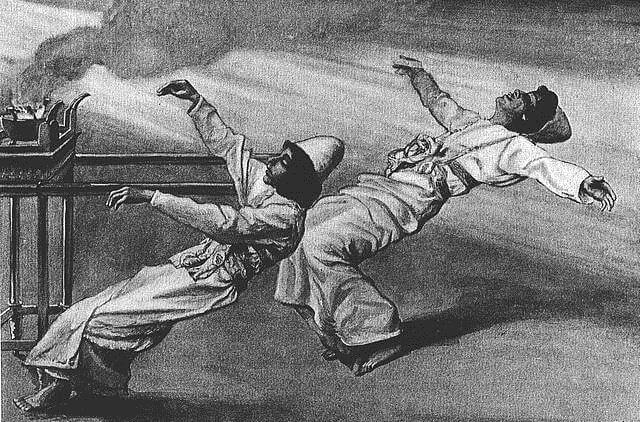
It would seem from our parsha (weekly portion) that spontaneity is not commendable at all. The Torah tells us (Vayikra 10:1-2) that Aaron’s sons, Nadav and Avihu offered an “unauthorized fire before the Hashem (G-d)”, which they had not been instructed to offer. As a result, “Fire came out from the presence of G-d and consumed them, and they died before Hashem”.

And although there are many different explanations regarding this story, the clear implication here (and in Bamidbar 3: 4 and 26: 61), is that they acted on their own initiative.

Rav Shimshon Raphael Hirsch suggests that they let the moment of sheer joy (of the dedication of the Tabernacle) carry them away, and their enthusiasm got the best of them. Apparently, the service of G-d and spirituality are not meant to be spontaneous. Indeed, this is not the first time spontaneity ended badly; way back in the beginning Kayin (Cain) spontaneously offers the first recorded offering, which does not end well. G-d does not seem pleased (Bereisheet 4); leading ultimately to disastrous results as Kayin perpetrates the first murder of his brother, Hevel (Abel).

And when Aharon, at the foot of Sinai, impulsively suggests that the people bring their gold, the result is the tragic debacle of the Golden calf.

And yet, sometimes, such seemingly impulsive behavior is exactly what is called for: When Pinchas is confronted with the brazen licentious behavior of a prince of the tribe of Shimon (Zimri) with a Midianite princess; he impulsively kills them both on the spot and is rewarded with no less than the blessing of G-d himself!

Indeed, Moshe’s entire career begins with such an apparently impulsive moment, when Moshe kills the Egyptian taskmaster beating a Jewish slave, and concludes on the same note, as Rashi on the last verse in the entire Torah (Deut. 34: 12) shares the Midrashic comment that again has no less than G-d Himself commending Moshe’s decision to shatter the Luchot (Tablets of the Law) at the sight of the people worshipping the Golden Calf. It would be hard to find a more impulsive and spontaneous act than this in all of Jewish history!

So, when is spontaneity a good thing, and when must we subscribe to the orders and tradition we have been given?

Indeed, this is the ultimate dilemma with which every IDF commander must eventually contend, and for which he or she is trained: On the one hand, particularly in a post Holocaust world, no Israeli commander can ever fall back on just ‘following orders’. And yet, an army where commanders do not obey orders cannot possibly function. So how does one navigate this conundrum, and how do we determine the distinction that will allow us to arrive at the correct conclusions?

Perhaps we can take a cue from Martin Luther King’s battle for civil rights in America. One of King’s principles in advocating for civil disobedience was that a person has an obligation to disobey a law he or she feels is unjust, but a responsibility to accept and pay for the consequences of his or her decision.

As such King felt it incumbent for black people to sit wherever they wanted on buses and in diners (regardless of signs suggesting ‘whites only’ seats) but they then had to be willing to go to jail until the law could be changed.

As an Israeli officer, on those rare occasions when you felt an order was mistaken, you knew you would be held accountable both for disobeying an order, as well as for fulfilling it, if it turned out to be incorrect or unethical. Indeed, for me the take-away message was that we would always be held accountable. In fact, in the IDF this holds true not only for Commanders but for every soldier as well. If a soldier is given an unethical order, he or she is actually bound to disobey it, which is a pretty scary thing to do, because he or she will absolutely subsequently be held accountable for that decision.

Perhaps the Torah here is teaching us a powerful message regarding our spiritual journey to connect with Hashem. It is so easy to lose our selves in the euphoria of a spiritual moment, particularly when such a journey is conducted with the understanding that said person is not the goal of the journey, but merely a vehicle who is part of a much bigger picture. But if each of us is created in G-d’s image, then the inner voice that tells us when something is right or wrong, is also part of Hashem’s voice which we must heed.

Judaism suggests that the balance of my own inner voice and journey, alongside how that voice and journey serves a bigger picture of the Jewish people, and the entire world, is what distinguishes us as Jews and human beings in the service of a greater good.

Nadav and Avihu, suggests Rav Hirsch, got too caught up in the spiritual journey of Nadav and Avihu. Moshe, on the other hand was all about how he could be a vehicle for the greater good and journey of the Jewish people, and the whole world. And that is what should guide all of our decisions, all the time.

Shabbat Shalom, from Jerusalem.

2022 demographic update – solid Jewish majority

by Ambassador (ret.) Yoram Ettinger

Overall demographic reality west of the Jordan River
In 2022, in contrast to conventional demographic wisdom, Israel is not facing a potential Arab demographic time bomb in the combined areas of Judea, Samaria (the West Bank) and the pre-1967 Israel. In fact, the Jewish State benefits from a robust Jewish demographic tailwind.

In 2022, the political and demographic establishment in Israel and the West persist in reverberating the official Palestinian numbers without due-diligence (auditing), ignoring a 50% artificial inflation of the population numbers.

In 2022, Israel is the only Western democracy endowed with a relatively high fertility rate, which facilitates further economic growth with no reliance on migrant labor. Moreover, Israel’s thriving demography provides for bolstered national security (larger classes of recruits) and a more confident foreign policy.

In 2022, for the first time – in defiance of projections made by Israel’s demographic establishment since the early 1940s – Israel’s Jewish fertility rate exceeds Israel’s Muslim fertility rate. Moreover, Israel’s Jewish fertility rate is higher than all Arab countries other than Yemen, Iraq and Egypt.

In 2022, Israel is facing a potential wave of Aliyah (Jewish immigration) of some 500,000 Olim from the Ukraine, Russia, other former Soviet republics, France, Britain, Germany, etc.

In 2022, the Westernization of Arab demography persists as a derivative of modernity, urbanization, women's enhanced social status, women's enrollment in higher education and increased use of contraceptives.

In 2022, the Jewish demographic momentum (since 1995) persists with the secular Jewish sector making the difference, while the ultra-orthodox experiencing a slight decline in fertility rate.

Jewish demographic momentum
*The number of Israeli Jewish births in 2021 (141,250) was 76% higher than 1995 (80,400), while the number of Israeli Arab births in 2020 (43,806) was 20% higher than 1995 (36,500), as reported by the March 2022 Monthly Bulletin of Israel’s Central Bureau of Statistics (ICBS).

* In 2021, Jewish births were 76% of total births, compared to 69% in 1995.

*The fertility rate (number of births per woman) of Israeli secular Jewish women has trended upward during the last 25 years, while ultra-orthodox women have experienced a slight decline.

*Israeli Jewish women – who are second only to Iceland in joining the job market – are unique in experiencing a rise of fertility rate, along with expanded urbanization, education, standard of living, integration into the job market and a rise of wedding age, while these phenomena have lowered the fertility rate in all other countries.

*In 1969, Israel’s Arab fertility rate was 6 births higher than the Jewish fertility rate. In 2015, both fertility rates were at 3.13 births per woman, reflecting the dramatic Westernization of Arab demography, triggered by the enhanced social status of women, older wedding age, expanded participation of women in the job market and shorter reproductive time. In 2020, the Jewish fertility rate was 3 (and 3.27 with an Israeli-born Jewish father), while the overall Arab fertility rate was 2.82 and the Muslim fertility rate was 2.99. The average OECD fertility rate is 1.61 births per woman.

*The unique growth in Israel’s Jewish fertility rate is attributed to optimism, patriotism, attachment to Jewish roots, communal solidarity, the Jewish high regard for raising children, frontier mentality and a declining number of abortions.

*In 2021, there were 43,879 Israeli Jewish deaths, compared to 31,575 in 1996, a 39% increase, which reflects a society growing younger. In 2021, there were 6,751 Arab deaths, compared to 3,089 in 1996, a 119% increase, which reflects a society growing older.

Israel’s Arab life expectancy (78 per men and 82 per women) is similar to the US life expectancy and higher than any Arab/Muslim country.

*In 2021, the number of Israeli Jewish deaths was 31% of Jewish births, compared to 40% in 1995 – a symptom of a society growing younger. In 2021, the number of Israeli Arab deaths was 15% of Arab births, compared to 8% in 1995 – a symptom of a society growing older.

*Since 1995, the demographic trend has expanded the younger segment of Israel’s Jewish population, which provides a solid foundation for an expanded Jewish majority in the next generation.

*The positive Jewish demographic trend is further bolstered by Israel’s net-immigration, which consists of an annual Aliyah (Jewish immigration) reinforced by the shrinking scope of Israeli emigration: from 14,200 net-emigration in 1990 to 6,000-7,000 net-emigration in recent years.

*Moreover, there is a potential of at least 500,000 Olim (Jewish immigrants) in the next 5 years – awaiting the Israeli government to leverage this potential – when considering the Jewish communities in the Ukraine, other former Soviet Republics, France, Britain, Germany, Argentina, as well as the USA, Canada and Australia.

Westernization of Arab demography
*500,000 overseas residents, who have been away for over a year, are included in the Palestinian population census, in violation of internationally accepted rules, which stipulate only a de-facto count. It was 325,000 in the first Palestinian census of 1997, as documented by the Head of the Palestinian Central Bureau of Statistics; and increased to 400,000 in 2005, as documented by the Palestinian Election Commission. The number grows daily because of overseas births.

*350,000 East Jerusalem Arabs, who possess Israeli ID cards, are doubly-counted. They are included in the Israeli census, while they are also included in the Palestinian census. The number grows daily due to births.

*Over 150,000 Arabs from Gaza and (mostly) from Judea and Samaria, who married Israeli Arabs and received Israeli ID cards, are doubly-counted counted: by Israel as well as by the Palestinian Authority. The number expands daily because of births.

*378,000 Arab emigrants from Judea and Samaria are not excluded from the population census of the Palestinian Authority. The latter ignores the annual net-emigration of mostly-young-Arabs from Judea and Samaria (20,000 annually in recent years). Net-emigration has been a systemic feature of the area, at least, since the Jordanian occupation in 1950. For example, 28,000 in 2021, 26,357 in 2019, 15,173 in 2017 and16,393 in 2015, as documented by Israel’s Immigration and Population Authority, which documents all Jewish and Arab exists and entries via Israel’s land, air and sea international passages.

*A 32% artificial inflation of Palestinian births was documented by the World Bank (page 8, item 6) in a 2006 audit. While the Palestinian Authority claimed an 8% increase in the number of births, the World Bank detected a 24% decrease.

*A dramatic decline in the fertility rate from 9 births per woman in the 1960s to 3.02 births in 2021 is documented by the CIA World Factbook, which generally echoes the official Palestinian numbers. It reflects the Westernization of Arab demography in Judea and Samaria, which has been accelerated by the sweeping urbanization (from a 70% rural population in 1967 to a 77% urban population in 2021), as well as the rising wedding age for women (from 15 years old to 22), the substantial use of contraceptives (70% of women) and the shrinking of the reproductive period (from 16-55 to 23-45).

*The median age of Judea and Samaria Arabs is 22 years old, compared to 18 years old in 2005.

*The Westernization of fertility rates has characterized all Muslim countries, other than the sub-Sahara region: Jordan (which is very similar to the Judea and Samaria Arabs) – 3 births per woman, Iran – 1.93, Saudi Arabia – 1.95, Morocco – 2.29, , Iraq – 3.32, Egypt – 3.23, Yemen – 3.1, United Arab Emirates – 1.65, etc.

*The number of Arab deaths in Judea and Samaria has been systematically under-reported (for political power and financial reasons), as documented by various studies since the British Mandate. For example, a recent Palestinian population census included Arabs who were born in 1845….

*The aforementioned data documents 1.5 million Arabs in Judea and Samaria, when deducting the aforementioned documented-data from the official Palestinian number (3 million).

The bottom line
*The US should derive much satisfaction from the aforementioned documentation, which demonstrates the demographic viability and therefore, the enhanced posture of deterrence of Israel – America’s top force-multiplier in the Middle East and beyond.

*In 1897, there was a 9% Jewish minority in the combined area of pre-1967 Israel, Judea and Samaria. In 1947, it had expanded to a 39% minority. In 2021, there is a 68% Jewish majority (7.5mn Jews, 2mn Israeli Arabs and 1.5mn Arabs in Judea and Samaria), benefitting from a robust demographic tailwind of births and migration.

*In contrast to conventional wisdom, there is no Arab demographic time bomb. There is, however, an unprecedented Jewish demographic tailwind.

The Yishai Fleisher Israel Podcast: A Convert Wedding and a Biblical Highway

Season 2022 Episdode 12: Yishai and Malkah attend an amazing wedding - and bring you along! This was a small but powerful consolation for the heinous terror attack which rocked Israel the day before. Then, Yishai talks about the Route 60 Israel Biblical Highway project on Fox Radio - come for a drive!

Thursday, March 24, 2022

Stretch yourself spiritually while the light of Rav Chaim can still be felt.

by Rabbi Pinchas Winston

Friday Night
THIS IS THE parsha in which Nadav and Avihu make the deadly mistake of offering an incense offering that was not commanded. Just when everything had reached such a great height at the ceremony to inaugurate the Mishkan, they did this thing that caused a complete reversal from joy to mourning, and from religious ecstasy to shock.

The commentators, of course, spend a lot words trying to explain what happened and why. And of course there is the idea of allilus, Divine pretext to carry out tikun on some level that we do not understand, but which can be traced back to Creation. (If you want to see the Leshem’s detailed explanation of allilus, go to my site at http://www.shaarnunproductions.org/leshem.html, Divine Pretext.)

From the Talmud, it seems that part of the problem may have been their over-anxiousness to lead the nation. The Talmud says that while walking behind Moshe and Aharon, they would wonder to each other when their elders would pass on and they could take over. In response to that, God said, “Let’s see who buries whom!” (Sanhedrin 52a).

It is okay to want to be great. It is the reason that makes the difference. If it is to be honored by others, the Zohar says that is an Erev Rav-like quality (Bereishis 25a). If you want to be great because you just want to be the very best you possibly can, that is a soul-drive. If you want to be great to make a positive difference to society, that is definitely a soul-drive.

A great way to learn about the path to greatness was actually in Megillas Esther last week. Mordechai did not aspire to be great for public praise. He wasn’t interested in rising to the top of anything. He was only looking out for the best of his people, and risked his life to do so. If he had died anonymously, it wouldn’t have bothered him as long as he knew he had done his best at what he believed God wanted him to do.

But look at where he ended up. In fact, the entire Megillah ends off talking about him and his success. It doesn’t even discuss what happened to Esther in the end, just Mordechai. Just as the Torah seems to chronicle Moshe Rabbeinu’s rise to prominence, Megillas Esther seems to do the same for Mordechai. The moral of the story: Greatness comes from God. Do your best to be the greatest for the right reasons, and God will take care of the rest. God knows who you are and where you can be found. If you deserve it, He’ll make sure you shine for the rest of the world.

Shabbos Day
THE YERUSHALMI LEARNS something else from Mordechai’s rise to power (Yoma 14a). It compares the redemption of the Jewish People to the rise in power of Mordechai. It says that just as the morning light sparks a bit first and then takes time to get brighter before becoming day (in five stages: Ayeles ha’Shachar, dawn, the eastern sky lights up, sunrise, and noon), likewise the geulah of the Jewish peoples comes little by little .

That’s certainly the way it seemed to have worked in Mordechai’s and Esther’s time. We talk about “v’nehafuch hu,” that all of a sudden, the events of Purim turned around in favor of the Jewish people. One moment they were facing down the barrel of Haman’s gun, and the next moment they were holding it on Haman. But that’s just the way it appeared to us because when the redemption actually started, it was too small for most people to notice.

How do we know this? Because these are the verses that the Yerushalmi mentions with respect to Mordechai:

“Mordechai was sitting at the gate, etc.” (Esther 2:21) … “Mordechai sat at the gate of the king” (6:12) … “Haman took the [royal] clothing and the horse, etc.” (6:11) … “Mordechai went out before the king in the royal clothing” (8:15), and “There was light and joy for the Jewish people” (8:16)

Now, until the last verse, do you think that anyone said, “Well that’s a sign that redemption is on its way!”? If anything, they might have wondered if Mordechai’s humiliation of Haman would only anger him more and intensify his hatred of the Jewish people. Sometimes good events are followed by even worse events, and given the spiritual condition of the nation at the beginning of the story, why should they have assumed that God wanted to save them?

But hindsight is not only 20-20, it is also very insightful. The Babylonian Exile had been the first one that the Jewish people had experienced since first becoming obligated in Torah. Everything was new including how redemption worked. Their learning experience was recorded for us to know for the future, because more exiles were eventually on their way, three major ones and other more local exiles.

Unfortunately, the lesson seems to have been lost over time. Again, people do not recognize the redemption in progress because it happens in stages and in amounts that most do not see as part of the final redemption. They’re waiting for the grand finish, when everything just seems to turn around so completely for the Jewish people.

Until then, they worry about the direction of history. Until redemption clearly happens, they ignore the signs that it is time to prepare for it and maybe even change locations. They see history as business as usual when in fact it is anything but that. They listen each year to Megillas Esther but they seem to miss its message.

Not good. Not safe.

Shalosh Seudot
WE SAID GOODBYE to another Gadol b’Torah this week, a truly remarkable man for many reasons, Rabbi Chaim Kanievsky, zt”l. Never someone who looked to be a famous Torah leader, Rav Chaim, as he was respectfully and affectionately called by so many in the Torah world, was clearly destined for it.

They once asked Rav Moshe Feinstein, zt”l, how one becomes a Posek HaDor, a leading halachah decider for a generation. In his trademark simple and humble style, Rav Moshe answered, “One day someone asks you a shailah (halachic question), which you answer. If they like your answer, they tell their friends about you, who ask you their shailos. Then it just grows from there.”

Rav Chaim insisted until the end that he wasn’t a posek. But that did not stop people from living by his word. How could he not be a posek? He knew so much Torah, including obscure commentaries and recalled them all. If anyone knew what there was to say about anything Torah, it was Rav Chaim.

His devotion to Torah was legendary and unparalleled in recent times. It is hard to imagine what the learning of such people even just 100 years ago was like if we had someone who could learn as he did in our time. Aside from everything else, he made a siyum once a year on the entire Talmud Bavli, Talmud Yerushalmi, Rambam, Shulchan Aruch, and who knows what else. And that was just his morning learning seder, because in the afternoons he saw people to help them with their issues.

We are not only a ship without a captain, as the signs posted around the country say, but a captain-less ship being tossed around in a tumultuous storm. There is no way to really know or properly appreciate how much a tzaddik counterbalances evil in the world. But you can be sure that the loss of a gadol of such caliber has left a gaping hole in our protective covering.

True, the Talmud says that the sun does not set on the life of one tzaddik without first rising for the next one. But there is also the concept of yeridas hadoros, a spiritual weakening that gets worse with each generation. To my knowledge, there is no next generation Rav Chaim as of yet.

If anything, that greatness is divided among different, less prominent, gedolim. Collectively, many gedolim may possess what Rav Chaim had as an individual. But it just works differently and more powerfully when all that Torah and middos (character traits) are in a single individual.

I was reminded this week of an idea I heard years ago that is very relevant and important at this time. Basically, when such a great person is taken from this world, it leaves a great spiritual void. As Rashi points out at the beginning of Parashas Vayaitzai, it also leaves a roshem, an impression. The void with the roshem creates a special opportunity for those left behind. It allows them to receive and make use of some of the light and heavenly help once used by the tzaddik who is no longer here to use either.

Of course, we need to mourn the loss of any great leader, but especially of a great Torah leader. But we must also take advantage of what they have left behind in their wake. Learn a little extra. Improve your middos a bit more. Stretch yourself spiritually while the light of Rav Chaim can still be felt.

Russian invasion relevance to US policy on Iran

by Ambassador (ret.) Yoram Ettinger

Does the US realize the relevance of the Russian invasion of Ukraine to its current negotiations with Iran's Ayatollahs, or does it ignore the Russia-Iran connection?

For example:

*The Russian invasion of Ukraine exposes the substantial gap between the norms, logic and state-of-mind of the democratic US and the despotic, ruthless Russia (e.g., the willingness to sustain economic cost, in order to advance a rogue vision), as it is between the US and the fanatically religious, despotic, ruthless and megalomaniacal Iran's Ayatollahs.

*The Russian invasion sheds light on the dramatic gap between global reality and Western conventional wisdom, as also demonstrated by the gap between the Iranian reality and US policy toward Iran, which failed to assess the nature of the 1979 Islamic Revolution and the consequences of the 2015 JCPOA (which intensified, rather than moderated, regional and global Iranian subversion, terrorism, drug trafficking and proliferation of advanced military technologies and systems).

*The Russian invasion wakes up US policy makers and public opinion molders to the fragile, unpredictable and explosive reality of the world, contrary to the misperception of a relatively-peaceful "new world order" free of major wars and ground invasions, which has recently dominated US conventional wisdom and attitude toward the rogue regime of the Ayatollahs in Iran.

*The Russian invasion exposes the unrealistic assumption that the diplomatic option supersedes the military option in the struggle between global democracies and rogue regimes and organizations, such as the negotiation with Iran's Ayatollahs.

*The Russian invasion underlines the fallacy of the US assumption that the waiving of the mioitary option (e.g., against Iran's Ayatollahs) preventsw military escalation; while in fact, it erodes the US' posture of deterence, thus whetting the appetite of rogue regimes, and therefore inensifying miliary escalation.

*The Russian invasion underscores the quixotic nature of the assumption – which is at the foundation of the negotiation with Iran's Ayatollahs - that most of the globe is amenable to Western values of peaceful-coexistence, democracy, human rights and good-faith negotiation. Iran and other rogue regimes have demonstrated that they are not!

*The Russian invasion reveals the contradiction-in-terms between the track record of rogue regimes – such as Iran's Ayatollahs - and the assumption that they could be good-faith negotiators.

*The Russian invasion accentuates the centrality of a military posture of deterrence in the face of rogue entities – such as Iran's – which adhere to a deeply-rooted fanatic vision, as demonstrated by their systematic anti-Western school curriculum, religious sermons, domestic and external track record.

*The Russian invasion emphasizes the critical role played by history in coalescing national ethos, vision and policies. It is also evident in the rogue conduct of Iran's Shiite Ayatollahs, which is a derivative of a series of historical milestones, such as the 1,400-year-old ferocious Sunni-Shiite confrontation; the 680 AD Battle of Karbala which is the "big bang" of the Sunni-Shiite conflict and the role model for the Shiite spirit of revolution, revenge, sacrifice and martyrdom; the 1501 AD declaration of Shiism as Iran's official religion; and the 1979 Islamic Revolution, which was driven by the aforementioned milestones. The Islamic Revolution has been the chief inspiration for Iran's daily rogue conduct from the Persian Gulf through Africa and Latin America, all the way to the US-Mexico border.

*The Russian invasion forewarns the West to be wary of rogue regimes, which adhere to the policy of subjugation and submission in Eastern Europe, as well as in the Middle East, where Iran's Ayatollahs have systematically and proactively attempted to topple every "apostate" Sunni Muslim regime (especially Saudi Arabia), and to bring to submission the "non-believer" West (especially "the Great American Satan").

*The Russian invasion is a reminder that leopards don't change spots, only tactics.

Ignoring the relevance of the Russian invasion of Ukraine to the US' negotiations with Iran's Ayatollahs would be tantamount to ignoring the lesson of the US/Spanish philosopher, George Santayana: "Those who cannot remember the past are condemned to repeat it!"

"G-d! May Your favor rest upon us"

by HaRav Dov Begon
Rosh HaYeshiva, Machon Meir


The moment of climax for which all the people were waiting after the Exodus and the receiving of the Torah was the moment when the Divine Presence was supposed to reveal itself at the end of the Mishkan's erection and the sacrifices of the eighth day of Installation. The longed-for moment arrived, but the Divine Presence did not descend nor reveal itself. The result was that Aaron was embarrassed and the Israelites were mortified, frustrated, and sad. As Rashi comments (Vayikra 9:23):

“When Aharon saw that they had offered all the sacrifices, and all the rituals had been performed, and still the Divine Presence had not descended for Israel, he was pained, and thought, ‘I know that G-d is angry with me and it is because of me that the Divine Presence did not descend!’ He said to Moshe: ‘ Moshe! Your efforts have resulted only in my entering the Mishkan and being embarrassed!’ Moshe immediately entered with him, and they begged for mercy, and the Divine Presence descended for Israel.”

And what was their blessing to the people (Vayikra 9:23)? They said, “G-d! May your favor rest upon us!” (Tehilim 90:17), and, “May it be Your will to cause Your Divine Presence to rest on our handiwork.” Immediately, “G-d's glory was revealed to all the people. Fire came forth from before G-d and consumed the burnt offering and the choice parts on the altar. When the people saw this, they raised their voices in praise and threw themselves on their faces” (Vayikra 9:23-24). In other words, the people's mood was transformed 180 degrees, and they rejoiced and praised G-d.

From here we may derive that it is not enough to erect the Mishkan and to bring offerings. Rather, we must seek G-d’s mercy for His favor to rest upon us. This recalls the following story:
“Rebbe Yishmael ben Elisha entered the Holy of Holies to burn incense and he saw “the L-rd of hosts sitting on His exalted throne. G-d said to him, ‘Yishmael, my son! Bless me!’ He answered, ‘May it be Your will that Your mercy should vanquish Your anger, and You should treat Your sons mercifully and go beyond the letter of the law for them.’ G-d then nodded in assent.”

This source serves to teach that “we should not take a layman’s blessings lightly” (Berachot 7a).

Today, how fortunate we are and how good our lot that we have merited to be part of a generation in which the Jewish People are rising up to rebirth after two thousand years of exile. We see with our own eyes the ingathering of the exiles and the flourishing of our country. The third temple is being rebuilt before our very eyes. We are still at the very height of a process at the end of which most certainly the Divine Presence will descend and reveal itself to all Israel, just as it did at the Mishkan's erection on the eighth day of the Installment, and just as it did with the building of the First Temple in Shlomo HaMelech's day.

Until then we must recite the prayer of Moshe, the man of G-d, “O G-d, may Your favor rest upon us! Establish for us the work of our hands, the work of our hands establish” (Tehilim 90:17).

May the work of our hands be complete. Let it not – G-d forbid – cause mishap. And may the result be to have G-d’s favor upon us, G-d’s Presence and His consolation (see Rashi and Metzudat David, ibid.).

With blessings for all of Israel,
Looking forward to salvation,
With Love of Israel,
Shabbat Shalom.

Yeshivat Machon Meir Parashat Shemini - The eight-day tragedy (video)

What’s the Plan?

by Victor Rosenthal

If you live in Israel, you know what happened in Beer Sheva on Tuesday. You know that a terrorist who was an Israeli citizen from one of the larger Bedouin towns that sprawl over Israel’s Negev desert, a former teacher (!) who spent four years in prison for his activities on behalf of ISIS, brutally murdered two women and two men because they were Jews living in Eretz Yisrael.

The terrorist, Mohammad Jalab Abu al-Quian, stabbed a woman at a gas station and then drove to a nearby shopping center, running over a bicycle rider on the way. He got out of his car and stabbed three more people before being shot dead by two armed citizens. Four of his victims died, and the fifth was very seriously injured. The nightmare took eight minutes.

Here are the names of those whose lives he took:

1) Laura Yitzchak, 43. Mother of 3 girls. Resident of Be’er Sheva.

2) [Rabbi] Moshe Kravitzky, 50. Father of 4. Managed a Colel Chabad soup kitchen in Be’er Sheva. Chabad Shaliach [he was the bicycle rider].

3) Doris Yahbas, 49. Mother of 3. From Moshav Gilat.

4) Menachem Menuchin Yechezkel, age 67.

As always happens, Gazans distributed sweets in honor of the successful “operation,” like it was a military triumph, instead of a vicious murder spree victimizing the softest of soft targets.

In recent weeks, there have been several attempts to murder police officers and random Jews in Jerusalem. And there are the daily cases of drivers been attacked with large rocks and firebombs.

I have a question for the Prime Minister, Naftali Bennett, his cabinet, and indeed every member of the Knesset:

What is your long range plan to deal with Palestinian Arab terrorism, both by Palestinians from the territories and Israeli Arabs?

I am not talking about your plans to increase the police presence over the Pesach and Ramadan holidays. That is the shortest of short-term plans. I am not talking about your plans to improve the economic conditions in Gaza, the PA, and the Negev, a slightly longer-term plan which will probably lead to more, not less, terrorism.

I want to know if you have any idea of what to do about the Palestinians in Judea, Samaria, and Gaza, who have been so radicalized by Hamas and the PLO that teenagers are capable of murdering Jewish babies? And I want to know if you understand the dangers of the continuing Islamization and Palestinization of the Arab citizens of Israel, which was demonstrated in May 2021 by the Arab pogroms against the Jewish residents of Lod, Acco, Bat Yam, Haifa, Yafo, and Tiberias?

Lately our leadership has been concerned with the war in Ukraine and a possible influx of refugees from there, Jewish and non-Jewish. It has been concerned with the betrayal of Israel by the Biden Administration, which seems to be prepared to go to almost any length to make a deal with Iran that will provide the evil regime with a Niagara of dollars and a free pass to deploy nuclear weapons. These are not small issues.

But the war between Israel and the Palestinian Arabs has been going on for far longer than the Ukraine war, and started long before the Iranian revolution. Unless there is a massive escalation into what would become WWIII – something that I doubt will happen – the war in Ukraine will be over soon. And either Israel will find a way to deal with Iran in the next year or two, or there won’t be a State of Israel to worry about.

Some will say that more people are killed in road accidents than are victims of terror. Some will say that most Arab citizens of Israel are loyal to the state, that only a minority took part in the 2021 riots, and that the Palestinian Authority and Hamas are viewed as corrupt and dictatorial by the residents of the territories. These things are all true. But it is also true that virtually all the Arabs living in Israel and the territories share the view that the Jewish presence between the river and the sea is illegitimate and temporary. And I think that in a situation in which they see the possibility of success in ending the Jewish occupation of the land – all of it – virtually all of them would support the effort to do so.

Today there is no such possibility on the immediate horizon. But in the context of a major war with Iran and her proxies, a war that will treat our home front very harshly – and a war that I believe to be inevitable – the glimmer of possible victory might appear visible to them on the horizon. If that happens it will make the Second Intifada and the May 2021 riots look small, as the “pragmatic” Arabs, including the doctors and professors that we are so proud of as examples of successful coexistence come together in support of the Palestinian national objective: the reversal of the Nakba and the “redemption of all of Palestine.”

The problem of Palestinian Arab terrorism will not go away by itself. The incitement that feeds it, coming from the PLO, Hamas, ISIS, and Iran, is greater today than it ever was. And today it feeds itself, too, via social media.

In 1993, Israel’s leadership, under pressure from outsiders who understood the situation even less well than they did, tried to solve the problem by an attempt at reconciliation and compromise. But they were fooled. They entirely misread the Palestinians, who have never lost sight of their national goals, which definitely do not include living at peace along with a Jewish state. The consequences of that mistake have compounded themselves over the years, and today the threat is greater than ever.

Our 1993 leaders had a plan, and it failed. Very few Israelis still think that a solution can be found via reconciliation and compromise. The rational thing to do in response to failure is to develop a different plan that takes into account the lessons learned. Such a plan would have to recognize the Palestinian narrative and objective that drives terrorism. It would have to comprehend that you can’t reconcile with those who hold onto an overwhelming sense of grievance. It would have to replace the idea of compromise with one of victory.

But today’s leaders have no plan at all.

Peter Beinart Blames Israel For Ukraine’s Plight

Connecting a handful of non-existent dots.
by Hugh Fitzgerald


Peter Beinart, who has previously announced to the world – which he believes hangs on his every word –that he no longer supports Israel as a “Jewish state,” is at it again, declaring this time that American support for Israel should be withdrawn because it has, just like Russia in Ukraine, “illegally” annexed territory. A report on his self-important bloviating is here: “Did Peter Beinart Just Blame Israel for Russia’s Invasion of Ukraine?,” by Gidon Ben-Zvi, Algemeiner, March 15, 2022:

In an article in The Guardian titled, “The US supports illegal annexations by Israel and Morocco. Why the hypocrisy?,” Peter Beinart draws a parallel between Russia’s incursion into Ukraine and Israel’s defensive actions during the 1967 Six-Day War.

What “illegal annexations” by Israel is Beinart talking about? Israel has formally annexed, among the territories it took possession of In the Six-Day War, only east Jerusalem, in 1980, and the Golan Heights, in 1981. Those annexations were not illegal. The League of Nations in 1922 created the Mandate for Palestine, that would become the Jewish National Home and, in time, a sovereign Jewish state. The territory included in Mandatory Palestine extended from the Jordan River in the east to the Mediterranean Sea in the west, and from the Golan Heights in the north to the Red Sea in the south. Israel was only annexing territory – the Golan and east Jerusalem — that had already been assigned to it by the League of Nations.

There is another, independent justification for Israel’s annexation of the Golan: UN Security Council Resolution 242 (Nov. 22, 1967) allows Israel to retain any territory taken “in the recent conflict” that Israel needed in order to have “secure [defensible] and recognized boundaries.” The Golan, from which Syrian artillery had from 1949 to 1967 fired on Israelis working the fields far below, certainly was needed by Israel to prevent a resumption of such attacks, and to prevent a full-scale invasion from the north, as Syria attempted in 1967 and 1973.

In the piece, Beinart suggests that the United States should no longer continue providing the Jewish state with military aid because doing so would “make Ukraine, Taiwan and every other weaker nation bordered by a rapacious neighbor more vulnerable.”

In Beinart’s view, Israel is a “rapacious neighbor” wantonly attacking others, and by providing it with military aid, the U.S. i not only encouraging Jerusalem’s aggression, but also that of Russia against Ukraine, China against Taiwan, and all stronger states that threaten weaker ones.

Beinart frames his argument by quoting US Secretary of State Antony Blinken, who described Russia’s aggression as an affront to “Ukraine’s sovereignty and territorial integrity,” as well as a “gross violation of international law.”

Beinart proceeds:

Remaking borders by force violates a core principle of international law. Which is why the Biden administration must do more than resist Russia’s aggression in Ukraine. It must stop violating that principle itself.

There is a difference between “remaking borders by force” and winning, and keeping, territory won in a war of self-defense. Israel did not attack Egypt, Syria, and Jordan first In the Six-Day War. That war began when, starting in mid-May, Nasser blockaded the Straits of Tiran, ordered the U.N. to pull its peacekeeping troops from the Sinai, and moved tens of thousands of Egyptian troops to the northern Sinai, ready to invade Israel. How does this compare to the unprovoked attack on Ukraine by Russia?

Israel won its war in June, 1967, against the gang-up of three Arab countries, and with it, took possession of Gaza, the Golan, east Jerusalem, and the Sinai. Eventually, in exchange for a peace treaty, it gave the Sinai back to Egypt; it also withdrew entirely from the Gaza Strip in 2005, leaving the Gazans to rule themselves. That is, it gave up 95% of the territory it had taken in the 1967 war.

Beinart writes this in the context of the Arab-Israeli conflict, accusing the Jewish state of disregarding “a core principle of international law” when it annexed the Golan Heights that were “seized from Syria in the 1967 War.”

What Beinart fails to note is that, in stark contrast to Russia’s offensive in Ukraine, Israel, which indeed gained control of parts of the Golan Heights during the Six-Day War, had been attacked by neighboring Arab countries and as such, was forced into fighting for its very survival.

Indeed, regional leaders in the run-up to launching the 1967 war launched by neighboring Arab states against Israel (in a manner similar to Putin’s invasion), repeatedly called for the destruction of Israel. Not only did then Egyptian President Gamal Abdel Nasser impose a blockade of Israeli goods through the Straits of Tiran, itself an act of war, all while ordering a massive military buildup and demanding the removal of UN peacekeeping forces monitoring the shared border, but top Arab officials repeatedly made genocidal statements — such as the following by then Syrian defense minister (and later president) Hafez Assad:

Our forces are now entirely ready not only to repulse any aggression, but to initiate the act ourselves, and to explode the Zionist presence in the Arab homeland of Palestine. The Syrian army, with its finger on the trigger, is united. I believe that the time has come to begin a battle of annihilation.

Who were the “rapacious neighbors” in 1967? Not Israel, which for the second time was forced to fight, as it had in 1948, for its very survival. Egypt and Syria were the aggressors; little Jordan joined in, King Hussein having been inveigled by Nasser into attacking Israel. It was a big mistake: Jordan lost east Jerusalem, including the Old City, as well as all of the West Bank.

Moreover, Beinart blithely ignores the fact that Syria remains in the throes of a decade-plus-long war that has killed hundreds of thousands of people, and that the country is run by a murderous dictator. Beinart also discounts the strategic importance of the area as it relates to Israel’s security, even as Iranian-backed fighters are trying to remilitarize the region so that they may one day exterminate Israel.

Syria is run by a murderous dictator who is the closest ally of Iran. Iran’s leaders have constantly pledged to “annihilate” the Jewish state. That is the reason for Iran’s nuclear program, and for its ballistic missile program. And recently, Iran-backed Hezbollah fighters, armed with Iranian weapons, have been trying to establish bases just to the north of the Golan, still under Syrian control. The Golan plateau, which with an average altitude of 1,000 meters looms over the Syrian plain beneath, is essential to the defense of Israel’s north. All Israeli military men are convinced of that. So were the American officers who were sent to Israel by President Johnson in 1967 to report back on which territories Israel would have to keep to ensure its security. But Field Marshall Peter Beinart, that master of military strategy, doesn’t agree. Whom should we trust?

Prior to the 1967 war, the Syrian army plagued northern Israel by frequently launching artillery attacks against Israelis. In the preceding 17 years, approximately 370 Israelis were hit by Syrian fire, resulting in 121 deaths. In the first three months of 1967 alone, Damascus and its allies caused over 270 border “incidents.”

Despite the obvious security ramifications, the Israeli government after the war still proposed returning the Golan Heights to Syria in exchange for peace. In response, the Arab League — at the time comprising Egypt, Syria, Jordan, Lebanon, Iraq, Algeria, Kuwait, and Sudan — issued a proclamation known as the Khartoum Resolution, or, more informally, the Three Nos: “no peace with Israel, no recognition of Israel, no negotiations with it….”

Perhaps sensing that his Russia-Israel comparison is unfounded, Beinart then compares Israel’s 1981 application of sovereignty over the Golan Heights to Morocco’s annexation of the Western Sahara — which Rabat invaded in 1975 after the withdrawal from the region of its Spanish colonial rulers.

Beinart wants us to believe that Morocco’s seizure and annexation of the Western Sahara, a sparsely populated area that posed no threat to Rabat, is akin to Israel keeping, in a war of self-defense, territory — the Golan — that had been used by Syria for only one purpose: to rain fire down on Israeli civilians.

For good measure, Beinart invokes the thoroughly debunked Israel “apartheid” libel:

Even as Human Rights Watch and Amnesty International allege that it [Israel] is practicing apartheid… the Biden administration has also boosted arms sales to Morocco even though the US-based democracy watchdog Freedom House reports that people in Western Sahara enjoy fewer freedoms than people in China or Iran….

We might as well, tedious as it has become, yet again rebut the absurd charge that Israel practices apartheid, Here goes. Israeli Arabs serve in the Knesset, sit on the Supreme Court, are sent abroad as Israeli ambassadors. The chairman of Israel’s largest bank, Bank Leumi, is an Arab. Jews and Arabs in Israel work in the same offices and factories, are doctors and nurses in the same hospitals, treating both Arab and Jewish patients. Jews and Arabs play on the same sports teams – an Arab is the captain of Israel’s national soccer team — and in the same orchestras. Jews and Arabs start businesses together – everything from restaurants to high-tech start-ups. But Peter Beinart refuses to recognize any of that, as he asserts, as If it were a universally-accepted truth, “even as Human Rights Watch and Amnesty International allege that it [Israel] is practicing apartheid” – and then he segues into a non sequitur about American aid to Morocco.

Let’s see. Because Israel annexed the Golan, which it had won in a war of self-defense – as international law permits — in order to better protect itself against another invasion attempt from the north, that means that China will be encouraged to attack Taiwan. I’ve tried to make sense out of this but have failed. Peter Beinart connects, I’m afraid, a handful of non-existent dots.

Grasshoppers Against God

If the technocrats were really so smart, they would learn from those who came before them.
by Rabbi Chananya Weissman


The wicked technocrats of today believe they are more “evolved” than everyone else, particularly those who believe in God. They imagine a world in which they control literally everything – the creation of life, our thoughts and behaviors, even the weather – but without the moral restraints that God demands of us. They are not content merely to flout God's commandments. They want to put God out of business.

Not only are these people – Schwab, Gates, Soros, Harari, and their demonic ilk around the world – anything but evolved, there is nothing innovative about them. They are spiritual retreads of the lowest of lowlifes who tried the same stunt thousands of years ago. Chazal told us all about them and foretold the modern incarnation.

The following quotes are from the Midrash Tanchuma 58:18, in reference to the tower of Bavel.

נחמן בנו של רבי שמואל בר נחמני אמר למה הדבר דומה לצנצנת מליאה חגבים עלה הראשון ונפל עלה השני ונפל והשלישי ונפל שלישי לא למד מן השני השני לא למד מן הראשון

Nachman the son of Rabbi Shmuel bar Nachmani said, this can be compared to a jar full of grasshoppers. The first one went up and fell, the second one went up and fell, and the third [went up] and fell. The third didn't learn from the second, and the second didn't learn from the first.


The Midrash relates this to the generation that built the tower. They too failed to learn from their predecessors who rebelled against God. The generation of Enosh was the first to serve idolatry, and God brought a flood upon one third of the world. The generation of Noach wanted to rid God from their midst, and God wiped them out.

אמרו לא כל הימנו שיבור לו העליונים ויתן לנו התחתונים נעלה לרקיע ונכהו בקרדומות, ונחלקו לג' כתות אחת אומרת נעלה ונשב שם וא' אומרת נעשה עמו מלחמה, וא' אומרת נעלה ונעבוד שם עבודת כוכבים ומזלות

They said, it is not right that He should select the upper world for Himself and give us the lower world. Let us go up to the sky and strike Him with axes. They split into three groups. One said “Let us go up and live there.” One said “Let us wage war against Him.” And one said “Let us go up and we will serve idolatry there.”


The notion of building a tower to climb to the heavens and attack God is ludicrous, but it is unlikely that this was their literal intention. After all, they could have gotten a head start by building the tower atop a mountain instead of the lowlands of Bavel. These people were extremely foolish – they should have learned from history – but they were not stupid.

While they were all united in their rebellion against God, they had different motives. Some of them simply wanted to be “free” from God and His rules. Some of them actually wanted to take God's place.

Essentially, they planned to create a New World Order.

רבי איבו בשם רבי יוסי הגלילי אומר בשלשה מקומות חלקו באי עולם על הקדוש ב"ה, אחת כאן, ואחת בימי יהושע שנאמר (יהושע, ט) ויקבצו יחדיו להלחם עם יהושע ועם ישראל פה אחד, ואחת בימי גוג ומגוג שנאמר (תהלים, ב) יתיצבו מלכי ארץ ורוזנים נוסדו יחד על יהוה ועל משיחו

Rabbi Ayvo said in the name of Rabbi Yosi HaGalili, in three places the inhabitants of the world split against the Holy One, blessed is He. Once here, once in the days of Yehoshua, as it says (Yehoshua 9) “And they gathered together to wage war with Yehoshua and with Israel with one mouth”, and once in the days of Gog and Magog, as it says (Tehillim 2) “Kings of the earth and officers plot together against God and His anointed one.”


The Midrashic teaching began by comparing these people to grasshoppers in a jar. This analogy is most apt. These blasphemous technocrats with their delusions of grandeur believe they can jump to the heavens, but God is toying with them. The grasshoppers cannot jump any higher than God allows them, and the technocrats cannot take God's place. They have no power.

Tehillim 33:10 states: 
ה' הפיר עצת גוים הניא מחשבות עמים
God abrogates the plans of the nations, He nullifies the thoughts of the people.


Radak comments: Even if all the nations are with one plan and in one agreement, God will nullify their plan, as it says (Yeshaya 40:17), “All the nations are nothing against Him.”

We are witnessing the fulfillment of this prophetic teaching in our time. The only new world order that will take place is the Messianic redemption and the destruction of those who are waging war against God. If the technocrats were really so smart, they would learn from those who came before them, and heed the prophetic warnings that foretell their impending defeat. They cannot win against God, yet still they jump against the walls of the jar.

It will be spectacular to watch them fall. May it be soon.

Biden’s Israel Ambassador Tells BDS Group He Wants Jews Out of Jerusalem

“Your agenda is where my heart is.”
by Daniel Greenfield


Daniel Greenfield, a Shillman Journalism Fellow at the Freedom Center, is an investigative journalist and writer focusing on the radical Left and Islamic terrorism.

Biden’s ambassador to Israel appeared at a pro-BDS group’s webinar co-hosted by its CEO, who had described Israel as an “oppressive regime”, and told its audience that the real problem with the Palestinian Authority funding terrorism is that “it gives the ‘haters’ an excuse not to support the PA based on the argument that it is ‘paying for people who killed Jews.’”

He also told the anti-Israel group which had cheered the Ben & Jerry’s boycott that, “your agenda is where my heart is.”

At this rate, Thomas Nides will be hugging and kissing Hamas leaders by the end of the year.

Expectations for Nides were already pretty low when the Biden administration announced that it had picked Obama's former deputy secretary of state as its ambassador to Israel.

Hillary Clinton was going to make Nides her chief of staff, but once Hillary in the White House became as likely as peace with Hamas and the PLO, Nides had to settle for being Biden's bully in Jerusalem while his wife who is a VP at CNN stays on in Washington D.C.

Nides' main qualification for the job had been yelling “You don’t want to f***ing defund UNESCO" at a former Israeli ambassador. He had also vocally opposed efforts to defund UNRWA and stop subsidizing the terror refugee industry. He has also served on the board of the International Rescue Committee which has repeatedly attacked Israel.

J Street, the anti-Israel pressure group, welcomed Nides’ nomination and announced that it “looked forward to working” with him. Other anti-Israel groups including the Israel Policy Forum and Americans for Peace Now echoed the sentiments.

It didn't take long for Nides to justify their faith in his hostility to the Jewish State.

Early on, Nides announced that he wanted to open an occupation consulate to the terrorists in Jerusalem, over the opposition of the Israeli government, and that he would not visit those parts of Israel wrongly described as “settlements” because they are claimed by Islamic terrorists.

"I absolutely will not," he replied.

That was an even more extreme position than the one adopted by Obama’s ambassador, Dan Shapiro, who had privately visited homes in those areas where many Americans live.

Nides however did meet with Mansour Abbas, the head of the Muslim Brotherhood’s United Arab List, which played a key role in removing Netanyahu from office and replacing him with a leftist coalition government.

"When it comes to Israel, I have no ideology," Nides had initially claimed. Then on a webinar by the anti-Israel APN group, he let his freak flag fly and admitted what everyone already knew.

“I’m center-left,” he joked. “I’m left generally, but I put in the ‘center’ just to make myself feel better.”

It got worse from there.

“You have a clear agenda. I think your agenda is where my heart is,” Nides told Americans for Peace Now.

What is APN’s agenda? The anti-Israel group opposes Jews living in Jerusalem, opposes anti-BDS legislation, and opposes Jews defending themselves against Islamic terrorism.

APN CEO Hadar Susskind praised Ben & Jerry's decision to boycott Israel as a "principled moral stance which we fully support".

He claimed that the Jewish outrage over Amnesty International libeling Israel as an apartheid state was “manufactured” and that the real issue is that Israel maintains an "endemic, oppressive regime, in which the… human rights of millions of Palestinians are ruthlessly violated."

That “clear agenda” is where the rotten heart of Biden’s ambassador to Israel lies.

The APN webinar was co-hosted by Susskind and teachers’ union boss Randi Weingarten. Weingarten, an APN board member, had previously ranted that "American Jews are now part of the ownership class... who now want to take that ladder of opportunity away from those who do not have it” when asked by a Jewish journalist if unions like hers had too much power.

Weingarten's lover, Sharon Kleinbaum, had faced a member revolt over her extreme anti-Israel views which included reading the names of dead Hamas terrorists alongside Israeli casualties from the pulpit, and providing space to Queers Against Israeli Apartheid.

Biden has since appointed Kleinbaum to the Commission on International Religious Freedom despite her support for Cuomo’s discrimination against Orthodox Jews during the pandemic.

So this gathering of antisemites was old home week for a member of the Biden administration.

Nides told Susskind and Weingarten that he and Biden wanted to divide Jerusalem and that "my job is to knock down things that make that possibility impossible."

The leading thing to knock down would be the Jewish State.

Nides ranted that his priority was fighting to prevent Jews from living in those parts of Jerusalem that had been captured by invading Muslim armies in 1948 and were liberated from their occupiers in 1967 during the Six Day War.

"We can't have the Israelis doing settlement growth, both in East Jerusalem or the West Bank," Nides whined. He failed to explain how Jews living in the city of King David and King Solomon, of Jewish kings and prophets, could be occupying "settlements".

“I can’t stop everything, just so we’re clear, I have to pick my battles,” Nides told his anti-Israel audience at the APN webinar. “E-1 was a disaster, I went full bore on E-1.”

E-1 would begin at Mount of Olives in Jerusalem. Perhaps Nides would also like to evict the Jews who have been buried there for thousands of years for also being “settlers”.

Nides apologized to his Americans for Peace Now audience for not being able to stop every Jew from living in Jerusalem. “I’d be lying to you if every single house… in east Jerusalem or the West Bank I could stop… I can’t stop everything, just so we are clear.”

"I'm a bit of a nag on this, including the idea of settlement growth – which infuriates me," Nides fumed, as if he were the proconsul of an occupying regime tasked with policing the natives rather than a diplomatic envoy dispatched by an ally to cooperate on regional security.

A few years ago, Congress passed the Taylor Force Act. The law was named after Taylor Force: an American military veteran murdered in Tel Aviv by an Islamic terrorists. The Palestinian Authority, the PLO government in Ramallah, treated Force's killer as one of its fighters and put his family on a generous pension. This 'Pay to Slay' program pays out millions to imprisoned Islamic terrorists or their families as a reward for killing Jews. The Taylor Force Act cut off a lot of American subsidies to the PLO until such a time as it stopped funding terrorism.

Nides used the PLO term for 'Pay to Slay', describing them as "martyr payments".

Islamic terrorists describe their crimes as "martyrdom", an American ambassador should use the term "terrorism" instead of talking like a Jihadist.

Biden’s ambassador further claimed that the issue with, "these martyr payments” is that they ”have caused an enormous amount of problems’ because it gives the ‘haters’ an excuse not to support the PA based on the argument that it is ‘paying for people who killed Jews.’”

Rather than vocally condemn the PLO for subsidizing the murder of Americans and Jews, Nides only appeared to be concerned that the terror payments were an “excuse” for Jewish “haters” to cut off funding to the terrorists.

It's no wonder that he recently tweeted, "Pleased to see lots for Palestinians in the budget just signed by @POTUS Biden: $144 million increase (now $219 million) for Economic Support Funds, $40 million for security forces training in the WBank, and $50 million for 2nd year of the Nita Lowey MEPPA Fund."

The Zionist Organization of America (ZOA) has condemned Nides' webinar with APN stating that a "U.S. official should not be legitimizing the pro-BDS group Peace Now."

ZOA President Morton A. Klein declared that he "strongly condemns U.S. Ambassador to Israel Thomas Nides’ immoral, anti-Jewish, discriminatory anti-Israel statements".

Unfortunately Nides is characteristic of the anti-Israel Biden administration.

The Americans for Peace Now webinar was co-hosted by Randi Weingarten, a close ally of the Biden administration. Beyond Weingarten, the APN board includes top lefty digital campaigner Mik Moore, top leftist donor Danny Goldberg, HRW's Kathleen Peratis, Christine Blasey Ford lawyer Debra Katz, and other Democrat political establishment figures.

Nides knew exactly whom he was talking to and who his real audience at this event was.

Much as when Stuart Eizenstat, contacted Jake Sullivan, currently Biden's National Security Advisor but then Hillary's foreign policy advisor, using Nides as his referral, and telling the Clinton campaign, "I am respected by the J Street group" and vouching that he had convinced the Israeli ambassador "to end the Israeli Embassy boycott of J Street".

The anti-Israel establishment controls the Democrats. Any ambassador to Israel is going to be vetted by them. Nides wasn’t picked by Biden, he was picked by J Street, APN, and other anti-Israel hate groups. His job isn’t to build relations with Israel, but with its haters.

Tom Nides is not the ambassador to Israel. He’s the ambassador to the anti-Israel lobby.

Monday, March 21, 2022

Rav Kook on Parashat Shemini: The Error of Nadav and Avihu


In the midst of the great public joy during the Tabernacle dedication, tragedy struck the family of the Kohen Gadol:

“Aharon’s sons, Nadav and Avihu, each took his fire pan, placed fire on it and then incense. They offered before God a strange fire that God had not instructed them. Fire came forth from before God and consumed them, and they died before God.” (Vayikra. 10:1-2)

Why did Nadav and Avihu die? What was their sin?

Chochmah and Binah
The Kabbalists explained that Nadav and Avihu erred by separating the spiritual realm of binah (insight) from the higher realm of chochmah (wisdom). To understand this statement, we must first clarify the concepts of chochmah and binah.

Chochmah is the very essence of holiness. It is pure awareness, a flash of intuitive understanding. This lofty perception contains the splendor of sublime ideals at their highest level, before they are applied to the detailed characteristics of reality. Compared to the infinite expanse of chochmah, all else is small and inconsequential.

Below chochmah lies the spiritual realm of binah. Binah is an elaboration and extension of chochmah. This realm is created when the light of chochmah is ready to realize the ideals that govern finite content, enabling the formation of worlds and souls. Binah reflects reality in its most idealized form. It corresponds to the sublime purpose of creation and the culmination of life.

Exquisite beauty and delight are revealed in the realm of binah. Enlightenment through prophecy emanates from this realm. The absolute holiness of chochmah, on the other hand, transcends all forms of spiritual pleasure.

Israel draws its inner spirit from the transcendent realm of chochmah. As the Zohar states, “Oraita me-chochmah nafkat” — the Torah emanates from chochmah. The source of Israel’s faith is beyond all spiritual delight, beyond all ideals. Ideals belong to the realm of binah. Ultimately, they restrict our aspirations and are unable to provide an absolute and constant level of morality.

Nadav_and_Avihu

Separating Binah from Chochmah
Nadav and Avihu drew their inspiration from the wellsprings of binah. They sought the sublime experiences that characterize this realm, a spiritual grandeur that is accessible in our world. Due to their heightened awareness of their own greatness, however, they mistakenly saw in the holy realm of binah the ultimate source of reality. They placed all of their aspirations in this spiritual realm.

By doing so, they abandoned the higher source of light that transcends all spiritual freedom and joy. The true basis of life is rooted in the supernal realm of chochmah and Torah. Unpunished, their mistake would have brought about the collapse of the world’s moral foundations. History is testimony to movements dedicated to great ideals that, because they were not anchored to the elevated source of chochmah, descended into the darkest depths of ignorance and cruelty.1

Nadav and Avihu erred by pursuing the spiritual joys of prophecy and inspiration in a form detached from Torah and its practical teachings. This is what the Kabbalists meant by saying that Nadav and Avihu divided binahfrom chochmah. They tried to attain closeness to the Holy on their own initiative, offering a fire “that God had not instructed them.” The various explanations for their behavior suggested by the Sages — that they were inebriated, that their heads were uncovered (a sign that they lacked proper awe of Heaven), that they taught Torah in front of their teacher - all reflect the same basic flaw. Nadav and Avihu concentrated their efforts on their own spiritual attainments, without integrating the discipline of Torah. They were highly aware of their own spiritual greatness, but personal holiness must be negated before the higher light of Torah.

Repairing the Mistake of Nadav and Avihu
The Torah stresses that Nadav and Avihu had no children. Their service of God was not one that could be transmitted to future generations. And yet their independent spirit and idealism have an important place in the future Messianic Era:

“Remember the Torah of Moshe My servant, which I enjoined him on Har Horev, laws and statutes for all of Israel. Behold, I am sending you the prophet Eliyahu before God’s great and terrible day. He will restore the hearts of the fathers to the children, and the hearts of the children to their fathers.” (Malachi 3:22-24)

Malachi envisioned a future reconciliation between fathers and children. His prophecy also mentions Eliyahu HaNavi and the Torah of Moshe. What is the connection between these different themes?

The pre-Messianic Era is a time characterized by a tragic rift between the younger generation, idealistic and independent in spirit, and the older generation, faithful to the old traditions and the Torah of Moshe. This divide parallels the sin of Nadav and Avihu, who separated binah from chochmah, dividing the ideals from their eternal source.

But the unique personality of Eliyahu, combining the prophetic ideals of justice with zeal for God’s covenant and Torah, will repair this rift. It is Elijah’s synthesis of Torah and idealism that will reconcile the generations. And together, the passionate spirit of youth (binah), together with the orderly and practical wisdom of the elders (chochmah), will bring about the final redemption.

(Sapphire from the Land of Israel. Adapted from Orot HaKodesh, vol. II, pp. 283-286; vol. III, pp. 360-361 by Rav Chananya Morrison.)

The Ambassador from Obamastan

by Victor Rosenthal

It was profoundly depressing to listen to the new American ambassador to Israel, Thomas Nides, speak on a webinar produced by Americans for Peace Now. Both the tone and the substance of his remarks were discouraging.

The tone expressed the arrogance that we learned to expect from Obama Administration officials, of which Nides was one. Jonathan Tobin said that American ambassadors to Israel often act more like “imperial proconsuls,” sent to give orders to the colonials, and that fits Nides. Jewish communities in Judea/Samaria “infuriate” him. Infuriate! The Palestinians, on the other hand, are merely less than perfect:

The Palestinians aren’t perfect either … these martyr payments [sic!] … have caused an enormous amount of problems … I’m working with minister Gantz and with the Prime Minister and the Palestinians to figure out how to stop it because it gives the haters – and there are haters – an excuse “well, we can’t do THIS, because they’re paying for people who kill Jews.”

So, wait. The trouble with the Palestinian Authority paying terrorists to murder Jews is that someone might cite this as a reason to withhold concessions to the Palestinians? That’s actually the problem, not the fact that they are murdering Jews? And anyone who thinks this way is a hater? I had to listen to this several times to believe that he actually said it. I was hamum, as they say in Hebrew, thunderstruck.

Nides doesn’t seem to realize how patronizing he sounds. In regard to Ukraine, he said “[Bennett and Lapid] have done everything we asked them to. They haven’t made a move without being in contact with us.” That makes me feel so … sovereign.

That’s the tone. But the substance is actually more pernicious, if possible.

Unsurprisingly, Nides wants a “two-state solution,” since that is the policy of his administration. He sees his job as removing the obstacles to achieving it, which he seems to think are primarily on the Israeli side. He is incredibly naïve about the attitude of the Palestinians, which he describes as though all they want is a little America in the “West Bank,” with 4G (or 5G!) cellular service available to everyone, with Google and Amazon opening facilities in their country, and of course “freedom” and “dignity.”

Somehow he has failed to notice that these admittedly imperfect Palestinians overwhelmingly – both the leadership and the street – reject the existence of any Jewish state between the river and the sea, and consider a two-state arrangement as only a temporary expedient on the way to “redeeming all of Palestine.” And somehow, the folks at Peace Now didn’t bring this up. They also failed to mention that a Palestinian state in Judea and Samaria is, by simple geography, a deadly threat to the survival of Israel.

Nides is one of those who speak in clauses, sometimes changing track in the middle of a sentence, so it can be hard to get a coherent quote out of it. But listen to what he said about Jerusalem:

He [Biden] is fully and completely supportive of a two state solution with a divided … you know, how that’s divided, the capital, and all the conversations around, you know, what the territories look like… my job is to knock down things that make that possibility impossible … if they lose hope …

A divided what? As if we don’t know! And I like the addition of “if they lose hope,” a nod to the view that Palestinian terrorism is a result of despair, when in fact it is encouraged when they think they are winning.

I say that Jerusalem is the capital of Israel, that is true, however I also say that the final status of Jerusalem will have to be decided by the parties. The reason that we [prior to Trump] never moved the embassy was to leave that open as a final status issue to be decided by the parties

It’s clear that we are back in Obamastan now, where the aspirations of the Palestinians have equal or greater weight than the security of the Jewish state; and where Israel must pay the price for the failures of the Arab leadership. I expect to see renewed pressure to freeze construction of any kind in Judea/Samaria and eastern Jerusalem, and possibly a return to “peace processing,” whose goal is to create a sovereign Palestinian state with its capital in a divided Jerusalem.

I know I must sound like an endless loop, but we got ourselves into this situation when we allowed our country to become a satellite of the US. Jonathan Tobin suggests that the Foreign Ministry should call Nides into its office and give him a dressing down, explaining that he is not an “imperial proconsul” and that Israel is a sovereign state. But who’s kidding whom – that is very unlikely, because we are a satellite. Thanks to our over-reliance on American military aid, we are vulnerable to sudden cut-offs of critical items, as when Obama stopped supplying US-made Hellfire missiles during one of our periodic wars with Hamas in Gaza, because he thought – after hearing casualty figures provided by Hamas! – that Israel was killing too many people in Gaza. And the recent hold-up in the allocation of funds for the Tamir interceptors used by the Iron Dome system should make us think.

There is no quick solution. We can’t cut off our “golden handcuffs” all at once. It will be a long process of developing home-grown sources for military hardware and other strategic goods (food can’t be ignored, either. I was shocked to notice how much of the stuff in my local supermarket was imported from Europe). We have now been blessed with a large supply of natural gas, which is an extremely important piece of the self-sufficiency puzzle.

But we won’t arrive at our destination if we don’t start our journey, and so far, I see no movement.