Thursday, January 16, 2025

Iran’s Ayatollahs Expand Encroachment on US Hemisphere (the Caribbean Sea)

by Ambassador (ret.) Yoram Ettinger

Will the Monroe Doctrine be revitalized in the face of the growing military, economic and diplomatic entrenchment of Iran’s Ayatollahs throughout Latin America?! The Ayatollahs aim to undermine the strategic posture of the US in its own “soft underbelly,” and bring “The Great American Satan” to submission. Against this alarming background, can the US afford to persist in its diplomatic option toward Iran, or revert to President Trump’s maximum pressure economic sanctions, which were proven reversible, while refraining from the irreversible regime-change?!

*”After more than four decades of systematic penetration of Latin America, Iran is reaching its full geopolitical potential in the Western Hemisphere, prepositioning military assets and armaments in the region. Tehran’s goal is to bring the fight to the United States.... Venezuela’s Armed Forces is the first Latin American military to have armed drones in its inventory, courtesy of Iran. In 2021, Venezuela began receiving shipments of Iran-made precision-guided short-range missiles that will likely be used to arm the drones...."

*The Warsaw, Poland-based Defense Industry Europe reports that “Iran’s supply of military systems to Venezuela creates grave concerns in South America. Iranian-made Zolfaghar-class missile boats (a modified version of the North Korean IPS-16) armed with Nasr-1 anti-ship missiles were observed during a July 24, 2023 naval parade in Venezuela [Do the Ayatollahs intend to export the Houthi piracy in the Red Sea to the Caribbean Sea and the Venezuela-Guyana territorial conflict?]. The Iranian defense industry is using straw companies to obtain dual-use components used in their locally manufactured military systems.... Iran is using Venezuela as its front base in South America, intending to target American interests....”

*The Riyadh-based Journal for Iranian Studies indicates that “Iran’s significant and growing presence in Latin America, [is noticed] among governments with adversarial relationships with the United States. [There is] a progression of Iran-Latin American cooperation from diplomatic, cultural and commercial ties to the signing of military agreements and the export of Iranian military technology, notably drones.... to Latin America, which represents a critical region for US national interests and security.... A drone production factory was established [in Venezuela] over a decade ago during Hugo Chavez’s tenure.... These commercial and military agreements help Iran circumvent international sanctions and the 2007 UN arms embargo, providing a venue for Iranian companies affiliated with the [US State Department terror-designated] Islamic Revolutionary Guard Corps to establish a presence beyond Iranian borders, notwithstanding the sanctions.... Bolivian Defense Minister, Edmundo Novillo, disclosed that the [Iran-Bolivia] agreement entailed provisions for acquiring drones and boats aimed at monitoring regional borders.... [He] underscored Bolivia’s need for maintenance services for its aircraft and helicopters [paid for by lithium], acknowledging the technical expertise offered by Iran in this regard....”

*According to the NYC-based The Latin Times, “Iran is increasing its military presence in Venezuela…., establishing a [predator] drone development base at the El Libertador Air Base, where training is carried out for Venezuelan military personnel…. Iran’s Mahan Air, makes direct flights between Caracas and Tehran, violating international sanctions by transporting Venezuelan gold in exchange for Iranian oil….”

*Iran’s Ayatollahs have expanded their Latin American footprint toward the Caribbean Sea in collaboration with Venezuela’s Nicolas Maduro, militarily, economically and diplomatically, supporting Maduro’s territorial claim in Guyana (in defiance of an 1899 US-led arbitration agreement), which Maduro considers as a US proxy. In fact, the accelerated US-Guyana military cooperation, has been in response to Venezuela’s growing military presence along the border with Guyana, which includes Iranian assistance with the construction of an airstrip and training ground next to the Guyana border.

*Iranian (as well as Russian and Chinese) support has bolstered Maduro’s military threat to occupy Guyana’s Essequibo region, which is the size of Florida (2/3 of Guyana’s area). Essequibo’s territorial waters have a bearing on the access from the Caribbean Sea to the Atlantic Ocean, and the illicit maritime trade conducted there with the involvement of Iran’s Ayatollahs and Hezbollah.

*Essequibo is rich in off-shore oil and natural gas deposits (mostly discovered in the mid-2010s), gold, bauxite, diamonds and additional natural resources. As reported by a 2023 report of the UN Economic Commission for Latin America and the Caribbean, significant ExxonMobile’s oil discoveries are projected to make Guyana the world’s 4th largest offshore oil producer by 2035, surpassing countries like the US, Mexico and Norway. In addition, Guyana’s oil has a major competitive advantage in the hydrocarbon market, with most of its oil resources being light crude with lower-than-average carbon emissions and low extraction cost.

*46 years of the self-destructive US diplomatic option toward Iran’s Ayatollahs, and 40 years of reversible economic sanctions against Iran, including President Trump’s maximum pressure crippling sanctions, have failed to moderate Iran’s Ayatollahs. This failure has demonstrated that the only way to end the Ayatollahs’ rogue conduct, and thus minimizing the level of wars and terrorism, is through an irreversible regime-change.


Wednesday, January 15, 2025

Jihad Must Have No Place in the West

by Guy Millière
  • That the attacks are jihadist is rarely mentioned, or only briefly. Then everything gets forgotten until the next jihadist attack.
  • In many American universities, tenured professors have openly supported radical Islam for years, described Hamas as a liberation movement, supported terrorism, shown their hatred of the United States and brainwashed students. Radical imams in many US mosques have incited their followers to hate and even murder Jews, and appear to be trying to legitimize jihad.
  • Political Islam, support for Islamic terrorism and incitement to jihad -- Islamic holy war -- need to be squarely faced and defeated.
  • It is hoped that the Trump administration will allow no place for jihad in the US or the West.

The jihadist attack in New Orleans on January 1, in which 14 people were murdered by an American convert to Islam, should come as no surprise. In many US universities, professors have openly supported radical Islam for years, described Hamas as a liberation movement, supported terrorism, shown their hatred of the US and brainwashed students. Radical imams in many US mosques have incited their followers to hate and even murder Jews, and appear to be trying to legitimize jihad. Pictured: Police investigators surround the truck used by the terrorist in New Orleans, on January 1, 2025. (Photo by Matthew Hinton/AFP via Getty Images)

The jihadist attack on Bourbon Street in New Orleans on January 1, 2025, in which 14 people were murdered by an American who converted to Islam and became an Islamist, should come as no surprise.

This was not the first time that a jihadist in the United States or Europe had attacked in "vehicular jihad." The Islamic State (ISIS) appears to have "encouraged" it in 2010. ISIS even recommended that to cause "maximum carnage," it be used preferably in "pedestrian only" sites.

In the US, jihadist attacks, vehicular and other, include 9/11/2001, the Boston Marathon bombing, the Fort Hood slayings and the New Orleans attack (for more, see Appendix 1).

Continue Reading Article

Tuesday, January 14, 2025

Qatar's Al-Jazeera, Bullhorn for the Muslim Brotherhood, Promotes Jihad, Radical Islam, Terrorism. Even Israelis and Palestinians Agree!

by Khaled Abu Toameh
  • ""Among the Islamist terrorist organizations that Qatar and Al-Jazeera have supported over the years are the Muslim Brotherhood, Al-Qaeda, the Taliban, Hizbullah, the Al-Nusrah Front/ Hay'at Tahrir Al-Sham, ISIS, Hamas, and even the Shiite Iranian proxies in Yemen, Ansar Allah (the Houthis)..." — MEMRI, May 6, 2024.
  • "The Al-Jazeera TV network is an arm of the Qatari regime. It is owned by the government and carries out its foreign policy by means of indoctrination of the Arabic-speaking masses worldwide. Al-Jazeera, therefore, should not be discussed as a means of telecommunications, but instead as an unyielding and forceful political tool of Qatari foreign policy under the guise of a mass media network." — MEMRI, May 6, 2024.
  • "Al-Jazeera was the prime power for toppling the secular authoritarian regime in Egypt, when Qatar, by means of Al-Jazeera, supported the Muslim Brotherhood in ousting then Egyptian president Hosni Mubarak. Al-Jazeera, the single most significant platform for mainstreaming jihadi and Muslim Brotherhood ideology, was the power that accorded [Muslim Brotherhood member] Mohamed Morsi his victory [in Egypt's 2012 presidential election]." — MEMRI, May 6, 2024.
  • Al-Jazeera's role in providing a platform for promoting extremist Islamist ideologies goes back decades: "The case of promoting Al-Qaeda is of particular interest.... Al-Jazeera's official role in the current Israel-Hamas war is nowhere more evident that its exclusive broadcast of Hamas military commander Mohammed Deif... at the very time that Hamas terrorists were carrying out their mega-terror attack in Israel... Deif declared the launch of 'Operation Al-Aqsa Flood' and incited all Palestinians to join the war, using all means in their possession – guns, knives, Molotov cocktails, and vehicles." — MEMRI, May 6, 2024.
  • They [Israelis and Palestinians] have both come to the conclusion that Al-Jazeera's goal is to promote radical Islam and terrorism. It now remains to be seen whether the US and other countries will follow suit and stop the Qatari-owned TV station from supporting terrorism, poisoning the hearts and minds of millions worldwide, and ravaging global security.

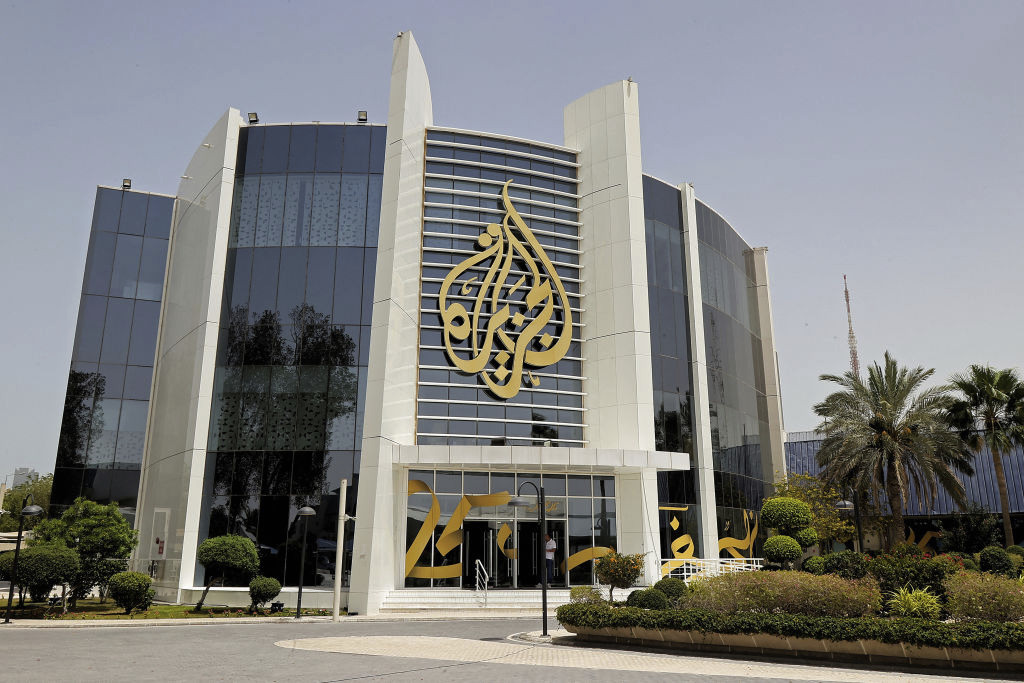
They Israelis and Palestinians have both come to the conclusion that Al-Jazeera's goal is to promote radical Islam and terrorism. It now remains to be seen whether the US and other countries will follow suit and stop the Qatari-owned TV station from supporting terrorism, poisoning the hearts and minds of millions worldwide, and ravaging global security.Pictured: The headquarters of Al Jazeera in Doha, Qatar. (Photo by Karim Jaafar/AFP via Getty Images)

The Palestinians have finally discovered that Qatar's Al-Jazeera television network -- which has long been serving as a mouthpiece for the Muslim Brotherhood, Hamas, and virtually all other Islamic terrorist groups -- is "broadcasting inciteful content, spreading misinformation, and interfering in internal Palestinian affairs, which [the Palestinian Authority Ministerial Committee] claimed stirred division and instability."

On January 1, the Palestinian Authority (PA) announced the suspension of Al-Jazeera's broadcast operations in the West Bank, ordering the temporary suspension of work by all journalists, staff and associated channels affiliated with Al-Jazeera, adding:

"The decision will remain in effect until the network resolves its legal status, which was deemed in violation of applicable laws and regulations in Palestine.

Continue Reading Article

Rabbi Ari Kahn on Parashat Shmot: The Birth of Redemption (video)

Rabbi Doniel Glatstein on Shemos: How We Were Able To Take the Blessings of Eisav and Yishmael By Going Down To Mitzrayim (video)

Rav Kook's Ein Ayah: The Danger of Accusing Scholars of Ulterior Motives

(based on Berachot 3:28)

Gemara: What is an example of one who speaks negatively about a talmid chacham (Torah scholar) after his death? It is as is found in a mishna: He [Akavya ben Mehalalel] said: The special sota waters are not administered to a convert or a freed slave. The Rabbis said that they are administered. They brought a proof from the story whereby a freed maid servant from Karakamit had sota waters administered to her by Shmaya and Avtalyon. Akavya answered: doogma they gave her to drink. They placed a ban on him, and he died with the ban upon him.

Ein Ayah: Rashi explains that doogma means that they gave her to drink because they were similar to her (they were from the families of converts).

The idea of speaking negatively about deceased talmidei chachamim refers to cases where someone assumes a suspicion that certain rulings of rabbis were motivated not by the depth of their understanding of the Torah’s laws or the true traditions they received but by personal interests, Heaven forbid. Actually, even if the critics were right, we would still be obligated to follow their rulings, for the Torah was not given to angels. Once someone is a decisor of Torah and his words were accepted by the rabbinical courts of the time, the Torah law to not stray from the words of the Rabbis applies. It is not for us to decide whether their intentions were pure from the outset regarding the case and whether the ruling was purely to get to the truth, which is certainly the case, or whether there was a matter of interest that sways the intellect. In any case, once the halacha is set, it becomes an entire element of Torah and woe unto us if we destroy it and weaken the hands of those who hold the tree of life [that the Torah is]. Rather we must fulfill with love and with holy trepidation all the words of the Rabbis and the fine inferences that the scholars make.

However, in the area of general morals, this bad [critical approach toward the Rabbis] makes many breaches by removing the foundation of the element of respect and honor for great people according to their holy and exalted value. This is along the situation that the prophet bemoans: “the youngster will be insolent to the elder” (Yeshaya 3:5).

Any society in which this phenomenon exists stands to be ruined even in the short term. This is certainly the case for the “vineyard of the house of Israel,” which is totally “planted” and reliant upon the foundations of Torah and wisdom, and the spirit of Hashem is forever its strength. The only source from which one can draw knowledge and fear of G-d is the wellspring of wisdom that comes from the scholars, who explained the Torah in a literal and in an expansive manner to set the path of life base on wisdom and fear of Hashem. Thus, one who attributes their words to personal inclinations or self-interest weakens the recognition of the lofty value and honor that should be attributed to the Rabbis and their rulings and sayings. Doing so will bring on an immediate moral loss and a weakening in practice and action over time as well.

This is why the gemara explains the foundation of speaking negatively about a deceased scholar by giving the case of accusing Shmaya and Avtalyon of giving a woman sota water to drink because she was similar to them. This would be an example of mixing in concern for their own dignity [by not distinguishing between their lineage and that of standard Jews] into their Torah rulings.

How out of hand is our generation in this regard of accusing the Rabbis of ulterior motives! May Hashem purify our wayward impulses and see to it that Hashem sees to our salvation, so that we will recognize the greatness of the fathers of our national goals, as the pasuk says: “Eating too much honey is not good, but the more one uncovers the honor [of the wise] is honorable” (Mishlei 25:27).

Three "Beliefs"

by HaRav Mordechai Greenberg
Nasi HaYeshiva, Kerem B'Yavneh

At the beginning of his mission to Bnei Yisrael, Moshe argues: "But they will not believe me." (Shemot 4:1) Hashem responds: "My children are believers, sons of believers," as it says: "The people believed, and they heard that Hashem had remembered Bnei Yisrael and that He saw their affliction, and they bowed their heads and prostrated themselves." (Shemot 4:31) Am Yisrael's faith repeats itself on the shores of the Red Sea: "They believed in Hashem and in Moshe, His servant." Their belief appears again a third time at the time of Matan Torah: "Behold! I come to you in thickness of the cloud so that the people will hear as I speak to you, and they will also believe in you forever." (Shemot 19:9)

Why was there a need for belief at Mt. Sinai after the Torah already states that Bnei Yisrael believed in Egypt and at the Red Sea? The Rambam (Hil. Yesodei HaTorah 8:1) writes that the initial belief was not absolute because it was based only on the miracles that occurred in Egypt and at the Red Sea:

Someone who believes because of miracles, there is doubt in his heart ... When did they believe in Him? At the Revelation at Sinai, where our own eyes saw, and our own ears heard ...From where do we know that the Revelation at Sinai is the only proof that [Moshe's] prophecy is true, that it holds no doubt? Because it says: "Behold! I come to you in the thickness of the cloud, so that the people will hear as I speak to you, and they will also believe in you forever." This implies that before this they did not believe in him with a trust that could last forever, but a trust that leaves room for consideration and thought.

The Maharal, on the other hand, writes (Gevurot Hashem ch. 47) that these events are not different levels of belief; they are three foundations of belief:

1. The belief in Providence, as opposed to the denial that argues: "High above all nations is Hashem, above the heavens is His glory" (Tehillim 113:4), that Hashem does not know and is not interested in what occurs on the earth below.

2. The belief in Hashem's existence, that not only does he exist, but also that he is the Creator and Omnipotent, and that there is no existence without Him. He is not dependent on anything, whereas everything else cannot exist on it's own and is dependent upon Him.

3. The belief in G-d's connection with man, that He spoke to him and gave him the Torah.

In Egypt Bnei Yisrael believed in Providence after they realized that Hashem saw their misery and remembered them. At the Red Sea they believed in Hashem's existence after He changed the sea to land, and they realized that the entire existence is dependent upon Him, and that He changes creation as he wishes. Rachav said: "For we have heard how Hashem dried up the waters of the Sea of Reeds ... For Hashem, your G-d, He is G-d in the heavens above and in the earth below." (Yehoshua 2:10-11) During Matan Torah they saw the voices and believed in prophecy and Matan Torah, as they said: "This day we saw that Hashem will speak to a person and he can live." (Devarim 5:21)

This is symbolized by the holidays, the three regalim (lit., feet). They are called regalim because "They are the feet of the religion, upon which the religion stands." Pesach indicates Hashem's ultimate existence and His ability to change the laws of nature. Shavuot corresponds, obviously, to the belief in Matan Torah. Succot, meanwhile, teaches about Divine Providence, as a reminder that Bnei Yisrael dwelled under the clouds of glory while Hashem guarded over them.

According to Sefer Ha'ikarim, Judaism is built on these three foundations, as opposed to the Rambam who mentions thirteen principles. Sefer Ha'ikarim writes:

What seems to me the correct path in counting the principles, which are the roots and foundations of the Divine Torah, is that the crucial and encompassing principles to the divine faith are three, and they are: Hashem's existence, Providence regarding reward and punishment, and that the Torah is from Heaven. These three are fathers to all the other principles of the Divine teachings.

Rav Kook on Parashat Shemot: Moshe's Love for Am Yisrael

Was Moshe's complaint appropriate?

When his initial efforts to free the Jewish slaves only resulted in Paroh issuing even harsher decrees, Moshe complained bitterly to God:

“God, why do You mistreat Your people? Why did You send me? From when I came to Paroh to speak in Your name, he made things even worse for these people. You have not rescued Your people!” (Shemot 5:22-23)

The Midrash says that the Middat haDin, sought to punish Moshe for his harsh words. But God saw that Moshe only spoke for the sake of the Jewish people, and he was not punished (Shemot Rabbah 5:27).

What exactly was Moshe's’ sin that he deserved to be punished? And what did God ’see’ that determined Moshe was not in the wrong?

The Sick Friend
Rav Kook explained the incident with the following parable:

Once there were two good friends, but one friend was seriously ill. His doctor determined that he could only save his life by performing a very painful operation.

During surgery, the doctor did not hold it against the patient when he moaned and wept. The poor man was in great pain, and his response was to be expected.

But when his healthy friend also wailed and cried out — the doctor ordered him to quiet down. The doctor interpreted his cries as a lack of faith in his medical skill, and even questioning the need for the painful procedure.


Feeling Their Pain
The Jewish slaves, Rav Kook explained, were like the ill patient. Divine providence decreed that the Jewish people needed to undergo Paroh’s harsh decrees in order to be redeemed, like a painful operation necessary to save the patient’s life. When the Jews cried out under the oppression and persecution of Egypt, that was understandable.

But Moshe — why was he complaining? Did he not have faith in God’s ability to redeem Am Yisrael? The Middat HaDin objected to Moshe’s complaints; this lack of faith should be rebuked and punished.

But the One who “searches the heart and examines the mind” saw into the depths of Moshe’s heart. Moshe was like a dear friend who cannot help but share in his friend’s pain. When the doctor operated on his friend, he felt as if the knife was slicing his own flesh.

“ Moshe is speaking for the Jewish people,” God pronounced. He did not deserve to be punished. The “faithful shepherd” cried out spontaneously, in his great love for his people.

This is the model for a true leader. The people are not a stepping stone to attain high office. They are the goal of public service.

As chief rabbi, Rav Kook was keenly aware of his duty to serve the people. Often he would sign his letters, עבד לעם קדוש — “servant to a holy nation.”

(Adapted from Mo'adei HaRe’iyah, pp. 233-234 by Rav Chanan Morrison)

The Divine Hand

by Rabbi Dov Berel Wein

The Torah leaves us basically unprepared for its description of the events that are recorded for us in this week’s parsha. When we last left the family of Israel at the conclusion of last week’s parsha of Vayechi, the Jews found themselves comfortable, affluent, protected and settled well in the land of Goshen.

The Torah does not describe to us the process by which this situation so radically changed into becoming a slave state for the Jews. It only tells us of a new king who didn’t know Yosef and, for reasons not explicitly mentioned in the Torah, became a hater and persecutor of the Jews.

The Torah seems to indicate that this is almost a natural state of affairs – to be expected. The Egyptian exile begins on a high note, deteriorates into abject sorrow and attempted genocide and ends with miraculous redemption. The Torah does not dwell upon any motives for the occurrence of this pattern of events. What did the Jews do wrong? Why was the Pharaoh such a hater? What were the economic or social factors of the time that allowed for such a dramatic worsening of the Jewish position in Egypt?

The Torah addresses none of these issues. It is almost as if the Torah wishes us to understand that these things happen blindly in human history. And, particularly in Jewish history, that the attempts of historians and sociologists to explain these irrational events and behavior patterns are really useless.

As has been often pointed out, all subsequent Jewish exiles – Babylonia, Spain, France, Germany, Eastern Europe, the Moslem Middle East – all seem to eerily conform to this original Egyptian template. As usual the Torah leaves us with more questions than it provides answers for. In effect, that is why the Torah is called the book of human life.

We are also unprepared to recognize the savior of Israel in the person of Moses. We are told how he was miraculously saved from the crocodiles of the Nile by the daughter of the Pharaoh and raised in the royal court. He sympathizes with the brutalized Jewish slaves, defends them, and is forced to flee from Egypt.

We hear nothing regarding Moses for the next sixty years until he reemerges as a shepherd in Midian, married to the daughter of Yitro, the local religious chief who, at this time, is still a pagan. Hardly the resume’ that one would expect for the leader of Israel, the greatest of all prophets and the teacher of all human kind.

Where did his holiness and greatness stem from, how was it developed, who were his mentors and what were his experiences over those long decades of separation from his people? The Torah gives us no clue or answer to these questions. It effectively points out that greatness oftentimes comes from unexpected sources and from people and leaders who operate outside of the usual establishment circles.

All of life is a mystery and certainly the Jewish story remains in its base an inexplicable one. This sets the stage for everything else that will now follow in the Torah. It is why the Jewish people, when accepting the Torah pledge to God that "we will do and then perhaps try to understand," if we wish to understand first we will never come to do. The Divine hand guides us but it is never subject to our rational thoughts and explanations.

Friday, December 27, 2024

Igrot Hare’aya – Letters of Rav Kook: A Public Letter on Observance of Shemitta – part I

#287 – part I

Date and Place: 4 Nisan 5670 (1910), Yafo

Recipient and Background: This letter for the public was apparently published in the newspaper “Hacherut” on 4 Nisan 5760 (halfway through the Shemitta year). As is clear from the letter, Rav Kook became aware of farmers who “took liberties” that his rulings forbade, and there was concern this would continue or increase over the spring/summer.

Body: Beloved, respected brothers! I feel an obligation to express something to you about the way the obligations of Shemitta should be handled this year, which by tradition is the Shemitta year.

There is no need to make pronouncements about what you already know – due to the difficult situation, for quite some time, rabbinic leaders who are beloved by the nation and love it with their whole soul, worked hard and agreed to push themselves into a very small space (i.e., a difficult leniency) based on the correct approach to Torah that gives [great weight] to the need to protect the dear Yishuv. This is the way Israel approaches rendering rulings in the case of hugely important need, in this case giving rise to the customary system that uproots the laws by means of the sale of the land. True, many and great rabbis, some of the greatest Torah scholars, who also excel at holy fear of Hashem and are well respected, criticized those who gave this lenient ruling. However, just like those who rule strictly, those who rule leniently do so with a pure heart with intention to act for the “sake of Heaven,” for the benefit of the nation and the Land. They act with authority, and it is appropriate for them to act according to the holy path they believe in.

Those great rabbis who took the yoke of this ruling on their shoulders drew the line in a manner that we should distance ourselves as well as we can from violations of Torah-level law. In other words, the leniency is arranged to apply only to those actions for which there are strong grounds to believe that their obligation is of a Rabbinic level; only in such matters, difficult situations warrant us to uproot the laws based on the system of selling the fields.

If we embrace this approach of the righteous, as the great majority of people in the Yishuv have done, then we will maintain the mitzva in the form that it existed [based only] on Torah law, and our offspring will not forget the existence of the mitzva. According to the degree the Yishuv in the Holy Land will expand, the situation can increasingly improve in regard to the sanctity of Shemitta as well, for the benefit of our nation and holy land, as well as the comfort of the spirit and [national] pride, until we reach the point when a new light, of redemption, will spread over Zion.

With this perspective, we should know how bad and bitter are the actions of individuals, who act without proper thought, to remove all guardrails and violate the rules with which the leniency was formulated. They desecrate the sanctity of Shemitta by means of actions that are forbidden by Torah-level law, which we did not include in the lenient ruling that accompanies the selling of the Land. These people are ruining the whole arrangement, which is a bad disservice for our Yishuv, the “young nursing baby” that requires so much care and supervision. This is because people start saying that the Yishuv as a whole tramples matters of sanctity and that matters of religion, Torah and mitzvot are discarded. When such irresponsible behavior spreads, Heaven forbid, it perforce increases the inclination of all rabbinic leaders to disallow support for the leniency of removing the sanctity and fight to implement the standard laws of Shemitta. How can we expect them to see that under the guise of a leniency based on uprooting, a system that was undertaken with concern and carefulness, large abuses that disrespect the Torah unabashedly exist? Understand how serious this is, considering how unfeasible it is for the Yishuv to survive without the leniency, which must be done according to the law by expert rabbis who are known for Torah and fear of Hashem.

Lights of Unity

by HaRav Dov Begon
Rosh HaYeshiva, Machon Meir


On Chanukah, we publicize the miracle of the victory over “the kingdom of Greece, which stood against Your people Israel to make them forget Your Torah and to have them transgress the laws of Your will.”

There are those who seek to project the struggle of the Maccabees from those days onto our time – viewing the conflict between the conservative approach and the new liberal approach, which rejects religion and tradition, as a direct continuation of the Maccabees’ wars against the Greeks. This perspective carries a tremendous danger of division and hatred, and could, G-d forbid, lead to a cultural war that could bring the worst of all – a civil war, Heaven forbid. Many ask themselves whether it is even possible to prevent a cultural war between religious and secular people. The answer is unequivocal – yes! Not only is it possible to prevent a war between Jews, but moreover, we can bring them to love one another. Therefore, a great responsibility rests upon us to prevent the stirring of the fires of division.

We must dispel the darkness by increasing the light, as Rav Kook, of blessed memory, said. Let us contemplate the Chanukah candles, which hint at lights of love and faith, lights of unity.

Currently, the forces acting today to make us forget the Torah and oppose the “laws of Your will” come, so to speak, in the name of progress and freedom, in the name of a developing and changing modern world. This destructive trend must be abolished by understanding that progress and freedom in no way contradict Judaism. On the contrary, our holy Torah views human freedom, as well as technological and scientific progress, as values that must be nurtured and encouraged, while simultaneously instilling in this world eternal spiritual and moral values that are unchanging. A human society cannot exist without the eternal Jewish values of justice and truth, of striving for peace and unity. The world would be pitch dark without the eternal values of Sinai, as recorded in the Torah of the Chumash and the Gemara.

Let us walk in the path of Rav Kook who said: “The purely righteous do not complain about wickedness, but add justice. They do not complain about heresy, but add faith. They do not complain about ignorance, but add wisdom.”

In this way it is possible and necessary to prevent a cultural war, and through this true enlightenment, we will all merit together to embrace a new light upon Tzion, speedily in our days, Ahmen.

Besorot Tovot,
Shabbat Shalom and Chanukah Sameach,
With love of Am Yisrael and Eretz Yisrael

Yeshivat Machon Meir: Sichot with the Rosh HaYeshivah Parashat Miketz (video)

When the setback is part of the journey

by Rav Binny Freedman

It was one of the darkest moments of my life. In retrospect it seems almost trivial; so insignificant against the backdrop of the significant events one experiences in life: marrying the girl of your dreams; the birth of your children; walking your daughter down the aisle at her wedding or holding your grandchild for the first time…. But at the time it seemed like my life had entered a dark cloud and I could not begin to fathom why it was happening.

After completing two months of basic infantry training, two months of tank school training to become a tank driver followed by the armored corps’ grueling twelve-week field training course, and then successfully completing tank commander’s course I was invited to IDF Officer training. This is a course by invitation only; no matter how much you want it the army has to decide you are worth the spot. I recall struggling with the decision as it meant signing up for a lot more army time, with no guarantee I would finish. As it turned out, I did not know the half of it.

There were two hundred and fifty of us who had been invited to try our hand at getting into Officer’s course and we were assembled for a month-long ‘mechin’ or prep course. The armored corps only had eighty spots for Officer’s course, and they wanted to be sure the cadets they chose would make it through. I was by then a tank commander with the rank of sergeant, and the temptation to let it go and finally enjoy army service as a soldier with rank, was almost overpowering. But I reasoned that if I had been offered a chance for a spot I had to try; maybe it was all part of Hashem’s plan….

I can still remember, after an intense month of constant tests, exhausting runs, navigations, and a variety of training exercises designed to see how we would fare under pressure, the day the names were called out. We were assembled on the parade ground (misdar) standing at attention while the eighty names were called out in what is known as a misdar de’maot or ‘parade of tears’; tears for the one hundred and seventy cadets who would not be going on to officer’s course.

Four months later after an even more painfully difficult IDF officer’s course at the infamous Bahd Echad, (IDF training base One) I can recall every moment of the day we received our IDF Officer oak leaf-and-sword pin.

Now there was only one course left; four months of one of the most grueling courses in the IDF was all that stood between me and receiving my second lieutenant’s bars: the IDF Tank platoon commander’s course.

And after three months and twenty-seven days, averaging three hours sleep a night, having slept in an actual bed for no more than seven or eight of those days, with just three days left to the course, a tribunal consisting of my company commander, battalion commander and the base commander, explained that they did not feel in good conscience they could send me out into the field to command men under fire.

I remember feeling it had all been like a whirlwind; perhaps it was my Hebrew which was still not up to snuff, or the fact that after so many courses one after the other I had not had enough field experience to run my maneuvers smoothly enough, but after the company commander had personally overseen one of my maneuvers followed by the battalion commander on a subsequent maneuver, my scores were apparently not high enough.

I had been given due notice throughout the course that my scores were borderline, but we had actually completed the course and were in the process of preparing for the final ceremony, practicing on the parade ground, giving back the gear we had signed off on, cleaning the tanks, and I could already taste it; I had allowed myself to think I was done, when they had sent word I was to appear that evening in dress uniform for a tribunal reviewing my course status.

They told me I was good; I just wasn’t good enough. And ten minutes later I was done; told I was free to leave the base and report for a new unit as a tank commander, the thought of spending the night on base watching all my buddies joking around and preparing for the ceremony was too much to bear.

Which was why I found myself at ten o’clock at night on a lonely stretch of road outside the base in the middle of the Negev desert, desperately waiting to hitch a ride, any ride and get as far away as I could from what I was now desperate to put behind me. For six hours I stood on the lonely road beneath the night sky full of stars with my kitbag and gear trying to figure it all out; if I was not meant to be an officer then what was the point of all the hell I had just been through? It was absolutely one of the darkest nights of my life….


This week’s portion of Miketz offers us a glimpse into just such a moment in the life of Yosef: beloved and favored son of Yaakov.

After being sold as a slave and eventually plucked out of the pit of Egypt’s Royal prison system, Yosef, literally overnight, finds himself standing in front of no less than Pharaoh himself being asked to interpret his dreams.

The seven fat healthy cows consumed by the seven sickly cows along the Nile, and the second dream of seven healthy wheat stalks consumed by seven moldy stalks all mean there will be seven years of plenty followed by seven years of famine.

And we all know how the story plays out: Paroh, impressed by Yosef’s wisdom and humility (“it is G-d who provides the interpretations of dreams…”) appoints him to be the viceroy over the entire Egyptian empire, and in a moment, the lowly slave has become the second most powerful person in the world.

But there is one fascinating and seemingly insignificant detail in the story that begs a question: Paroh has two dreams, and they both seem to be identical. So why the need for both dreams?

Yosef actually explains this puzzling detail:

“That Paroh has dreamed this twice means that G-d is firmly resolved regarding this plan and is speedily setting it in motion.” (Bereisheet 41:32)

And one wonders how Yosef knows this? It may well be that G-d has shared with Yosef a prophecy to that effect, but the Torah usually shares such information as prophecy; here, there is no ‘and G-d spoke to Yosef…’ so one has to wonder.

Think about it: Paroh is not the first person to have two dreams; Yosef himself had two dreams many years earlier, which seemed to be the prelude for everything that happened subsequently as the favored son of Yaakov, dreaming of wheat bushels and even the sun moon and stars bowing down to him, suddenly found himself in a pit and then as a slave in darkest Egypt wondering what had happened.

It is hard to imagine Yosef standing before Pharaoh, not recalling his own dreams as well, and one wonders if Yosef suddenly began to realize he was finally getting a glimpse of the bigger picture.

It must have been devastating for Yosef; one minute he was the favored son of Yaakov, gifted with a beautiful technicolor coat as a symbol of his father’s love and dreaming of great things; even the sun moon and stars would bow down to him!

He must have felt G-d was guiding his path: he was destined for greatness.

And in a whirlwind of events he found himself in a pit of despair. First the pit his brothers threw him in, and later the pit of Egyptian servitude. Gone were his delusions of grandeur as the years snuck by and no salvation seemed imminent.

His beloved father Yaakov was not coming to save him and no one seemed to care as he languished in the pit of despair; even the butler whose life he had saved had long forgotten him.

But the Gemara tells us:

“Yeshuat Hashem ke’heref ayin”

“The salvation of Hashem (G-d) can come like the blink of an eye”

And as Yosef stands before Paaoh, perhaps he finally starts to realize this was all part of a bigger picture. It was not the brothers who had thrown him into that pit all those years ago; Hashem had placed him in that pit; indeed, Hashem had been guiding his journey all these years.

In fact, it is fascinating to note that Yosef as a young lad dreamed of wheat bushels bowing down, and Paroh dreamed of wheat stalks being consumed, and it was through the storing of wheat and its later barter that Yosef becomes the instrument for G-d’s plan causing the brothers to eventually come down to Egypt.

And of course, the brothers’ coming to Egypt leads to the eventual servitude of the Jews in Egypt which itself leads to the eventual Exodus which of course leads to the giving of the Torah and the Ten Commandments and the Jews’ eventual return to the land of Israel… because it’s all part of Hashem’s plan….

Perhaps Yosef realizes: that pit was not a setback at all; it was all part of the journey.

And that pit was what allowed Joseph not just to stand before Paroh, but to stand before him with humility which was probably why he was appointed viceroy….

Sometimes we find ourselves in the pit of life, and things all seem to be headed in the wrong direction. But there is always a bigger picture; we just don’t usually get to see it. And though it may seem the wrong direction to us, Hashem is a pretty good navigator, and if we wait long enough, sometimes we get a glimpse of where that journey was really taking us.

They had told me, just before dismissing me, that although normally when a cadet is dismissed from Officer’s course he is never allowed to return (having been found unworthy), in my case, given the circumstances, I would be allowed to repeat the entire course form the beginning; but I had only until Sunday morning to decide….

I thought they were nuts; and in that moment, could not imagine doing it all over again. But after a long tortuous weekend, I decided I had to try if only so I would not spend the rest of my life thinking ‘I should have…’

Which was why, four months later, I finally found myself, nearly two years after first donning an IDF uniform, on the parade ground on that same base in the Negev desert, this time under a bright sun, squinting up at Moshe Levy, the IDF Chief of staff as I received my lieutenant’s bars at last.

It would take a while longer, on a lonely stretch of road in Lebanon, before I finally started to glimpse why I needed those extra months in Officer’s training and why sometimes ‘good’ was actually not good enough. But then, that’s another story…
.

Shabbat Shalom and Chanukah Sameach from Yerushalayim.

Millions of Christians Are Under Islamist Assault, so Pope Francis Targets the Jews

Perhaps he believes that pointing a finger at the Jews will divert Muslim rage from the Vatican.

by Charles Jacobs and Uzay Bulut
  • The Jews are not committing genocide against Muslims in Gaza, whose population grew almost 3% last year. Muslims, however, are committing mass murder via jihad against Christians in Africa. Yet the Pope cowers from defending his own flock.
  • The number of Christians intentionally murdered, let alone tortured, raped, kidnapped and forcibly converted to Islam far exceeds the number of Gazans killed unintentionally as Israel directs its fire at terrorists who hide behind civilians. Indeed, Israel is defending its population from the very same jihadist assaults faced by African Christians.
  • Ahsan Raja Masih, a young Pakistani Christian, has been sentenced to hang for his faith over false "blasphemy" charges. The Catholic Bishops of Pakistan have recently joined the Christian community's outcry against the death sentence. Where is the Pope?
  • By turning reality on its head, the Pope's shameful defamation of the Jews complements his passivity in the face of Islamic jihad against Christians. Perhaps he believes that pointing a finger at the Jews will divert Muslim rage from the Vatican. Surely, it distracts the world from his own cowardice and failure to protect Christians.

"Nigeria is the most violent country in the world for Christians. Every two hours, a Christian is killed in Nigeria," according to Open Doors. Pope Francis has not called for an investigation of the jihadists and their sponsors. Pictured: State officials walk past wounded survivors of a jihadist attack on St. Francis Catholic Church in Ondo State, Nigeria, in which they murdered 50 Christians, on June 5, 2022. (Photo by AFP via Getty Images)

Christians face persecution, discrimination, forced conversion and even mass murder for their faith in many parts of the Muslim world, yet Pope Francis, in his upcoming book called Hope, calls for an investigation to see if the Jews are committing a "genocide" against Palestinian Muslims in the Gaza Strip.

The Jews are not committing genocide against Muslims in Gaza, whose population grew almost 3% last year. Muslims, however, are committing mass murder via jihad against Christians in Africa. Yet the Pope cowers from defending his own flock.

Africa has become the epicenter of radical Islamic terrorism. Murderous jihad attacks against Christians abound in Nigeria, Mali, Burkina Faso, Egypt, Niger, the Central African Republic, Mozambique, the Democratic Republic of Congo and Cameroon.

Continue Reading Article

Thursday, December 26, 2024

How Israeli Arab Leaders Betray Their Own People

by Khaled Abu Toameh
  • "For the longest time, I struggled with my identity. A Palestinian kid born inside Israel. Like...wtf. Many of my friends refuse to this day to say the word 'Israel' and call themselves 'Palestinian' only. But since I was 12, that did not make sense to me. So, I decided to mix the two and become a 'Palestinian-Israeli.' I thought this term reflected who I was. Palestinian first. Israeli second. But after recent events, I started to think. And think. And think. And then my thoughts turned to anger. I realized that if Israel were to be 'invaded' like that again, we would not be safe. To a terrorist invading Israel, all citizens are targets.... And I do not want to live under a Palestinian government. Which means I only have one home, even if I'm not Jewish: Israel." — Nuseir Yassin ("Nas Daily"), Israeli Arab blogger, the day after October 8, 2023.
  • These [Arab Israeli] leaders will do anything to grab the attention of the media – even if that means inciting against Israel. They know that when they deal with the real problems facing their Arab constituents – such as unemployment and poverty – no one will write about them in the media. Yet, when these leaders make fiery statements against Israel, they often win headlines and front-page stories. As far as they are concerned, "I don't care what you write about me as long as you spell my name right."
  • By engaging in anti-Israel incitement, these Israeli Arab leaders are causing huge damage to their own constituents. These leaders make the Israeli Arabs look as if they are a "Fifth Column" -- an enemy within. These leaders are stoking fear and mistrust between Jews and Arabs inside Israel, while ignoring that most Israeli Arabs say they feel comfortable living in the Jewish state.
  • If Israeli Arabs want to secure a prosperous future for themselves and their children, they need to get rid of extremist Arab leaders who speak and act against the interests of the Arab community inside Israel. If these Arab leaders are unhappy living in Israel, they are welcome to move to the West Bank, Gaza Strip or any Arab country -- where they will quickly miss Israel's democracy and freedom of speech.

While the attitudes of the Israeli Arabs toward Israel are encouraging, some of their leaders continue to act against the interests of their own people. These leaders, including current and former members of the Israeli Knesset (parliament), have long been taking advantage of the country's democratic system to engage in anti-Israel rhetoric, causing huge damage to their own constituents. Pictured: Arab Israeli Members of Knesset Ayman Odeh (L), Ahmad Tibi (R) and Aida Touma-Suleiman in the Knesset chamber, in Jerusalem on July 10, 2023. (Photo by Menahem Kahana/AFP via Getty Images)

The Iran-backed Palestinian Hamas terrorist group has long been seeking to spark a civil war between Israel's Arab and Jewish citizens. Over the past few years, Hamas has called on the two million Arab citizens of Israel to revolt against their own country and join the Jihad against Israel.

Hamas's attempts were partially successful in May 2021, when some Arabs attacked their Jewish neighbors. The assaults occurred at the same time as an Israeli military operation in the Gaza Strip. That operation was launched in response to rockets fired by Hamas and other Palestinian terrorist groups at Israel. Fortunately, the violence that erupted in 2021 ended quickly.

Continue Reading Article

Wednesday, December 25, 2024

Yosef’s encoded message

by Rabbi Pinchas Winston

I have mentioned several times in the past that when Yosef, as Viceroy of Egypt, accused his brothers of being meraglim—spies, it was a coded message. Each of the Hebrew letters—Mem-Raish-Gimmel-Lamed-Yud-Mem—stood for a different word, the coded message being: M’Immi Rachel genavtem, l’Midianim Yishmael mechartem—from my mother Rachel you stole me; to Midianites, Arabs you sold me. Not bad, eh?

And the brothers were supposed to figure that out off the bat? They had just gotten down to Egypt and it was the first thing to go wrong. That the man standing before them dressed and acting Egyptian and wielding so much power was Yosef was the last thing they could have imagined at that point. So what was the point of Yosef’s encoded message?

It wasn’t for that moment. It was for later, after they had gone through enough to make them start to question what was really going on, which they began to do once they found their money in their sacks on their way back home. Until that time, they were still in their own world and only asked the questions they wanted to. Freaking them out with weird events forced them to start asking questions they didn’t want to.

After all, “necessity is the mother of invention.” Why invent something new when the old works well enough? It’s only once people suffer for reasons they can’t figure out that they go looking for answers, answers that often lead to other questions and then other answers.

And not just for things that are currently happening, or will in the future, but also retroactively. The brain has a remarkable way of doing that, of taking new information and using it to solve old puzzles, sometimes even unconsciously. When Yosef accused his brothers of being spies, he was planting the seeds of future revelations.

Still, even if the brothers had begun to suspect that the Viceroy was Yosef, a big leap of faith to begin with, breaking the world meraglim down into six separate words that told the tale of his sale and enslavement was an even bigger leap. It would have been like figuring out the winning number of a lottery in advance using mathematics. It might be possible, but the odds are heavily against being right, even for the smartest person in the world.

But you can’t believe how many things you enjoy in life whose discovery had similar odds. Some were just the result of trial and error, lots of trial and error. Others were discovered more quickly because of some “lucky” circumstance. But since we don’t believe in luck at all, because everything is a function of Divine Providence, we have to assume that God decided to give the discoverer a break by speeding up the right result.

It works the same with insights as well. If I had a dollar for every time an insight came to me because of some unplanned circumstance, I could almost retire. I’m talking about getting the idea for a parsha sheet or an entire book because I happened to be thinking about something at a bus stop while a bus went by with an advertisement on the side. The advertisement had nothing to do with the idea I was thinking about, but seeing it at exactly the same time I was thinking about an idea somehow led to a new insight.

Yosef had known that if he got his brothers started, they would ask the questions, maybe even do a little teshuvah and warrant the necessary Divine Providence to work out the puzzle. In fact, one of the best ways to know if you’re going in the right direction in life is how God helps you connect the dots in whatever you’re doing right. Somehow life, history, a book, a person, or even the most unusual thing will make some impression on you to move your thinking in the right direction.

Because knowledge is just light, Divine light. But being holy, it can only flow to people according to their level of holiness. The more fitting a vessel is spiritually speaking, the greater and more insightful the light will be. The higher a person ascends spiritually, the higher the spiritual light they can access will be.

This is what it means that the Ohr HaGanuz, the Primordial Light that God hid on Day One of Creation from the evil history, can be found in the thirty-six Ner Shel Chanukah. Obviously, it is not a physical thing, but a spiritual one, not something seen with the physical eye but the mind’s eye. And the thing about the mind’s eye is that it opens only as wide as a person’s heart does for truth.

Countless times throughout history, people have come to know far more knowledge than they actually learned, more sophisticated knowledge than they should have been able to. We don’t notice it much in our own lives because most people never try to know or understand much more than they need to in order to get by in life. So God says, “If they don’t want to know, why should I tell them?”

Want to know, so God will tell you…and you will be more than amazed by what He has to say. A freilechen Chanukah.

Israel, Amos and the Philistines

by Nils A. Haug
  • Israel's enemies in Gaza today, like the Philistines of old, constitute a mortal threat to the nation, although that threat diminishes as Israel again succeeds in overcoming its enemies.
  • One hopes, with the astounding team of Israeli Prime Minister Benjamin Netanyahu and US President-elect Donald J. Trump, who successfully initiated the Abraham Accords, that jihads, pogroms and similar events will no longer take place, and that Israel will soon herald in a new dispensation of peace and redemption, as promised to Moses on Mt. Sinai, and live once again as "a kingdom of priests and a holy nation."

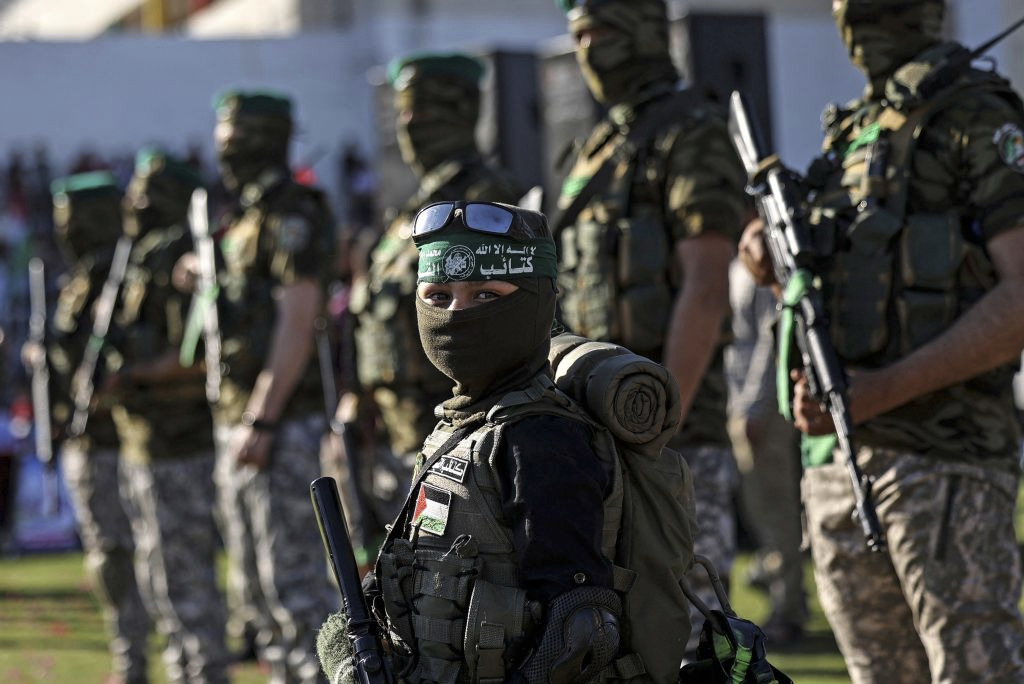
Hamas has been occupying Gaza, as did the Philistines. Both tribes had a similar agenda: eliminating all Israelites, the Israelis of today. Pictured: Hamas terrorists with their child trainee at a rally in Gaza City on May 24, 2021. (Photo by Mahmud Hams/AFP via Getty Images)


The Hebrew prophet Amos lived some 2,700 years ago, during the reign of King Jeroboam II of Israel. At the time, the Israelites' main enemies were the Philistines of Gaza, reputed to be the most menacing tribe in the region and dedicated to the destruction of Israel.

Amos predicted dire punishment for the Philistines, who had taken "captive whole communities and sold them to Edom." The Philistines had attacked the Israelites, enslaved and sold them to another of their enemies, the tribe of Edom. According to Amos, divine retribution was at hand. Certain passages of Amos's prophecy cite the punishment of Israel's Gazan enemies:


"Because she took captive whole communities
and sold them to Edom,
I will send fire on the walls of Gaza
that will consume her fortresses.
I will destroy the king of Ashdod
and the one who holds the scepter in Ashkelon.
I will turn my hand against Ekron,
till the last of the Philistines are dead."

Continue Reading Article

Rabbi Doniel Glatstein on Chanukah and Parshas Mikeitz: Rashi's Frequent Citing of Targum in Mikeitz (video)

Rabbi Ari Kahn on Parashat Miketz: The Executioner’s Protégé (video)

Rav Kook's Ein Ayah: Thanking Hashem and Divine Free Will

Gemara: From the day the world was created, there was no one who thanked Hashem until Leah came and thanked Him, as the pasuk says: “This time I will thank Hashem” (Bereisheet 29:35).

Ein Ayah: There is a difference between a blessing and thanksgiving. A blessing is said on any good thing that comes from a specific cause even if was not done especially for the purpose [that positively affected the one who is blessing]. Examples are: “blessed be he who begot this child;” “blessed is he who raised this child.” In contrast, thanksgiving comes specifically over a good thing that came from the free will of the provider of the good, who could have either provided it or refrained from doing so.

It is for this reason that until Leah, no person bothered to give thanks. Although Hashem is the real reason behind all things, matters do not emanate from Him in a manner that He needed to do so, as some philosophers posit, but out of Divine free will, which is deserving of thanks. One should not deflect the opinion [that Hashem is forced to by absolute Divine justice or logic] because if everything [that Hashem brings] comes of Divine necessity, then there would be no room for service of Hashem and reward and punishment, which the forefathers already taught us exist. This is not necessarily so. It is plausible that Hashem brings on all the good things and the entire existence with all of its details with wonderful providence so that even human completeness (shleimut), which is included in existence, is an outgrowth of it. It would follow from this possibility that since man needs to serve in holiness to elevate his soul and fix his attributes in order to be complete, this would cause the Divine shleimut to arrange that the more righteous one is, the more he would merit shleimut and real success, etc. Since it is plausible, one could have said that Hashem is forced to act in a certain way.

Despite the above explanation’s plausibility, the truth is not that way. After all, man’s ability to thank Hashem includes a major part of the ethical element and the loftiness of the human spirit, which could not be missing from existence. This shleimut couldn’t exist unless there was a Divine manner of leading the world that extended from Divine free will without any element of Hashem having to act in a certain way out of necessity. [In other words, Hashem ensured His own free will so that we could be able to thank Him.] This is why Leah came and thanked, to let this true idea be known. Based on this foundation was built the obligation of the korban todah (the thanksgiving sacrifice), whose level is lofty and will not be done away with even in the Days to Come.

One should understand that prayer could have existed even if Hashem would have been drawn into a certain behavior out of [moral] necessity. This would have worked in the following manner. Since a person becomes more complete through his prayers to his Maker, Hashem could be forced through His Divine shleimut to find value in the prayer, which could cause its goal to be reached. [The approach of Divine necessity, then,] would not preclude the need for all the things that prepare and uplift the value of one’s prayers. However, the matter of thanks to Hashem and the human shleimutthat comes with it, would by necessity be missing had the truth not been that the Divine manner of leading the world is not forced but is of choice, as we say “life by His will” (Tehillim 30:6). [It turns out that] the human shleimut which we get based on our free choice serves as a trustworthy witness regarding our Maker [who also has free choice]. This is why there is chametz in the korban todah, for chametz is an indication of the reversibility of the good powers that are responsible for the freedom of choice. This would not be appropriate if all the powers were capable of doing only good.