Wednesday, May 12, 2021

To choose dignity over indignity

by Rabbi Pinchas Winston

Friday Night
WE GENERALLY READ Parashas Bamidbar in advance of the holiday of Shavuos. To begin with, Kabbalas Hatorah was a desert experience. We did not receive it in Egypt and we did not receive it in Eretz Canaan. God descended upon a mountain in the Sinai desert, and made it bloom like Gan Aiden before He did. Talk about “atmosphere.”

Furthermore, the Talmud says that if a person wants to learn and keep Torah, they must make themselves into a midbar—desert, a symbol of humility. It is ownerless, trampled by anyone who goes there, and produces little of physical significance. Likewise, a person who sincerely wants to learn Torah has to detach themself from the trappings of this world. Otherwise, their heart will be divided between the eternal world of Torah and the temporal world of materialism, something many a Torah Jew struggles with especially today.

I have also pointed out in the past that the same letters that spell “midbar” also spell the word “medabehr,” which is someone who speaks. Considering that Onkeles says that receiving a soul gave us the power of speech, and the Talmud says that the entire purpose of life is to speak in Torah (Sanhedrin 99b), this is hardly incidental. The Zohar even says that it is a person’s speech that reveals who they truly are.

Speech is one of those things that is so natural that we tend to take it for granted. Until that is, a person loses the ability to speak, God forbid. Taking it for granted makes it very easy to abuse, so that even theoretically “refined” people sometimes resort to foul language to make their point, or to leave their mark. As if this wasn’t bad enough in everyday life, people pay money to watch others speak that way, for no other reason than “entertainment.” It just makes it so much more “lifelike.”

But not if you’re a superhero. Somehow people know that having a superhero use inappropriate language makes them, well, so much less a superhero. And when a more down-to-earth hero seems to accomplish great things without “compensating” with bad words, it seems to make them so much more, well, super.

Many argue that it has nothing to do with anything real. They claim that someone got the idea a long time ago that what they defined as “inappropriate” language was base, and somehow convinced society of this as well. They believe that people’s distaste for such language, and the people who use it, was nurtured, not “natured.” And they are right, sort of.

Shabbos Day
A CHILD HAS no problem with filth. They do not feel any need to run and grab a tissue just because their nose is running. They are okay with torn and messy clothing, even in the fanciest of places. This is why when we see adults behave similarly, we think they are immature if they do not have a “mature” excuse to look so unkempt.

There is something emotionally “cleansing” about being physically clean. We NEED a good shower at the end of a hard day, and we NEED to clean up before eating. Somehow being clean enhances the human experience. I appreciated this even more when watching a cat the other day roll back and forth in a very dusty patch to scratch its back and sides. The cat felt great, but I all of a sudden had a desire for a shower.

We have a word for it: dignity. This is “the state or quality of being worthy of honor or respect.” We crave honor. We demand respect, first from ourselves and then from others. Somehow being honorable and respectable validates our existence and makes it more meaningful. Though our bodies may buy into the whole “survival of the fittest” thing, there is also something about being human that demands we tweak our definition of survival “fitness.”

This is what children lack, a sense of dignity. A child will not hesitate to do things that we, as adults, may also want to do, but won’t as a matter of self-dignity. And even many who cannot control their childish tendencies will act in a concealed manner, aware of how they will look to others if caught in the act.

In a sense this is really what “sin” is all about, acting childishly. The Torah emphasizes the need to teach children from a young age how to act in a dignified manner. God however does not hold a child responsible for their behavior until Bar or Bas Mitzvah age. That’s when they are supposed to become a “Bar Da’as,” someone capable of recognizing the need to live in a dignified manner.

The fact that undignified behavior makes exciting news shows us that even secular society considers such behavior to be “sinful,” punishable by public shame. In some cases, the punishment is even more severe. The fact that the Torah calls it a “sin” and makes such behavior punishable in one of a few ways, shows us that undignified behavior is actually a sin against our Creator. It reveals that immaturity is not only disgraceful, but a denial of one’s own godliness.

In fact, life could be defined and gaged by where a person is holding on the continuum between immaturity and maturity. The process of “growing up” is one of moving further away from the former while approaching the latter. It is not merely about learning what the right thing is and then doing it. It is about using the “right” thing to bring us to new levels of maturity…of dignity.

This is the biggest obstacle a person has to receiving Torah, a desire to not grow up. They’ll perform good as much as they have to in order to get by in life, but not more. Children love fun. Adults love pleasure, and though the two can be the same at times they are often not. Fun can often mean a surrender of dignity, if only momentarily. Pleasure often means a surrender of “fun,” and the child inside all of us has a BIG problem with that.

Shalosh Seudot
WHEN GOD MADE the animals, it mentioned nothing about any image of God, even though they too have a spark of life and do really remarkable things. God is the life force within them, but there is nothing godly about them. They belong to God, and must be treated respectfully. However they know nothing about dignity and behave as programmed regardless of what others might think about them.

When man was created, it was a different story:

And God created man in His image; in the image of God He created him; male and female He created them. (Bereishis 1:27)

Since God is not physical at all, “image” cannot be physical. Since man is physical, “image” cannot be completely spiritual. What’s left? As the Nefesh Hachaim explains, there has to be some aspect of man that is the same as some aspect of God. According to the Sforno, it is our power of reason. But according to this verse, that doesn’t sound so positive:

God said, “Behold man has become like one of us, having the ability of knowing good and evil, and now, lest he stretch forth his hand and take also from the Tree of Life and eat and live forever…”(Bereishis 3:22)

The answer to these questions came at the end of the previous chapter:

Now they were both naked, the man and his wife, but they were not ashamed. (Bereishis 2:25)

They did not know the way of modesty, to distinguish between good and evil. Even though knowledge was granted him to call [all the creatures] names, he was not imbued with the evil inclination until he ate of the tree, and the evil inclination entered into him, and he knew the difference between good and evil. (Rashi)

They weren’t ashamed, but not because they had chosen to live dignified lives. Prior to the sin of eating from the Aitz Hada’as, they had not known how to live any other way but honorably. And it can’t be called living nobly if living nobly is all you are accustomed to do. To be truly noble, once must have the opportunity to live in an undignified way, and then choose dignity instead.

This is why Adam and Chava had to leave the Garden of Eden. Yes, it was banishment for having sinned. The question is, was that a punishment, or a consequence? If the goal of life is to choose to live a dignified life, the Garden of Eden was not the place for that. The world we live in outside the Garden is. The sin may have activated the yetzer hara and opened the door to sin, but as God told Kayin:

“Is it not so that if you improve, it will be forgiven you? If you do not improve however, sin is lying at the entrance, and to you is its longing, but you can rule over it.” (Bereishis 4:7)

“You,” God told Kayin, “can choose dignity over indignity, and in doing so live up to the image of God in which you were created.” It would be a mistake to think that God was only talking to Kayin. He says the same to each of us every day of our lives.

Melave Malkah
THIS IS THE Torah’s offer to us. It will say later:

This day, I call upon the heaven and the earth as witnesses [that I have warned] you: I have set before you life and death, the blessing and the curse. You shall choose life, so that you and your offspring will live… (Devarim 30:19)

Choose life. The words are both profound and obscure. Obviously the Torah is not trying to talk us off a ledge. It is telling us two things. The first is, breathing means you’re only alive. It doesn’t mean you are truly living. The second thing is, living is not something that just happens, only death. Living is a choice you have to make, and make, and keep making the entire time you are alive.

Obviously the Torah has mitzvos in mind, and even says so in the next verse. But even that is a general statement, which is why so many Jews throughout the ages have turned away from Torah and mitzvos for a more “carefree” life. They chose fun over pleasure because they only understood the one and not the other. They thought the Torah was only interested in making them “good.” They didn’t understand that the Torah was trying to give them dignity.

They did not understand how much dignity mattered to their sense of being, and well-being. They assumed, as so many always have, that dignity is just a nice thing to have, at least every once in a while. They did not know, and therefore could not appreciate, that it is our sense of dignity that allows us to confirm our very existence by making life meaningful. It’s just the way we’re made.

We have moved on too quickly from the Lag B’omer tragedy, especially since many families may never be able to. There were, of course, those who chose the undignified route of looking for blame and where to put it. But if you listen to the stories of the people who were there and witnessed the response of so many to what happened, you hear about just how dignified—godly—humans can be. The tragedy brought this to our national attention, but it is Torah’s call to us everyday.

The acceptance of Torah? More like the acceptance that we were made in the image of God, and that like God, we can choose to be noble in spirit and dignified in action. Fortunate is the person who understands this. Great is the person who chooses it as their way of life.

Good Shabbos, and a successful Kabbalas Hatorah.

“Let us Fulfill Gladly all the Torah’s Teachings!”

by HaRav Dov Begon
Rosh HaYeshiva, Machon Meir


“The Torah is embedded in the Jewish spirit. The abstract spirit of Israel encompasses everything, the light of G-d, the purpose of existence, the spiritual life-source. When the Torah gains a stronger foothold, when its knowledge spreads, when its light shines forth, when its sentiments strike deep roots within every soul, the divine light permeates still more throughout the world, rising in grandeur, and the entire world ascends spiritually” (Rav Kook, Orot HaTorah, 12) 

It is a Jewish custom that when a child reaches the age of speech, his father accustoms him to saying, “Moses prescribed the Torah to us, an eternal heritage for the congregation of Jacob” (Deuteronomy 33:4). Already from earliest childhood, a child hears that the Torah is an inheritance, and that it belongs to the entire Jewish people. The Torah does not belong just to this individual or that, or to this movement or that. Rather, it belongs to the entire Jewish people till the end of time.

Before the Sinai Revelation, the Jewish people repented, abandoning their divisiveness and uniting, as it says, “They had departed from Rephidim and had arrived in the Sinai Desert, camping in the wilderness. Israel camped opposite the mountain” (Exodus 19:2). Rashi comments, “As one man, with one heart.” From their receiving of the Torah, about 3000 years ago, until today, the Jewish people have never ceased to learn, teach, and fulfill our holy Torah. The Torah is a book of life. As it says, “It is a tree of life for those who take hold of it” (Proverbs 3:18).

Today, our generation, the generation of the rebirth and of ingathering of the exiles, is facing spiritual, social, physical and political crises. The means of rectifying this complex situation is to foment a change in culture and education, and to establish Torah learning as a national value of the first order. All Jewish children, and adults as well, should be learning Torah, as was the situation during the time of King Hezekiah, who passed a compulsory education law. If during the dark exile, Torah learning illuminated the Jewish souls, ensuring their survival, all the more so in the Land of Israel and State of Israel, that the Torah learning of myriad Jews should strengthen the spirit of the nation.

Our holy Torah belongs to the entire Jewish people, and to every individual Jew. We shall certainly be the living fulfillment of the blessing, “Our Father! Merciful Father! You, who are ever compassionate! Have pity on us and inspire us to understand and discern, to perceive, learn and teach, to observe, do and fulfill gladly all the teachings of Your Torah” (Blessings of the Shema).

With blessings for a joyous Shavuot holiday,
Looking forward to complete salvation.
Shabbat Shalom.

Why Does Tragedy Strike Us?: The Tragic Events in Meron on Lag B’Omer 5781

BS”D
Parashat Bamidbar and Shavuot 5781
by HaRav Nachman Kahana


The tragic events in Meron on Lag B’Omer seem so long ago because in HaShem’s “divine little acre” challenge pursues challenge and headache pursues heartache.

That most people suffer in this world is axiomatic, but so too is the reality that HaShem’s chosen people suffer most. Why?

There is a fundamental difference between why humanity as a whole must suffer anguish, and the suffering of Am Yisrael. Gentiles are punished because of their evil ways. The purpose of Jewish suffering is not to punish, but to serve as a warning and a signal from HaShem for us to redirect our failing ways.

I have felt for years that Meron would be the place for a tragedy – one that would grip the nation and hopefully shock us to return to Jewish sanity.

Every year before Rosh HaShana, tens of thousands of Israelis leave the Holy Land in order to re-charge their spiritual batteries in preparation of drawing closer to HaShem in the town of Uman – in that immense Jewish cemetery called Ukraine. And every year, hundreds of thousands of Israelis throng in pilgrimage to the town of Meron in the upper Galil to unite in religious fervor through the kindling of the fire in their souls via the glorious fires of Chassidic rebbes.


Both the trekkers to Uman and the olei regel of Meron share a common flaw – Yerushalayim and the Temple Mount are excluded from their religious equation! Where is Har HaBayit when these pilgrims are being enthralled and enraptured in their religious commitments? The “Mountain of HaShem” is bleak and silent, except for the Islamic heirs of Hitler defiling the holiest precinct of Am Yisrael with their presence.

Then the hatchet fell. On Friday, Lag B’Omer the 18th of Iyar, in the week that we read from the Torah parashat EMOR, 45 Jews were trampled to death in Meron.

The Tragic Earthquake of 5597
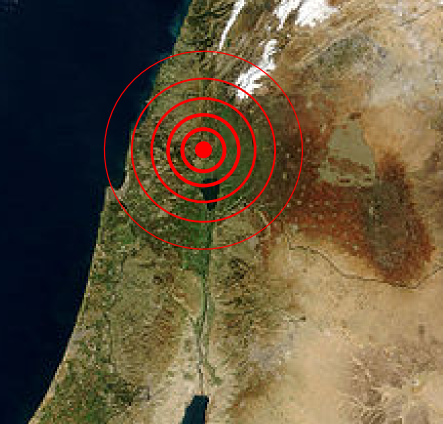
In 1837, a tragic earthquake occurred in the north of the country. The towns of Tiveria, Shechem and 30 other villages were affected, with the death of thousands and the destruction of homes and lives. The worst affected was the town of Tzfat.

The illustrious Chatam Sofer (1662-1739) spoke in his bet midrash after the event and recorded his drasha in his commentary on the Torah (Torah Moshe).

The following is an excerpt from his drasha.

רעידת הארץ הוא מקנאת ירושלי’ כי צדיק הוא אלקינו, וקנאת ירושלי’ עשתה זאת, כי שם שער השמים עיר שחוברה לה יחדיו שם הר המורי’ עקידת יצחק שם שכב יעקב וחלם לו סולם שם הר בית ה’ ותל שכל פיות עליו פונים ולא זזה שכינה מכותל מערבי, והנה לגמרי זה מקרוב מאה שנים שמו פניהם לצפת כי שם קבר איש אלקי הרשב”י במירון והאר”י בצפת וכל העולים לא”י לא שמו פניהם אלא לצפת וטברי’ – וירושלי’ נשכחה לגמרי והוא עיר שם ה’ שמה שגם בזה”ז מצוה לעלות לרגל לירושלים… לא שם איש על לב אלא לעלות לצפת להילולא דרשב”י…

The earthquake was the expression of HaShem’s zealousness for the honor of Yerushalayim, for HaShem is righteous in all His ways. Yerushalayim is the “Gateway to Heaven,” the city united with the spiritual world. Therein is the site of Mount Moriah where Avraham was prepared to sacrifice his son Yitzchak. There Ya’akov saw in a dream the ladder connecting the worlds. There is the place of the Bet HaMikdash towards which all Jews face in prayer; the place where the Shechina never abandoned the Western Wall.


Now it has come to pass that for the past one hundred years, people have been making their way to the area of Tzfat where Rabbi Shimon bar Yochai is interred at Meron and Ha’Ari is buried in Tzfat. All the olim turn only to Tzfat and Tiveria – while Yerushalayim is forgotten. Yerushalayim where HaShem’s name is rooted in the word Yerushalayim. And even in our time there is a mitzva to make a pilgrimage to Yerushalayim.

The Chatam Sofer bemoans the rejection of Yerushalayim in favor of Tzfat and Meron as the cause of the devastating earthquake and records the day he said this drasha:

בבה”כ הקדושה יום א’ ב’ אייר פ’ אמור תקצ”ז לפ”ק המו מעי לו זכור אזכרנו עוד לפ”ק.

SUNDAY, THE SECOND OF IYAR 5597 (1837), THE WEEK WE READ FROM THE TORAH PARASHAT EMOR.

The Chatam Sofer made his public declaration on the week of Shabbat Emor, and the tragedy of Lag B’Omer occurred on the week of parashat EMOR.

The Talmud Yerushalmi (Brachot chapter 9 halacha 2) records a discussion between the Prophet Eliyahu and Rabbi Nehorei regarding the causes of earthquakes. Rabbi Nehorei said the cause is the Jews’ transgressions in the matter of separating the various tithes. Eliyahu corrected the Rabbi and said that the reason is that HaShem sees the theaters and arenas in the world built beautifully, while His Holy Temple lays desolate on the Temple Mount.

This is one more of many other sources that place the blame for unnatural events on the Jewish people who continue to reject our responsibility to restore our former glory on the Temple Mount.

Yom Yerushalayim
Before we have to witness another tragedy, I suggest that we place our religious loyalties on Yerushalayim and specifically on the Temple Mount.

Continue to go to Uman if that’s what your neshama craves and to Meron if that is what brings you to a spiritual high. However, the focal point of our yirat shamayim is the Temple Mount. A day must be set aside for hundreds of thousands of our people – more than are counted in Meron and Uman – to celebrate the unprecedented miracle of Am Yisrael being again sovereign over the site where the Bet HaMikdash will stand again. There is no better day than the 28th of Iyar, Yom Yerushalayim, and the yahrzeit (anniversary of the passing away) of the prophet Shmuel. The Gemara (Zevachim 54b) states that Shmuel, together with David, were the authorities who pinpointed the exact site to serve as the Temple Mount.


There is a simple reason why, on this day and on every day, there must be a large presence of Jews on the Mount – If you believe HaShem gave it to you, then take it! If you don’t take it, someone else will, because in this world every vacuum becomes filled.

There is so much more to say about the Temple Mount and the future Bet HaMikdash, but it might be sufficient just to quote the ceasefire order of General Motta Gur to the troops in 1967 when he said:

הר הבית בידינו - The Temple Mount is in our hands.

But I must add an extension:

הר הבית בליבנו - The Temple Mount is in our hearts.

Shabbat Shalom and have a meaningful Chag Shavuot,

JLMM Jewish Lives Matter Most
Nachman Kahana
Copyright © 5781/2021 Nachman Kahana

Forcing Jewish Students to Malign and Injure Israel at Pomona College

by Richard L. Cravatts 

Yet another vile tactic in the cognitive war against Israel


As more evidence that maligning and seeking to weaken and destroy Israel is still common behavior on American college campuses, the student government of Pomona College successfully pushed through a resolution that would compel student clubs to participate in a boycott of targeted companies doing business with Israel. Claremont Colleges Students for Justice in Palestine (SJP) and Claremont Jewish Voice for Peace (JVP) sponsored the odious bill and the Associated Students of Pomona College (ASPC) passed the resolution aimed at “divesting all ASPC funds from companies complicit in the occupation of Palestine, and banning future use of funds towards such companies.”

The resolution, revealingly named “Banning the Use of ASPC Funding to Support the Occupation of Palestine,” was not unique in targeting the Jewish state for divestment and boycott; other campuses have pushed through resolutions that call on their respective university administrations to divest from holdings in companies that do business with Israel or which somehow are “complicit in the occupation of Palestine.” When those student efforts to push for divestment are passed, university administrators have regularly rejected the demands, claiming, rightly, that such boycotts and targeted divestment are inconsistent with university policies and moral behavior by focusing solely on Israel.

The Pomona divestment bill, however, took the novel and troubling step of focusing the divestment on student funds for the college’s various student organizations, thereby sidestepping the inconvenient step of convincing administrators that seeking to punish Israel, and Israel alone, is a sound or reasonable policy in the first place.

This bill put the divestment activities in the hands of the students themselves so that the ASPC “will change its internal spending habits . . . by stopping . . . spending on items that knowingly support the Israeli occupation of Palestine or contributes to any companies on the . . . United Nations list . . . [of] companies involved in the creation of illegal Israeli settlements ‘in the Occupied Palestinian Territory, including East Jerusalem, and in the occupied Syrian Golan.’”

It is one thing for student governments to vote on and introduce resolutions that concern matters directly related to their college experience—tuition rates, grading, teacher evaluations, policies on guest speakers, confronting on-campus hate crimes and vandalism, even academic freedom and free speech. But when student leaders attempt to deal with matters extraneous to their universities, such as the Israeli-Palestinian conflict, and then force only one view of that conflict on all students, and insist that that view is absolute and inviolable, there is a danger that they not only overstep the purpose and intent of student government, but they also enforce a rigid, one-sided policy that is certain to offend and ignore the rights of certain students—in this case, Jewish and other pro-Israel students.

In a press release it issued after the resolution was passed, SJP used the typical mendacious language that animates the anti-Israel crowd, bragging that “Claremont SJP, alongside Claremont Jewish Voice for Peace, introduced this resolution to stand in material and ideological solidarity with Palestinians struggling for their freedom from Israeli apartheid, occupation, and oppression.” The participation of the noxious group Jewish Voice for Peace helps provide cover for other anti-Israel groups like SJP by promoting its seeming Jewish identity, even though its opinions about Israel and the Arab Palestinians mirrors those of Israel’s other ideological foes, and the “peace” they purportedly seek is one in which Israel as a sovereign state ceases to exist, with Israel either dismantled or Jews living as second-class citizens in a new, bi-national state.

SJP and JVP may contend that they are standing in solidarity with the Palestinians who struggle “for their freedom from Israeli apartheid, occupation, and oppression,” but these charges against the Jewish state are habitual untruths and completely ignore the complicity the Palestinians have in creating the circumstances in which they currently live. The apartheid slander, for one, is a lie, even though, for example, it was the primary focus of the recently released and roundly-denounced Human Rights Watch report on Israel, in which this other Israel-hating organization perpetuated the apartheid myth as a way of framing the Israeli/Palestinian conflict as a matter of race.

The authors of the resolution also suggest that they seek “total divestment from the Israeli occupation of Palestine,” another contortion of fact and history. There is certainly no so-called “occupation of Palestine” currently in place, unless one assumes that the area that now comprises Israel proper is itself occupied, in which case it is clear that the enemies of Israel are not actually seeking a new Palestinian state “living side-by-side Israel in peace,” the phrase promiscuously thrown about, but a sovereign Muslim state that would extirpate Israel completely.

The SJP release also suggested that its resolution “is an important first step in reducing our complicity with a country that maintains an illegal military occupation and regularly commits crimes against humanity against the indigenous Palestinian population,” again propagating a series of untruths that form the basis of their ideology and activism. Israel’s presence in Judea and Samaria, the area referred to as the West Bank, is the result of its victory in a defensive war in 1967, so legal experts have repeatedly affirmed that there is nothing illegal about a Jewish presence in territories to which the Jewish state has legal, historical, biblical, and other binding and valid claims.

And in their Manichean view that Israel is a brutal oppressor and the ever-suffering Palestinians are an innocent indigenous people, SJP conveniently ignores the reality of Arab aggression and the unrelenting attempts over decades by homicidal psychopaths to murder Jews with knives, cars, guns, rockets, and explosive suicide vests. Of course, in the BDS campaign, no mention is ever made of Arab terror and incitement against the Jewish state. No suggestions are made to the Palestinians that they recognize Israel and make efforts to build their state without further incitement and repeated rejection of peace offers.

Resolutions like the Pomona one, more relevantly, ignore the fact that by attempting to weaken and destroy firms doing business in Judea and Samaria—either owned by Jews or selling to them—boycotts often have the perverse unintended side-effect of hurting those Palestinians who work in those companies and who often enjoy pay scales and benefits not available to them in Arab-owned businesses.

So, as has been obvious to any sentient observer, the BDS movement is not actually concerned with the well-being of the Palestinians at all. Those who promote boycotts, as was the case when the Arab League instituted a punitive boycott against the nascent Jewish state in 1948, do so with the intent, not of changing Israel’s behavior, but to cripple and weaken Israel with the ultimate goal of destroying it.

That is precisely why the Pomona resolution is so troubling, and why the notion that every student group at the college must accept and support the boycott is so unreasonable. Pomona’s SJP and JVP have no right to appoint themselves the thought police, and they do the college a great disservice by setting themselves up as the arbiters of truth and compelling other student groups to adopt their views, particularly when, in fact, they are toxic extremists with a bigoted, libelous, and often historically and factually inaccurate view of the Middle East.

On April 30th, after facing considerable push-back for the ill-advised resolution, the ASPC conducted a Zoom meeting in which members debated the intent and effect of the resolution, focusing on the final clause of the bill which exposed the malignancy of the resolution. Not content to push this toxic resolution only on its own campus, the radical sponsors stated that “ASPC calls upon the other Claremont Colleges Student Government Associations to follow suit, with the end goal of an ultimate adoption of a Consortium-wide agreement to ban clubs from using student government allocations to invest in or purchase goods or services from companies that contribute to the settlement and occupation of Palestinian occupied territories by the UN-designated companies or the Israeli state.”

And, SJP and JVP instructed, compliance with the boycott would not be optional. “Clubs that fail to divest and/or refrain from such uses of funding,” the resolution demanded, “would face the loss of all Claremont Colleges Student Government Association funds.”

So, Jewish student groups, some of which may well support Israel and would feel discomfort in participating in a boycott against companies doing business with the Jewish state or in the disputed territories, would potentially jeopardize their group’s funding if they refused to become economic enemies of Israel.

This is clearly unreasonable and unjust, just as it would be if a similar resolution were passed by activist students which made it mandatory to denounce and attack the Black Lives Matter organization because of their virulent hatred of law enforcement, their Marxist ideology, their anti-Semitic rhetoric and beliefs, and the violence and civil unrest they caused in American cities after the death of George Floyd. Would black student groups feel comfortable if their funding became contingent upon rejecting the BLM movement? Would it be just if one group of students, those holding the view that BLM was a toxic, unproductive, and dangerous group, mandated for all other students at Pomona that they must withhold support for a group which, although it has detractors, has gained wide support as a central part of the movement for racial justice?

It is obvious that the Pomona resolution is one-sided and is unfairly and inaccurately biased against Israel. And the student groups who would be targeted by the resolution, and who would suffer as a result of their likely non-compliance, are Jewish groups. That reality was made clear by Janie Marcus, a member of the Claremont Progressive Israel Alliance, a pro-Israel student group, when she correctly observed that the resolution “marginalizes Jewish students who view Israel as the Jewish homeland and directly targets these Jewish students.”

The sententious activists fueling this ideological bullying may well feel that they have access to all the truth and facts, but even if this were true—which it demonstrably and regularly is not—it certainly does not empower them with the right to have the only voice and to then force their ideology on all other students with a mandatory boycott against Israel. No one individual or group has the moral authority or intellectual might to decide what may and may not be discussed, and especially young, sanctimonious students—whose expertise and knowledge about the Middle East, as noted, is frequently characterized by distortions, lies, lack of context, corrosive bias against Israel, and errors in history and fact.

University officials regularly proclaim that they have a “commitment to the principles of freedom of inquiry, freedom of speech and freedom of association.” But that empty exhortation has shown itself, repeatedly, to be, at best, disingenuous, and, at worst, a masking of the true intention of campus radicals, such as those pushing the Pomona resolution: enabling favored victim groups to utter vitriol and libel against Israel and Jews, with the pretense that they have somehow encouraged intellectual debate and productive political discussion. This is not rigorous debate and dialogue at all; it is Jew-hatred dressed up in academic clothes.

And making Jewish students conform to this bigotry by forcing them to disavow Israel is an unreasonable and unjust tactic in the cognitive war against Israel by the Jewish state’s ideological foes.

Richard L. Cravatts, Ph.D., a Freedom Center Journalism Fellow in Academic Free Speech and President Emeritus of Scholars for Peace in the Middle East, is the author of "Dispatches From the Campus War Against Israel and Jews".

Iran's Proxy War Against Israel

by Khaled Abu Toameh
  • Last year, Iran's Supreme Leader Ayatollah Ali Khamenei admitted for the first time that his country was supplying the Palestinian terrorist groups with weapons...."Iran realized Palestinian fighters' only problem was lack of access to weapons" — Iran's Supreme Leader Ayatollah Ali Khamenei, Reuters, May 22, 2020.
  • The [earlier] denial exposes the extent of Iran's scheme to deceive the international community not only regarding its supply of weapons to the Palestinian terrorist groups, but also concerning its plan to acquire a nuclear bomb and bolster its production of nuclear material.
  • Iran... repeatedly violated the terms of the [2015 JCPOA] nuclear deal, according to the UN's nuclear monitoring Atomic Energy Agency.
  • Were it not for Iran's financial and military aid, the Palestinian terrorist groups would not have been able to attack Israel with thousands of rockets and missiles.
  • In the past, Iran used its proxy in Lebanon, Hezbollah, to attack Israel. Iran is now using its Palestinian proxies to achieve its goal of eliminating Israel and killing Jews. This is a war not only between Israel and the Palestinian terrorist groups. Rather, it is a war waged by Iran against Israel.
  • The Western powers that are currently negotiating with Iran about the revival of the 2015 nuclear deal are emboldening the mullahs and allowing them to continue their war of "kill[ing] all the Jews."

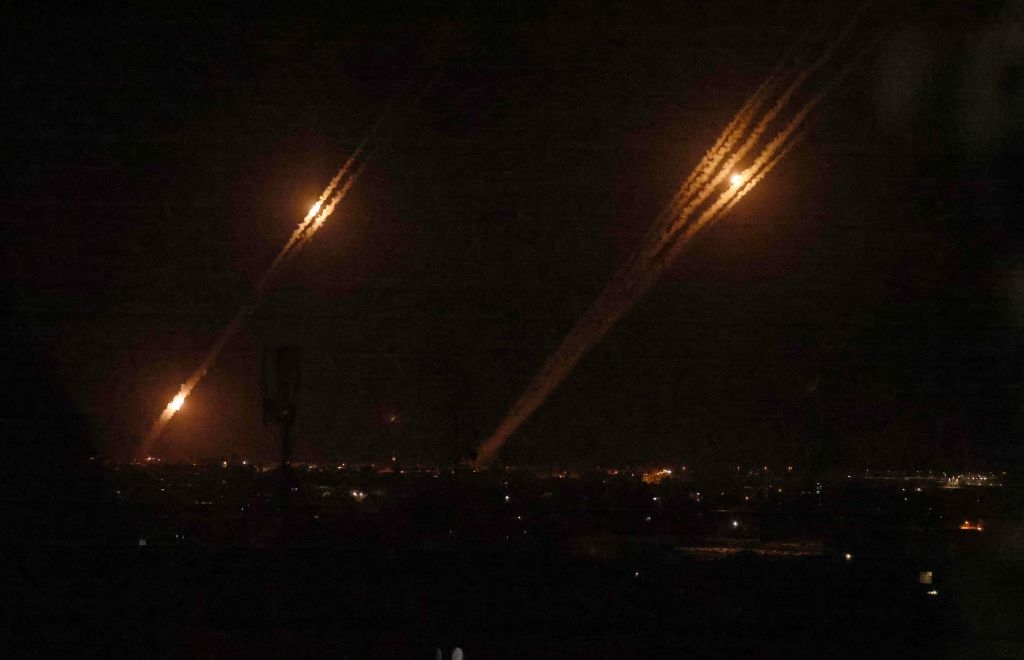
Were it not for Iran's financial and military aid, the Palestinian terrorist groups would not have been able to attack Israel with thousands of rockets and missiles. Pictured: A barrage of rockets launched toward towns in Israel by the Hamas and Palestinian Islamic Jihad terrorist organizations from the Gaza Strip early on May 12, 2021. (Photo by Said Khatib/AFP via Getty Images)

The Iranian-backed Palestinian Islamic Jihad (PIJ) organization announced on May 11 that its members fired a burst of "Badr-3" missiles into Israel, killing two women and injuring dozens others. The announcement was made by PIJ's military wing, Al-Quds Brigades, after the group and other terror factions in the Gaza Strip, including Hamas, fired hundreds of rockets into Israel within 24 hours.

The "Badr-3" missile is an Iranian-made missile that appeared for the first time on the battlefields of the Middle East in April 2019, when the Iranian-backed Houthi militia used it during the fighting in war-torn Yemen.

The "Badr-3" missile carries an explosive warhead weighing 250 kg, and has a range of more than 160 km, according to Debka, an Israeli website that reports on military issues. "The missile explodes within 20m of target and releases a 1,400-piece shower of shrapnel fragments," the website reported.

Continue Reading Article

Palestinians: Our True Goal is to Destroy Israel

by Bassam Tawil
  • The Palestinians are upset because Jews are being permitted to tour the Temple Mount. The Palestinians do not want to see Jews visiting their holy site; they do not want to see Jews in Jerusalem, and they do not want to see any Jew at all in the land that stretches from the Jordan River to the Mediterranean Sea.
  • No one is disputing the Palestinians' right to protest Israeli policies. Yet when the protests turn into large pro-Hamas demonstrations, with calls for bombing Tel Aviv and killing Jews, they expose the true deadly intention of the protesters.
  • When thousands of Palestinians chant "We are all Mohammed Deif" they are saying that they see themselves as terrorists ready to attack and destroy Israel. They are saying that Deif is their role model because he managed to murder many Jews and remains at large, despite Israeli attempts to apprehend or kill him.
  • Hamas owes its growing popularity to the anti-Israel inflammatory campaign waged in the Palestinian media, especially social media platforms, the mosques and public rhetoric of Palestinian leaders. Hamas also owes its popularity to the ongoing corruption and incompetence of the Palestinian Authority and its autocratic president, Mahmoud Abbas.
  • The demonstrations in favor of Hamas should also sound alarm bells with the Biden administration and serve as an accurate indicator as to Palestinian priorities. The Biden administration is talking about reviving the stalled peace process between Israel and the Palestinians on the basis of the "two-state solution." Hamas and the thousands of Palestinians who chanted slogans in support of Hamas and Deif, however, have a different solution in mind: the annihilation of Israel and the deaths of Jews -- the more the merrier.


Hamas and the thousands of Palestinians who chanted slogans in support of Hamas and terrorist mastermind Mohammed Deif have a solution in mind: the annihilation of Israel and the deaths of Jews -- the more the merrier. Pictured: An apartment building in Ashkelon, Israel that was damaged by rockets fired from the Hamas-ruled Gaza Strip during the night of May 10-11, 2021. (Photo by Jack Guez/AFP via Getty Images)

When former Iraqi dictator Saddam Hussein fired 39 Scud missiles at Israel in 1991, many Palestinians took to the streets to celebrate the attacks. Many demonstrations took place in the West Bank, Gaza Strip and east Jerusalem even while Palestinians were being issued gas masks by the Israeli authorities to protect them against a possible chemical attack by Iraq against Israel.

The Los Angeles Times reported back then that "several Palestinians expressed joy at last week's [Iraqi] missile assault on Tel Aviv and Haifa."

When the Iranian-backed Hezbollah terrorist group launched rocket attacks on Israel from Lebanon in 2015, Palestinians took to the streets to celebrate, holding Hezbollah flags and handing out sweets to drivers and passersby.

For the Palestinians, anyone who attacks Israel or threatens to destroy it is a real "hero."

Continue Reading Article

For Some Arabs, Preventing Peace with Israel Is More Important Than Combating Coronavirus

by Khaled Abu Toameh
  • The project sounds like the type of assistance that Jordanian women need, especially during this difficult period of the economic and health crises in their country.
  • What particularly irritated the anti-normalization activists and groups in Jordan was that some of the Jordanian women appeared in a video praising the project and talking about how happy they were to join forces with their Israeli neighbors on the other side of the border.
  • This Jordanian writer [Mohammed Sweidan] has taken it upon himself to be the spokesman for all women in his country. He claims to have some special knowledge of their actual intentions. Notably, he did not even bother to contact the Jordanian women to ask them about their attitude toward the joint project with the Israeli women.
  • These [Arab] leaders and media have filled the Arab people with so much hate against Israel that participating in a positive, productive endeavor becomes a major crime.
  • As long as such incitement against Israel in the Arab world continues, any talk about peace will be a pipe dream with hopes going up in smoke.

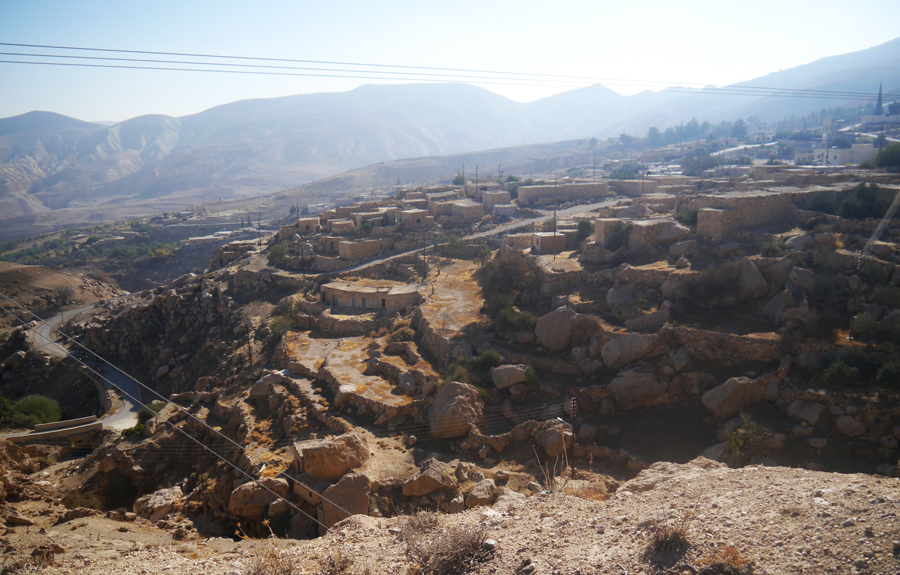
Instead of focusing their efforts on trying to find solutions to the severe medical crisis in the country,
many Jordanians are busy condemning a meeting between Jordanian and Israeli women that took place
in Wadi Arava, an area south of the Dead Sea Basin that forms part of the border between Israel and Jordan. Pictured: The Wadi Arava area on the Jordanian side.
(Image source: Zairon/Wikimedia Commons)

Hatred for Israel (and Jews) in many Arab countries continues to take priority over economic, health and political problems. Some Arabs prefer to dedicate more time and energy to combating peace with Israel than to dealing with the deadly fallout of COVID-19 in their own backyards.

Jordan, an Arab country that signed a peace treaty with Israel in 1994, is no exception.

On March 31, Jordan reported 111 COVID-related deaths, the highest daily toll since the outbreak of the pandemic. The report came as some Jordanians took to the streets to protest the government's failed policies, especially in healthcare and the economy.

Instead of focusing their efforts on trying to find solutions to the severe medical crisis in the country, many Jordanians are busy condemning a meeting between Jordanian and Israeli women. These aggrieved Jordanians are dubbing the meeting an act of treason and calling for a commission of inquiry into the encounter.

Continue Reading Article

Monday, May 10, 2021

You Do Your Part and I Will Do Mine

by HaRav Mordechai Greenberg
Nasi HaYeshiva, Kerem B'Yavneh


"Moshe counted them according to the word of Hashem, as he had been commanded." (Bamidbar 3:16)

Moshe said to Hashem: "How will I enter their tents to know the number of infants." Hashem replied: "You do your part and I will do Mine." Moshe went and stood at the entrance of the tent. The Shechina would precede him, and a heavenly voice would emit from the tent and say: "There are so and so babies in this tent." This is why it says, "according to the word of Hashem." (Rashi)

This important teaching holds implications for all of a person's affairs. Hashem will help only after a person's initiative. It says in Masechet Nidah 70b:

What should a person do to become wise? He should study diligently and minimize business. They replied: Many have done this and it has not availed them. Instead, they should ask mercy from He who is the owner of wisdom, as it says: "For Hashem grants wisdom, from His mouth comes knowledge and understanding." (Mishlei 2:6) What does this teach us? (Why did he say to study often, since it depends upon mercy – Rashi.) That one without the other is not enough.

What should a person do to become rich? He should do business diligently and deal in good faith. They replied to him: Many have done so, and it has not availed them. Instead, he should ask mercy from He who owns all riches, as it says: "Mine is the silver and mine is the gold." (Chaggai 2:8) What does this teach us? That one without the other is not enough.

What should a person do to have male children? He should marry a woman who is worthy of him and he should sanctify himself when intimate with her. They replied to him: Many have done this and it has not availed them. Instead, he should ask mercy from He who provides sons as it says: "Behold! The heritage of Hashem is children; a reward is the fruit of the womb." (Tehillim 127:3) What does this teach us? That one without the other is not enough.

This is a basic tenet of Judaism, that one without the other is not enough. The obligation to pray is something obvious. However, if a person were to pray all day, but does not lift a finger and act to achieve his wants – his prayer will not avail him. Chazal hint to this in three areas that are the main points of a person's life: wisdom – representing spiritual matters, wealth – representing physical existence, and family life.

Some thus explain the pasuk: "One thing I asked of Hashem, that I shall seek; Would that I dwell in the House of Hashem all the days of my life.'" (Tehillim 27:4)

What is the difference between "I asked" and "I shall seek?" Based on what was previously said, it is clear that if a person were to pray all day to become a Torah scholar, but instead of sitting in the Beit Midrash and studying he occupies himself with other things – he will never obtain his request. The solution is to study as much as he can, and, at the same time, present his request to He who owns all wisdom to open the gates of wisdom before him.

"I asked" is the prayer that a person asks of Hashem; "I shall seek" is the effort made, as it says: "I will rise now and roam about the city, through the streets and through the squares; I will seek the One I love." (Shir Hashirim 3:2) Seeking is through the active searching through the streets. Similarly, "Seek peace and pursue it" (Tehillim 34:15), in deed and action.

This is what David said: "One thing I asked of Hashem, that I shall seek." Asking is from Hashem, seeking is through action and making an effort, by dwelling in the House of Hashem. Through dwelling he will be entitled to assistance from Hashem, for without actually sitting and studying there is no value to prayer.

This is also what Chazal said about Yaakov Avinu. On the verses, "Yaakov departed from Be'er Sheva and went toward Charan. He encountered the place" (Bereishit 28:10-11), Chazal teach: When he arrived at Charan he said: "Is it possible that I passed through the place where my forefathers prayed and I did not pray?! When he decided to return, the way was shortened for him. Immediately, "He encountered the place." Rashi adds: "If you shall say, when Yaakov passed by the Temple, why was he not delayed there? He himself did not pay attention to pray at the site where his forefathers prayed, and from Heaven he should be delayed?! When he arrived at Charan ... he decided to return, and the way was shortened for him.

This is how the Ramban (1:45) interprets the need for a census in our Parsha:

Moshe and the tribal leaders needed to know the number of those serving in the war army, and the number of each and every tribe, and what he would be commanding over at the Plains of Moav, because the Torah does rely on a miracle that one man should chase a thousand." (See also Parshat Shelach 13:2, introduction of Rabbeinu Bachya to Parshat Shelach, and Rashi Shabbat 23b.)

The Ran, as well, in his sermons, emphasizes this idea on the pasuk, "Then you shall remember Hashem, your G-d: that it was he who gave you strength to make wealth." (Devarim 8:18) It does not mean that we sit by idly and do nothing except pray, and He makes the wealth for us. Instead we make the wealth, only knowing that it is Hashem who gives us the strength to make the wealth. The same is true for military strength.

Rav Zvi Yehuda zt"l would frequently explain the pasuk: "Some with chariots, and some with horses; but we, in the Name of Hashem, our G-d, call out." (Tehillim 20:8) This does not mean that they fight with tanks and planes, and all we do is call out the Name of Hashem and pray. We also fight with tanks and planes, but we add to this the Name of Hashem, because one without the other is not enough, and we do not rely on a miracle.

Desert, Water and Torah

by Rabbi Dov Berel Wein

I have always been fascinated why this book of the Bible and this week’s Torah reading is called Bamidbar – in the desert. The rabbis of Midrash have stated that the lesson involved here is that the Torah only remains in a person who empties all other causes from one’s midst, and is as open and unoccupied as is the desert.

Nevertheless, there may be other insights that may be gleaned from the use of the desert as the backdrop for the events and laws contained in this fourth book of the Torah. One of these different insights has to do with the ability of water to transform a barren desert into a productive place of lush fields and orchards.

Here in Israel, the Negev desert that began fifty years ago just south of Chevron has now expanded many kilometers far south of Beersheba. This is due to the national water carrier system and other means of bringing water to that area of our country. Literally, the desert has bloomed in fulfillment of the ancient prophecies of Isaiah.

Water can overcome the arid dryness and barrenness of the desert of the Negev. In California, desert valleys have been transformed into America’s vegetable basket by systems of water diverted from the Colorado River. Again, in that case water was the key to transforming a desert into a garden and orchard. There are plans afloat all over the world to transform deserts into arable land. However, fresh water is a valuable and oftentimes scarce commodity and the struggle to discover and harness more of it for agricultural and human use is a continuous one.

Throughout the books of the prophets of Israel and as well as within the Talmud, the Torah itself is metaphorically compared to and even called water. Just as water has the ability to convert desolate and nonproductive desert land into a veritable Garden of Eden, so too can Torah fill the void in our hearts and souls and make us productive holy people.

Torah, like the water that represents it, has this enormous regenerative power. The book of Bamidbar will, in its narrative of the many sad and tragic events that befell Israel in its sojourn in the desert, constantly remind us of the powers of water/Torah to restore the Jewish people to a purposeful existence with greatly productive achievements in spite of all of its failures and backsliding.

No matter how bleak and barren the desert landscape in which we currently find ourselves, we should always be cognizant of the ability of Torah to refresh and renew us. The Jewish people are an old nation and yet our powers of rejuvenation have never waned. We were and are constantly nourished by the waters of Torah irrespective of whatever desert we found or find ourselves in.

Thus the choice of Jewish tradition to call this book of the Torah by the name of Bamidbar - in the desert – is meant to convey to us this message of hope, constant redemption and rebirth.

As Shavuot Approaches...

by HaRav Zalman Baruch Melamed
Rosh HaYeshiva, Beit El


Dedicated to the memory of Amram ben Sultana

A TIME AND PLACE
"There is a time and place for everything under the heavens." (Kohelet 3:1) According to the Midrash, "there was a time for Adam to enter the Garden of Eden, as it says, 'He [God] placed [Adam] in the Garden of Eden.' (Bereisheet 2:15) There was also a time for him to leave there, as it says: 'And He chased him out of the Garden..' (Verse 23) There was a time in which Noah had to enter the ark, as it says (Bereishit 7:1) 'Come into the ark' - and there was a time for him to leave, as it says '[Now] you should leave....' (8: 16) There was a time for Avraham our forefather to be circumcised.... Rav Berchiya said: 'There was also a time for the Torah, originating in Heaven, to be given to Israel - as it says, 'And God spoke all of these words to Moshe saying..' (Shmot 20:1)"

Each and every event occurs at the time appropriate for it to happen. This is true even more for an event as central as the Giving of the Torah, since it had universal significance. When was it given? "In the third month after the Children of Israel left Egypt..." (Shmot 19:1) On the timing of Matan Torah , Midrash Tanchumah (Parshat Yitro) observes: "The giving of the Torah occurred in the third month. Why did it take place then, and not in the second or fourth months? Rav Hoshiyah said: The great Rabbi Chiyyah taught me that a woman who converts to Judaism - or a female slave that has been released - must not get married until three months after having undergone conversion or release, respectively. The Jewish people are called 'converts' (' Gerim '). In Shmot 22, we are referred to as " Gerim in the Land of Egypt..."(Shmot 22:20) The Book of Isaiah even terms us "captives." After our Egyptian enslavement, we were freed, as it says 'I am the Lord your God who took you out of the Land of Egypt from your predicament of slavery.' (Vayikra 26:13) Said the Holy One, Blessed be He: 'I'll wait three months for them, and only thereafter will I give them the Torah"'.

The convert, maidservant and freed slave must wait three months before marriage, in order to verify whether any subsequent pregnancy began when she was a non-Jew, servant, etc - or whether she became pregnant only once she became a full-fledged Jew. A Jewish woman who gets divorced must also wait three months before she remarries. The reason: if she gives birth after nine months, we will be able to determine whether the baby was fathered by the first or the second husband.

According to the midrash, then, the Children of Israel required, after being subject for so long to Egyptian slavery, a period of three months before they would be ready to nestle themselves under the wings of the Shechina (Divine Presence). It was simply impossible to quickly transform ourselves from a slave lifestyle to a people ready to unconditionally accept the yoke of Heaven. As a nation, we had to undergo an internal revolution, a distancing of ourselves from the yoke of non-Jews. Although it is true that three complete months did not elapse between Pesach and Shavuot, the Maharal of Prague explains that a portion of the first month, a full second month, and a portion of a third month were sufficient to facilitate this transition. The seven weeks of the Omer was preparation enough for Matan Torah .

HAPPY BIRTHDAY
Each year, time returns once again to the same point it had reached the previous year. Every season of the year has a special quality unto itself. We presently find ourselves in the period of the Counting of the Omer - a time of preparation, during which we Jews are constantly rising from one level to another, waiting for the big day, Shavuot, Chag Matan Torateinu - the Festival of the Giving of the Torah. Our sages teach that Shavuot possesses its own quality of renewal. This is certainly not an overt phenomenon, but it is present. It is a like a birthday of the Torah.

The Siddur says that on a person's birthday, it is fitting for him to receive an Aliyah to the Torah. A birthday is a special day. Regarding the mishna, which asks - "Did Moshe's hands actually fight the war [against Amalek]? Rather, when Israel looks heavenwards, they would begin to be victorious" - the Jerusalem Talmud explains that Amalek would send soldiers to war on their birthdays, since, Amalek understood, a person is not that likely to be killed on his birthday. In other words, even Amalek understood that one is blessed with special Siyata Dishemayah - Divine help - on one's birthday; it is a day of success, of good fortune. What did Moshe do by raising his hands? He confused the mazalot (constellations), preventing Amalek from determining just when each Amalekite soldier's birthday fell.

RELIVING MATAN TORAH
In light of the above, it becomes clear that the dynamic of Matan Torah recurs - is relived each year - on Shavuot. Not everyone is sensitive to this reality or aware of it, but it is a reality. The same holds true for Shabbat, as well, regarding which our sages say that a person earns an extra "Neshama" - or extra soul. Not everyone detects this extra soul, but it still exists. There are many things that, although we don't consciously sense them, are still very much present and influential.

Shavuot brings with it special bounty. During the Torah reading recounting the Giving of Torah on Mt. Sinai, we should attempt to tune in to the renewed power of Matan Torah . To prepare ourselves for our encounter with God, we learn all night long. The Zohar explains that the community of Israel may be compared to a bride; the day before the wedding, great efforts are exerted to clothe her with various adornments. The adornments appropriate for Israel are those of Torah and good deeds.

On the verse in the book of Bereisheet, "It was evening and it was morning, the Sixth day ," our sages explain that at the climax of creation, God issued a condition to the Heavens and Earth. What was that condition? If Israel agrees to receive the Torah on the sixth day of Sivan, then the process of Creation will have meant something and can the world can justifiably remain intact. If Israel were to choose not to receive the Torah, however, God warned, the universe would be thrown back into Tohu Vavohu , or chaos. The message? The world exists by virtue of the Torah.

Today’s Blood Libel

by Victor Rosenthal

1912 was not so long ago. Two of my grandparents, whom I came to know very well somewhat later, were young then. They emigrated from the Jewish Pale of Settlement in Ukraine that year, coming to New York to start a life that they hoped would be free from antisemitic persecution.

That was the year of the trial of Menachem Mendel Beilis in Kiev, not too far from where my grandparents had lived.

Beilis, as you probably know, was a Jew that was chosen as a scapegoat by antisemitic officials who wanted to absolve the incompetent government of Tsar Nicholas II of guilt for economic and social problems by stirring up hatred for the Jews. They took advantage of the murder of a 13-year-old boy, Andrei Yushchinsky, to accuse Beilis of having snatched the boy and drained his blood for ritual purposes. The trial attracted international interest – after all, it was the 20th century already! – and featured the testimony of antisemitic “authorities” versus well-known rabbis and Talmud scholars, who understood that all Am Yisrael were in the dock, not just the unfortunate Beilis.

A Russian police detective, Nikolay Krasovsky (who ultimately lost his job as a result), discovered the real murderers of Yushchinsky, a gang led by a woman named Vera Cheberiak, whose son was a friend of Yushchinsky and had told him about his mother’s criminal activities. Beilis had a good alibi, having been seen by others at work at the time of the murder. The coroner’s report showed that the victim’s blood had not been drained. Nevertheless, the trial was held in October-November of 1912.

Although the jury had been specially selected for antisemitism, the prosecution and its witnesses bungled their case and were made fools of on numerous occasions. One “expert” on Judaism, a Catholic priest named Justinas Pranaitis, who had written an antisemitic book on the Talmud, was asked “Who was Baba Basra and what was her activity?” He responded that he didn’t know who she was, which evoked laughter from the Jews in the courtroom, who knew that Bava Batra was a section of the Talmud.

Ultimately – after two years of pre-trial imprisonment and a month-long trial – Beilis was acquitted. However, the divided jury compromised by rendering the verdict that there had indeed been a bloody ritual murder committed, but some other Jew must have done it.

Why am I telling this story? Because, in the past one hundred years, nothing has changed except for the defendant.

Accusations of ritual murder have been made against Jews since medieval times, and possibly even before. They are still current in Arab countries, and even present-day Russia. The Tsarist officials who orchestrated the scapegoating of Beilis did so to inflame the masses against the Jews of the Russian empire. They wanted to blame them for their failures, and also to discredit the various progressive and leftist movements by association with the Jews. They hoped to incite a wave of pogroms which would bleed off the energy of the anti-monarchic forces by directing them at a safe target.

Today most Jewish communities outside of the US and Israel have dwindled to near-insignificance, and while there is plenty of antisemitic agitation, it comes from marginal players. It does not have the official sanction that Russian Jew-hatred did in 1912. But at the same time, a new scapegoat has been chosen, and this one is being accused by official and quasi-official organs of the international community of crimes worse than ritual murder, of all-encompassing crimes against humanity. The accused is no longer a Jewish individual but the Jewish state; however similarities between the prosecutions abound.

Charges are trumped up and even the crimes themselves are sometimes tailored to this specific defendant. For example, in a recent Human Rights Watch report, Israel is accused of “the crime of apartheid” despite the fact that nothing Israel has done in her conflict with the Palestinians bears the slightest resemblance to actual apartheid. Israel is regularly accused of “settler colonialism,” although there is no colonizing metropole (mother country) to be found, and Jews have lived in the Land of Israel since biblical times. Sometimes there are echoes of the original blood libel, as when the IDF is falsely accused of deliberately targeting Palestinian children.

“Witnesses” and “experts,” often with similar qualifications to those of Justinas Pranaitis, are found to testify against her. Real evidence of actual wrongdoing can’t be found, but that is unimportant because the purpose of the trial is not to determine guilt, which is already assumed by the media and international organizations that are passing judgment in the defendant, but to turn public opinion against her. But why do they want to?

In the Arab and wider Muslim world, deflecting the anger of a dissatisfied and restive populace away from their kleptocratic rulers onto Israel and the Jewish people has been a tried and tested policy for decades, indeed since 1948. The need to “resist” non-existent Israeli expansionism, for example, has sustained Hezbollah and provided cover for the true expansionism and aggression of Iran.

European motivations to convict Israel of crimes against humanity are manifold. Wanting good relations with the resource-rich third world that they formerly colonized and exploited, by attacking Israel they at the same time appease the corrupt leaders that control those resources and assuage their guilt for their behavior during the colonial period. By accusing the Jews of Israel of behaving like Nazis, they can absolve themselves for their almost universal history of cooperation with the real, genocidal Nazis. By displaying their anti-Israel bona fides, politicians vie for the support of their growing populations of Middle-Eastern origin, whom they invited in to compensate for the steep demographic decline of their native populations.

America has been less directly involved in the prosecution until recently; but lately various organizations have developed which are dedicated to the demonization and delegitimization of Israel. They have received funding from a collection of sources, including Iran, Arab countries, Turkey, and international leftist charities such as the Open Society Foundations of George Soros, the Rockefeller Brothers Fund, and others. They are working at making “Israel” synonymous with racism and oppression of minorities, which is the hottest of hot-button issues in the US today. There is also a growing Arab and Muslim population in the US, which has contributed both money and political clout to the anti-Israel movement.

In the days of Beilis, much of Western intelligentsia and media were horrified by the atavistic hatred cynically deployed by the elites of the Russian Empire. But today the academic world and media were the first sectors to be suborned by those who wish to criminalize the Jewish state, and now they are in the forefront of the campaign against her. Literally billions of petrodollars went into creating whole academic departments which are little more than factories for anti-Israel propaganda.

Above all, this worldwide epidemic of misoziony – irrational, extreme, obsessive hatred of Israel – fell on fertile ground. It’s almost as if Jew-hatred, tabooed and bottled up since the Holocaust, could not be denied, and had to burst out in some form, like the creature in the movie Alien. The blood libel that ensnared numerous Jewish victims throughout the centuries is apparently alive and well.

Selections from a Diary of Jerusalem's Liberation

by HaRav Shlomo Goren, zt"l
Dedicated to the speedy recovery of Yehudah ben Hadasah Hinde Malkah

First to the Wailing Wall
In a private conversation, I told division commander Motta Gur that I had managed to secured a guarantee through operational documents that when we conquer the Old City of Jerusalem, I would be the first to reach the Wailing Wall. To this Motta Gur replied, "If you want to be the first to reach the Wailing Wall, you will have to be on good terms with me."

"Why with you?" I asked.

"Because," he replied, "I am going to be the one who conquers the Old City."

I said to him, "If you promise me that you will conquer the Old City and allow me to be the first person by the Western Wall, I promise to keep on good terms with you."

We shook hands as a sign of accord and commitment. There were two other officers present who heard our discussion. This took place in 1961. Thereafter, Motta Gur changed positions until he finally became commander of 55 Parachute Brigade.

Noontime . . . the armored vehicle came and took me to the museum. There, I found division commander Motta Gur and late deputy brigade commander Moshe Peles. I congratulated them on the task they had been given and on the historic privilege that had fallen into their hands - the conquest of the Old City and the liberation of the Temple Mount and Western Wall. I reminded Motta Gur of our agreement six years earlier regarding my entrance to the Western Wall.

Motta was very depressed. He informed me that he had received orders not to enter the Old City but rather to surround it from all sides. Under no circumstances was he to enter the city. He added that apparently the policy was to leave the Old City in the hands of the city's Arab population without conquering it.

To this I replied that were I in his shoes I would not be able to resist such an historic opportunity to liberate the Temple Mount after two thousand years. After all, what is the worst that could happen? They could put me on trial and perhaps sentence me to imprisonment. Better that I spend my whole life in prison so that Jerusalem and the Temple mount be free than to be free while Jerusalem remained enslaved.

I explained, however, that my comments were in no way an attempt to convince him to go against his orders. I was merely expressing my personal thoughts on the matter at this very fateful hour for the Jewish people. Perhaps, I explained, this is a onetime opportunity given to us by God to return the stolen property of Jerusalem and the Temple Mount to the Jewish people. Missing this opportunity might be an irremissible sin that causes "weeping for generations to come."

Yet, I told him, we have full confidence in the authorities. We are certain that they know what they are doing and that the matter of Jerusalem is as dear to them as it is to us. I added that at any rate he should not despair. I am certain that this historic opportunity will not be neglected. This time we shall merit liberating Jerusalem and the Temple Mount and we must therefore prepare for this from a spiritual standpoint . . .

I saw how one of the paratroopers volunteered to hang the flag on the roof of the Museum. This involved considerable self-sacrifice, for he exposed himself to great danger as he climbed up the topmost spire to hang the flag there. He was exposed to sniper fire from all sides. The Arabs immediately began shooting at the flag from the wall of the Old City. Thousands of bullets were fired for a number of hours but none succeeded in hitting the flag.

"This Year in the Restored Jerusalem"
Meanwhile, other paratroopers began reaching the Western Wall from two directions - from the Mugrabim Gate and from the main alleyway that we generally took to reach the Western Wall. Within 20-25 minutes the entourage of the Deputy Chief of Staff and the Regional Headquarters Commanding General reached the Western Wall Plaza (Motta was not among them, for he apparently remained on the Temple Mount).

I suggested conducting the first prayer service by the Western Wall. Then I recited the "Sehechiyanu" blessing and the "Who Consoles Zion and Builds Jerusalem" blessing. I recited Psalm 84, "How beloved are your dwelling places, God of Legions," and "Ashrei." After this I recited Kaddish for the souls of the fallen and concluded with "El Male Rachamim" to benefit the souls of the holy individuals who fell in "this" war, because as of then the war had no name. As I recited "El Male Rachamim" those present broke out crying. I too became choked up by tears and had to stop in the middle.

Finally, I finished the memorial service and then we all stood at attention and sang "Ha-Tikvah." I kissed the Regional Headquarters Commanding General and other soldiers and officers. Then I began singing, "This year in the restored Jerusalem!" (I changed the wording of the phrase as it appears in the Yom Kippur Neilah service and the Passover Haggadah, "Next year in the restored Jerusalem").

I handed out copies of the Pre-Battle Prayer with a special dedication to the paratroopers who were present. The Regional Headquarters Commanding General ordered the soldiers to move on and continue purging the city. General Narkiss said, "The war is not yet over, and the enemy is still battling in the city. We must continue until it is finished." All the while, there was much sniper fire from all sides. The soldiers laid down on the floor of the Western Wall Plaza a number of times because of the sniper fire, and I stood in the corner and continued reciting Psalms.

Rav David HaKohen and Rav Tzvi Yehudah Kook
After this, a religious paratrooper battalion commander descended the stairway to the plaza. It was deputy Zamush who was just now arriving at the Western Wall Plaza for the first time. He arrived after I finished the prayer service and the General's entourage had dispersed. After lingering for a while he asked me if I would agree to bring the head of the Merkaz HaRav Yeshiva.

I told him that I would send for my father-in-law, the Kabbalist Rav David HaKohen, "the Nazirite of Jerusalem," who had prayed for this moment his entire life, and Rav Tzvi Yehudah Kook (son of the first Chief Rabbi of the Land of Israel), both of whom were heads of the Merkaz HaRav Yeshiva. I told my assistant, Menachem HaKohen to go and take my vehicle and bring both of them - my father-in-law, "the Nazir," and Rav Tzvi Yehudah Kook. He went together with my driver and they were delayed for some time.

After about three quarters of an hour, the rabbis appeared - the Nazirite of Jerusalem, my father-in-law, Rav David HaKohen and Rav Tzvi Yehudah Kook, head of the Merkaz HaRav Yeshiva - and these were the first civilians to stand by the liberated Western Wall. We embraced each other, kissed and wept.

I asked Menachem HaKohen what had kept them so long, and he replied that the road was blocked because of the shelling and sniper fire. It was impossible to leave the Old City. He had to take a jeep with a recoilless cannon in order to get through. In addition, the Nazirite tarried because he had to assemble a special court to annul his vow not to leave his house. I gave over my space in the southern corner of the wall to my father-in-law, and he did not move from that spot for a long time. He prayed continuously.

In the mean time, the Western Wall Plaza became filled with soldiers and a few civilians. When the hour became 12:11, which according to the calculation was the earliest possible time for the afternoon prayer service, I began to lead the Mincha prayer. I changed the words of the prayer, adding to my repetition the "Nachem" prayer that we recite in the Tisha B'Av afternoon prayer, and that closes with the words "Who comforts Zion and builds Jerusalem."

I made changes in "Nachem" itself, and instead of "the grieved, ruined and despised city" I said "the city that rejoices and exalts over the victory of Israel" . . . After Chazarat HaShatz (the prayer leader's repetition) I recited the Hallel blessing and the Hallel prayer in its entirety. After the prayer service we began dancing and singing "This year in the restored Jerusalem!" and "Yibaneh HaMikdash!" (the Temple will be rebuilt).

In the middle of the prayer service the military rabbi of the Jerusalem District Brigade, Rabbi Zemel, arrived at the Western Wall and brought with him a portable Holy Ark. It was the property of the Army Rabbinate and bore a large sign reading "Military Synagogue." This was the first Holy Ark to arrive at the Western Wall after its liberation. I had placed the Torah scroll that I brought with me between the stones of the Western Wall upon arriving, and it remained there until the military Holy Ark arrived.

The Importance of Ascending the Temple Mount

by HaRav Eliezer Melamed
Rosh HaYeshiva, Har Bracha


Rabbi Goren’s letter to Prime Minister Rabin in protest of his intention to hand over the Temple Mount to the Jordanians * Rabbi Tzvi Yehudah Kook’s principal approach to the Temple Mount was the demand for full sovereignty over it, and not the prohibition of going up to pray there * Thanks to those who go up to the Temple Mount, our sovereignty over the Mount, and the entire country, becomes clear

On the 17th of Av 5754 (July, 1994), Rabbi Shlomo Goren ztz”l, Chief Rabbi of Israel 5733-5743 (1972- 1982), sent an important letter to Prime Minister Yitzhak Rabin z”l:

“To the honorable Prime Minister and Minister of Defense, Mr. Yitzhak Rabin, May your peace abound!

I find it my moral duty to respond to the reports emanating from your Foreign Minister, that there is a plan to compromise with King Hussein on giving King Hussein sovereignty on Har HaBayit (the Temple Mount), and in so doing, captivate the heart of the Hashemite King, who claims ownership of Jerusalem and the holy sites.

I would like to inform you that Har HaBayit is considered the kodesh ha-kodeshim (holy of holies) of the Jewish nation, and don’t be deceived by fabricated stories that, in any event, Jews are not allowed to ascend and pray on Har HaBayit. I enclose with this letter, my book “Har HaBayit” that I published two years ago, with some 12 maps in which I demarcated the boundaries of the places on the Temple Mount that Jews are forbidden to ascend, and the areas in which Jews are permitted to ascend and pray there. From the maps, it is proven that, according to halakha, Jews are permitted to enter the majority of the Temple Mount. In addition, in the aforementioned book, I determine where a synagogue for Jews to pray can conceivably be built.

We have no intention whatsoever to prevent Muslims from ascending the Temple Mount and praying in their mosques; we do request to leave the vacant areas of the Temple Mount where there are no mosques, and are under the open sky and under Jewish sovereignty, and allow Jews to pray there as they please.

From the destruction of the Second Temple until three hundred years ago, prayer of the Jewish people on the Temple Mount did not cease:
  1. With the destruction of the Second Temple, Rabban Gamliel, Nasi of Israel, established his office on the steps of the Temple Mount, and from there, Torah went out to the Jewish nation, as clarified in Tractate Sanhedrin (11b). Rabban Shimon ben Gamliel also established his base on the steps of the Temple Mount (Tractate Avodah Zara 20a).
  2. On fast days, there were special prayers to say on Har HaBayit with the blowing of the shofar, as explained in Tractate Ta’anit (15b): “They would act in accordance with this custom only at the Eastern Gate of the Temple, and on the Temple Mount.”
  3. The traveler from Bordeaux (4th century) related: “And the Jews would come once a year (on the 9th of Av) to this place (Har HaBayit) and weep and mourn at a certain stone that remained there from their Temple, and they would anoint it with oil” (see, “Zion” journal, book 3, p. 111 onward, the article by Yehuda Yitzchak Yechezkel).
  4. Rav Avraham son of Rav Chiya HaNasi (12th century) describes the “Beit Ha-Knesset ve’Ha-Midrash” (“House of Prayer and Study”) that existed for the Jews on Har HaBayit, as he related: “Also, the kings of Ishmael treated them well, and allowed the Jews to come to the Temple Mount, and build there a house of prayer and study, and all of Israel’s exiles would come up to the house on holidays and festivals and pray there, and set their prayers corresponding to the tamid’in and musaf’im (communal offerings)” (see, the important article of Professor Ben-Tzion Dinur, ‘House of Prayer and Midrash for Jews on the Temple Mount in the Days of the Arabs’, “Zion” journal, ibid, from p.4 onwards).
  5. Rambam (Maimonides), during his ascent to Jerusalem in the month of Sivan 4926 (1165), prayed in the house of prayer on the Temple Mount. This emerges from Maimonides’ letter quoted in “Sefer Haredim: Sha’ar Teshuvah” chap.4 (see also, Dinur’s article (ibid), p. 87, note 178, and Yechezkel’s article, pp. 107-114).
  6. The great traveler R. Benjamin of Tudela, who resided in Jerusalem for about two years in the 12th century, describes the prayer of the Jews before the dome of the even ha-shti-ah (the foundation stone).
  7. As early as the 16th century in the days of the Radbaz – R. David Ben Zimra, “the whole world used to ascend those same ascents (on the Temple Mount) to see the whole House from there, and we did not hear or see anyone that protested” (Responsa Radbaz, Vol.1, siman 691).
I do not want to discuss here the halakhic aspects of entrance to Har HaBayit, for us, it is enough to remember that Rambam, who is considered to be machmir (strict) in this matter, prayed there himself, so after that, what are we to say?

The uniqueness of the ‘Kotel HaMaaravi’ (‘Western Wall’) as a place of worship for Jews is historically recent, and does not exceed three hundred years. It began after the decrees and restrictions imposed by the Muslim rulers on the Jews, and the eradication of the ‘Beit Ha-Knesset ve’Ha-Midrash’ that had existed for centuries on the Temple Mount. However, under no circumstances is there any self-virtue to the Kotel – whose entire sanctity is that it borders the Temple Mount – to be a substitute for Har Hashem (the Mount of God), because the Western Wall, about which said in the Midrash (Exodus Rabbah 2: 2): “The Shechinah (Holy Presence)never departed from the Western Wall”, is referring to the Western Wall of the Kodeshei Ha-Kodashim (Holy of Holies) or the Azarah (Temple Courtyard) in the Beit HaMikdash, and not to the kotel of Har HaBayit (which I have already clarified in my book ‘Har HaBayit’). The prayers near the Western Wall symbolize the exile of the Nation, and their expulsion from Har HaBayit, and our prayers on the Temple Mount, symbolize the return of the Nation to their Land, and to the place of their Holy Temple.

Rabbis who lack the topographical and halakhic knowledge of the Temple Mount and are cautious not to ascend Har HaBayit and pray there, are permitted to be machmir (stringent) on themselves, but we, and the entire nation, should be permitted to pray freely on the Temple Mount in halachically permitted areas, after immersion in a mikvah (ritual bath), and Muslims should be given free access to their mosques on the Temple Mount. But God forbid, from handing over sovereignty over the entire Temple Mount to the Waqf or King Hussein.”


About three months after the letter was sent, on the 24th of Marcheshvan 5755 (October 1994), Rav Goren passed away. Prime Minister Yitzhak Rabin took time off from his schedule to comfort the family of Rav Goren ztz”l.

The Foundation of the Halakha
To explain the halakha, first, it should be pointed out that on Har HaBayit there are two sections – the first section, and it is the smaller one, includes the place of the Mikdash and the Azarot, and is called the ‘Machaneh Shechinah’ (the innermost camp). In the opinion of Rambam and the majority of poskim, it is forbidden to enter it today, because we cannot be cleansed of tumat met (the defilement of the dead). The other section is termed “Machaneh Leviyah” which today can be entered after immersion in a mikvah.

It is well-known, however, that in the years before the establishment of the state, due to various concerns, the rabbis, including Maran HaRav Kook ztz”l, instructed not to ascend all of Har HaBayit.

Three reasons motivated Rav Goren to permit aliyah to the majority of the area of the Temple Mount.

1) The precise mapping of the Temple Mount conducted by the I.D.F. Engineer Corps under his orders after the liberation of the Temple Mount. With these maps, it was possible to determine accurately, which areas were permitted to enter according to all halakhic opinions.

2) The many testimonies that for more than a thousand years after the destruction of the Holy Temple, Gedolei Yisrael (eminent rabbis) were accustomed to pray on the Temple Mount in the permitted areas.

3) The threat to Jewish sovereignty on the Temple Mount.

It is worth noting that one of the probable reasons for placing warning signs not to go up to the Temple Mount during the reigns of the Turks and the British, was to prevent provoking the Muslims and rulers who governed the country at the time, and during riots, did not properly protect the Jews.

The Words of HaRav Tzvi Yehudah HaKohen Kook
There are those who question this issue from the words of Moreinu ve’Rabbeinu HaRav Tzvi Yehudah HaKohen Kook ztz”l, but from reading his official position in the proclamation from the 27th of Shvat, 5737 (1976), the opposite conclusion emerges:

“The enormous halakhic prohibition of entering [Har Habayit] because we are still, according to halakha, in a state of impurity, does not pertain, harm, or detract even in the slightest, the importance of our proprietary ownership over that area of the glorious, holy place. Our Chief of Staff, Mr. Mordechai Gur, together and in assistance with our honorable teacher and guide, Rabbi Shlomo Goren, foremost of Israel’s rabbis, merited liberating this holy place from non-Jewish authority, and it, as well, as all parts of our holy Land, is in our possession and ownership. Under our possession and ownership, they [the Muslims] organize for themselves prayer arrangements on Fridays. Groups of our soldiers stationed there, guard and supervise them by order of our government. Even if we are careful not to enter there, according to the attributes of Jewish law, in spite of this, and for this reason, our ownership over the entire area remains unequivocally permanent and binding, and the existence of non-Jews there is only with our permission, and under no circumstances, are they owners of this place.”

The Meaning of His Words
His remarks indicate that sovereignty is the most important point, for indeed, the mitzvah of yishuv ha’aretz (settling the Land of Israel) requires that Eretz Yisrael be in our possession, and not abandoned to other nations – let alone Har HaBayit, the place of our Holy Temple. Since sovereignty at the time was clear, as he went out of his way to detail the signs of sovereignty and rule on the Temple Mount, he did not seek to clarify details of the limits of the prohibition according to halakha. However, had he heard that as a result of the failure of Jews ascending the Temple Mount the flag of Israel was removed from Har HaBayit; the permanent police station was abandoned; there is no longer a permanent military presence on the Mount; police and soldiers are not allowed to enter the mosque; the Muslim Waqf claims to be the sovereign ruler of Har HaBayit, and the Arabs are no longer just “organizing for themselves prayer arrangements on Fridays”, but rather, from there, incite the entire world against Israel, and Arab gangs curse and insult police and soldiers and Jews who ascend the Temple Mount – had Rav Tzvi Yehudah heard all of this, he would have been outraged, and supported all legitimate means within the framework of halakha to strengthen sovereignty over the Temple Mount.

Indeed, thanks to those ascending Har HaBayit and the government ministers who support them, the situation is changing for the better.

It is also evident from his wording, how much Rav Tzvi Yehudah respected Rav Goren and his halakhic authority, making it possible to assume he would have trusted his halakhic inquiries, and along with him, encouraged ascending Har HaBayit.

Blessed are Those Who Ascend
Towards Jerusalem Day, I once again bless those who go up to Har HaBayit in purity. Thanks to them, our sovereignty over the mountain and all of Eretz Yisrael is revealed. Through this, may we merit learning Torah in the proper way. “For out of Zion shall go forth Torah, and the word of the Lord from Jerusalem.”

Friday, May 07, 2021

Rav Kook's Igrot Hare’aya – Improving Education in Yafo and The Need to Take Steps to Keep the Rabbi

Improving Education in Yafo - Letter #21

Date and Place: 10 Menachem Av 5665 (1905), Rechovot
Recipient: Not specified.
Body: The general situation regarding education and especially that of religious studies teachers, requires fixing. There is a lot of work to be done, and there is a need for much good council and valor, with Hashem’s help. Therefore, I am very happy about the spirit of purity and grandeur that was awakened in the hearts of special individuals in the Holy Land, to call for a meeting of all the religious studies teachers of the holy city of Yafo and the surrounding agricultural settlements (of which Rav Kook was then the rabbi), may they be built firmly, to arrive at wise ideas to raise the situation of education and educators. 

I pray that Hashem will ensure that this meeting will be a good start in the effort to set proper systems and standards in the approach to education. This will give honor and a good reputation to Torah and Torah education in Israel. May Hashem give success to our actions with great power, to create a proper and honorable stature for the education of our children by teachers who fear Hashem and give proper regard to His Name. They should be fit to stand in the breaches and fix the fences in Yehuda (i.e., deal with religious challenges in society - see Yechezkel 13:5) to raise the status of fear of Hashem in the Holy Land. Therefore, I agree with all my might to take part in what the distinguished organizers want me to do, and I am prepared bli neder to take part in this distinguished meeting.

The Need to Take Steps to Keep the Rabbi – Letter #22

Date and Place: 12 Iyar 5665 (1905), the holy city of Yafo
Recipient: The respected council of Ekron (the first agricultural settlement financed by Baron Benjamin Rothschild, founded by religious new immigrants in 1882; its name was later changed to Mazkeret Batya. (Presumably, Ekron was within Rav Kook’s regional jurisdiction).
Greeting: My beloved brothers …
Body: I have been told that the honorable rabbi and illustrious head of your rabbinical court, may he live, is leaving you to return to his original place, the holy city of Jerusalem, may it be built firmly. I also heard that the reason is that he lacks proper lodging in the settlement.

It is superfluous for me to write at length about the importance of the holy mitzva and benefit of having a rabbi and a giant in Torah and fear of Hashem living in every Jewish community, especially in the Land of Israel. This is especially true if he is a great and important rabbi, who is truly a beloved man to a rare degree.

I am certain that the feelings of love of Hashem and of the holy Torah in the midst of your pure hearts will be aroused by the situation and that you will try as well as you can to remove this impediment and exert yourselves so that your congregation’s crown and pride not move away from you. Hashem should assist you, as Chazal’s promise, “Subsequent to [having a] Torah scholar in your midst comes a blessing” (Berachot 42a), should help, so that your stature will be raised and you will be successful. “Whoever gives honor to the Torah will be honored by others” (Avot 4:6). You shall see good coming from your actions, and your honor should be great. I am confident that the force of your reliable spirit toward Hashem and His Torah will succeed in providing much honor to Torah and lively love in your midst.

I hope that my short words will suffice to bring you to the necessary actions, so that your community will not backtrack in the sanctity that it worthily attained, i.e., having a great rabbi live permanently among you, to adjudicate and rule on matters of Hashem’s laws for Israel.

Sign Off: I sign with a blessing and with great love, Avraham Yitzchak HaKohen Kook, rabbi and head of the rabbinical court of the holy city of Yafo and the settlements.