Monday, December 06, 2021

Wayward Journalists

by Rabbi Steven Pruzansky

It is hard to conceive of a more repugnant editorial than the one published in Friday’s Jerusalem Post entitled “Wayward rabbis” (Apparently the title was deemed so negative that it was changed in the online editions.) The editorial castigates our nation’s rabbinical leadership for its opposition to the proposed government reforms in kashrut supervision and conversion and for good measure lambastes them for adhering to the Torah’s moral standards that are at odds with Western values. Perfect timing, indeed, like editorializing on Chanukah against the Maccabees for their fidelity to Jewish tradition and antagonism to Hellenism.

One might think that the opposition of the leading rabbis in the country to reforms of Jewish law and practice would mute the ardor of proponents of those reforms. After all, who but the rabbis are better situated to opine on such matters, given their dedication, years of study and experience? It is lost on the editorialists that merely being Jewish does not make one an expert on Judaism.

Imagine, for a moment, that the nation’s leading doctors joined together and opposed a particular government edict regarding the Coronavirus. (They probably should, but that is a different topic altogether.) No one would consider condemning those physicians for their opinions or suggest that they be fired, silenced, prosecuted or replaced by more “diverse” and accommodating doctors. In fact, one would be foolish not to strongly consider their recommendations or their resistance to a given approach, seeing that they have studied medicine and others have not. Editorialists have routinely denounced governments across the globe for not following the doctors, the science, or the data.

Why then are doctors’ opinions treated with greater deference than is accorded to the Rabbis? Why do some people value the guidance of physicians but belittle the guidance of rabbis?

The answer is multifaceted. In the worst sense, it reflects the attitude of the heretic (noted in Masechet Sanhedrin 99b) of “Mai ahanu rabanan?” How have the rabbis ever benefited us? But that itself presupposes a cavalier attitude towards Judaism, as if Jewish law doesn’t matter at all and the Torah offered us suggestions but not commandments, suggestions that we can spurn if we don’t like them. And Westerners struggle with obeisance to any authority figure.

More typically, this dismissive posture reflects an approach to Judaism, and often religion generally, as something that lacks real substance or gravitas. To them, religion is meant to be fluff. Feelings count more than do facts or laws, and since we can intuit the right and wrong ways to live, who needs rabbis? So if the Western rejection of traditional morality feels right, that must be Judaism. If people want to join Judaism for whatever reason, they should be allowed to, no questions asked, because that too is Judaism. If a ritual does not speak to one’s sensibility, then abandon it or reform it. Science is real, Torah is not real. As such, we would sound like fools if we laymen offered amateurish opinions on physics or medicine, but Torah? Apparently, everyone can have an opinion and claim it is legitimate, even journalists and pilots. It completely dismisses the rigor, dedication and discipline needed to acquire expertise in Torah.

That conceptual error engenders the view of rabbis as mere functionaries, or in the words of the editorial, “there to provide services.” What a constricted and ultimately embarrassing and uneducated view of the rabbinate! I am reminded of the old school rabbinate whose primary purposes were to be available to Jews to “hatch ‘em, latch ‘em, and dispatch ‘em” (meaning present at the Brit, where actually a mohel but not a rabbi is needed; there to officiate at a wedding, which today’s reformers also want to revise; and present at a funeral, where technically speaking a rabbi is also not required). It was the rabbi as supervisor of life cycle events, called upon to spout a few platitudes to which no one paid much attention, and then to be ushered aside.

But that conception of the rabbinate died decades ago. Its death was hastened by the collapse of the non-Orthodox movements in America whose members, among other things, began to largely tune out their spiritual leaders who responded by supporting every new ideological and immoral fad in the hope of remaining relevant. That failed miserably and the toll it has taken in assimilation and intermarriage is so steep that those who shepherded those catastrophes now extol the virtues of assimilation and intermarriage – and want a seat at the table to plan the Jewish future.

“Who is a Jew,” by conversion or otherwise, is a Torah issue, a rabbinic issue, and not a governmental or journalistic concern. No Jew has authorized the Knesset to determine matters of Jewish law – not to decide Jewishness, move Shabbat to Tuesday or permit the consumption of cheeseburgers. Israel has many Muslim and Christian citizens, and it would obviously be preposterous if the Knesset took it upon itself to liberalize conversion to Islam or Christianity on its own authority. Israel can rightly decide who can be Israelis but not who can be Jews. That is up to the rabbis, and properly so.

Similarly, the definition of sin or mitzvah, right and wrong, moral or immoral is a Torah issue, a rabbinic issue, for which guidance should be sought and accepted. To chastise rabbis for espousing Jewish morality is as absurd as chastising doctors for prescribing antibiotics. Neither pressure nor parades will change that. As faithful Jews perceive it, matters of the spirit are in fact more real than matter of the body, for the former is eternal and the latter temporal.

The narrow minded view of Judaism as just ceremonies, meals and feelings is self-defeating in the extreme. Whether or not Israelis recognize it, our claim to the land of Israel is rooted in the Torah. To the extent that we diminish the Torah, reform or revise it to suit transient trends, we undermine our claim to the land. It is this same mentality that gives rise to the notion of the Kotel as an historical site that should be available for all forms of worship rather than a sacred place of traditional Jewish prayer, in the shadow of the holiest place on earth, the Temple Mount.

It is obvious that matters of Jewish law should remain the province of the authorized decisors of Jewish law rather than politicians or journalists. But rabbis should also be emboldened to speak out more, not less, on public issues that touch on moral, ethical and political matters. (Here’s a good laugh line: the editorial asked “Would we allow a situation in which a Supreme Court justice would openly voice his or her opinion on controversial political issues?” It is as if they never heard of Aharon Barak, who of course claimed that everything was justiciable, not political – as long as it suited his preferred ideological conclusions.)

Rabbis must be wary of being used as mere functionaries. Here is a good example. Rather than recite a chapter of tehillim at the state ceremonies for Yom Hashoah and Yom Hazikaron (which an eight year old can do), wouldn’t it be more meaningful if the Chief Rabbis actually spoke words of Torah – instead of the annual clichés of the President, Prime Minister, Chief of Staff, etc. – about the ultimate meaning of these events, the State of Israel, the prophesies of exilic calamities and eventual return to the land of Israel? That perspective, that analysis, is sorely lacking in these somber events.

What do rabbis do? True, they interpret the Torah in line with tradition, they decide questions of Jewish law, and they guide Jews (and even sometimes Gentiles) through the vicissitudes of life. But primarily, they are to be voices of Jewish morality and reason, especially when they run counter to modern life. They are here, to the best of their abilities, to bring a divine perspective to events and challenges, even if they won’t always agree on every conclusion. The criticism of “how have the rabbis ever benefited us?” was directed at rabbis “who study the Torah and the Mishnah for their own benefit” and never engage in public affairs.

Ironically, these wayward journalists want just that – rabbis who remain in the House of Study, uninvolved with the public, to be trotted out for ceremonies, and then duly criticized for their aloofness. But here is another irony. Today’s Chief Rabbis, for example, engage with the public far more than any Cabinet Minister or Knesset member ever does. They engage daily, teaching, guiding, interacting, and sharing the eternal wisdom of our Creator.

It is a shame that many journalists, wedded to their own agendas, do not see it. If they even tasted it, they would savor the Torah as the elixir of life and the rabbis as purveyors of goodness and wisdom. And together we would build an Israel that is proudly Jewish, awaiting the coming redemption.

The US and the Iranian Octopus (part 2)

by Ambassador (ret.) Yoram Ettinger

Since the 1978/79 revolution against the Shah of Iran, the Ayatollahs regime has adhered to its mega-goal of global Shite domination, developing mega-capabilities (nuclear, ballistic technologies and worldwide terrorism), aiming to remove/subordinate its mega-obstacle, the USA.

During 1962-1970, then anti-US Egypt was involved in the Yemen civil war, as a springboard to topple the pro-US regime in Saudi Arabia and, subsequently, all other pro-US Arab regimes in a most critical region to global trade, oil and security, the Arabian Peninsula.

Since 2011, Iran's anti-US Ayatollahs are deeply involved in the Yemen civil war on the side of the anti-US Shite Houthis ("Soldiers of Allah") – via Iranian and Hezbollah manpower, military supplies, training and intelligence – as a springboard to oust the pro-US Sunni House of Saud (bordering north Yemen), and subsequently, all other pro-US Sunni regimes in the Arabian Peninsula.

In February, 2021, the US removed Yemen's Shite Houthis – who are Iran's proxy – from the list of terrorist organizations, courted Iran's rogue Ayatollahs, terminated US support of the pro-US Saudi military offensive against the anti-US Houthis, and pressured Saudi Arabia on account of human rights violations. However, in November, 2021, the Houthis stormed the US Embassy in Sanaa, holding a few of the local staff hostage, demonstrating – once again - that Islamic/Arab terrorists bite the hands that feed them.

Yemen's geostrategic importance for the US
The limbs of the Iranian octopus extend from the Persian Gulf and Central Asia to the whole Middle East, Europe, Africa, South, Central and North America, including Yemen, where Iran's Ayatollahs outflank the Persian Gulf, Arabian Sea, Indian Ocean and the Gulf of Aden, playing a decisive role in fueling the civil war, as a dagger aimed at its Sunni arch-rival, the pro-US Saudi Arabia.

Iran's Ayatollahs are aware of the geo-strategic significance of Yemen - regionally and globally – and its impact on the national security, homeland security and economy of the US, "The Great Satan," which they consider the most critical obstacle on their way to global domination.

The gravely underdeveloped Yemen plays a key role in the survival of the highly-vulnerable House of Saud, in particular, and all other pro-US oil-producing, strategically-situated Arab regimes in the Arabian Peninsula, such as the United Arab Emirates, Bahrain and Oman.

Yemen shares 1,458 and 288-kilometer-explosive borders with Saudi Arabia and Oman respectively, and could serve as a land-sea-air base of Iran's rogue Ayatollahs.

Yemen is an epicenter of regional and global Islamic terrorism and a platform for the 1,400-year-old intra-Muslim Sunni-Shia conflict, inherent intra-Sunni conflicts and intra-Arab tribal fighting.

Yemen shares a maritime border with the inherently unstable, unpredictable and non-democratic Eritrea, Djibouti, Somaliland and Somalia in the strategically crucial Horn of Africa, controlling the Bab el Mandeb Strait ("Gate of Tears"), which connects the Red Sea and the Gulf of Aden and the Indian Ocean, and facilitating the European-Asian trade. Bab el Mandeb is critical to global energy security, in general, and the supply of Gulf oil to Europe, in particular, as well as the functioning of the Suez Canal, the economic stability of Egypt and the safety of the prominent Saudi Red Sea port of Jeddah.

Yemen's prominence as a hub of critical shipping routes, and a site of actual and potential naval bases, is derived from the highly-strategic Yemen ports of Aden, Mukalla, Mocha, Al-Hudaydah and the Yemen islands of Socotra (Arabian Sea), Perim, Zuqar and Hanish (southern Red Sea).

While the US is the world largest oil producer, approaching energy-independence, the price and supply of oil still largely depend upon Middle East oil, which accounts for 27% of world production and hinges on the safety of the Bab el Mandeb Strait and the southern part of the Red Sea.

Iran's military involvement in Yemen
Iran's intervention in the Yemen civil war on the side of the anti-US, anti-Saudi Shite Houthis minority against the Saudi-backed highly-fragmented Sunni majority, shifted into high gear in 2011, after the eruption of the Arab Tsunami (superficially known as "the Arab Spring"), which triggered the current turbulence, which is raging throughout the Middle East.

The significance of Iran's (and Hezbollah's) involvement has been evidenced by the recent successful Houthi military offensive, solidifying their control of Yemen's capital, Sanaa, coalescing their domination of western and northern Yemen (along the border of Saudi Arabia), and their progress in the battle over Yemen's oil and natural gas-producing area of Marib.

These Houthi gains have been made possible by Iranian finance, manpower, training, intelligence and the supply of rockets, surface-to-air missiles, rocket-propelled grenades, explosives and ammunition.

Also, the anti-US Houthis have employed the Iran-supplied drones and missiles to strike Riyadh, additional Saudi cities, Saudi oil installations, airports and other civilian targets.

The Iran-US bottom line
Iran's aggressive intervention reflects the imperialistic, fanatic vision and global policy of Iran's Ayatollahs, which – contrary to the worldview of Western foreign policy and national security establishments - are not driven by despair, humiliation, economic deprivation, or local border disputes; are not amenable to compromise, compliance with agreements, peaceful-existence, human rights and democracy; and are not limited to the Persian Gulf and the Middle East, but encompass the entire world, including South and Central America.

Iran's Ayatollahs are energized by the apparent US shift of paradigm from military to diplomacy, the US rejection of the regime-change option, and the US tendency to accommodate and appease – rather than confront and crush – the rogue regime in Teheran.

Biden's Doppelganger for the UN

by Amir Taheri

  • [W]hen you lack a foreign policy, why not pretend that you have one by holding an international summit?
  • To start with, what does Biden mean by democracy?
  • Biden's invitation excludes at least 20 long-standing allies of the United States.
  • ... Obama went around the UN and its agencies on a number of issues, including the "nuclear deal" with the mullahs of Tehran, the humanitarian catastrophe in Syria, and the public-relations hoax known as "saving the planet".
  • The doppelganger may furnish the emptiness for a few days and furnish a rudderless administration with a few favorable headlines. But it will provide no answer to problems the world faces today, problems that cannot be tackled without the participation of all nations within the framework of a world order based on law, not ideology.

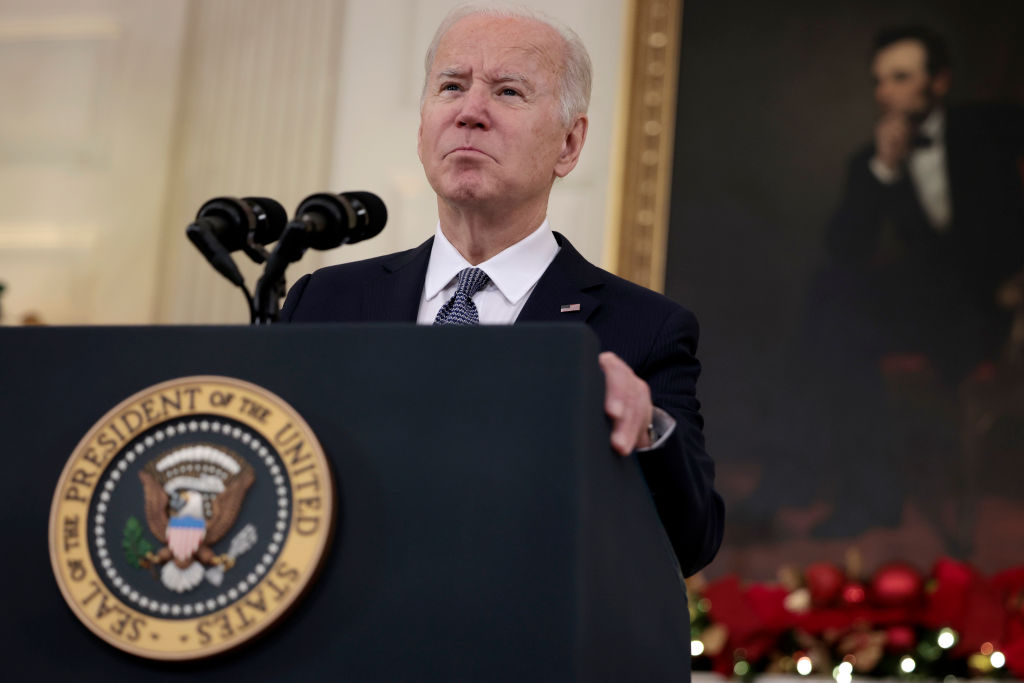
When you lack a foreign policy, why not pretend that you have one by holding an international summit? US President Joe Biden has certified 109 countries as "democracies" by inviting them to a virtual "Summit for Democracy." What does Biden mean by democracy? Biden's invitation excludes at least 20 long-standing allies of the US. (Photo by Anna Moneymaker/Getty Images)

What do India, Iraq and the Solomon Islands have in a common?

The answer is that US President Joe Biden has certified all three as "democracies" along with 106 other countries, by inviting them to a virtual "Summit for Democracy" on December 9-10, 2021.

Biden's move reminds me of one of my favorite French phrases: Furnishing the emptiness.

In this case, when you lack a foreign policy, why not pretend that you have one by holding an international summit?

And what is the summit going to discuss?

Well, three objectives have been set: Defending against authoritarianism, fighting corruption, and promoting human rights. Something else forgotten -- maybe motherhood and apple pie?

The trouble is that the entire project, a hasty and poorly thought-out public relations gimmick, is built around concepts that are never defined.

To start with, what does Biden mean by democracy?

Continue Reading Article

Sorry, Everyone, Hamas is Still a Terrorist Group

by Khaled Abu Toameh
  • First, the document reportedly depicting Hamas as a moderate group that accepts the "two-state solution" is a bluff intended to dupe the international community.
  • As Mashaal himself explained, even if Hamas accepts a Palestinian state in the West Bank, Gaza Strip and east Jerusalem, that does not mean that it would ever recognize Israel's right to exist.
  • Second, Hamas has not renounced violence and terrorism. In fact, it intends to continue the "resistance" and jihad (holy war) against Israel after the establishment of the Palestinian state with the purpose of "liberating all of Palestine."
  • Third, the new document did not cancel or change the content of the Hamas charter, which, according to Hamas leaders, remains valid and relevant to this day.
  • Hamas's representative in Iran, Khaled Qaddoumi, confirmed.... that the talk about Hamas accepting a Palestinian state in the West Bank, Gaza Strip and east Jerusalem was in the context of a plan to destroy Israel in phases. "There is no solution to the Palestinian problem except by jihad." — Hamas charter, Article 13.
  • Hamas, of course, never misses an opportunity to remind its followers and the rest of the world that it remains faithful to the words of the prophet Mohammed, who said: "The time will not come until Muslims will fight the Jews (and kill them); until the Jews hide behind rocks and trees, which will cry: O Muslim! There is a Jew hiding behind me, come on and kill him!" — Hamas charter, Article 7.
  • Days after the decision was announced, the Hamas leadership leader said...: "Palestine - all of Palestine - from its [Mediterranean] sea to its [Jordan] river, is for the Palestinian people, and there is no place or legitimacy for strangers over any inch of it." — hamas.ps, November 29, 2021.
  • The statements of Hamas leaders show that they dissemble less than many of their own apologists in the West, who claim that they understand Hamas better than Hamas understands itself.

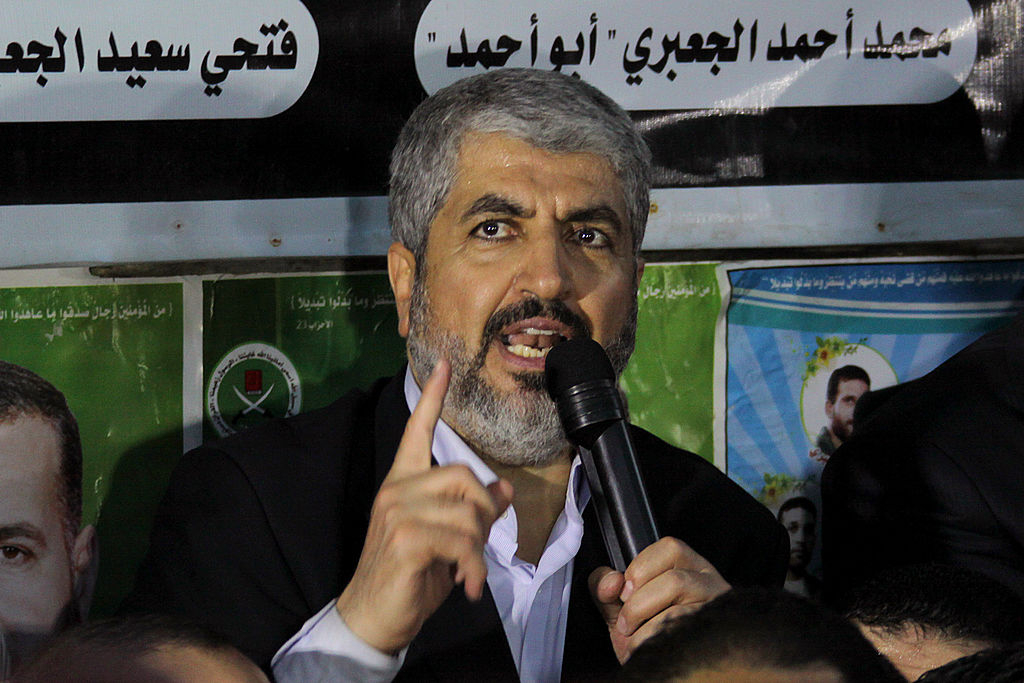
The document reportedly depicting Hamas as a moderate group that accepts the "two-state solution" is a bluff intended to dupe the international community. As Hamas leader Khaled Mashaal (pictured) explained, even if Hamas accepts a Palestinian state in the West Bank, Gaza Strip and east Jerusalem, that does not mean that it would ever recognize Israel's right to exist. (Photo by Mohammed Saber/AFP via Getty Images)

One of the arguments that is being raised against the British government's recent decision to designate Hamas an extremist terrorist organization is that the Gaza-based movement, which does not recognize Israel's right to exist, has changed and now supports the establishment of a Palestinian state next to Israel.

Opponents of the UK's decision claim that in 2017 Hamas "softened its stance on Israel by accepting the idea of a Palestinian state in territories occupied by Israel in the six-day war of 1967."

The purported change, they argue, was included in a new document announced by Hamas leader Khaled Mashaal at a press conference in Doha, Qatar. Mashaal was quoted as saying:

"Hamas advocates the liberation of all of Palestine, but is ready to support the [Palestinian] state on 1967 borders without recognizing Israel or ceding any rights."

Continue Reading Article

The National Endowment for the Humanities Spends $250K to Fund a 1619 Project for Israel

“To say that Jews were subject to restrictions that would not allow them to prosper and live in the Middle East is just nonsense.

by Daniel Greenfield


Daniel Greenfield is a Shillman Journalism Fellow at the David Horowitz Freedom Center specializing in investigative reporting on the Left and Islamic terrorism.

Last year, Lior Sternfeld and Michelle Campos signed the so-called Jerusalem Declaration on Antisemitism which argued that calling for the destruction of Israel was not antisemitic.

The signatures of Sternfeld and Campos alongside numerous other anti-Israel academics was unsurprising. Sternfeld had previously signed a petition in support of BDS activists which concluded with the assertion that the signers might refuse to “enter the State of Israel”. He and Campos had also signed another petition accusing the Jewish State of “apartheid”.

More recently, Campos, Sternfeld, and Orit Bashkin had signed on to the Statement on Israel and Palestine in Jewish Studies accusing Israel of engaging in “state violence” against Hamas. In language echoing Soviet propaganda, it denounced Zionism as “ethnonationalist” and “settler colonial” systems of “Jewish supremacy” that led to the “segregation” of “Palestinians”.

Israel, all of it, it asserts, exists on occupied territory, not only from the 1967, but the 1948 War of Independence.

From an academic standpoint, the various professors and graduate students declare that they will support their colleagues who boycott Israel and as scholars to “amplify, and support our Palestinian and other colleagues” and emphasize the “place of Palestine in Jewish Studies”.

With the support of the National Endowment for the Humanities.

The NEH is one of the more toxic components of the federal government. While the Trump administration tried to defund it, the Biden administration is using it to push critical race theory into classrooms. But not to leave anyone out, it’s also funding a 1619 Project for Israel.

Sternfeld, Campos, and Bashkin were showered with a nearly $250,000 grant to “reimagine” Jewish life in the Middle East before Zionism. The NEH grant, one of the two largest in Pennsylvania, funds a “large-scale collaborative project to rewrite the histories, narratives, and memories of and by Jews in the Middle East in the 19th-21st centuries.”

“Most history books just want to show that Zionism was the only alternative for Jews living in the Middle East. To say that Jews were subject to restrictions that would not allow them to prosper and live in the Middle East is just nonsense,” Sternfeld contended in a story about the project.

The only nonsense here is Sternfeld, who can’t even enter Iran, insisting that a million Jewish refugees and a thousand years of discrimination are a figment of the imagination.

The NEH would never fund revisionist history that denied that black people were discriminated against during segregation. Why is it funding the same sort of revisionism against Israel?

The three beneficiaries of the NEH’s reappropriation of taxpayer money on their behalf have made little secret of their hostility to the Jewish State.

Lior Sternfeld has described Hamas a “bogeyman”, suggested that Israeli attempts to cut off Hamas “merited digging tunnels” and argued, “Can someone really compare the risk of living anywhere in Israel, to the risk of living anywhere in Gaza?”

Sternfeld slandered Israel as an “apartheid regime” and insisted that through “manipulation” Israelis "came to believe that the entire Middle East genuinely wants to eradicate Israel and the Jews" and for some reason, Israelis "do not believe the Arab leaders when they talk about peace (be it the Arab League peace initiative, or the Egyptian Muslim Brotherhood leaders".

Orit Bashkin writes in one review of "discriminatory practices" as being the "building blocks of the meaning of Israeli citizenship" and rants about Israeli efforts to defend against Hamas.

Campos has accused Israelis of racism and repeated antisemitic tropes that the White House and Congress were “easily manipulated” by Israel and sent diplomats who lacked the “will to stand up to Israel”. She falsely claimed that Israel had killed "hundreds of Palestinians–among them militants, yes, but mostly civilians and those just defending their homes and villages".

Academic work does not have to be defined by personal politics, but “Reimagining Jewish Life in the Modern Middle East, 1800 – Present: Culture, Society, and History” from Sternfeld, Campos, and Bashkin, is unlikely to be anything but a grander distillation of anti-zionist revisionist history that falsely insists that Jews lived peacefully under Arab Muslim occupation.

A workshop proposal from Sternfeld co-signed by Campos and Bashkin cheers "groundbreaking studies that view Jewish communities as part of their respective societies" and proposes an attempt to counter the narratives "that lament the end of Jewish existence in the Middle East and the Muslim World".

Sternfeld writes revisionist history about Iran’s Jews without ever having been there. An academic who authored “Iranophobia: The Logic of an Israeli Obsession" even hailed his "revisionist history of Jews in Iran". Campos similarly tackles Jewish life under the Ottoman Empire. Her work has even been translated into Turkish. And Bashkin writes about Iraqi Jews.

The common theme of anti-zionist revisionist history is that the Jews enjoyed a good life under Muslim rule. They only moved to Israel because the left failed to build its utopian tyranny.

The implicit underlying idea is that had the Arab world undergone a true leftist revolution, Israel would never have existed or even been needed. Instead, Jews, Turks, and Arabs would have all lived happily in a socialist utopia. No matter how thoroughly the reality of the Soviet Union discredited this sort of antisemitism wrapped in utopian garb, leftists can never abandon it.

Rather than some sort of insightful perspective, this just copies and pastes the old Communist arguments against Zionism into an Arab-Muslim context. Not only isn’t this sort of revisionist history new, but its Jewish proponents are just building on the old propaganda of Arab Socialist academics demanding that Jews accept their place in their own nationalist schemes.

All it takes is believing that the Jews were never a people, and never had a nation or a history.

Revisionist history of this sort is padded out with interviews with elderly Jewish refugees from Muslim countries with a fondness for Arabic. The resulting exercises are as hollow as interviews with German Jewish refugees who retain a fondness for Goethe and Berlin cafes.

But what’s old hat in the middle east looks like an exciting new idea in American academia.

Jews, like all minorities, were always oppressed under Muslim rule. While there were periods of greater and lighter persecution, the myth that Sephardi Jews living under Sharia law had it easier was largely a product of Ashkenazi Jewish mythmaking and local appeasement.

While Sternfeld and Bashkin appropriate the history and suffering of Sephardi Jews, both of them carry typical European Ashkenazi last names. Sternfeld even celebrated his NEH cash with “I am beyond verklempt to share the news” in the typical minstrel show comic Yiddishism embraced by anti-Israel activists trying and failing to appropriate Jewishness.

Wondering why Sephardi Jews "vote for right-wing parties", Bashkin agonized, "I often asked myself if I had been born to Iraqi Jewish Israeli parents, what my own political inclinations might have been".

The agenda behind appropriating the Sephardi experience is to justify antisemitic violence against some Jews. Or as Campos writes in a piece on the Hebron massacre of Jewish men, women and children of "the degree to which indigenous Jews lived intimitately within the broader Palestinian community". Jews who had remained behind under Muslim rule were “indigenous” while those who had been expelled and returned to their homeland were not.

Michelle Campos dismisses the brutal murder and mutilation of Jewish men, women, and children of Hebron as "sixty-seven Jews" killed in "countrywide clashes". Behind the slick academic discourse is a dismissal and dehumanization of the Jewish victims of Islamic oppression. Campos, like most revisionist historians, seeks to replace the brutal reality of over a thousand years of oppression with selective fond memories and unfulfilled leftist aspirations.

Lior Sternfeld hailed Jewish participation in Iran’s Islamic revolution in the form of Edna Sabet, born a Jewish woman, who "in the wake of her Muslim husband... joined the Mujahedin".

“Despite her tragic end, her story illustrates another aspect in the complex weave of identities and loyalties that characterized many of those from her generation,” Sternfeld argued.

There are hundreds of thousands of Persian Jews living in Israel, but revisionist historians insist on displacing them for the one Jewish woman who “joined the Mujahedin".

Revisionist history begins by erasing the past even as it insists that it is really reclaiming it. Like the 1619 Project, it seeks a particular vantage point for reframing the ongoing reality while erasing the larger history that doesn’t suit its ideological agenda.

Anti-Israel and anti-Zionist historians erase Jewish history to justify the erasure of Israel.

And like the 1619 Project, the revisionist history here is meant to be injected into schools.

“The book is not just for scholars. We want it to be accessible to high school students, to professors,” Lior Sternfeld contends.

Propaganda is rarely meant for scholars. And this particular brand of propaganda produced by radical anti-Israel leftists is meant to influence the American educational system.

Leftists demand that the United States stop providing military aid to Israel, but they’re happy to accept USAID money for their anti-Israel group and NEH funding for their anti-Israel histories.

Friday, December 03, 2021

Rav Kook's Igrot Hare’aya: Spread the Tzaddik’s Teachings, Not His Asceticism #73 – part III

#73 – part III

Date and Place: Iyar 5667, Yafo

Recipient: Rav Yaakov Moshe Charlop, the illustrious talmid chacham and a close confidante of Rav Kook, later to be rabbi of Sha’arei Chesed and Rosh Yeshiva of Merkaz Harav. Rav Charlop was one of the closest disciples of Rav Tzvi Michal Shapira, a saintly scholar and ascetic. Rav Charlop was involved in the posthumous publishing of letters and teachings of Rav Shapira.

Body: [We have seen that while Rav Kook revered Rav Shapiro and welcomed Rav Charlop’s publishing of his writings, he thought that real asceticism is appropriate only for a tiny number of tzaddikim. Now Rav Kook focuses on what is appropriate for the rest of those who are ambitious religiously.]

The goal of our actions must always be to have the light of wisdom shine upon us, so that we will be set in the holy halls of the study of fear and service of Hashem. This must be studied from teachers and books and include an attempt to elevate ourselves step by step, with common sense and the pleasantness of good, accepted characteristics, so that we can find favor in the eyes of Hashem and our fellow man. This will heal our weak, afflicted bodies and give new life to our dark, depressed spirit with the light of the joy of the divine graciousness, which is embedded in the light of Torah. It is especially revealed in the internal glow of the esoteric Torah teachings and those relating to the fear and service of Hashem. This is achieved by the teachings in these spiritual works as understood intellectually, written by the generation’s greatest people. However, it is also and especially achieved through concealed elements of study, which can be revealed, by “looking through the cracks” (Shir Hashirim 2:9) for all whose heart desires to draw close to sanctity and seek Hashem and His might.

Haphazard study is insufficient. It must be done on a regular, daily basis, until a spirit from Above will shine upon us, and internal serenity and a true joy of Torah and pure service will light our hearts. This will fill us with strength and vigor, and we might reach the point at which we may incorporate, in a thought-out manner, an element of asceticism and self-affliction. We should weigh the steps as one would weigh precious coins, so that it has only a positive impact on both our physical and spiritual well-being. Thereby, a divine charm and the grandeur of the light of Torah will illuminate all the dark places in our lives, and we will succeed in whatever we do. It will open wellsprings of pure water of true Torah teachings in different types of analysis of halachic and philosophical elements, as well as interpersonal matters, bringing peace and love toward our people and our beloved Land, upon which Hashem’s eyes and Israel’s attention are always focused. It will penetrate through the walls of the heart and through the stream of wisdom and divine sanctity, taught to us by early scholars and recent ones. From the great teachings of your holy rebbe, we will drink until satiation to revive our soul. Then we can bring merit to the masses and return the glory of the perfect Torah of Hashem and the honor of those who toil in its study in purity in the Holy Land for all to see. This will give us a part in sanctifying Hashem’s great Name from His holy mountain.

The merit of the saintly author, whose work you want to publish, should accompany you and all who assist in spreading the light of his Torah and sanctity. May this bring you additional years of productive life and the light of the joy of Hashem and His pleasantness. May you have great success and see the light of salvation and eternal redemption and the light of Hashem’s return to Zion, as her children return to her in joy. May the “horns of the righteous” be raised in Jerusalem, and let all who seek Hashem see salvation, which will bring eternal life to their hearts.

Thursday, December 02, 2021

Chanukah affords us the opportunity to discover our mistakes

by Rav Binny Freedman

It was late, and normally he would have been on his way home, but he had some unfinished business at work, bringing him back up the hill late that night.

Very few people would even have noticed what he saw, much less done anything about it, but Aryeh, an expert in archeology, and very familiar with the normal comings and goings in East Jerusalem, realized something was going on: a long line of trucks was moving up and down the road, in and out of the Old City.

Arabs do not normally work late at night and certainly so many trucks would have to mean a major building project, which was strange considering the late hour. As it turned out, the Wakf (the Muslim religious authority on the Temple Mount) was overseeing an illegal expansion of the El Aksa Mosque on the Mount and needed somewhere to dump all the dirt and rubble they were digging up. And as any digging on the temple Mount is illegal, they needed to do it without anyone noticing.

It took Aryeh a couple of hours to find a reporter willing to come out with a camera crew in the middle of the night, but his discovery which has now become a famous and a matter of public record was nothing short of an archeological, historical earthquake.

Fifty trucks, over a period of nearly a month, simply dumped at least fifty (and some say as much as two hundred!) tons of earth and rubble, in at least three separate garbage sites in East Jerusalem.

Imagine: Earth that had been untouched since the Romans burned the second Temple two thousand years ago was dug up and simply dumped in valleys in the middle of the night!

For the last fifteen years, in a valley in East Jerusalem, an archeological dig has been set up and volunteers from all over the world, under the guidance of Israeli archeologists, have been sifting through three thousand years of history.

Among the finds: a twenty-six-hundred-year-old Seal (clay stamp used to seal letters) with the Hebrew letters IMER (Aleph, Mem, Reish), a priestly (Kohanim) family name mentioned in the bible as serving in the Temple during the first Temple period!

And you can visit this valley in East Jerusalem and hold these stones and artifacts in your hand!

All of which leaves one wondering: how do hundreds of millions of Muslims continue to deny what is now so obviously historical fact? When archeologists have uncovered nearly fifty different seals in the City of David excavations, including that of Baruch Ben Neriah, the scribe and student of no less than Jeremiah himself, how can anyone doubt the incontestable Jewish historical connection to the land of Israel?

Is it a conscious decision to deny the truth? Or can so many people really convince themselves that what seems so obviously to be the case as the existence of an ancient Jewish State in what is today the state of Israel be impossible?

Make no mistake about it: this question is not limited to any one particular ethnicity, religion, or theology. How do hundreds of thousands of people still believe the Holocaust never happened? And how are there still people who believe that Stalin was a savior to the poor people of the world?

How do people look at the same scenario and see completely different realities? How, nearly twenty-five years and countless terror attacks, missile launches, and suicide (homicide) bombers after Oslo can some people remain convinced that Oslo could have and still might work, while others view it as the greatest calamity since the Holocaust?

To be sure, our purpose is not to take a particular political position, but rather to question how it is that we seem to become so ensconced in the positions we have taken.

This week’s portion, Miketz, and its place in the story of Joseph and his brothers, presents us with a fascinating perspective on this question.

Sold by his brothers into slavery some twenty years earlier, Joseph, who has now taken the Egyptian name Tzofnat-Paneach, has, by Divine design, been elevated to the grand position of Viceroy of Egypt, the second most powerful position, in the most powerful empire the world had ever known.

In the midst of a devastating famine the brothers are forced to come to Egypt, standing before no less than the Viceroy himself, who unbeknownst to them, is the same Yoseph they mercilessly sold into slavery all those years ago.

Yoseph is presented with an incredible opportunity: the chance for a most delicious payback. But revenge does not seem to be on his mind and instead he orchestrates a series of puzzling events until eventually they find themselves opening their packs on the road to discover all the money they were meant to have paid (for the Egyptian Grain they were carrying) still in their possession. Are they being set up? Will they be accused of theft from the Egyptian crown (a crime punishable by death)?

“…And each said to his brother, my money has been returned and behold it is in my pack; and their hearts went out and they trembled, one to his brother saying: what is this G-d has done to us?” (Bereisheet 42:28)

Clearly, the brothers see this as a calamity. The thought that the mightiest empire on the face of the Earth, the personification of evil that was ancient Egypt might now be hunting them is clearly cause for concern.

And yet, interestingly enough, they immediately seem to question no less than G-d himself! ‘How could Hashem (G-d) do this to us?’ is the question that immediately escapes their lips.

Considering that the brothers quite clearly still have guilt over having sold their brother into slavery years earlier, one would imagine they might consider this to be warranted due to their past behavior, instead of immediately questioning G-d?

Even more questionable however, is not what the brothers do consider, but rather what they don’t.

One wonders why it never occurs to the brothers that Joseph might be connected to the events at hand. How is it that when they are brought before Joseph none of them recognize their own brother whose face (being sold into slavery) must still haunt their dreams? And why is this Viceroy so interested in their father Yaakov, constantly asking if he is still alive? Why does this not arouse the brothers’ curiosity?

Even more fascinating, all those years ago, Yoseph tells the family of his dreams that the brothers’ bushels are bowing to his, and that the moon, the sun and the stars are bowing before him, and this so outrages the brothers, it pushes them over the edge, causing them to nearly kill (and actually sell as a slave) their brother. Is this not a moment one would expect to be carried in their collective consciousness? And yet, here they are, bowing down together before a ruler they ought never to have met, and they do not even question whether Joseph might be involved?

And as if this is not enough, why would an Egyptian ruler accuse them of espionage, a charge with almost no basis, and then essentially let them go, simply to bring their brother back?

To top it all off, when the brothers return to Egypt with Binyamin, and are invited to the Viceroy’s home for a feast (ibid. chap. 43), they are inexplicably seated in the precise order of their birth which, while causing the brothers to ‘wonder’ (42: 33), incredibly does not cause any of them to think Joseph might have something to do with it! Well, how on earth else would the Viceroy know the order of their birth?!

Yet, despite all of these indications, the brothers just go on about their business never questioning all of these events!

Indeed, the brothers are speechless with shock when Joseph finally reveals himself to them. Why is this so shocking? Why did not a single one of them see this coming?

Are we missing something? What is really going on here?

The Torah (Shemot 23:8) makes a point of saying, in discussing the prohibition against bribery of a judge: “…For bribery blinds the eyes of the wise.”

The Torah is suggesting that once bribed, a judge is no longer capable of seeing truthfully. No matter how clear justice might be, bribery warps his vision to the extent that he no longer is capable of seeing things the way they really are.

And this, perhaps, is the brothers’ undoing. A long time ago they made an assumption, that Yoseph’s motivations were impure, that he was simply after their birthright, and that perhaps ego and greed were coloring his actions and flavoring his dreams.

To actually recognize that the assumption which forms the core of a person’s entire life journey could be completely mistaken and that my entire life might be built on false premises takes an enormous amount of strength and great inner resolve, not to mention character.

Rare is the individual who is prepared to make such an admission, but this perhaps, is the level the Torah wants us to aspire to reach, in unraveling before us the human drama that is the story of Joseph and his brothers.

Despite all the obvious signs, the brothers simply cannot see the obvious solution to the mystery that confronts them. To do so is to admit that the dream has come true, and that they are in fact bowing to their own brother, and that would mean they were wrong, and their lives have been based on a completely flawed assumption.

And if Yoseph is a tzaddik, then they are the villains, which is a very hard conclusion to draw.

We need look no farther than today’s newspapers to find this lesson all around us.

If Oslo in 1993 was a failure, because we had no real partners, then that would mean all the death and violence since then was the result of that failure and we need to completely change directions, and that is a very hard pill to swallow. Far easier to keep trying the same experiment, no matter how strange that may seem, than admit such far-reaching errors.

And of course, this applies equally in our personal day to day lives.

If I am miserable as a lawyer because I chose the field for the wrong reasons then I might need to accept twenty years of mistakes, in order to make life better. And if the fellow or relative I am angry at actually had a point, then I might need to accept that I have been walking a path of behavior based on a completely mistaken assumption….

And it is no accident that the portion of Miketz always falls on the Shabbat of Chanukah: because this is the essence of what Chanukah was all about.

Too many Jews were living lives based on Greek assumptions that from a Jewish perception were completely flawed. And that may be why the festival of Chanukah is all about lighting the Menorah, because the solution to correcting flawed assumptions, is to hold them up to the light of impartial analysis, the light of objective truth, which from a Jewish perspective is the ancient and ever beautiful light of Torah.

Perhaps Chanukah affords us the opportunity to discover our mistakes, the strength to correct them and the courage to live life differently ….

Best wishes for a wonderful Chanukah, full of joy and light for all people everywhere,

Shabbat Shalom.

The Yishai Fleisher Israel Podcast: Hanukkah Makes Israel Great Again

Rabbi Yishai walks the Negev desert on Hanukkah and thinks about those who were there before like the brothers of Joseph going down to Egypt and the Jewish people camping here on the way to the Land of Israel. He also ponders Pharaoh's dreams and Joseph's explanation about the nature of God and his plan to save the Jews from assimilation.

Rabbi Ari Kahn on Chanukah - More than a festival of lights

Yes, Israel Can Attack Iran

by Victor Rosenthal

Did you ever notice how from time to time a particular theme appears simultaneously in various media? One that I’ve seen a lot of lately is “Israel doesn’t have the ability to destroy Iran’s nuclear program, so we need to find a way to live with it.” Here is yet another example, from security analyst Yossi Melman, writing in Ha’aretz:

As the nuclear talks with Iran resume in Vienna, Israel must try to reach an agreement with Washington, by which the U.S. will extend it a nuclear umbrella and openly acknowledge it. …

The deployment of a nuclear umbrella is the ultimate guarantee of deterrence in the face of Iran’s nuclear program and, if Tehran succeeds in assembling a nuclear weapon, the possibility that Iran will threaten Israel in order to extract concessions from it. …

You don’t have to be a general or a military strategist to understand [why Israel can’t destroy Iran’s nuclear program]. It’s enough to look at the map, at the forces operating in the area and to read about the air force power from available sources. …

I’ve left out Melman’s detailed arguments about why it would be difficult. He discusses countries the IAF can and can’t fly over, the need for refueling, the fact that we would almost certainly lose some pilots, and so on. But all he can do is produce a list of constraints. Such a list only shows that he, Melman, doesn’t know how to attack Iran.

Let’s look at the consequences if Iran develops a nuclear capability (in this context it doesn’t matter if they have a bomb or just the ability to assemble one quickly). The psychological effects for Israelis of living under that kind of threat would be crushing. Because of the great imbalance in size and population between the countries, the threat of Israeli retaliation might not be sufficient to deter Iran from a first strike, especially if it were combined with a massive rocket attack from Hezbollah. And remember that the Iranian leadership acts in large part from religious motives, which may lead to irrational behavior.

Other countries in the region, like Saudi Arabia or Egypt might decide that they needed bombs too, which they could purchase from several suppliers with no need for an extended development program. Israel’s Begin Doctrine would be shredded. The possibility of an accidental nuclear exchange would become exponentially greater, as would the possibility that such weapons would fall into the hands of terrorists. Outside investment in Israel would dry up, the economy would struggle, and some Israelis might even flee the country.

The issue is much simpler than Melman presents it. Israel does not have a choice but to destroy Iran’s nuclear program, because she cannot live with it. The suggestion that Israel could simply outsource her deterrence to the US, even if the US were led by someone more dependable than the man who called the rout of American forces from Afghanistan “an extraordinary success,” is more than stupid – it is suicidal.

The US, unfortunately, is a nation in decline, socially, economically, politically, and militarily. I don’t think any of her adversaries – China, Russia, and Iran – are strong enough to frontally challenge her at this point, but I expect to see them chipping away at her allies, like Taiwan and Ukraine. Israel would be very foolish to put all her eggs in America’s basket today.

Melman himself admits the “weakness of the Biden Administration and its lack of desire to confront Iran” in connection with the negotiations for a nuclear deal. But a few sentences later, he suggests that a “nuclear umbrella” placed over Israel by the same administration would protect her. And this he calls “a bold and creative move!”

It seems to me that despite what Melman and others have said, Israel doeshave options to attack Iran. One approach is to paralyze the regime as a whole: cut off the head by killing the leadership, and cut the spinal cord by wrecking her communications and power infrastructure (perhaps with EMP weapons). Not everything must be done by manned aircraft: drones, submarine-launched missiles, Jericho ICBMs, and even special forces on the ground could take part. In this way, Iran can be taken out of the game without the need to destroy all her nuclear facilities at once. This also entails neutralizing Hezbollah at the same time, which might be the most difficult part.

There are other approaches, but rather than the surgical removal of the nuclear program, I prefer an attack targeting the regime because it will also lead to solutions to other problems, like Hezbollah. Possibly if the regime is hurt badly enough, the domestic Iranian opposition will be free to act, which could bring about the best outcome of all.

It’s not known to me who is encouraging the voices of defeatism coming from those like Ehud Barak and Yossi Melman, but in both cases the suggested solution is that Israel beg for the protection of the US, which makes me suspicious of those circles in America – for example, former president Barack Obama and his associates – who would like to see a further erosion of Israel’s independence and freedom of action.

Israel has a history of solving difficult problems in innovative ways. This is precisely such a case. I’m confident that she will prevail – and sooner than some think.

JCPOA – Joint Comprehensive Plan of Action

BS”D
Parashat Mikeitz – Chanuka 5782
by HaRav Nachman Kahana


The JCPOA – Joint Comprehensive Plan of Action, is known commonly as the Iran nuclear deal.

This is an agreement on the Iranian nuclear program reached in Vienna on 14 July 2015, between Iran and the five permanent members of the United Nations Security Council – China, France, Russia, United Kingdom, United States, plus Germany and the European Union.

Frankly, I am not insulted that I was not invited to attend, although I have an important message for all the American and European “chachamim”.

Learning from the Past
The most eloquent and articulate orator could not describe the depth of Yosef’s emotions as he was lowered into a pit swarming with snakes and scorpions, or the helplessness he felt during his years in the Egyptian dungeon, or the suffering of his father during the years he believed that Yosef was no longer among the living.

By the same token, we cannot imagine the profound despair felt by Yehuda Maccabee and his soldiers when they observed from their mountain stronghold the thousands of Greek soldiers moving forward in a “phalanx” formation, units of sixteen times sixteen soldiers each grasping a seven-meter spear.

To bring the issue a bit closer to home, how will we feel when it becomes apparent that the United States has thrown us “under the bus” when Iran achieves nuclear capability via the distorted logic of the White House?

Or when the “enlightened” nations of Europe will be apathetic when Israel will be expelled from the United Nations?

Or when China and Russia back the Arab claims that we are an occupier nation and must return to the international cease fire lines of 1947. Even more, we must permit the return of the children, grandchildren and great grandchildren of the Arabs who following their leaders’ directions fled during the War of Independence, thereby relegating the Jews in the holy land into an endangered minority.

Or when the US restores the military draft and begins drafting nice young orthodox Jewish men and women.

Or prohibiting shechita and circumcision? And limiting the sum that an oleh may take with him out of the US to 100 dollars, virtually closing the door on aliya?

One might say that these things cannot happen. Dear friends, not only can they happen, they will happen!

Why?

If we open our history books, we will perceive that HaShem comes to our rescue only when our backs are to the wall, in order to discern between the “light” believers and “true” believers (see the 10th blessing in the middle part of the Amida prayer).

The exodus from Egypt occurred when Moshe’s desperate efforts to free the Jews resulted in Paro’s increased cruelty by denying the slaves of raw material, yet compelling them to fill their usual daily quotas, dashing the slaves’ last hope for freedom.

HaShem caused the Red Sea to split only when the waves reached the lips of Nachshon ben Aminadav who was the first to jump into the churning waters.

Learning from the Prophets
Let’s return to the Iranian nuclear effort.

I would like to state my thoughts regarding the true intentions of the ruthless, Islamic State of Iran-Persia, which will go down in history as the second greatest ruse after Pearl Harbor, based on three of our sources:

1- The Gemara (Yoma 10a) states in the name of Rabbi Yochanan:

In the future, Paras (Iran) will wage war against Rome (Europe).

And the Gemara informs us that the rabbis disagree as to who will be victorious – the Christians or Islamic Persia (let’s wish both sides great success).

2- The book of Midrashim, Yalkut Shimoni, Yishayahu chapter 498:

“The year when the Mashiach will appear, the world’s nations will taunt and provoke each other. Persia (Iran) will provoke the king of Arabia who will seek advice from Aram. Persia will destroy the world.”

The world order of nations.

“All the nations will be in a state of terror and fear and suffer the pangs like a woman in childbirth. Yisrael, too, will be panic stricken and cry out: “where shall we come? where shall we go?”


Then HaShem will say to Am Yisrael, “My children, be not afraid. All that I have done is for your benefit. The time for your redemption has arrived. But unlike the redemption from Egyptian slavery, which was followed by a long history of suffering, this redemption from the hatred of the nations will be without suffering. There will be no nation that will threaten you again.”

3- The commentary of the Malbim (Meir Laibish ben Yechiel Michal) to the prophet Yechezkel 32,17:

“It will come to pass in the end of days, after the Jewish people will return to the land of Israel, that the nations will come together in order (with the intent) to capture Yerushalayim.

The prophet names the nations who will come. Gog, the king of Meshech and Tuval from the north and west who are uncircumcised and called “Edom” living now in Europe. And Paras (Persia), Kush and the House of Turgama who are all circumcised and adhering to the belief of Yishmael, will join with the children of Edom to attempt to capture the Land of Israel from the Jews.

When they arrive, however, they will create chaos among themselves and make war on each other. In other words, Edom will make war on Yishmael because their beliefs are different.

“And there HaShem will judge them in sword and blood”, as stated by the prophet Zecharia chapter 14.

And here the prophet (Yechezkel) relates how they all will be lost; and he singles out Egypt, Ashur and Elam (Persia today) who adhere to the religion of Yishmael and are today circumcised. The first to be utterly destroyed will be the Egyptians, who are the closest to the Land of Israel and will come forward first and fall. Then the Assyrians and Persians will come to avenge their ally, and they all will be destroyed.

Learning from Current Events
The Islamic Shi’ite leaders of Iran are inherently and innately incapable of telling the truth, as are most Arab and Moslem leaders and their adherents. Lying and deceit are part of their culture when it serves their purposes. Muhammad did it often, and many people paid with their lives by believing him. So, what they say at any given moment is total fabrication, or at best a distortion of the truth.

The Iranians do not want nuclear weapons in order to attack Israel, for that they don’t need intercontinental ballistic missiles. We are simply a deceptive camouflage for their real enemies – the Christian nations of Europe and points west across the Atlantic. Moslems, Sunnis, and Shi’ite, hate Christians more than they hate the Jews, and Christians hate Moslems almost as much as Christians hate Jews.

What is in store for the world? As I understand our sources, the Christian nations of Europe and the US will wage a war to the death against the Islamic Republic of Iran. At some point, China will enter the fray on the side of Iran, while we, in Medinat Yisrael will view it all live on color TV.

What does the future hold?

The Iranians will soon achieve nuclear capability.

The West and Iran are on a collision course towards mutual destruction, as they meet to discuss ways of defusing the ticking time bomb. The representatives of the respective nations will be utterly frustrated, except in one area – their mutual hatred towards Jews in general, and specifically the Jews in Eretz Yisrael.

Here, in Eretz Yisrael, bewilderment will share the stage with dread. Many will try to leave, but there will be nowhere to go. The emergency “hotline” request to Washington will go unheeded. The President informs the Prime Minister that the US has no choice but to be neutral in this situation, since the decision was taken by the UN General Assembly where the US has no veto power.

Dear brothers and sisters:

Many among us are apprehensive at the unfolding of current events; however, it is a postulate in world events – those of our time and of times past – that they are all designed by HaShem for the ultimate redemption of the Jewish nation. There is no reason to fear, no matter what might seem to be the perils – because hakol be’ye’day shamayim – it is all in HaShem’s hands.

The ninth of the middle blessings in the Amida prayer:

“And let there be no hope for informers (or slanderers) and let all wickedness (Aisav and Yishmael to begin with) perish in a moment, and let all Your enemies be swiftly cut off and quickly uproot the dominion of arrogance, crushing, reducing, and humbling it in our day. Blessed are You, Lord, who breaks your enemies and humbles the arrogant”.

AMEN

Shabbat Shalom
Nachman Kahana
Copyright © 5782/2021 Nachman Kahana

Wednesday, December 01, 2021

The problem is with our understanding of good and evil

by Rabbi Pinchas Winston

Friday Night
THE BIG PICTURE Zoominar continues this Tuesday, b”H. You can register at any time by writing to pinchasw@thirtysix.org.

YOSEF’S LIFE WAS boring. It was the pits. After all, he was put into a bor, which is a pit, twice. And regarding the first bor, it says:

Rav Kahana said: Rav Nachman bar Munyumi elucidated in the name of Rebi Tanchum: Why does it say, “The pit was empty and was without water” (Bereishis 37:24)? If the pit was empty, do I not know that it had no water?…[To teach that] there wasn’t any water, but there were snakes and scorpions. (Shabbos 22a)

As in, poisonous snakes and deadly scorpions. How did Yosef survive? By a miracle, which the brothers seemed to have overlooked. Perhaps had they noticed the miracle, they might have reconsidered their decision to sell Yosef. After all, does God do miracles for the evil?

Perhaps though they overlooked the miracle because there is a different meaning to the above statement from the Talmud.

Let’s say a person is dovening Shemonah Esrai and a snake enters the vicinity. Is the person allowed to stop in the middle of their Shemonah Esrai and run to safety? The halachah says no. What about a scorpion? There the halachah is yes, the person can run to safety even if in the middle of their Shemonah Esrai.

The Maharal sees this halachah as more of an analogy. The snake is a reference to the yetzer hara for desirable things, and the scorpion alludes to idol worship. Therefore, the Maharal explains, if a person has thoughts about inappropriate desires during their Shemonah Esrai, they should not stop dovening. Instead, they should force their mind away from their ta’avos—desires, and resume the appropriate focus.

But, continues the Maharal, if a person thinks about idol worship during Shemonah Esrai, God forbid, they must stop immediately. Otherwise they can find themself praying to avodah zarah—idol worship, and it doesn’t get any worse than that.

Shabbos Day
THE TALMUD SAYS elsewhere that “there is no water except Torah.” Plugging this into the verse above, it would read: the pit was empty and was without Torah. But would that mean? It could mean that when someone goes through emotional upheaval, they lose their connection to Torah. They can’t think straight. They can’t focus. They panic and all of a sudden, the Torah they have learned seems so far away. You see it happen often in life.

As if that wasn’t bad enough, the lack of Torah results in a spiritual vacuum that ta’avah and avodah zarah tend to fill. It doesn’t mean that all of a sudden a person in the midst of a crisis has a craving for an ice cream cone, or that they think about joining some new cult. It can mean something more understandable, like yearning for the comfort of a peaceful home, or wondering where God is when you need Him.

Perhaps that was the plan of the brothers. Torah protects a person. Even Elisha ben Abuya, Acher, who became the quintessential heretic was protected by his Torah learning (Chagigah 15a). Certainly Yosef, who was no heretic, could be protected by his, making it difficult for the brothers to carry out their plan.

Therefore, by causing Yosef to become emotionally frantic, which we hear about at the end of this week’s parsha, the brothers broke his connection to Torah and made him spiritually vulnerable. And when they sold him, it probably depressed him as well. As the Arizal says, psychological depression is a function of the Klipos, that reality of impurity in the world, whose goal is to make a person waste life.

But “many are the thoughts of man, but it is the plan of God that prevails.” When it comes to tzaddikim, even the bad that happens to them for is for their ultimate good. The perpetrators may think they have won, but they have only carried out God’s plan that will eventually backfire on them, as it did to Yosef’s brothers.

After all, consider where Yosef was heading. There was no great bor in the world than Mitzrayim. By its very nature and lifestyle, Mitzrayim constricted the light of Torah, and filled the void with nothing but hedonistic desires and a plentitude of idol worship. In short, not a good place at all for a good Jewish boy. How could Yosef be expected to survive that?

Even Ya’akov will wonder the same thing in Parashas Vayigash. But Yosef did not only survive Mitzrayim, he thrived there. Perhaps his being thrown into the pit and thrust into emotional upheaval prepared him for what was coming up. Adversity builds. We fear it, and can’t wait for it to end. But if we’re experiencing it, there is something we’re supposed to learn from it.

Shalosh Seudot
THE PRI TZADDIK says something similar with respect to the war with the Greeks. From a historical perspective, oppressing another people was what mighty empires did in those days. From a Torah perspective, God sent the Greeks and created the situation that compelled the Chashmonaim to fight back. In the process, it drew out the miracle of Chanukah.

Part of the problem we have is attributing the bad to God. God is all good, and can only do good. It’s one thing for evil to exist in the world He made, but isn’t it something else for God to actually create that evil, or use it against His own people?

Seemingly yes. But the problem isn’t with God. The problem is with our understanding of good and evil. We tend to oversimplify it, and personalize it. Good is anything we like and agree with, and evil is the opposite. Good has to start off as good and end as good, even though so many times we have seen it start of as bad and end up good, or start off good and end bad.

I used to have a Latvian university professor who would tell us that, as much as we know, we don’t know as much as we think we do. He would say about himself with a Latvian accent, “I don’t know very much, but at least I know I don’t know very much.” I wanted to ask him how he got his job in the end, but obviously that wasn’t his point. And the truth is, he probably knew a lot more than his co-professors who thought they knew more than they did.

People don’t like loose ends. Everything should wrap up nice and neatly like an expensive present. There are people who profess to be atheists or agnostics because they don’t like the idea of having to reign in their immoral activities. But some people are that way because they simply don’t like loose ends, and that’s exactly what you get when believe in God and Divine Providence.

But there’s nothing wrong with loose ends when it comes to God. He doesn’t have any. Everything by Him is all worked out to the last detail. He has perfect and absolute control over all of the chaos (Chullin 7a), and Chanukah reminds us of that. As long as God has everything under control, we can just rely on Him that it will all work out for the good. It may seem unlikely at the time, and even impossible to believe. But if history and Chanukah teaches us anything at all, it is how over time that everything does work out for the good.

Melave Malkah:
THE YEAR WAS 1775, and the place was Valley Forge. George Washington was Commander-in-Chief over the Continental army in the American Revolutionary War against Britain, who were heavily favored to win. The weather was freezing and food was scarce. The situation was bleak.

There was only one Jew in the entire American army. He had escaped the cruelty and humiliation of life as a Jew in Poland. And though conditions as a soldier in Washington’s army were extremely harsh, the promise of living in a free land inspired him.

So did his Chanukiah. His father had sent it with him to do exactly that, and being the first night of Chanukah, he lit it. And, as it burned before him, he was shocked to find that General Washington himself was standing over him, asking about his welfare.

“Why are you crying, soldier? Are you cold?”

Pain and compassion were in his voice. I couldn’t bear to see him suffer. I jumped up, forgot that I was a soldier standing before a General, and said what came from my heart, like a son speaking to his father.

“General Washington,” I said, “I am crying and praying for your victory. And I know that with the help of God we will win. Today they are strong, but tomorrow they will fall because justice is with us. We want to be free in this land . . . They will fall and you will rise!”

General Washington pressed my hand.

“Thank you, soldier,” he said. He sat next to me on the ground, in front of the Menorah.

“What is this candlestick?” he asked.

I told him, “I brought it from my father’s house. The Jews all over the world light candles tonight, on Chanukah, the holiday of the great miracle.”

The Chanukah candles lit up Washington’s eyes, and he asked joyfully, “You are a Jew from the nation of Prophets and you say we will be victorious?!”

“Yes sir," I answered with conviction. "We will win just like the Maccabees won, for ourselves and for all those who come here after us to build a new land and new lives.”

The General got up and his face was shining. He shook my hand and disappeared in the darkness.

Apparently, the story did not end there. On the contrary, this is what supposedly followed the following year:

I was sitting in my apartment in New York, on Broome Street, and the Chanukah candles were burning in my window. Suddenly, I heard a knock at my door. I opened the door and was shocked: my General, President George Washington, was standing in the doorway, in all his glory.

“Behold the wonderful candle. The candle of hope of the Jewish People,” he proclaimed joyously when he saw the Chanukah candles in my window.

He put his hand on my shoulder and said, “This candle and your beautiful words ignited a light in my heart that night. Soon you will receive a Medal of Honor from the United States of America, together with all of the brave men of Valley Forge. But tonight, please accept this token from me.”

He hung a golden medallion on my chest and shook my hand. Tears filled my eyes and I couldn’t speak. The President shook my hand again and departed . . .

I came to, as if from a wonderful dream, then I looked at the medallion and saw an etching of a beautiful Chanukah Menorah. Under it was written: “A token of gratitude for the light of your candle—George Washington.”

It’s supposed to be a true story. The question is, is it only a story, or is it a CHANUKAH story? Was the light of the Menorah and the words of the soldier mere inspiration, or in fact a portal to a higher level of reality that ended up impacting the flow of history?

It may not be clear that this was the case in Valley Forge in 1775. But it is clear that this has been the case other times in history, and continues to be true for those who know how to reveal, and not again conceal the Hidden Light of Creation. (From the book, Once Revealed, Twice Concealed, available in Paperback and Kindle formats through Amazon, and PDF format through Thirtysix.org)

Rav Kook on Chanukah: Flickering Lights in Dark Times

Suitable Wicks and Oils
The Mishnah (Shabbat, chapter two) discusses which wicks and oils are suitable for Shabbat lights. Certain materials may not be used for wicks since they make “the flame sputter” and fail to burn evenly; and certain oils may not be used because “they do not flow freely to the wick.” With regard to Chanukah, however, the Talmud (Shabbat 21b) rules that these restrictions do not apply. Even wicks and oil that do not burn smoothly may be used for Chanukah lights. Why are all oils permitted for use on Chanukah, even when lit on Friday evening? Why this distinction between Shabbat and Chanukah lights?

The Sages required that Shabbat lights be lit from high-quality oils and wicks in order to prevent situations where one might be tempted to relight or adjust sputtering lights (and thus desecrate the Shabbat). They were more lenient, however, regarding Chanukah, since Chanukah lights need not be re-lit should the flame go out. Also, since it is forbidden to use their light for reading or other purposes, the Sages were less concerned that one would attempt to relight a poorly-lit Chanukah light.

The Lights of Chanukah
Rav Kook explained that the special rules of Chanukah lights reflect the nature of the Maccabean struggle against Greek dominance, in both political and cultural spheres.

The authentic heritage of Israel is Torah. The Torah’s eternal wisdom is symbolized by the Sabbath lights — lights that require a pure oil that burns clearly and brightly.

However, there have been many times during their long history when the Jewish people have been attracted to the wisdom and beliefs of other nations. This phenomenon is particularly prevalent when the Jewish people are ruled by other nations or exiled from their land. During these times of national vulnerability, many are drawn to the ideologies of powerful and successful nations, even if these beliefs are not thoroughly considered and may be based only on theories and speculations.

For such times, Divine providence provided the Jewish people with gifted scholars who were able to defend the Torah by utilizing these foreign ideas. One example is the Rambam, who attempted where possible to reconcile Aristotelian philosophy with the Torah.


Short-Lived Flame
However, these foreign philosophies lack the eternal truth of Torah. They are like flickering flames that illuminate only for a short time. After a generation or two, the assumptions upon which these ideas are based are often refuted. Utilizing foreign philosophies to bolster the Torah may be compared to lighting Chanukah lights with oils that fail to produce a bright and even light.

Nonetheless, when these beliefs are popular and widely-held, the generation is strongly drawn to them. If it were not possible to find some measure of agreement with the Torah, many would be tempted to reject the Torah altogether. In order to protect the nation, Divine providence allowed the possibility of aligning these fashionable ideas with the Torah’s wisdom. They do not always match neatly with practical mitzvot and Halachic rulings — in the words of the Talmud, ‘they do not flow freely to the wick’ — but with a little effort, they can be made to at least partially correspond.

We should be aware that such philosophies are not eternal truths and we are not responsible for their accuracy. “When their light goes out, they need not be re-lit.” Certainly we should not make practical changes to Torah observance based on these ideas — “it is forbidden to make use of its light.” They are useful only to put troubled minds to rest, not as a true foundation with practical implications. Thus the special rules of Chanukah lights aptly parallel the Maccabean struggle against the Greeks, at a time when Hellenism and Greek wisdom dominated the world with its new ideas.

Jewish Nationalism
There was a second arena in which the Maccabees contested the Greek empire: the military-political one. Here too, the Hasmonean rule did not follow the eternal path of Israel, which designated the monarchy to the descendants of David for all generations. The throne of David is compared to an eternal flame — “You promised him that his candle will never be extinguished” (from the Shabbat davening). But the hour was not ripe for a Davidic king, and the temporary rule of the Hasmoneans provided stability and independence for many years.

The Davidic dynasty combined both Torah scholarship and political leadership. David studied Torah assiduously day and night (Berachot 3b), and at the same time was energetic and decisive in establishing a secure reign. Authentic Jewish nationalism must be based on the light of Torah — “From Zion, Torah will come forth” (Isaiah 2:3).

In summary, the laws of Chanukah lights reflect the transient quality of the Hasmonean victory, both spiritually and materially. Spiritually — the accommodation of foreign philosophies that may be partially reconciled with the Torah’s teachings, as represented by oils that do not burn well. And materially — a political rule not of the Davidic dynasty. This corresponds to the wicks (the more material side of the lights) that fail to hold a constant flame. These achievements provided light, albeit a weak and unsteady one, for a people lacking true independence. They are only fit for Chanukah lights, commemorating a holiday that was not inscribed for all generations in the Biblical canon (Yoma 29a). Yet even though they are not the ideal, unlike the pure lights of the Sabbath, we need these lights during the precarious times of foreign occupation and exile.

Kodesh Heim
Despite their shortcomings, these transient lights are holy — kodesh heim.We should recognize in them the hand of God, that God prepared a path so that those attracted to the prevalent culture should not be lost. And the very fact that foreign ideas may be accommodated within the Torah is an indication that these ideas contain a kernel of eternal truth — a small cruse of pure oil, sealed with the stamp of High Priest.

(Silver from the Land of Israel, pp. 112-115. Adapted from Ein Eyah vol. III on Shabbat 21b (2:5) by Rav Chanan Morrison.)

The Soul of Chanukah

by HaRav Dov Begon
Rosh HaYeshiva, Machon Meir


The Eighth Day of Chanukah is known as Zot Chanukah, for we read the section in the Torah beginning with the word Zot – “This is the dedication of the altar” (Vayikra 7:84). However, the more famous Zot refers to our Torah, as our sages taught: “‘Zot’ can only connote Torah, as it says, ‘This is the Torah that Moshe placed before the Israelites’” (Devarim 4:44; see Avodah Zarah 2b).

The number seven alludes to finite time, as in the seven-day week. The number eight alludes to the dimension of eternity, for it symbolizes a day beyond Shabbat, transcending the usual cycle of time. The Hebrew word for eight (shemoneh) has the same letters as the Hebrew word for “soul” (neshamah). Hence the eighth day of Chanukah is its soul and essence. Moreover, Torah, linked to Chanukah by the dual use of the word zot, is likewise the soul of the people of Israel, the eternal nation.

On Chanukah, we must all light Chanukah candles, but when the Temple stood, the Temple was like an enormous atomic power station bringing light to the whole country. The whole Jewish People would unite through the Temple. The Talmud, quoting from Shir HaShirim 4:4, called the Temple Talpiot, “a tel (hill) to which all piyot (mouths) turn in prayer.” From the Temple went forth the light of Torah to all. As Yishayahu said (2:3), “Out of Zion shall go forth the Torah, and the word of God from Jerusalem.”

Now, that the Temple has been destroyed and remains in its state of ruin, that central spiritual power station lies idle. Only our “miniature Temples” remain, in the form of synagogues and study halls. Hence, every Jew must “light his own candle,” Chanukah: Publicizing the Miracles 51 illuminating his soul through Torah, mitzvot and good deeds, “for God’s commandments are a candle and the Torah is light” (Mishlei 6:23).

Yet “we are believers, the sons of believers” (Shabbat 97a). We are sure that the day is not far off when the Third Temple will be rebuilt. God will then renew our days as of old, and once more, by means of God’s chosen Temple, the light of Torah and faith will shine as a beacon for us and for the whole world. We live in the remarkable period of the ingathering of exiles and the rebirth of the Jewish People in their land. All of this can be seen as a preparation, laying the groundwork for the building of the Third Temple. With God’s help we will soon be privileged to see with our own eyes the return of the priests to their service in the Temple and the Levites to their singing, and the Israelites to their station, as in ancient times. And may we merit that “a new light will shine upon Zion."

Looking forward to salvation,
With blessings for a joyous Chanukah,
Shabbat Shalom.

Yeshivat Machon Meir - Parshat Mikeitz: The Fast Ascent of Yosef (video)

Biden's Chanukah gift to Israel is helping Islamic Terrorists seize Jerusalem

by Daniel Greenfield

Some 2,200 years ago, Antiochus IV set up an idol in the Jewish Temple in Jerusalem and had pigs sacrificed on the altar. Joseph Biden II has his own plans for a pig and an altar in Jerusalem.
Bidentiochus’ Chanukah gift to the Jews is an Islamic terrorist consulate in Jerusalem.


Like Antiochus, the Biden administration has spent the past few months alternately terrorizing and bribing Israelis to accept its plans for a consulate to the terrorists killing Jews in Jerusalem.

“We want the American Consulate to constitute the seed of a U.S. embassy in the State of Palestine,” Mohammad Shtayyeh, the PLO’s current prime minister, had boasted.

Biden is clearly on the same page.

Russia and China operate diplomatic missions to the PLO in Ramallah. If the Biden administration really wanted to open a consulate to be closer to the terrorists, they would stick it in that terrorist capital: a former Christian city taken over by Islamic killers as their base in Israel.

Instead like the old dead Syrian-Greek tyrant, Biden wants to plant his idol in Jerusalem.

Antiochus had forbidden the Jews to keep the Sabbath, inaugurate the new monthly moon of Rosh Chodesh, and celebrate the holidays. Biden followed in his footsteps by forbidding the Jews to celebrate Jerusalem Day marking the liberation and reunification of the city.

The joyous celebration in which children sing and wave Israeli flags, and thousands of people from across the country and the world take part in a parade through the Old City, was denounced by Biden's State Department as a "provocation". What else is a provocation?

Prayer.

The Biden administration ordered Israel to “preserve the historic status quo on the Haram al-Sharif / Temple Mount – in word and in practice.” This “historic status quo” was imposed by the Muslim occupiers and bans Jews from praying at their own holiest site.

The Trump peace plan had proposed that, “People of every faith should be permitted to pray on the Temple Mount/Haram al-Sharif, in a manner that is fully respectful to their religion, taking into account the times of each religion's prayers and holidays, as well as other religious factors."

The PLO, Hamas, and the Biden administration rejected this call for basic religious freedom.

Instead the Biden administration, following in the footsteps of Antiochus, has ordered that only Islamic idolatry should be permitted on the site of the Holy Temple.

The only thing Biden hasn’t done is erect an altar to Zeus and sacrifice a pig on it.

Maybe he’s saving that for his next Chanukah party.

The Biden administration restarted the flow of cash to the PLO even though the Islamic terrorist group continues to incite and finance the murder of Jews. In the week before Chanukah, an Islamic terrorist opened fire in Jerusalem’s Old City killing Eliyahu David Kay, a 26-year-old guide at the remnant of the Temple known as the Western Wall, and wounding 4 others.

The PLO’s Palestinian Authority media declared that the terrorist had “died as a martyr.”

In response, Biden’s State Department warned its employees to stop visiting the Old City so that none of its personnel will be caught up in the terrorist attacks that the administration is funding.

When Biden isn’t sending hundreds of millions of dollars in “aid” to the Taliban in Afghanistan, he’s dispatching hundreds of millions to the Palestinian Industrial Terrorist Complex. Hundreds of millions of dollars a year is what the PLO spends on its “Pay-to-Slay” program for terrorists.

Meanwhile the Biden administration is applying diplomatic pressure on Israel by refusing to vote against a UN resolution calling for the destruction of the Jewish State and warning against allowing Jews to live in homes in parts of Israel claimed by its Islamic terrorist allies.

The creation of a terrorist consulate in Jerusalem is against both Israeli and American law.

When President Trump moved the embassy to Jerusalem, he followed the Jerusalem Embassy Act of 1995. The Act had been co-sponsored by Biden and stated in plain language that, “Jerusalem should be recognized as the capital of the State of Israel.”

Before that, Biden had co-sponsored 1992's SR-113 which had congratulated "the residents of Jerusalem and the people of Israel on the twenty-fifth anniversary of the reunification of that historic city" and called on "the President and the Secretary of State to issue an unequivocal statement in support of these principles." Maybe Biden ought to follow his own resolution.

In 1990, Biden co-sponsored SSR-0106 which had gone even further by denouncing "ambiguous statements by the Government of the United States concerning the right of Jews to live in all parts of Jerusalem" which "raise concerns in Israel that Jerusalem might one day be redivided and access to religious sites in Jerusalem denied to Israeli citizens."

From that Biden has gone on to denounce the right of Jews to live and pray in Jerusalem.

When an Israeli court ruled that Muslim occupiers who had been illegally resettled by the UN in Jewish homes in Jerusalem when Jordan invaded, occupied, and ethnically cleansed the holy city had to pay rent or leave, the Biden administration warned Israel not to evict the occupiers.

While Jews don’t have a right to live in their own homes in Jerusalem, Biden wants to impose his terrorist consulate on Jerusalem on behalf of the Islamic terror state he hopes to create.

Having turned over Afghanistan to Al Qaeda, ISIS-K, and the Taliban, he wants to turn over Jerusalem to the PLO and Hamas.

Biden had vowed during his campaign to open a terror consulate in Jerusalem without even consulting the Jewish State. Now as Chanukah approaches he is ramping up the pressure. The Islamists and appeasers in Biden’s State Department have reportedly taken to yelling and threatening Israeli officials over their refusal to place Biden’s PLO pig on the altar.

But the legacy of Chanukah tells us that the fortitude of faith can prevail over tyranny.

The Democrats and the media pretended that their problem wasn’t with Israel, but with Netanyahu. And yet now that Netanyahu is out of office, nothing has changed at all.

They didn’t hate Netanyahu: they hated the Jewish State. Just like they don’t hate any particular Republican president, when they burn American flags and cities: they hate America.

Like Antiochus, they hate the religious conviction and moral tradition that Israel represents. It’s what drives their obsession with denying Jews the right to pray at the Temple Mount, and with struggling to keep Jews out of every house in the city that exists as a living testament of G-d.

Why is the Biden administration following in the footsteps of Obama’s religious war to claim Jerusalem for Islam? How better to destroy the roots of the Jewish and Christian religions?

The Biden administration wants to turn Chanukah from a celebration of religious rebirth to its suppression in the very city where the faith and arms of a tiny people defeated the might of an evil empire and unleashed a heavenly fire from a neglected flask of oil in the Holy Temple.

As Jews light the menorah once again the way that their ancestors thousands of years lit that single menorah, flooding the courtyards and alleyways of Jerusalem with a golden glow, they send a message to Antiochus IV and Biden II that faith in G-d is stronger than any tyrant.