Thursday, January 06, 2022

The Fate of our Generation

BS”D 
Parashat Bo 5782
by HaRav Nachman Kahana


Vayikra 26:42:

וזכרתי את בריתי
יעקוב ואף את בריתי יצחק ואף את בריתי אברהם אזכר והארץ אזכר:

“I will remember My covenant with Ya’akov as well as My covenant with Yitzchak and My covenant with Avraham. And I will remember the land.”

Three questions:

1- The order of the patriarchs is chronologically reversed. The verse begins with Ya’akov, the third generation, continues with Yitzchak, his father, and concludes with Avraham, the first generation. Why?

2- The subject of the verse is the patriarchs, so why is the Land of Israel mentioned? And why is its mention a secondary “by the way” attachment?

3- This verse provides encouragement and hope. Why then does it appear in the Tochacha, the terrible chapter of rebuke from Parashat BeChukotai (Vayikra 26)?

I submit:

1- The straightforward meaning of the “covenant” [Hebrew “brit”] in the verse is a reference to brit milah, circumcision, as a sign of the covenant between HaShem and Israel.

Ya’akov was born circumcised (Bereishiet Rabbah 84, et. al.), which is a rare, even miraculous, phenomenon such that Ya’akov deserves to appear first in the verse.

Yitzchak was circumcised on the eighth day after his birth, as the Torah commands us, without any miracle; his place in the verse is after Ya’akov.

At the other extreme, Avraham’s circumcision was not miraculous, neither did it occur on the eighth day. Avraham was 99 years old, and his circumcision involved difficult surgery, so much so that HaShem Himself saw fit to fulfill the mitzvah of visiting the sick on the third day after the circumcision. It was thus appropriate for Avraham to appear last in the verse.

2- Our nation’s entrance into the land parallels the three types of “brit” alluded to in the beginning of the above verse.

We, as a people, entered the Land of Israel three times. The first was with Yehoshua bin Nun, the second with Zerubavel, Ezra the Scribe and Nechemiah to rebuild the second temple, and the third is occurring in our own time, following 2000 years of exile and the Shoah.

Entering the Land in Yehoshua’s day was accompanied by open miracles, such as HaShem’s stopping the flow of the Jordan River, the victories over Jericho and the rest of the Canaanite population, paralleling the miracle brit of Ya’akov.

Zerubavel, Ezra and Nechemiah and their generation received a permit from Cyrus and Darius the Second, kings of Persia, to return to the Land of Israel and rebuild the holy Temple, without open miracles, like the brit of Yitzchak.

3- The third entrance into the land began 150 years ago when the Jewish people had their fill of suffering after 2000 years of exile. There were neither miracles nor permits – only blood, sweat and a Holocaust, paralleling the brit of Avraham, who was elderly, sick and in pain.

It thus turns out that this verse, on the whole, does not arouse happy thoughts, so its positioning in the Tochacha is appropriate.

All this is alluded to by three words at the end of the verse, which we translated, “I will remember the Land”. Our return to the Land three times parallels the circumcisions of the patriarchs: one miraculous, a second conventional, and a third involving great personal sacrifice which is the reality of our generation.

Now if this is the fate of our generation, as testified to by the flow of contemporary history, can we conjecture or conceive what awaits our nation and the world? Let’s try:

Egyptian Military
Paro dictated national policy, but it was implemented by the “good people” of Egypt in all their stratas. They were all implicated in the genocide policy of killing the Jewish males, in effect terminating the family of Hebrews. For this they deserved the death penalty and the end of Egypt as a nation (as do the Germans, Poles, etc. of our time). However, for some unknown reason HaShem killed the first-born Egyptians and that part of the army that ran after the Jews at Yam Suf, but the nation of Egypt continued to exist. Why in HaShem’s “Book of Justice” is the chapter entitled “Egypt” without the concluding words “The End”?

I suggest:

Presently, Egypt has the largest army in the Middle East. One wonders, who are their enemies? And why is a country that cannot feed its citizens (every 8 months another million children are born there) spending tens of billions of dollars to create such a large and sophisticated military?

The answer is that Egypt, like Turkey, Iran and the whole Moslem world have a common enemy; the ferociously aggressive, belligerent, combative, truculent, warlike State of Israel whose land mass on a map cannot even contain the word “Israel”!

Although over 3000 years separates the Egypt of Paro from the contemporary Egypt of the “Moslem Brotherhood”, there is a gene for hating HaShem’s chosen people that is passed on forever in the descendants of Aisav and Yishmael.

The day will come when the “para adam” (wild man, as the Torah describes Yishmael) will use their might against the Jewish State. At that time, the midat hadin (quality of justice) will come before the Almighty and suggest that the time has arrived to complete the destruction of Egypt that began with the exodus of Am YIsrael but was held in abeyance until needed in the future.

The Fulfillment of Prophecy
Now, many will scorn at this projection of history, because:
It is outlandish to think that Egypt will endanger its existence by attacking the might of Israel, and
America will protect us since they are the major supplier of weapons for Egypt, and
The Abraham Accords is creating an atmosphere of peace in the Middle East.

Frankly, I would agree with those who rationally reject my perception of what will be in the not-too-distant future, were it not for one simple fact. The prophet Yechezkel details the final war of Gog King of Magog where Egypt will be a major player.

The above scenario and what will ensue is detailed in the Book of Yechezkel (32,17) and elaborated in the Malbim’s commentary, which I frequently quote in these weekly messages.

The prophet describes a treaty between the uncircumcised Aisav’ian peoples to the north and west of Eretz Yisrael, which is today’s Europe, and the circumcised House of Turgema, the Moslems of today.

The initial attack against the Jewish State will be launched by Egypt. And they will be destroyed at the hands of Tzahal (the IDF). The nations that will be allied with Gog will descend upon us for the purpose of avenging our obliteration of Egypt, the largest Moslem army in the Middle East. At the crucial moment of their attack, the pent up religious and cultural animosity between Christianity and Islam and between Sunni and Shiite Moslems will erupt, and each side will destroy the other. The Jewish nation will emerge unscathed as the eminent power in the world.

That is the scenario as described by the prophet Yechezkel.

At that juncture in world history, the three britot of our forefathers and our parallel entrances into the holy land, as alluded to in the above verse will have been fulfilled. And a new day will shine for Am Yisrael and for those non-Jewish survivors.


Remember the message of JLMM? Jewish lives matter more!

Shabbat Shalom
Nachman Kahana
Copyright © 5782/2022 Nachman Kahana

Wednesday, January 05, 2022

Rav Kook on Parashat Bo: Two New Years - Nisan and Tishrei

The first mitzvah given to the Jewish people was to establish their own calendar. The Jewish calendar, based on the lunar cycle, starts with the month of Nisan in the spring, when the Israelites left Egypt.

“This month will be for you the head month, the first of the months of the year.” (Shemot. 12:2)

There is, however, another start of the Jewish year — Rosh Hashanah, on the first of Tishrei in the fall.

So when is the true New Year, Tishrei or Nisan?

Also: why is the Jewish calendar based on the cycles of the moon, while the non-Jewish Gregorian calendar is based on the 365-day cycle of the sun?

Two Paths
There are two paths of spiritual growth available to humanity. The first path utilizes mankind’s natural integrity, as it says, “God made man straight” (Kohelet 7:29). This path does not require extraordinary effort — as long as the soul has not been sullied with corrupt acts. To maintain this basic decency, it is sufficient to comply with the seven laws of the Noahide Code. This code prohibit actions which only those who have debased their innate goodness would desire — such as murder, theft, and idolatry.

The second path is special to the Jewish people. It requires constant, daily effort, by studying Torah and fulfilling its 613 mitzvot. This path involves the transformation of our human nature to a holy, angelic one; it cannot be attained without significant time and effort.

The Jewish people merited this path when they accepted the Torah. At Mount Sinai, they were adorned with crowns — a metaphor for this higher path of spiritual perfection.

Two Forms of Providence
Corresponding to these two paths of spiritual growth, there are two ways in which God governs the universe. The first form of Divine rule is according to the attribute of Judgment, which measures the merits of each individual. This form of providence corresponds to the natural integrity of all human beings.

The second form of Divine order is a supernatural rule. Due to the extraordinary effort of the Jewish people to perfect themselves, they merit miraculous Divine providence. Thus we find that Moses pleaded at Sinai that they should merit special Divine protection: “May I and Your people be distinguished from every nation on the face of the earth” (Shemot 33:16).

This Divine rule takes into account how each individual connects and contributes to the universe as an organic whole. Why is this a supernatural governance of the world? Its goal is to reveal the underlying unity of all creation. Since everything is working towards the same goal, even opposites blend and complement each other, acting in “unnatural,” miraculous ways. Fire and water, land and sea, are equals; each is willing to perform the work of the other in order to attain the common goal.

Tishrei and Nisan, Justice and Mercy
Now we can understand why there are two New Years in the Jewish calendar.

Tishrei and Nisan correspond to these two forms of Divine rule. The rabbis explained that God decided to create the world in Tishrei, but the actual creation took place in Nisan (Tosafot on Rosh Hashanah 27a). We find a similar statement in the Midrash, distinguishing between God’s initial plan for the world and its actual creation:

“God desired to create the world with the attribute of Justice. But He saw the world could not exist solely on that basis, so He blended the attribute of Mercy with that of Justice.” (Pesikta Rabbati 40)

The initial creation of Tishrei is rooted in the attribute of Justice. Each individual is judged on the basis of how he fulfills his purpose in life. The creation of Tishrei relates to the natural Divine order and the natural level of spiritual completion that is the lot of all of humanity.

The actual creation in Nisan, on the other hand, reflects the attribute of Mercy. This aspect of creation goes beyond the personal judgment of Tishrei, transcending the rule of natural law.

Nisan is the month of the miraculous Exodus from Egypt. It is the time of supernatural providence, when individuals are measured according to their connection to the overall purpose of creation. During Nisan, the Jewish people left Egypt and prepared to unite as a nation with a common goal of serving God.

Why does the month of Nisan reflect the attribute of Mercy? Even with some minor merit we become worthy, since we are connected to the underlying unity of the universe. This connection is through Torah and mitzvot, as we transform our individual nature to align with the overall pattern of Divine Will. Thus, “All of Israel have a share in the World to Come” (Sanhedrin 10:1).

The Sun and the Moon
So why is the Jewish calendar based on the moon?

The sun has its own light, which it projects effortlessly. This corresponds to the natural integrity of all peoples. The moon, on the other hand, is constantly changing, waning and waxing in its attempts to reflect the light of the sun. This corresponds to the constant efforts of the Jewish people to attain their unique level of perfection through Torah and mitzvot.

In the future, however, this will change. The sun and the moon will shine equally, and all of the months will be illuminated with the light of supernatural Divine rule.

(Adapted from Midbar Shur, pp. 11-18 by Rav Chanan Morrison)

The Shamrak Report: Jewish vs Arab Violence and more...

by Yisrael Medad
Pro-Palestinian organizations are trying to draw a picture in which 'settler violence' is spiking; however, data regarding the number of violent incidents committed by both, Israelis and Palestinians, indicates otherwise.

Over the past several months, the pro-Palestinian chorus has been pushing the theme of settler violence running rampant in the West Bank. A search using Google shows that these reports say the violence has risen, increased and spiked and that there has been an upsurge in violence by Israeli settlers.

One can even read a statement from the Euro-Mediterranean Human Rights Monitor asserting state-sponsored violence and attacks that were mostly executed with full protection from the Israeli army.

Data made available by the Israel Police point to something remarkable - the number of incidents of Jewish violence is decreasing. From 2019 to 2021, there has been a 61.1% drop in so-called price-tag attacks. Moreover, the number of indictments of Jewish extremists has doubled from 16 to 32 over the past year. That is not the picture the pro-Palestinian groups wish you to see.

The Rescuers Without Borders paramedical organization reports that in the past two and a half months they reported 315 rock-throwing incidents and 50 firebombs tossed at Jewish targets in the Judea and Samaria. In one night in eastern Jerusalem s Silwan neighborhood, dozens of firebombs were thrown at Jewish homes.

The IDF data indicates that in 2020 there were 1,500 rock-throwing incidents, 229 firebombs tossed, 31 shootings, nine stabbings, 541 guns and rifles were seized, and 330 knives were recovered.

The Shin Bet security agency recorded over 100 Palestinian terror attacks in Judea and Samaria (West Bank) in October 2021. In 2020, it reported almost 800 acts of Palestinian terror; and an additional 424 significant attacks were thwarted.

In addition, it must be recalled that whereas local and national Israeli officials have strongly condemned what some have called Jewish acts of terror, the Palestinian leadership is quite explicit in encouraging attacks on Jews. Indeed, the severity of Arab violence - car-rammings, stabbings, or shootings - is obvious but, unfortunately, downplayed.

Food for Thought
by Steven Shamrak
When Israel and the Jewish people are finally able to shake off the slave-mentality developed during the last two millennia, the world will see a shining country, free of terrorising neighbours. This Jewish state will then be the world s spiritual and technological leader.

Israel Hits Gaza - Here We go Again
Israel struck against Hamas targets in retaliation to two rockets fired from Gaza on Saturday, which landed in the Mediterranean Sea off central Israel, near Tel-Aviv. The Israeli military said the attacks targeted a rocket manufacturing facility and a military post for Hamas. (The cease-fires with Hamas do not work. Only the removal of the hostile enemies from Jewish land will)

Abbas was 'Friend' of Israel for a Day
Days after meeting Defense Minister Benny Gantz at his home in Rosh HaAyin, Palestinian Authority (PA) chairman Mahmoud Abbas launched a scathing attack on Israel, accusing it of hideous policies of ethnic cleansing and organized terrorism. The PA chairman also praised the terrorist prisoners held in Israeli prisons for their sacrifices and patience, stressing that the PA leadership will not abandon them or their families. Gantz approved a number of measures to benefit the PA, following his meeting with Abbas, demanding nothing in return. The PA chairman made no mention of his meeting with Gantz. (Appeasement of the enemies does not work for Israel, as it did not work when Jews tried to please anti-Semites of Europe.)

Air Refuelers are Coming to Israel
Israel signed a deal with the US for 12 CH-53K helicopters, two KC-46 refuelers. With a range of 11,830 km and the capacity to carry 207,000 pounds of fuel, the KC-46 can refuel over 64 different types of aircraft and allow dozens of jets to remain airborne for up to 12 hours. (Hopefully, the KC-46 refuelers will be delivered first and soon.)

Quote of the Week:
We presented to our friends in the US a plan of action, as well as to countries in the region, because we d be happy if, along with our independent actions, our partners will act. Either way, the responsibility is here, and we will stop Iran from getting a nuclear weapon at any price. Remember the presentation of my predecessor with the bomb and the redline? Iran passed it long ago. - Prime Minister Naftali Bennett

Sinai Option Make it Israel s New Year Resolution
by Steven Shamrak

Not long ago, most parts of the Middle East, including Palestine and the entire Sinai Peninsula, were desolate, arid landmasses, not belonging to any country. It was a no man s land with which Jews had an unbroken spiritual and historical bond for 2000 years.

After the defeat of the Ottoman Empire in World War 1, the League of Nations created a Mandate system, appointing new masters, Britain and France. This laid the foundations of the current Arab-Israel conflict.

Trans-Jordan was the part of the Palestinian Mandate which was allocated for the creation of a Jewish state in 1922, in accordance with the Balfour Declaration. Its separation from the Mandate was an illegal act! Unfortunately, the dominant imperial powers, Britain and France, who controlled the League of Nations, used it to rubber-stamp their shady deals at the time.

As a result of the deal, Britain secured financial interests in the Suez Canal; Sinai was illegally given to Egypt by the British with the permission of King Hussein of Hejaz and Nejd, now Saudi Arabia. In return, Britain transferred control of the land east of the river Jordan to Abdullah, son of Hussein bin Ali, Sharif of Mecca. Control of the Golan Heights was ceded to the French-run Syrian Mandate. In exchange, the United Kingdom got control of newly discovered oil fields in Kirkuk.

The creation of a united Arab kingdom, Caliphate, and the Jewish state was proposed and accepted by both Arab and Jewish leaders over 100 years ago. This would bring permanent peace to Jews and Arabs, who could then live with dignity in their own countries.

Britain, France, and the League of Nations have deliberately sabotaged, ignored, and disallowed this. The United Nations has been artificially keeping this ugly status quo.

Since its independence, Israel has fought many wars with its Arab neighbours; signed numerous cease-fires (so-called Hudnas - temporary "calm" or "quiet"), and even peace agreements. All those efforts have not brought about any permanent solution to the endless terror Israeli/Jewish society has been enduring daily.

The Sinai option the transfer of all the so-called Palestinians from the land that used to be called the Palestinian Mandate to the Sinai Peninsula is the Road to Permanent Peace.

The Sinai option will separate the two entirely incompatible communities, and will create an environment conducive to the development of a new nation totally independent of Israel.

1. The Sinai Peninsula is a contiguous land which is comparable in size to the entire Palestinian Mandate: Israel, Gaza, Judea, Samaria, Golan Heights, and Jordan!

2. It will provide so-called Palestinians with a contiguous landmass. Isn t that what the PA demanding?

3. It will give Arabs full territorial, financial, military, political, and religious control over the land and its natural resources, as well as their population. There will be no dependency on Israel!

4. The new entity will be accountable for its actions in accordance with international law.

5. Israel will be able to securely control its border with the new state, and keep it accountable for any terror activity.

6. All anti-Israel terrorist organisations and supporting population will be removed from the Jewish lands.

This plan is also relatively easy to implement.

Several years ago, during the breakout of violence on the Sinai border with Egypt, almost half of Gaza s population went to Sinai and came back in just two days. This is proof that the Sinai Option can be swiftly implemented by Israel when an opportunity presents itself!

1. There are only around 250,000 people living in the Sinai today, predominantly Bedouins.

2. The SINAI OPTION will resolve the so-called Palestinian refugee question, as they can be easily re-settled in the Sinai. (Note: Over 70% of Jordan's population is so-called Palestinians others are decedents of the refuges from Saudi Arabia.)

3. For many decades (over 70 years) the international community has been wasting/spending billions of dollars on the maintenance of the Israel-Palestinian conflict. The SINAI OPTION offers the opportunity for investment in the permanent resolution of the conflict. Those billions of dollars can be productively used to establish a homeland for so-called Palestinian refugees and will be available to alleviate the suffering of many real refugees over the world.

4. Population transfers were successfully implemented before and after the adoption of the Fourth Geneva Convention resolution, 1949. In fact, Israel is the only country this resolution is targeting - to prevent the transfer of the fake Palestinian population from Jewish land after the War of Independence.

5. It will create investment opportunities and would be of great benefit to Egypt, as well as a financial bonanza for those Palestinians who are currently living in Judea, Samaria, Gaza, and Jordan.

6. It will improve the lifestyle and living conditions, and bring peace, stability, and prosperity not just to so-called Palestinians, but to the entire Middle East region including the Arabs states and the people of Israel!

This will be the beginning of the process of ending the occupation of Jewish land by enemies, and establishing true and permanent peace in Israel - free of terror! The new entity can be either part of Egypt or become another independent state.

The plan can be implemented humanely and gradually under the supervision of the international community or Israel can execute it unilaterally by force when the Arab enemies of the Jewish state start the next war or commit a hideous act of terror against the Israeli population. Israel must be ready to implement the SINAI OPTION at any time.

This is the only way toward permanent peace in the region and fulfilment of the 2000-year-old commandment and inspiration of Jewish people the return to the G-d given land of our ancestors.

The International community and Arab and Muslim countries insist that they want peace in the Middle East. Why don t they even want to hear about this alternative plan?

When you take on Gd

by Rabbi Pinchas Winston

Friday Night
​The pain was excruciating, the worst I ever experienced. It began the day before in my lower back, and I thought I had just pulled a muscle as I have done many times before. I had been jogging on our runner, fast and on an incline, and assumed that I had overdone it. At my age, it is easy to do that.

But this time it was different. In the past it could be bad, but not worse by the hour. By the next morning, I could barely walk up the hill after dovening and headed straight for the sofa when I came home. I could not find a single position where there was no pain, which was not the case other times. Just getting up to go to the bathroom was torture, literally. An hour later, I was in an ambulance on the way to the Emergency Room.

It turned out that I had a herniated disk, and all I could do was take pain killers and wait for it to heal itself. That would take at least six weeks, tons of Percocet, and some unconventional therapy from a kind neighbor. It was completely debilitating, leaving me bedridden, and with what seemed like interminable suffering. I could not imagine living the rest of my life like that without relief.

While in that state, I had answered a question I had for years. I have never been able to fathom how a person of relatively sound mind can take their own life, God forbid. As bad as things get, how can they get that bad? Suffering can be really terrible, but death is so very permanent. There’s no going back once it is done. Isn’t that enough of a deterrent? Maybe the suffering will go away at some time, but death cannot.

The question became even stronger once I heard about a suicide of a religious Jew. As it is well known, suicide is not acceptable under most circumstances by Torah. There are times it is permissible, and the Talmud has some cases. But most of the time it is not considered to be a halachically acceptable way out of life, and committing it means having to account for a terrible sin on the other side. But that’s for God to decide, and we have no way of knowing how He looks at a person who has done it.

Lying there in terrible pain that just wouldn’t go away, feeling emotionally worn down from just coping with it and, having no sense of hope for better times, I began to understand how all of that could override a person’s relatively sound mind. The desperation can become so bad that, a person starts to focus more on ending the pain than ending their life, even though they know they come together. The pain can be so intense that they steal the person’s emotions until they can feel what they need to, in order to hold back from doing something they will regret later.

In fact, I once read that many failed suicides have said that after making the attempt, they changed their mind when they realized what they were doing. The reality of their actions stole back their emotions from the pain, and woke them up. How many people experienced the same awakening, but did not get to change what they had already done?

In any case, I had learned one of the most frightening lessons of my life. I became aware firsthand how pain and suffering can cause a person to lose the battle to their yetzer hara. As the Talmud says, the yetzer hara gets up everyday to kill a person (Kiddushin 30b).

Shabbos Day
WHAT DOES THIS have to do with this week’s parsha? Because we look at Pharaoh as a meshuganim who was arrogant to the point of destroying himself and his country. And, of course, God only made it worse by making him even more stubborn, so that God could perform His signs in Egypt and make it clear that He is God over everything. I mean, who takes on God?

The Titanic did. Years ago while traveling I came across the book just out in the Duty Free shop. Naturally I picked it up, and naturally I turned to the middle section where they put the pictures. I only needed to see one picture to answer a question I had for years. Lots of ships have hit icebergs and many have sunken. What was so unique about the Titanic that God paid such attention to it? There’s even a children’s song about it.

Then I saw the picture. I was stunned. There were about 20 people on the deck of the ship right before departure holding up a long banner that read, “A ship that even God can’t sink.” After staring at the picture for a few moments I closed the book, put it down, and went on my way, disturbed. I kept thinking to myself, “Why? Why? Why? Why challenge God, even as a joke? Why take that risk? What else was there to prove? The ship was seaworthy, it was a beauty, and everyone was excited to sail on it. Wasn’t that enough to be proud of?”

Apparently not. And though people will argue that it was just a coincidence, do they know for sure? Are they speaking from experience, or just a lack of knowledge about God and how He works in history? Maybe the ship was destined to hit the iceberg. But maybe, had they not been so bold in their assertions, God might have had mercy on them and miraculously save them.

Including Levi Strauss, who went down with the ship. His brother, Nathan, chose to remain in Eretz Yisroel at the behest of the organizations the Strauss brothers gave to. Unlike his brother Levi, Nathan’s priority was doing a bit more tzedakah than sailing on the Titanic. Levi has pants named after him. Nathan has a city (Netanya) and street (Strauss Street) named after him in Eretz Yisroel.

It was the Pharaoh mentality that sunk Egypt, and it may have been the Pharaoh mentality that sunk the Titanic, and who knows how many other things over history.

Shalosh Seudot
IT’S CALLED EMOTIONAL investment. When we first approach something, we don’t know how we’ll feel about it. Meet a person for the first time and we don’t know if we’ll like them. Move to a new city and we don’t know if we’ll settle there. Until we do, we will remain neutral to a person or a place or a thing.

But start to like someone, or dislike them, and it will tint what they do in your eyes. If you like them, you will minimalize their shortcomings. Dislike someone, and you will study their every flaw under the largest of magnifying glasses. First we invest emotionally, and then we develop biases for or against.

This is nothing new of course, and Marketing and Advertising companies take advantage of this everyday. So do controlling people, and they constantly force us to do things we’d rather not do, because of some emotional investment we have made in the past.

Just this morning I was sent an article about a “fellow” Jew who prefers Hamas over Israel, comparing Israel to the Nazi regime. And he isn’t some left wing secular Jew, but he’s supposed to be religious though, these days, that does not necessarily mean what is used to. He is gravely mistaken and obviously very hurt. What makes a person become a turncoat to his own people? Emotional investment, because it certainly isn’t logic.

The truth is, we’re all emotionally invested in something. It’s just a part of life. You’re not living if you’re not emotionally invested in life. The trick is making sure your investment is well based, because it is nothing short of tragic to put your emotions into the wrong thing. A person who does that just keeps making the wrong sacrifices the rest of their life. So many people have gone down for the wrong reasons, so many marriages have ended for no reason, and so much of life has been wasted without any reason.

That is as much of the freedom story from Egypt as the rest of it. Personal freedom depends upon being able to stand up for truth and, if necessary, die for it. Our commitment to truth defines who we are as people, and determines whether we’ll live a meaningful life, or just a life. Compromise is good, but only when it is for the sake of truth, not to avoid it.

One of the most difficult parts of analyzing past history is being able to understand how entire societies could make such catastrophic mistakes in choosing their direction. Looking back from a different time period, we don’t feel their emotional investment, only our own. The best we can do is learn the lesson that does stay the same from generation to generation. Choose your emotional investments wisely.

Melaveh Malka
BOOK OF THE WEEK
Loose Ends: A Torah Approach to the Loose Ends of Life & History

NO ONE LIKES loose ends. They are so dissatisfying. You can work for months on a project and accomplish a great deal, but loose ends make you feel as if you didn’t really get where you wanted to in the end. It’s like running a marathon, coming within inches of the finish line, and falling before crossing it.

Ouch.

We humans like closure. When we want something to be over, we want it to be completely over. People pay a lot of money for therapy to get closure on dead situations that linger emotionally. It’s hard to move on until we do.

We also tend to compartmentalize life. An organized life is a more carefree life. It lets us know where things are so we can avoid them or find them when we need them. It just makes life more efficient, safer.

It’s like driving on the freeway during the day. We can clearly see the other cars and protect ourselves from them. At night, it is harder to see and trickier to judge distances and speed. It greatly increases the risk of a crash just as loose ends increase the possibility of error.

One of the biggest loose ends in history is God. On one hand, you can’t prove His existence, not like you can prove something physical. Even negative matter, which we can’t see, has a physical impact. God’s impact is far greater, but also far more subtle. The only laboratory capable of assessing it is our mind’s eye.

On the other hand, God’s existence is the most obvious conclusion to draw for how Creation came to be what it is, if a person can get past their fears and biases. Some people think that people turn religious as capitulation to the loose ends. In reality, it is the loose ends that point the intellect in that direction. That’s why Avraham Avinu, even without Torah came to this conclusion and went in search of God.

But we have Torah, and a tradition that three million people heard God speak at Mt. Sinai. That’s quite the head start, if you start with your head. But so many people don’t. They don’t do their homework, even though the most important decision a person can make in life is to believe in God.

After all, if God does exist, then He probably wants something from us. And if He expects something from us, then we’ll have to answer for where we fell short. There might be excuses for not living up to His expectations, but how many of them are valid, especially today when truth is so easy to access?

Besides, who ever said that the truth doesn’t include loose ends?

Tuesday, January 04, 2022

The Scourge of Sexual Abuse

by Rabbi Steven Pruzansky

(First published on Israelnationalnews.com)

The famed American novelist F. Scott Fitzgerald once wrote: “The test of a first rate intelligence is the ability to hold opposed ideas in mind at the same time and still retain the ability to function.” Such intelligence would be helpful today but is unfortunately lacking.

The Chaim Walder case has riveted much of Israel and the rabbinic world, yet another example of a Haredi individual who allegedly used a position of trust and influence to prey on children and women, and for years. The stories of abuse are horrific, and the inability of the legal or rabbinic world to deal with the criminal effectively is typical of the global problem in these matters. If one accusation against an individual can be attributed to malice, jealousy or mental illness (or can be true), dozens of accusations coming from disparate and unrelated sources substantiate each other.

Let us posit that he was guilty of all these crimes. These deeds warrant the death penalty, which in a sense, was carried out. So be it.

Beyond the abuser, we have to look to heal his victims who bear no responsibility for his death, and console his family (wife, children, grandchildren, parents, and siblings) who are also guiltless, assuming – as all current information indicates – that they knew nothing of the criminal’s predations.

Chief Rabbi Lau’s shivah visit to the family has been criticized, hotly by some of the usual suspects like the Jerusalem Post, which never misses an opportunity to attack religious Jews, the Rabbinate or the Torah. But it was also criticized by some rabbis who need to be reminded of Fitzgerald’s quote above. Consoling the victims and the family are, indeed, opposed ideas, at least superficially. But these ideas can be kept in mind and still allow us to function, particularly in line with Jewish law and custom.

Is it a rabbi’s place to show support for a family that just a few months ago was stable and well respected, and has now collapsed? Of course. The family is understandably broken. Those who think that Rav Lau should have contented himself with visiting or calling after shivah do not understand the importance of his visit, which was to emphasize that the family must not be ostracized or stigmatized. The only way to show that was to appear, in person, even knowing his visit would be castigated.

It is neither the first nor the last time that doing the right albeit controversial thing leads a rabbi into hot water. Such is life. And to those who argue that he should have reached out to the victims, well, who says he didn’t? The tendentious media that trumpets its stories with all the subtlety, substance, accuracy and careful contemplation of the average Twitter user. Don’t believe it.

That being said, reports of glowing eulogies at the funeral of this miscreant, if accurate, are disgraceful. To be sure, eulogies are meant to shed a positive light on the deceased, not to maledict him. On the other hand, exaggerating a deceased’s accomplishments in the face of the pervasive evil that was attributed to him is perverse. Sometimes it is better to say little or nothing. Going to console the mourners is not the same as attending the funeral – perhaps justifiable also as support for the family – but going overboard on the eulogies is sinful. Those who allegedly eulogized the serial abuser as a “persecuted tzadik” are clueless fools, if not worse. (That conclusion is as theologically sound as averring that he died for our sins.) Those whose only conclusion from this tragic episode is to rail against the sin of lashon hara are disconnected from reality and cause detriment to Torah. Surely, lashon hara is a grave sin – so is rape and molestation, and so is standing by while lives are being endangered.

Those who continue to deny that problems of abuse exist in their community are enablers of the worst kind.

Nevertheless, we should be accurate and circumspect in judging any group for the sins of an individual. Predators exist everywhere, since time immemorial. There are Haredi predators, Modern Orthodox, Dati Leumi, Conservative, Reform, unaffiliated Jews, and Catholic and Muslim predators. There are predators who are priests, rabbis and imams, journalists and politicians, doctors and lawyers, teachers and professors, police officers, plumbers and piano teachers, producers and directors, actors and actresses, parents and step-parents. And at first, and shamefully, each group always rallies around its own accused. We do a disservice, and even mislead, when we harp on one group as particularly prone to this malevolence. It is a uniquely toxic blend of sickness and evil that should be beyond the capability of those who should know better and even those who may not know better. And yet it persists.

Its endurance points to the impossibility of its eradication, something that no decent person wants to hear and no rational person will deny. What then can be done to minimize its prevalence and dastardly effects? There are several elements of society to consider – the victims, the parents, the police, the clergy, and the media. Each of them do not possess the tools to stamp out this phenomenon either individually or collectively but approached properly could limit its horror.

The first line of defense is the parents, who must educate their children as to acceptable boundaries and the impropriety of physical contact by others. Parents must impress on their children that no adult is ever allowed to tell them to keep a secret from their parents, and that children should never be embarrassed or afraid to share with their parents anything that has happened to them. Children – boys and girls – should be informed of the laws of yichud, and try to not to be alone behind closed doors with any person, even a respected authority figure. And children should cry out immediately, run from their assailant, and immediately inform their parents.

Parents should immediately inform the police. The legal authorities are in the best position to investigate these types of crimes, even if their investigations and prosecutions don’t always bear fruit. Often, the police are unhelpful when there is insufficient evidence, as indeed are rabbis, untrained as investigators and unaccustomed to dealing with reprobates. For sure, there are false accusations as well, and these accusations can ruin someone’s life, but the likelihood of false accusations dwindles to near zero when there are multiple, unrelated victims. And immediate action often unsettles the perpetrator and itself inhibits future misconduct.

Victims should be encouraged to prosecute, and immediately, not ten years later. No one likes to blame the victims for anything, and prosecution and testimony can be frustrating and stressful. But it also saves lives. Sadly, I have dealt with this matter for decades as an attorney and then a rabbi, and most victims, for one reason or another (usually, the desire to just move on) do not want to prosecute. And that allows the predator to go on and on and on.

Instead of prosecution, we are living in the world of trial by media, one of the more execrable phenomena of modern life. The media are unbounded by ethics, evidence or substance, and therefore often choose their targets based more on their agenda items than on the nature of the evidence. It is one of the worst forms of street justice; even Don Corleone’s justice was more equitable, legitimate and principled. The role of the media should be limited to publicizing the formal prosecution of alleged abusers, not publicizing the accusations of anonymous victims. That alone will garner sympathy for any accused. And suing for libel or slander for unfounded accusations is a non-starter, as it is widely ineffective especially in jurisdictions that elevate freedom of the press over the rights of an individual.

As even one victim of abuse is too many, so too one life ruined because of a false accusation is also one too many.

Sadly, this evil will always exist. Even the Torah’s judicial system had such inherent limitations that the king of Israel was authorized to execute his own justice for the protection of society when the legal system failed. Centuries ago, English courts featured the Star Chamber, also used when the traditional court system was of no avail. Both point to the insolubility of some crimes through classical means. Since such means are not available to us, we have to use other methods to protect the innocent and thwart the wicked.

What might help is parents educating their children properly, developing with them a warm and open relationship so children feel comfortable sharing anything and parents are acutely sensitive to changes in their child’s temperament. The authorities must be informed immediately and the victims must be encouraged to file charges and testify. The clergy should be supportive of the victims and never coddle the accused. The media should report fairly and objectively, not assail others while shielding their own degenerates. Society should be educated as to the existence of the problem and how it can emerge from any individual in any group.

We might not end this scourge – but we can isolate it and burn this evil from our midst.

Palestinians: We Are Proud of Terrorists

by Bassam Tawil 

  • Last year, Abbas paid the family of a Palestinian terrorist who murdered two Jews 30,000 Jordanian dinars ($42,000).

  • By rewarding the family of al-Halabi and other terrorists who carried out attacks or murdered Jews, Abbas is also stating that he, too, is proud of those who engage in terrorism.

  • Some Palestinian parents, however, are proud to see their children carry out terrorist attacks or murder Jews. For these parents, it is more "honorable" if their son or daughter murders a Jew than becomes a doctor, lawyer or engineer.

  • Abbas and his senior officials have repeatedly made it clear that they will continue to pay monthly stipends to families of Palestinian terrorists.

  • This is the same Abbas who recently has been telling the Biden administration that he wants to revive the stalled peace process with Israel.

  • This is also the same Abbas whose government continues to pay hundreds of millions of dollars to families of terrorists and the same Abbas whose media continues to glorify terrorists by describing them as "heroes" and "martyrs" of the Palestinians.

  • The next time a US official arrives in Ramallah to meet with Abbas or any of his senior aides, he or she should ask them about the wild incitement against Israel and Jews, especially in the Palestinian media. They need to ask the Palestinian leaders why the PA educates its youth to admire terrorist murderers and deny Jewish history. It does not matter what the Palestinian leaders say in response; they need to be told that the indoctrination and violence will not improve the living conditions or boost the economy of the Palestinians.

  • The top priority of the US officials should be to stop the latest wave of terrorism against Jews in the West Bank and Jerusalem. This can be achieved only if the Americans put pressure on the Palestinian leadership to stop the incitement and glorification of terrorists.

  • Mahmoud Abbas and his PA officials Palestinian say (in public, at least) that they want a better future for their people. Their actions and rhetoric, however, suggest otherwise. They pay salaries to families of terrorists and glorify murderers, thus encouraging more Palestinians to become terrorists. A Palestinian leader who wants to see children grow up to become doctors and engineers does not glorify terrorists and encourage young men and women to go on television and talk about their desire to murder Jews.

  • The US officials should then tell the Palestinians that... such statements prove that there is no difference between the Mahmoud Abbas's Palestinian Authority and Hamas, which also does not recognize Israel's right to exit. They should tell the Palestinian leaders that that the time has come for them to stop the vicious campaign to delegitimize Israel and demonize Jews or else the US will stop providing them with financial aid and suspend all its relations with them.

  • The Palestinian leaders were happy to resume their relations with the Biden administration earlier this year. The Palestinians want American money. They want the US to be involved in any future peace process with Israel. They know that they cannot ignore the role of the US as a major broker in any deal with Israel.

  • The Palestinians leaders need to hear these questions.... daily -- not only from the Biden administration, but also from all Western countries that fund the PA.

  • The Abbas who picks up the phone to congratulate a terrorist upon his release from prison is saying, loud and clear, that murdering or wounding a Jew is a noble act, worthy of the leader's time and attention.

  • Is it any wonder, then, that not a single Palestinian dares to speak in public against the murder of Jews? Abbas knows very well that if he ever uttered a negative word about terrorism against Israelis, he would be instantly condemned by his people as a traitor.

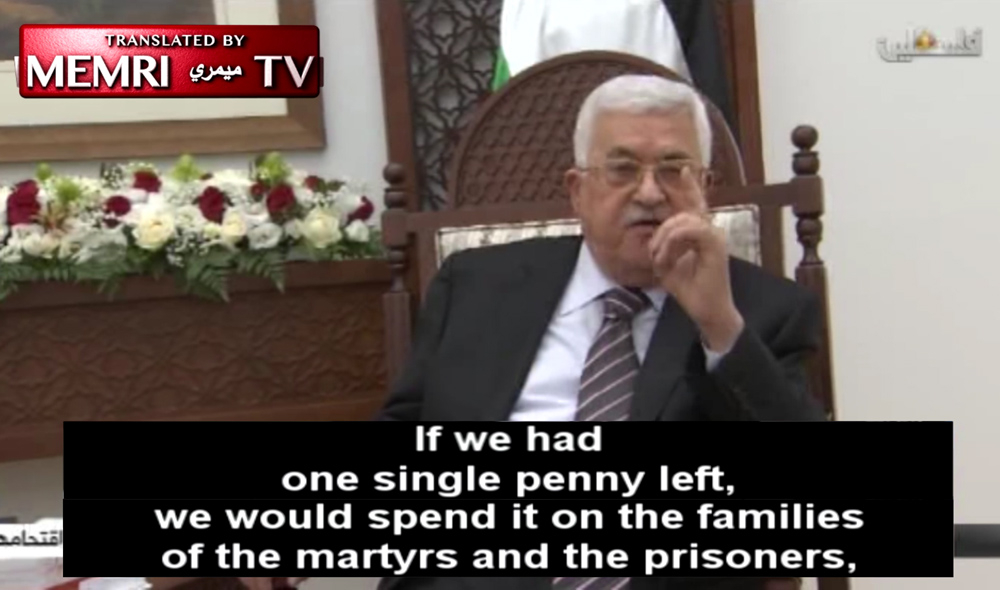
Last year, Palestinian Authority President Mahmoud Abbas paid the family of a Palestinian terrorist who murdered two Jews 30,000 Jordanian dinars ($42,000). Abbas and his senior officials have repeatedly made it clear that they will continue to pay monthly stipends to families of Palestinian terrorists. On July 23, 2018, at a ceremony honoring Palestinian terrorists, Abbas said: "We will neither reduce nor withhold the allowances of the families of martyrs, prisoners, and released prisoners... if we had one single penny left, we would spend it on the families of the martyrs and the prisoners." (Image source: MEMRI)

Normally, parents are proud to see their sons and daughters graduate from high school or university and go on to pursue their lives. This is true of ordinary parents who care about the well-being of their children and want the best for them.

Some Palestinian parents, however, are proud to see their children carry out terrorist attacks or murder Jews. For these parents, it is more "honorable" if their son or daughter murders a Jew than becomes a doctor, lawyer or engineer.

In the past few decades, many Palestinian parents have publicly boasted of the involvement of their children and family members in terrorist attacks against Jews.

Like most Palestinians, the parents consider the terrorists "heroes" and "martyrs" who sacrificed their lives for the sake of the Palestinian issue.

Scenes of Palestinians handing out candies to celebrate terrorist attacks against Jews have become the norm in the West Bank and Gaza Strip.

Continue Reading Article

Monday, January 03, 2022

Tefilin and Eretz Yisrael

by HaRav Mordechai Greenberg
Nasi HaYeshiva, Kerem B'Yavneh


Parshat Bo concludes with the mitzvah of tefilin (Shemot 13:11,16):

When Hashem will bring you to the land of the Canaanites ... It shall be a sign upon your arm, and an ornament between your eyes, for with a strong hand Hashem took us out of Egypt.

The Gemara in Kiddushin 37a asks, "Why does the Torah mention 'bringing [to the Land]' in regards to tefilin?" It answers, "This is needed as taught in the academy of R. Yishmael: Do this mitzvah so that in its merit you will enter the Land." What is the connection between the mitzvah of tefilin and entering the Land?

Normally, the more that a person invests himself in worldly matters, the more he distances from spiritual pursuits, as the author of the Chovot Halevavot writes, "The more the yishuv (physical world) is developed, the more the sechel (spirit) is destroyed."

However, the Torah does not reject the physical life of the body. It just desires that the physical realm should not become the dominant side of life, but rather it should take its proper place, and should be ruled by the spirit. Through this, the matters of the body will be turned to good, so that, just the opposite, the more the body becomes stronger and bolder, the spirit will also become more holy and elevated.

Tefilin express this idea. Tefilin of the hand corresponds to physical activity, and are next to the heart, which is the source of desire, and which is to be ruled by the brain, which is expressed by the tefilin of the head. Tefilin of the head indicate not only the intellectual aspect of man, but also the Divine spirit in him, as Chazal say, "Then all the people of the earth will see that the Name of Hashem is proclaimed over you, and they will revere you. (Devarim 28:10) – These are the tefilin of the head." ["Shem YKVK Nikra" form the acronym, shin, which is the shin in the tefilin of the head.]

Thus, we say in the prayer before placing tefilin:

He commanded us to place on the hand ... which corresponds to the heart, to thereby subjugate the desires and thoughts of our heart to His service. And on the head, corresponding to the brain, since the soul is in my brain with all my other senses and faculties; they should all be subjugated to His service, may He be blessed. From the shefa (Divine influence) of the mitzvah of tefilin, may the shefa of holy thoughts be drawn upon me, etc.

Eretz Yisrael is a land "flowing with milk and honey," so that there is danger that in it the physical body will be strengthened, and thereby the spiritual faculties of man and of the nation will be weakened. Therefore, the mitzvah of tefilin was given to us as a preparation for entering the Land, so that the spiritual forces will be strengthened, and there will be no concern of the destruction of the sechel through the development of the yishuv.

This was the great concern of the spies, as explained by the ancient Seforim. They were afraid to confront this problem, and preferred to remain in the desert, where one can only be involved with the spiritual realm. However, this is not the goal of the Torah, but rather to prove that it is possible to be involved in worldly matters and to remain connected to heaven. To build the body, but to strengthen the spiritual faculty; to be people, but to behave as angels: "People of holiness you shall be to me." (Shemot 22:30)

The Chatam Sofer writes about this (as has been mentioned before), that R. Yishmael's statement that a person should involve himself in worldly pursuits together with his learning is said only in Eretz Yisrael,

where labor itself is a mitzvah of yishuv Eretz Yisrael, and of bringing forth its holy fruits. About this the Torah commands, 'Gather your grain.' However, when we are scattered amongst the nations, and the more the world is developed, the service of G-d is destroyed, R. Yishmael concedes to R. Shimon b. Yochai.

Therefore, the Torah says about the mitzvah of tefilin, "Do this mitzvah so that in its merit you will enter the Land," and there will be no danger of spiritual damage due to material involvement.

Rav Kook zt"l writes that this, apparently, is the reason that the satanic forces are striving that this mitzvah should be observed weakly nowadays, in order to hold back the redemption. Thus, it is important to strengthen and put on tefilin mehudarot, written properly and worn in the proper place. (See Chavosh Pe'er Drush #1)

Liberation Built on Self-Sacrifice

by HaRav Shaul Yisraeli, zt"l
Rosh HaYeshiva, Mercaz HaRav
Rosh Kollel, Eretz Hemdah
Chaver, Beit Din HaGadol Yerushalayim
based on Siach Shaul, p. 217-8


The pasuk in Yechezkel (16:6), which we read in the Haggada, repeats the phrase, "In your blood you shall live." The midrash (P’sikta 17) says it refers to the blood of mila and the blood of Korban Pesach. We are forbidden to give the Korban Pesach to a non-Jew or to one who does not have a brit mila (Shemot 12:43,48). Pirkei D’Rabbi Eliezer says: "In the merit of the blood of brit mila and Korban Pesach, they were liberated from Egypt, and in the merit of the blood of brit mila and Korban Pesach, they will be liberated at the end of ‘the fourth kingdom.’"

The Korban Pesach represents the liberation. We are to eat roasted lamb with the whole family celebrating as a unit at an elaborate meal, on the one hand, and eat matza and maror to remember the past, as well. Only if, at the time of success, we remember the times of affliction, can we be sure that the light of success will not blind us. This is best accomplished when there is first a brit mila.

There are many who are ready to sacrifice for independence as long as that independence seems fit for posh festivities. At that point, one does not want to have to remember the past with its difficulties. One wants to see in the independent nation a new nation, in our case, not the same "Yiddelach" from the exile. A certain self-pride is born, as we see, with a hollow boastfulness, which can eventually turn into empty disregard for others. To combat that, we need the blood of mila. The independence of Israel is a chain of self-sacrifice, whose purpose is not to let us rest on our laurels. Indeed, one who is not circumcised cannot take part in the full Pesach celebration. Without a life of purity, independence can be dangerous.

This is what Chazal (Shemot Rabba 3:4) meant in saying that Bnei Yisrael went down to Egypt with the word "anochi," were taken out with the word "anochi," and will be redeemed at the end of time with "anochi" ("Alas, I (anochi) am sending you Eliya the Prophet"). Some think that one can be liberated without calling out in the name of Hashem (anochi), as the other nations can. Without anochi the hearts of the fathers are not lined up with the hearts of the sons (see Malachi 3:24). This is not only in regard to Torah observance but when things are done wrong, the younger generation will be disillusioned with that which their fathers cherished and fought for. We already see the emergence of youth who feel over-entitlement. That is because one who does not keep on a straight line, will grow increasingly crooked.

For the liberation at the end of the fourth liberation there is a need for preparation done by Eliyahu before the "day of Hashem" and "the offering of Yehuda and Yerushalyim like the days of the past." The navi (ibid. 4) referred to it in a double language that hints about the time of Moshe and the time of Shlomo (Vayikra Rabba 7:4). Both before the time of the particular national emergence (time of Moshe) and before the time that will usher in an era where all of mankind will learn from the Torah emanating from Zion (time of Shlomo) there is a need for Eliyahu to set the stage.

A Mighty Hand and an Outstretched Arm

by HaRav Zalman Baruch Melamed
Rosh HaYeshiva, Beit El


The Torah study is dedicated in the memory of Hana Bat Haim

"We were slaves to Pharaoh in Egypt, and God our Lord took us out of there with a mighty hand and an outstretched arm." We read these words from the Haggadah each year on Seder Night.

The question is: Why do we make special note of the fact that the Almighty took us out with a "mighty hand"? Is God's taking us out of Egypt with a mighty hand it so important? It would seem that the most important thing is the fact that the He took us out of slavery to freedom. Even had God taken us out of Egypt peacefully without striking the Egyptians, we would have to thank Him. Perhaps it would have even been better had He taken us out in a peaceful manner, placing in Pharaoh's heart the desire for peace and goodwill so that he let us go of his own desire. Would this not have been better than to take us out by force, with a mighty hand and an outstretched arm, making the Egyptians hate us?

The answer to this question is this: It is precisely due to God's taking us out with a "mighty hand" that we must thank Him. God did us a favor, for, by arranging things such, He made it known to the entire world that the Creator of the universe had chosen us to be his people.

All understood the mighty and miraculous plagues to be the work of the hand of God, as it is written, "And the Magicians said, 'This is the finger of God, and the hand of God." Indeed, only the Almighty Creator of the Universe could perform such signs and wonders, and He did this in order to take the People of Israel out of Egypt. This act caused people to conclude that the Jewish people had been chosen as the nation of God. From this point onward, the Jews would forever be seen as the chosen nation of the Almighty, and being God's chosen people serves to guarantee the eternal existence of the Nation of Israel.

When, for example, the Children of Israel sinned with the Golden Calf, and God wanted to destroy them, Moses stood up and prayed to God, telling him that it was unthinkable to eradicate the Jewish people. This would be a desecration of God's name, for when they were redeemed from Egypt it became known to the entire world that the People of Israel are God's people, and if the Almighty were to destroy them, the nations would say that because God was unable to bring them into the Land of Israel, he destroyed them in the wilderness. "Why should the Egyptians be able to say that You took them out with evil intentions..."

We may thus conclude that the plagues which God brought upon Egypt served to publicize the bond between God and the People of Israel, and this fact is what saves the People of Israel from all tribulation throughout the generations. Even if, Heaven forbid, Israel should happen to sin and thus make themselves unworthy of salvation, God, for the sake of His great name which is attached to Israel, comes to their aid, saving them from all distress.

So, God performed a great act of kindness by taking us out of Egypt from slavery to freedom, and, perhaps principally, by striking the Egyptians with great and Divine plagues. In this manner, the name of God became attached to the People of Israel. The honor of Israel is the honor of God. And when Israel suffers (Heaven forbid!), God's name is desecrated. We can therefore rest assured that the Jewish people will persevere forever and be saved from all affliction, even if we are not truly worthy of such.

Therefore, we thank the Almighty for each and every plague which he brought upon the Egyptians. This is what we say in the thanksgiving Hallel prayer on the Passover Night: "To Him who struck the Egyptians through their firstborn - His kindness endures forever! With a mighty hand and an outstretched arm - His kindness endures forever!" These plagues are an act of everlasting Heavenly kindness. Because of them, God protects us.

It is possible to find this concept expressed in Rabbi Yaakov MiLita's commentary to the Passover Haggadah, entitled "Maaseh Nisim."

What the Word "Bo" Really Means

by Rabbi Dov Berel Wein

Since every word of our holy Torah carries with it many layers of significance and importance, it is incumbent upon us to understand why this particular word, Bo, is employed by the Torah to describe a certain situation.

In the opinion of the commentators to the Torah, the word Bo, which appears at the beginning of this week's reading, contains a deeper meaning than the simple translation meaning ‘to come.’ The fact that the word is then followed by the Hebrew word ‘el’ meaning not only ‘to’ but perhaps more literally ‘into,’ gives us insight into what the word Bo in this context really means.

It was not sufficient for Moshe merely to visit or come to the Pharaoh of Egypt to deliver the warnings from God regarding the plagues that were going to descend upon the Egyptian nation, because of their refusal to free the Jewish people from bondage.
Moshe could have delivered this information by proxy, by messenger, by letter or any of the other means that human beings used then to communicate one with another.

Rather, it was necessary for Moshe to enter into the brain and feelings of Pharaoh, so to speak, that propels the entire narrative of this week's reading and will lead to the great moment of freedom and emancipation for the Jewish people.

It is as though the Lord, so to speak, wants Moshe to really understand the stubbornness and almost suicidal behavior of the Pharaoh, and to appreciate that it is this intransigence itself that will be his undoing and the destruction of Egypt.

It is as though the Torah is teaching us that if one is unable to comprehend the depths of the personality of evil, one can never really combat evil in a practical and strong fashion. It is this recognition of the evil lurking originally, though only in the background of events, that is the beginning of the process of preventing it from triumphing.

The Jewish people were fooled by the Pharaoh into volunteering for their own forced labor and eventual slavery. They did not recognize his call for patriotism as the true evil that lay behind his national plan for them. The Jewish people were so willing to be recognized as good Egyptians that they volunteered to become their own worst enemy and submit themselves to centuries of slavery and servitude.

Jewish people, for centuries, have often been unable to perceive that they themselves create the seeds of their own destruction. In the rush for acceptance and approbation by others, Jews are often blinded, willfully overlooking the evil arising around them.

It is insufficient to come to the Pharaoh to argue one’s case. One must be able to come ‘into’ Pharaoh and to see the true motivation that created this situation of sadness and servitude. This lesson, recorded for us in the Torah, forms a message that applies to all ages of Jewish existence and to all circumstances of political, social, and national life.

Support for Minister Kahana’s Conversion Plan

by HaRav Eliezer Melamed
Rosh HaYeshiva, Har Bracha

In the situation that has been created, it is a mitzvah to follow the opinion of the poskim who rule leniently, and accept a convert who intends to live as a traditional Jew – as long as his principled approach to Torah and mitzvot is positive * Rav Eliezer Waldman ztz”l agreed to cooperate with Reform Jews for Clal-Yisraeli purposes, but stood firmly on the truth in opposition to them on the issue of conversion, and considering them as rabbis * He vehemently opposed boycotts, and argued that Rav Kook’s proclamations regarding the Temple Mount have no influence on today’s ruling

About a week ago, my position on the issue of conversion was published:
“I support the initiative of the Minister of Religions, Matan Kahana, in restoring the authority of conversion to local rabbis. This is the law from time immemorial, namely, that every rabbi is authorized to convert. This was the practice in the State of Israel until about thirty years ago, and similarly, it is fitting and correct today, in order to open the majority of doors for immigrants from Jewish families who are not halachically Jews, to convert according to halakha. I hope that this initiative will add Torah and mitzvot in Israel, and on account of it, more immigrants will return to their roots, and more Jews in the Land of Israel will be strengthened in keeping tradition, in the love of Torah, and in keeping mitzvot.”

I will elaborate a bit on the issue (based on my book, “HaMasoret HaYehudit” 18: 6).

Acceptance of the Mitzvot
The foundation of conversion is that the ger (convert) accepts upon himself the great vision of Am Yisrael, realized by way of Torah and mitzvot. Therefore, if a ger says that in principle, he is not willing to keep a certain mitzvah, he is not converted (Bechorot 30b). If, nonetheless, he was converted with the knowledge that in principle he does not agree to accept some of the mitzvot – his conversion is void. Consequently, conversion in a Reform or Conservative framework is not a valid conversion, since their principled position is that it is not necessary to observe all the mitzvot according to the tradition of Israel. And if this “ger” married a Jewish woman, and then left her – she is permitted to marry a Jew without receiving a get (a divorce according to Jewish law) from him.

On the other hand, anyone who has accepted the Torah and the mitzvot according to the tradition of Israel, although he is unfamiliar with the majority of the mitzvot, since in principle he is interested in keeping the mitzvot, his conversion is valid. Moreover, even if at the time of conversion he fears he will not be able to keep some of the mitzvoth, such as Shabbat, because perhaps his yetzer (evil inclination) will overcome him, or because of the necessity of earning a living – since in principle he wants to keep the mitzvot, his conversion is valid.

The question is: what is the law when a ger does not intend to live as a dati (observant) Jew, but only as a masoriti (traditional) Jew? Should, le-chatchila (from the outset), he be accepted?

The Opinion that a Ger who intends to be Masoriti Should Not be Accepted
According to many poskim (Jewish law arbiters), he should not be accepted, since only a person who intends to keep all the mitzvot as a dati Jew, should be accepted as a ger. However, if the ger accepted upon himself to keep all the mitzvot, and the Beit Din (Jewish law court) decided to convert him, but after the conversion he weakened, to the point where he stopped keeping Torah and mitzvot – he is still considered a Jew. For just as a Jew who does not keep Torah and mitzvot remains a Jew, similarly, a ger who converted according to halakha but stopped observing mitzvot, remains a Jew.

The Opinion that He Can be Accepted
There are poskim who rule leniently, and are of the opinion that even if the ger intends to live as a masoriti Jew – as long as his principled approach to Torah and mitzvot is positive, he should be accepted. First, since he is interested in keeping the mitzvot, there is a chance that over time he will keep them all. Second, the mitzvot that he intends to observe are countless, and indicate a genuine desire to join the destiny of Am Yisrael: all the numerous mitzvot bein adam le-chaveiro (between man and his fellow neighbor) which are the foundation of the entire Torah, as well as many other mitzvot, including brit milah (circumcision), nisu’in (marriage), halvayah (funeral), aveilut (mourning), and eating kosher food. And even if he does not intend to keep all the laws of Shabbat, he does intend to refrain from working on Shabbat, to honor it by lighting candles and making kiddush, and to celebrate all the Chagim (holidays). And if he enlists in the IDF, well then, he keeps all the mitzvot related to yishuv ha’aretz (settlement of the Land) and the defense of Israel, about which our Sages said, these mitzvot are equivalent to all the other mitzvot.

In practice, even according to the strict opinion, if a Beit Din decided to act in accordance with the lenient opinion and accepted a ger who intends to live as a masoriti Jew – his conversion is valid.

Summary
There are currently hundreds of thousands of people living in Israel who, according to halakha, are not Jews, but are descendants of Jewish families, identify themselves as Israeli and Jewish, and are interested in returning to their roots. On the one hand, the majority of them want to convert and live as masoriti Jews. On the other hand, if they do not convert, they will establish families with Jews who will also move away from the Jewish tradition. In this situation, it is a mitzvah to open the possibility for all rabbis of the lenient opinion, to establish Batei Din and convert them, thereby adding Torah and mitzvot in Israel.

Ultimately, the main goal is for the entire Jewish public to grow in Torah and mitzvot, and in this way, the converts will also grow together with Clal Yisrael.

From the Words of Rav Tzvi Yehuda Concerning Meeting with Reform Jews
Last week, I spoke about Rav Eliezer Waldman ztz”l. Now, I will add things he said to me in regards to Reform Jews:
Several times he was invited to talk to Reform congregations and participate in panels with Reform rabbis, and asked our teacher and mentor, Rav Tzvi Yehuda, whether to participate. Rav Tzvi Yehuda replied that if they wished to listen, of course he should speak to them, and added with satisfaction, that after the establishment of the State of Israel, the Reform movement began to change direction: initially it was in the process of moving away from Am Yisrael and Eretz Yisrael, but now, after the Holocaust, the general direction is a return to the values of the Nation and the Land. Some joined the Zionist Organization, and others returned to the traditional wording recalling the Land of Israel in their prayer books (unfortunately, today there are also opposite trends). Rav Shapira ztz”l and Rav Eliyahu ztz”l spoke similarly, as well.

Rav Waldman added: I always understood from Rabbeinu, Rav Tzvi Yehuda, that regardless of the fact that positive changes of rapprochement to the values ​​of the Nation and the Land had begun to take place, it was possible to participate with them in Clal-Yisraeli matters, such as for the sake of Russian Jewry, and against anti-Semitism. The intention of course, is with the rabbis, since the rabbi is the person who manages the life of the Jewish community, and in addition to religious affairs, organizes all social activities; consequently, everything depends on him, and only if he is involved in the activity, will his congregants take part.

About his Lecture in Los Angeles
There was a Reform congregation in Los Angeles, which at the time was the largest in America, and the rabbi there was probably the only one who supported right-wing positions in relation to the Land of Israel. Therefore, he invited Rav Waldman to speak to the community (not in the synagogue) about Hebron, and Judea and Samaria. The rabbi told him that they would probably ask difficult questions, including about conversion, because in those days there were discussions in the Knesset about conversion according to halakha.

After finishing his speech about Eretz Yisrael, a woman stood up and said: “I am a Reform convert! What do you have against me?!” Rav Waldman replied: “I have nothing against you. I assume you really want to belong to the Jewish people, but I do have a claim against whoever converted you. He should have told you that, indeed, there are people who convert in different ways, but there is only one conversion by which you will be accepted as a Jew amongst all of Israel, and that is conversion according to halakha.”

Telling the Truth with Sensitivity
He also related:

I was invited to participate in a panel at the Plaza Hotel in Jerusalem in front of an American audience. The organizer asked me to arrive early so that the participants of the panel could talk, and get to know each other. I was happy about that, because I wanted to ask them their names, so that in the panel, I could call them by their name without the title “Rav” or “Rabbi” as is customary in America. Indeed, when it was my turn to speak, I opened and said that I was happy to be here and participate along with some friends – so and so – without mentioning their title rabbi. The Reform rabbi jumped up and said to me: “Call me Rabbi! Why don’t you call me Rabbi?” I replied: “If you want me to call you rabbi, I am willing to call you rabbi, because in my opinion, every person should be called by the name he wishes to be called by. But I will not hide from you the fact that I do not recognize you as a qualified rabbi, because there are criteria for a qualified rabbi.”

He argued against me: “Indeed, there are intellectual criteria, and I meet them, because I have sufficient knowledge.” I said to him: “Not only do we need knowledge, but also moral-ethical criteria and they are emuna (faith), kabbalat ol Malchut Shamayim (accepting the yoke of the Kingdom of Heaven), Torah min ha’Shamayim (Torah from Heaven), kiyum mitzvot (observance of mitzvoth), etc.”


In the end, since Rav Waldman respected him and complied with his request to call him a rabbi, they concluded the meeting with respect and friendship.

An Explanation of the Situation of Reform Jews
Rav Waldman ztz”l added that the Reform public follows their rabbi, and if we do not respect him – they will all be insulted. In addition, the public that becomes members of the Reform community joins with the intention of connecting to Judaism, which is a positive direction. There are those who are not even aware there is another option. Nevertheless, even those who are aware that religious communities exist, but prefer to join the Reform community because of its easier demands – in the end, they want a connection to the Jewish people, which is good.

I asked Rav Waldman ztz”l what he would answer a person who asked if it would be better for him to join a Reform community, or to be left without one? He replied: Unfortunately, there is a large American public that is not connected to any community, and is disconnected from the Jewish people. Therefore, it is certainly better to belong to a Reform community, than no community at all.”

Incidentally, I have asked rabbis from abroad what the customary answer is to this question among all rabbis abroad, including those from all the various circles. They replied that almost all rabbis respond “it is better to belong to a Reform community”, but many of them add “but do not say it in my name”, and some even add “and if you say it in my name – I will deny it”…

On Boycotts and the Temple Mount
Rav Waldman ztz”l added that the whole issue of boycotts is distressing, and not a good thing. When Rav Kook ztz”l established the Talmud Torah in Jaffa where they combined vocational and language studies, people argued against him that rabbis of the previous generation had imposed a boycott on doing so. He responded that the boycott greatly upset him, especially considering that times change, and a claim should not be made from a judgement said in a different time and place, to our generation.

Similarly, in regards to those who printed posters with Rav Kook’s signature that it is forbidden to ascend Har HaBayit (the Temple Mount), he said, what do things written nearly a hundred years ago have to do with our times? Only one foundation can be learned from this – that the halakha follows Rambam, and not like Ra’avad, namely, that there is kedusha (holiness) on Har HaBayit even after the Destruction. However, if one ascends in holiness in the permitted areas, then it is good. This concludes his remarks.

Life in the Stone Age

by Victor Rosenthal

Almost every day that passes sees attempts to murder Jews, because they are Jews. Some of these can even be called attempts at mass murder. No, I am not only talking about rockets launched from the Gaza strip and aimed at Israeli towns and cities. I am referring to something which almost never makes the news outside of Israel, and often goes unmentioned even here: what I have called “smalltime terrorism,” which includes firebomb and rock-throwing attacks against Jews.

If you think rock-throwing is only an annoyance, watch the video here and think about this: a rock thrown from an oncoming vehicle at one in the opposing lane strikes its target at a velocity equal to the sum of the speeds of the two vehicles, plus whatever the thrower adds to it, less a bit due to air resistance. So a rock thrown at you from a car traveling at 100 km/h (60 mph) may hit your windshield at more than 200 km/h. Let’s say the rock is 10 cm (4.1”) in diameter; it will weigh nearly 1.5 kg, or more than 3 pounds. A brick could weigh twice as much.

Such a projectile is a deadly weapon which can smash through safety glass. Even if it does not also smash your skull or crush your chest, even if it misses you entirely, it can cause you to swerve off the road, as happened to Asher Palmer and his 1-year old son Yonatan, who were murdered by Arab rock-throwers.

But what if your vehicle is a bus with 30-50 passengers? What if you are a bus driver that has to fear every oncoming car day (and especially night) in and day out? Some of the roads are narrow, with unforgiving drop-offs or rocks on either side. Last night, two buses were attacked in this way, and only sheer luck (or a miracle) prevented a tragedy. Attempted mass murder.

Throwing stones at Jews has a long history, especially in the Muslim-Arab world. Edward Said, the Palestinian-American intellectual famous for the book Orientalism, symbolically (or ineffectually) threw a stone in the direction of Israeli soldiers at the Lebanese border. It is probably the most popular form of anti-Jewish terrorism practiced by Palestinian Arabs, since it is cheap, easy, and can be practiced by terrorists of any age. Sometimes Arab terrorists build barriers in the middle of a road to force cars to stop, and then attack them with rocks before trying to drag the occupants out and beat or kill them.

The Jewish state was created so that Jews would not have to live among cultures where the of stoning Jews is an everyday occurrence. Or, for that matter, stabbing them, shooting them, or running over them with cars. But that’s what Jews face here today. And they are expected to not defend themselves. So far this month four Palestinian Arabs have been killed by Israeli soldiers or police while attempting to commit murder, or immediately after. Palestinian officials are outraged. How dare we? They are supposed to kill us, not the reverse.

The problem is the same one that the Jewish people faced after they left Egypt and found their way to the Land of Israel. It is one that has beset human tribes since there were human tribes: the need to truly possess our land and repel those that want to take it from us. The ancient and elemental nature of the struggle is demonstrated by the fact that it is partly fought with stones, the oldest of weapons.

A solution to this problem will not be found in the realm of high technology, nor in the halls of diplomacy or international law. We will not get it from the Americans along with F-35s. It will begin with the understanding that it is our land, from the river to the sea (as the Arabs are fond of saying), and that it is the mission and the responsibility of the Jewish people to populate it, and to rule it. It is our ambiguity about this mission that allows our enemies to become strong enough to think that they can prevail.