Monday, February 06, 2023

A Response of Greatness

by Rabbi Dov Berel Wein

A literal reading of the Parsha tells us that Yitro, who was the high priest of Midian and the father-in-law of Moshe, saw of the events of the Exodus from Egypt and, according to Rashi based on Midrash, saw the battle the Jewish people fought against Amalek.

The Torah implies, and Rashi states openly, that upon hearing of these events, Yitro was propelled to leave his home, and to come into the desert to accompany the Jewish people, at least initially, on their travels through the Sinai desert. The Torah does not tell us how he heard about these events, but, apparently, they were of such earth-shattering proportions, that the news spread rapidly throughout the Middle East.

From the verses in the song of Moshe and the Jewish people, at the splitting of the waters of Yam Suf, it is obvious that Yitro was not alone in hearing about these wonderous events. The verse says that all the nations of the area were also astounded to hear of these miracles, and to realize that a new nation had been born from the slavery of Egypt. Yet, the reaction of the people in those countries and especially that of Amalek certainly differed greatly from the response of Yitro to the very same news.

The nations of the world chose either to oppose the news by attacking the Jewish people, or, mostly, to simply ignore it as not being worthy of their concern. People are so confirmed in their inertia that even when there is an event that obviously is historic and earth-shattering, but which would, at the same time, cause a reassessment of their own lives, attitudes, and policies, they will, in the main, either deny the news, besmirch the miracle, or ignore the matter completely.

It is to the credit of Yitro that he chose to act positively upon hearing of the events that occurred to the Jewish people in their exodus from Egypt. Of course, being the father-in-law of Moshe, he also had a personal vested interest in visiting his family, but, nevertheless, it must be recorded to his credit, that he uprooted himself to join the Jewish people in their travels through the desert.

One of the great tests in life is how one responds to news that is momentous and unexpected, that makes it necessary to change one's habits and life direction. Jews often piously – and I do not doubt their sincerity when they say it – put off momentous decisions until the Messiah arrives. But the little I know of human nature teaches me that even when the Messiah arrives, there will be many who will not be willing to change their life pattern, sell everything to join the Jewish people in the land of Israel, with all the accompanying hardships that inevitably will be involved. People hear many things, many times very important things, but this knowledge does not necessarily imply that they are willing to act upon them in a positive and productive manner. Yitro is eternally privileged to have a portion of the Torah on his name because he heard and shortly thereafter, he acted.

The Reward for Honoring Parents and Eretz Yisrael

by HaRav Mordechai Greenberg
Nasi HaYeshiva, Kerem B'Yavneh


Honor your father and your mother, so that your days will be lengthened upon the land that Hashem, your G-d, gives you. (Shemot 20:12)

One may ask: It is understandable that the reward for agricultural mitzvot will be in Eretz Yisrael. However, honoring parents is a rational, humanistic mitzvah, which other nations also observe due to its moral ethic, and which applies equally in Eretz Yisrael and outside of the Land. Why, then, is the reward specifically determined to be in Eretz Yisrael?

The answer to this question is rooted in a comment of the Ramban on Parshat Acharei Mot, where he asks a similar question, but in the opposite direction. It says there, in the section of the arayot, "Let not the Land disgorge you for having contaminated it, as it disgorged the nation that was before you." (Vayikra 18:28) The Ramban asks: Arayot are sins between man and G-d, which are incumbent upon the person's body, and are not linked specifically to Eretz Yisrael. Why, then, is the punishment for these sins greater in Eretz Yisrael than outside of the Land?

The Ramban explains there at great length the special quality of Eretz Yisrael, that is constantly guided by G-d in a direct manner, unlike other lands, where the Divine guidance is through officers and kings and G-d rules only in an indirect manner. Therefore, it is impossible to draw close to Him other than in Eretz Yisrael -- the Land that is "before Hashem," about which it says, "the eyes of Hashem are always upon it," and which is called, "the gate of Heaven" and "G-d's Sanctuary." Clearly, it is impossible to compare one who sins in G-d's Sanctuary to one who sins in the street. So, too, regarding the mitzvot -- which draw a person close to the Creator -- closeness to the King in His palace is far greater than closeness to Him outside.

Therefore, the Ramban writes, "The mitzvot are primarily for those who sit in the Land of Hashem," and there the mitzvot achieve their special value. Hence, the sin of arayot in Eretz Yisrael is entirely different than arayot outside of Israel.

In regards to honoring parents, the Torah introduces a novel concept. Even though it is a rational, humanistic mitzvah, still, it is connected -- like all other mitzvot -- specifically to Eretz Yisrael. Therefore, the Torah emphasizes that even mitzvot such as these apply especially to Eretz Yisrael -- "so that your days will be lengthened upon the land that Hashem, your G-d, gives you."

The GR"A's disciples add a collective dimension to this mitzvah. Besides honoring parents in the simple sense, there is a collective mitzvah on Am Yisrael to honor its parents, its elders from previous generations, and to guard above all the tradition of its ancestors, until the earliest patriarchs of Am Yisrael. When they observe the early tradition, they will be worthy of the rightful privilege of the early ones. What is their rightful privilege? -- That which was said to Avraham initially, "Go forth from your land ... to the land that I will show you ... To your offspring I will give this land (Bereisheet 12:1-7); "For all the land that you see, to you I will give it, and to your descendents forever" (13:15). This commitment was repeated to all the patriarchs.

This is what is promised here. If Israel will honor the heritage of the patriarchs, the Divine promise regarding their connection to Eretz Yisrael will be fulfilled, and they will live long lives, "upon the land that Hashem, your G-d, gives you."

Rav Kook on Parashat Yitro: The Date of Matan Torah

On what day was the Torah revealed to Israel? The majority opinion is that the Torah was given on the sixth day of Sivan. Rebbi Yossi, however, disagreed, arguing that the Torah was given on the seventh of Sivan (Shabbat 86b).

What is the essence of this disagreement? What is the significance of the date of Matan Torah?

Perfecting Creation
Rav Kook explained that the Sages were debating the fundamental goal of the Torah. The sixth and seventh of Sivan correspond to the very first sixth and seventh days in history — the sixth and seventh day of Creation.

Most of the Sages associated the Siniatic revelation with the sixth day of Creation, the day that mankind was created. This connection indicates that the primary objective of the Torah is to complete that act of Creation — the birth of humanity. The goal of Torah is to perfect humanity, to recreate it in a holier, purer form.  

Rebbi Yossi, on the other hand, wanted to stress an even higher goal of the Torah. For after the Torah has made its mark on mankind and its ideals have been internalized in the human heart, it will then take root into the innermost soul of the world, uplifting and refining the entire universe.


Illustration image: ‘Moses Breaking the Tablets of the Law’ (Rembrandt, 1659)

In terms of this ultimate goal of the Torah, it is fitting that the Torah be revealed to the world on the seventh day, the concluding day of Creation. Through the seventh day, the Torah is linked to the true culmination of Creation — the Sabbath, the day of ultimate perfection and rest.

(Silver from the Land of Israel. Adapted from Ein Eyah vol. IV on Shabbat 86b (9:17) by Rav Chanan Morrison.)

How 'The Collective Voice of the Muslim World' Weaponizes the UN against Israel

by Bassam Tawil 
  • OPEC and the OIC are infused with nearly incalculable wealth and most member states of the OIC have found themselves upbraided for questionable ethics.
  • One critic suggested: "If the OIC Summiteers are serious about the burning issues of justice, freedom and good governance, then they should schedule a special debate on the Transparency International's (TI) 2003 Corruption Perception Index (CPI) which ranked 38 of the 57 OIC member nations in its latest chart of the corruption levels of 133 countries... [it] is dismal reading for OIC as it is an overall indictment of the failures of the OIC countries to grapple with the problem of corruption..."
  • The UN itself is certainly not above reproach in the corruption department, as evidenced, among other cases, by the "Oil-for-Food Program;" the extensive history of "food for sex" with children by "peacekeepers" who enjoy immunity from prosecution; or the trial of Chinese executive Julia Wang, who attempted to purchase an influential UN post.
  • One may wonder why Nicaragua, not an Islamic country, and with significant problems on its own home front, would trouble itself with submitting the motion. A cursory investigation reveals some significant motivation: "With the majority vote of the Sandinista Caucus, the National Assembly today approved the Loan Agreement signed between the OPEC Fund for International Development (OFID) and the Republic of Nicaragua... The project, which has an estimated investment of 23 million dollars, of which the OPEC Fund will finance 20.5 million..."
  • The OIC even attempted to co-opt UN forces as a pretext for Islamic military support of Lebanon's offensive against Israel.
  • Returning to the pre-1967 lines -- simply the armistice lines from 1949 where fighting had happened to stop -- is nothing short of suicide for Israel; it would be virtually indefensible, and the UN and all of its sponsors are well aware of that.
  • It would seem... that protecting freedom of religion, outside of Islamic fundamentalism, is not of any particular concern to the OIC or what now stands mostly as its legitimizing but rapidly crumbling front, the UN. The collaboration between the OIC and UN is simply a pretext to twist international law -- and public opinion -- to their own purposes, whether they are promoting themselves or delegitimizing the State of Israel.

The Organisation of Islamic Cooperation (OIC) presumptuously calls itself "The Collective Voice of The Muslim World," and simple observation of its activities would seem to place it as Islam's political Caliphate. One would wonder, then, how such a single-interest organization could lay claim to such a disproportionate amount of the United Nations' attention. Pictured: A special meeting of the OIC in Islamabad, Pakistan on December 19, 2021. (Photo by Farooq Naeem/AFP via Getty Images)

It is already a tired truism to say that the United Nations has a distinctly anti-Israel bias. The US became exasperated with this laser-like focus and, in unequivocal condemnation of the agency, withdrew from the UN Human Rights Council (UNHRC) in 2018 and, for the same reason, from UNESCO the following year.

Predictably, a UN Committee on the Status of Women resolution singled out Israel as the only state in the world to be condemned for violations of women's rights, as well.

How can such an overwhelming amount of time, paperwork and energy of the UN's extensive agencies, professedly representing global interests, be so single-mindedly devoted to the censure of a single democratic state?

Second only to the UN, the Organisation of Islamic Cooperation (OIC) is the world's largest intergovernmental organization.

Continue Reading Article

I Am Concerned

by Rabbi Steven Pruzansky

The left-leaning Israeli media is disseminating news articles transmitting the discontent of American Jewish leaders with the new Israeli government and the policies it wishes to implement. A good example of this genre is the recent headline that blared “169 liberal US Jewish leaders sign letter expressing concern over Israeli government.” These leaders headed non-Orthodox rabbinical seminaries, federations, AIPAC, the Conference of Presidents and others, and they decried accusations of “anti-Semitism” directed against critics of Israel’s government (I haven’t heard any but be that as it may) as well as the now familiar laments about the proposed judicial reforms that will preserve Israel’s democracy and the amendment to the grandfather clause in the Law of Return that currently allows third-generation Gentiles to become Israeli citizens as “Jews.”

The lines are drawn and there is little I can do to assuage their “concern over the Israeli government.” What I can do is this: express my concern over the state of American Jewish leadership. And these concerns are well founded.

It is not only that these leaders are self-appointed and often found their own organizations of which they anoint themselves the leaders for life. It is primarily that these leaders are presiding over the rapid decline and disappearance of American Jewry under the dual albatrosses of assimilation and intermarriage. The population of American Jewry is steadily declining, artificially sustained only by counting halachic non-Jews as part of the Jewish community (even those who do not perceive themselves as such). The intermarriage rate among American Jews outside the Orthodox world hovers at around 75%. I am concerned about that because I grieve at the disappearance of every single Jew. I am concerned about American Jewish leadership’s attitude toward this problem and lament their inability or reluctance to do anything about it.

I am concerned over the drift over American Jewish leadership from liberalism to the far left, the progressive end of the political spectrum. I am concerned that the Reform Jewish movement proudly features on its website an article entitled “Why Pronouns are So Important – and Why Using the Right Ones is so Jewish.” I am concerned because that is not at all important (in fact, it seems ridiculous and a denial of reality) and it is not at all Jewish. I am concerned because American Jewish leadership seems enamored with every progressive cause far more than they are with Torah knowledge and observance of mitzvot, Jewish identity and Jewish continuity. Indeed, as the progressives embrace anti-Israel activism in all its forms – delegitimization, boycott, divestment and sanction, I am concerned that American Jewish leaders will ultimately fall into lockstep with these Jew haters so as to remain in their good graces.

I am concerned that American Jewish leaders do little to try to influence Jews to be more Jewish – more learned in Torah, more observant of mitzvot, more inclined to marry Jews and have Jewish children and grandchildren. Some of these signatories are intermarried themselves.

I am concerned that American Jewish leaders have fallen into the trap of denouncing anti-Jewish attacks from so-called right wingers but rarely (or never) if perpetrated by leftists, progressives, blacks or Muslims. I am concerned that they downplay or ignore assaults on easily-identifiable religious Jews. I am concerned that many American Jewish leaders have come to the defense of Ilhan Omar and Rashida Tlaib, blatant Jew haters but, nevertheless, still Democrats, like almost all of these American Jewish leaders, and thus must be defended.

I am concerned that American Jews have so many problems – internal and external – and American Jewish leaders are racing, tripping over themselves, sending letter and issuing daily statements criticizing Israel’s democracy and opining on pending legislation, which, by any reasonable reading, will have absolutely no effect on American Jewry (not even revising the grandfather clause pursuant to which very few Americans ever apply for Aliyah).

I would be even more concerned if I hadn’t seen this movie before. In this week’s sedrah (Beshalach), God eschewed guiding the Jewish people to Israel through the shorter sea route and instead takes the more arduous wilderness journey “lest the people reconsider when they see a war and return to Egypt” (Shemot 13:17). A few days later, the people saw the approaching Egyptian army, fearsome in its might and capabilities, and complained to Moshe: “Was there a shortage of graves in Egypt that you took us to die in the wilderness…Did we not say ‘better to serve the Egyptians than to die in the wilderness’” (14:11-12)?

The “people” feared a war and the “people” complained to Moshe. And where were the leaders, the heads of the Jewish tribes and organizations, to calm the people, to explain to them the situation, to have faith in God and confidence in Moshe? Where were the Egyptian-Jewish leaders to assist Moshe?

The answer is that they were long gone. Moshe and Aharon appealed to them before the first summit with Pharaoh and they were enthused with Moshe’s mission and the impending redemption – until they had to undertake personally the risky assignment of accompanying Moshe and Aharon to Pharaoh. They did not quite make it. Rashi (5:1) comments that one by one these leaders slinked away out of fear of what Pharaoh would say or do. They were not “leaders.” They had organizations and titles but they could not lead people and they could not even follow Moshe. So, confronted with George Patton’s choice of “lead, follow or get out of the way,” they got out of the way, and quickly. Moshe (and Aharon) had to lead alone, by themselves. Thereafter the people approached them, directly, without any intermediary. They had other “leaders” in name only.

American Jewish leaders profess to support a Jewish and democratic Israel. Yet they blithely oppose legislation that would make the State of Israel more Jewish (repealing the grandfather clause) and more democratic (reforming the judiciary). They need to get their house in order. I do not doubt their sincerity. These leaders are dedicated professionals. But their misguided choices, shallow understanding of Torah and failure to adequately address the real problems of American Jewry has me concerned.

And that should concern all Jews who are lovers of Israel and the Jewish people.

Friday, February 03, 2023

Igrot Hare’aya – Letters of Rav Kook: Our National Sleep

#140, Part I

Date and Place: 27 Iyar 5668 (1908), Yafo

Recipient: Rabbi Shmuel Alexandrov. Alexandrov was a yeshiva-trained scholar, who was an autodidact in languages, philosophy, and science. He was a very independent thinker who at times angered the Maskilimand at times angered traditional rabbis. He was a member of the Mizrachi movement and tried, over the years, to recruit Rav Kook to take a leadership role within that movement. This is one of many correspondences between the two on matters of Jewish philosophy.

Body: About the yeiush (despair; apparently, Alexandrov complained that the Jewish people’s outlook was overly gloomy), you have exaggerated the matter. It is true that our stature is diminished by a large measure, whether it be regarding the masses or the elite in the nation. However, when we look well at the matter, we will see that the solution to the diminishment is in the renewal of the loftiest life that our nation can look forward to.

The state of sleep in a living organism, especially in humans, causes the powers of the body to focus on the inside. In that state, logic and the senses do not work. What does work, and in a diligent manner, is the lower physical functions, and imagination works unimpeded. Wise and righteous people are exposed to spiritually elevated dreams, with visions of great importance, which excite the heart. This is on a level that is beyond what a person can sense awake. When a person starts to awaken, the imagination diminishes as does the more spiritual attainments, and powers of lower physicality weaken before the abilities of logic and full control of his senses and body return to function. At this time a person is groggy and is full of emotions that are similar to being burdened and in despair. One who is diligent will awaken like a lion when it is still very early, but even a brave man will not be able to escape from moments of weakness.

[These matters are parallel to the] stages in national history. We slept a deep sleep in exile, at which time the national senses were almost fully dormant. The “utensils” of activity and work, logic and knowledge, in relation to national matters, were not in use. On the other hand, the powers of lower life were fully active. This includes a strong feeling of connection to the nation, which is a leftover from the divine light that was put in hiding, which was able to work powerfully even though it was on a reduced level.

Among the masses, the imagination played tricks, providing both pleasant and bitter dreams. Uniquely wonderful people saw lofty visions, based on eternal truths that lead in all matters. This is the way hundreds of years of slumber have transpired, and now the approaching of the end of days has but begun the process of reawakening. The eyes have opened, and we have begun to see clearly the world that surrounds us. The power of the “lower life,” which is represented by sleep, has for the most part stopped. The period of widespread imagination has passed, as have the lofty, holy people. At this moment in history, we are in a state of weakness.

However, everyone should be able to see that this situation will not last for too long, but rather there will be a process of increasing light. Other nations did not require a period of sleep because they did not have such a long national life, which would weigh them down to that extent. Rather, when they became tired, they slept forever.

In contrast, about us it says: “I have lied down and slept; I have woken up because Hashem has supported me” (Tehillim 3:6). After a lot of toil, in the war of a life of materialism and spirituality, we slept, and it was an unpleasant sleep. However, on the inside, the storehouse of great life, which is the source of our national life, unique and of importance, remains.

Thursday, February 02, 2023

To move forward, we have to leave the Exile behind

by Rav Binny Freedman

One of the saddest stories I ever heard was from a Holocaust survivor many years ago who would say Kaddish on the tenth of Tevet every year, in the shul I grew up in as a boy. He was given the privilege of leading the services on that day and for a long time I thought he just had a Yahrtzeit (the anniversary of the death of a loved one…) on the tenth of Tevet. Until one year when I found out he said Kaddish for his whole family on this day because he never found out the exact day of their deaths; the tenth of Tevet is the day chosen to remember those whose exact date of death is not known.

One year he spoke on Yom Hashoah (Holocaust Memorial Day) in the Synagogue’s Hebrew School, and I went to hear him speak. It transpired that he had escaped the Warsaw ghetto by hiding under a pile of dirty uniforms being taken for cleaning and he had begged his parents and two siblings to come with him, but they had refused to join him.

This was before the infamous ghetto wall had been constructed and the Germans had promised things would get better. His parents were Volksdeutsch (native Germans) who hailed originally from Germany before they had been deported to Poland. For a period, these Jews were treated better than Polish Jews as they knew German and carried themselves as Germans. His parents believed the Germans when they said things would get better and tried to convince their son it was too dangerous to leave.

After years of German propaganda, they simply could not imagine where things were headed, so they refused to leave, essentially dooming themselves and his siblings to their tragic end. Ultimately, he was the only survivor; the rest of his family was murdered in Treblinka; they simply could not bring themselves to leave when there was still time…

This week’s portion, Beshalach, contains a fascinating insight into the challenges that lie behind this seemingly endless question.

This week at long last, the Jewish people are finally free, having left Egypt at the behest of no less than Paroh himself, who at the end of last week’s portion (Bo) cannot even wait until morning to be rid of them, calling Moses and Aaron in the middle of the night (Shemot 12:31) to send the Jewish people on their way. It seems as if the future is bright and sunny and the Jewish people are headed for destiny, when suddenly, everything changes and in an instant, the Jewish people find themselves caught with the Sea before them and the entire Egyptian army bearing down behind them. It seems as if the dream is about to end before it ever really had a chance to get started.

What caused Paroh to change his mind so suddenly? The Torah tells us:

“And it was told to the King of Egypt that the people had escaped, and Paroh's heart and the hearts of his servants were turned (changed), and they said: ‘what we have done, that we have sent Israel away from serving us?” (Shemot 14:5)

What does this mean that Paroh is told the people have escaped? Didn’t he just send them away in the midst of the tenth plague?

Indeed, Paroh himself summons Moshe and Aaron in the middle of the night saying:

“… Get ye’ up and get out from amongst my people, you and the children of Israel a well, and go and worship G-d as you have said.” (Shemot 12:31)

Why is Pharaoh concerned with what the Jewish people will do when they leave Egypt? Isn’t it enough to say, ‘get out of Egypt’?

Apparently, Paroh was sending the Jewish people out of Egypt to worship G-d, and one wonders whether he has any idea the Jews are leaving for good. Perhaps he thinks it is the ancient version of Woodstock; they need to party and serve their god, but they’ll be back, right?

Could Paroh have been so naïve as to believe that once released from bondage, the Jews would be coming back? In truth, this was not an innocent assumption; this seems to be exactly what Moshe wanted Paroh to think!

When Moshe and Aaron first meet Paroh, their initial request is:

“… So said Hashem, the G-d of Israel: Send out my people that they may celebrate (to) me in the desert.” (Shemot 5:1)

In other words, Moshe and Aaron do not ask Paroh to let the Jewish people go free, all he seems to want is a three-day furlough in the desert!

And it’s no wonder Paroh does not take Moshe, (and for that matter, G-d,) seriously, when all he is asking for is a three-day weekend! Pharaoh might well be thinking that if G-d were so powerful, he would be talking about freedom, not a few days off.

And, lest we think this was just a tactic dreamed up by Moshe, a careful look at the beginning of Moshe’s entire mission at the burning bush is revealing:

“And now go, and I will send you to Paroh that you may take my people, the children of Israel, out of Egypt.” (Shemot 3:10)

To which Moshe responds:

“Who am I that I should go to Paroh and that I should take the children of Israel out of Egypt?” (3:11)

To which G-d responds:

“For I will be with you, and this shall be for you the sign that I have sent you: when you will take the nation out of Egypt, you shall serve G-d (The G-d) on this mountain.” (3:12)

The point of this entire exercise seems to be for the Jewish people to get out of Egypt so they can worship G-d on ‘this mountain’, which according to Jewish tradition, as Rashi points out here, is in fact Mount Sinai.

Indeed, G-d, when describing to Moshe what he will say when first meeting Paroh actually says:

“And you shall come, you and the elders of Israel to the king of Egypt and say to him: G-d, the Lord of the Hebrews appeared to us and now please let us go on a three-day journey into the desert that we may offer up to Hashem our G-d.” (3:18)

What is this request for a three-day jaunt into the desert? Why isn’t the plan to just ask Paroh to ‘let my people go’? Why is there a need for this deception? Clearly, the plan is for the Jewish people to leave Egypt behind them for a lot more than three days, as G-d tells Moshe is meant to tell the elders of Israel:

“I will bring you up from the affliction of Egypt to the land of the Canaanites… to the land flowing with milk and honey.” (3:17)

So what’s the game? Why is Moshe trying to trick Paroh into letting them go by telling him they are only taking a three-day vacation?

Indeed, a careful look reveals that throughout the ten plagues G-d visits on Egypt, Moshe consistently asks Paroh, in G-d’s name to: “send my people that they may worship me in the desert….” (7:16,26 etc.)

The Ramban suggests a fascinating possibility:

According to the Torah there were 600,000 men between the ages of twenty and sixty (military service age) leaving Egypt, which, when adding the old and young, men women and children, would mean the Jewish people actually numbered in the millions.

Consider the implications, then, of walking out of Egypt into the desert with millions of people: who would feed them? Where would they find water? And of course, where were they going? Israel (nee’ Canaan) was occupied at the time by seven fierce and war-like tribes including the Philistines and the Amalekites; how would an un-armed (from Paroh's perspective) and untrained mass of rabble hope to conquer this land from its inhabitants?

Who would take such a plan as ‘Let my people go’ seriously?

So it would be understandable to use the ruse of a three-day party in the desert in order to get the Jews out of Egypt.

What place has this entire masquerade in the Torah?

In truth, the question was never whether G-d could take the Jewish people out of Egypt; the question is when the Jewish people will be ready to leave. And so the first mission really is to get the Jewish people out of Egypt to Mount Sinai, because only when the people stand before G-d, away from the pagan and evil world that is Egypt, will they be capable of letting go of the hold Egypt has on their minds and hearts.

Physically, G-d could certainly have moved the Jewish people out of Egypt, but if the Jews don’t really want to go, then what’s the point?

And this was precisely the issue at the core of Moshe’s mission three thousand years ago.

After two hundred plus years in Egypt, having suffered the pain and agony of persecution at the hands of a bestial society which at the time set the standard for evil and cruelty in the world, the time has finally come to set the Jewish people free, but if Hashem forces them to leave then they may be physically leaving, but emotionally and psychologically they will remain in Egypt.

All of which is why the mission of leaving Egypt is all about arriving at Sinai: because only at Sinai, in the desert, away from the paganism and wickedness of Egypt, can the Jews discover who they are meant to be. And that is also why it is so important for them to accept the Torah, as illustrated by the words they speak as one at the foot of Sinai (Shemot 24): “Na’aseh Ve’Nishma”; “We will do, and will hear”, which means they chose to accept their mission as a people.

But in order for the Jewish people to be ready to receive Hashem in their lives they first need to let go of Egypt. As long as they were in Egypt, two hundred years of slavery meant their minds were still enslaved; as much as G-d is setting them free they need to see Pharaoh let them go. And only when they subsequently see Paroh and his army destroyed, something they might not have been able to see in Egypt, can they then journey to Sinai and receive the Torah.

Sometimes before we can move forward, we first have to let go of what has been holding us back all along…. The Talmud (Tractate Rosh Hashanah 10b) suggests that changing one’s environment can change everything. If a person wants to lose weight, he has to walk out of the bakery before he can get to the gym. And perhaps as a people, to move forward, we have to leave the exile behind so that we can see where it is we could be headed ….

Shabbat Shalom,
Tu B'Shvat Sameach.

The Yishai Fleisher Israel Podcast: Rain, Prisoners, and the Manna

SEASON 2023 EPISODE 5: Yishai Fleisher returns to Israel and is joined by Malkah Fleisher to discuss the return of Israeli rain. Then, Advocate Maurice Hirsch on the problem of Israel's security prisons. Ben Bresky on the life and times of Hebrew reviver Eliezer Ben-Yehuda. And Rav Mike Feuer on the tension between Haman and the Manna in the Torah portion of Beshalach

Rabbi Ari Kahn on Parashat Bshalach - The Dance of Faith

Yeshivat Machon Meir: Beshalach (video)

The Sweet Fruits of the Land - Among the Signs of Redemption

by HaRav Dov Begon
Rosh HaYeshiva, Machon Meir 

Regarding the well-known question of what sign there will be of Israel’s redemption, Rebbe Abba answers that we have no clearer sign than that of Yechezkeil 36:8: “But you, O mountains of Israel, shall shoot forth your branches and yield your fruit to My people Israel; for they will soon be coming.” Rashi explains: “When Eretz Yisrael yields its fruit bountifully, the end will be near, and we have no clearer sign of redemption” (Sanhedrin 98).

In Shlomo HaMelech's day as well, when Eretz Yisrael achieved one of its most bountiful periods, Shlomo HaMelech said, “I planted vineyards, I made gardens and orchards, and I planted trees in them of all kinds of fruits” (Kohelet 2:4-5).

Almost all the fruits of the world are found in Eretz Yisrael because Eretz Yisrael has all the types of soil: “Out of Zion, the perfection [michlal] of beauty” (Tehilim 50:2). All beauty is included [kalul] in it.

As of now, the custom has taken root that many Jews eat the fruits of Eretz Yisrael on Tu B'Shvat. By doing so, we demonstrate our love and affection for the Land, thereby effecting a great spiritual improvement in the world. When we taste the enormous assortment of fruits that grow in our land, there is almost no fruit on earth that cannot be found here, as in the days of Shlomo HaMelech. We must show our gratitude to G-d, who is renewing our days as of old, for the fact that Eretz Yisrael is yielding its fruit bountifully to the People of Israel. Following two thousand years of exile, they are now gathering together in their millions. How fortunate we are and how good is our lot, that we are privileged to see all of this with our own eyes! The day is not far off when the continuation of the prophecy in Yechezkeil 36 will be fulfilled as well, “I will gather you out of all the countries, and will bring you into your land... Then I will sprinkle clean water upon you, and you shall be clean... A new heart also will I give you, and a new spirit will I put within you... I will put My spirit within you... You shall dwell in the land that I gave to your fathers, and you shall be My people, and I will be your G-d” (verses 24-28).

Looking forward to salvation,
With the Love of Israel,
Tu B'Shvat Sameach,
Shabbat Shalom.

Wednesday, February 01, 2023

Self-Esteem

BS”D
Parshiot Bo-Be’shalach 5783
by HaRav Nachman Kahana


Shemot 12:35:

וּבְנֵי יִשְׂרָאֵל עָשׂוּ כִּדְבַר מֹשֶׁה וַיִּשְׁאֲלוּ מִמִּצְרַיִם כְּלֵי כֶסֶף וּכְלֵי זָהָב וּשְׂמָלֹת
The Israelites acted in accordance with the words of Moshe; they borrowed from the Egyptians vessels of silver and gold and clothing.


Rashi explains that the newly freed slaves preferred the clothing over the gold and silver, according to the principle that in a verse that contains a string of items the ones that appear later are the preferred.

What can we learn from this seemingly “innocent” verse that the Jews appreciated the gifts of clothing more than gold and silver?

The repeated strategy of anti-Semitic nations is the final and total annihilation of Jews and Judaism. Their initial tactic is to dehumanize the Jew by destroying his self-esteem, thus making it easier to destroy his body.

It began with Aisav, twin brother of our father Ya’akov, passed down to the Egyptian Paros, then to Hitler, Stalin and the Arabic speaking Moslems.

As the Midrash in parashat Vayaitzeh relates:

At the request of his parents, Ya’akov leaves for his uncle Lavan’s home to meet his “besheret” (wife to be). But unlike Eliezer, who showered Rivka and her family (including her money-hungry brother, Lavan) with exquisite gifts, Ya’akov arrives penniless.

Rashi (chapter 29:11) explains that Ya’akov left his parent’s home with lavish gifts but was “relieved” of them in a very distressing manner.

When Aisav learned that his brother had left their parents’ home, he sent his loyal son, Eliphaz, to murder him. Upon meeting Ya’akov, Eliphaz apologizes for what he was about to do, but ke’bud av (paternal obedience) is a mitzvah, which, in his evil mind takes precedence over the murder of his uncle. When seeing that his nephew was taking this “mitzva” seriously, Ya’akov suggested that they “talk things over”. He suggests a way that Eliphaz could fulfill his father’s wishes and yet permit Ya’akov to live. Ya’akov quotes a euphemism (later brought in the Yalkut Shimoni Midrash, Bereishiet 82) “Ani Chashuv Ke’mayt” – an impoverished (in those days) person is as good as dead.

So Ya’akov offered Eliphaz all the possessions he had intended for his future bride, rendering Ya’akov a penniless pauper. Eliphaz accepts the offer and returns home, happy in the knowledge that he had fulfilled his father’s wishes.

What transpired in the home of Aisav, upon Eliphaz’s return?

Aisav: “Did you kill Ya’akov as I directed?”

Eliphaz: “Dear father, yes, and no”.

Aisav: “This is a matter too serious for sophistry; he is either alive or dead – which is it?”

Eliphaz: “He is dead and alive.”

Eliphaz, always the good son, goes to his father’s library, pulls out a Yalkut Shimoni, and says, “I took all his money. And look for yourself, the Midrash states that an impoverished person is as good as dead”.

At first glance, Eliphaz appears to be dysfunctional if he believed that his father would accept this; in fact, Eliphaz was a genius that knew very well the workings of his father’s evil mind.

Aisav: “Ya’akov deceived me twice in the past, now he is doing it to my son!”

Eliphaz: “Dear Father, listen a moment. Had I killed Ya’akov, it would have been a great time for celebration, but for how long? A week? A month? A year? But after a while, you would have gotten used to the new reality in your life and the thrill would be gone. What I have done will be a constant source of simcha for you. Just think: every time you sit down to a sumptuous meal, Ya’akov will be scrounging in the garbage dumps for a potato peel (picture a scene from Auschwitz); every cold winter night, when you are warm under your thick feather quilt , Ya’akov will be searching for a street grating to keep warm from the escaping heat of the subway below; when you are surrounded with your 400 loyal men, Ya’akov will be a social reject, living the life of a recluse.”

“Dear father, to disgrace, degrade, demoralize, degenerate and destroy Ya’akov’s sense of self value until his dying day, is so much more pleasurable than the fleeting thrill of hearing of his death.”

Aisav realizes that he had succeeded in educating Eliphaz, and he is now properly prepared to be the father of Amalek. Aisav closes his eyes in deep satisfaction in the knowledge that the lessons will be handed down faithfully to all his generations, that Ya’akov is to be forever a non-entity, an “unter-mensch” (dehumanized).

The degradation of Ya’akov and his future Jewish descendants explains Aisav’s behavior in parashat Vayishlach. The brothers prepare to meet after an absence of 22 years. The Torah relates that Aisav ran to Ya’akov and kissed him. Our rabbis explain that Aisav intended to kill him, but at the last moment he kissed Ya’akov. What made him change his mind?

When Aisav saw Ya’akov and his entire family prostrated on the ground before him, he savored the delight of once again seeing Ya’akov ground into submission. The precedent begun by Eliphaz, that it is far better to degrade Ya’akov than to murder him, was experienced again by Aisav.

The lesson of Aisav and Eliphaz has been incorporated into the psyche of their descendants until this very day. The thrill of degrading the Jew is what motivates Christianity and Islam to this day.

The German murder machine could have done the job more simply and cost-efficiently had they used different methods. But the descendants of Amalek chose to first bring the Jews into the squalor of the Ghetto, where we lost our self-respect (I use the pronouns “we” and “our” because had we been in Europe at the time, we too would have been victims). Cattle cars transported us, and after days and weeks of thirst, hunger, and disease, we were taken down by whips and dogs to the hundreds of camps spread over the length and breadth of Europe. We were reduced to sub-human levels by medical experimentation and the branding of numbers on our bodies. And when the Goyim had had their fill of our degradation, we were gassed and thrown into huge pits.

The Germans were avid proteges of the ancient Egyptians who set the precedent of degrading the Jewish individual and nation to the point where just before the Exodus, 80% of the Jews rejected the thought of freedom, choosing rather to remain in Egypt. Their spirits were so degraded that even the uplifting experiences of the ten plagues could not ignite their tortured souls.

The remaining 20% who decided to follow Moshe into the desert took with them the wealth of Egypt which included, as related in the above pasuk, gold and silver; but the preferred items were the clothing.

This is the message of the pasuk! A slave gives no thought to his external appearance. In the 210 years of Egyptian slavery, as in the German extermination camps, the color and design of the thin rags that the Jews wore were not the subject of discussion among the suffering Jews.

In the days before emancipation, the Egyptians presented the Jews with gifts of gold and silver and clothing: the Jews treasured the clothing most. Because the clothing was the first sign of their sense of freedom; of their feeling of “self,” of their humanity. The discarding of their slave rags opened the way to sense their individuality which was denied them for hundreds of years.

In our time, when the depth of suffering our people underwent became known, there descended upon our nation feelings of grief, sorrow, misery, dejection, inferiority and disbelief; and above all the big question – where was HaShem?

Many Jews, including those who did not suffer the horrors of the Shoah, were depressed to the point of rejecting Judaism. They were at that time at the same level of desperation as were the Jewish slaves in Egypt.

Those who followed Moshe became uplifted when seeing the miracles that HaShem had wrought for them, and their feelings of self-value were restored. Their new hope for life was expressed in the desire to restore the values and culture they had only heard of, regarding Avraham, Yitzchak and Ya’akov. Now was the time to change appearances by donning the clothing of freemen. Their holy spirit returned, and they were prepared to face the challenges that lay ahead in the threatening desert.

The above quoted pasuk had profound meaning for our ancestors when discarding the shackles of slavery, but it also does for us 3300 years later.

There is an ongoing controversy among our religious leaders as to the relevance of the Medina in our anticipation of total redemption.

Indeed, the Medina was born and exists by miracles, and we all agree that it is not the epitome of perfection; but it is HaShem’s “messenger” to save His chosen people from spiritual and national extinction; an expression of newfound pride after 2000 years of sadistic cruelty. the Medina for our generation is the parallel of the clothing the Jews received in Egypt that propelled the newly freed Jews from slavery to feelings of self-worth.

The Medina drew us out of the malaise of sadness, anger and pessimism that engulfed the Jewish nation after learning of what had happened in Europe, much like the ten plagues restored our ancestor’s spirits in Egypt.

A Jew can walk with head held high in New York, Moscow and Berlin because of the Medina. The anti-Zionists in Meah Sh’earim and Williamsburg can shout against the Medina because deep down they know that the Medina in a time of disaster will take them in.

To be free de jure but physiologically feel subjugated is to be subjugated. To be free but still wear the clothing of a slave, one is in reality a slave. To survive the holocaust but remain in the blood-soaked lands of torment, is to relive every moment the pain of yesterday.

HaShem opened the gates of Eretz Yisrael for us to escape the lands of Aisav and Yishmael and return to His holy land. To close the pitiful chapter of our exile and open a new volume of hope and renewal of our unique relationship with the Creator.

We are living in the most momentous period of Jewish history where we will merit to see the step-by-step realization of HaShem’s blessings for Am Yisrael in our status of HaShem’s chosen people.

כי מציון תצא תורה ודבר השם מירושלים
For out of Zion shall go forth Torah and the word of HaShem from Yerushalayim

(Yeshayahu 2:3)

Shabbat Shalom
Nachman Kahana
Copyright © 5783/2023 Nachman Kahana

Rosh Hashanah of the Tree

by Rabbi Pinchas Winston

Friday Night
THIS SHABBOS MAKES me want to sing. (Don’t worry… you won’t hear me even if I do.) After all, it is Shabbos Shirah, the parsha with the Shir Shel Yumm—Song at the Sea. But what I’d really like to do is sing the praises of Eretz Yisroel, since this Sunday night, b’ezras Hashem, is Tu BeShevat, when we do exactly that. I can’t wait for the Seder to begin.

Seder? That’s not for another couple of months when Pesach arrives. What Seder?

The Tu BeShevat Seder, of course.

There’s a Seder on Tu BeShevat? Says who?

In the 16th century, the Arizal and his students created a Tu BeShevat seder, somewhat like the Pesach Seder, that celebrates the Aitz Chaim—the map of the sefiros. The earliest published version of this seder is called the Pri Aitz Hadar, arranged by an anonymous student of the Arizal. It is a 50-page pamphlet with instructions regarding the fruits to eat, the verses to accompany them, and the order to follow.

The Tu BeShevat Seder is a lot of fun for the novice, and probably more people do it each year. It is also extremely deep for the kabbalist, and if you want to know why, check out the sefer Tuv HaAretz: Ma’alos Peiros Eretz Yisroel. The author, Rabbi Noson Shapira, the rav of Yerushalayim during the 1600s, explains, based upon the writings of the Arizal, how different fruits of Eretz Yisroel correspond to specific sefiros in the four worlds of Asiyah, Yetzirah, Beriyah, and Atzilus, or AYB”A for short.

They’re called “worlds,” but they are more like levels of spiritual consciousness. Asiyah, which means action, is the lowest of the four worlds and the one we live in physically, and the bulk of the world’s population spiritually as well. Unfortunately, since most people relate to very little more than what they see or experience, they never tend to make it past the world of Asiyah.

Above that is Yetzirah, which means formation. It was on that level of reality that God formed physical Creation, yaish m’yaish, something from something. The materials for Creation had already been made yaish m’ayin— something from nothing—on the level of Beriyah, which means creation (from nothing). God used those “supplies” to make the physical world on the level of Yetzirah, including Gan Aiden.

The “nothing” from which God made the “something” was actually not nothing at all. It was just completely spiritual so, compared to the physical world that followed, it was if it didn’t exist, just as a soul compared to a body. This level of reality is called Atzilus, which means emanations, because the spiritual light emanates from here to create and maintain all the worlds below.

Shabbos Day
THERE ARE MANY kinds of fruit in the world, and it is interesting how they differ from one another. Some are large, some are small, some have big pits, some have small ones, some have thin skins and some are thick skinned, etc. Why? Perhaps because of the temperature of where they grow, the availability of water, etc. That is all physically true, but it turns out that there is a kabbalistic reason for this as well.

In Tuv HaAretz, the author explains which fruits of Eretz Yisroel correspond to which level of reality, Atzilus, Beriyah, Yetzirah, or Asiyah, and why this impacts their physical make-up. It has to do with another kabbalistic idea called the Klipos, which means “peels,” because they act a spiritual barrier between a person and God. Not only do they undermine holiness, but they feed off it as well to become stronger and deadlier.

Consequently, we do our best to avoid “feeding” the Klipos any more than their Divine due (evil is necessary for free will). Simply, that translates into minimizing sin, because sin feeds the Klipos the most, and. We also protect whatever kedushah—holiness—we generate from the Torah we learn and the mitzvos we do. This is why we don’t learn Torah at certain times of the year, and in places associated with spiritual impurity.

The fruits of Eretz Yisroel reflect this idea. Tuv HaAretz explains how the various fruits grow differently based upon the level of spiritual consciousness with which they are associated. The further down a fruit is in the spiritual realm, the closer it is to the Klipos and the more protection it needs, something represented by its physical reality.

There is more. Fruit (the pronunciation of the Hebrew peiros if you read the word without knowing the vowels), represents creative power. Adam HaRishon wasn’t just told to have family. He was told to be “fruitful,” a term that all cultures seem to have adapted to mean productive and successful. That is something the Klipos wish to inhibit if not stop altogether, and we are only as “fruitful” as we are because of God’s help.

Therefore, Tu BeShevat is also a time to thank God for the fruits of our labors, the kinds that grow on trees, and the ones that result from the efforts we make to get ahead in life. But there is one particular task we are supposed to focus on, as the Pri Tzaddik (Fruit of the Righteous) points out, alluded to by one word in the mishnah: elan—tree. Tu BeShevat is called the “Rosh Hashanah of the Tree” in the mishnah, when it should really have written “trees.”

There’s a deep reason for that.

Shalosh Seudot
WHEN YOU THINK of tree and fruit, what comes to mind? Okay, besides your favorite apple or lemon tree. Personally, I usually think about the Aitz HaDa’as Tov v’Ra, the Tree of Knowledge of Good and Evil, because it is such a central theme in my writings. This is not only because of what the Torah says happened through it, but because of what Kabbalah says has to happen with it, at least by the end of history.

What has to happen to the Aitz HaDa’as? What was supposed to have happened back in Gan Aiden, had Adam HaRishon only waited until Shabbos to eat its fruit. It would have joined together with the Aitz HaChaim, the Tree of Life, and become one with it. As the Pri Tzaddik explains, Tu BeShevat reminds us of this and celebrates our opportunity to do this. And just as the rabbis composed the Pesach Seder to help us gain personal freedom in our time, the kabbalists later composed the Tu BeShevat Seder to help us focus on our daily life task, and facilitate the tikun process.

Eating has a lot to do with it. As most of us merrily eat without giving much thought to what it is doing for the world in general, we are completing one of the most important tikun processes there are: Birrur. Birrur is separation, because that is what we’re here to do: separate the holy sparks from the impure aspects of Creation in which they are absorbed.

Just as our bodies physically separate the nutrients in food from the waste and use the good while disposing of the bad, the eating process is doing the same on a spiritual level. If a food is “healthy,” it is because of the holy sparks it contains. The “unhealthy” part is where the sparks are not (french fries taste great but they do not contain many sparks or they’d be healthy to eat).

While combined, the food (and we too!) have the status of an aitz haDa’as tov v’ra—a tree of knowledge of good and evil. Once the good is removed and the “evil” is disposed of, that thing changes its status to an aitz hachaim, a tree of life, so to speak, and Creation is that much more rectified.

The holier the foods, the more sparks they contain, and no food is holier than food that is grown in Eretz Yisroel and then used for a mitzvah. Since there is a hierarchy of fruits that correspond to the hierarchy of worlds, the Seder takes us higher and higher to each of the four levels of spiritual consciousness.

Of course, wine is one of the ultimate symbols of the tikun process, and four cups of wine are part of the Tu BeShevat Seder as well, but with a twist. Though Kiddush is usually made with red wine on all other holy occasions, for the Tu BeShevat Seder it is made on white wine, representing the snow on Mount Hermon and the cold winter season. For the second cup, one-third red wine is combined with two-thirds white wine, representing the beginning of spring.

The third cup is half white and half red, corresponding to the spring which has half rainy days and half sunny days. And the fourth cup is all red wine, symbolizing the hot summer days that end the agricultural season. Shlomo HaMelech wrote, “Do not look at wine when it is red; when he puts his eye on the cup, it goes smoothly” (Mishlei 23:31). But as Rashi explains, that is talking about the person who drinks only to get drunk. At the sederarim of Tu BeShevat and Pesach, we drink as a means to free our souls to come closer to God.

Ain Od Milvado, Part 37
As I mentioned in the previous parsha, whether you like the Erev Rav or hate them, they were, are, necessary as a means for the Jewish people to actualize potential that otherwise would have remained unrealized. All adversity is for this reason, and though we may want to question the means, the end is for certain.

Amalek too. We have to hate them. We have to go to war against them. But we also have to realize what Rav Hutner, zt”l, said in his drush on Chanukah. Doubt pushes us to intellectual and spiritual clarity, and it is that intellectual and spiritual clarity that brings us closer to God.

Amalek epitomizes doubt in God and His providence. His name equals suffek—doubt—in gematria (240). This number is also the difference in gematrios between the first and second verses of the Shema. As mentioned in previous Perceptions, the Shema represents the unwavering clarity of the angels in Heaven, and Boruch Shem represents our lower level of clarity which, at this stage of history, is more of an emumah. It’s what you get when you add “Amalek” to the clarity of the Shema.

The opposite of this is what we find in this week’s parsha, what the Jewish people said after they safely crossed the sea and the Egyptians drowned:

This is my God and I will glorify Him. (Shemos 15:2)

He revealed Himself in His glory to them, and they pointed at Him with their finger. By the sea, [even] a maidservant perceived what prophets did not perceive. (Rashi)

This is why the episode of Amalek interrupts the incredible revelation of God at Yum Suf, and the even more incredible revelation of God at Har Sinai. Amalek was not just a historical hiccup. He was a necessary crisis to push us to grow enough spiritually to be ready to receive Torah at Har Sinai. The attack in Rephidim helped push the Jewish people from theoretical of ain od Milvado to the actual ain od Milvado. This is why next week’s parsha’s connects the two events with this verse:

They journeyed from Rephidim, and they arrived in the desert of Sinai, and they encamped in the desert, and the Jewish people encamped there opposite the mountain. (Shemos 19:2)

And that is the ULTIMATE tikun on every level. Taking the knowledge of Ain Od Milvado from the level of dayah—general awareness—to Binah—intellectual understanding—and then to Haskel—intellectual and emotional integration, is why God made all of Creation in the first place, and continues to maintain it. This is THE tikun of the Aitz HaDa’as Tov v’Ra.

The drinking feast of Tu BeShevat is when we achieve the level of Dayah of this and start the process of ascending. The Purim Mishteh, we will see b”H, is the opportunity to ascend to the level of Binah. As a result, the four cups of wine on Pesach together with the rest of the Seder, can allow us to reach the ultimate level of Haskel of Ain Od Milvado. That is the true path to lasting freedom. Chag Samayach.

UNRWA is Part of the Problem – Not the Solution

by Bassam Tawil 
  • The United Nations Relief and Work Agency for Palestine Refugees (UNRWA) has once again requested international financial aid. This is the same organization whose workers have been promoting violence and antisemitism on social media.
  • UNRWA has since done absolutely nothing to help the "refugees" move on with their lives and seek a better future for themselves or their families.
  • "Almost all of [the incorrectly labeled Palestinians in Gaza] have been born in Gaza, their parents have been born in Gaza, their grandparents have been born in Gaza... they were never displaced an inch. Yet, every day they hear, they learn, and they get an official stamp from the UN agency that says: 'That's not your home. You might have lived here all your life, but your home is there, just across the fence. That's your real home [Israel], and it was taken from you." — Einat Wilf, former Israeli Member of Knesset, December 1, 2015.
  • The Geneva-based independent human rights group UN Watch has uncovered evidence of UNRWA staff incitement which clearly violate the agency's own rules as well as its proclaimed values of intolerance for racism, discrimination or antisemitism.
  • Meanwhile, in 2021, the US government confirmed its "failure to ensure that taxpayer aid dollars sent to the Palestinian government did not ultimately make their way to terrorists."
  • Terrorist groups in Gaza, such as Hamas, have continued to build terror tunnels under UNRWA schools, to use the children as human shields if Israel retaliates after it is attacked -- as Hamas member Abu Khaled, openly admitted in December 2021.
  • "UNRWA's procurement contracts suggest that funds are already flowing to PFLP affiliates," wrote foreign policy expert Julia Shulman.
  • "[T]he Palestinian Anti-Terrorism Act (PATA).... prohibits assistance to the PA unless the administration certifies that 'no ministry, agency, or instrumentality of the Palestinian Authority is effectively controlled by Hamas'" — Matthew Zweig, Foundation for Defense of Democracies, June 2021.
  • Commenting on the Biden administration decision to restore the financial aid, UN Watch said that now is the time for the US to demand that "neutrality, accountability and transparency" Secretary Antony Blinken paraded.
  • It does not seem, however, that UNRWA has taken far-reaching and drastic measures to end the incitement to violence and antisemitism. In fact, it has not taken any at all.
  • It is clear that UNRWA, like many other UN agencies, has become part of the problem, not part of the solution. Instead of seeking ways to solve the problem of the so-called refugees, UNRWA has perpetuated and inflated it.... Instead of promoting peace and non-violence, UNRWA employees have been doing the reverse.... UNRWA donors might consider these evasions before they sign the next check to one of the UN's most incompetent and corrupt organizations.

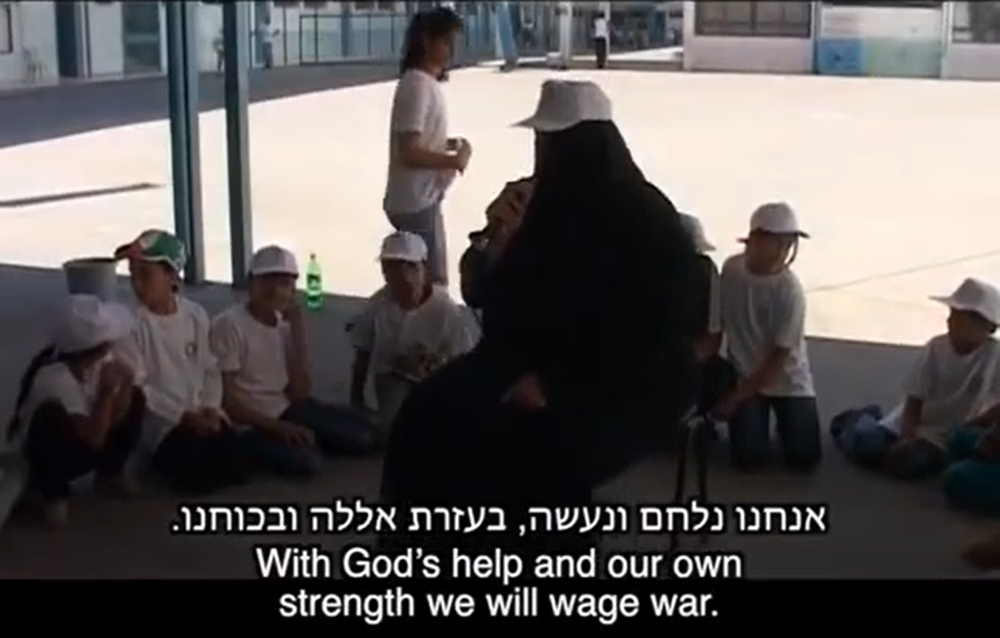
The United Nations Relief and Work Agency for Palestine Refugees (UNRWA) has once again requested international financial aid. This is the same organization whose workers have been promoting violence and antisemitism on social media. Pictured: A still shot from the documentary film "Camp Jihad," featuring a summer camp in Gaza sponsored and funded by UNWRA. (Image source: Nahum Bedein Center for Near East Policy Research)

The United Nations Relief and Work Agency for Palestine Refugees (UNRWA) has once again requested international financial aid. This is the same organization whose workers have been promoting violence and antisemitism on social media.

On January 24, the agency appealed for $1.6 billion "for programs and operations." UNRWA said it "continues to play an indispensable role in the lives of millions of Palestine refugees," and warned that "compounding challenges over the past year, including underfunding, competing global crises, inflation, disruption in the supply chain, geopolitical dynamics and skyrocketing levels of poverty and unemployment among Palestine refugees have put immense strain on UNRWA."

Continue Reading Article

Secretary Blinken, Middle East reality and US interests

by Ambassador (ret.) Yoram Ettinger

Secretary Blinken's January 29-31, 2023 visit to Egypt, Israel and the Palestinian Authority was another one of his milestones, well-intentioned - but erroneous - Middle East legacies. It has backfired on vital US interests, in general, and the pursuit of regional stability and peace, in particular.

Secretary Blinken in Egypt
*A major issue raised by President El-Sisi, during his meeting with Secretary Blinken, was the volcanic turbulence in Libya, which has traumatized the region since 2011, fueling Muslim Brotherhood terrorism in Egypt and overall Islamic terrorism in Africa and Europe.

*This turbulence was triggered by a US-led NATO military offensive against the Gaddafi regime, and was masterminded, largely, by key policy-makers in the Obama-Biden Administration. They included Antony Blinken, then National Security Advisor to Vice President Biden, and were led by Secretary of State Hillary Clinton, her close advisor and Director of Policy Planning Jake Sullivan, UN Ambassador Susan Rice and Special Assistant to President Obama Samantha Power.

*The offensive was motivated by noble values of human rights, but went astray due to an intrinsic misreading of the Middle East, in general, and Libya, in particular, where Gaddafi was not fighting innocent bystanders, but anti-US Islamic terrorists. In fact, these terrorists murdered the US Ambassador to Libya, Christopher Stevens, following their US-facilitated victory over Gaddafi.

*While the aim of the offensive was to prevent a massive slaughter of non-combatant Libyans by Gaddafi, the outcome of the offensive has doomed Libya to decades of chaos, plagued by an ongoing slaughter house, which has dwarfed the worst casualty assessments made by Clinton and Blinken.

*The ill-advised offensive has transformed Libya – the soft underbelly of Europe - into one of the world's largest platforms of anti-Western Islamic terrorists, drugs and arms traffickers. It energized a global resurgence of Islamic terrorism, and became a home base for scores of terrorist militias and an arena of civil wars with the participation of Turkey, Qatar, Italy, Russia, Egypt, the UAE, Saudi Arabia and France.

*Secretary Blinken's well-intentioned, but misguided, human rights-driven policy has ignored the only choice facing the US in the Middle East, where human rights have not been complied by Arab regimes: a choice between pro-US human rights violating Arab regimes, or anti-US human rights violating Arab regimes.

*The refusal to accept that reality has also led to US military, financial and diplomatic pressure on the pro-US President Sisi – as well as the pro-US Saudi Crown Prince MBS and the pro-US UAE Crown Prince MBZ - to desist from the rough-handling of Muslim Brotherhood terrorists and the Iran-supported Houthi Yemenite terrorists, which the State Department establishment considers legitimate political, religious and social entities.

*This US policy – highlighted by the eagerness to conclude another accord with Iran's Ayatollahs, who threaten the survival of every pro-US Arab Sunni regime - has pushed Egypt, Saudi Arabia. the United Arab Emirates and Bahrain closer to China and Russia.

Secretary Blinken in Israel and the Palestinian Authority
*As frustrated as Secretary Blinken is with the rogue conduct of Iran's Ayatollahs, and notwithstanding the recently expanded US-Israel military drills, Blinken still opposes Israel's determination that the 43-year-old diplomatic option has dramatically failed, while significantly bolstering the Ayatollahs anti-US global rogue strategy in the Middle East, Africa and Latin America.

*Blinken rejects the Israeli suggestion (shared by all pro-US Arab regimes) that a credible threat to resort to regime-change and military options is the only way to abort the regional and global terroristic, conventional, ballistic and nuclear Ayatollah threats. He still assumes that the apocalyptic Ayatollahs could be induced – via a generous financial and diplomatic package – into good faith negotiation, peaceful-coexistence and to abandon their 1,400-year-old fanatic, religious and megalomaniacal vision.

*Blinken's policy toward Iran's Ayatollahs and the Muslim Brotherhood – which pose a lethal threat to all Sunni Arab regimes - has eroded the US strategic credibility in pro-US Arab capitals, and has pushed Egypt, Saudi Arabia, the United Arab Emirates and Bahrain – reluctantly - closer to China and Russia, militarily and commercially.

*According to the State Department spokesperson: "The Secretary will underscore the urgent need for the parties [Israel and the Palestinians] to take steps to deescalate tensions… [and] put an end to the cycle of violence that has claimed too many innocent lives…."

*Once again, Secretary Blinken resorts to the immoral moral-equivalence, failing to distinguish between PA-incited Palestinian terrorists (killed by Israel) and Israeli civilians (murdered by Palestinian terrorists). Inadvertently, moral equivalence energizes Palestinian terrorism, while aiming to constrain Israel's counter-terrorist efforts.

*Secretary Blinken's visit to Ramallah enhanced legitimacy of the Palestinian Authority, while the latter has enshrined, since 1993, K-12 hate-education, which has brainwashed Palestinian youth against the existence of the "infidel" Jewish State. This rogue education system has been the most authentic reflection of the Palestinian vision/aspiration - consistent with the 1959 and 1964 charters of Fatah and the PLO, which focus on the annihilation of the pre-1967 "Zionist entity." The PA education system has become the most effective hot house and production-line of terrorists and suicide-bombers.

*Blinken has accorded more weight to Palestinian diplomatic-talk than to the Palestinian hate-walk and its induced terrorism. He has ignored the fact that a prerequisite to meaningful negotiation and peace is the uprooting of hate-education, mosque incitement, generous monthly allowances to terrorists' families, and the glorification of terrorists through public monuments, schools and other institutions.

*Secretary Blinken attempts to convince Israel that the establishment of a Palestinian state is a prerequisite for bolstering Middle East stability and concluding an Israel-Saudi Arabia peace treaty. However, such a proposal should be assessed against the backdrop of the systematic failure of all State Department's proposals to resolve the Arab-Israeli conflict. They failed because they ignored the Palestinian track record, the non-central role of the Palestinian issue in the Middle East, and due to the preoccupation with the Palestinian issue, which yielded a Palestinian veto power.

*In fact, Israel's peace treaties with Egypt, Jordan, the UAE, Bahrain, Morocco and the Sudan were successfully concluded by bypassing the Palestinian issue, and focusing on Arab – not Palestinian – interests, which are increasingly served by enhanced defense and commercial cooperation with Israel. Arabs do not cut off their noses to spite their faces.

*Blinken ignores Middle East reality, which highlights the non-centrality of the Palestinian issue (no Arab-Israel war has erupted due to the Palestinian issue) and Arab order of priorities (no Arab country has flexed its military – and hardly its financial – muscle on behalf of the Palestinians), unless one assumes that the Palestinian-embracing Arab talk supersedes the indifferent/negative Arab walk.

*Unlike Secretary Blinken, the pro-US Arab Sunni regimes are aware of the despotic, corrupt and terroristic nature of the Palestinian Authority, and the rogue nature of the proposed Palestinian state, as evidenced by the Palestinian intra-Arab track record. Arabs perceive the Palestinians as an intra-Arab role model of subversion, terrorism, treachery and ingratitude, who bite the hands that feed them (Egypt – in the 1950s, Syria – 1960s, Jordan – 1968-1970, Lebanon – 1970-1982 and Kuwait – in 1990).

*The Arabs are also aware of the systematic Palestinian collaboration with anti-Western rogue entities, such as Nazi Germany, the Soviet Bloc, Iran's Ayatollahs, Saddam Hussein, Latin American and other international terrorist organizations, Muslim Brotherhood terrorists, Cuba, Venezuela, Nicaragua and North Korea.

*The bottom line is that a Palestinian state west of the Jordan River would topple the pro-US Hashemite regime east of the river, transforming Jordan into another platform of Islamic terrorism (just like Libya, Lebanon, Syria, Iraq and Yemen), and triggering a domino scenario into the Arabian Peninsula. It would topple the pro-US Arab oil-producing regimes, undermine regional and global stability and economy and erode the US economy and geo-strategic posture, while advancing the fortunes of Russia, China, Iran's Ayatollahs and anti-US Islamic Sunni terrorism.

Who Was Really Behind the Jerusalem Terror Attack

by Daniel Greenfield

On Thursday, Jan 26, the Palestinian Authority announced that it was suspending “security coordination” after Israel broke up a Jenin terror cell that had been planning a major attack.

On Friday, Jan 27, an Islamic terrorist opened fire outside a Jerusalem synagogue killing 7 Israelis, including Asher Natan, a 14-year-old boy, Eli and Natali Mizrahi, a married couple who rushed out to help the victims, and Shaul Hai, a 68-year-old synagogue sexton.

The shooter, despite being branded a “lone wolf” with no previous connection to terrorism, was described as having advanced shooting skills. And the death rate testifies to that. It seems highly likely that he was selected and secretly prepped to carry out this attack.

On Saturday, Jan 28, a second shooting in Jerusalem injured two other Israelis. Another armed terrorist was taken out by the town’s security team in Kedumim. That may not be the last of it.

There is nothing coincidental about the timing of this surge of violence: the deadliest in years.


CIA director Bill Burns arrived in Israel on Thursday. The same day the PLO announced the end of its security coordination. Secretary of State Blinken visited Israel this week. Biden’s National Security Advisor Jake Sullivan came to Israel the week before. The PLO’s suspension of security coordination and the attacks that followed were put on for their benefit. 7 Israelis thus far were killed to help the Biden administration pressure Israel.

Had Israel not taken out the terror cell in Jenin, the numbers might be far higher.

The last time attacks on this scale took place was when 11 Israelis were killed in three attacks in late March 2022. Those attacks also came after the Palestinian Authority had suspended “security coordination” a month earlier and overlapped with the Negev Summit featuring Arab leaders and Secretary of State Blinken.

What is happening is not random terror, it’s carefully calculated terror, executed, as usual, through plausibly deniable attackers who will be rewarded by the PLO’s pay-to-slay fund.

The Palestinian Authority made a show of suspending its mostly worthless “security coordination” before launching terror attacks to show that it can turn the violence on and off.

But not all of the pressure is coming from the outside.

The attacks were launched less than a month after the new Israeli government was sworn in. The Netanyahu government has pledged to reform the leftist judiciary which enables terrorism.

While the Israeli police claim that they responded to the Jerusalem attack in 5 minutes, local residents claim that it took more like 20 minutes with the police initially refusing to come because they believed that the gunfire was actually celebrations from nearby Arab Muslim occupied areas in Jerusalem.

This conveniently undermines Itamar Ben Gvir, a key right-wing coalition figure and major target of the Left, who had assumed authority over the Israeli police and promised to create a strong and responsive force. When Ben Gvir arrived at the scene, angry crowds jeered and chanted, “death to the terrorists” and “death to the leftists”. Some berated a leftist reporter and the media is shrieking that the real threat isn’t coming from the Islamic terrorists who murdered Israelis, but from Israeli “right-wing extremists” who may attack Muslims and, worse still, the media.

This will serve as a pretext for expanding pressure on Netanyahu to push out Ben Gvir and collapse the coalition while also shutting down Ben Gvir’s proposals to make guns easier to obtain for Israeli civilians.

Did the Israeli police authorities delay their response time to undermine Ben Gvir and efforts at police reform while putting further pressure on overstressed Israelis in Jerusalem? There’s no way to know, but the attacks targeted the sorts of people who would generally be likely to vote for members of the Netanyahu government, rather than those who belong to the authorities.

Either way the attack shifts the focus away from judicial reform, which has the potential to break the Left’s grip on the country, and toward terrorism. And that is exactly what the Left wants.

The attack weakened the conservative government’s image with its base. Netanyahu will either launch an inadequate crackdown on the terrorists which will lead to more fighting and further pressure from the Biden administration or fail to do so and lose support from his base.

It’s a Catch 22 that will either sideline the domestic reform agenda or the support for it. Either way the Left wins.

A generation of Israelis has grown up in a state of siege because the terrorists waging war on the country enjoy extensive foreign support from Iran, the EU, and the State Department in the United States, as well as domestic support from the Israeli Left, which uses its official and activist arms to undermine the fight against terrorism in every possible way.

The Left was able to legitimize the PLO and give it control of sizable parts of Israel by crippling previous efforts by conservative governments to defeat the terrorists and expel them from Israel. Long after their terrorist deal fell apart into treachery and rocket attacks on Israeli cities, they still rely on using the terrorists as their “stick” to defeat conservatives and retain institutional power.

The Jerusalem shootings took place far from the stomping grounds of the Tel Aviv ruling class like Attorney General Gali Baharav-Miara, who came out against the death penalty for terrorists enabled the previous government’s dirty Hezbollah deal, claimed that judicial reforms threaten “democracy”, and tried to stall action against the home of the latest terrorist.

The dead in Jerusalem were mainly Mizrahi, descendants of Middle Eastern Jewish refugees, often poorer and more likely to live near Muslim areas and become targets of violence.

They are representative of the ‘two Israels’: the one that seeks a deal with the terrorists and the one that seeks to defeat them. The new Netanyahu coalition was elected by those voters, Mizrahi, Orthodox Jews, people living in development towns and in Judea and Samaria, in Jerusalem and in the not so nice parts of Tel Aviv and Haifa, who want to beat the terrorists.

And they want to roll back the power of the leftists who have enabled a generation of massacres, who imported terrorists into the country, armed them and promised that it would lead to peace and improve Israel’s position in the world, when just the opposite has happened.

These are the real Israelis, the ones who confronted the reporters exploiting their deaths in Jerusalem, and who went to the polls to be heard above the lies of the elites. Their deaths are of far less interest to the elites than the media outrage over judicial reform, cuts in subsidies for Kan’s leftist public broadcasting and an end to an environmental tax on disposable utensils.

That is what is at stake here.

What is going on in Israel is not just warfare, but a culture war between the democratic majority and an entrenched leftist elite that will use any means to protect its power and privilege.

The terrorist massacre in Jerusalem did little to impede the terrorist supporters in Tel Aviv which protested judicial reform by waving PLO flags. That same media which gushes that the leftists in Marxist shirts waving terror flags are the “youth” campaigning for “democracy”, will paint every angry word by young Mizrahis protesting the terrorists as a grave threat to “democracy”.

If an Arab Muslim house is vandalized in a “price-tag” attack, the media will clamor that it is a badge of eternal shame for the entire country and requires a war against the “extremists”.

Anyone who follows Israeli politics has seen this cynical farce play out any number of times.

The new Israeli government was elected by desperate people in the hopes of finally breaking the cycle of appeasement and terror, of fake political scandals and third parties, of an unelected judiciary that claims supreme power in the name of “democracy” and of police and prosecutors who connive to remove any elected officials who defy their power. That is to say, of the Left.

These people, courageous and beleaguered, hanging on in bad neighborhoods and outposts in Judea and Samaria, are the real resistance. The terrorists in Jerusalem and around the country came for them. They killed innocent people on behalf of the Islamic terrorists inside the nation, and of the Biden administration and the Left, as part of their shared mission to destroy Israel.

The Survival Imperative

by Victor Rosenthal

It has been this way since our ancestors started walking upright, maybe before that. Two tribes struggle over a piece of land. One will prevail and the other will be defeated. One will remain in the land and the other will not. The loser will be destroyed, expelled, dispersed, or absorbed. Usually, the loser of such a conflict disappears from history.

The Jewish people are connected to Eretz Yisrael by religion, language, culture and history. They were expelled from their historic homeland and were dispersed throughout the world for thousands of years, before they finally succeeded to return and reestablish sovereignty here. I know of no other people with a comparable story. Indeed, the Jews are the paradigm case for the concept of a people. And our struggle to keep the land that we regained at great cost is classic.

Arguments about international law and postcolonialism vs. Zionism are a waste of time. The justice of our case is entirely irrelevant to the likely outcome of the struggle. It will be determined by which tribe is successful at occupying the land, establishing control over it, and assuring its demographic dominance, just as humans and other primates have been doing for hundreds of thousands of years.

This is what our enemies, the Palestinian Arabs, understand – and what many, perhaps most, Israeli Jews do not. How else can you understand the weakness and vacillation that characterize the policies of the State of Israel?

We have amply demonstrated that we Jews are capable of fighting, fiercely and effectively, to protect our land when we have been attacked. What we can’t seem to do is to see clearly what’s necessary to keep the state that we won at such great cost. We have consistently failed to articulate long-term national goals and make policy to reach them.

Our greatest mistakes have come from our failure to perceive the nature of the struggle that we find ourselves in. Three examples speak for themselves: the decision in 1967 to give control of the Temple Mount to the Jordanian Waqf; the Oslo Accords of 1993; and the withdrawal from the Gaza Strip in 2005. In each case, Israel deliberately surrendered sovereignty over part of Eretz Yisrael, giving up our honor in addition to our land, and weakening our strategic deterrence. Whatever was expected in return by our foolish leaders was not forthcoming, as the Arabs took what we handed them and only pressed harder.

These mistakes and countless other less serious ones have encouraged the Arabs to believe that their strategy of combining violence short of war with diplomatic and cognitive warfare is succeeding. Our reactions have been sporadic, weak, and partial. The Arabs are convinced that time is on their side and they will ultimately prevail. We, on the other hand, are conflicted and unsure of how to proceed. They sense our lack of direction and reluctance to fight, and respond with more frequent and more vicious terrorism, such as we’ve seen in recent days.

Violence is now decentralized, and traditional command and control has been replaced by “organic” terrorism, in which civilian youth are the soldiers and social media the motivator. This is a relatively novel development in warfare, and it is very difficult to counter.

At one time, many of us believed that our conflict had a compromise solution, that Jews and Arabs could share the land. We thought that if the economic condition of the Arabs could be improved, they would come to accept Jewish sovereignty between the Jordan and the Mediterranean, and give up their historical grievance against the Jews. We thought we could cooperate, at least to some extent, with “moderate” elements among them. But we underestimated their tenacity and the seriousness of their ideological and religious commitment.

Perhaps we also failed to understand that Jews and Arabs are still primates (at least in respect to territorial behavior), and that victory over our enemies is a necessary condition for our survival. I call this fact the survival imperative. In particular, it calls on us to strengthen our sovereignty over Eretz Yisrael, to fully occupy it, and to ensure perpetual demographic superiority for our people in it; because only thus will we survive as a people.

While this reality might be disappointing, inasmuch as it precludes a quick, peaceful solution to the Israeli-Palestinian conflict, it also is liberating: it provides clear national goals and suggests policies for reaching them.

For example, rather than dismantling Jewish settlements in Judea and Samaria, we should be strengthening them and building new ones. Sovereignty over all of the land is paramount. Efforts should be made to settle Jews everywhere in the land. Policies should be designed to encourage Jews to move to Israel and stay there, while Arabs, particularly those in the territories, should be encouraged to emigrate. Policies designed to improve the lot of Arabs should be replaced by their opposite. Cooperation and support for the Palestinian Authority should be stopped. Enemies should be treated as enemies.

There will be objections that this is a prescription for war, that there will be international condemnation, that the policies I advocate are racist and undemocratic, and that the Biden Administration will be displeased. But (if you hadn’t noticed), we are getting war and international condemnation in any case, and hypocritical moralism from those without a knife at their throat is best ignored. Finally, part of the program must be to end our dangerous dependency on the US, whose military aid is intended to control Israel and reduce her to a satellite nation.

The survival of the world’s only Jewish state, and probably also of the Jewish people, depends on our clear perception of the world in which we live, and of the unchanging reality of human behavior. We have the resources and the strength to prevail; the only question is whether we have the vision and the will.