by HaRav Zalman Baruch Melamed
Rosh HaYeshiva, Beit El
Shmitta - Incumbent on the Person or the Land?
Of late some have asked the question as to whether the halachot of the Shmitta year in Eretz Yisrael relate to the land itself or whether they are obligations on the person. From the Torah’s terminology, "the Land should have a rest (Shabbat) for God," - it would seem that the land itself requires a "rest." This issue has important legal ramifications: If the prohibited labors during Shmitta are directed at the Jew, one who instructs his non-Jewish worker to work his field has transgressed only a rabbinic prohibition; if, on the other hand, we are obliged to let the land itself rest, then one who hires a non-Jewish worker during Shmitta has transgressed a Torah prohibition - since, after all, the Land is not resting! The Minchat Chinuch discusses this matter and concludes that our main obligation is to let the land rest during Shmitta. According to this formulation, the Land of Israel has intrinsic holiness, and the mitzvoth associated with the land are indicative of this holiness. Because of Eretz Yisrael’s holiness, the Master of the Universe commanded us to perform special commandments with regards to the land. Some mistakenly believe the opposite: namely, that the mitzvoth of the land give Eretz Yisrael its holiness.
Holiness Fosters Mitzvoth
The same principle applies to the Kohanim, whose special mitzvoth do not give them sanctity, but are rather a manifestation of their inherent sanctity. This holiness reflects itself in the need for the Kohen to refrain from confronting situations of ritual impurity and in the prohibition of him marrying a divorcee. Similarly, the holiness of the Land of Israel does not diminish in periods during which it is impossible to fulfill certain mitzvoth, since the land’s holiness is independent of those mitzvoth. Obviously, the more we perform mitzvoth of the Land, the more its holiness becomes apparent.
Since Eretz Yisrael’s holiness is inherent, many scholars assert that the mitzvah of dwelling in the Land is independent of its various special mitzvoth. The mitzvah of separating a portion of "Challah" from one’s dough (to be a Torah obligation, most Jews must be living in Eretz Yisrael), the mitzvoth of tithes, which according to the Rambam, are also contingent on most Jews living in Israel - are all not obligatory according to Torah law at present. Yet, the mitzvah of living in Israel remains intact.
The Earth is the Lord's
These matters are very straightforward, and this is probably why we rarely discuss them. Still, it is advisable to regularly review and deepen our understanding of them. We should study Israel’s holiness more intensely than ever - with a special accent on our Torah portion. Parshat Behar speaks in great depth about the mitzvoth of the land. In fact, Parshat Behar teaches us that everything is in God’s domain. Land, people, money - literally, everything! "The Land will not be sold for eternity," states the verse in Vayikra, "because I own the entire Land." The laws of Shmitta are not so much there to teach us the limitations on working the land in the seventh year, but rather to inform us that we are permitted to work the land in other years. The Land is God’s; He gave it to us as a "deposit" - with certain conditions. He allows us to work on the land for six years, but forbids us to do so in the seventh. God, as "Master of the House" - also forbids working the land in the fiftieth Jubilee year, or selling a piece of land forever. The land can be sold for only a set period of time, since it must remain divisible into the units designated by the Creator when the Jewish people entered the land.
Each time we partake of something in this world, we are using "God’s property." One who benefits from this world without permission is guilty of "Me’ila" - or misappropriation - of holy property. Blessings on food permit one to partake of this world. The Talmud in Berachot cites the verse "Hashem possesses the Land and everything in it" as referring the relationship between man and the world before one makes a blessing on food. After saying a blessing, the verse "the land was given over to man" is the rule of the day. Everything is Hashem’s. A person cannot even sell himself as a slave unless he has the permission of God - and even then, for a very short time. "They are my servants and not the servants of servants," says God.
We have spoken in the past of how after we liberated the Land of Israel and freed ourselves from the non-Jewish domination of the land, our service of God has changed as a result. We are no longer servants; no more are we subject to the burden of the rule of other nations, and our acceptance of the yoke of Heaven is now in our own hands. It is clear why we mention the theme of learning Torah as an introduction to Kriat Shma; when we ask God "to put into our hearts the ability to understand and comprehend, to listen, to learn and to teach, etc." But why do we mention the theme of Geulah - or redemption - prior to Shma? The answer: It is impossible to fully accept the yoke of Heaven upon ourselves as long as we are overwhelmed by pressures and influences of foreign powers. Therefore, before Shma - the acceptance of the kingdom of Heaven - we must pray to be relieved of the burden of non-Jewish nations, to be fully returned to our land.
Monday, May 08, 2023
On the Mount of Sinai
by Rabbi Dov Berel Wein
This week's portion creates an eternal connection between Mount Sinai, the Jewish people, and the Torah itself. The fact that the Torah emphasizes its eternal association with Mount Sinai is meant to teach us important lessons regarding Judaism and Jewish life.
There are grand and majestic mountains that dot our planet. They are awe-inspiring in their height and strength, and they tower over us, making us feel puny and insignificant when standing at their base. I remember that when I was able to visit Mount McKinley in Alaska, a mountain which rises vertically more than 20,000 feet above the plane from which it emanates, the feeling of tension was so overpowering that people in our tour group burst into tears. The mountain blocks out the sun and creates its own weather.
However, the Torah was not given to human beings on Mount McKinley or Mount Everest or any of the other great mastiffs that exist in our world. Midrash teaches us that Mount Sinai was and is a relatively low mountain. The rabbis derived from this the emphasis on and the requirements of humility. Arrogance and godly values do not coexist. So, even though Mount Sinai is a mountain, it is a low mountain, one that can be scaled and conquered. And the achievement of climbing that mountain will not produce fanfare or notoriety.
If the Torah had been granted on Mount Everest it would be unreachable for almost all human beings. It was given on Mount Sinai, to emphasize that it is accessible to all, and that even though it is a mountain, it is one that can and must be scaled, to achieve the eternity that it promises human beings.
From the top of a mountain, one has a majestic view of the surrounding area. A mountain peak provides us with perspective, and the ability to judge the world from an overview as an observer, even though we are participants. Without that overview, is very difficult to make sense of life, or to have any personal sense of serenity or peace.
The prophet tells us that the wicked are like the raging sea whose waves constantly batter the shoreline but are always limited. Mountains, when appreciated, give us the blessings of unique wisdom, patience, and a sense of optimism and hope in our lives, no matter how bleak events may be, or how worrisome situations are.
Our father Abraham founded the Jewish people and brought "godliness" down to our earth. He saw that measure of godliness as being in the form of a mountain. His son, Isaac, would modify it so that it would become like a field. And his grandson Jacob would see it as being a house. But all of these characteristics still remain within Judaism. Mount Sinai exemplifies the mountain that Abraham saw.
Life is never an easy climb, but climb it we must, to be able to stand at its peak, and truly observe life in society in a measured and wise way.
This week's portion creates an eternal connection between Mount Sinai, the Jewish people, and the Torah itself. The fact that the Torah emphasizes its eternal association with Mount Sinai is meant to teach us important lessons regarding Judaism and Jewish life.
There are grand and majestic mountains that dot our planet. They are awe-inspiring in their height and strength, and they tower over us, making us feel puny and insignificant when standing at their base. I remember that when I was able to visit Mount McKinley in Alaska, a mountain which rises vertically more than 20,000 feet above the plane from which it emanates, the feeling of tension was so overpowering that people in our tour group burst into tears. The mountain blocks out the sun and creates its own weather.
However, the Torah was not given to human beings on Mount McKinley or Mount Everest or any of the other great mastiffs that exist in our world. Midrash teaches us that Mount Sinai was and is a relatively low mountain. The rabbis derived from this the emphasis on and the requirements of humility. Arrogance and godly values do not coexist. So, even though Mount Sinai is a mountain, it is a low mountain, one that can be scaled and conquered. And the achievement of climbing that mountain will not produce fanfare or notoriety.
If the Torah had been granted on Mount Everest it would be unreachable for almost all human beings. It was given on Mount Sinai, to emphasize that it is accessible to all, and that even though it is a mountain, it is one that can and must be scaled, to achieve the eternity that it promises human beings.
From the top of a mountain, one has a majestic view of the surrounding area. A mountain peak provides us with perspective, and the ability to judge the world from an overview as an observer, even though we are participants. Without that overview, is very difficult to make sense of life, or to have any personal sense of serenity or peace.
The prophet tells us that the wicked are like the raging sea whose waves constantly batter the shoreline but are always limited. Mountains, when appreciated, give us the blessings of unique wisdom, patience, and a sense of optimism and hope in our lives, no matter how bleak events may be, or how worrisome situations are.
Our father Abraham founded the Jewish people and brought "godliness" down to our earth. He saw that measure of godliness as being in the form of a mountain. His son, Isaac, would modify it so that it would become like a field. And his grandson Jacob would see it as being a house. But all of these characteristics still remain within Judaism. Mount Sinai exemplifies the mountain that Abraham saw.
Life is never an easy climb, but climb it we must, to be able to stand at its peak, and truly observe life in society in a measured and wise way.
Palestinians: More Human Rights Violations No One Talks About
by Bassam Tawil

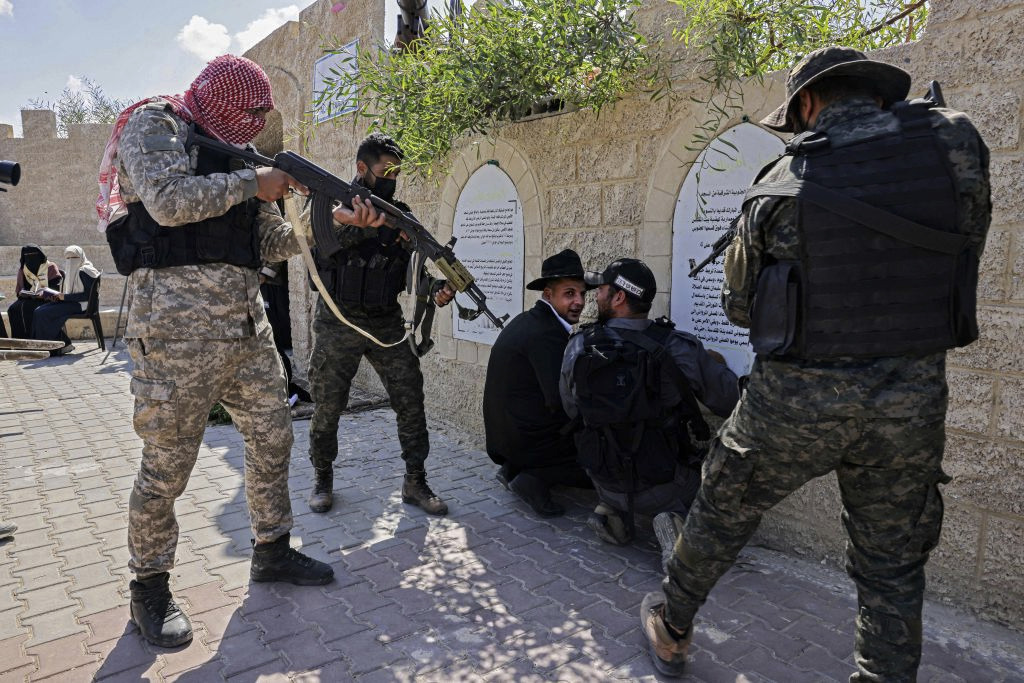
No one cares about the two men who died in Hamas custody in Gaza, apparently because Israel is not associated with their deaths. Had Al-Sufi and Al-Louh died in an Israeli prison, they would have made headlines in The New York Times, the BBC and CNN. Pictured: Hamas security forces carry out an exercise simulating the murder of detainees, near Khan Yunis in the Gaza Strip on October 13, 2022. (Photo by Said Khatib/AFP via Getty Images)
The death on May 1 in an Israeli prison of Khader Adnan, a senior member of the Iranian-backed Palestinian Islamic Jihad (PIJ) organization, has received worldwide coverage in major media outlets, including CNN, BBC, The Guardian, Reuters, and The New York Times.
Meanwhile, two Palestinian men detained by the Islamist organization Hamas, which controls the Gaza Strip, died after a supposed unexpected "deterioration" in their health conditions in just the past month.
The deaths of the men in Hamas custody, however, was not given nearly the same attention by the international media and human rights organizations as the death of Adnan. The same newspapers and media organizations that highlighted the case of Adnan -- who died after an 86-day hunger strike -- chose to ignore the deaths of the two Palestinian detainees in the Hamas-controlled Gaza Strip.
Continue Reading Article
- The failure [to report the deaths of two men in Hamas custody] underscores what appears their total lack of concern for the human rights of Palestinians living under the rule of Hamas....
- The media seem more worried about the human rights of Palestinian terrorists than the rights of victims of Palestinian terrorists.
- Adnan [the leader of the Iranian-backed Palestinian Islamic Jihad] was neither tortured nor mistreated in Israeli prison.
- The stories of the two Palestinian men who died in Hamas custody are vastly different from that of Adnan. Al-Sufi's family insist he died of torture while in Hamas custody.
- Foreign journalists did not visit, or even try to contact, the families of the two men held by Hamas in the Gaza Strip.
- The UN and human rights organizations -- who expressed so much concern over the death of the hunger striker in an Israeli prison -- have yet to comment on the suspicious deaths of the two Palestinians in Hamas detention in the Gaza Strip, which could constitute crimes against humanity.
- No one cares about the two men who died in Hamas custody, apparently because Israel is not associated with their deaths. Had Al-Sufi and Al-Louh died in an Israeli prison, they would have made headlines in The New York Times, the BBC and CNN.
- The newspapers and media organizations turning a blind eye to human rights violations committed by Hamas against Palestinians are implying, through their failure to cover these suspicious deaths, that there is nothing newsworthy about Palestinians reportedly being tortured to death in Palestinian prisons.
- The media's indifference to these deaths appears the result of the "racism of low expectations."
- "They treat Muslims like monkeys in a zoo," stated Egyptian scholar Hamed Abdel Samad. It is as if journalists and so-called human rights groups assume that Muslims are such savages that it would be laughable even to expect civilized behavior from them; so why report it at all?
- Some of these "correspondents" appear so blinded by their bigotry that, under the banner of being "pro-Palestinian," they are ready to give Hamas a free pass to arrest, torture and kill as many of their fellow-Palestinians they wish.
- There is much damning evidence of anti-Israel bias in the mainstream media and so-called human rights organizations in the West.
- Those who ignore human rights violations committed by both Hamas and the Palestinian Authority against Palestinians do a massive disservice to the Palestinians whom they claim to support, but who remain horribly mistreated by their own leaders.

No one cares about the two men who died in Hamas custody in Gaza, apparently because Israel is not associated with their deaths. Had Al-Sufi and Al-Louh died in an Israeli prison, they would have made headlines in The New York Times, the BBC and CNN. Pictured: Hamas security forces carry out an exercise simulating the murder of detainees, near Khan Yunis in the Gaza Strip on October 13, 2022. (Photo by Said Khatib/AFP via Getty Images)
The death on May 1 in an Israeli prison of Khader Adnan, a senior member of the Iranian-backed Palestinian Islamic Jihad (PIJ) organization, has received worldwide coverage in major media outlets, including CNN, BBC, The Guardian, Reuters, and The New York Times.
Meanwhile, two Palestinian men detained by the Islamist organization Hamas, which controls the Gaza Strip, died after a supposed unexpected "deterioration" in their health conditions in just the past month.
The deaths of the men in Hamas custody, however, was not given nearly the same attention by the international media and human rights organizations as the death of Adnan. The same newspapers and media organizations that highlighted the case of Adnan -- who died after an 86-day hunger strike -- chose to ignore the deaths of the two Palestinian detainees in the Hamas-controlled Gaza Strip.
Continue Reading Article

Friday, May 05, 2023
Igrot Hare’aya – Letters of Rav Kook: The Study of Machshevet Yisrael in Yeshiva – part I
#149 – part I
Date and Place: 4 Menachem Av 5668 (1908), Rechovot
Recipient: Rav Yitzchak Isaac Halevi. We have featured many letters between Rav kook and Rav Levi. The ideological negotiations between the two, around the question of Rav Halevi’s help with Rav Kook’s proposed yeshiva, focus this time on the study of Machshevet Yisrael (Jewish Philosophy).
Body: I want that the upper echelon of the institution, the full-time yeshiva, will learn Torah in the broadest sense, consisting of all its parts, both from a practical perspective and a more theoretical, spiritual perspective. You apparently do not agree, and what I desire to include in the set Torah study, you apparently call “old investigations, which do not make a difference in our days.” I must clarify matters, so that hopefully we can agree on this fundamental point.
When I say that we need to learn the Torah’s spiritual side on a regular basis, as it is the generation’s salvation, I do not at all mean to limit my aspirations to studying a set list of books, classic or more recent ones. I do not intend to promote study of Rav Saadia Gaon’s Emunot V’de’ot, the Moreh Nevuhim, the Kuzari, or the like, so students will know what they say and use their ideas in our philosophical battles. I agree that much of what they wrote is outdated because the world no longer accepts the old philosophical foundations. We still have interest in studying these works, because they contain eternal ideas that cannot be nullified by the time’s prevalent scientific assumptions.
The world has moved on from the whole approach, because they have left the realm of spiritual ideas and have embraced the study of life and activity instead. In truth, [the world] is very negatively affected by the absence in its thoughts of the “oil of spirituality.” It robs them of all the grace and gentleness of the circle of life. Therefore, clearly, they will eventually return to search with candles for the spiritual treasure the world abandoned in favor of briskly adopting life’s material side.
In any case, this applies only to special individuals, and therefore these are not elements [I look to teach students because of its practical value], but rather because it is included in the obligation of Torah study in its most complete degree, and the value will eventually be reached. Therefore, I do not remove any element of such study, which are part of the Torah’s spiritual treasure house, whether in the Written Law or Oral Law, from the medieval or more recent thinkers, whether those with a philosophical approach or those who research, Kabbalists, experts in aggadic literature and homiletics or those who focus on ethics and lessons in service of Hashem. They all represent a major area of Torah, and therefore there is a major obligation to know the works.
Included in [topics for the yeshiva curriculum] is inquiry into all elements of history, of which your books are the main contemporary resource. We know that the richness of Halacha is enhanced by knowing all the opinions on a topic, even those that are rejected in terms of practice. Greater knowledge and recognition of the multitude of shades make the learner more creative and versatile and capable of new ideas and wise decisions. This is also true regarding the richness of homiletics, not in its superficial perspective, as the German scholars and the members of the seminaries practice, but rather in its deep, internal perspective. This is acquired only by hard work and study on a regular basis, when one is connected to the sanctity and pure fear of Heaven of those who study Torah for its intrinsic value. This prepares a person to live a spiritual, holy life, enabling him to think of new, powerful approaches to spread the light of Torah in all the ways the present generation needs, just as previous generations of great thinkers did for their times.
Date and Place: 4 Menachem Av 5668 (1908), Rechovot
Recipient: Rav Yitzchak Isaac Halevi. We have featured many letters between Rav kook and Rav Levi. The ideological negotiations between the two, around the question of Rav Halevi’s help with Rav Kook’s proposed yeshiva, focus this time on the study of Machshevet Yisrael (Jewish Philosophy).
Body: I want that the upper echelon of the institution, the full-time yeshiva, will learn Torah in the broadest sense, consisting of all its parts, both from a practical perspective and a more theoretical, spiritual perspective. You apparently do not agree, and what I desire to include in the set Torah study, you apparently call “old investigations, which do not make a difference in our days.” I must clarify matters, so that hopefully we can agree on this fundamental point.
When I say that we need to learn the Torah’s spiritual side on a regular basis, as it is the generation’s salvation, I do not at all mean to limit my aspirations to studying a set list of books, classic or more recent ones. I do not intend to promote study of Rav Saadia Gaon’s Emunot V’de’ot, the Moreh Nevuhim, the Kuzari, or the like, so students will know what they say and use their ideas in our philosophical battles. I agree that much of what they wrote is outdated because the world no longer accepts the old philosophical foundations. We still have interest in studying these works, because they contain eternal ideas that cannot be nullified by the time’s prevalent scientific assumptions.
The world has moved on from the whole approach, because they have left the realm of spiritual ideas and have embraced the study of life and activity instead. In truth, [the world] is very negatively affected by the absence in its thoughts of the “oil of spirituality.” It robs them of all the grace and gentleness of the circle of life. Therefore, clearly, they will eventually return to search with candles for the spiritual treasure the world abandoned in favor of briskly adopting life’s material side.
In any case, this applies only to special individuals, and therefore these are not elements [I look to teach students because of its practical value], but rather because it is included in the obligation of Torah study in its most complete degree, and the value will eventually be reached. Therefore, I do not remove any element of such study, which are part of the Torah’s spiritual treasure house, whether in the Written Law or Oral Law, from the medieval or more recent thinkers, whether those with a philosophical approach or those who research, Kabbalists, experts in aggadic literature and homiletics or those who focus on ethics and lessons in service of Hashem. They all represent a major area of Torah, and therefore there is a major obligation to know the works.
Included in [topics for the yeshiva curriculum] is inquiry into all elements of history, of which your books are the main contemporary resource. We know that the richness of Halacha is enhanced by knowing all the opinions on a topic, even those that are rejected in terms of practice. Greater knowledge and recognition of the multitude of shades make the learner more creative and versatile and capable of new ideas and wise decisions. This is also true regarding the richness of homiletics, not in its superficial perspective, as the German scholars and the members of the seminaries practice, but rather in its deep, internal perspective. This is acquired only by hard work and study on a regular basis, when one is connected to the sanctity and pure fear of Heaven of those who study Torah for its intrinsic value. This prepares a person to live a spiritual, holy life, enabling him to think of new, powerful approaches to spread the light of Torah in all the ways the present generation needs, just as previous generations of great thinkers did for their times.
The Magen David as Symbol of a Unified but Complex Nation
by HaRav Dov Begon
Rosh HaYeshiva, Machon Meir
The Magen David - the symbol that is emblazoned upon the flag of Medinat Yisrael, contains an allusion to the complexity of the Jewish People. The Magen David is a single object, yet it is composed of opposing points. It is the same with the Jewish People: “The Israelites shall camp with each person near the banner having his paternal family’s insignia” (Bamidbar 2:2). On the one hand, we find a profusion of banners, and on the other hand, we are “one nation in the Land” (II Shmuel 7:23).
Regarding Moshe's blessing, “G-d was King in Jeshurun, when the people’s leaders gathered themselves together and the tribes of Israel were united” (Devarim 33:5), Rashi comments, “‘When the people’s leaders gathered themselves together’ - When they gather together as one group, with peace reigning between them, G-d is then their King, but not when there is strife among them.”
Right now, we are going through times where opposing points of “the Magen David” are expressed in terms of the various views and political streams within the nation. That variety finds voice in the profusion of political parties, with each sector striving to stand out in the national spectrum.
At times, the political struggles are harsh and volatile, yet we must remind ourselves over and over that despite the differences, the controversies and the opposing views, we are one people. True valor and national maturity consist of our continuing together despite the differences and opposing views.
To remain "one" despite differences in viewpoint and mentality is a major prerequisite of family life, as well as in the life of a society and a nation. Quite the contrary, it is the profusion of different outlooks and the struggle between streams of thought which ultimately brings about the right balance in the social fabric, and all of this with faith in the Eternal One of Yisrael, faith that above all, there is a Guardian, and that He who chooses His people Am Yisrael with love is leading us safely up the ascending path towards complete redemption.
Longing for salvation,
With the Love of Eretz Yisrael and Am Yisrael,
Shabbat Shalom.
Rosh HaYeshiva, Machon Meir
The Magen David - the symbol that is emblazoned upon the flag of Medinat Yisrael, contains an allusion to the complexity of the Jewish People. The Magen David is a single object, yet it is composed of opposing points. It is the same with the Jewish People: “The Israelites shall camp with each person near the banner having his paternal family’s insignia” (Bamidbar 2:2). On the one hand, we find a profusion of banners, and on the other hand, we are “one nation in the Land” (II Shmuel 7:23).
Regarding Moshe's blessing, “G-d was King in Jeshurun, when the people’s leaders gathered themselves together and the tribes of Israel were united” (Devarim 33:5), Rashi comments, “‘When the people’s leaders gathered themselves together’ - When they gather together as one group, with peace reigning between them, G-d is then their King, but not when there is strife among them.”
Right now, we are going through times where opposing points of “the Magen David” are expressed in terms of the various views and political streams within the nation. That variety finds voice in the profusion of political parties, with each sector striving to stand out in the national spectrum.
At times, the political struggles are harsh and volatile, yet we must remind ourselves over and over that despite the differences, the controversies and the opposing views, we are one people. True valor and national maturity consist of our continuing together despite the differences and opposing views.
To remain "one" despite differences in viewpoint and mentality is a major prerequisite of family life, as well as in the life of a society and a nation. Quite the contrary, it is the profusion of different outlooks and the struggle between streams of thought which ultimately brings about the right balance in the social fabric, and all of this with faith in the Eternal One of Yisrael, faith that above all, there is a Guardian, and that He who chooses His people Am Yisrael with love is leading us safely up the ascending path towards complete redemption.
Longing for salvation,
With the Love of Eretz Yisrael and Am Yisrael,
Shabbat Shalom.
The Yishai Fleisher Israel Podcast: Go Big AND Go Home
SEASON 2023 EPISODE 17: Yishai and Malkah Fleisher discuss the speech given in Knesset by US Speaker of the House Kevin McCarthy's and the heart of terror victim Lucy Dee which got a new chest to beat in and a life saved. Then, Rabbi Shimshon Nadel on Jewish law accepting a new Jewish holiday. And finally, Yishai talks about the beauty and challenge of Aliyah with international family lawyer Jay Hait.
Loving Life
by Rav Binny Freedman
Many years ago, when I was in High School, my mother arranged for me to get a ride up to school once a week with one of the teachers who taught there. We lived in Manhattan, and as the Mesivta High School I attended was in Riverdale, having a ride that morning saved me a good hour I would have spent on public transportation. It also meant leaving our apartment at 7:30am instead of 6:30 for which I was understandably grateful.
In retrospect, I am not entirely certain the arrangement was purely practical, as the teacher would regularly engage me in a variety of Torah topics and philosophical and existential questions …
One morning as we were driving up the West Side Highway, a car barreled down an entrance ramp and slammed into the front of our car. After being thrown across the highway, the rebbe managed to get control of the car as the engine puttered off, and we pulled back onto the shoulder behind the offending vehicle. Telling me to wait in the car and explaining this might take a few minutes, he went off to exchange information and discuss the accident with the other driver. Fortunately, no-one had been injured.
When he came back to the car, I silently prayed he would not be able to start the car as I had a test for which I was not ready and you could not pick a better excuse than being stuck on the highway with a teacher! Alas, after a couple of turns, his car started and after a tentative moment we resumed our drive up the highway, albeit with the engine making some funny noises and some obviously significant body damage to the front right corner of the vehicle.
He had been in the middle of a funny story when were interrupted, and as soon as he saw we could drive safely he simply resumed his story where he had left off! I could not believe he was just resuming his story, and when he finished, he chuckled to himself and promptly launched into another story and topic for discussion! After a few minutes I could not contain myself and finally blurted out:
“Aren’t you upset your car got creamed? The whole front of your car is messed up and you now
will have to go to the garage… aren’t you the least bit upset?
Honestly, I don’t remember most of what I learned in High School, but I still remember his simple response:
“Look, I can be upset he creamed the front of my car, or I can be happy about it; but either way,
the front of the car will still be destroyed, so I might as well be happy!”
There is a fascinating thought worth noting in this week’s portion of Emor:
Hashem tells Moshe: “Speak to the Kohanim, the sons of Aharon, and say to them (each of them) shall not become impure amongst his people.” (Vayikra 21:1)
Rashi, noting the obvious repetition of the enjoinder to speak, quotes the Talmud (Yevamot 114a) which explains this repetition to mean that the Kohanim also have to pass this on to the younger children who are also obligated not to allow themselves to become impure. The problem with this explanation is the text implies that it is all meant for the adults, why then, would we take this to refer to teaching the children?
Rav Moshe Feinstein (in his Darash Moshe) notes that the word used for speaking here (from which our portion takes its name: Emor) is a warmer softer form of speech (as opposed to Dibur, also meaning to speak, which is harsher and more direct). And that is the tone one is meant to use with children.
The first usage of the word refers to the fact that Moshe is meant to instruct the Kohanim in the limitations the Kohanim will need to accept upon themselves, something which is difficult to accept and thus best given over in a softer and warmer communication. And the second time the verse repeats the enjoinder to speak, it is referring to the Kohanim themselves being responsible to pass this along to their children as well. It’s not easy to teach your children limits, and sharing the idea is a better strategy than merely issuing a command.
Furthermore, Rav Moshe deduces that the second usage implies that the Kohanim have to have a positive feeling towards the mitzvot: it has to be chaviv (affectionate) to them. In fact, he points out, even when your children see you are willing to make sacrifices for Torah that is not what will connect them to tradition; what really impacts our children is when they see we love it.
“Precisely when children hear their parents say that mitzvot are not a sacrifice at all, we simply love them and they enrich our lives and fulfill us, which is when the children are receiving a good education…” (Darash Moshe, Emor, p. 97)
How many of us wish our kids would love learning more, but neglect to ask ourselves how much we love learning? And how often do we wish our kids would be more scrupulous about wearing tzitzit, saying blessings, or even keeping Shabbat, without considering whether our kids are seeing us enthusiastic about mitzvot, and Torah study and the like.
If I had to pick what impacted me the most Jewishly, growing up, it would without hesitation be the unbridled enthusiasm many of my teachers and especially my parents had for Jewish learning, Shabbat, and Mitzvot.
Our children will most certainly learn far more from what they see us do and how we do it, than they ever will from what we say.
The things that really last in life are the things we love, and while there are no guarantees, certainly the degree to which we love that which we do will have the most impact on what the next generation values. If we want our children to love Shabbat, they at least have to see me loving Shabbat; if they perceive Shabbat as a chore that forces me to give up my Sports games and cell phone, then why would we expect them to want to continue doing such a burdensome chore?
But if Shabbat is filled with favorite moments and experiences we love and the enthusiastic energy permeates the home, then who wouldn’t want that as a part of their life?
This is not to say there is no value in carrying on with the things we need to do even when we don’t want to do them; we are not talking about living life we are rather speaking of the possibility of elevating our experiences to loving life.
The allusion to the Kohanim who are meant to be our role models then is not just to do it, but to find a way to love doing it.
Nike, the bastion of Western consumer culture has taught us to Just Do It; Judaism says don’t just do it: Love doing it!
And that teacher, with his one simple comment, shared with me an ideal that it wasn’t just about living life, it was about loving life.
Wishing all a Shabbat Shalom, from Jerusalem.
Many years ago, when I was in High School, my mother arranged for me to get a ride up to school once a week with one of the teachers who taught there. We lived in Manhattan, and as the Mesivta High School I attended was in Riverdale, having a ride that morning saved me a good hour I would have spent on public transportation. It also meant leaving our apartment at 7:30am instead of 6:30 for which I was understandably grateful.
In retrospect, I am not entirely certain the arrangement was purely practical, as the teacher would regularly engage me in a variety of Torah topics and philosophical and existential questions …
One morning as we were driving up the West Side Highway, a car barreled down an entrance ramp and slammed into the front of our car. After being thrown across the highway, the rebbe managed to get control of the car as the engine puttered off, and we pulled back onto the shoulder behind the offending vehicle. Telling me to wait in the car and explaining this might take a few minutes, he went off to exchange information and discuss the accident with the other driver. Fortunately, no-one had been injured.
When he came back to the car, I silently prayed he would not be able to start the car as I had a test for which I was not ready and you could not pick a better excuse than being stuck on the highway with a teacher! Alas, after a couple of turns, his car started and after a tentative moment we resumed our drive up the highway, albeit with the engine making some funny noises and some obviously significant body damage to the front right corner of the vehicle.
He had been in the middle of a funny story when were interrupted, and as soon as he saw we could drive safely he simply resumed his story where he had left off! I could not believe he was just resuming his story, and when he finished, he chuckled to himself and promptly launched into another story and topic for discussion! After a few minutes I could not contain myself and finally blurted out:
“Aren’t you upset your car got creamed? The whole front of your car is messed up and you now
will have to go to the garage… aren’t you the least bit upset?
Honestly, I don’t remember most of what I learned in High School, but I still remember his simple response:
“Look, I can be upset he creamed the front of my car, or I can be happy about it; but either way,
the front of the car will still be destroyed, so I might as well be happy!”
There is a fascinating thought worth noting in this week’s portion of Emor:
Hashem tells Moshe: “Speak to the Kohanim, the sons of Aharon, and say to them (each of them) shall not become impure amongst his people.” (Vayikra 21:1)
Rashi, noting the obvious repetition of the enjoinder to speak, quotes the Talmud (Yevamot 114a) which explains this repetition to mean that the Kohanim also have to pass this on to the younger children who are also obligated not to allow themselves to become impure. The problem with this explanation is the text implies that it is all meant for the adults, why then, would we take this to refer to teaching the children?
Rav Moshe Feinstein (in his Darash Moshe) notes that the word used for speaking here (from which our portion takes its name: Emor) is a warmer softer form of speech (as opposed to Dibur, also meaning to speak, which is harsher and more direct). And that is the tone one is meant to use with children.
The first usage of the word refers to the fact that Moshe is meant to instruct the Kohanim in the limitations the Kohanim will need to accept upon themselves, something which is difficult to accept and thus best given over in a softer and warmer communication. And the second time the verse repeats the enjoinder to speak, it is referring to the Kohanim themselves being responsible to pass this along to their children as well. It’s not easy to teach your children limits, and sharing the idea is a better strategy than merely issuing a command.
Furthermore, Rav Moshe deduces that the second usage implies that the Kohanim have to have a positive feeling towards the mitzvot: it has to be chaviv (affectionate) to them. In fact, he points out, even when your children see you are willing to make sacrifices for Torah that is not what will connect them to tradition; what really impacts our children is when they see we love it.
“Precisely when children hear their parents say that mitzvot are not a sacrifice at all, we simply love them and they enrich our lives and fulfill us, which is when the children are receiving a good education…” (Darash Moshe, Emor, p. 97)
How many of us wish our kids would love learning more, but neglect to ask ourselves how much we love learning? And how often do we wish our kids would be more scrupulous about wearing tzitzit, saying blessings, or even keeping Shabbat, without considering whether our kids are seeing us enthusiastic about mitzvot, and Torah study and the like.
If I had to pick what impacted me the most Jewishly, growing up, it would without hesitation be the unbridled enthusiasm many of my teachers and especially my parents had for Jewish learning, Shabbat, and Mitzvot.
Our children will most certainly learn far more from what they see us do and how we do it, than they ever will from what we say.
The things that really last in life are the things we love, and while there are no guarantees, certainly the degree to which we love that which we do will have the most impact on what the next generation values. If we want our children to love Shabbat, they at least have to see me loving Shabbat; if they perceive Shabbat as a chore that forces me to give up my Sports games and cell phone, then why would we expect them to want to continue doing such a burdensome chore?
But if Shabbat is filled with favorite moments and experiences we love and the enthusiastic energy permeates the home, then who wouldn’t want that as a part of their life?
This is not to say there is no value in carrying on with the things we need to do even when we don’t want to do them; we are not talking about living life we are rather speaking of the possibility of elevating our experiences to loving life.
The allusion to the Kohanim who are meant to be our role models then is not just to do it, but to find a way to love doing it.
Nike, the bastion of Western consumer culture has taught us to Just Do It; Judaism says don’t just do it: Love doing it!
And that teacher, with his one simple comment, shared with me an ideal that it wasn’t just about living life, it was about loving life.
Wishing all a Shabbat Shalom, from Jerusalem.
Thursday, May 04, 2023
The Halachic State
by Rabbi Steven Pruzansky
The headline alone must send shivers down some people’s spines.
It has become fashionable in Israel to repudiate any notion of a medinat halacha, a state that is run according to Jewish law. Religious politicians who utter the phrase are forced to retract, and still its mere utterance clings to their biography as an obvious indication of their venality. Prime Minister Netanyahu has taken to beginning almost every speech about the judicial reforms with a disclaimer that “we are not creating a halachic state.” It is true that the judicial reforms do not envision a Torah state. Unspoken is that such a declaration by the PM and others repudiating a halachic state should be a point of pride; it is actually a point of shame.
The greatest fear of a medinat halacha pertains to enforcement and punishment. The specter of Iran, the Ayatollahs, the Revolutionary Guards and the morality police always lurk in the background, as if for us – what would be misnamed a theocracy – is actually a bludgeon that would be used to beat people, suppress them, and make their lives miserable. Such an approach is the product of much ignorance and not a little tendentiousness.
Even when the Sanhedrin functioned, enforcement of halacha in personal matters was rare and punishment – especially capital punishment – was almost non-existent. The Talmud (Makkot 7a) states that a Sanhedrin which executed an offender once every seven years – perhaps even once every seventy years – was considered a bloody, violent Sanhedrin. What detractors of the halachic state seem not to realize is that coercion of religious practice, including but even without punishment of offenders, is a failure of religion, not its success. To compel someone to engage in a religious ritual or requirement is almost by definition not construed as service of God – but rather service of man, and service of man that is prompted by fear of man and not reverence for or love of God. That is the degradation of faith and the opposite of what the Torah desires for us. Somehow, as implicit in the story of King Shlomo and the two mothers (I Melachim 3:16), harlots plied their trade while the First Temple stood. From other sources it is clear that that the same occurred during the Second Temple era within shouting distance of the holiest site on earth. It is certainly not that it was encouraged, God-forbid, but there are limits to human enforcement.
If so, once we get beyond the fears that there will be mass executions for driving on Shabbat and floggings for pork eaters (personally, I would not object to public lashing of abusive spouses or child abusers, but that’s me), what else exercises the detractors? To be sure, there are many who perceive halacha only through the prism of those groups that choose the most stringent opinions and make them normative and are otherwise less than fully engaged in building, defending or developing the nation. That is also the product of ignorance of halacha, as if Jewish law demands that every person must wear black and white (never a color) and women should never be seen in public. That was never the norm in Jewish life – especially when we were governed according to Jewish law. People whose only frame of reference for a Torah state is the fear of enforcement sadly miss the point; indeed, some fear punishment for their own sins while some fear the missed opportunity to punish others for their sins. Both are misguided.
Every sophisticated pulpit rabbi knows how to make the halacha “user friendly,” to be colloquial, which is not to say that everything every person wants to do must be accommodated by Jewish law. Sometimes the answer is “no,” and that “no” is conveyed in a way that reinforces to the questioner the beauty of the halachic system and how such conduct is unworthy of a servant of God. And sometimes the answer is “yes,” depending on the halachic reality, person, the question, and other factors.
Much of Jewish law already pervades Israeli society – Shabbat, the holidays, tzedakah, the primacy of Torah study – although we could certainly improve our fulfillment of the mitzvot between people in the way we talk to each other, drive on the roads, and care for the underprivileged. And Jewish civil law is used in legal adjudications in the Israeli court system although not as often as it could or should be (based on the Foundations of Law Act, 1980). Of course, it is not as if a halachic state will change little or nothing, for that would mean it is superfluous in a modern society.
The primary fear engendered by the imaginary bogeyman known as the medinat halacha seems to be the perceived loss of freedom for the non-observant to do what they want to do when they want to do it. These fears are stoked by people who delight in exposing extreme halachic opinions that are either distorted or not normative. But law by its very nature – secular or Torah – places limits on what we may or may not do, whom we may marry and how many at one time, how we conduct ourselves in public, and what obligations and rights individuals possess in society. The question really is what is the provenance of the value system that underlies the law? Is Western law, with its disconnect from all that is godly and the human degradation, corruption, unhappiness, and decadence it has often produced, morally superior to Jewish law? Actually, I think it is morally inferior, and the moral confusion it has sowed among youth, the god of materialism that it exalts, and the declining population in Western countries, is living proof of that.
The transition to a halachic state will require some adjustments to modernity, but which are already found within the system. Leading sages have pointed out that the classic rules of evidence (e.g., crimes must be witnessed by two qualified and unrelated witnesses who forewarn the criminal) are hard to sustain in a society where crime is rampant but already in biblical times the king – in our case, a duly elected government – was able to act extra-judicially in order to promote the general welfare of society. But the burden of proof generally required to prosecute illicit conduct should itself comfort the detractors who feel that a medinat halacha would encroach on their private, personal conduct. It never did, it is easy to see why it did not, and impossible to see how it ever could.
Additionally, litigation usually involves the resolution of clashing rights of two individuals or groups. I would prefer that the values underpinning those rights be grounded in the eternal Torah than in some transient human concoction. After all, that is what should be expected of a Jewish state – not the pale mimicry of foreign laws and values but the expression of the greatness of Judaism and our Torah.
Beyond that, what are the advantages of a medinat halacha? There would be nothing wrong with gently and lovingly encouraging the observance of Jewish law. Living a halachic life – besides heeding God’s will – provides a sense of discipline, self-control, and meaning. It is abundantly clear that being observant is not a contradiction to having a full and consequential life. That is why we find Orthodox Jews who are lawyers and doctors, generals and engineers, tycoons and scientists, and even rabbis. The observant life does not require that we run away from society but that we engage it and sanctify it.
Recent studies have shown that observant Jews tend to be happier people. (Not everyone, of course. I know some gloomy people but often that entails their personal struggle to rein in instinctual tendencies that are prohibited and thus they live with internal dissonance. And as a general rule, the more unhappy the person, the more he or she feels the need to poke around in the private lives of others.) But having a purposeful life with built-in times for reflection on deeper issues, like Shabbat, is almost a guarantee of greater happiness and productivity in life. These are not merely mercenary considerations but rooted in the very gift of Torah and the land of Israel to the Jewish people.
As such, failure to evolve into a medinat halacha is actually counterproductive. Such a state would enhance people’s lives, have greater respect for human dignity, and better marshal society’s resources to help the needy in all spheres. It would ensure that the law is applied equally and fairly to all and not, unfortunately, as we perceive the prevailing legal system today. Worse, it is self-defeating! Our very claim to the land of Israel is based on the Torah. Ignoring the Torah undermines that claim, as there is no cogent or incontrovertible secular claim to this land. And as history has taught us, Jewish possession of the land of Israel is dependent on its level of observance, a point reiterated constantly in the Torah and the prophets.
Obviously, this has to be a gradual process as so many modern Jews are estranged from Torah observance, many through no fault of their own. As such, perhaps it would be wise to begin with the Torah’s commandments, leaving aside rabbinic enactments and customs until observance takes root in a majority of the population. Ironically, a Jewish nation that honors and observes the Torah could ease some of the perceived burdens the secular population often complains about. For example, many authorities (including Rav Shimon Shkop) assumed that when the Jewish state would be established public transport could operate on Shabbat in a way that was acceptable according to Jewish law. In a secular state, such would lead to the disappearance of Shabbat and make a mockery of what is termed a “Jewish” state; in a Torah state, such could enhance the observance of Shabbat for all.
Perhaps we are not yet ready for a medinat halacha, and of that we should be ashamed, not proud. A proud Jew yearns for the implementation of the Torah system as he or she does for the Messianic era. Those who dread it do so either because they do not believe in the Torah, do not properly understand it, or wrongly compare it to the governance of communities in the exile.
We are heading in that direction in any event; as the Midrash (Mechilta Yitro) states, “God would not save a nation that is forever disloyal.” The false allure of Western progressivism still lingers in a segment of society and has to fade away. The fears of a medinat halacha also have to be assuaged, and one way to do that is for good people to stop demonizing it, disparaging it, apologizing for it, or running away from it. That requires education, patient and loving, accompanied by the realization on the part of today’s detractors that the halachic life is rich and fulfilling, speaks to everyone, challenges but also gratifies us, and is fully applicable to a modern state. Surely there will be bumps in the road and much discussion about the details but nothing we can’t handle as a nation. A good beginning might be a proclamation, similar in spirit to Israel’s Declaration of Independence, which enunciates our basic principles and aspirations to be a holy nation.
What could also diminish the fear and even increase the enthusiasm for a halachic state would be fostering the notion that such a state would be open, embracing, and joyous rather than angry and repressive. It would certainly help that cause if religious, observant Jews always reflected the Torah’s openness, depth and joy. When we model the Torah personality, or at least strive to do so, it increases respect and love for Torah.
On the 75th anniversary of Israel’s independence, it is appropriate to acknowledge God’s gift of the restoration of Jewish sovereignty to the land of Israel. But we should acknowledge as well that God’s gifts were not limited to the land of Israel alone but also encompassed the Torah that was to be the governing constitution of that land. May we soon be worthy!
The headline alone must send shivers down some people’s spines.
It has become fashionable in Israel to repudiate any notion of a medinat halacha, a state that is run according to Jewish law. Religious politicians who utter the phrase are forced to retract, and still its mere utterance clings to their biography as an obvious indication of their venality. Prime Minister Netanyahu has taken to beginning almost every speech about the judicial reforms with a disclaimer that “we are not creating a halachic state.” It is true that the judicial reforms do not envision a Torah state. Unspoken is that such a declaration by the PM and others repudiating a halachic state should be a point of pride; it is actually a point of shame.
The greatest fear of a medinat halacha pertains to enforcement and punishment. The specter of Iran, the Ayatollahs, the Revolutionary Guards and the morality police always lurk in the background, as if for us – what would be misnamed a theocracy – is actually a bludgeon that would be used to beat people, suppress them, and make their lives miserable. Such an approach is the product of much ignorance and not a little tendentiousness.
Even when the Sanhedrin functioned, enforcement of halacha in personal matters was rare and punishment – especially capital punishment – was almost non-existent. The Talmud (Makkot 7a) states that a Sanhedrin which executed an offender once every seven years – perhaps even once every seventy years – was considered a bloody, violent Sanhedrin. What detractors of the halachic state seem not to realize is that coercion of religious practice, including but even without punishment of offenders, is a failure of religion, not its success. To compel someone to engage in a religious ritual or requirement is almost by definition not construed as service of God – but rather service of man, and service of man that is prompted by fear of man and not reverence for or love of God. That is the degradation of faith and the opposite of what the Torah desires for us. Somehow, as implicit in the story of King Shlomo and the two mothers (I Melachim 3:16), harlots plied their trade while the First Temple stood. From other sources it is clear that that the same occurred during the Second Temple era within shouting distance of the holiest site on earth. It is certainly not that it was encouraged, God-forbid, but there are limits to human enforcement.
If so, once we get beyond the fears that there will be mass executions for driving on Shabbat and floggings for pork eaters (personally, I would not object to public lashing of abusive spouses or child abusers, but that’s me), what else exercises the detractors? To be sure, there are many who perceive halacha only through the prism of those groups that choose the most stringent opinions and make them normative and are otherwise less than fully engaged in building, defending or developing the nation. That is also the product of ignorance of halacha, as if Jewish law demands that every person must wear black and white (never a color) and women should never be seen in public. That was never the norm in Jewish life – especially when we were governed according to Jewish law. People whose only frame of reference for a Torah state is the fear of enforcement sadly miss the point; indeed, some fear punishment for their own sins while some fear the missed opportunity to punish others for their sins. Both are misguided.
Every sophisticated pulpit rabbi knows how to make the halacha “user friendly,” to be colloquial, which is not to say that everything every person wants to do must be accommodated by Jewish law. Sometimes the answer is “no,” and that “no” is conveyed in a way that reinforces to the questioner the beauty of the halachic system and how such conduct is unworthy of a servant of God. And sometimes the answer is “yes,” depending on the halachic reality, person, the question, and other factors.
Much of Jewish law already pervades Israeli society – Shabbat, the holidays, tzedakah, the primacy of Torah study – although we could certainly improve our fulfillment of the mitzvot between people in the way we talk to each other, drive on the roads, and care for the underprivileged. And Jewish civil law is used in legal adjudications in the Israeli court system although not as often as it could or should be (based on the Foundations of Law Act, 1980). Of course, it is not as if a halachic state will change little or nothing, for that would mean it is superfluous in a modern society.
The primary fear engendered by the imaginary bogeyman known as the medinat halacha seems to be the perceived loss of freedom for the non-observant to do what they want to do when they want to do it. These fears are stoked by people who delight in exposing extreme halachic opinions that are either distorted or not normative. But law by its very nature – secular or Torah – places limits on what we may or may not do, whom we may marry and how many at one time, how we conduct ourselves in public, and what obligations and rights individuals possess in society. The question really is what is the provenance of the value system that underlies the law? Is Western law, with its disconnect from all that is godly and the human degradation, corruption, unhappiness, and decadence it has often produced, morally superior to Jewish law? Actually, I think it is morally inferior, and the moral confusion it has sowed among youth, the god of materialism that it exalts, and the declining population in Western countries, is living proof of that.
The transition to a halachic state will require some adjustments to modernity, but which are already found within the system. Leading sages have pointed out that the classic rules of evidence (e.g., crimes must be witnessed by two qualified and unrelated witnesses who forewarn the criminal) are hard to sustain in a society where crime is rampant but already in biblical times the king – in our case, a duly elected government – was able to act extra-judicially in order to promote the general welfare of society. But the burden of proof generally required to prosecute illicit conduct should itself comfort the detractors who feel that a medinat halacha would encroach on their private, personal conduct. It never did, it is easy to see why it did not, and impossible to see how it ever could.
Additionally, litigation usually involves the resolution of clashing rights of two individuals or groups. I would prefer that the values underpinning those rights be grounded in the eternal Torah than in some transient human concoction. After all, that is what should be expected of a Jewish state – not the pale mimicry of foreign laws and values but the expression of the greatness of Judaism and our Torah.
Beyond that, what are the advantages of a medinat halacha? There would be nothing wrong with gently and lovingly encouraging the observance of Jewish law. Living a halachic life – besides heeding God’s will – provides a sense of discipline, self-control, and meaning. It is abundantly clear that being observant is not a contradiction to having a full and consequential life. That is why we find Orthodox Jews who are lawyers and doctors, generals and engineers, tycoons and scientists, and even rabbis. The observant life does not require that we run away from society but that we engage it and sanctify it.
Recent studies have shown that observant Jews tend to be happier people. (Not everyone, of course. I know some gloomy people but often that entails their personal struggle to rein in instinctual tendencies that are prohibited and thus they live with internal dissonance. And as a general rule, the more unhappy the person, the more he or she feels the need to poke around in the private lives of others.) But having a purposeful life with built-in times for reflection on deeper issues, like Shabbat, is almost a guarantee of greater happiness and productivity in life. These are not merely mercenary considerations but rooted in the very gift of Torah and the land of Israel to the Jewish people.
As such, failure to evolve into a medinat halacha is actually counterproductive. Such a state would enhance people’s lives, have greater respect for human dignity, and better marshal society’s resources to help the needy in all spheres. It would ensure that the law is applied equally and fairly to all and not, unfortunately, as we perceive the prevailing legal system today. Worse, it is self-defeating! Our very claim to the land of Israel is based on the Torah. Ignoring the Torah undermines that claim, as there is no cogent or incontrovertible secular claim to this land. And as history has taught us, Jewish possession of the land of Israel is dependent on its level of observance, a point reiterated constantly in the Torah and the prophets.
Obviously, this has to be a gradual process as so many modern Jews are estranged from Torah observance, many through no fault of their own. As such, perhaps it would be wise to begin with the Torah’s commandments, leaving aside rabbinic enactments and customs until observance takes root in a majority of the population. Ironically, a Jewish nation that honors and observes the Torah could ease some of the perceived burdens the secular population often complains about. For example, many authorities (including Rav Shimon Shkop) assumed that when the Jewish state would be established public transport could operate on Shabbat in a way that was acceptable according to Jewish law. In a secular state, such would lead to the disappearance of Shabbat and make a mockery of what is termed a “Jewish” state; in a Torah state, such could enhance the observance of Shabbat for all.
Perhaps we are not yet ready for a medinat halacha, and of that we should be ashamed, not proud. A proud Jew yearns for the implementation of the Torah system as he or she does for the Messianic era. Those who dread it do so either because they do not believe in the Torah, do not properly understand it, or wrongly compare it to the governance of communities in the exile.
We are heading in that direction in any event; as the Midrash (Mechilta Yitro) states, “God would not save a nation that is forever disloyal.” The false allure of Western progressivism still lingers in a segment of society and has to fade away. The fears of a medinat halacha also have to be assuaged, and one way to do that is for good people to stop demonizing it, disparaging it, apologizing for it, or running away from it. That requires education, patient and loving, accompanied by the realization on the part of today’s detractors that the halachic life is rich and fulfilling, speaks to everyone, challenges but also gratifies us, and is fully applicable to a modern state. Surely there will be bumps in the road and much discussion about the details but nothing we can’t handle as a nation. A good beginning might be a proclamation, similar in spirit to Israel’s Declaration of Independence, which enunciates our basic principles and aspirations to be a holy nation.
What could also diminish the fear and even increase the enthusiasm for a halachic state would be fostering the notion that such a state would be open, embracing, and joyous rather than angry and repressive. It would certainly help that cause if religious, observant Jews always reflected the Torah’s openness, depth and joy. When we model the Torah personality, or at least strive to do so, it increases respect and love for Torah.
On the 75th anniversary of Israel’s independence, it is appropriate to acknowledge God’s gift of the restoration of Jewish sovereignty to the land of Israel. But we should acknowledge as well that God’s gifts were not limited to the land of Israel alone but also encompassed the Torah that was to be the governing constitution of that land. May we soon be worthy!
Jordanian MP Lauded as "Hero" for Smuggling Weapons into Israel
by Bassam Tawil

Imad Al-Adwan, a member of Jordan's parliament, is being praised as a "hero" by many Jordanians and Palestinians after he was reportedly caught trying to smuggle hundreds of guns into Israel. Pictured: The Israeli side of the Allenby Bridge crossing between Israel and Jordan. (Photo by Ahmad Gharabli/AFP via Getty Images)
Imad Al-Adwan, a member of Jordan's parliament, is being praised as a "hero" by many Jordanians and Palestinians after he was reportedly caught trying to smuggle weapons into Israel.
On April 22, Israeli authorities arrested Al-Adwan, 35, when he tried to cross from Jordan into Israel through the Allenby Bridge border crossing. A video posted on social media showed the contents of three bags containing 100 kilograms of gold, 12 automatic rifles and 270 semi-automatic pistols discovered in his possession.
Al-Adwan is known for his staunch vocal support for the Iranian-backed Palestinian terror group, Hamas. In a video posted on social media, he said: "We send our greetings and respect to the Palestinian resistance groups, Hamas and the Arab symbol Abu Obaidah [spokesman of Hamas' military wing, Izaddin Al-Qassam]."
Continue Reading Article
- Why would a member of the Jordanian parliament who hates Israel with a passion and supports a terror group whose charter calls for the elimination of Israel try to smuggle weapons? To kill Jews.
- That is precisely why Al-Adwan is seen by many Jordanians and Palestinians as a "hero" and a "brave man."
- It is not difficult to imagine the public outcry had an Israeli MP been caught trying to smuggle weapons into Jordan or any other country.
- Sadly, the campaign of solidarity with the Jordanian parliament member who was caught while trying to smuggle a large cache of weapons into Israel signals the hatred that Jordanians and Palestinians feel towards Israel and Jews.
- This hate is the direct result of decades of indoctrination and brainwashing of Jordanians and Palestinians. Israel does not harbor any bad feelings towards Jordan. The opposite is true. Israel has always been supportive of the Jordanian monarchy and the stability of the Hashemite regime was and still is an important cornerstone of Israel's security.
- As for the international community and the mainstream media in the West, they could learn from the failed smuggling attempt that Israel's security concerns are not unjustified and not exaggerated. This week, over 100 rockets were fired from Gaza into Israel, a country roughly the size of Victoria Island. What would the UK do if one rocket – let alone 100 – were fired into England? Or Germany, if rockets were fired at Munich? Or France, if rockets were fired at Nice or Cannes or St. Tropez?
- Israel daily faces attempts by Hamas and other terror groups to carry out terrorist attacks to kill Jews. The next time people complain about "tough Israeli security measures," please remind them of that?

Imad Al-Adwan, a member of Jordan's parliament, is being praised as a "hero" by many Jordanians and Palestinians after he was reportedly caught trying to smuggle hundreds of guns into Israel. Pictured: The Israeli side of the Allenby Bridge crossing between Israel and Jordan. (Photo by Ahmad Gharabli/AFP via Getty Images)
Imad Al-Adwan, a member of Jordan's parliament, is being praised as a "hero" by many Jordanians and Palestinians after he was reportedly caught trying to smuggle weapons into Israel.
On April 22, Israeli authorities arrested Al-Adwan, 35, when he tried to cross from Jordan into Israel through the Allenby Bridge border crossing. A video posted on social media showed the contents of three bags containing 100 kilograms of gold, 12 automatic rifles and 270 semi-automatic pistols discovered in his possession.
Al-Adwan is known for his staunch vocal support for the Iranian-backed Palestinian terror group, Hamas. In a video posted on social media, he said: "We send our greetings and respect to the Palestinian resistance groups, Hamas and the Arab symbol Abu Obaidah [spokesman of Hamas' military wing, Izaddin Al-Qassam]."
Continue Reading Article

Wednesday, May 03, 2023
Unwitting
by Rabbi Pinchas Winston
Friday Night
TALK ABOUT STARTING off behind the eight ball. He was the son of an illicit relationship back in Egypt—
The son of an Israelite woman, the son of an Egyptian man… (Vayikra 24:10)
—which could not have served him well in Cheder and Yeshivah Katana. He had been 100 percent Jewish, being from a Jewish mother. But his father had been the Egyptian taskmaster who had been beating Dasan, his mother’s true husband, when Moshe Rabbeinu killed with the Name of God.
Now wonder he ended up using the Name of God to curse someone:
The son of the Israelite woman pronounced the [Divine] Name and cursed… (Vayikra 24:11)
He pronounced the ineffable Divine Name and cursed. (Rashi)
He must have had a tough life from the beginning, growing up angry and resentful, and becoming the miscreant that the Torah say he was. But not for long though, since he was culpable of the death penalty and received it. A lot of people must have been relieved to see him finally removed from the gene pool.
But you have to wonder how much of it was actually his fault. He did not choose to be conceived the way he had been, or to grow up in the family he lived with. It must have only added fuel to the fire as he looked on with a jealous eye at other families around him lacking the same yichus issues and enjoying the simple pleasures of life. He was denied all of this because of circumstances he himself did not create.
The same thing is true for a mamzer, a child born of a forbidden relationship that is punishable with death or kares—excision. Did the child have the forbidden relationship? Did they ask their “parents” to? Not at all. If they could have, they would have begged them not to have their forbidden relationship so they would not be born illicitly. So why punish their unwitting offspring who is born into the world already spiritually handicapped?
Or physically handicapped? When it comes to spiritual handicaps, we can at least know the reason for them. But sometimes children born with physical handicaps come from otherwise healthy families, seemingly placing the “blame” somewhere else, somewhere more mysterious. This usually eventually translates into blaming God.
Shabbos Day
EVEN POLITICAL TENDENCIES that only show up in adulthood are the result of conditions created during childhood years that were not chosen. Children are either the continuation of their parents, or the rejection of them. If we liked growing up in our homes, we often continue the patterns into our own homes later in life. If we didn’t, we make a point of changing them.
People don’t realize how much of their point of view was inherited, not only from family but from society as a whole. It’s just very hard to become aware that there is something different and possibly better in the world beyond your own, when your world encompasses everyone else around you.
This was part of the issue when World War II ended and judgment came for the German people. How many Germans were true Nazis and guilty of heinous war crimes, and how many were just swept up in a national mob mentality? Not that a mob mentality is ever a justification for genocide, but it does at least explain how otherwise “decent” people can act so indecently.
I once heard a radio interview with the author of the book, “Mob Mentality.” He was explaining how he, an otherwise respectable citizen back home got swept up in a mob mentality and destroyed property on foreign soil, just because his soccer team lost the game. A lot of the people he had traveled with to watch the game began the rampage, and he found himself drawn into it, later to his shock and horror, by some invisible force he hadn’t recognized.
He hadn’t written the book to excuse himself. He had written it and was talking about it to warn others. He was like a reformed alcoholic who, under the influence had done some serious damage and wanted to make sure others did not commit the same unwitting mistake he had.
Unwitting. Now there’s an interesting word. Even halachah takes into account that a person can “accidentally” make mistakes, even fatal ones. For example, if a person intentionally breaks Shabbos, they are guilty of the death penalty if they were warned and there were witnesses. If they meant to do the act but didn’t realize they were breaking Shabbos, they have to at least atone by bringing a sacrifice. But if they unintentionally violated Shabbos by, for example, accidentally hitting a light switch while leaning against a wall, they have done nothing wrong.
Well, at least nothing wrong for which they are punishable by man. With respect to Heaven, it may be another story.
Shalosh Seudot
IT SAYS IN Sha’ar HaGilgulim that a Jew is punishable for carrying dust on their shoes in a public domain on Shabbos. But anyone who knows the laws of Shabbos knows that no such prohibition exists in the entire body of Jewish law. Yes, it is forbidden to carry anything in a public domain on Shabbos if there is no kosher eiruv (halachic enclosure), but dust you cannot see is not part of that “anything.” So why does Heaven later punish a person for it?
Because after Heaven has finished punishing us for the things we were responsible for and could have directly avoided, Heaven begins to punish us for the things that we were responsible for and could have indirectly avoided. It doesn’t make a difference if you cut your finger while slicing vegetables or accidentally scraped it on a “hidden” nail. Either way your finger will bleed and have to heal. Likewise, a sin on any level impacts our spiritual perfection and has to be rectified, either in this world, the next world, or both.
Because that’s what it is all about, personal rectification. History is just the stage that makes it possible to achieve, and often too big a distraction away from it. We call it punishment, which makes it sound so mean. Really it is rectification, a way to help us achieve the perfection we need to live in the World to Come with a perfect God.
The trick and key to successful personal rectification is spiritual sensitivity. It is the key because it not only helps us to avoid mistakes for which we are responsible and could have avoided, but even to avoid the mistakes that we could not have avoided, being human and spiritually clumsy. As it says, “If someone sanctifies themself a little, they (Heaven) sanctify them a lot” (Yoma 38b).
Sometimes hishtadalus—personal effort—means actually doing everything physically and spiritually possible to do the right thing by God. Other times it means recognizing that you can’t succeed on your own, and turning to God for help. As the Gemora says, if a person doesn’t ask God for help against the yetzer hara, they can’t prevail against it (Kiddushin 30b). Sometimes just recognizing this is hishtadalus enough.
Recently, someone bemoaned how letting their child play with another child for a couple of hours undid years of hard effort to keep their child from certain influences. But they added that they know that’s what it’s going to be like in the years to come, because you can only control so much when it comes to outside influences. The only solution? Do the best you can without going too extreme, and ask God to take care of the rest. After all, He can control everything.
But even still, He doesn’t always choose to. The righteous Chizkiah HaMelech married the righteous daughter of Yeshaya the prophet, and they still gave birth to the idol-worshipping Menashe. And you can be sure that they did everything in their power to raise him right, and prayed fervently to God in the Temple for help to keep him on the right path…and Menashe still strayed.
But as Yeshaya had earlier told Chizkiah, the Lord works in mysterious ways. It’s not our job to second-guess Him, but to do the best on our end of the job and trust God for His—even if it looks as if He has failed us.
Ain Od Milvado, Part 49
BECAUSE AT THE end of the day, life is not about raising righteous children, or getting everything right on a sub-atomic level. As God told a complaining Iyov, history is bigger than any one person, family, or even nation. What seems to be the biggest and most important goal to us may barely register on the grand scale of things. As Shlomo HaMelech said, “Many thoughts are in a man’s heart, but God’s plan is what stands” (Mishlei 19:21).
But if a person allows themself to become spiritually desensitized, then they can lose the Heavenly help necessary to avoid those situations that, without the help, they cannot protect themself against. Perhaps that is the reason why the Torah saw fit to include this piece of information in the narrative as well:
His mother's name was Shlomis bas of Divri, of the tribe of Dan. (Vayikra 24:10)
The daughter of Divri: She was very talkative, talking (medaberes) with every person. That is why she fell into sin. (Rashi)
Her illegitimate son was the net result of her lack of spiritual sensitivity.
But still, why punish the offspring? Because it also says in Sha’ar HaGilgulim that God deals measure-for-measure, even across incarnations. If a person is born with a certain spiritual handicap, it is often because they were guilty of doing the same thing to their child in a previous life. Then it is just a question of orchestrating that the guilty give birth to the guilty, which is a not a problem for the Master Orchestrator of history.
At the end of the day, it is really about ain od Milvado. It is about recognizing that everything flows from the will of God and there is nothing else besides it. It is about living with the reality that we can never fail if we do the best we can to do the right thing. It is about trusting God for the results when our very best does not fulfill our expectations. As it says, “All is in the hands of Heaven but the fear of Heaven” (Brochos 33b).
The rest, as Hillel said, is commentary.
Friday Night
TALK ABOUT STARTING off behind the eight ball. He was the son of an illicit relationship back in Egypt—
The son of an Israelite woman, the son of an Egyptian man… (Vayikra 24:10)
—which could not have served him well in Cheder and Yeshivah Katana. He had been 100 percent Jewish, being from a Jewish mother. But his father had been the Egyptian taskmaster who had been beating Dasan, his mother’s true husband, when Moshe Rabbeinu killed with the Name of God.
Now wonder he ended up using the Name of God to curse someone:
The son of the Israelite woman pronounced the [Divine] Name and cursed… (Vayikra 24:11)
He pronounced the ineffable Divine Name and cursed. (Rashi)
He must have had a tough life from the beginning, growing up angry and resentful, and becoming the miscreant that the Torah say he was. But not for long though, since he was culpable of the death penalty and received it. A lot of people must have been relieved to see him finally removed from the gene pool.
But you have to wonder how much of it was actually his fault. He did not choose to be conceived the way he had been, or to grow up in the family he lived with. It must have only added fuel to the fire as he looked on with a jealous eye at other families around him lacking the same yichus issues and enjoying the simple pleasures of life. He was denied all of this because of circumstances he himself did not create.
The same thing is true for a mamzer, a child born of a forbidden relationship that is punishable with death or kares—excision. Did the child have the forbidden relationship? Did they ask their “parents” to? Not at all. If they could have, they would have begged them not to have their forbidden relationship so they would not be born illicitly. So why punish their unwitting offspring who is born into the world already spiritually handicapped?
Or physically handicapped? When it comes to spiritual handicaps, we can at least know the reason for them. But sometimes children born with physical handicaps come from otherwise healthy families, seemingly placing the “blame” somewhere else, somewhere more mysterious. This usually eventually translates into blaming God.
Shabbos Day
EVEN POLITICAL TENDENCIES that only show up in adulthood are the result of conditions created during childhood years that were not chosen. Children are either the continuation of their parents, or the rejection of them. If we liked growing up in our homes, we often continue the patterns into our own homes later in life. If we didn’t, we make a point of changing them.
People don’t realize how much of their point of view was inherited, not only from family but from society as a whole. It’s just very hard to become aware that there is something different and possibly better in the world beyond your own, when your world encompasses everyone else around you.
This was part of the issue when World War II ended and judgment came for the German people. How many Germans were true Nazis and guilty of heinous war crimes, and how many were just swept up in a national mob mentality? Not that a mob mentality is ever a justification for genocide, but it does at least explain how otherwise “decent” people can act so indecently.
I once heard a radio interview with the author of the book, “Mob Mentality.” He was explaining how he, an otherwise respectable citizen back home got swept up in a mob mentality and destroyed property on foreign soil, just because his soccer team lost the game. A lot of the people he had traveled with to watch the game began the rampage, and he found himself drawn into it, later to his shock and horror, by some invisible force he hadn’t recognized.
He hadn’t written the book to excuse himself. He had written it and was talking about it to warn others. He was like a reformed alcoholic who, under the influence had done some serious damage and wanted to make sure others did not commit the same unwitting mistake he had.
Unwitting. Now there’s an interesting word. Even halachah takes into account that a person can “accidentally” make mistakes, even fatal ones. For example, if a person intentionally breaks Shabbos, they are guilty of the death penalty if they were warned and there were witnesses. If they meant to do the act but didn’t realize they were breaking Shabbos, they have to at least atone by bringing a sacrifice. But if they unintentionally violated Shabbos by, for example, accidentally hitting a light switch while leaning against a wall, they have done nothing wrong.
Well, at least nothing wrong for which they are punishable by man. With respect to Heaven, it may be another story.
Shalosh Seudot
IT SAYS IN Sha’ar HaGilgulim that a Jew is punishable for carrying dust on their shoes in a public domain on Shabbos. But anyone who knows the laws of Shabbos knows that no such prohibition exists in the entire body of Jewish law. Yes, it is forbidden to carry anything in a public domain on Shabbos if there is no kosher eiruv (halachic enclosure), but dust you cannot see is not part of that “anything.” So why does Heaven later punish a person for it?
Because after Heaven has finished punishing us for the things we were responsible for and could have directly avoided, Heaven begins to punish us for the things that we were responsible for and could have indirectly avoided. It doesn’t make a difference if you cut your finger while slicing vegetables or accidentally scraped it on a “hidden” nail. Either way your finger will bleed and have to heal. Likewise, a sin on any level impacts our spiritual perfection and has to be rectified, either in this world, the next world, or both.
Because that’s what it is all about, personal rectification. History is just the stage that makes it possible to achieve, and often too big a distraction away from it. We call it punishment, which makes it sound so mean. Really it is rectification, a way to help us achieve the perfection we need to live in the World to Come with a perfect God.
The trick and key to successful personal rectification is spiritual sensitivity. It is the key because it not only helps us to avoid mistakes for which we are responsible and could have avoided, but even to avoid the mistakes that we could not have avoided, being human and spiritually clumsy. As it says, “If someone sanctifies themself a little, they (Heaven) sanctify them a lot” (Yoma 38b).
Sometimes hishtadalus—personal effort—means actually doing everything physically and spiritually possible to do the right thing by God. Other times it means recognizing that you can’t succeed on your own, and turning to God for help. As the Gemora says, if a person doesn’t ask God for help against the yetzer hara, they can’t prevail against it (Kiddushin 30b). Sometimes just recognizing this is hishtadalus enough.
Recently, someone bemoaned how letting their child play with another child for a couple of hours undid years of hard effort to keep their child from certain influences. But they added that they know that’s what it’s going to be like in the years to come, because you can only control so much when it comes to outside influences. The only solution? Do the best you can without going too extreme, and ask God to take care of the rest. After all, He can control everything.
But even still, He doesn’t always choose to. The righteous Chizkiah HaMelech married the righteous daughter of Yeshaya the prophet, and they still gave birth to the idol-worshipping Menashe. And you can be sure that they did everything in their power to raise him right, and prayed fervently to God in the Temple for help to keep him on the right path…and Menashe still strayed.
But as Yeshaya had earlier told Chizkiah, the Lord works in mysterious ways. It’s not our job to second-guess Him, but to do the best on our end of the job and trust God for His—even if it looks as if He has failed us.
Ain Od Milvado, Part 49
BECAUSE AT THE end of the day, life is not about raising righteous children, or getting everything right on a sub-atomic level. As God told a complaining Iyov, history is bigger than any one person, family, or even nation. What seems to be the biggest and most important goal to us may barely register on the grand scale of things. As Shlomo HaMelech said, “Many thoughts are in a man’s heart, but God’s plan is what stands” (Mishlei 19:21).
But if a person allows themself to become spiritually desensitized, then they can lose the Heavenly help necessary to avoid those situations that, without the help, they cannot protect themself against. Perhaps that is the reason why the Torah saw fit to include this piece of information in the narrative as well:
His mother's name was Shlomis bas of Divri, of the tribe of Dan. (Vayikra 24:10)
The daughter of Divri: She was very talkative, talking (medaberes) with every person. That is why she fell into sin. (Rashi)
Her illegitimate son was the net result of her lack of spiritual sensitivity.
But still, why punish the offspring? Because it also says in Sha’ar HaGilgulim that God deals measure-for-measure, even across incarnations. If a person is born with a certain spiritual handicap, it is often because they were guilty of doing the same thing to their child in a previous life. Then it is just a question of orchestrating that the guilty give birth to the guilty, which is a not a problem for the Master Orchestrator of history.
At the end of the day, it is really about ain od Milvado. It is about recognizing that everything flows from the will of God and there is nothing else besides it. It is about living with the reality that we can never fail if we do the best we can to do the right thing. It is about trusting God for the results when our very best does not fulfill our expectations. As it says, “All is in the hands of Heaven but the fear of Heaven” (Brochos 33b).
The rest, as Hillel said, is commentary.
Tuesday, May 02, 2023
The US-Israel nexus transcends politics and geo-strategy
by Ambassador (ret.) Yoram Ettinger
*Notwithstanding the 75-year-old systematic – and sometimes brutal - pressure on Israel by the US State Department and almost all US presidents, US-Israel commercial and defense cooperation has surged to dramatic heights.
*The mutually-beneficial US-Israel cooperation has been consistent with US economic and defense interests and with the US mindset about Israel. Unlike the US mindset on most other countries, the mindset on Israel is a bottom-top phenomenon. Thus, US policy toward Israel is a derivative of the worldview of the American constituency, which is generally followed by elected officials in the US House and Senate and acknowledged by the White House.
*The US constituency’s perspective of the Jewish State has been impacted by Israel’s unwavering democracy, reliability and unique technological, intelligence and military capabilities. Moreover, the worldview of most constituents has been influenced by the historic, religious, ethical and moral roots of US culture and civic life, which were heavily influenced by British and French philosophers as well as by Biblical sources, as documented by the legacy of the Founding Fathers, who established the Federalist system of governance and authored the US Constitution and Bill of Rights.
*While the attachment of the US population to the Biblically-driven legacy of the Founding Fathers has gradually eroded, it still impacts the worldview of most Americans, as evidenced by the political discourse, which frequently features Biblical quotes.
The role played by the Old Testament in shaping contemporary US culture and civic life is highlighted by a special issue of Mosaic Magazine:
“…. The separation of powers and the system of checks and balances reflect an awareness [embodied in the Mosaic legacy]… of the need to guard against the concentration of power vested in human actors….
“…. Americans wove into their constitutional traditions specific principles and measures derived from the Hebrew Bible…. Among them would be constitutional provisions ranging from the need for multiple witnesses of malfeasance for purposes of conviction and punishment, to the concepts of double jeopardy and cruel and unusual punishment, to national standards for weights and measures. According to James Madison’s notes, the understanding of human nature contained in Hebrew Scripture contributed substantively to the debates in the Constitutional Convention of 1787…. For example, the venerable Benjamin Franklin spoke in opposition to any proposal that ‘tended to debase the spirit of the common people…. We should remember the character which the Scriptures requires in rulers…’ invoking Jethro’s advice to Moses regarding qualifications for prospective Israelite rulers, ‘that they should be men hating covetousness….’
“…. From the time of the Early Pilgrims to the Founding Fathers, and even to later generations, many Americans saw themselves as chosen people – as God’s New Israel – reliving the Exodus story…. Thus, the political repression and religious persecution so many early settlers had endured in England was their Egyptian bondage; the Stuart monarchs were their intransigent Pharaohs; the treacherous waters of the Atlantic Ocean were their Red Sea….
“…. Americans in the founding era came to regard George Washington as their Moses, who led them out of bondage and into freedom. For these Americans, the providential history of the Hebrew people and the Biblical record of Moses’ instructions for creating the political and legal infrastructure needed to govern that people held special meaning and played a key role in directing their own ambitious errand into the new Promised Land….
“…. America’s founding generation appealed frequently to the Hebrew experience for principles, precedents, normative standards and cultural motifs with which to define a community-in-formation and to order its political experiments. The discourse of the age was replete with quotations from, and allusions to, the sacred text. Indeed, the Bible – and the Hebrew Bible in particular – was the single most cited work in the political literature of the founding era, with the book of Deuteronomy, which recapitulates Mosaic law and recounts the providential progress of God’s ‘Chosen Nation…’ referred to more frequently than to the works of influential thinkers like John Locke….
“In 1783, Ezra Stiles, the President of Yale College, delivered a sermon before Connecticut’s highest public officials based on Deuteronomy 26:19, a passage describing God’s promise to exalt the nation of Israel on the condition that it remains a ‘holy people.’ This, Stiles declared, was ‘allusively prophetic of the future prosperity and splendor of the United States – of ‘God’s American Israel….’
“The ancient ‘Republic of the Israelites,’ declared Samuel Langdon, the Congregationalist Minister and politically active President of Harvard College in 1788, was ‘an example to the American States… Instead of the twelve tribes of Israel, we may substitute the thirteen states of the American union….’
“…. Some Americans also saw in the Hebrew Scriptures certain political models that were worthy of emulation. In 1775, Langdon opined: ‘The Jewish government, according to the original Constitution, which was divinely established, was a perfect Republic and an excellent general model’ for the nation now aborning.’
“In his wildly popular revolutionary pamphlet Common Sense (1776), Thomas Paine also turned to the Hebraic republican tradition, in order to denounce monarchy and hereditary succession. Monarchy, he asserted, had been ‘first introduced into the world by the Heathens and could not be defended on the authority of Scripture; for the will of the Almighty, as declared by Gideon and the Prophet Samuel, expressly disapproves of government by kings….’ But, in their folly, the Israelites then rejected God’s designs and insisted on having a king to reign over them, which Paine concluded is exactly why ‘monarchy is ranked in Scripture as one of the sins of the Jews…. The republic described in the Hebrew Bible reassured all Americans that republicanism was a political system favored by God….”
*The Biblical roots of the US culture and civic system have yielded the inherent American popular – and therefore political - support of the reconstruction of the Jewish Commonwealth in the Land of Israel, which preceded the 1897 convening of the First Zionist Congress. For example, on March 5, 1891, over 400 distinguished Americans – including the Chief Justice, House and Senate leaders, governors, mayors, clergy, businessmen, professors and editors – signed the Blackstone Memorial, calling for the reestablishment of a Jewish State in the Land of Israel. Moreover, in 1825, John Quincy Adams, the 6th President, called for the “rebuilding of Judea as an independent nation. And, in 1819, John Adams, the 2nd President, stated that “I really wish the Jews again in Judea, an independent nation.”
*The deeply-rooted US mindset on the Jewish State has been forged, primarily, by the US population, rather than by the Administration. It has evolved from the relatively-permanent bottom (constituents) to the relatively-tenuous top (elected officials).
*The roots of the US mindset on Israel eclipse the political beltway of Washington, DC; transcend the pertinent role of the Jewish community; run deeper than geo-strategic considerations and formal agreements; and precede the 1948 establishment of the Jewish State and the 1776 US Declaration of Independence.
*Notwithstanding the 75-year-old systematic – and sometimes brutal - pressure on Israel by the US State Department and almost all US presidents, US-Israel commercial and defense cooperation has surged to dramatic heights.
*The mutually-beneficial US-Israel cooperation has been consistent with US economic and defense interests and with the US mindset about Israel. Unlike the US mindset on most other countries, the mindset on Israel is a bottom-top phenomenon. Thus, US policy toward Israel is a derivative of the worldview of the American constituency, which is generally followed by elected officials in the US House and Senate and acknowledged by the White House.
*The US constituency’s perspective of the Jewish State has been impacted by Israel’s unwavering democracy, reliability and unique technological, intelligence and military capabilities. Moreover, the worldview of most constituents has been influenced by the historic, religious, ethical and moral roots of US culture and civic life, which were heavily influenced by British and French philosophers as well as by Biblical sources, as documented by the legacy of the Founding Fathers, who established the Federalist system of governance and authored the US Constitution and Bill of Rights.
*While the attachment of the US population to the Biblically-driven legacy of the Founding Fathers has gradually eroded, it still impacts the worldview of most Americans, as evidenced by the political discourse, which frequently features Biblical quotes.
The role played by the Old Testament in shaping contemporary US culture and civic life is highlighted by a special issue of Mosaic Magazine:
“…. The separation of powers and the system of checks and balances reflect an awareness [embodied in the Mosaic legacy]… of the need to guard against the concentration of power vested in human actors….
“…. Americans wove into their constitutional traditions specific principles and measures derived from the Hebrew Bible…. Among them would be constitutional provisions ranging from the need for multiple witnesses of malfeasance for purposes of conviction and punishment, to the concepts of double jeopardy and cruel and unusual punishment, to national standards for weights and measures. According to James Madison’s notes, the understanding of human nature contained in Hebrew Scripture contributed substantively to the debates in the Constitutional Convention of 1787…. For example, the venerable Benjamin Franklin spoke in opposition to any proposal that ‘tended to debase the spirit of the common people…. We should remember the character which the Scriptures requires in rulers…’ invoking Jethro’s advice to Moses regarding qualifications for prospective Israelite rulers, ‘that they should be men hating covetousness….’
“…. From the time of the Early Pilgrims to the Founding Fathers, and even to later generations, many Americans saw themselves as chosen people – as God’s New Israel – reliving the Exodus story…. Thus, the political repression and religious persecution so many early settlers had endured in England was their Egyptian bondage; the Stuart monarchs were their intransigent Pharaohs; the treacherous waters of the Atlantic Ocean were their Red Sea….
“…. Americans in the founding era came to regard George Washington as their Moses, who led them out of bondage and into freedom. For these Americans, the providential history of the Hebrew people and the Biblical record of Moses’ instructions for creating the political and legal infrastructure needed to govern that people held special meaning and played a key role in directing their own ambitious errand into the new Promised Land….
“…. America’s founding generation appealed frequently to the Hebrew experience for principles, precedents, normative standards and cultural motifs with which to define a community-in-formation and to order its political experiments. The discourse of the age was replete with quotations from, and allusions to, the sacred text. Indeed, the Bible – and the Hebrew Bible in particular – was the single most cited work in the political literature of the founding era, with the book of Deuteronomy, which recapitulates Mosaic law and recounts the providential progress of God’s ‘Chosen Nation…’ referred to more frequently than to the works of influential thinkers like John Locke….
“In 1783, Ezra Stiles, the President of Yale College, delivered a sermon before Connecticut’s highest public officials based on Deuteronomy 26:19, a passage describing God’s promise to exalt the nation of Israel on the condition that it remains a ‘holy people.’ This, Stiles declared, was ‘allusively prophetic of the future prosperity and splendor of the United States – of ‘God’s American Israel….’
“The ancient ‘Republic of the Israelites,’ declared Samuel Langdon, the Congregationalist Minister and politically active President of Harvard College in 1788, was ‘an example to the American States… Instead of the twelve tribes of Israel, we may substitute the thirteen states of the American union….’
“…. Some Americans also saw in the Hebrew Scriptures certain political models that were worthy of emulation. In 1775, Langdon opined: ‘The Jewish government, according to the original Constitution, which was divinely established, was a perfect Republic and an excellent general model’ for the nation now aborning.’
“In his wildly popular revolutionary pamphlet Common Sense (1776), Thomas Paine also turned to the Hebraic republican tradition, in order to denounce monarchy and hereditary succession. Monarchy, he asserted, had been ‘first introduced into the world by the Heathens and could not be defended on the authority of Scripture; for the will of the Almighty, as declared by Gideon and the Prophet Samuel, expressly disapproves of government by kings….’ But, in their folly, the Israelites then rejected God’s designs and insisted on having a king to reign over them, which Paine concluded is exactly why ‘monarchy is ranked in Scripture as one of the sins of the Jews…. The republic described in the Hebrew Bible reassured all Americans that republicanism was a political system favored by God….”
*The Biblical roots of the US culture and civic system have yielded the inherent American popular – and therefore political - support of the reconstruction of the Jewish Commonwealth in the Land of Israel, which preceded the 1897 convening of the First Zionist Congress. For example, on March 5, 1891, over 400 distinguished Americans – including the Chief Justice, House and Senate leaders, governors, mayors, clergy, businessmen, professors and editors – signed the Blackstone Memorial, calling for the reestablishment of a Jewish State in the Land of Israel. Moreover, in 1825, John Quincy Adams, the 6th President, called for the “rebuilding of Judea as an independent nation. And, in 1819, John Adams, the 2nd President, stated that “I really wish the Jews again in Judea, an independent nation.”
*The deeply-rooted US mindset on the Jewish State has been forged, primarily, by the US population, rather than by the Administration. It has evolved from the relatively-permanent bottom (constituents) to the relatively-tenuous top (elected officials).
*The roots of the US mindset on Israel eclipse the political beltway of Washington, DC; transcend the pertinent role of the Jewish community; run deeper than geo-strategic considerations and formal agreements; and precede the 1948 establishment of the Jewish State and the 1776 US Declaration of Independence.
All the President’s Islamists
by Daniel Greenfield
In 2014, Abdullah Hasan was a recipient of the CAIR-SFBA Islamic Scholarship Fund. He went on to defend BDS for the ACLU. Now he’s an assistant press secretary at the White House.
CAIR is an Islamist organization that was named as an unindicted co-conspirator in one of the largest terror financing trials in America. Its founders were linked to Hamas and the Muslim Brotherhood, and it has opposed efforts to protect the United States against Islamic terrorism.
“Islam isn’t in America to be equal to any other faith, but to become dominant,” CAIR co-founder Omar Ahmad had declared.
When Hasan received his scholarship in 2014-2015, the Islamic Scholarship Fund’s board members included Hatem Bazian, one of the country’s most notorious Islamic bigots, the co-founder of Students for Justice in Palestine, and an alleged supporter of Hamas, who has spent decades trafficking in antisemitism.
Hasan’s fellow CAIR-SFBA recipients included Salmah Rizvi, a former fellow at Al-Haq, a BDS group listed by Israel as a terrorist organization over its connections to the PFLP. Al-Haq’s general director is allegedly a key terrorist leader in the PFLP. Despite this background, Rizvi got an intelligence position in the Obama administration and produced materials that went into the President’s Daily Brief. After leaving the administration, she bailed out her best friend,
Urooj Rahman, who had been accused of throwing molotov cocktails at a police car.

After conducting research around “primary Islamic texts and within a post-9/11 surveillance culture”, Hasan went into activism, opposing anti-BDS measures on behalf of the ACLU.
In an op-ed co-written by Hasan, he defended “lawful boycotts of Israel” and claimed that opposition to BDS was a “loyalty test”.
In 2019, Hasan ranted that, “Islamophobia is rampant even in our highest democratic institutions” like the Supreme Court.
Now he represents the Biden administration as one of its press secretaries.
Abdullah Hasan is one of a record number of over 100 Muslim staffers in the Biden administration. The growth has been especially astonishing considering that MOSAIC, an association of Muslim federal employees, could only gather 110 personnel for its second Iftar in 2016 and there are now almost as many aligned Muslims within the administration.
Kamala Harris commemorated Ramadan by posing with most of them on the steps of the Eisenhower Executive Office Building and described them as “our administration’s incredible Muslim team.”
Biden’s incredible Muslim team includes men and women whom we have already profiled like Maher Bitar, a former executive board member of Hatem Bazian’s Students for Justice in Palestine and anti-Israel BDS activist who became Biden’s Senior Director for Intelligence on the National Security Council, Reema Dodin, Biden’s first “Palestinian” staffer who had defended suicide bombings, and Mazen Basrawi, Biden’s new Muslim liaison, who attended a conference honoring one of the unindicted co-conspirators of the World Trade Center bombing,
But there are many others who have not been fully investigated or profiled.
They include Aya Ibrahim, who started out as a legislative fellow to Rep. Rashida Tlaib, one of the most vocal terrorist supporters in Congress, and then a legislative assistant and adviser to fellow Squad member Rep. Ayanna Pressley. Biden took her on and brought her into the National Economic Council and then elevated her to a senior adviser in the White House Office of Technology and Policy only six years after she had graduated with a BA in Political Science.
Sameera Fazili briefly served as Deputy Director of the National Economic Council in the Biden Administration. At Harvard, she had served as president of the Harvard Islamic Society the year that it had conducted a fundraising dinner for the Holy Land Foundation: a Hamas front group.
(The event, part of the Harvard Islamic Society’s Islamic Awareness Week was co-chaired by Faiz Shakir who went on to become a top adviser to Senator Harry Reid, worked for Nancy Pelosi and became Bernie Sanders’ campaign manager.)
At Harvard, Fazili had assailed counterterrorism expert Steve Emerson.
Fazili had a past with Karamah: Muslim Women for Human Rights which claims that “Islamic jurisprudence is the source of the knowledge base essential to the promotion of the rights of Muslim women”. The organization has defended Sharia law.
According to the Middle East Forum’s Islamist Watch, Fazili was a leading member of Stand With Kashmir: “best known for praising and defending violent Islamists in South Asia.” Her organization had called for the release of Islamic terrorists including supporters of Osama bin Laden and Al Qaeda.
Uzra Zeya started out as a staffer at the Washington Report on Middle East Affairs: an informal arm of the Arab Lobby started by former diplomats to Muslim countries. While there Zeya helped compile material for a book claiming that Jews secretly control the United States. Biden chose Zeya as his undersecretary for civilian security, democracy and human rights.
After the Muslim Brotherhood was overthrown, Zeya complained that “there are activists — including some in Egypt — who face criminal charges and intimidation for the peaceful exercise of their rights.”
Salman Ahmed, a former UN Peacekeeping official, was picked by Biden to oversee his transition team’s national security and foreign policy review before taking over at the Director of the Secretary of State’s Policy Planning Staff. When Biden allowed the Taliban to take Kabul, Ahmed was sent to negotiate with the Taliban in Qatar.
Rashad Hussain, Biden’s “ambassador for religious freedom”, who has a degree in Islamic Studies and had memorized the Koran, had been Obama’s envoy to the Organization of Islamic Cooperation. During his time working for Obama, he had been caught lying about his past defense of an Islamic terrorist. Hussain had appeared at events with Muslim Brotherhood leaders. His wife, Isra Bhatty, became famous volunteering as a translator for Islamic terrorists in Gitmo before moving on to a senior position at the Justice Department.
Even after Hussain’s appointment, he appeared at an Islamic Society of North America convention whose speakers had “promoted anti-Hindu rhetoric, called for the release of convicted terror supporters and for the establishment of a caliphate.” “One activist who spoke at the convention called convicted Hamas terror supporters, ‘the finest men.'”
Brenda Abdelall, the daughter of Egyptian immigrants, had participated in anti-Israel BDS protests in college. In a newspaper op-ed in 2002, she had falsely accused Israel of “ethnic cleansing” as part of a “brutal occupation”.
“We cannot let the entire population of Palestinians suffer any longer, nor can we let the entire population of Chechens suffer either,” the Muslim activist had insisted.
Abdelall went on to work for the ACLU and then Muslim Advocates: a group working to stop America from fighting against Islamic terrorism. She taught a course at the University of Michigan Law School on ‘Islamophobia and the Law’. joined “Arab Americans for Biden” and was rewarded with a position at the Department of Homeland Security as “assistant secretary for partnership and engagement”.
Even after this appointment, Abdelall appeared at the same convention as Hussain where speakers had called for a caliphate ruled by Islamic law and freeing Islamic terrorists..
This is a snapshot of not all, but some of the President’s Islamists. As the number of Islamic staffers in the administration continues to grow, it becomes difficult to keep track of more than a few of them. What was once ‘entryism’ has become a hijacking. And yet what we do see is troubling. Despite the denials, looking into the backgrounds of some of Biden’s more than 100 Islamic staffers, it doesn’t take much to turn up support for terrorists, hostility to America and Israel, and associations with the Muslim Brotherhood and its front groups.
The Biden administration is not, as some call it, “soft on terror”; it’s a Trojan horse of terror.
In 2014, Abdullah Hasan was a recipient of the CAIR-SFBA Islamic Scholarship Fund. He went on to defend BDS for the ACLU. Now he’s an assistant press secretary at the White House.
CAIR is an Islamist organization that was named as an unindicted co-conspirator in one of the largest terror financing trials in America. Its founders were linked to Hamas and the Muslim Brotherhood, and it has opposed efforts to protect the United States against Islamic terrorism.
“Islam isn’t in America to be equal to any other faith, but to become dominant,” CAIR co-founder Omar Ahmad had declared.
When Hasan received his scholarship in 2014-2015, the Islamic Scholarship Fund’s board members included Hatem Bazian, one of the country’s most notorious Islamic bigots, the co-founder of Students for Justice in Palestine, and an alleged supporter of Hamas, who has spent decades trafficking in antisemitism.
Hasan’s fellow CAIR-SFBA recipients included Salmah Rizvi, a former fellow at Al-Haq, a BDS group listed by Israel as a terrorist organization over its connections to the PFLP. Al-Haq’s general director is allegedly a key terrorist leader in the PFLP. Despite this background, Rizvi got an intelligence position in the Obama administration and produced materials that went into the President’s Daily Brief. After leaving the administration, she bailed out her best friend,
Urooj Rahman, who had been accused of throwing molotov cocktails at a police car.

After conducting research around “primary Islamic texts and within a post-9/11 surveillance culture”, Hasan went into activism, opposing anti-BDS measures on behalf of the ACLU.
In an op-ed co-written by Hasan, he defended “lawful boycotts of Israel” and claimed that opposition to BDS was a “loyalty test”.
In 2019, Hasan ranted that, “Islamophobia is rampant even in our highest democratic institutions” like the Supreme Court.
Now he represents the Biden administration as one of its press secretaries.
Abdullah Hasan is one of a record number of over 100 Muslim staffers in the Biden administration. The growth has been especially astonishing considering that MOSAIC, an association of Muslim federal employees, could only gather 110 personnel for its second Iftar in 2016 and there are now almost as many aligned Muslims within the administration.
Kamala Harris commemorated Ramadan by posing with most of them on the steps of the Eisenhower Executive Office Building and described them as “our administration’s incredible Muslim team.”
Biden’s incredible Muslim team includes men and women whom we have already profiled like Maher Bitar, a former executive board member of Hatem Bazian’s Students for Justice in Palestine and anti-Israel BDS activist who became Biden’s Senior Director for Intelligence on the National Security Council, Reema Dodin, Biden’s first “Palestinian” staffer who had defended suicide bombings, and Mazen Basrawi, Biden’s new Muslim liaison, who attended a conference honoring one of the unindicted co-conspirators of the World Trade Center bombing,
But there are many others who have not been fully investigated or profiled.
They include Aya Ibrahim, who started out as a legislative fellow to Rep. Rashida Tlaib, one of the most vocal terrorist supporters in Congress, and then a legislative assistant and adviser to fellow Squad member Rep. Ayanna Pressley. Biden took her on and brought her into the National Economic Council and then elevated her to a senior adviser in the White House Office of Technology and Policy only six years after she had graduated with a BA in Political Science.
Sameera Fazili briefly served as Deputy Director of the National Economic Council in the Biden Administration. At Harvard, she had served as president of the Harvard Islamic Society the year that it had conducted a fundraising dinner for the Holy Land Foundation: a Hamas front group.
(The event, part of the Harvard Islamic Society’s Islamic Awareness Week was co-chaired by Faiz Shakir who went on to become a top adviser to Senator Harry Reid, worked for Nancy Pelosi and became Bernie Sanders’ campaign manager.)
At Harvard, Fazili had assailed counterterrorism expert Steve Emerson.
Fazili had a past with Karamah: Muslim Women for Human Rights which claims that “Islamic jurisprudence is the source of the knowledge base essential to the promotion of the rights of Muslim women”. The organization has defended Sharia law.
According to the Middle East Forum’s Islamist Watch, Fazili was a leading member of Stand With Kashmir: “best known for praising and defending violent Islamists in South Asia.” Her organization had called for the release of Islamic terrorists including supporters of Osama bin Laden and Al Qaeda.
Uzra Zeya started out as a staffer at the Washington Report on Middle East Affairs: an informal arm of the Arab Lobby started by former diplomats to Muslim countries. While there Zeya helped compile material for a book claiming that Jews secretly control the United States. Biden chose Zeya as his undersecretary for civilian security, democracy and human rights.
After the Muslim Brotherhood was overthrown, Zeya complained that “there are activists — including some in Egypt — who face criminal charges and intimidation for the peaceful exercise of their rights.”
Salman Ahmed, a former UN Peacekeeping official, was picked by Biden to oversee his transition team’s national security and foreign policy review before taking over at the Director of the Secretary of State’s Policy Planning Staff. When Biden allowed the Taliban to take Kabul, Ahmed was sent to negotiate with the Taliban in Qatar.
Rashad Hussain, Biden’s “ambassador for religious freedom”, who has a degree in Islamic Studies and had memorized the Koran, had been Obama’s envoy to the Organization of Islamic Cooperation. During his time working for Obama, he had been caught lying about his past defense of an Islamic terrorist. Hussain had appeared at events with Muslim Brotherhood leaders. His wife, Isra Bhatty, became famous volunteering as a translator for Islamic terrorists in Gitmo before moving on to a senior position at the Justice Department.
Even after Hussain’s appointment, he appeared at an Islamic Society of North America convention whose speakers had “promoted anti-Hindu rhetoric, called for the release of convicted terror supporters and for the establishment of a caliphate.” “One activist who spoke at the convention called convicted Hamas terror supporters, ‘the finest men.'”
Brenda Abdelall, the daughter of Egyptian immigrants, had participated in anti-Israel BDS protests in college. In a newspaper op-ed in 2002, she had falsely accused Israel of “ethnic cleansing” as part of a “brutal occupation”.
“We cannot let the entire population of Palestinians suffer any longer, nor can we let the entire population of Chechens suffer either,” the Muslim activist had insisted.
Abdelall went on to work for the ACLU and then Muslim Advocates: a group working to stop America from fighting against Islamic terrorism. She taught a course at the University of Michigan Law School on ‘Islamophobia and the Law’. joined “Arab Americans for Biden” and was rewarded with a position at the Department of Homeland Security as “assistant secretary for partnership and engagement”.
Even after this appointment, Abdelall appeared at the same convention as Hussain where speakers had called for a caliphate ruled by Islamic law and freeing Islamic terrorists..
This is a snapshot of not all, but some of the President’s Islamists. As the number of Islamic staffers in the administration continues to grow, it becomes difficult to keep track of more than a few of them. What was once ‘entryism’ has become a hijacking. And yet what we do see is troubling. Despite the denials, looking into the backgrounds of some of Biden’s more than 100 Islamic staffers, it doesn’t take much to turn up support for terrorists, hostility to America and Israel, and associations with the Muslim Brotherhood and its front groups.
The Biden administration is not, as some call it, “soft on terror”; it’s a Trojan horse of terror.
How Palestinians Are Trying to Destroy Lebanon
by Bassam Tawil

Last month, rockets were fired from Lebanon into Israel. Several reports suggest that Hamas was behind the attack, and that Hamas could not have carried it out without the blessing of Hezbollah, Iran's terror proxy in Lebanon. Pictured: Lebanese soldiers stand next to a truck carrying a multiple rocket launcher after confiscating it from Hezbollah terrorists, in Shouayya, Lebanon, on August 6, 2021. (Photo by Mahmoud Zayyat/AFP via Getty Images)
Many people in Lebanon are worried that the Iranian-backed Islamist group Hamas and other Palestinian terror factions might drag Lebanon into another war with Israel.
The concern was expressed after several rockets were fired in early April from south Lebanon into Israel. Several reports have suggested that Hamas was behind the rocket attack. According to these reports, Hamas could not have carried out the rocket attack without the blessing of Hezbollah, Iran's terror proxy in Lebanon.
The voices condemning Hamas for using Lebanon as a launching pad to attack Israel reflect the widespread fear in Lebanon of engaging in another war with Israel, especially as the country faces an unprecedented economic crisis. According to a March 2023 report in Axios:
Continue Reading Article
- According to these reports, Hamas could not have carried out the rocket attack without the blessing of Hezbollah, Iran's terror proxy in Lebanon.
- "[T]here are those who seek to turn Lebanon into a military base. What [Hamas] did [by firing missiles at Israel] will be an incentive for other organizations to carry out similar military actions that could drag Lebanon into disaster." — Elie Mahfoud, a lawyer for Sovereign Front for Lebanon, Asharq Al-Awsat, April 24, 2023.
- Hezbollah has proven that it is the only authority in Lebanon and that the Islamic Republic of Iran controls all aspects of the country." — Kheirallah Kheirallah, veteran Lebanese journalist, Al Arabiya, April 9, 2023.
- Kheirallah also took the Lebanese foreign ministry to task for protesting against Israel when it fired back "instead of asking itself what Hamas and its rockets are doing in Lebanon."
- The bad news... is that Lebanon will continue to be used by Iran's ruling mullahs and their proxies as a launching pad to attack Israel as long as the Lebanese people do not rise up against them.
- More bad news: this is exactly what will happen if and when a Palestinian state is established next to Israel. This new state will be use by Iran and its terrorist militias as a base for attacking Israel and killing as many Jews as they can.

Last month, rockets were fired from Lebanon into Israel. Several reports suggest that Hamas was behind the attack, and that Hamas could not have carried it out without the blessing of Hezbollah, Iran's terror proxy in Lebanon. Pictured: Lebanese soldiers stand next to a truck carrying a multiple rocket launcher after confiscating it from Hezbollah terrorists, in Shouayya, Lebanon, on August 6, 2021. (Photo by Mahmoud Zayyat/AFP via Getty Images)
Many people in Lebanon are worried that the Iranian-backed Islamist group Hamas and other Palestinian terror factions might drag Lebanon into another war with Israel.
The concern was expressed after several rockets were fired in early April from south Lebanon into Israel. Several reports have suggested that Hamas was behind the rocket attack. According to these reports, Hamas could not have carried out the rocket attack without the blessing of Hezbollah, Iran's terror proxy in Lebanon.
The voices condemning Hamas for using Lebanon as a launching pad to attack Israel reflect the widespread fear in Lebanon of engaging in another war with Israel, especially as the country faces an unprecedented economic crisis. According to a March 2023 report in Axios:
Continue Reading Article

Monday, May 01, 2023
Rav Kook's Ein Ayah: Awe and Fear of the King
(condensed from Berachot 4:36)
Gemara: When Rebbe Yochanan ben Zakai became seriously ill, his students came to visit him. When he saw them, he began to cry. They asked him why he was crying, and he answered: “If they would take me before a human king who - today is alive and tomorrow will be in the grave, if he gets angry at me, his anger is not eternal and if he incarcerates me, the incarceration is not eternal, if he kills me, the death is not eternal, and I can appease him with words and bribe him with money - still I would be afraid. Now that they are bringing me before the King of kings, the Holy One Blessed Be He, who - if He gets angry at me, His anger is eternal, and if He incarcerates me, the incarceration is eternal, and if He kills me, the death is eternal, and I cannot appease Him with words or bribe Him with money, and furthermore, there are two paths before me, one to Hell and one to the Garden of Eden, and I do not know in which path they will take me - should I not cry?”
Ein Ayah: Crying is linked to the spirit and the emotion. When one realizes that he will have to stand before someone far greater than he in ability and level, even if he has no logical reason to be afraid, it is still fitting for him to be overcome with emotion and awe while contemplating the encounter. If one did not feel that way before going before Hashem, it would be a sign that he did not recognize Hashem’s greatness. Certainly, just as truth can emerge from logic and intellect, so can it emerge from actions and emotions. When an emotion is missing, something cognitive is also missing. Only when moved by the upcoming encounter with the Divine can a person approach the truth of Hashem’s greatness. Even before a human king, one should be awed by his ability to mete out punishment, even if one is logically confident that he has done nothing to expect punishment. If one’s logical confidence cannot overcome his emotion of awe and fear regarding a human king, all the more so before the King of kings, whose capabilities are limitless.
Regarding the areas of completeness (shleimut), one can identify three relevant areas: shleimut in actuality, in freedom, and in love. Shleimut in love is the highest level, as it engenders full happiness and brings with it the goodness of wisdom.
Corresponding to these areas, Rebbe Yochanan mentioned three things about the king’s potential treatment of him. The matter of anger corresponds to the opposite of love, which, in such a central relationship as with the king, is an important matter. Incarceration relates to the loss of the shleimut of freedom, and death relates to the loss of the shleimutof existence. None of these matters needs to be so terrifying if the power to cause the loss can be neutralized. One can fix things in different ways. Appeasing relates to removing the reason for the anger, as it can put the king’s anger, which is the danger, to rest. Externally, one can give a bribe and remove a harsh decree, despite the king’s intrinsic desire to carry it out. However, if it is Hashem who has made a decree because of reasons of justice so that an area of human shleimut is at risk, there is no intrinsic or external way to overcome it [without one doing something to give him new merit]. Facing such a potential danger, one should be awe-struck, even if he logically realizes that his situation should be safe.
However, there is also a logical reason for concern. That which we consider righteousness or evil has a lot to do with our subjective nature, including our physical side. It is possible that one thinks he has sufficiently fulfilled his obligations because he did not succeed in elevating himself sufficiently. If one opens his eyes, he might see that which is wrong about him. Thus, Rebbe Yochanan had both an emotional and a logical fear of what could await him from his encounter with Hashem after death.
Gemara: When Rebbe Yochanan ben Zakai became seriously ill, his students came to visit him. When he saw them, he began to cry. They asked him why he was crying, and he answered: “If they would take me before a human king who - today is alive and tomorrow will be in the grave, if he gets angry at me, his anger is not eternal and if he incarcerates me, the incarceration is not eternal, if he kills me, the death is not eternal, and I can appease him with words and bribe him with money - still I would be afraid. Now that they are bringing me before the King of kings, the Holy One Blessed Be He, who - if He gets angry at me, His anger is eternal, and if He incarcerates me, the incarceration is eternal, and if He kills me, the death is eternal, and I cannot appease Him with words or bribe Him with money, and furthermore, there are two paths before me, one to Hell and one to the Garden of Eden, and I do not know in which path they will take me - should I not cry?”
Ein Ayah: Crying is linked to the spirit and the emotion. When one realizes that he will have to stand before someone far greater than he in ability and level, even if he has no logical reason to be afraid, it is still fitting for him to be overcome with emotion and awe while contemplating the encounter. If one did not feel that way before going before Hashem, it would be a sign that he did not recognize Hashem’s greatness. Certainly, just as truth can emerge from logic and intellect, so can it emerge from actions and emotions. When an emotion is missing, something cognitive is also missing. Only when moved by the upcoming encounter with the Divine can a person approach the truth of Hashem’s greatness. Even before a human king, one should be awed by his ability to mete out punishment, even if one is logically confident that he has done nothing to expect punishment. If one’s logical confidence cannot overcome his emotion of awe and fear regarding a human king, all the more so before the King of kings, whose capabilities are limitless.
Regarding the areas of completeness (shleimut), one can identify three relevant areas: shleimut in actuality, in freedom, and in love. Shleimut in love is the highest level, as it engenders full happiness and brings with it the goodness of wisdom.
Corresponding to these areas, Rebbe Yochanan mentioned three things about the king’s potential treatment of him. The matter of anger corresponds to the opposite of love, which, in such a central relationship as with the king, is an important matter. Incarceration relates to the loss of the shleimut of freedom, and death relates to the loss of the shleimutof existence. None of these matters needs to be so terrifying if the power to cause the loss can be neutralized. One can fix things in different ways. Appeasing relates to removing the reason for the anger, as it can put the king’s anger, which is the danger, to rest. Externally, one can give a bribe and remove a harsh decree, despite the king’s intrinsic desire to carry it out. However, if it is Hashem who has made a decree because of reasons of justice so that an area of human shleimut is at risk, there is no intrinsic or external way to overcome it [without one doing something to give him new merit]. Facing such a potential danger, one should be awe-struck, even if he logically realizes that his situation should be safe.
However, there is also a logical reason for concern. That which we consider righteousness or evil has a lot to do with our subjective nature, including our physical side. It is possible that one thinks he has sufficiently fulfilled his obligations because he did not succeed in elevating himself sufficiently. If one opens his eyes, he might see that which is wrong about him. Thus, Rebbe Yochanan had both an emotional and a logical fear of what could await him from his encounter with Hashem after death.
Rav Kook on Parashat Emor: Kohanim and the Illusion of Death
“God told Moshe, ‘Speak to the kohanim, the descendants of Aaron. Let no [kohen] defile himself [by contact] with a dead soul among his people.” (Vayikra 21:1)
Why are kohanim not allowed to come in contact with a dead body? Why does the Torah refer to the dead person as a “dead soul"? After all, it is the body that dies, not the soul!
The Parable of Twin Brothers
In his book on mourning practices, Gesher Hachaim, Rav Tukachinsky used the following parable to explain the Jewish view on life after death:
Twin brothers, fetuses in their mother’s womb, enjoyed a carefree life. Their world was dark and warm and protected. These twins were alike in all aspects but one. One brother was a ‘believer': he believed in an afterlife, in a future reality much different from their current, miniature universe.
The second brother, however, was a skeptic. All he knew was the familiar world of the womb. Anything besides what he could feel and sense was only an illusion. The skeptic tried to talk some sense into his brother. He warned him to be realistic, but to no avail. His naive brother insisted on believing in an extraordinary world that exists after life in the womb, a world so immense and fantastic that it transcends their wildest dreams.

The months passed, and the fatal moment arrived. Labor began. The fetuses became aware of tremendous contractions and shifting in their little world.
The freethinker recognized that “this is it.” His short but pleasant life was about to end. He felt the forces pressuring him to go down, but fought against them. He knew that outside the womb, a cruel death awaited, with no protective sack and no umbilical cord. Suddenly, he realized that his naive brother was giving in to the forces around them. His brother was sinking lower!
“Don’t give up!” he cried, but his twin took no heed. “Where are you, my dear brother?”
He shuddered as he heard the screams from outside the womb. His poor brother had met his cruel fate. How naive he had been, with his foolish belief in a bigger, better world!
Then the skeptic felt the uterine muscles pushing him out, against his will, into the abyss. He screamed out ...
“Mazal Tov!” called out the doctor. “Two healthy baby boys!”
The Illusion of Death
Rav Kook wrote:
“Death is a false illusion; its defilement is due to its deceptive nature. What people call ‘death’ is in fact the intensification of life. Because man wallows in pettiness, he pictures this increase of life in a pained, black fashion, which he calls ‘death.'”
The kohanim in their holiness are able to rise above this falsehood. Yet, falsehood and deception rule over the world. In order to overcome the illusion of death, the kohanim must limit their exposure to death. They need to protect themselves from those images that impress the soul with deceiving messages.
The word “soul” in the verse does not refer to soul of the dead person. It refers to the soul of the kohen. This is how the verse should be understood: “For the sake of the soul, the kohen shall not defile himself among his people” — for the sake of the kohen’s soul, he must distance and protect himself from death and its illusions.
(Gold from the Land of Israel, pp. 207-209. Adapted from Orot HaKodesh vol. II, p. 380 by Rav Chanan Morrison.)
Why are kohanim not allowed to come in contact with a dead body? Why does the Torah refer to the dead person as a “dead soul"? After all, it is the body that dies, not the soul!
The Parable of Twin Brothers
In his book on mourning practices, Gesher Hachaim, Rav Tukachinsky used the following parable to explain the Jewish view on life after death:
Twin brothers, fetuses in their mother’s womb, enjoyed a carefree life. Their world was dark and warm and protected. These twins were alike in all aspects but one. One brother was a ‘believer': he believed in an afterlife, in a future reality much different from their current, miniature universe.
The second brother, however, was a skeptic. All he knew was the familiar world of the womb. Anything besides what he could feel and sense was only an illusion. The skeptic tried to talk some sense into his brother. He warned him to be realistic, but to no avail. His naive brother insisted on believing in an extraordinary world that exists after life in the womb, a world so immense and fantastic that it transcends their wildest dreams.

The months passed, and the fatal moment arrived. Labor began. The fetuses became aware of tremendous contractions and shifting in their little world.
The freethinker recognized that “this is it.” His short but pleasant life was about to end. He felt the forces pressuring him to go down, but fought against them. He knew that outside the womb, a cruel death awaited, with no protective sack and no umbilical cord. Suddenly, he realized that his naive brother was giving in to the forces around them. His brother was sinking lower!
“Don’t give up!” he cried, but his twin took no heed. “Where are you, my dear brother?”
He shuddered as he heard the screams from outside the womb. His poor brother had met his cruel fate. How naive he had been, with his foolish belief in a bigger, better world!
Then the skeptic felt the uterine muscles pushing him out, against his will, into the abyss. He screamed out ...
“Mazal Tov!” called out the doctor. “Two healthy baby boys!”
The Illusion of Death
Rav Kook wrote:
“Death is a false illusion; its defilement is due to its deceptive nature. What people call ‘death’ is in fact the intensification of life. Because man wallows in pettiness, he pictures this increase of life in a pained, black fashion, which he calls ‘death.'”
The kohanim in their holiness are able to rise above this falsehood. Yet, falsehood and deception rule over the world. In order to overcome the illusion of death, the kohanim must limit their exposure to death. They need to protect themselves from those images that impress the soul with deceiving messages.
The word “soul” in the verse does not refer to soul of the dead person. It refers to the soul of the kohen. This is how the verse should be understood: “For the sake of the soul, the kohen shall not defile himself among his people” — for the sake of the kohen’s soul, he must distance and protect himself from death and its illusions.
(Gold from the Land of Israel, pp. 207-209. Adapted from Orot HaKodesh vol. II, p. 380 by Rav Chanan Morrison.)
Count for Yourselves
by HaRav Mordechai Greenberg
Nasi HaYeshiva, Kerem B'Yavneh
It says regarding the mitzvah of sefirat ha'omer (Vayikra 23:15-16):
You shall count for yourselves – from the morrow of the rest day, from the day when you bring the omer of the waving ... and you shall offer a new meal-offering to Hashem. From your dwelling places you shall bring bread that shall be waved, two loaves...
There are a number of unique elements here that are not found in other offerings: "the omer of the waving," "a new meal offering," "two loaves," and the command, "you shall count for yourselves." What is the message of the omer?
On the pasuk in the beginning of Shemot, "They did not heed Moshe, because of shortness of breath and hard work" (Shemot 6:9), Chazal say: "They did not heed Moshe" – to abandon their idolatrous practices. This is what Yechezkel said: "No man of them cast away the detestable [idols] of their eyes, and they did not forsake the idols of Egypt." (20:8) This interpretation is difficult, since the Torah says that they did not heed Moshe because of shortness of breath, whereas Chazal teach that it was because they were immersed in idolatry!
The sefer Gelilei Zahav explains that social nature and a national bond is something natural to every human society, in contrast to animals, where each individual cares only for itself and is willing to kill another to fulfill its personal needs. In human society, though, each person has a strong feeling to associate with his nation, and many times is even willing to give up his life for the nation's rights.
When Am Yisrael were in their land, this feeling was strong, and they would give their lives for the good of the nation and its land, more so than other nations, because this feeling among Jews, at its source, is spiritual and Divine. Chazal say that regarding Esav it says, "the souls (nafshot – pl.) of his household," whereas about Israel it says, "seventy soul (nefesh – sing.)." Israel, who serve one G-d, is one soul; the other nations, since they worship many gods, are many souls. However, from the time we were exiled from our land, the nationalistic feeling has been weakened, and everyone concerns himself only with himself and his family. Therefore, Chazal say on the pasuk, "Curse Meroz ... for they failed to come to aid [the nation of] Hashem" (Shoftim 5:23), that one who helps Israel is like one who helps Hashem. In contrast, one who is affected with the trait of self-centeredness, even if he is involved in the service of Hashem, but his intention is only for himself – it is like he is worshiping idols.
Chazal say: "Whoever lives outside of Israel is like one who does not have a G-d." Outside of Israel a person does not have nationalistic feelings, and the concern only for oneself is like idolatry.
This is what was lacking in the exile in Egypt. Each person was steeped in his own self-interests. They did not know what nationalistic feelings were, and therefore, they did not want to leave. It therefore says, "With a strong hand [Pharaoh] will send them out," because they did not want to leave by themselves. This was Moshe's concern, that they would prefer the conveniences of exile to life in Israel.
This is Chazal's intention that they did not heed Moshe to abandon their idolatry; they were steeped in the trait of self-centeredness, and did not want to throw away the idol of self-centeredness. This is what Yechezkel complained about, that, to this day, "No man of them cast away the detestable [idols] of their eyes, and they did not forsake the idols of Egypt." They repeated the sin that they did in Egypt, and did not succeed in understanding the importance of the community. Chazal say: "The son of David (i.e., Mashiach) will not come until the prutah (lit., penny) is gone from the pocket" – until the pratiut (individualism) is gone from the pocket of the heart.
The idea of sefirat ha'omer is to correct his fault. Therefore it says, "Count for yourselves," i.e., for that negative trait which is "for yourselves," your self-centeredness. You should take the barley, animal food, which cares only about itself, and wave it and rise from this low trait. Then bring a new meal-offering, which comes from wheat, human food, which has social feeling, and is concerned not only for himself. Therefore, two breads are brought, one for him and one for his friend, after correcting the seven traits, when each trait blends with the others, forty-nine in all. In this way, man rises from low depths to great heights, from the trait of an individual animal to the trait of a social person, and brings a new meal-offering, since he is made a new person.
Nasi HaYeshiva, Kerem B'Yavneh
It says regarding the mitzvah of sefirat ha'omer (Vayikra 23:15-16):
You shall count for yourselves – from the morrow of the rest day, from the day when you bring the omer of the waving ... and you shall offer a new meal-offering to Hashem. From your dwelling places you shall bring bread that shall be waved, two loaves...
There are a number of unique elements here that are not found in other offerings: "the omer of the waving," "a new meal offering," "two loaves," and the command, "you shall count for yourselves." What is the message of the omer?
On the pasuk in the beginning of Shemot, "They did not heed Moshe, because of shortness of breath and hard work" (Shemot 6:9), Chazal say: "They did not heed Moshe" – to abandon their idolatrous practices. This is what Yechezkel said: "No man of them cast away the detestable [idols] of their eyes, and they did not forsake the idols of Egypt." (20:8) This interpretation is difficult, since the Torah says that they did not heed Moshe because of shortness of breath, whereas Chazal teach that it was because they were immersed in idolatry!
The sefer Gelilei Zahav explains that social nature and a national bond is something natural to every human society, in contrast to animals, where each individual cares only for itself and is willing to kill another to fulfill its personal needs. In human society, though, each person has a strong feeling to associate with his nation, and many times is even willing to give up his life for the nation's rights.
When Am Yisrael were in their land, this feeling was strong, and they would give their lives for the good of the nation and its land, more so than other nations, because this feeling among Jews, at its source, is spiritual and Divine. Chazal say that regarding Esav it says, "the souls (nafshot – pl.) of his household," whereas about Israel it says, "seventy soul (nefesh – sing.)." Israel, who serve one G-d, is one soul; the other nations, since they worship many gods, are many souls. However, from the time we were exiled from our land, the nationalistic feeling has been weakened, and everyone concerns himself only with himself and his family. Therefore, Chazal say on the pasuk, "Curse Meroz ... for they failed to come to aid [the nation of] Hashem" (Shoftim 5:23), that one who helps Israel is like one who helps Hashem. In contrast, one who is affected with the trait of self-centeredness, even if he is involved in the service of Hashem, but his intention is only for himself – it is like he is worshiping idols.
Chazal say: "Whoever lives outside of Israel is like one who does not have a G-d." Outside of Israel a person does not have nationalistic feelings, and the concern only for oneself is like idolatry.
This is what was lacking in the exile in Egypt. Each person was steeped in his own self-interests. They did not know what nationalistic feelings were, and therefore, they did not want to leave. It therefore says, "With a strong hand [Pharaoh] will send them out," because they did not want to leave by themselves. This was Moshe's concern, that they would prefer the conveniences of exile to life in Israel.
This is Chazal's intention that they did not heed Moshe to abandon their idolatry; they were steeped in the trait of self-centeredness, and did not want to throw away the idol of self-centeredness. This is what Yechezkel complained about, that, to this day, "No man of them cast away the detestable [idols] of their eyes, and they did not forsake the idols of Egypt." They repeated the sin that they did in Egypt, and did not succeed in understanding the importance of the community. Chazal say: "The son of David (i.e., Mashiach) will not come until the prutah (lit., penny) is gone from the pocket" – until the pratiut (individualism) is gone from the pocket of the heart.
The idea of sefirat ha'omer is to correct his fault. Therefore it says, "Count for yourselves," i.e., for that negative trait which is "for yourselves," your self-centeredness. You should take the barley, animal food, which cares only about itself, and wave it and rise from this low trait. Then bring a new meal-offering, which comes from wheat, human food, which has social feeling, and is concerned not only for himself. Therefore, two breads are brought, one for him and one for his friend, after correcting the seven traits, when each trait blends with the others, forty-nine in all. In this way, man rises from low depths to great heights, from the trait of an individual animal to the trait of a social person, and brings a new meal-offering, since he is made a new person.
The Chosen Tribe
by Rabbi Dov Berel Wein
One of the central themes in this week's Torah reading concerns the special and unique laws and commandments that pertain to the kohanim – the family of Aaron who became the priests of Israel. While the people of Israel did not democratically elect them to serve in that exalted role, they were, rather, appointed to their duties and status by the will of Heaven, as expressed through Moshe.
We have seen earlier in the Torah that there was hesitancy on the part of Aaron to accept his role of priesthood. Nevertheless, at the insistence of Moshe and the direction of Heaven, the family of Aaron became the everlasting chain of priesthood that exists within Jewish society even until today.
It is obvious that the Torah was aware of the pitfalls of choosing the priesthood instead of electing it through the medium of the will of the people of Israel. Later in the Torah, a rebellion was mounted against this notion and Moshe's leadership, and one of the main complaints against them would be that somehow Moshe was guilty of nepotism in choosing his brother Aaron as the first and founding member of the priesthood of Israel. Yet, the Torah did not flinch from establishing Aaron and his family as the priesthood of Israel, and that choice has weathered all storms, and remains valid and vital, even in current Jewish society, thousands of years after Moshe and Aaron are no longer with us.
Truly, human beings have many thoughts, plans, and ideas, but eventually it is the will of the Lord that will prevail and survive. All human choices are, by their very nature, subject to fallibility and mistakes. But the will of Heaven always has the imprint of perfection and infinity upon it.
Aaron and his descendants have a special place in Jewish life. They are entitled to financial support, social favor, and status. The laws that we read in this week's portion still apply to them. In my experience, I have noticed that kohanim possess a special pride in their heritage and in their uniqueness. Judaism, which always is a meritocracy, nevertheless, creates an aristocracy to the priesthood of Aaron and his descendants. Scholarship, piety and even leadership are fields that are open to each and every Jewish person, without regard to ancestral advantage. However, the service of bridging the gap between God and the Jewish people, between the practical and mundane parts of life, and that of the Temple service with the exalted infinity that the temple was meant to encompass, was a task that was left those that were chosen by Heaven for the fulfillment of that very role – Aaron and his family.
Not every kohen was necessarily fit for the task, nor did he live up to the responsibilities of the priesthood. However, as a group and as a class, it is obvious that even until today, the family of Aaron is deservedly held in high regard throughout Jewish society, and remains a constant reminder of the will of Heaven as expressed in our own societal lives.
One of the central themes in this week's Torah reading concerns the special and unique laws and commandments that pertain to the kohanim – the family of Aaron who became the priests of Israel. While the people of Israel did not democratically elect them to serve in that exalted role, they were, rather, appointed to their duties and status by the will of Heaven, as expressed through Moshe.
We have seen earlier in the Torah that there was hesitancy on the part of Aaron to accept his role of priesthood. Nevertheless, at the insistence of Moshe and the direction of Heaven, the family of Aaron became the everlasting chain of priesthood that exists within Jewish society even until today.
It is obvious that the Torah was aware of the pitfalls of choosing the priesthood instead of electing it through the medium of the will of the people of Israel. Later in the Torah, a rebellion was mounted against this notion and Moshe's leadership, and one of the main complaints against them would be that somehow Moshe was guilty of nepotism in choosing his brother Aaron as the first and founding member of the priesthood of Israel. Yet, the Torah did not flinch from establishing Aaron and his family as the priesthood of Israel, and that choice has weathered all storms, and remains valid and vital, even in current Jewish society, thousands of years after Moshe and Aaron are no longer with us.
Truly, human beings have many thoughts, plans, and ideas, but eventually it is the will of the Lord that will prevail and survive. All human choices are, by their very nature, subject to fallibility and mistakes. But the will of Heaven always has the imprint of perfection and infinity upon it.
Aaron and his descendants have a special place in Jewish life. They are entitled to financial support, social favor, and status. The laws that we read in this week's portion still apply to them. In my experience, I have noticed that kohanim possess a special pride in their heritage and in their uniqueness. Judaism, which always is a meritocracy, nevertheless, creates an aristocracy to the priesthood of Aaron and his descendants. Scholarship, piety and even leadership are fields that are open to each and every Jewish person, without regard to ancestral advantage. However, the service of bridging the gap between God and the Jewish people, between the practical and mundane parts of life, and that of the Temple service with the exalted infinity that the temple was meant to encompass, was a task that was left those that were chosen by Heaven for the fulfillment of that very role – Aaron and his family.
Not every kohen was necessarily fit for the task, nor did he live up to the responsibilities of the priesthood. However, as a group and as a class, it is obvious that even until today, the family of Aaron is deservedly held in high regard throughout Jewish society, and remains a constant reminder of the will of Heaven as expressed in our own societal lives.
Subscribe to:
Posts (Atom)