Thursday, January 11, 2024

Authorities Treat Pro-Hamas and Anti-Drag Protests in Very Different Ways

by Daniel Greenfield

After years of riots, including the latest outburst of pro-Hamas attacks targeting synagogues, churches, and Jewish restaurants, it turns out that there is a way to stop them after all.

New Hampshire Attorney General John M. Formella recently filed civil rights charges against a Neo-Nazi group which had been protesting outside a drag event at a cafe.

In December, Massachusetts Attorney General Andrea Campbell filed civil rights charges against the same group for harassing drag events and migrant housing facilities. Campbell claimed that the Nationalist Social Club had “engaged in a concerted attempt to target and terrorize people across Massachusetts and interfere with their rights.”

The National Socialists didn’t actually do anything more (and arguably less) than BLM and Hamas supporters have spent the last three years doing to people around the country.

In New Hampshire, they were accused of banging on the windows and making intimidating gestures. In Massachusetts, they were charged with trespassing, intimidating hotel staff and disrupting the operations of hotels. They’ve also been accused of minor vandalism.


Name a leftist aligned protest movement that doesn’t routinely do all of these things.

The problem isn’t that Neo-Nazis are being charged when their behavior is illegal, it’s that the same kinds of behavior are treated as sacrosanct when practiced by eco-terrorists, BLM and now Hamas supporters who intimidate, threaten, interfere with operations and vandalize targets.

The two states claim that civil rights charges are legitimate because the Neo-Nazis targeted “minority groups”. But that’s exactly what Hamas supporters have been doing.

Massachusetts is the home of the ‘Mapping Project’ targeting Jewish institutions for protests which listed Jewish schools, synagogues and community groups.

This came after antisemitic incidents were at all time high in Manhattan.

In 2020, as part of a ‘Day of Rage’, terrorist supporters had marched to the offices of Jewish organizations while chanting calls for Intifada and the destruction of Israel. With a mob of 300, the Day of Rage had a much larger turnout than the paltry Neo-Nazi rallies.

No civil rights charges were filed.


Earlier in 2023, the National Socialists had been charged with a civil rights violation in New Hampshire for hanging up a “Keep New England white” banner. But at the University of New Hampshire campus, students had gathered to chant the “From the River to the Sea, Palestine Will Be Free” call for the destruction of Israel which was described as “protected speech”. Both are calls for getting rid of minority groups, but only one resulted in criminal charges.

Given the right political incentive, minor protest charges like trespassing, vandalism or disrupting a business that lead to nothing more than a desk appearance ticket (and usually not even that) for leftists are hooked up to civil rights laws that suddenly put real teeth into them.

Massachusetts and New Hampshire showed that the abusive behaviors we have been forced to take for granted from leftist protest movements have a legal recourse. Massachusetts had previously explored adding Neo-Nazis to gang member databases as an “unincorporated group”. Is there any reason that BLM rioters and Hamas supporters shouldn’t also be there?

During the BLM and pro-Hamas riots, the authorities insisted on describing any behavior short of blowing things up as “first amendment activities”. But they’re actually not. Blocking roads, streets and buildings is not a “first amendment activity”. And if you doubt that, try doing it while advocating for the Fourth Reich, Kim Jong-Un or some other socially unapproved cause.

The extended difference granted to leftist protesters is not a matter of law, but of privilege.

The same authorities that claimed that they are unable to do anything about even the most abusive protests enforce the Freedom of Access to Clinic Entrances Act under which even the most non-violent forms of civil disobedience in front of a Planned Parenthood clinic are a federal crime that can lead to serious prison time. In the last few years, the FBI has raided the homes of abortion clinic protesters who did the same things that leftist protesters routinely do.

Last year, Eva Zastrow, who sat in front of the door at an abortion clinic to block people from going inside, was charged with multiple FACE violations. Some of her fellow protesters were charged with engaging in a conspiracy against civil rights and face 11 years in prison.

How is that possible? The Clinton administration decided that access to abortion clinics was a federal protected civil right and protesting against them was therefore a civil rights violation.

Pro-abortion protesters who broke into the Supreme Court and disrupted hearings on abortion were sentenced to nothing more than unsupervised probation while anti-abortion protesters face 11 years in prison for doing less than that. Faced with a protest or a riot that they oppose, like Jan 6, the authorities find legal tools for throwing everyone involved in prison for a long time.

Break into Congress to oppose Biden and you will spend years in prison, but break into Congress to oppose Republicans or support Hamas, and you get off with nothing or less than nothing. That’s because the tools are there left over from the civil rights era, counterintelligence, counterterrorism, the war on drugs or other events that gave federal and local law enforcement extensive and arguably unconstitutional powers for dealing with the crisis of the moment.

Both the use of those tools and the failure to use them are themselves forms of discrimination.

In recent years, the Biden administration, under Secretary of Transportation Buttigieg began charging passengers with federal crimes for getting into tussles with flight attendants, yet Hamas supporters have been able to invade and besiege airports, and even fly a balloon to ground planes near JFK without a single word from Buttigieg or any threat of intervention. Have too many drinks and you’re a federal offender, attack an airport for terrorists, and you’re fine.

In every case there are selective reasons for applying the law and for choosing not to do so.

What is not true is that there are no legal remedies. Instead the authorities file the same problems and the same behaviors under different categories for political reasons. A BLM or pro-Hamas riot targeting churches and synagogues is filed as a first amendment protected activity because it is categorized as a civil rights protest, while Neo-Nazis doing the same thing outside a drag event get locked up because they are categorized as violating civil rights.

These are not differences in behavior or even intent, but in the politics of the perpetrators.

We don’t have to live in a country in which race rioters and terrorists can block roads and airports, harass churches and synagogues, and endorse violence and domestic terror.

All we have to do is start categorizing their behavior as a violation of our civil rights.

People have a right to leave their homes. They have a right to visit their chosen houses of worship. And they have a right to attend their university of choice without harassment.

The First Amendment does not extend to intimidating, terrorizing, threatening and preventing people from living their lives. Once people are being blocked, harassed or threatened, it is no longer a legal protest, but a civil rights violation. And it should be treated as such. The failure to do so has normalized radicals fighting police, blocking people and roads, and filming themselves stalking and harassing passerby before posting the videos on TikTok.

The authorities have shown us that the tools exist to end this nightmare. They just need to be used. And if elected officials and prosecutors refuse, then those ready to act will replace them.

Is Qatar, That Built Hamas's Empire of Terrorism, An Honest Broker?

by Bassam Tawil
  • If the ruler of Qatar really wanted to end the hostage saga, all he has to do is issue an ultimatum to Hamas that if the hostages are not released within, say, 48 hours, he will expel all the Hamas leaders who are still in Qatar and stop funding and providing political support to the group. Arab dictators are not known to be merciful toward those who defy them.
  • Apparently, Qatar does not feel that it is under any pressure from the Biden administration to end the ordeal of the hostages.
  • If Hamas released the hostages and laid down its weapons, the war would end tomorrow. However, with Biden and Blinken handling both Iran and Hamas's patrons in Qatar with kid gloves, Doha and Tehran have no reason whatever to stop it.

If Hamas released the hostages and laid down its weapons, the war would end tomorrow. However, with President Joe Biden and Secretary of State Antony Blinken handling both Iran and Hamas's patrons in Qatar with kid gloves, Doha and Tehran have no reason whatever to stop it. Pictured: Blinken and Qatar's Prime Minister Mohammed bin Abdulrahman al-Thani at a press conference in Doha on January 7, 2024. (Photo by Karim Jaafar/AFP via Getty Images)

The Biden administration is evidently continuing to pretend that Qatar, the Gulf state that funds and sponsors Hamas, is an honest broker in the Israeli-Palestinian conflict. Qatar, in addition to the billions of dollars it has been pouring on Hamas, is still hosting several leaders of Hamas, the Palestinian Islamist terror group, whose members, on October 7, 2023, beheaded, raped, tortured, burned alive more than 1,200 Israelis and kidnapped hundreds more.

Not only is Qatar far from being a neutral mediator, it is massively biased in favor of Hamas and other Islamist terror groups, including Hezbollah in Lebanon, the Houthis in Yemen, and Shiite militias in Iraq and Syria.

Qatar's Al-Jazeera Arabic-language television channel has long served as a central platform for actively promoting the messages of Hamas and other Iranian terror proxies in the Middle East.

Continue Reading Article

The Transformation from Moses to Moshe Rabbeinu

BS”D
Parashat Vayera 5784
by HaRav Nachman Kahana


Last week’s parashat Shemot ends with Moshe emotionally complaining to HaShem for sending him to Paro to demand the release of the Jewish slaves; the result of which only angered Paro more, increasing their torment and suffering.

This week’s parasha Va’ai’ra begins with HaShem castigating Moshe for speaking out of turn.

Question: Was Moshe correct in voicing his grievances over the failed result of his missions?

I will return to this.

Shemini Atzeret (October 7, 2023): The Pogrom on the Jews Living Close to Gaza
In order to understand what happened on that grievous day when Israel’s technically advanced security system was so easily breached, and 1400 Jews were brutally tortured and massacred, one has to understand the two parshiot Shemot and Va’ai’ra.
The Emancipator

When the God of Avraham, Yitzchak and Yaakov sent his beloved Jews into slavery, He had already set the scene for their future emancipation and the personalities who would be empowered with its implementation.

The emancipator would have to possess three characteristics:

1- An affiliation with the Jewish people (which leaves out an Egyptian).

2- He would have to be immune and invulnerable to the pomp and elegance of the royal court.

3- He would have to able to admonish and castigate Paro without fear that it might cost him his life.

Enter the episode of the child Moshe. He was placed among the reeds of the river, found by princess Batya, returned to his mother Yocheved to be nursed, and at two years old was returned to Batya to raise him as a prince in the palace “under the nose” of the ruthless Paro.

The next time we encounter Moshe he is eighty years old. From the Midrashim we learn that Moshe filled important positions in the Egyptian government, including many outside of the land of Egypt. It would be logical to say that Moshe was aware of his Jewish background but was consciously an Egyptian.

Parashat Shemot relates that “one day” Moshe set out from the palace to inspect the outlying regions removed from the capital. He saw an Egyptian taskmaster smiting a Hebrew slave. Moshe was seized with wrath, killed the Egyptian, and escaped to the land of Midian.

Questions:Why was Moshe shocked by the sight of an Egyptian smiting a Jew? Did he not know that millions of Jews were being beaten daily?If Moshe believed that he behaved properly in killing the Egyptian, why did he not bring the matter before Paro, instead choosing to flee the country?Was it just a “coincidence” that in Midian Moshe found himself in Yitro’s home, among in the vast expanses of Midian?In the miraculous episode of the burning bush that was not consumed, our sages say that for seven days and nights Moshe was commanded to return to Egypt to intervene in the violation of the Jews’ “human rights” and Moshe refused. Is that possible?How did it happen that Moshe could come and go from Paro’s palace as he pleased? What is more, how could it be that Moshe severely rebuked Paro in an insulting manner, yet Paro did not lift a finger to punish him?In Moshe’s first encounter with Paro upon his return from Midian, he warned the King: “I have told you to let My son (Am Yisrael) go and serve Me. If you refuse to let him leave, I will [ultimately] kill your own first-born son” (Shemot 4:23). Yet isn’t it a fact that Paro had no first-born son, with the nearest thing to it being Moshe himself!

I suggest:

Moshe, as Paro’s adopted grandson, was heavily ensconced in Egyptian culture. He had studied in excellent military and civilian academies, and all the “right people” in Egypt wanted to “rub elbows” with him.

We can assume that Amram and Yocheved, his biological and halachic parents did not receive visitation rights to teach Moshe the rudiments of Judaism, as it had been received from Avraham, Yitzchak and Ya’akov. Moshe was brought up as the beloved son of Batya and grandson of Paro and many in the royal court were probably aware of his Hebraic background.

Out of his love for Moshe, Paro distanced him from the harsh reality of the Egyptian regime that enslaved millions of Jews under heinous conditions. He had further appointed Moshe to run “his household” so Moshe would concentrate totally on the palace and royal court and not on what was happening outside. He did not want Moshe to wake up one morning and discover that his beloved grandfather Paro, was the “Commandant of Dachau”.

Between Shemot 2:10, in which Batya adopts Moshe as a son, and the very next verse Moshe “is grown and begins to go out to his own people,” spotting the Egyptian smiting the Jew.

What emerges from the text is that Moshe had been unaware that the Jews were being cruelly enslaved, and that on a daily basis many were being beaten to death. As noted, Paro had taken pains to distance Moshe from the harsh reality that reigned in Egypt due to the decree of Paro, himself.

Moshe’s world was about to collapse. Not because he had killed an Egyptian but because of the sudden awareness that the man who had been like a father to him, who had educated and provided him with all of the world’s bounty, Paro, was in fact a cruel despot who was subjugating an entire nation; and what is more, it was the nation of Yosef, who had saved Egypt.

Moses understood that he must approach Paro and chastise him. Yet that was a mission impossible for two reasons: Moshe understood now that the Egyptian economy was based on slavery, and all of Egypt’s military and political power derived from its strong economic situation.

Moreover, Moshe was incapable of castigating Paro because he loved Paro and Batya and identified himself as an Egyptian. Moshe was left with no choice but to flee Egypt to escape the reality in which he was indirectly a partner due to his associations with the monarchy.

Moshe fled to Midian and without any intent found himself in the house of Yitro. Who was Yitro? The Talmud in Sotah relates that Paro had three advisors who were privy to the plan to enslave the Jewish People: Yitro, Bilam and Iyov. When Paro presented his plan, Bilam agreed immediately, Iyov remained silent, and Yitro fled to Midian.

Here “hashgacha pratit” (Divine Providence) directed Moshe, the escapee, to the home of Yitro, the escapee.

Yitro knew Moshe from Paro’s palace, and Moshe knew Yitro, as well. In the cold nights of Midian, as Moshe and Yitro sat around the warm hearth, Yitro thought to himself that the only person who could influence Paro was his beloved Moshe, the man sitting across from him, yet Moshe had fled from his moral responsibility. Moshe thought to himself that the policy of slavery was largely facilitated by Yitro’s not having opposed it, instead preferring flight. Moshe and Yitro were two men who had fled from their moral responsibilities, expected of anyone with a spark of integrity and fairness.

One day, Moshe was herding Yitro’s flocks on Mount Chorev, i.e., Mount Sinai. Suddenly he noticed a wondrous sight – a burning bush that was not being consumed. When Moshe drew near to the strange sight, he heard a voice telling him to return to Egypt, to approach Paro, to identify himself as a member of the Jewish People and to demand that Paro release the Jewish people. For seven days and nights he stood firm in his refusal, arguing by various means that he was not the right man for the mission.

And how indeed was it possible to refuse HaShem for even a moment, let alone seven days and nights?

As a rule, HaShem does not force spirituality on a person. Everyone is given free will to choose between good and evil. What happened there on the mountain did not involve HaShem’s immediately commanding Moshe to undertake the mission, but rather His arousing Moshe’s pure conscience. For an entire week, Moshe’s conscience weighed upon him to do the right thing, to approach Paro and demand freedom for the Jewish People.

Moshe struggled to block out the truth within his conscience, but ultimately gave in and decided that he must return to Egypt. Once he made that decision, HaShem revealed Himself and appointed Moshe as His emissary until the day of his death on Mount Avarim.

Moshe returned to Egypt, to the palace of his childhood, to his “mother” Batya and to his “grandfather” Paro whom he so much loved.

One can only imagine what occurred when Moshe entered the royal palace after being away for decades. Paro hurriedly summoned Batya. Moshe approached them, and Batya ran to hug and kiss him, tearfully exclaiming, “Moshe, my son! Moshe, my son! Where have you been?” Yet Moshe did not respond. Then Paro alighted from his high throne and with a penetrating gaze said, in a tone of anger and pain: “Where were you? Not a letter! Not a single message! Look at your mother Batya who raised you from when you were an infant. Her eyes are red from crying over you!”

Paro waited for an answer that did not come. So, he said to Moshe, “What do you have to say, Moshe?” Moshe looked at Paro and at Batya, and with tears in his eyes, declared, “Let my people go!”

Paro was shocked by what he heard. “Let my people go?” What are you talking about? We are your people!”

Moshe gazed directly at Paro, raised his voice, and proclaimed, “The Hebrew slaves are my people! If you do not free them, the God of the Hebrews will kill your first-born son!” But Paro had no sons. In fact, Moshe was announcing that if Paro did not free the Israelites, he would no longer be able to view Moshe as part of the royal family. Paro could not bear the threat that Moshe would be cut off from him, but to the same extent he could not sabotage the economic infrastructure of his kingdom – his Hebrew slaves.

In order to free the Israelites from Egyptian bondage, Moshe would have to trample Paro’s glory and humiliate him in the extreme. But how could Moshe trample the man who had given him his life as a gift, and had raised and educated him as a son?

Moshe had come a long way to being the liberator of Am Yisrael, but there was one more hurdle that Moshe would have to overcome – the way Moshe related to Paro.

Moshe’s attitude would have to sink from the heights of love to the depths of hatred. Paro’s reaction to Moshe’s request to allow the Israelites a number of days of rest, “in order to serve HaShem” (Shemot 5:1), was to increase the suffering:

“You are indolent!” retorted Paro. “Lazy! That’s why you are saying that you want to sacrifice to HaShem. Now go! Get to work! You will not be given any straw, but you must deliver your quota of bricks.” (Shemot 5:17-18)

At that moment, Moshe understood just how evil Paro had become. Moshe said: “All your officials here will come and bow down to me. They will say, ‘Leave! You and all your followers!’ Only then will I leave.’ He left Paro in great anger” (11:8).

At this point, Moshe turned full circle and was now in the position to smite the Egyptians with ten plagues, after replacing his deep feelings of love for Paro with a deeper feeling of disgust and hatred for the man.

At that moment the Egyptian called Moses became Moshe the messenger of HaShem and soon to become “Moshe Rabbeinu”.
The connection between the Moshe episode and the killing spree on last Shemini Atzeret

Until October 7th there were many in the country who believed that peace between Jews and Arabs can come about if we would be a little more forth coming in our policies to them. Their position was based on the belief that people are basically good, and the two states can live in peace and harmony, like America and Canada.

The US State Department has traditionally been anti-Jewish even in the horrific years of World War Two when the gates to the “Golden Land” were double locked, and its opposition to the establishment of the Jewish State, and their present policy of two states between the river and the sea. Every thinking person understands that such an arrangement would spell the end of the Jewish state and all its inhabitants. Even now after the Arabs of Gaza and Judea-Shomron have shown their poison fangs the Secretary of State (A Jew, what else!) is demanding that we agree to the establishment of this terror state.

HaShem brought about the horrific events of Oct. 7th to exhibit the profound hate that the Arabs possess for the Jews, no less than that of the Germans. Interesting fact: there is no documentation of a Nazi committing suicide in order to kill a Jew, but the Arabs are proud of their suicide bombers. So, there is no amount of compromise that could overcome their enmity.

Our “leftists” had a shocking awakening when it became disclosed in a survey that nearly all of our Arabs support Hamas and the atrocities they committed.

Moshe had to experience the evil in the heart of Paro as a pre-condition to becoming the leader who would free the Jews, and our Israeli leftists had to experience the ingrained evil in the hearts of our neighbors.

We know now that there is no room for our Arab enemies in this country. The question we will have to deal with in the near future is if our political and military leaders have the courage to remove these devils from our midst, as did our father Avraham did when he expelled Yishmael and Hagar from his home.

Conclusion: Even the events of Shemini Atzeret 5784 can be led by the precedents set down in the Torah over 3000 years ago.

Shabbat Shalom and Chodesh Tov,
Nachman Kahana
Copyright © 5784/2023 Nachman Kahana

Wednesday, January 10, 2024

Rabbi Ari Kahn on Parashat Vaera: Birthright (video)

Where is the Outrage?

by Rabbi Steven Pruzansky

(First published at Israelnationalnews.com)

In a world that seems constantly on edge, on the verge of apocalypse, and saturated with daily outrages – usually fabricated, contrived, or vacuous – there is a surprising lack of outrage at genuine indignities that we ignore at our peril. On second thought, perhaps it is not so surprising, as the outrages are perpetrated against Jews. There is a daily stream of anti-Israel outrage about the plight of the Gaza civilians that certainly elides the role that they play in their own suffering – and they continue to play gathering intelligence for Hamas. But Hamas rockets are still launched against Israel’s cities, towns and villages, and we are still forced into our safe rooms. 

Where’s the outrage? Why does the world not find it intolerable that Hamas, presumably on its last legs, continues to target Israeli civilians after massacring 1200 of us on October 7? Do not Israeli civilians bleed as well? Why did the “world” ever find it tolerable? Why is Antony Blinken silent about this continued affront to civilization? And if the answer is that, well, the flow of rockets and missiles has decreased significantly in the last few weeks, why is any rocket or missile acceptable, and not worthy of a devastating response? What other country in the world is forced to tolerate missiles on its citizens – and receives no sympathy for it, no expression of outrage?

Pursuant to the much-vaunted “international law,” civilians caught in a war zone are entitled to leave, and the international community is obligated to find them safe passage to avoid the ravages of war. Such was done for more than five million Syrian civilians who fled Syria’s civil war in just the last decade, finding a haven in Europe and elsewhere. Why are such accommodations not afforded to Gazan refugees, far fewer in number than Syrian refugees? Why does “international law” not pertain to them, or is “international law” just a cynical, rhetorical cudgel to use against Israel? Where is the outrage?

Where is the international effort to save these “civilians” or at least to condemn Hamas to the extent that they are not allowed safe passage out of Gaza? Instead of affording these “civilians” the protections of “international law,” haters of Israel and their accomplices use the plight of these “civilians” to hamstring Israel and encroach on our right of self-defense. They are deliberately kept in the war zone in order that they should be killed – and some who try to flee have been killed by Hamas. So where is the outrage?

Even worse, in defiance of international law, Antony Blinken has trumpeted a number of conditions that are supposed to serve as the end game, the ultimate goal of the cessation of hostilities: the first – “no forcible displacement of Palestinians from Gaza” – is hollow, as even voluntary displacement is denied them. What measures have been undertaken to aid the resettlement of Gazans out of the war zone – not north to south (which is only a few miles) but out of Gaza entirely? It is clear that the entire territory of Gaza, small as it is, is a center for terror. It is equally clear that Gaza will be uninhabitable for years. Why is the obvious solution – resettlement from the terror-infested war zone – not seriously contemplated? Where is the concern? Where is the outrage?

Blinken’s other conditions are equally farcical. “No use of Gaza as a platform for terrorism or other violent attacks,” which is a delusion if Israel is not responsible for security. Oh, “no reoccupation of Gaza after the conflict end,” so how will Israel ensure that Gaza does not revert to a terror center? Relying on “others” recalls PM Yitzchak Rabin’s Oslo fantasy that Yasser Arafat will crack down on terror better than Israel can because Arafat will not be encumbered by Israel’s Supreme Court. And how did that work out?

Furthermore, Blinken routinely intones, “no attempt to blockade or besiege Gaza,” which is an odd tactic if the goal is to preclude future terrorist activity. The day is nearing when Israel will be told that we must again allow concrete and metal back into Gaza for “construction purposes,” which has always meant the building of terror infrastructure. And finally, in the Blinken world view, “no reduction in the territory of Gaza.” In other words, there can be no victory for Israel and there should be no price paid by the aggressor. This is a classic recipe for stalemate, for conflict management, by the chief diplomat of a country that has not won a war in eighty years. It should be indulged in the short term – and then rejected for the repugnant absurdity that it is.

After all, Israel is now in the process of conquering Gaza for the third time. Israel first conquered Gaza in 1956 (and surrendered it under American pressure in 1957). Israel conquered Gaza again in 1967 (and surrendered it in a mindboggling act of folly, a self-inflicted wound, in 2005). How many times must we conquer the same land? How many soldiers must die over the same few kilometers? Where is the outrage?

There is no other country in the world that is expected to surrender to the aggressor the territory from which it was aggressed – and whose invasion was repeatedly repulsed. Why must Israel? The question answers itself – we must not, and if we do, we have only ourselves and our weak leadership to blame. It is worse than insane – it is immoral to continue to coddle our enemies and restore to them the bases of their aggression, regardless of what “new leadership” is suddenly produced. After all, to do so means there is no price to be paid for attacking, for marauding, for murdering – and that simply incentivizes the next attack.

The mere suggestion of such a policy – the Blinken objective – is abhorrent. It will consign us to future invasions and wars, is the opposite of victory, and renders our suffering futile and our sacrifices pointless. Wars end when the aggressive enemy loses its territory and all hope of recovering it. The Blinken plan promotes stalemate, provides the enemy with hope and a way forward. And the enemy is not just Hamas – that is just today’s bogeyman Israel was savaged in the international media for bombing “hospitals, schools, and mosques,” all venues touted by “international law” as sacrosanct, inviolable, and off limits to military activity because of their primary civilian purpose. In truth, the verbal attacks on Israel have somewhat subsided, once it became clear that each of these facilities were used for terrorist purposes, as weapons depots, rocket launching pads, and entrances to tunnels.

It is actually worse than that. The terror infrastructure was so extensive that it is patently obvious that these facilities were constructed as terrorist bases in the first place. In other words, a terror base was erected – with schools used as fronts. A terror center was established – with hospitals used as cover for their nefarious activities, with the doctors, administrators, and staff all Hamas operatives. Hamas built a terror headquarters – and masked its evil behind the façade of a functioning mosque.

And where is the outrage? The time has come for Israel to define its ultimate objective in this conflict as victory, with all that entails – security, sovereignty, and settlement. We have become so accustomed to stalemate that we have no bigger picture, not even a clear expression of our strategic goals. Every war cannot end in a draw, tilling the soil for the next war. We should be rightly outraged as a nation that we have been forced to fight in Gaza repeatedly, win, leave, and then do it all over again, and again.

We cannot expect the world’s outrage or even recognition of its own hypocrisy. The biblical destiny of the Jewish people in G-d’s land is not yet universally acknowledged. Nonetheless, we can at least muster our own outrage – at the repeated retreats, at the failed “quiet for quiet” policy, at the political and diplomatic games played at the expense of the lives of our soldiers and civilians.

If we tolerate these outrages, the world community will demand that we continue to swallow one indignity after another, and never win. That is because its vision for our future is wholly different than what our vision should be. Certainly, we cannot thumb our noses at the world. What we must do, however, is define our ultimate interests, stand up for them and not back down, and achieve them. That is how nations act when they want to prevail and not simply stalemate. Then we will garner the respect we deserve from our friends, and gain even more allies.

What it means to walk with God

by Rabbi Pinchas Winston

Friday Night
THE OPENING VERSE sets the stage for the rest of the parsha. Actually, for the rest of the Torah. Actually, for the rest of history. It says, “God spoke to Moshe, and He said to him, ‘I am God’” (Shemos 6:2), which tells us very little in English. But in Hebrew it reads, “Elokim spoke to Moshe, and He said to him, ‘I am Hovayah’.”

For those who do not know (or have just forgotten), these are two very different Names for just one God, Whom we are told never changes. But that’s okay, because the Names of God do not describe Him, just the trait of God that He has chosen to reveal to mankind at any particular moment in history.

As Paraoh is about to learn the hard way, Elokim is the Name that indicates God is working through Nature. Hence, the gematria of Elokim and HaTeva—The Nature—are the same (86). Hovayah is the Name that indicates that God is operating in an obviously miraculous way, supernaturally, and is overriding the Laws of Physics that He created.

What is interesting is that it is Elokim Who is introducing Hovayah to Moshe Rabbeinu. That’s like an employee introducing their CEO to someone, which seems to be the opposite of how we end Yom Kippur. At the end of Yom Kippur, we repeat seven times, “Hashem Hu HaElokim—Hovayah is Elokim,” one for each level of “Heaven” the Divine Presence departs to at that time.

But the difference is obvious. In Moshe’s time, everyone lived on the level of Elokim and needed to learn about Hovayah. On Yom Kippur we operate on the level of Hovayah, and have to descend to the level of Elokim once it is over. We need to remind ourselves that, even though life is about to return to “normal” and the level of Elokim, we can’t lose sight of the fact that it is really Hovayah.

That is the entire test of life, every conscious moment of it. That is what it means to walk with God. You know how, if you are in the room with someone else, you’re always conscious of their presence, especially if you know them well? When they move, you can’t help but see them move. If they make a noise, you hear it, and maybe wonder what they’re doing. You might even look for an excuse to catch their attention and converse with them, even if you’re busy or distracted.

That’s how it is supposed to be with us and God. We’re supposed to be sensitive to His Presence and every move or sound He makes, which sounds simple enough until we realize that God is invisible and, by normal standards, silent. So much so that we live as if He isn’t in the “room” at all, like Chava when she ate from the Aitz HaDa’as Tov v’Ra, and when Kayin killed his brother Hevel.

Shabbos Day
BUT THAT’S ON us. People expect God to be the one to introduce Himself to them, and if He hasn’t, it must be that He isn’t actually there. They don’t realize that it is just the other way around. As the navi said, “Seek God when He is found, call Him when He is near” (Yeshayahu 55:6).

Even though this verse is used in reference to Elul Zman and the Aseres Yemai Teshuvah, it really applies all the time. It’s just that at that time of year God is reaching out to us even more than He does the rest of the year. Why disregard the spiritual opportunity?

What the verse really means is, seek out Hovayah, because Elokim is all around us in the form of nature. Don’t relate to God only on the level of Elokim, because even Pharaoh did that. God gave us the Torah and 613 mitzvos to help us to ascend to a higher level of Divine recognition, to peel back the layers of Elokim and find the heart of Hovayah inside.

Not only is that the only path back to Gan Aiden, it is Gan Aiden. That’s “all” Gan Aiden was, a higher level of God consciousness. That is the definition of paradise, because it is the greatest level of good a person can ever know in life. It is what the World to Come will be completely about.

Once upon a time, this was too abstract for people to understand. But today we live in a technologically advanced society that knows that the fabric of reality is very much determined by the people who perceive it. Once thought to be objective and concrete, regardless of the thinking of the people living within it, we now know that reality is also shaped by our perception of it.

That’s why it is called a temporal reality. Not only will the physical world not last forever, but even from day to day it is weaker. The only reason we can’t yet walk through walls without breaking something, is because that is what we believe. And because it is what we believe, God makes it so.

But a true kabbalist for whom the level of Hovayah is life, it is not so. They could do miracles at will because God loosened His hold on the physical reality for them to manipulate it as they saw fit. They weren’t fooled by nature, as this little story tells us regarding one of the greatest miracle workers of his time, Rebi Chanina ben Dosa:

“One Friday night he noticed that his daughter was sad and asked her, ‘My daughter, why are you sad?’ She answered, ‘My oil container got mixed up with my vinegar container and I lit Shabbos candles with it.’ He told her, ‘My daughter, Why should this trouble you? The One Who commanded the oil to burn will also command the vinegar to burn!’” (Ta’anis 25a)

We may know that too. But for Rebi Chanina, it was a bigger miracle that oil burned so consistently than it was that vinegar burned once. Every single time oil burns, it is God willing all over again that it should burn, and for as long as man has existed, it has continued to do that. Vinegar burning was a one-off thing, so what was the big deal?

Shalosh Seudot
WHAT DOES THIS mean for us? It means not accepting the simplest level of Torah as the last level you learn on. Or the second level, or third level for that matter. The process of digging deeper into Torah concepts and mitzvos in general, accomplishes for us in a big way what the Ten Plagues are about to do for the Jewish people in these parshios.

Look at Torah and mitzvos as a tube that stretches from our mundane reality to the highest heights of Creation. It’s upper end transcends the physical world and provides a glimpse into higher and hidden levels of Divine consciousness. The deeper the level of one’s understanding, the clearer their vision will be of what’s at the other end, which is Hovayah.

That is how you seek out God and find Him. When we had prophecy, that was the most direct way. But we don’t have prophecy, so now Pardes, going from Pshat to Remez to Drush to Sod, the four levels of Torah learning (see my book, The Big Picture) is now the only real way to do it.

A simple example is the birth of baby, which just about everyone takes for granted. But if you take the time to understand what goes into giving birth, and then what’s involved in the fetus growing to the point of being born, and then all of the miracles that occur so that conception results in anything viable, you will become overwhelmed by the process. You will never take birth for granted anymore. You will see all of it as the great miracle that it is, and that will lead you to the sensing of Hovayah.

When a person approaches life in this way every day and for everything, they will find themselves “walking” with God. They will sense His Presence at all times and everywhere. They will feel constant inspiration to improve themselves, always look for ways to come closer to their Creator. It’s what we’re here to do, and our personal completion and freedom depend upon it.

Acharis K’Reishis, Part 2
CONTINUING ON WITH the translation of the sefer and the discussion of pekidah, the initial stage of any redemption, it says:

Thus, it is explicit in the words of the GR”A mentioned previously (Ch. 1) that the future pekidah will be the leaving of the oppression of the nations, and that it will come before the days of Moshiach Ben Dovid. However, at the time of the revelation of Moshiach Ben Dovid, the designated times of the prophets will be fulfilled, [as it says] “God will spill out His spirit on all flesh” (Yoel 3:1).

In this way, the final pekidah [for the sake of the final redemption] will be similar to the pekidah in the time of Koresh. For, just as the “nations” (i.e., the Persian Empire) gave permission to [the exiled Jewish people to] go back and rebuild Yerushalayim, also in the final pekidah they will go out from the oppression of nations.

See Aderes Eliyahu on Sefer Hoshea (14:8), on the verse, “Those who dwelt in its shade will return; they will revive [like] wheat and blossom like the vine, [its fragrance shall be like the wine of Levanon].” [The GR”A explains that the Hebrew word for] “those who dwelt” [refers to] those who dwelt in exile. “In its shade” [refers to] Eretz Yisroel. “Revive like wheat” [is talking about] the time of the resurrection of the dead; they will stand in their Torah, etc. “Blossom like the vine” is the building of the Temple, as it says in Tehillim (92:14): “In the courtyard of our God they will blossom.” “Like the wine of Levanon,” that is, Olam HaBa (the World to Come), etc.

Thus, prior to the designated times of the prophets, the building of the Temple and the elimination of death, the Jewish people will already have gone out and returned from exile to settle Eretz Yisroel.

And so we have.

For essays on the current situation, go to www.shaarnproductions.org.

Good Shabbos,
Pinchas Winston
​www.thirtysix.org
www.shaarnunproductions.org

Tuesday, January 09, 2024

The mirage of US guarantees and international peacekeepers

by Ambassador (ret.) Yoram Ettinger

The Gaza theatre!
*The track record of the Gaza Strip reveals that it lends itself to terrorism, as contended by the June 29, 1967 memorandum submitted by General Earl Wheeler, the Chairman of the Joint Chiefs-of-Staff, to Defense Secretary Robert McNamara.

*Gaza is contiguous to the largely lawless Sinai Peninsula, which has been a platform for anti-US ISIS-supported and Iran-supported Palestinian, Syrian, Iraqi, Libyan, Egyptian terrorists and drug traffickers.

*The Gaza reality is impacted by the unpredictably volcanic Middle East, especially by Iran’s Ayatollahs, the Muslim Brotherhood and other Islamic terror entities.

*A postwar plan for the Gaza Strip must be based on exclusive Israeli military control, not on well-intentioned US guarantees and defense pacts, and not on non-Israeli peacekeepers, who would not be limited to observing compliance, but mostly to combatting terrorists. However, non-Israeli peacekeepers should not be expected to sacrifice their lives on the altar of Israel’s security.

*In 1983, Hezbollah terrorists car-bombed the US Marine barracks and US Embassy in Beirut, killing 260 Americans, prompting the withdrawal of US soldiers – who participated in the Multinational (peacekeeping) Force - from Lebanon.

US guarantees and defense pacts?
*According to Prof. Michla Pomerance, Hebrew University, international relations, US guarantees and defense pacts (dating back to the early 19th century) feature escape routes - highlighting the dominance of US interests over the interests of the guaranteed party - facilitating delay, suspension and non-implementation:

<Non-specificity;
<Non-automaticity;
<Non-implementation;
<Subordination to the US Constitution, which limits presidential power.

*In fact, the inherent ambiguity, non-durability and tentative nature of US guarantees and defense pacts have unintentionally tended to fuel conflicts.

For example:

<On December 5, 1994, the US, Britain, and Russia signed the Budapest Memorandum on Security Assurances, guaranteeing the territorial integrity of Ukraine. It prohibited Russia from using military force or economic coercion against Ukraine, except in self-defense. It required Ukraine to give up its nuclear arsenal, which was at the time the 3rd largest in the world. Donald Blinken, the US Ambassador to Hungary and father of Secretary Tony Blinken, was in attendance.

The undeterred 2014 Russian occupation of Crimea and Donbas in eastern Ukraine and the 2022 invasion of other parts of Ukraine, and the resulting destruction of Ukraine, attest to the mirage-like significance of US and British guarantees, which were not ratified by the US Senate.

<In 1954, President Eisenhower signed a defense treaty pact with Taiwan, but in 1979 - when China sided with the US against the USSR – President Carter annulled the treaty unilaterally with the support of Congress, acknowledging the “one China position” with “Taiwan is part of China….” The US Supreme Court refrained from action, declaring it “non-justiciable.” The defense treaty was substituted with the 1979 non-diplomatic and militarily non-committal congressional Taiwan Relations Act.
The predominance of the US Constitution in the shaping of US domestic and foreign policy attests that US defense pacts are not iron clad.

<In November 1956, President Eisenhower issued a memorandum, compensating Israel for its full withdrawal from the Sinai Peninsula: “No nation has the right to forcibly prevent free and innocent passage in the Gulf [of Suez] and through the Straits [of Tiran, leading to Eilat].... The United States… is prepared to exercise the right of free passage and to join with others to secure general recognition of this right.” Israel was led to believe that the US would use all means to prevent Egyptian violations of demilitarized Sinai, blocking Israeli passage in the Suez Canal and blockading the access to the port of Eilat. However, in 1967, when the documentation of Egyptian violations were presented to President Johnson, he (rightly) claimed that the memorandum was not ratified by the US Senate, that there was no congressional support for military intervention, and “I’m a tall Texan, but without Congress, I’m a short President…. It ain’t worth a solitary dime.”

The Egyptian violations, the withdrawal of the UN Emergency Force, and the imminent Egypt-Syria-Jordan military offensive, along with the intrinsic unreliability of US guarantees, led to the preemptive 1967 Six Day War.

<US military guarantees are not carved in stone as demonstrated by the open-ended NATO treaty (article 5): “…The Parties agree that an armed attack against one or more of them shall be considered an attack against them all….Each of them… will assist the party or parties so attacked by taking…such action as it deems necessary, including the use of armed force….”

International peacekeepers?
*International peacekeeping forces are ineffective, not durable, nor politically and militarily sustainable. Just like US guarantees, it creates a false sense of security, eroding Israel’s posture of deterrence, yielding a tailwind to anti-US and anti-Israel Islamic terrorists and a headwind to Israel and the US. Non-Israeli peacekeepers would be targeted by Gaza and Sinai-based Islamic terrorists, which would severely undermine the relations with Israel and fuel anti-Semitism. Furthermore, the stationing of foreign peacekeepers on Israel’s borders would cripple Israel’s defense capabilities, requiring Israel to seek prior approval in preempting or countering terrorism, which would damage Israel’s ties with the peacekeepers, transforming Israel’s image from a unique force-multiplier for – to a burden upon – the US.

For example:

<On March 19, 1978, the US-funded UN Interim Force in Lebanon (UNIFIL) was established, in order to restore peace and security in the aftermath of Israel’s war against southern Lebanon-based Palestinian terrorists. In 2006, UNIFIL was expanded to 10,000 soldiers, aiming to facilitate Lebanon’s effective authority in southern Lebanon, “free of any armed personnel, assets and weapons, other than those of the Government of Lebanon and of UNIFIL…. To ensure that its area of operations is not utilized for hostile activities of any kind….”

The inherent ineptness of international peacekeepers facilitated the Iran-supported Hezbollah’s takeover of Lebanon – especially southern Lebanon - and its systematic raining down upon Israeli civilians with rockets and missiles; thus, paving the road to the 2024 Israel war against Hezbollah terrorists.

<In 2007, when Hamas assumed full control of the Gaza Strip, the European Union observers fled the (Egypt-Gaza) Rafah Border Crossing, which exponentially expanded the smuggling of advanced military systems to Gaza.

<On May 18, 1967, the UN Emergency Force withdrew from Sinai and Gaza, in compliance with Egypt’s demand, and irrespective of the Egyptian violation of Sinai’s demilitarization and additional commitments made to the US and Israel, in return for Israel’s withdrawal from Gaza and the Sinai Peninsula.

*The bottom line
There is no substitute for Israel’s exclusive military control of the Gaza Strip. Moreover, intangible, tenuous, open-ended and reversible security guarantees and an international peacekeeping force – whose implementation is not determined by Israel – would engender a false sense of security, compromising Israel’s existence. As stated by Prof. Alan Dowty, Notre Dame University: “The effectiveness of a guarantee depends upon the willingness of the guarantor to react to a threat, and upon his ability to react with sufficient force…. Fear of disrupting US relations with Arab states was a factor in the 1967 US decision not to force open the Red Sea Straits of Tiran to Israeli ships…. The effectiveness of a commitment depends on the underlying interests and capabilities of the guarantor [not the guaranteed!]…. Guarantees are not unambiguous blessings….”

Lebanon Hosts Terrorists, Points Massive Arsenal at Israel, Then Complains When Israel Defends Itself

by Bassam Tawil
  • Hezbollah Secretary-General Hassan Nasrallah revealed in a speech that his terror militia had conducted around 670 armed attacks against Israel since October 8.
  • Instead of blaming Hamas and Hezbollah for dragging Lebanon into another war, the Lebanese government is rushing to accuse Israel of killing a Hamas fugitive and violating Lebanese airspace to attack Syria.
  • Instead of criticizing Israel for defending its citizens against the Hezbollah and Hamas attacks, the Lebanese government should enforce Security Council Resolution 1701, according to which Hezbollah was supposed to withdraw all its terrorists north of the Litani River in southern Lebanon.
  • Lebanon has been in flagrant violation of Resolution 1701 since 2006, of course with no consequences. Similarly, the UN has never enforced its own Article 2(4) under which member states are not permitted to threaten each other. The UN, it would seem, is actually an instigator and conservator of war.
  • US Secretary of State Antony Blinken should be addressing Lebanon, the Palestinian Authority and the United Nations about their accountability, concessions and compromises; not Israel.
  • It is high time for the UN and all its agencies, including the Security Council, to toss out anti-Israel complaints, including the latest one from Lebanon. Failing to do so will just once again expose the double standards -- really, no standards -- of the UN and once again throw the Middle East and the US into further violence and bloodshed.

Instead of blaming Hamas and Hezbollah for dragging Lebanon into another war, the Lebanese government is rushing to accuse Israel of killing a Hamas fugitive and violating Lebanese airspace to attack Syria. Pictured: A banner glorifying Hezbollah terrorist leader Hassan Nasrallah hangs on the building where a drone attack killed senior Hamas official Saleh al-Arouri in Beirut, Lebanon. (Photo by Anwar Amro/AFP via Getty Images)

In the past few decades, Lebanon has allowed the Hezbollah terror militia and several Palestinian terror groups, including Hamas, to use its territory to plan and launch attacks against Israel. Hezbollah, Hamas and Palestinian Islamic Jihad – the three major officially-designated Foreign Terrorist Organizations operating in Lebanon – are all armed and funded by Iran.

The Lebanese government and army have done nothing to stop these terrorist organizations from establishing military bases, placing an estimated 150,000 rockets and missiles -- some precision-guided, in addition to "new weapons" -- along its 75-mile southern border, and turning Lebanon into a launching pad for attacking Israel, a country smaller than New Jersey (Israel: 22,145 sq.km, 8,630 sq.mi; New Jersey: 22,590 sq.km, 8,722 sq.mi). Many of the leaders of Hamas and Palestinian Islamic Jihad are currently based in areas controlled by Hezbollah in the Lebanese capital of Beirut and other parts of the country.

Continue Reading Article

Monday, January 08, 2024

Rav Kook's Ein Ayah: Holy Things That Bring Long Life

(based on Berachot 1:91)

Gemara: They told Rebbi Yochanan: there are old men in Bavel. He was surprised and said: “The pasuk says, ‘… so that your days and the days of your children shall be long in the Land,’ implying that in chutz la’aretz (the Diaspora) there is not long life.” Once they told him that they came early and stayed late in batei k’nesset (synagogues), he said: “That is what did it for them.”

Ein Ayah: The lengthening of lives comes from two factors: 1. from the arrangement of ethical life with good middot (personal qualities) and 
2. refraining from getting pulled in after desires and luxuries. This can be attained only by the good influence of ethics and fear of G-d. Additionally, when the powers of the spirit increase they lengthen the days of one’s life.

For this reason, Rebbi Yochanan wondered about long life in the Diaspora. Long life for Jews is suitable only in Eretz Yisrael, where the Land’s sanctity and great ethical elements for the Nation of Israel that are inherent to it uplift the spirit and strengthen the spiritual powers. It also leads people in the straight path of an ethical life and good middot. However, in the Diaspora the land causes “torn-up wisdom” and a confusion of the middot. How can the spiritual powers be strengthened and the middot straightened there to arrange good ethical lives that lengthen days?

However, when people told Rebbi Yochanan that people came early and stayed late in batei k’nesset, he said that this is what did it for them. This is because the elevating of the spirit, the influence of good middot, and arriving at abundant, pleasant ethical life come to the heart by one being in the house of Hashem daily, joining in to the communal ethical life. This helps by the beit k’nesset serving as a mini-sanctuary in the lands of dispersion. The gemara brings a proof that wisdom can cause more complete middot and the justice of life, which increase the length of life from the following pasuk: “Fortunate is the person who listens to Me to frequent My doorways daily, to guard the doorposts of My openings” (Mishlei 8:34). This means that when entering the places where wisdom and completeness find a place, the spirit must be uplifted and the middotmust be straightened. The pasuk continues to speak of one “who finds Me,” in the manner of chancing upon something without giving the matter thought, but by frequenting good holy places where people sanctify His Blessed Name. This naturally causes the sanctification of one’s spirit and completeness until he “finds life and extracts good will from Hashem.” This occurs by going on a straight path and keeping statutes and proper justice to be good to Hashem and with people.

The Chartumim did the Same with their Incantations

by HaRav Mordechai Greenberg
Nasi HaYeshiva, Kerem B'Yavneh


Rav Yaakov Kaminetzky zt"l writes that because the world was created in spiritual balance, the magicians and devils of ancient times that are mentioned in the Torah are not encountered today. In order for freedom of choice to exist, the forces of tumah have to be allowed to oppose the forces of holiness. If Moshe had been the only one with the ability to perform wonders, Pharaoh would have had no choice but to listen to him. Therefore the chartumim (necromancers) of Egypt were given similar powers in order to balance the miracles' impact on Pharaoh. If the spiritual leadership of Israel has the power to act in miraculous ways, then the "sitra achra" (demonic force) has to be given the same ability. As the generation decline and miracle workers have ceased, since the world was created in balance – the devils and magic have also disappeared.

Chazal write on the pasuk: "Never again has there arisen in Israel a prophet like Moshe" (Devarim 34:10) – but among the nations someone arose: Bilam b. Beor. Opposite Moshe, someone from the sitra achra had to be appointed, who would have similar abilities.

The Rambam writes in his commentary on the Mishna in Avoda Zara (ch. 4), that devils or ghosts are not real, and that all the stories about them are false. However, the Gra writes in Yoreh Deah (#179) that the Rambam was attacked on this point, because we find many stories in the Gemara about magic and devils. Rav Kaminetsky's explanation resolves this difficulty. The Rambam does not intend to totally deny the existence of devils. He is saying that they existed only during the time of the Tannaim and Amoraim. Nowadays, though, when the spiritual forces have faded, the world needs to remain in balance, so they do not exist.

Rav Tzadok already mentioned this idea, and writes in his book, Resisei Laila, that during the First Temple period the Written Torah, prophecy and open miracles were the norm. During the Second Temple period, the Written Torah was replaced with the Oral Torah, prophecy was replaced with wisdom, and miracles became concealed. During the First Temple period these three elements could be felt tangibly, which explains the existence of idol worship, as the recognition of the Divine also sought a tangible expression. During the Second Temple period, when prophecy and open miracles had already disappeared, the inclination to worship idols was conquered and defeated.

This is what it says in the beginning of our Parsha: "I appeared to Avraham..." (Shemot 6:3) R. Tzadok writes (Resisei Laila):

Also in the prophetic influence He appeared to the patriarchs in the Divine manner spreading through the world. Therefore their prophecy was with image and vision, according to the cloaks and veils with which the Divine garbs itself in this world ... Hashem created the world in balance, so that always according to the Torah's manner with Am Yisrael is Hashem's guidance with all the other worlds. Even the nations act this way, with balance, so that the increase of idol worship, chartumim and magicians was only so long as the Shechina was revealed with Am Yisrael. When the Shechina departed and the Oral Torah began, Greek wisdom – which is also human wisdom – appeared among them."

Rav Kook zt"l writes about the relationship between idol worship and prophecy: "The imaginative power was banished from its widespread domination in Israel, and the inclination for idol worship was contained in a lead tank. (The members of the Knesset Hagedola sealed it in a lead tank; cf. Yoma 69b) ... In parallel, we no longer have a prophet" (Orot, pg. 36)

"Trust in Hashem forever," the prophet advises

by HaRav Zalman Baruch Melamed
Rosh HaYeshiva, Beit El


A CRITICAL MIDRASH
The midrash teaches that although God had told Moshe that Paroah was not going to allow the Jews to leave Egypt (as it says in the verse in Shmot [3:19]: "And I [God] know that the King of Egypt will not let you go, and not even when I punish him with a strong hand...") Moshe remained oblivious. According to our sages, Moshe acted inappropriately when he responded to Paroah's escalation of violence and oppression by turning to God and saying (Shmot 5:22) "Why have You done badly to Your people?" The midrash asks: "What right did he have to doubt God - especially since He told him earlier that He would harden Paroah's heart as a punishment for ruthlessly oppressing the Children of Israel"?

It is for this reason, the midrash concludes, that the first verse of our Torah portion begins: "And Elokim spoke to Moshe". The name "Elokim" refers to God's attribute of strict judgement; its use in this context conveys Divine dissatisfaction with Moshe's impatient appeal to God. But, say the rabbis, since Moshe acted in response to the harsh suffering that the Jews were undergoing - midway through the same verse, God softens his stance by speaking to Moshe using the attribute of Divine compassion or mercy: "And He said to him: I am Hashem." This Hebrew four-letter name, according to Jewish mystical teachings, refers to God's quality of mercy and compassion.

TRUST IN GOD
We Jews are called upon to have a pure, simple faith in God. This pure faith is what the verse in Yeshaya 26 referred to when it said: "Trust in God forever, because God is the Rock of Ages." The renowned Maharal of Prague explains that the term used by the prophet calls upon us to have a boundless faith in God. Even when human reason would seem to dictate that there is simply no chance, no hope - that all is lost - that according to the rules of nature, there is just no way out - even then, "Trust in God forever." Why? "Because God is the Rock of Ages." He is the Creator of everything. Our sages tell us that God created both this world and the World-to-Come with the two letters of his shortest name, the Hebrew letters"yud" and "heh." All of nature is thus subject to His rule. If so, explains the Maharal, one who trusts in God links himself to an entity - God - who transcends the laws of existence as we have come to know it.
Many people probably ask themselves: "Even when we do trust in God at times, salvation does not necessarily come"!

Two responses can be offered to this query: First, each person must ask him or herself whether or not his or her trust in God was complete and absolute; only a complete sense of bitachon (trust) allows one to supersede the limits of mundane physical reality. Second, our trust in Hashem does wonders, even if it appears to us from our limited human perspective that it has been pointless. Superficially, the world seems to be deteriorating more and more - starvation, wars, nuclear armament, the diplomatic and security situation of the Land of Israel and the like. A broader perspective, however, indicates that even the most difficult periods of time are there to serve a greater long-term goal.

A LONG-RANGE PERSPECTIVE
In other words, it is misleading to analyze processes when they are only half-complete. "Trust in Hashem forever," the prophet advises. Trust in God must be absolute; we must be aware that God is good, desires only good, and is All-Powerful. All of the difficult circumstances that one finds himself in can be overcome via the power of the spirit. He prays to God to extricate him from both personal and national problems. When a person is full of trust, he brings about the bestowal of Divine bounty and improves the world. Sometimes results are evident quickly, while other times, they are perceptible only after a very long time. True "bitachon" in Hashem, means not to stop swimming in midstream, but to boldly continue onwards...

After the Holy One, Blessed be He, informed Moshe Rabeinu that He will harden Paroah's heart, Moshe understood that God would cause Paroah to refuse to let the Children of Israel leave Egypt. And yet, Moshe did not think that the situation would worsen! And even if it may be somewhat worse, it would never be this bad! Or so he thought. This is why, when the situation deteriorated, and Paroah intensified his pressure on the Jews, Moshe turned to God and questioned and complained. The midrash quoted above reproves Moshe for this inappropriate attitude.

The midrash concludes by saying that since Moshe responded the way he did "because of the suffering that the Children of Israel were undergoing at the time." Even though Moshe spoke inappropriately, the Divine attribute of mercy overtook the Divine attribute of strict justice. Initially, "and Elokim spoke to Moshe" - the attribute of strict Justice appeared to reprove Moshe, and in the end, "And He said to him: 'I am Hashem'- a reference to the attribute of mercy.

SILVER LININGS
We sometimes encounter a particular Divine attribute only to misinterpret it. Moshe Rabeinu, for instance, sees that God is hardening Paroah's heart, and believes that this is an example of the application of the attribute of strict justice. Hashem responds to him by saying: "You feel that the situation is too harsh? You're not understanding the depth of what is happening here! What you are witnessing is really the attribute of mercy disguised as the attribute of strict justice." Hidden within the immediate event of the hardening of Paroah's heart, there is great compassion. Moshe failed to grasp that this mercy had to evolve slowly, through a chain of events, starting with the hardening of Paroah's heart.

The obligation to look at events more "deeply" is really a call to express "bitachon" or trust in Hashem. "Trust in God forever." Even when we experience and witness hardships, we must always recall that God is the greatest of all possible goods, and everything that He does is for the best. This is true both on the universal and personal levels. This was true in the past, and remains true today. In line with the idea of history moving towards a process of redemption for the Jewish people and the rest of humanity. All of the challenges that have faced the Jewish people throughout the generations - though not to be minimized - have merely been the expression of the attribute of mercy disguised as the attribute of judgement. The greater the hardship, paradoxically, the more intense the mercy latent within.

THE TRUE TEST
The hardship that faced the Children of Israel at the very last moment of the exodus from Egypt was overwhelming. When you expect that eventually, you will be helped, it is hard, but possible to tolerate the present situation. But when Moshe Rabeinu came to the nation and informed it that Hashem had sent him to deliver the people, and the people already began feeling that redemption was imminent, it was - from that point on - significantly more difficult to endure hardships. "We thought that redemption was here, and all of a sudden - our plight worsens! " Although the intensification of the oppression coupled with the promise of redemption was devastating, this is how Divine Providence must sometimes work. We are expected to draw from the depths of our religious belief and trust in Hashem in those cases. No hardships can take away our trust in the Creator of the World. "Trust in God forever, without bounds"!

Our trust, or bitachon, must become more sophisticated than it is now. When someone trusts in God, he may think "that everything will be okay." People often imagine that it will be okay according to their own perceptions. If, for instance, I pray for a sick person to become well, and the patient does not get better, I think that things are not "okay." But this view constitutes a serious flaw in our understanding of what it means to trust in God. When things do not work out the way you expect, it is forbidden to think that your trust was in vain! It's just that, apparently, what you wanted was somewhat more than what Hashem was willing to give now. The reason that you weren't given what you wanted now - is not that your request wasn't heard, and your trust in God was for naught, but rather that you deserve actually more than you asked for! You will eventually receive much more - now it is hidden - but it will ultimately come. Whenever a person senses that his requests are not being granted, he should say to himself: "God presumably has better things in store for me..."

Rav Kook on Parashat Va'eira: Order in Miracles

Presenting his ‘credentials’ before Paraoh, Moshe threw down his staff before the Egyptian king, and it transformed into a viper. When the magicians of Egypt did the same with their magic, “the staff of Aharon swallowed up their staffs” (Shemot 7:12).

The Gemara in Shabbat 97a noted that the Torah does not say that Aharon’s snake swallowed up the magicians’ staffs. It says Aharon’s staff did the swallowing. A double miracle, a “miracle within a miracle” occurred. The viper became a staff once again, and only then — as a staff — did it swallow up the other staffs. What is the significance of this double miracle?

Levels of Miracles
Just as there is an underlying order in the world of nature, so too there is order and structure in the realm of miracles. We may distinguish between two types of laws of the natural world: those of a fundamental nature, and those that have a detailed and specific function. The extent to which a miracle defies natural law depends on the purpose of that divine intervention.

Sometimes it is sufficient to have a minor disruption, and still remain within the overall system of natural law. For example, when the prophet Elisha advised the widow in debt how to miraculously produce oil Melachim II 4:1-7), the oil was not created ex nihilo. Rather, the miracle was based on an existing jar of oil. There occurred no blatant abrogation of the laws of nature; they were merely ‘extended,’ as the small cruse of oil sufficed to fill up many large pots. But the basic framework of natural law was left undisturbed. 


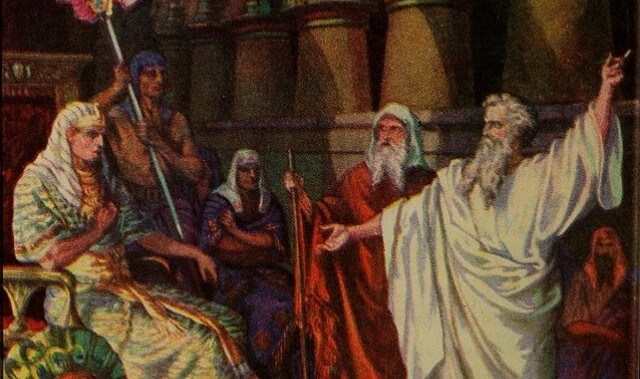
Illustration image: ‘Moses Before Pharoah’ (1919)

The purpose of Elisha’s miracle was to help out a poor woman in need. The goal of Moshe’s miraculous signs in Egypt, on the other hand, was far more grandiose. These wonders were meant to demonstrate the power and greatness of the Creator, “so that you will know that I am God here on earth” (Shemot. 8:18).

In Egypt, God willed to demonstrate His ability to overrule any law and limitation of the natural world. Therefore, it was necessary to have a “miracle within a miracle.” This exhibited independence and autonomy at all levels of natural law, both specific and fundamental. The miracle of the staff occurred not only as a minor disruption of nature — a level at which the Egyptian magicians could also function — but also at the level of total disregard for the most basic laws of nature, so that one staff could “swallow up” other staffs.

(Gold from the Land of Israel pp. 108-109. Adapted from Ein Eyah vol. IV, pp. 243-244 by Rav Chanan Morrison)

Public Pressure

by Rabbi Dov Berel Wein

Many of the Torah commentaries point out that unlike our forefathers, Moshe, in this week's opening verses to the Parsha, did not accept that God's promises of redemption for the Jewish people had not yet been fulfilled. In God's response to this, we sense a veiled criticism of our great teacher and leader Moshe.

Heaven responded to Moshe by saying that he enjoyed a higher and different relationship to the Revelation from God than those original founders of the Jewish people. Because of this state of elevated Revelation, Moshe's complaint was unnecessary. Moshe should have realized that Heaven has its own timetable, and that its promises will always be fulfilled, but not necessarily according to the time schedule established by human beings.

It is difficult to understand the attitude in Moshe's statement to Heaven that it had not yet freed the Jewish people from Egyptian bondage. Moshe certainly realized through his powers of Revelation that he had experienced, and through the commitments made to him and to the Jewish people about redemption, that Heaven was aware of the promises, and that there was no need to be prompted by Moshe to fulfill its commitments.

However, Moshe, like all leaders, was subject to public pressure, complaints and hostility directed towards him by the Jewish taskmasters after the decree of the Pharaoh to withhold straw from them, while demanding the same number of bricks to be produced. These complaints by the people were deeply disturbing to Moshe. He deflects the criticism directed towards him and, instead, holds Heaven accountable for the situation.

Moshe, himself, has no doubt as to the eventual outcome and the inevitable redemption of Israel from Egyptian bondage. Unlike Abraham, Isaac, and Jacob though, he was subject to popular opinion in the mood of the Jewish people, whom he had to convince that redemption would in fact take place.

According to the Midrash, many, if not most, of the Jewish people in Egypt did not believe Moshe’s promises that they would soon be delivered from Egyptian slavery. Even after the series of plagues and punishments visited upon the Egyptians, most of the Jews still did not believe in their coming redemption. In contending with this psychological and emotional state of mind by a large part of the Jewish people, Moshe necessarily turns the Heaven for help. He has no doubt that the redemption from Egyptian slavery will shortly take place. However, he must bring the masses of Israel along with him in this belief and faith.

Because of his great modesty and humility, Moshe does not rely upon his own powers of persuasion to accomplish this task, and he turns to Heaven in an almost provocative fashion. He implores God to hasten the process of the delivery of the Jewish people from Egyptian bondage. His courageous words to Heaven, which seem like a complaint, are, indeed, but an expression of the greatness of his character and the forcefulness of Moshe's leadership.

Sunday, January 07, 2024

Jeff Bezos’ Employee was Kidnapped, His Paper Promotes Hamas

by Daniel Greenfield

On Oct 7, Sasha Troufanov, an Amazon engineer, was abducted by Hamas and his father was murdered. The massive international tech giant has maintained its silence about him despite urgings from Sasha’s fellow employees and family members to speak out.

Andy Jassy, Amazon’s first Jewish CEO, tweeted briefly on Oct 9 that “the attacks against civilians in Israel are shocking and painful to watch” and claimed that he had “been in touch with our teammates there to make sure we do everything we can to help support their family’s (sic) and their safety, and to assist however we can in this very difficult time.”

He also promised to be “in close contact with our humanitarian relief partners on the ground and will be supporting their efforts. Hoping that peace arrives as soon as possible.”

After that glib message, there have been no further updates.

Amazon has refused to comment because it would be “too controversial” to speak out against the kidnapping of one of its employees. Not only Sasha, but his mother and his 73-year-old grandmother were also kidnapped. They were eventually traded for terrorists, but not Sasha.

The company has made public statements of support for Ukraine, after George Floyd’s death, and on other trending political issues, but avoided making any mention of the attack on Israel.

When Amazon Web Services, which Sasha worked for, held its ‘re:Invent 2023’ conference in Vegas, some of his friends hired billboard trucks to remind AWS of its missing member who should have been there at the product launch, but was instead being held captive by terrorists.

Again there was no corporate response.

“We shouldn’t even have to…ask management to acknowledge that we have an abducted employee,” a fellow worker said.

Internally, Muslim employees at Amazon have expressed support for terrorism and the company has refused to recognize Jews as an “affinity group” alongside black, gay, indigenous, Latinos and “body positive” corporate affinity groups.

After George Floyd’s death, Amazon denounced what it claimed was the “inequitable and brutal treatment of black people”. Founder Jeff Bezos posted a customer’s email complaining about the retail monopoly’s support for Black Lives Matter and sneered, “you’re the kind of customer I’m happy to lose.”

Which kind of employees is he happy to lose? Whose lives don’t matter?

While Amazon has remained silent, the Washington Post, a newspaper owned by its executive chairman, Jeff Bezos, has never stopped attacking Israel or spreading Hamas propaganda.

The Washington Post has spent the Oct 7 war uncritically repeating Hamas propaganda while promoting the false claims that Israel is guilty of “apartheid” and “genocide”.

While media coverage has been terrible in general, the Post still managed to be worse.

On Oct 7, the Washington Post framed the mass murder of Israelis as a response to Israelis provoking Hamas by living in Jerusalem and visiting the Temple Mount: the holiest site in Judaism. In November, the paper used distorted numbers to smear Israel as being engaged in “killing children at a rate unprecedented in 21st-century conflict.” CAMERA senior research analyst Sean Durns accused the paper of contending that “the Hamas-run Health Ministry can sometimes be trusted with casualty counts”.


The Post’s obsessive propaganda left no stone unturned and so when Israel provided free medical care for newborn Arab Muslim babies from Gaza, the paper headlined it as “Israel’s war with Hamas separates Palestinian babies from their mothers.”

When the Post wanted to find an example of “brutal voyeurism” from the war, it did not lead with the Hamas footage of terrorists brutally murdering and kidnapping civilians, but with an Israeli Navy unit shooting Hamas terrorists trying to attack Israel, which the paper described as “using assault rifles and grenades to blast away at people floating in the water.”

When the article finally got around to mentioning the footage of the Hamas atrocities, it depicted it as Israeli propaganda being distributed to “enrage” Americans and American support for Israel was described, in another article, as due to the “decades-long influence of a powerful lobby.”

Earlier in 2023, the Washington Post crossed a line when it ran a story describing how its reporters had embedded with a “branch of al-Aqsa Martyrs Brigades, which is listed as a terrorist group by Israel and the United States.” In exchange for the propaganda, the paper agreed “that full names and specific locations be withheld” meaning that the newspaper was collaborating with an Islamic terrorist group.

But there are larger concerns about the Washington Post that encompass not only the paper, but Bezos, and the state sponsors of Hamas in Qatar. The most vocal pro-Islamist figure at the Post is Karen Attiah. Attiah, the daughter of African immigrants, serves as the paper’s Global Opinions Editor, and its all-around propagandist waging war on the non-Muslim world.

Attiah rocketed to fame during the Jamal Khashoggi hoax in which the old friend of Osama bin Laden was falsely depicted as a journalist and human rights campaigner, when in reality he was an Islamist terrorist supporter who was promoting material created for him by his sponsors in Qatar. Editing has since been halted on her book about the terror supporter for unknown reasons.

But rather than paying a price for her involvement in the Khashoggi hoax, Attiah used it to boost her prominence even while spreading lies to benefit Islamists.

Attiah attacked France for trying to crack down on Muslim terrorism by falsely claiming that President Macron “wants to give Muslim kids ID numbers to go to school.” Rather than suffer any consequences, the Washington Post allowed her to write an article complaining that France was responding to Muslims beheadings of its people with “feverish fragility.” She claimed that Brexit was motivated by “Islamophobia” and so was fighting “honor killings” among Muslims.

So it comes as little surprise that Attiah has spent the Hamas war in a state of endless fury.

Attiah ranted that she would “never forgive” Biden for supporting Israel, and claimed a week after the Hamas attacks that “people are showing themselves to be okay with genocide”.

“This is not a war against Hamas. This is Israel waging a colonial-style, punitive massacre against Palestinians,” she argued. “What Israel and the US are doing in real time to Palestinians activate very recent, unhealed trauma around Western violence against Africans,” she claimed.

Israeli Jews, she contended, were colonists. And she suggested that Jews were perpetrating a Holocaust against Muslims. “Israel’s barbarity knows no bounds,” she shrieked.

By December, Attiah’s desperate hunger for pro-terrorist propaganda had reduced her to attacking Beyonce for not boycotting Israel. “When it comes to speaking out about Israel and Gaza, her silence says a lot about the immense cultural power — and structural powerlessness — of black women.”

Attiah’s presence at the Washington Post and Jeff Bezos remaining silent while one of his employees is in Hamas captivity form part of a pattern. After the Post’s Khashoggi hoax, Bezos claimed that nude photos of him had been hacked by Saudi Arabia; supposedly offended by the paper’s support for the Qatari regime change operation using the Post as a platform.

The bafflingly tawdry story of a billionaire’s peccadillos had larger implications. It wasn’t just a rogue editor who was promoting Qatari interests, it was one of the wealthiest men in the world.

And Qatar stands behind Hamas.

Why won’t Amazon address the kidnapping of one of its employees by Hamas? Is it because of its executive chairman and his paper’s ties to the state sponsor of Hamas?

Jeff Bezos claims to be a humanitarian, but neither he nor his company have anything to say about his own abducted employee. While Bezos’ company has nothing to say about Sasha Troufanov, his paper promotes Hamas propaganda.

The lives of his employees don’t matter to Bezos, those of Hamas do.

Friday, January 05, 2024

Groups That Support Hamas

by John Wilson
  • Surprisingly, by far the largest group supporting Hamas appears to be TikTok.
  • "Some have argued that there is a constitutional right to TikTok, that banning it would violate Americans' rights under the First Amendment. But the First Amendment surely does not require us to allow social media apps controlled by foreign adversaries to dominate the U.S. market." — US Rep. Mike Gallagher, chairman of the House Select Committee on Strategic Competition between the United States and the Chinese Communist Party, The Free Press, November 2, 2023.
  • Other groups leading anti-Israel protests reportedly include....
  • There appears to be more moral rot around than is good for any nation. The US, the UK and countries in Europe that encourage racism and other ways of pitting groups against one another -- which for many now is "Big Business" -- would do well to get rid of all of it, the sooner the better.

Surprisingly, by far the largest group supporting Hamas appears to be the social media app TikTok.

Even before the bodies of roughly 1,200 people in Israel , including dozens of children, were cold after being tortured, raped and massacred on October 7 by the Iran-backed terrorist group Hamas, not just Palestinians and Arabs, but people in the West could be seen demonstrating in support of the torturers, murderers and rapists. Even the otherwise outraged hashtag women's groups have yet to be heard from, with at least one politician in the US, a woman, Rep. Pramila Jayapal (D-WA), actually "downplaying" the atrocities and other members of the public denying that they had even happened.

Who are these people and groups supporting a terrorist group, Hamas?

Continue Reading Article

Igrot Hare’aya – Letters of Rav Kook: Call to Plant More Etrog Trees

#182

Date and Place: 7 Shevat 5669, Yafo

Recipient: The members of the moshavot (agricultural settlements)

Body: The time has come that I feel an obligation to point out to you something about an important area within the agriculture of our Desired Land – the planting of etrog trees with careful precautions that there is no possibility of grafted fruit. This is something that specific growers started to do a few years ago in a reliable manner. The increase of such orchards is important to us, especially now that so many people are interested in expanding the Jewish community of our Holy Land.

There are three important goals that are included in this dear, holy service [of planting kosher etrog trees]:

1. To save the broad Nation of Hashem from missing out on the mitzva of etrog and the other species that go with it (if one of the species is not kosher, no part of the mitzva is fulfilled). Until now, the non-Jewish growers have spoiled the sanctity [of the mitzva] by flooding the world with prohibited, grafted etrogim.

2. To use this branch of agriculture to expand the reaches of the community in our Holy Land, by adding fruit-bearing trees that bring blessing to their owners. The flow of money from our dear brothers to these non-Jews, some of whom are our enemies and those who hate us, should, instead, go to our brothers, who glorify the strength of our nation, as they expand our community in the Desired Land, the place we are able to live a full life.

3. To connect the souls of our dear brothers who are dispersed throughout the Diaspora with increased love and appreciation of our holy and desired Land, which is to be eternally desired, by being reminded of Zion. This happens when one takes an etrog that grew in sanctity in the Holy Land on our Holiday of Joy, and we add to it grandeur because it was grown by our brethren, who are returning life to the Holy Land, which is the source of the dew of our resurrection.

[Word of the need and availability of non-grafted etrog trees] has been heard among [people with religious sensitivity], and the nature of the reliability of the certification of the Jewishly grown etrogim in the Holy Land has started to become known to the masses. Also, [many are aware of] the certainty that the non-Jewishly grown etrogimare grafted and not kosher. Since consumers have flocked to the etrogim of our dear moshavot, whose kashrut is guarded, I have received one question from the brilliant and righteous rabbis of the world, which needs to be answered with action, not words. These great brothers, who love Zion and want the mitzva to be done in the way it should be, who are wise enough to have realized that the mitzva can be done properly only with the moshavot involved, ask: Will there be enough etrogim grown in the moshavot for the whole nation [including the Diaspora]? Only if the answer is affirmative, will they be able to encourage people to refuse to buy the unsupervised etrogim, and have people accept the new source of etrogim.

This holy work is for now and for future generations. Therefore, I find it appropriate to ask you, dear brothers, who are involved in agriculture, that each of you should leave a part of your land for an etrog grove. If this is done, then the individuals who plant will quickly accumulate to produce enough etrogim for us to supply the whole Jewish world through the efforts of the sons/builders who worked so hard. Then, we can hope that each rabbinic leader, according to his level of influence, will support us, and we will be those who make a path toward fulfillment of this great mitzva, in contrast to the present desolation. Then, commerce in etrogim will find its place in strengthening the place of orchards within the Holy Land.

Dear brothers, it is appropriate that you will take part in this new challenge for the sake of the mitzva and the yishuv to do this great thing, of fixing the mitzva, embellishing the yishuv, and raising the stature of Zion in the hearts of our brethren, as the [etrogim will help] people remember Yerushalayim.

The Yishai Fleisher Israel Podcast: THE BLESSINGS OF WAR

SEASON 2024 EPISODE 1: Yishai and Malkah Fleisher are back and reflect on three months of the October 7th War including the killing of master terrorist Saleh al-Arouri, the political willingness to discuss voluntary emigration for Gaza Arabs, and the religious change - Teshuva - happening in the Land of Israel. Also, Ben Bresky on the amazing story of the Tekhelet blue string commandment. And finally, Table Torah on celebrating Jewish birth on the Torah portion and new book of Shemot.

Rabbi Ari Kahn on Parashat Shemot The Birth of Redemption (video)

Yeshivat Machon Meir: The Symbolism of the Burning Bush (video)