Thursday, August 08, 2024

Every ‘Rabbi’ From ‘Jewish Americans For Kamala Harris’ Belongs To Anti-Israel Groups

by Daniel Greenfield

Democrats have tried to reassure Jewish voters that they have nothing to worry about despite Kamala’s harsh criticism of Israel’s war on Hamas.

To counter those concerns, the Jewish Democratic Council of America, headed by Haile Sofer, Kamala’s old policy adviser, rolled out a ‘Jewish Americans for Kamala Harris’ online rally. But while the Zoom rally flier may feature a photo of Kamala and her husband, Doug Emhoff, awkwardly lighting a menorah, the leading figures in the rally only raise more questions.
The two most prominent non-elected officials taking part in the rally are Randi Weingarten, the head of the American Federation of Teachers union, and her girlfriend, Sharon Kleinbaum.

While Weingarten is best known for her work in keeping school closed leading to as much as a grade point of loss in education, she is militantly anti-Israel and has used antisemitic rhetoric.

In response to a question from the JTA, a liberal Jewish media outlet, about the power of teachers’ unions, Weingarten launched into an antisemitic tirade in which she claimed that “American Jews are now part of the ownership class” who “want to take that ladder of opportunity away from those who do not have it.” The American Jewish Committee had responded with an op-ed urging her to “Counter, Not Inflame, Antisemitism”.

I have tried to reach out to ‘Jewish Americans for Kamala Harris’ to inquire if they agree with Randi Weingarten that Jews are “the ownership class” who “want to take that ladder of opportunity away from those who do not have it”, but have not received an answer.


(Pictured: Sharon Brous with Linda Sarsour)

Weingarten had befriended and defended antisemites including former Women’s March leaders Tamika Mallory and Linda Sarsour, calling them “friends” and “warriors for justice.” Mallory was an enthusiastic fan of Nation of Islam leader Louis Farrakhan, who had praised Hitler. She had described the creation of Israel as a “human rights crime” and attacked Jewish groups.

Sarsour had a long track record of antisemitism and support for Islamic terrorism. After the Oct 7 Hamas attacks, the Islamic activist claimed that Jewish hostage posters were entrapment and that Jews everywhere were watching them. “So when you go home, they have their little people all over the place, trust me I know them, I got a radar for them… you think they’re ordinary people, trust me when I tell you they are everywhere. They’re on your college campus, they’re outside the supermarket, they’re outside Grand Central Station.”

Not only did Weingarten not stand with Jewish activists against the Women’s March antisemitic leaders, but she is a board member of the Americans for Peace Now BDS group whose CEO Hadar Susskind praised Ben & Jerry’s decision to boycott Israel as a “principled moral stance which we fully support”. APN has platformed antisemitic figures like UN Special Rapporteur Francesca Albanese who claimed that America is “subjugated by the Jewish lobby”.

Weingarten’s AFT union has demanded that Israel stop attacking Hamas in a resolution presented with personal support from Randi at a convention where Kamala spoke. The AFT defended the pro-terrorist mobs harassing Jewish students and faculty on campuses.

Randi Weingarten has repeatedly attacked Israel and tweeted a quote claiming that “the Hamas attack was heinous; the Israeli government’s actions in Gaza have been reprehensible.”

Weingarten’s girlfriend, Sharon Kleinbaum, and fellow participant in Jewish Americans for Kamala Harris is even worse. After Kleinbaum read the names of Hamas terrorists alongside fallen Israeli soldiers at the LGBTQ temple she formerly officiated at, congregants left feeling that it had become pro-terrorist. One departing congregant complained that it “was essentially delivering Hamas propaganda. … My partner and I are starting a family and frankly I don’t want to raise my kids in a synagogue that’s praying for people firing rockets.”

Kleinbaum had co-signed a T’ruah letter together with anti-Israel activists urging Biden not to allow Israel to finish off Hamas in Rafah and claimed that Israel cannot “lay the full responsibility for the unimaginable suffering of a massive population of trapped civilians at the feet of Hamas.” The letter also called for Biden to impose sanctions on members of Israel’s government.

Weingarten and Kleinbaum are not outliers at Jewish Americans for Kamala Harris.

Sharon Brous of IKAR, profiled by Variety as a “trendy, progressive congregation”whose wealthy congregants include Steven Spielberg and appears to have some link to Kamala’s husband, is also on the list. Brous had attacked the Jewish State before the Oct 7 attacks, including in a hateful Yom Kippur address, claiming that “there can be no democracy with occupation.”

Brous is a member of the councils of anti-Israel groups like J Street, and the New Israel Fund. Worse still, IKAR has participated in events with IfNotNow, an anti-Israel hate group linked to many of the ugly protests against the Jewish State.

Sharon Brous has a long history of supporting antisemites, attacking Jews for opposing Rep. Rashida Tlaib and Rep. Ilhan Omar, claiming that Jews “have spent years in hive mentality, pouncing on indications of anti-Semitism among Israel’s critics”, accused the Jewish State of a “52-year military occupation of millions of Palestinian people” and ranted that American Jews must “hear Palestinian voices.”

Like Weingarten, Brous attacked Jewish critics of the antisemitism in the Women’s March leadership, falsely claiming that the criticisms were, “a deliberate smear campaign from the far right to delegitimize the march itself.” She complained that, “a much greater problem would be if the Jewish community stepped out of activism because we’re afraid that someone on the stage has a position on BDS different than our own.”

Lauren Holtzblatt, the final clergymember on the Jewish Americans for Kamala Harris call, is a member of J Street cabinet (while also tragically and inappropriately) serving as Hillel International’s director of campus initiatives and has also been associated with the anti-Israel group T’ruah and signed on to its letters.

Every single ‘rabbi’ presented by ‘Jewish Americans for Kamala Harris’ is also affiliated with anti-Israel groups. This raises troubling questions about not only the anti-Israel extremism that had already infiltrated the Jewish Democratic Council of America, but Kamala’s campaign.

Not only does ‘Jewish Americans for Kamala Harris’ appear to be co-hosted with the Kamala Harris presidential campaign, but several of its anti-Israel clergy have ties to Kamala.

‘Jewish Americans for Kamala Harris’ shows that the Kamala campaign, like the Obama campaign, calculatedly platforms and normalizes anti-Israel activists while shutting out normative figures in the Jewish community. It is not a coincidence that all of the clergy at the virtual rally were anti-Israel activists. It also not a coincidence that no pro-Israel clergy or members of more traditionally religious denominations were on the call.

The ‘Jewish Americans for Kamala Harris’ rally anticipates a Kamala administration that will pursue anti-Israel policies while surrounding itself with anti-Israel activists of Jewish descent.

Jewish Democratic Council of America has sent a clear signal that the only Jews welcome by the Kamala campaign are those that will join it in opposing the Jewish State.

Israel and the November 2024 Congressional election

by Ambassador (ret.) Yoram Ettinger

*While most of the attention to the November 2024 election is centered around the Presidential election, the outcome of the November 2024 Congressional election - 435 House seats and 34 Senate seats - will greatly impact US national security and foreign policy, in general, and US-Israel relations and US policy toward Iran’s Ayatollahs, in particular.

*According to the US Constitution and to a litany of precedents, both Chambers of Congress – which constitute the most authentic representation of the US constituency - are co-equal to the Executive, as derived from a series of Constitutional checks and balances. Thus, the US Congress is the most powerful Legislature in the world, possessing the power of the purse, and the muscle to check, defy, oversee and overrule (the Administration), direct, investigate, suspend, fund and defund the Executive, as well as to formulate domestic, foreign and national security policies.

Secretary of State, Jim Baker, used to complain that “you cannot conduct foreign policy with 535 Secretaries of State on Capitol Hill.”

*The impact of the November 2024 Congressional election will be measured by the resulting clout of the "Progressive Democrats," who currently number 96 – out of 212 Democrats - in the House of Representatives and 1 – out of 51 Democrats - in the Senate.

*The “Progressive” worldview, which is directly related to US-Israel relations and US policy toward Iran’s Ayatollahs includes the following:

<A drastic cut in the defense budget, impacting the US’ posture of deterrence;
<Multinational/cosmopolitan - rather than unilateral/independent – foreign and national security policy;
<Policy coordination with the UN, international organizations and Europe;
<Sacrificing Middle East reality on the altar of alternate reality (e.g., Islamic terrorism driven by despair, not by anti-US fanatic, religious ideology);
<Ignoring the dominance of fanatic ideology in shaping the Ayatollahs’ policy;
<Assuming that generous diplomatic and financial gestures could moderate terror entities (e.g., Iran’s Ayatollahs), irrespective of their track record. Ruling out regime-change and the military option, thus bolstering terrorism.
<Embracing Iran's Ayatollahs and the Muslim Brotherhood, taking lightly their clear and present threat to the US homeland security, and devaluing pro-US Arab regimes, which are threatened by the Ayatollahs and the Brotherhood;
<Disregarding the rogue Palestinian intra-Arab track record - which has made Palestinians a role model of intra-Arab terrorism and treachery - and the adverse impact of the proposed Palestinian state on US interests;
<Ignoring the benefits of Israel's control of the Golan Heights and the mountain ridges of Judea and Samaria to regional stability, the safety of pro-US Arab regimes, and US interests;
<Ignoring Israel's role as a force and dollar-multiplier for the US taxpayer;
<Dismissing the Biblical roots of the US Constitution, civil rights, civic system and culture.

*Depending on the outcome of the Congressional election, the next Chairperson of the House Full Appropriations Committee – which is the most crucial committee for US-Israel cooperation, currently chaired by the staunchly pro-Israel Congressman Tom Cole (R-OK) – could be Congresswoman Rosa DeLauro (D-CT), a founding member of the Progressive Caucus and a systematic supporter of the proposed Palestinian state, while criticizing Israeli presence in Judea and Samaria, condemning the October 7, 2023 Hamas terrorism, but calling on Israel to abort its offensive against the perpetrators of this terrorism.

Moreover, the Chairperson of the House Appropriations Subcommittee on Defense – which appropriates much of the US-Israel defense cooperation and currently chaired by Congressman Ken Calvert (R-CA), a systematic supporter of enhanced cooperation with Israel – could be Congresswoman Betty McCullum (D-MN), who is one of the fiercest critics of Israel on Capitol Hill. The Chairperson of the House Appropriations Subcommittee on State and Foreign Operations – which appropriates foreign aid and is currently chaired by Congressman Diaz-Balart (R-FL), a major supporter of upgraded collaboration with Israel – could be the pro-Israel Congresswomen Grace Meng (D-NY) or Lois Frankel (D-FL), who would be pressured by the “Progressives.”

The Chairman of the House Foreign Affairs Committee – currently chaired by the systematic promoter of deeper US-Israel cooperation, Congressman Mike McCaul (R-TX) – could be the non-“Progressive” Congressman Gregory Meeks, who embraces the State Department’s worldview, supporting the proposed Palestinian state and calling upon Israel to abort its military offensive against Hamas. Furthermore, the Chairman of the Foreign Affairs Subcommittee on the Middle East – currently chaired by the staunchly pro-Israel Congressman Joe Wilson (R-SC) – could be chaired by Congressman Dean Phillips (D-MN), a lukewarm supporter of Israel, who would be under pressure from “Progressives” to playdown his support of Israel.

While the “Progressive” Caucus has a very low profile in the Senate, the outcome of the election (with 23 Democrats and 11 Republicans defending their Senate seats) could yield a Republican majority, which would dramatically impact the co-equal power of Congress, when arm wrestling the President (if the Republican majority is sustained in the House).

A Senate change of balance of power would also switch the Chairmanship of the Senate Full Appropriations Committee (the most powerful Senate committee) from Senator Patty Murray (D-WA), a Foggy Bottom-like critic of Israel, to Senator Suzan Collins (R-ME), a supporter of enhanced US-Israel cooperation, who opposes any delay in the supply of military systems to Israel. In addition, the Chairmanship of the critical Appropriations Subcommittee on Defense (funding US-Israel defense cooperation) could shift from Senator Jon Tester (D-MT) to Senator Susan Collins (R-ME), both are pro-Israel, who opposed the 2015 nuclear accord with Iran’s Ayatollahs. Also, the Chairmanship of the pivotal Appropriations Subcommittee on State and Foreign Operations could switch from Senator Chris Coon (D-DE), who echoes State Department’s criticism of Israel, to Senator Lindsey Graham (R-SC), a harsh critic of the State Department and a staunch supporter of Israel.

Moreover, the Chairmanship of the Senate Foreign Relations Committee could switch from retiring Senator Ben Cardin (D-MD) to Senator Jim Risch (R-ID), both are supporters of upgraded US-Israel cooperation, who opposed the 2015 nuclear accord. However, a change of majority would change the Chairmanship of the Foreign Relations Subcommittee on the Middle East from Senator Chris Murphy (D-CT), a State Department like critic of Israel, to Senator Todd Young (R-IN) a steady supporter of enhanced US-Israel relations.

*A focus on the November 2024 Congressional election is advisable in light of the power vested in Congress by the US Constitution, aiming to preclude excessive Executive power through checks and balances, limited government and a strict separation of powers. Therefore, US presidents are not super-legislators, nor do they determine the congressional agenda or congressional leadership. The President proposes, but Congress disposes. The President is the commander-in-chief, but only as authorized and appropriated by Congress, which has been a systematic supporter of the mutually-beneficial US-Israel two-way-street cooperation.

Wednesday, August 07, 2024

Rav Doniel Glatstein on Parshas Devorim: The Advantage of "Reknown" Judges - The Insight of Ben Ish Chai (video)

Rabbi Ari Kahn on Parashat Devarim: Indifference (video)

Rav Doniel Glatstein on Parshas Devorim: The Chida Identifies The two Main Causes of the Churban (video)

To live a Temple-less life as a Torah Jew?

by Rabbi Pinchas Winston

THE GEMARA SAYS that any generation in which the Temple has not been rebuilt, it is as if it was destroyed in that generation (Yerushalmi, Yoma 5a). Of course, a statement like this raises all kinds of questions and inspires different kinds of answers because it just doesn’t seem fair.

For starters, it is a lot harder to build something that doesn’t exist than it is to destroy something that does. It takes a wrecking ball two days to bring down what took a year to build. Relationships too. It can take months, even years to cultivate a good relationship, but one quick slip of the tongue can destroy it. Besides, while the Temple stood, people saw what had to be preserved. While it doesn’t, well, as the expression goes, “Out of sight, out of mind.”

I remember once, while ascending the long stairway leaving the Kosel (Western Wall), looking back to get one more glimpse of the holiest spot in the universe before leaving. At that point, I was high enough to also see the Temple Mount and, of course, the mosque squatting there. But this time, before turning around to continue my ascent and journey home as in the past, something made me stop.

As I thought about it, it all of a sudden occurred to me how I, and so many others, had become so accustomed to seeing an Arab place of worship where the Jewish one belonged, that I related more to a retaining wall than I did to the Makom HaMikdosh, the place of the Temple. It was as if I had lost all connection to the Temple Mount and made the Kosel HaMa’arvi the new Makom HaMikdosh, and wondered how many others had done the same.

Surprised by my realization, I continued to stand there but instead imagined the Jewish Temple functioning where it belonged. Every time I return to the Kosel, I make a point of the reminding myself that the Kosel, as wonderful and holy as it is, is not the Bais HaMikdosh. When I daven there, especially Mussaf on Rosh Chodesh, I have intention for the sacrifice being offered where it should be and, as a Levi, helping with the avodah.

We don’t need to ask eichah—how—about how we haven’t yet built the Temple. Thousands of years have passed since the destruction of the Second Temple, and many exiles have been endured. If we didn’t have Tisha B’Av, and the two weeks leading upon to it, only those fortunate few who learn about the Temple service would remember it. Look how easy it has become to live a Temple-less life as a Torah Jew.

Tuesday, August 06, 2024

Rav Kook's Ein Ayah: Hashem’s Despair Over Bnei Yisrael’s State of Exile

(based on Berachot 1:7)

Gemara: Rav Yitzchak bar Shmuel said in the name of Rav: There are three mishmarot (“watches”= sections of time) to the night, and for every mishmar Hashem sits and roars like a lion, and says: “Woe on the sons that because of their sins I destroyed My house and burnt My hall and exiled My sons among the idol worshippers.

Ein Ayah: [Rav Kook refers to his comments on the previous gemara. The baraita spoke about the connection of different animals to the various mishmarot and explained how each hinted at things that are related to the respective animals and are missing in the heavenly sphere. The idea is that deficiencies in the heavens stem from deficiencies in how Bnei Yisrael’s serve Hashem.]

We can explain based on our previous ideas. Rav is explaining the baraita that explained the noticeable deficiency in each mishmarstemming from the realm of practical mitzvot and the shleimut (completeness) of character traits (middot), andfrom the revealed Torah and the hidden one which is double in wisdom. Rav added to explain that all of the levels are included one in the other, and in each part of them, the deficiency is recognizable.

Note that the Beit Hamikdash is called the house of Hashem and the hall of Hashem. It seems that in regard to a human king, there is a difference between a reference to the king’s place as the king’s house or the king’s hall. The difference is that his house refers to matters of the kingdom that are performed there, for the house refers to everything that is included in it, as the matters of the kingdom include also its officers. The hall is specially designated to aggrandize the king’s stature, so that all will know the honor of the king by virtue of his sitting in the grand hall.

This is [serves as a metaphor to] the difference between the explicit laws of the Torah and the general good middot. The mitzvotof the Torah, which are set according to their specifications from Hashem, are the matters of the Kingdom upon which the world runs according to His desire. The good middot are that which more fully prepare the heart of man to know Hashem and His honor. The Beit Hamikdash was the center of sanctity and through it, great sanctity was enjoyed in Bnei Yisrael’s service by means of all of the mitzvot. It also instilled purity in the heart and enabled all dear middot. From the perspective of the matters of the mitzvot and the physical service, it was called the house of Hashem. In regard to the sanctity of a person’s attributes, it was called the hall of Hashem. [We will skip over the reference to different animals upon which he expounded in the previous piece.]

[We can now understand why the gemara refers to] “I destroyed My house and burned My hall.” Mitzvot are the root of the soul’s clinging to the divine light in the World to Come. Middot prepare the soul to cling to Hashem even in this world so that it will be fit for prophecy. The holy mitzvot have an impact even without a Beit Hamikdash; it is just that the impact is not on the level that it is when the Beit Hamikdash stands. However, the pinnacle of middot, which is the light of prophecy, has been totally removed. This is what the pasuk says in reference to Baruch ben Neriyah in Yirmiyah (45:10): “For that which I have built I am destroying … and you are seeking greatness?” Therefore in reference to the house, the word churban (destruction) is used, implying that its aura is removed but its basis remains. Regarding the hall, though, it says that it is burnt [implying, burnt to ashes]. Afterward it says that “I exiled my sons among the idol worshippers.” This refers to the root of the loss of Torah in both elements. This is what Chazal said (Chagiga 5b): “Once Israel went into exile from their place, there is no greater loss of Torah than this, for only ‘from Zion shall Torah go forth’ (Yeshaya 2:3).”

The Sin of the Spies and Moshe's Punishment

by HaRav Mordechai Greenberg
Nasi HaYeshiva, Kerem B'Yavneh

"With me, as well, Hashem became angry because of you." (Devarim 1:37) What does Moshe's punishment, which was on account of Mei Meriva, have to do with the sin of the spies?

The Ohr Hachaim and Sforno explain based on the Gemara in Ta'anit (29a) which comments on the pasuk, "The people wept that night" (Bamidbar 14:1): Hashem said to them, "You cried for naught; I will establish a crying for all generations." That day was Tisha B'Av, on which the first and second Temples were destroyed.

Furthermore, Chazal say that had Moshe entered the land, the Temple would not have been destroyed, as no nation would have been able to touch it. On the pasuk, "A psalm of Asaph: O G-d! The nations have entered into Your inheritance," Chazal say (Midrash Tehillim 79): "A psalm of Asaph?!" It should have said, "A lamentation," since they destroyed the Temple! Rather, it is called a psalm because G-d expended His wrath on the wood and stones of the Temple, while Israel survived.

Thus, had Moshe entered Eretz Yisrael, the Temple would not have been destroyed, and hence, Heaven forbid, G-d would have expended his wrath on Israel instead, leaving no remnant of them. Therefore, it worked out that the decree was issued that Moshe should not enter the Land, so that the Temple could be destroyed, and Israel was saved.

However, were it not for the sin of the spies, Israel would certainly have remained righteous, and the forces of evil would not have prevailed. We would never have reached the point at which to weigh the destruction of Israel or the destruction of the Temple. However, after the sin of the spies, G-d foresaw that the hand of the wicked would prevail, and there was a need to allow the destruction of the Temple. Therefore, it was necessary that Moshe not enter the Land, to allow saving Israel by destroying the Temple.

What was the cause for this crying for all generations? The Sforno comments on the pasuk, "Hashem heard the sound of your words" (Devarim 1:34): "The sound of crying for naught." It is possible that the spies, and Bnei Yisrael in their wake, spoke logically; that there was merit to their arguments. However, a lot depends on the tone in which the words are said, on what is implied by them. Hashem listened to "the sound of your words" -- not only to the claim itself. He listened to the tone and heard the sound of crying for naught; for this came the decree.

This bears a lesson for our generation. There are those who see in our current political situation a problem of security or of saving lives. There are those who see an injustice to another nation. We, based on our world outlook, reject outright claims of this sort, since in our opinion they are insufficient to weaken our right to Eretz Yisrael, which was given to us with a covenant and oath by the Creator of the world. Still, these are claims that are understandable. But what is the meaning of the rejoicing on every concession and every piece of land which is ripped away from Eretz Yisrael? Here we already hear the tone which is behind the logic, and the tone is very worrying. Heaven forbid that it should be said about us, "From a distance shall you see the Land, but you shall not enter there." (Devarim 32:52)

During the period of the three weeks we must deal with issues of Eretz Yisrael, to strengthen our love of it, in order to rectify the crying for naught, as opposed to, "They despised the desirable land." (Tehillim 106:24)

Rav Kook on Parashat Devarim: Right versus Might

“We turned and went up towards Bashan, and Og, king of Bashan, and his people came out to fight against us at Edrei. God told me: ‘Do not fear him. I will place him and all his people and his land in your hands.'”
(Devarim 3:1-3)

The Battle Against Og
Moshe gave a terse account of the battle against the fearful giant, King Og, and his people. The Midrash (Berachot 54b), however, elaborated greatly upon this amazing event:

“Og said to himself, ‘How large is the encampment of Israel? Three Persian miles? I will grab a mountain three miles wide, throw it on them and kill them!’ So Og took a mountain three miles wide, and lifted it over his head in order to throw it.

But God brought ants. They ate a hole in the mountain, and the rock crashed down on Og’s neck. Og tried to lift it up, but his teeth stuck out in both directions and prevented the rock from lifting over his head.

Now, Moshe was ten cubits [15 feet] tall. He took a hammer ten cubits long, jumped up ten cubits and swung the hammer at Og’s ankles, killing him.”

Nice story. But what does it mean? What message was Chazal trying to tell us?

Brute Force versus Spiritual Greatness
The battle between Og and Moshe is a metaphor for the struggle between the physical and spiritual realms. Og the giant viewed everything in terms of brute force and power. He was enraged seeing a small, weak people — the Israelites — take on and defeat the Midianites and the Amorites. Og decided he would demonstrate that spiritual power cannot compete against physical strength. He would use the ultimate symbol of brute force — a massive, inanimate mountain — to bury the Jews and all of their pretensions!

The giant lifted the mountain up, over his head. This indicated that the huge rock, as a symbol of brute power, was his crown, his glory, his ultimate value.

“But God brought ants that ate a hole in the mountain.” Significantly, Og’s downfall was not by means of an even greater physical force. Og’s faith in power and might was conclusively shattered by his defeat at the hands of the smallest and most fragile of creatures, the lowly ant.

Overgrown Teeth
At this point, the heavy rock weighed down heavily on Og’s shoulders. He began to realize that his trust in physical force was misplaced. His crown had become an oppressive burden. However, it was too late to escape. His teeth, symbolizing his aggressiveness and lust, had grown outwards. His traits of violence and rapacity, like his reliance on brute force, had become an integral part of his life and personality, at the expense of spiritual inclinations.

Such is the fate of an individual — or a people — addicted to the drug of physical force, living by the power of the fist. In hindsight, such a life of aggression will be a burden and a source of bitter discontent. Old and weak, even if he should now desire to change his ways to a more peaceful existence, he will not succeed. His teeth overgrown, his basic nature has been usurped by the lifelong habits of aggression and savage greed.

(Gold from the Land of Israel, pp. 294-296. Adapted from Ein Eyah vol. II, pp. 248-249 by Rav Chanan Morrison)

Recalling Past Events

by Rabbi Dov Berel Wein

This last oration of our teacher Moshe reviews the occurrences in history of the Jewish people after their miraculous Exodus from Egypt. The words of Moshe are very personal to him alone and reflect his recollection and viewpoint of all of the events and incidents that occurred during the 40 -year sojourn of the Jewish people in the desert of Sinai.

Nuances of difference sometime appear between the descriptions that Moshe attributed to events that occurred, and the more objective description of those events recorded previously in the Torah. This is natural because of the different personal recollections by humans regarding events that occurred in the purely objective description, giving them a view of the same events but from a different perspective.

There is no need to reconcile the two apparent differing descriptions of the same Torah event. We know that human beings can never really be truly objective, and that everything that we see, and experience is always filtered through our own personalities, thoughts and even prejudices. As such, we can never claim objectivity in recalling past events and describing them for later generations.

It is not that truth is a subjective value, but, rather, it is not possible within the limitations of human existence, for truths to be accurately described, without the injection of the personality and the subjective viewpoint of the person recalling or describing the truth as to what occurred. Only heaven achieves ultimate accuracy of truth. We human beings strive for such perfection but should be aware that it is beyond our abilities to actually attain.

We see this clearly in how Moshe describes the origin of the debacle that befell the Jewish people regarding the sending of the spies to gain intelligence about the land of Israel. In the Torah previously, it appears that Moshe himself was the instigator and catalyst for this idea that later went so wrong. However, when Moshe relives the matter here in the book of Dvarim, he casts the incident in a different light completely. It was the people emerging as a mob upon him that forced him to agree to send spies, and to bring back a report about the land of Israel to the Jewish people before their actual entry into the country.

It is not that Moshe was trying to extract himself from blame and participation in this sad incident, which would doom that generation of the desert and never reach the land of Israel. It is simply that he records for us his absolute misgivings when the proposal first surfaced. In his memory, he does not see himself as ever having instigated the proposal and describes himself as an almost unwilling participant in the process that later ensued. In the eyes of heaven, because Moshe later acquiesced to the public demand for the sending of the spies, it made Moshe a prime mover, and instigator, if you will, in the event of the spies.

Oftentimes, in life, we are apparently innocent victims of forces brought upon us, and yet, we are held accountable personally for the consequences of our participation in the event, unwilling and hesitant as it may have been. The book of Dvarim teaches us many lessons in life that otherwise we may overlook, ignore and of which we may not be aware.

David vs. Goliath

BS”D
Parashat Devarim 5784
by HaRav Nachman Kahana


Devarim, the 2nd of Menachem Av 5784

The Book of Shmuel 1, chapter 17, describes the miraculous, surprise ending of the thrilling standoff between the Philistine giant warrior, Goliat (Goliath) and the teenage shepherd boy, David ben Yishai from Bet Lechem. This episode serves as a metaphor for future altercations between HaShem’s chosen nation and all the world’s human rejects, to this very day.

The lines were drawn between the two armies, positioned atop two opposing hills with the valley of Elah, south of today’s city of Bet Shemesh, separating the combatants.

Apparently, these ancient cultures were more sympathetic to human life than our current sophisticated enlightened societies. Their rules of combat were that instead of thousands of soldiers on both sides being killed and maimed, each would send one warrior with the “winner takes all” and the losers amicably consenting to being slaves of the victor.

The Philistines sent their champion – Goliat. He was six cubits tall (three meters, the official height of the net in basketball games). He wore a bronze helmet and bronze coat of armor weighing 5,000 shekels (about 57kg or 125 lbs.)! His spear shaft was as thick as a weaver’s rod, and its iron point weighed six hundred shekels (about 7kg or 15.4 lbs.).

Twice a day for 40 days, the Philistine would march out to no man’s land and bark out: “This day I defy the armies of Israel! Give me a man and let us fight each other”.

On hearing the Philistine’s words, Shaul and his soldiers were dismayed and terrified.

On day 40, David arrived at the front to meet his brothers, who were serving in the army. Just when Goliat stepped out and shouted his usual defiance, David answered: ”Who is this uncircumcised Philistine that he should defy the armies of the living God?”

While the army, to a man, was fearful of fighting Goliat, David approached King Shaul and volunteered to challenge the Philistine. The King rejected the offer, pointing out that David was a teenage shepherd whereas Goliat was a seasoned warrior.

David replied with an experience he had as a shepherd, when a lion and a bear threatened his flock. “Your servant has killed both the lion and the bear. This uncircumcised Philistine will be like one of them, because he has defied the armies of the living God. The Lord who rescued me from the paw of the lion and the paw of the bear will rescue me from the hand of this Philistine.”

In view of the circumstances, Shaul had no choice but to accept David’s offer.

David refused to don the standard military armor, preferring instead his simple sling. With wooden staff in hand, David chose five smooth stones, put them in his pouch, and proudly approached the Philistine.

Now an interesting sidenote. When the two combatants – the Jewish David and the pagan Goliat were staring at each other’s eyes, what were they thinking?

David and Goliat knew that they were cousins. David’s great grandmother was the righteous Ruth and Goliat’s great grandmother (or grandmother) Orpah were sisters. They were married to the sons of Naomi, who died in Moav leaving their widowed wives.

When no longer connected to Naomi, Orpah returned to her Moabite roots, but Ruth clung to Naomi. She converted to Judaism and accompanied Naomi back to Bet Lechem.

Goliat, with his shield bearer in front of him, ran towards David.

HaShem then put words into Goliat’s mouth that brought him disgrace and irrational anger. He saw the staff held by David and said, “am I a dog, that you come at me with sticks?” David then probably brought up the discreet secret known only to members of the family (including David and Goliat) that on the day that Orpah (Goliath’s grandmother) left Naomi to return to her Moabite roots, she had relations with 100 men and a dog (according to the Midrash).

This provoked Goliath to the point of infuriation where there is no room for logic.

David replied, “you come against me with sword and spear and javelin, but I come against you in the name of HaShem, the God of the armies of Israel, whom you have defied. This day HaShem will deliver you into my hands, and I’ll strike you down and cut off your head. This very day I will give the carcasses of the Philistine army to the birds and the wild animals, and the whole world will know that there is a God in Israel. All those gathered here (Jews and the goyim) will know that it is not by sword or spear that HaShem saves; for the battle is the Lord’s and He will give all of you into our hands.”

As the Philistine moved closer to attack, David reached into his bag and took out a stone, he slung it and struck the Philistine on the forehead, bringing him face down on the ground.

David then took hold of the Philistine’s sword and beheaded Goliat.

The Philistines saw that their hero was dead; but instead of fulfilling the deal that loser becomes slaves, they turned and ran.

The soldiers of Israel pursued the Philistines whose bodies were strewn along the road to Gath and Ekron.

David brought Goliat’s head to Jerusalem as a warning to potential enemies.
As it was then, so will it be in our time

Medinat Yisrael is now being threatened by a coalition of Arab entities who have etched in concrete their aim to destroy the Jewish state as a forerunner of destroying world Jewry.

As with David and Goliat, all bets were on Goliat to win and today the UN’s preference is with the enemies of the Jewish nation. Goliat was twice David’s size, a veteran warrior, shielded with metal armor, and armed to the hilt.

Iran, with Russia’s backing; has Hezbollah in Lebanon with its many missiles; the Chitim of Yemen; and over two million Arabs in Judea and Samaria who at a moment’s notice could cross the “green line” into Israel; as well as the large army of Egypt, and the dictator of Turkey looking over our shoulder.

Over the millennia, Goliats of various sizes from many continents, strange cultures speaking different languages, have appeared in our history; all sharing the same goal: to trample on the seemingly “helpless” David.

We have seen them all and have collected a museum of “heads” to prove that our “David” is invincible.

So will it be now and forever!

As we say when blessing the new moon:

דוד מלך ישראל חי וקיים

David King of Israel lives forever!

Shabbat Shalom,
Nachman Kahana,
Copyright © 5784/2024 Nachman Kahana

Israel’s treacherous frenemies

by MELANIE PHILLIPS

Professions of ironclad support by America and Britain at this dark hour for the Jewish state are humbug

At time of writing, Israelis are bracing for a possible direct and multi-front attack by Iran.

Following Israel’s assassination in Beirut of Hezbollah chief of staff Fuad Shukr and the even more spectacular assassination in Tehran itself of the Hamas leader Ismail Haniyeh, Iran’s Supreme Leader Ayatollah Ali Khamenei has issued an order for Iran to strike Israel directly in retaliation.
If this takes place, it may take a terrible toll of Israeli civilians. Nevertheless, Iran will be the loser because Israel will use those high casualty numbers to launch an all-out war against this genocidal enemy.

The point is that, until now, Israel has been unable to do that even though it has the capacity. That’s because its ostensible best friend, the US, has been playing a two-faced game.

The general assumption is that, in the event of an Iranian onslaught that may overwhelm Israeli defences, the US will come to Israel’s aid. While this remains likely, with at least 12 US warships now deployed to the region, there is nevertheless an element of doubt.

America may not want Israel to be destroyed. But it has been preventing Israel from directly attacking Iran, the instigator and funder of the seven-front war against the Jewish state that started with the October 7 pogrom. For that reason, the US may even be cooking up with Tehran the “acceptable limits” of any Iranian revenge attack — just as it astonishingly did over the Iranian attack on Israel in April — to forestall a devastating Israeli counter-strike.

With Iran openly advertising its intention to destroy Israel and America after four decades of terrorist attacks against the west, this war could have ended soon after it began 10 months ago if Israel, with or without the US, had set fire to Iran’s oilfields or sunk the Iranian fleet.

The October 7 pogrom itself wouldn’t have happened had the Biden administration not been funnelling billions in sanctions relief into Tehran’s coffers, refusing to respond appropriately to multiple Iranian attacks on American assets and frantically signalling that the US would take no action to harm Iran.

If the US had wanted to deter Iran, it would have conspicuously equipped Israel with bunker-buster bombs. Instead, the Bidenites have applied the thumbscrews to Israel by forbidding it to take the action necessary to deter let alone defeat such an enemy.

Straight after the October 7 attack, the US forbade Israel from mounting a pre-emptive attack on Hezbollah, which has some 150,000 missiles embedded in southern Lebanon. The result has been more than 6,000 rockets, drones and missiles fired by Hezbollah at northern Israel, burning great swathes of it to the ground and turning some 80,000 Israelis into refugees in their own country.

Whenever Iran or its proxies have attacked Israel over the past 10 months, America has forced Israel not to respond with anything like deterrent force. As an inevitable result, Iranian proxies have continued to attack again and again.

This is what the Bidenites call “de-escalation”. The strange thing about the word “escalation” as used by the Bidenites and their western media echo- chamber is that it never seems to apply when Iran or its proxies unleash further and bigger volleys of rockets and missiles.

When a Hezbollah rocket hit the soccer pitch in Majdal Shams last weekend and massacred 12 Druze children, White House National Security Communications Advisor John Kirby said: “We certainly don’t believe that, as horrific as this attack was, that it needs to result in any kind of escalation.”

For the Bidenites, “escalation” only appears to happen when Israel defends itself against further attack. This is a way of always pinning aggression on Israel, even when it is defending itself against aggression.

Israel can never be perceived as the victim, only the villain of the region — the grotesque mindset shared to a greater or lesser extent across the progressive west.

That’s why, for media outlets from the BBC to CNN and even The Wall Street Journal, the assassinated Haniyeh was described as “pragmatic,” “moderate” and a “leading advocate for ceasefire”.

This to describe a man who had the blood of thousands of Jews on his hands, celebrated the October 7 pogrom and said that the people of Gaza needed “the blood of the children, women and elderly … so that it will ignite within us the spirit of revolution so that it will arouse within us persistence … defiance and advance”.

In similar vein, Britain’s new Labour government has turned venomously against Israel.


UK Prime Minister Sir Keir Starmer and US President Joe Biden

Britain has withdrawn its legal objection to the International Criminal Court prosecutor’s request for warrants to arrest Israel’s Prime Minister Benjamin Netanyahu and Defense Minister Yoav Gallant. Britain’s prime minister, the former human rights lawyer Sir Keir Starmer, has thus demonstrated that he regards the two men as war criminals rather than condemning the prosecutor for upending international law, truth and justice in favour of genocidal propaganda.

Britain has also restored funding to the UN Relief and Works Agency (UNRWA), despite evidence of its copious links with Hamas. And it has signalled that it will ban at least some arms sales to the embattled Jewish state.

At the moment that Israel is fighting for its very life, Starmer has decided to side with Israel’s barbaric enemies. Yet his government regularly intones its “support for Israel’s right to self-defence,” just as members of the Biden administration routinely declare that America’s commitment to Israel is “ironclad”.

This is all utter humbug. Astoundingly, the US is going out of its way to protect Iran. Not only has it helped enrich and empower Iran by lifting sanctions; not only does it persistently grovel to Tehran; but the administration has been compromised by clandestine ties to the terrorist regime — ties that also implicate the Democratic presidential candidate, Vice President Kamala Harris.

The Washington Free Beacon has revealed that Sen. Tom Cotton (R-Ark.) and Rep. Elise Stefanik (R-N.Y.) this week wrote to Harris expressing concern over links between her National Security Adviser Philip Gordon and Ariane Tabatabai, chief of staff to the assistant secretary of defence for special operations and low-intensity conflict.

Shortly before the October 7 pogrom, Tabatabai was named as an agent of influence for Iran — at the heart of the US government and with the highest level of security clearance — as part of an “Iran Experts Initiative” created by Iranian officials to bolster Tehran’s position on global security issues within the Beltway.

She had been infiltrated into the US State Department by Robert Malley, who was the point man on Iran under both the Obama and Biden administrations until he was removed in June 2023 following a still unexplained “mishandling of classified materials”.

Gordon, who is likely to play a central national security role in a Harris White House, was the co-author with Tabatabai of at least three opinion pieces that the lawmakers said had been “blatantly promoting the Iranian regime’s perspective and interests,” claiming that sanctions against Iran would create “catastrophe” and cause Tehran to “lash out”.

Cotton and Stefanik also claimed that Gordon was “closely associated with the National Iranian American Council (NIAC), another Iranian influence organisation that allegedly collaborates with Tehran”.

Yet more explosively still, the two lawmakers added that Amos Hochstein, a senior energy official who has become an unofficial envoy to Lebanon, “allegedly passed intelligence about Israeli airstrikes to Hezbollah potentially as recently as this weekend”.

These astounding claims that the Biden administration has been suborned by Iran seem to have caused barely a ripple in the American media. Instead, like others across the progressive west, they are busily complaining that the assassinations of Shakr and Haniyeh have set back the chances of a ceasefire in Gaza.

In any normal universe, the insistence that a war by Iran aimed at destroying the west is nothing more than a conflict between Israel and the Palestinian Arabs in Gaza that could be ended by a ceasefire that would give Iran victory would be regarded as evidence of either insanity or treason.

In the Democratic Party and in liberal circles throughout the west, however, it’s mandatory.

Revivim: Settling the Land in Practice

by HaRav Eliezer Melamed
Rosh HaYeshiva, Har Bracha


When the people of Israel are in exile, the land will not accept any other nation, but will wait for us in its desolation until we return to it * When the time for redemption arrives, the Land of Israel begins to yield its fruits generously in anticipation of Israel’s gathering within it * Blessed are the Jews who chose to immigrate to the Land of Israel, settle it, and fight for the establishment and defense of the state * The commandment to be fruitful and multiply depends on settling the land, meaning maintaining a developed society economically, socially, scientifically, and morally * It is a commandment for older parents, rabbis, and educators to create an atmosphere that encourages childbirth

The Desolation of the Land in Exile
Among the punishments that will befall Israel if they do not engage in Torah and fulfill the commandments, the most severe is exile, and all that it entails. However, within this, it is said: “I will make the land desolate, and your enemies who dwell in it shall be astonished… Your land shall be a desolation and your cities a ruin” (Vayikra 26:32-33). Chazal said: “This is a good measure so that Israel will not say, ‘Since we have been exiled from our land, now the enemies come and find comfort in it.'” Therefore, it is said, “and your enemies who dwell in it shall be astonished,” even the enemies who come afterwards will not find comfort in it (Sifra, ibid). These words of Chazal are quoted by Rashi and many commentators, for indeed, within the curses there is a small consolation, that the land will not accept any other people, but will wait for us in its desolation, until we return to it.

At the Time of Redemption
But when the time for redemption arrives, the Land of Israel begins to yield its fruits generously in anticipation of Israel’s gathering within it. As Rebbi Abba said: “There is no clearer sign of the end than this, as it is said: ‘But you, O mountains of Israel, shall shoot forth your branches, and yield your fruit to My people Israel; for they will soon be coming'” (Yechezkeil 36:8) (Sanhedrin 98a).

Indeed, this is what happened. The Land of Israel, which was flowing with milk and honey, became more desolate than all the surrounding lands, and when Israel began to return to it, in the days of the First Aliyah, it gradually began to emerge from its desolation. Agriculture and the economy began to develop gradually, but the masses of the House of Israel delayed in returning, and meanwhile, Arabs from all around flocked to it to enjoy the prosperity brought by the Jews who had immigrated to the land.

Thus, our confrontation with the Arab enemy became more difficult. Although Israel has a prior right to enjoy the fruits of the Land of Israel, when they do not come to enjoy this right, they have no sufficiently strong claim to prevent hostile foreigners from enjoying its fruits. As the Torah says: “I will not drive them out from before you in one year, lest the land become desolate and the wild beasts multiply against you. Little by little I will drive them out from before you, until you have increased and possess the land” (Shemot 23:29-30). And it is also said: “The Lord your God will clear away these nations before you little by little. You may not make an end of them at once, lest the wild beasts grow too numerous for you” (Devarim 7:22).

One Who Begins a Mitzvah and Does Not Complete It
Chazal said: “Anyone who begins a mitzvah and does not complete it, buries his wife and two children (in Pesikta Zutarta: ‘they lower him from his greatness’); from whom do you learn this? From Judah.” Who said to his brothers when they sat down to break bread: “Are we killing and blessing?!” As it is said: “What profit is it if we kill our brother and conceal his blood? Come, let us sell him to the Yishmaelites, and let not our hand be upon him, for he is our brother, our own flesh. And his brothers listened to him” (Bereisheet 37:26-27). “If he had told them to return him to his father, they would have listened to him, but he began the mitzvah and did not complete it,” and his punishment was that he buried his wife and two children, and his brothers lowered him down from his greatness. “Therefore, one who begins a mitzvah should complete it entirely” (Tanchuma Eikev 6).

The Sad Result
About 120 years ago, at the time of the establishment of the Zionist movement, the Jewish people numbered about 11 million souls. The Arabs who lived within the biblical borders of the Land of Israel, including Lebanon, Syria, and Iraq, numbered slightly more than five million. On both sides of the Jordan, about half a million Arabs lived. There was then an opportunity for the Jewish people to return to the land and settle it in its length and breadth, and to be fruitful and multiply in it. However, most of our people remained in exile and underwent terrible troubles, until the Holocaust. At the same time, despair over the revival of the nation in its land led to a cessation of proliferation, and extensive assimilation.

As a result, there are currently about 15 million declared Jews worldwide, of whom about seven million live in the Land of Israel. In contrast, about five million Arabs live in the Western Bank of the Jordan, and in the Eastern Bank of the Jordan under the Kingdom of Jordan – 11 million. And about two million Palestinian refugees who claim that their fathers lived in the Land of Israel (one or two generations).

It Can Be Fixed
Just as Yehuda repented by being willing to sacrifice himself to save Binyamin and return him to his father, and in the trial with Tamar, despite the enormous shame, he admitted and said: “She is more righteous than I” (Bereisheet 38:26). He merited to establish with Tamar a more glorious family, and he merited and rose to unparalleled greatness, that from his descendants came the lineage of the House of David. In the place where penitents stand, even the completely righteous do not stand (Berachot 34b).

The Answer for Our Days
Blessed are the Jews who chose to immigrate to the Land of Israel, to settle it, and to fight for the establishment and defense of the state. They are the penitents through whom, despite the difficulties, the people of Israel are gradually being redeemed. But still, there is a long way ahead of us, and we must continue to repent: to be fruitful and multiply, to continue building the land, to work for the necessary correction in the army, to educate all the children of Israel to love the Torah, the people, and the land, to encourage immigration and its absorption in the best, and most respectable way.

The Blessing of “Be Fruitful and Multiply” and Settling the Land
In these difficult days of a war of attrition, with a crisis of judicial, military, and political leadership, there is a need to continue to progress by encouraging young people to fulfill the commandments of marriage and being fruitful and multiplying, as the commandments of settling the land and Israel’s security depend on this.

Indeed, even the commandment to be fruitful and multiply depends on settling the land, meaning maintaining a developed society economically, socially, scientifically, and morally. This includes the responsibility of parents to support their children and provide them with education in Torah, along with derech eretz (worldly occupation). As brought in the Mishnah: “Rabban Gamaliel, son of Rabbi Judah HaNasi, says: Beautiful is the study of Torah with derch eretz, for the toil of both of them makes sin forgotten, and all Torah that is not accompanied by work will eventually cease and lead to sin” (Avot 2:2). And also: “Rabbi Judah says: Anyone who does not teach his son a trade, it is as if he teaches him banditry” (Kiddushin 29a). And so ruled Rambam: “Anyone who sets in his heart to engage in Torah and not do work and be supported by charity, behold, this person has profaned the Name and disgraced the Torah and extinguished the light of religion… And they further commanded and said: Love work and hate lordship, and all Torah that is not accompanied by work will eventually cease and lead to sin, and in the end, this person will rob from others” (De’ot 3:10).

The Borders of the Land in Torah Portion ‘Masei’
The borders of the land in the Torah portion ‘Masei’ include only the western bank of the Jordan. This apparently poses a difficulty, for the eastern bank of the Jordan also belongs to the Land of Israel, and it was already conquered by Moshe. However, Israel did not have enough people to settle the entire land, and therefore God commanded Israel to inherit first the main part of the land, and after they multiply, they will gradually inherit the entire land (Ramban). Indeed, after the sons of Reuven and Gad asked to inherit the eastern bank of the Jordan, their request was accepted. Once again, we learn that settling the land depends on the multiplication of Israel.

The Promise of the Land and the Promise of Childbirth
And so it was said to our forefathers, that the commandments of settling the land and proliferating are intertwined and dependent on one another. To Avraham our forefather, it was said: “Lift up your eyes and look from the place where you are, northward and southward and eastward and westward, for all the land that you see I will give to you and to your offspring forever. I will make your offspring as the dust of the earth, so that if one can count the dust of the earth, so that if one can count the dust of the earth, your offspring also can be counted” (Bereisheet 13:14-16). And so it was said to him after the trial of the Binding of Isaac: “I will surely bless you, and I will surely multiply your offspring as the stars of heaven, and as the sand that is on the seashore. And your offspring shall possess the gate of his enemies” (Bereisheet 22:17).

And so it was said to Isaac our forefather: “I will multiply your offspring as the stars of heaven and will give to your offspring all these lands, and in your offspring, all the nations of the earth shall be blessed” (Bereisheet 26:4).

And so it was said to Jacob our forefather in Bethel before he left for Haran (Bereisheet 28:13-14): “The land on which you lie I will give to you and to your offspring. Your offspring shall be like the dust of the earth, and you shall spread abroad to the west and to the east and to the north and to the south, and in you and your offspring shall all the families of the earth be blessed.” And so it was said to him after he returned from Haran to the land: “I am God Almighty: be fruitful and multiply. A nation and a company of nations shall come from you, and kings shall come from your own body. The land that I gave to Abraham and Isaac I will give to you, and I will give the land to your offspring after you” (Bereisheet 35:11-12).
Redemption by Virtue of Faith and Childbearing

Troubles can stifle the will to live, and thus bring annihilation to people, families, and nations. This is what was expected to happen to Israel who were enslaved in Egypt. For this purpose, the Egyptians intensified their yoke on the children of Israel with hard and exhausting labor, from dawn to dusk, and decreed that they should not return to their homes, but sleep in the fields. However, our Sages said: “By virtue of the righteous women of that generation – Israel was redeemed from Egypt” (Sotah 11b). By virtue of their faith in life, in the love they had for their husbands, in the destiny awaiting the people of Israel, they clung to their husbands, and would come to them in the fields, and make them happy, and thus they merited to be very fruitful, and multiply. “But the more they afflicted them, the more they multiplied, and the more they spread abroad” (Shemot 1:12).

Our Sages said: “Just as Israel was redeemed from Egypt by virtue of being fruitful and multiplying, so too, they will be redeemed in the future by virtue of being fruitful and multiplying. How do you know this? Know that this is so, for Israel will not be redeemed unless they are fruitful and multiply, and fill the whole world, as it is said: For you shall spread abroad to the right and to the left, and your offspring will possess the nations, and will people the desolate cities” (Yishayahu 54:3) (Eliyahu Zuta 14).

Creating an Encouraging Atmosphere
It is a duty for older parents, rabbis, and educators to create an atmosphere that encourages childbearing that exalts families who merit to raise many children, and provide them with excellent education.

Often, young men and women deliberate whether it’s the right time to start getting to know a potential spouse for marriage. In many families, there’s a dilemma about whether to expand the family, whether it’s a good time for another pregnancy. An encouraging atmosphere enhances the desire to marry and have children.

Beautiful stories about matchmaking and weddings that grew out of the heroism of war, and touching stories about couples who had children as a continuation of brothers and friends who were killed for the sanctification of God’s name, can contribute to this. May God bless us, and add to us a thousand times over.

This article appears in the ‘Besheva’ newspaper and was translated from Hebrew.

Monday, August 05, 2024

Palestinians ❤ Hamas

by Bassam Tawil
  • By hailing Haniyeh as a "great leader," Abbas and his Palestinian Authority cohorts are sending a message to all Palestinians that the murderous Hamas leader is their role model.
  • [T]he Biden-Harris administration and those who continue to talk about the creation of a Palestinian state alongside Israel.... must be reminded that Haniyeh, who is being praised by Abbas and the PA as a "great leader," belongs to a group that has long been waging a Jihad (holy war) to murder Jews and destroy Israel – and that does not have the slightest intention of being "revitalized."
  • Abbas and other Palestinian Authority leaders have once again demonstrated their preference to ally with Islamist terror groups such as Hamas rather than to secure a brighter future for their own people. Abbas and the PA have also once again served as a reminder that they share the same goal as Hamas: glorify terrorism and destroy Israel.

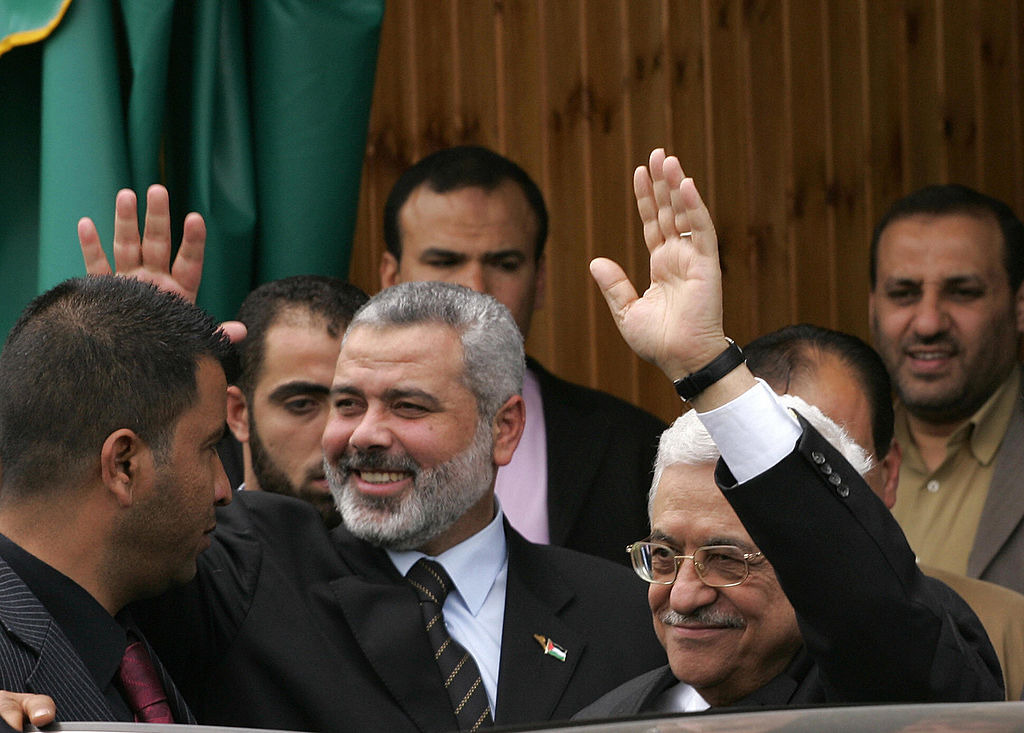
By hailing as a "great leader" the late Ismail Haniyeh, head of the political bureau of the Iran-backed Palestinian terrorist group Hamas, Palestinian Authority President Mahmoud Abbas and his cohorts are sending a message to all Palestinians that the murderous Hamas leader is their role model. Pictured: Abbas (R) and Haniyeh in Gaza City, on April 5, 2007. (Photo by Mahmud Hams/AFP via Getty Images)

The Palestinian Authority (PA) should have been happy over the assassination of Ismail Haniyeh, head of the political bureau of the Iran-backed Palestinian terrorist group Hamas.

PA President Mahmoud Abbas appears to have forgotten that Haniyeh represents a group that carried out a violent and brutal coup against his loyalists in the Gaza Strip back in 2007.

Instead, the PA and its leaders have been mourning the death of Haniyeh, who was killed during a visit to Tehran on July 31. They have, in addition, used the assassination to step up their incitement against Israel.

The Palestinian Center for Human Rights (PCHR) reported in 2007 that at least 161 Palestinians were killed and more than 700 wounded during fighting between Hamas on one side and members of Abbas's security forces and Fatah faction on the other. According to the PCHR:

Continue Reading Article

Friday, August 02, 2024

Igrot Hare’aya – Letters of Rav Kook

Printing of Shabbat Ha’aretz and Preparing for Parents’ Arrival – #246

Date and Place: 22 Kislev 5670 (1909), Yafo

Recipient: Rav Shmuel Kook, Rav Kook’s brother, who was involved in some of Rav Kook’s publications.

Body: Thank you very much for bringing joy to my Shabbat, by sending me the book (Rav Kook’s work on Shemitta, Shabbat Ha’aretz). Please send me a package of a few hundred copies as soon as you can. It is proper to print large envelopes to put the books into with stationery, so that we can send several hundred. This is also my intention for the future, should I have the strength to be involved in other similar works, regarding other mitzvot of the land, etc. These matters have more impact, even when done secretly, than mundane matters that are done with great raucousness. May Hashem fill our internal world with the air of Eretz Yisrael as much as possible, in a way that Hashem will be with us.

I do not understand your complaint and your agitation from the matter [of the planned and then cancelled fundraising trip with the Ridbaz]. I could not exempt myself from it, as it was a case of saving lives [for those who wanted to keep Shemitta]. True, it would hurt my heart to leave the Holy Land even temporarily, and now that there is no need, I thank G-d that I do not have to go, as nothing came of it. What other people have to say about it does not enter my considerations. (Ed. note – apparently there were rumors Rav Kook was going to fundraise and keep some of the income.) Only Hashem, Who sees into people’s hearts, knows the rectitude of my heart and intentions, and that makes me as happy as all the riches in the world. My heart is strong with the bravery that comes with being truthful.

I also need cards [to go with the books]. Please print some for me with my personal stationery, perhaps with small envelopes. Of course, it should be in good taste.

We received a letter from our father’s house, as they prepare [to move to the Holy Land]. Perhaps it is correct to point out that it is not worthwhile to sell all of their furniture; it is better for them to take some things that are expensive here.

It pays to start describing things in letters, so that they will not be shocked by the visible spiritual status of the Holy Land’s inhabitants, as well as, and especially, our material situation. They should know that with all of the detriments, we are very happy with our lot, having the great fortune of living in our Desired Land. We hope they too will be happy here.

Instructions for a Sick Person – #247

Date and Place: 28 Kislev 5670 (1909), Yafo

Recipient: A man named Z’ev (translated from Yiddish)

Body: I received your letter and was very pained by your present medical situation. I hope that before long, your situation will improve with Hashem’s help, and you will fully recover with His help.

Do not have any doubts about your wife. You should distance the non-Jew from the house, as much as possible, but without anger.

For Hashem’s sake, learn every day one page from some holy book that you can. Some examples are: Menorat Hama’or, Shevet Mussar, Kav Hayashar, Nofet Tzufim, etc. – only holy books.

Do not go to a burial under any circumstances until you feel fully healthy. Please write me your mother’s name.

Do not be afraid at all; Hashem will help you. Accept the idea, without making an oath, that when Hashem will help you and your livelihood improves enough that you will be able to live in Eretz Yisrael, that you will come. It will strengthen you, your fortitude, and your Judaism.

A Time for National Soul-Searching

by HaRav Dov Begon
Rosh HaYeshiva, Machon Meir


During The Three Weeks - the period that falls between the 17th of Tammuz and the 9th of Av - the Jewish People mourn the bad things that occurred to Israel during this period. On the 17th of Tamuz, five troubles befell Israel: the tablets were broken in the Golden Calf Incident; the Daily “Tamid” offering of the First Temple was cancelled; Jerusalem’s wall was breeched during the Second Temple period; the Torah was burnt by wicked Apostomos; and, an idol was installed in the Temple Sanctuary. On the 9th of Av, the First and Second Temples were destroyed; it was decreed that our ancestors in the desert would not enter the Land; Beitar was captured and tens of thousands were murdered by the Romans. On this day, the Temple Sanctuary and its environs were ploughed, thereby fulfilling the verse, “Tzion shall be ploughed as a field” (Yirmeyahu 26:18).

At this time of year, we have to arouse our hearts and look for ways to repent; to think about our own deeds and those of our ancestors. Their deeds were like ours, and those deeds brought both them and us suffering. Recalling these things will make us repent and become better... Therefore, every Jew must repent during this period, examining his own deeds and making amends” (Kitzur Shulchan Aruch 121:1). Today, we must search our souls not just as individuals, but as a nation - in regards to our relationship to the People, Torah and Land of Israel.

Regarding our relationship to the People, we must return to ourselves. We must learn and recognize, study and make ourselves aware, become acquainted and inform others of what we are, what our destiny is and what our specialness consists of. We are not like all the nations, we are set apart from them. We are a kingdom of kohanim and a holy nation. Our historic task on earth is to shower light upon the world and to bring goodness to mankind, in accordance with G-d’s command to Avraham: “I will make you a great nation... and you shall be for a blessing... All the families of the earth shall be blessed through you” (Beresheet 12:1-3). As Rav Avraham Yitzchak HaKohen Kook taught in Orot (55): “We are greater than any other people; if we recognize this greatness, we will recognize ourselves, and if we forget it, then we will forget ourselves. A people that forgets itself is small and lowly... Forgetting ourselves constitutes forgetting our greatness.”

As far as our relationship to the Torah of Israel is concerned, our sages long ago said, “Each day, a heavenly voice resounds from Har Sinai proclaiming, ‘Woe to the people for their disregard of the Torah!’ (Avot 6:2). Rav Kook adds, “We must study Torah and give it the appropriate respect, and we must relate to it reverently. Surely when one ponders the Torah, one finds that everything is contained within it, every delight and every splendor” (Orot HaTeshuva 4:9). Our holy Torah is a living Torah for us and for the entire world, as we say in our prayers, “Everlasting life did He plant in our midst”. We, as a nation, must repent, and bring ourselves and our children once more to study Torah lovingly. By such means, we will merit that our people, rising to rebirth in Zion, will have a new heart and a new spirit.

As far as our relationship to the land - Eretz Yisrael - is concerned, we must rid ourselves of the fundamentally erroneous assumption that Eretz Yisrael is just a means towards achieving existential goals such as security, prosperity or even spiritual and religious goals. Eretz Yisrael is not an external acquisition of our nation. It is “an independent entity tied to the nation by a living bond, enveloped in inner virtues inherent to it” (Orot 9). Eretz Yisrael is not a topic for negotiations. It cannot be handed over to any individual or people on earth. Just as one does not concede his own life, so are we forbidden to concede our land, not one single millimeter.

Unfortunately, portions of our political leadership and of the public, are suffering from a kind of confusion - as well as a weakness of faith - that, together, have brought them to unprecedented effeteness and lowliness in their relationship to Eretz Yisrael. That relationship is expressed by such notions as expelling Jews from our land and establishing a state for the Arabs who long to destroy us. By repenting nationally and as individuals vis-à-vis the people, Torah and Land, we will merit that these days will be transformed from a time of mourning and pain to a time of joy and gladness. As Zechariah said, “The fast of the fourth month, and the fast of the fifth, and the fast of the seventh, and the fast of the tenth, shall be to the house of Yehudah joy and gladness, and cheerful seasons. Therefore love truth and peace” (Zechariah 8:19).

Besorot Tovot and Shabbat Shalom,
Looking forward to complete salvation,
With the Love of An Yisrael and Eretz Yisrael.

Yeshivat Machon Meir: Sichot with Rosh HaYeshivah Parshat Matot-Masei (video)

The transformation of the family of Yaakov into the nation of Yisrael

by Rav Binny Freedman

Maxim Cohen was born in Morocco and made Aliyah to Israel as child in 1948. He enlisted in the IDF and became a driver. But following the Six-Day War in1967, Cohen left Israel with his parents to live in France.

On Yom Kippur in 1973, Cohen – a traditional, observant Jew – was in Synagogue with the Jews of his community. At 2 p.m. during the afternoon prayers, his wife arrived in a car and Cohen immediately knew something was wrong. He rushed outside to discover that war had broken out in Israel. He rushed to the Israeli embassy in Paris where they were assisting soldiers wanting to return to Israel to join the war effort.

Arriving in Israel, he was attached to an armored force fighting the Egyptians in the Sinai. Cohen and his unit eventually crossed the Suez Canal, and after three weeks of intense fighting, on October 24 – the last day of the war, arrived at the outskirts of the city of Suez.

The IDF had decided to attempt to conquer the city, a key strategic point on the canal. Preparations were rushed and the breaching forces received little forward intelligence. Cohen found himself part of an armored column rolling into the city.

Suddenly, on one of the streets that appeared empty, an inferno of concentrated fire was unleashed on the vehicles from inside the buildings that lined the street. The Israelis were trapped in a wall of fire. Bazooka rockets, anti-tank missiles, and thousands of grenades and bullets from automatic weapons rained down on the Israeli force which dispersed in every direction to escape the inferno. The battle continued for many hours – the Israeli soldiers took cover in the houses.

The commander of Cohen’s APC (Armored personnel carrier) had been hit in the firefight, along with most of the vehicle’s soldiers. Cohen maintained composure under heavy fire and proceeded to evacuate the wounded Israeli soldiers while running over enemy troops with his vehicle. Without concern for his own safety, Cohen drove back into the city and the heart of the inferno again and again to save more wounded troops.

After the war, Cohen was awarded the Medal of Courage for his resourcefulness, composure under fire, and for putting his own life in danger to save the lives of his brothers in arms.

So, what motivates a Jew, safely living in France, to drop everything, literally at a moment’s notice and risk all for a land he was not even born in?

This week, we will read the double portion of Matot-Masei, concluding the entire book of Bamidbar. Bamidbar is the book that sees the transformation of the family of Yaakov transformed into the nation of Yisrael.

Interestingly, it begins with a census suggesting the value of each individual, which seems to be somewhat of a theme throughout the book as some individuals (Eldad and Meidad, Yehoshua, Moshe, Aaron, and Miriam, Elazar and Pinchas) get it right, while some (Korach, Balak, Datan and Aviram, Zimri and Bilaam) seem to get it very wrong…

There is a flow to this book both in terms of its events as well as the historical unfolding of the Jewish journey, which is what makes its conclusion so odd:

The final verses of the entire book of Bamidbar (36:1-13) return us to the story of the daughters of Tzlafchad and their quest to honor their fathers’ name by inheriting his portion in lieu of sons to inherit the land. After no less than G-d Himself ruling they should receive their father’s portion, the tribal leaders of the Tribe of Menashe approach Moshe with a seemingly legitimate complaint. If these daughters of Tzlafchad receive his portion and marry outside the tribe, the lands they inherit will end up in a different tribe, which seems to be upsetting. Again, after approaching G-d the ruling received is that this is a legitimate issue. The women can inherit their deceased father’s portion but must then marry within the tribe.

Why is this the conclusion of the entire book of Bamidbar? And why this concern with where the land ends up? Aren’t we all in the end one nation: one people? Seems like a less than inspiring idea with which to conclude one of the five books of the Torah, no? It’s also surprising that this story is not placed in conjunction with the original story of the daughters’ query to Moshe back in last week’s portion of Pinchas; why are these two parts of this story separated in such a way?

Perhaps the Torah is making an important point:

In truth, the daughters’ initial request is a very individual issue: to uphold the name of their father and to acquire land for their individual family. (Thus, the story initially appears in the portion of Pinchaswhose theme is clearly the value and power of an individual, in the right place and at the right time, to effect change and make a difference.)

But it takes a lot more than healthy individuals to build a healthy society. It takes a willingness to compromise individually in order to be part of a larger Tribe. It is no accident that the Jewish people are consistently counted by Tribes; each Tribal group brought something special to the nation while maintaining a certain level of individual, alongside the context of a group, identity.

The Tribe is the paradigm of the compromise between the individual’s need for self-expression and fulfillment, alongside the need to sacrifice one’s individual wants and desires for the benefit of a greater good.

And so the book which begins with the counting of every individual, concludes with an expression of the inherent danger of individual expression left unchecked. As we conclude Bamidbar, the Torah affirms the value of compromise, and the willingness to subjugate one’s individual desires to a greater good, without completely losing the value of the individual, and the individual subset group to which one belongs.

Fifty years ago, one Maxim Cohen, safe and sound in Paris, was willing to give it all up without even being called for something greater than himself. But he never lost his individual identity as a religious Moroccan Jew through all the battles he fought.

There is a powerful message here we would do well to consider.

We live in a society which seems to place the right to individual expression as the be-all end-all pinnacle of society. Whether in prayer debates at the Kotel, or the right of every individual to choose and live the lifestyle he or she feels most comfortable with, we try to be sensitive to the needs and different forms of expression of every person, any and everywhere.

But it is not accidental we always read these words during the three weeks in between the breaching of the walls of Jerusalem by the Roman Legions, and their ultimate destruction of the Temple on the ninth day of Av in the year 70 of the Common Era.

We need to be careful that in our desire to be sensitive to and respect every individual, we don’t lose the beauty and value of the larger group that has kept us together ever since we were able to all crowd into the Temple Mount all those thousands of years ago…

Shabbat Shalom from Yerushalayim

The Yishai Fleisher Israel Podcast: HOW TO FREE ISRAEL

SEASON 2024 EPISODE 30: Yishai Fleisher goes on Piers Morgan to fight Israel-haters and to talk about the attack on Druze children. Then, Yishai rants on how to take steps to secure Israel with stronger policy. And finally, Ben Bresky on story of the Jewish Olympics.

Thursday, August 01, 2024

Rav Doniel Glatstein on Parashat Matos: Rav Chaim Kanievski's Frightening Teaching - One Who Grabs Torah Will Go Lost (video)

The Horror of an Iranian Nuclear Weapon

by Nils A. Haug
  • Iran has hardly been shy about articulating its genocidal objectives against Israel. Iran's newly elected President Masoud Pezeshkian, in early July, reaffirmed "Tehran's dedication to destroying Israel." This aim, he added, is "rooted in the fundamental policies of the Islamic Republic."
  • The question, therefore, is what exactly is to be done to prevent a nuclear catastrophe initiated by Iran, one that could arrive at any moment?
  • "In the Middle East, Iran is virtually behind all the terrorism.... When he founded the Islamic Republic, Ayatollah Khomeini pledged, 'We will export our revolution to the entire world. We will export the Islamic revolution to the entire world'... which country ultimately stands in the way of Iran's maniacal plans to impose radical Islam on the world?... It's America, the guardian of Western civilization and the world's greatest power. That's why Iran sees America as its greatest enemy... Last month.... the foreign minister of Iran's proxy, Hezbollah... said this: 'This is not a war with Israel. Israel... is merely a tool. The main war, the real war, is with America.'" — Israeli Prime Minister Benjamin Netanyahu, speaking before a joint session of the US Congress, July 25 2o24.
  • "Is this war now with Israel?... My answer is that this is not a war with Israel. Israel is merely a tool. The main war, the real war, is with America." — Khalil Rizk, Hezbollah's head of foreign relations on Al-Manar TV, June 17, 2024.
  • "The greatest tragedy of the Jewish people," Nobel Peace Prize laureate Eli Wiesel stated, "is that they listen to the promises of their friends and not the threats of their enemies."
  • The leaders of Israel should take seriously the threats of their enemies and act to protect both Israel and the Free World from potential imminent disaster.

Iran is racing ahead with its nuclear weapons program, with one primary aim in mind: the absolute eradication of Israel. Iran has hardly been shy about articulating its genocidal objectives against Israel. Iran's newly elected President Masoud Pezeshkian, in early July, reaffirmed "Tehran's dedication to destroying Israel." (Image source: iStock)

The primary obligation of any national leader, including Israel's Prime Minister Benjamin Netanyahu, is to protect the integrity of the country's borders and to ensure the safety of every citizen. Netanyahu's legal, political, and moral duty is to ensure that every citizen can live in peace, and be free, prosperous, and independent.

These objectives of peace, prosperity, and a secure homeland are precisely what the founders of Israel strove for and what led to so many successive defensive wars started by Israel's antagonists.

Concerningly, at this moment, Israel again faces a genocidal assault by a determined adversary, as Iran races ahead with its nuclear weapons program with one primary aim in mind: the absolute eradication of Israel. "The nuclear situation in Iran," the IDF's Deputy Chief of Staff, General Amir Baram, informed Israel's Knesset in July, "is like a car with all the parts ready – now they just need to be assembled."

Continue Reading Article