Tuesday, December 17, 2024

White House Islamophobia Strategy Says Muslims Were the Real Victims of Oct 7th

by Daniel Greenfield

On October 7, Islamic terrorists invaded Israel and murdered over 1,000 people. They raped, looted, and burned families alive in their home. Those whom they did not kill, they took hostage.

According to the Biden administration’s newly announced Islamophobia strategy, however, Muslims in America were the real victims of Oct 7 just like they were the real victims of 9/11.

“Threats and acts of violence against Muslim and Arab communities have increased since the October 7 terrorist attacks,” the official White House ‘Islamophobia’ strategy claims. Muslims are also concerned “about the recent spike in incidents of hate and discrimination in the aftermath of the October 7, 2023 Hamas terrorist attacks on Israel, concerns they say mirror their community’s experiences following the 9/11 attacks.”

Forget the hostages, the real issue stemming from the brutal Hamas massacres, according to the administration’s ‘strategy’ is that “members of Muslim and Arab communities have often faced obstacles in renting and using public and private gathering spaces. This issue has become more prevalent following the Hamas terrorist attacks on Israel on October 7, 2023.”

The U.S. National Strategy to Counter Islamophobia and Anti-Arab Hate operates out of this parallel universe in which Muslim mobs have not been attacking synagogues and assaulting Jews, or blockading Jewish students from college campuses, but have been the victims.

The Biden administration has yet to condemn the sustained harassment, boycotts and assaults on Jewish students at UCLA, CUNY and Columbia, instead it claims that “since October 7, 2023”, “Muslim and Arab students, faculty, and staff, have been subject to violence, discrimination, hate, harassment, bullying, and online targeting.”

The Islamophobia strategy provides no citation for its claim of nationwide harassment of Muslims on college campuses. Under its Department of Education Office’s for Civil Rights section its few named incidents include a University of Michigan student who claimed that “someone yelled at her that she had terrorist friends because she participated in a pro-Palestinian protest” and that “CUNY Law School cancelled an event hosted by a Muslim student group without adequate justification for doing so”.


The event in question was by the Muslim Law Students Association falsely accusing Israel of genocide for fighting against Hamas that was reportedly to feature CUNY students who had expressed support for terrorism including Fatima Mohammed who had tweeted, “i pray upon the death of the USA on a public platform “ and had urged, “grant victory to the Mujahideen” or the Jihadis, and Nerdeen Kiswani who had quipped, “I hope that pop-pop is the last noise that some Zionists hear in their lifetime!”

According to the White House Islamophobia strategy, CUNY’s failure to platform murderous hatred for America and Israel was ‘discrimination’ and ‘hate’ against Muslim students.

Meanwhile at CUNY, anti-Israel students had demanded the expulsion of most Jewish students and called to “globalize the intifada”. A CUNY professor described how “a Kingsborough/CUNY student beat a Jewish man in a kippah with a bat while yelling, ‘Kill all Jews, free Palestine.’”

But according to the Biden administration, Muslim students at CUNY are the real victims because a Muslim group’s ugly hate event was canceled “without adequate justification”

Students for Justice in Palestine, the top campus anti-Israel group, had openly celebrated and praised the atrocities of Oct 7, and campus protests featured Hamas and Hezbollah flags, but the Islamophobia strategy falsely claims that “student protestors, despite having condemned Hamas and terrorism and engaging in only peaceful protests, have been accused of supporting terrorism merely due to their advocacy for the human rights of Palestinian civilians”.

The strategy’s citation for the claim that anti-Israel students faced “violent attacks, threats, discrimination” was the UCLA encampment where a federal judge ruled that “Jewish students were excluded from portions of the UCLA campus because they refused to denounce their faith.” Prior to what the CNN story linked in the strategy describes as Jewish violence against the terrorist encampment, multiple Jewish students and community members had been assaulted, including on camera, and a Jewish female student had been knocked unconscious.

The Biden administration’s idea of “peaceful protests” was kicking a Jewish girl in the head and it claims that students calling for Hamas to destroy Tel Aviv were “accused of supporting terrorism merely due to their advocacy for the human rights of Palestinian civilians”.

The UCLA encampment had been set up by Students for Justice in Palestine UCLA which had co-signed a statement declaring “our unwavering support of the resistance in Gaza” and taking pride in “Towfan Al-Aqsa” (the Hamas name for the October 7 massacres) “as a revolutionary moment in contemporary Palestinian resistance.”

The White House Islamophobia strategy has as little basis for the “peaceful” nature of the terrorist mobs as it does for the contention that Muslims faced a surge of violence after Oct 7.

The U.S. National Strategy to Counter Islamophobia and Anti-Arab Hate quickly discredits itself by citing hoax after hoax. It repeatedly plays up the Burlington hoax referencing “the shooting of three young men in Vermont” and the contention that “a gunman shot three college students of Palestinian descent in Burlington, Vermont,”

While a mentally ill man did shoot three Muslim men, he was a Hamas supporter.

Rather than being anti-Muslim, the gunman had tweeted, “the notion that Hamas is ‘evil’ for defending their state from occupation is absurd” and “what if someone occupied your country? Wouldn’t you fight them?” The Burlington Islamophobia hoax was so thoroughly discredited that even CAIR had given up on listing it in its litany of ‘Islamophobic’ events, but the Biden administration somehow manages to have even lower standards for the truth than CAIR.

The Islamophobia strategy also lists an incident where “an individual believed to have been involved in prior violent incidents at a Minneapolis mosque struck a man with a minivan in the mosque’s parking lot.” The individual, James Evan Suttles, was a black man who had a long list of prior violent incidents, suffered from paranoid delusions and had been committed four times to mental institutions. No hate crimes charges were brought against him over the attack.

The Biden Islamophobia strategy has to lean on such cases to manufacture the myth of Muslim victimhood because it lacks any actual substance. And it props that up with calls for censorship.

The strategy urges social media platforms to specifically cover Islamophobia and to rig their algorithms “de-rank and stop recommending” content that Muslim groups consider hateful.

Beyond censorship, what does the Biden administration propose we do to fight ‘Islamophobia’?

The strategy calls on Congress to formally recognize the UN’s International Day to Combat Islamophobia. The Islamophobia resolution was introduced by former Pakistani Prime Minister Imran Khan. Khan had described Osama bin Laden, whom Pakistan had harbored, as a “martyr”, supported the Taliban and was later charged by his own country under its terrorism act.

Once again, Islamophobia turns out to be how Islamic terrorists silence criticism of their crimes.

The Biden administration’s National Strategy to Counter Islamophobia is an insult to American Jews and Christians. It uses lies and hoaxes to turn the Muslim terrorist supporters who have shut down Christmas tree lightings and attacked synagogues, and who rally for the murder of Americans and Jews as the victims, while portraying Christians and Jews as ‘Islamophobes’.

The Islamophobia strategy is the final insult of many from an administration that has stood with the Islamic terrorists and never with their Jewish and Christian victims.

Monday, December 16, 2024

President Trump – Beware of HTS and the Moslem Brotherhood

by Ambassador (ret.) Yoram Ettinger

*The success of Hayat Tahrir al-Sham (HTS) terrorists to topple the Assad regime is traumatizing all pro-US Arab regimes, which, for decades, have had the machetes of Iran’s Ayatollahs and the Moslem Brotherhood at their throats.

*Contrary to some Western policy makers, journalists and academics, the pro-US Arab leaders do not take HTS’ moderate statements at face value. They are aware of the fanatic, religious vision, which has guided the HTS, and are familiar with the Middle Eastern gap between the talk and the walk, and with the Islamic tactic of Taqiyya (dissimulation). Taqiyya was also employed by Bashar Assad upon assuming power in 2000, when his moderate talk led US legislators (e.g., Senator John Kerry), Secretary of State Madeleine Albright and NYT’s Tom Friedman to view him as a potentially peaceful leader. It was used by Ayatollah Khomeini in 1978/79, ahead of assuming power in Iran, convincing President Carter and the State Department that he would be “an Iranian edition of Ghandi.... preoccupied with tractors, not tanks.” The Houthis issued moderate pronouncements that led to their delisting from the list of terror organizations in 2021 by President Biden. Also, Arafat issued peaceful statements upon concluding the Oslo Accord, which won him the Nobel Prize for Peace, and led Tom Friedman to wonder: “Who’s Arafat? Is he Nelson Mandela or Willie Nelson?”). Etc.

*The vision of the HTS is not limited to Syria. It aims to topple all national Islamic regimes, and establish a universal Islamic entity, as prescribed by the precepts of the Moslem Brotherhood, which has pursued its goals through politics, education, social welfare and affiliates, splinters and offshoots that engage in terrorism.

*The initial strategy of HTS, as suggested by their name (al-Sham = the Levant) is to “liberate” the Levant, which was “Greater Syria” (Syria, Lebanon, Jordan, Israel, Cyprus and Turkey’s Hatay province), then the entire Middle East, the “Abode of Islam,” and finally the “Abode of the Infidel,” preferably via peaceful means, or militarily, if resisted by the “infidel.”

*The Moslem Brotherhood is inspired by the HTS’ success in Syria, to be replicated in additional Moslem countries. Therefore, the Muslim Brotherhood branches in Egypt, Jordan, Lebanon and other Moslem countries have congratulated HTS for achieving the first goal of the Sunni Islamic revolution, expecting a robust tailwind to bringing down additional national Moslem regimes.

*HTS considers the toppling of Jordan’s pro-US Hashemite regime as a top priority, as does a chief enemy of HTS, Iran’s Ayatollahs. Both have intensified subversion, terrorism and drug trafficking in Jordan, leveraging the presence – in Jordan – of 2 million refugees from Syria and Iraq, a solid operational foundation of the Moslem Brotherhood, the presence of Palestinian terror organizations, and the intra-Bedouin animosity.

*The HTS’ success in Syria is inspiring the Moslem Brotherhood in its attempts to topple the pro-US General Sisi regime in Egypt, which is the 1928 birth site of the Moslem Brotherhood. In 1949, the Moslem Brotherhood assassinated Egyptian Prime Minister Mahmoud Nuqrashi; in 1954, the Moslem Brotherhood failed in its attempt to murder Egyptian President Nasser; in 1981, the Moslem Brotherhood’s offshoot, the Egyptian Islamic Jihad, murdered Egyptian President Sadat. The Islamic Jihad merged with Al Qaeda.

*Prof. Albert Hourani, a leading Middle East historian, Oxford University’s St. Anthony’s College, noted the following tenets of the Muslim Brotherhood (A History of the Arab Peoples, pp. 445-446): “A total rejection of all forms of society except the wholly Islamic one…. The true Islamic society…regarded the Quran as the source of all guidance for human life…. All other societies were societies of Jahiliyya (ignorance of religious truth), whether they were communist, capitalist, nationalist, [followers of] false religions, or claimed to be Muslim but did not obey the Sharia…. The leadership of Western man in the human world is coming to an end… The turn of Islam has come….Those who accepted [the Muslim Brotherhood] program would form a vanguard of dedicated fighters, using every means, including Jihad… The struggle should aim at creating a universal Muslim society.... The Western age is finished…. Only Islam offered hope to the world…. [The Muslim Brotherhood] were prepared for violence and martyrdom.”

*The Muslim Brotherhood, just like the HTS, have been very skillful in obfuscating the West through Taqiyya and a two-pronged operation: the religious, educational, social and political screensavers, as well as the operational (subversive and terroristic) modes. In fact, the Muslim Brotherhood poses the following proposition: Submission to Allah and the Koran, or else...!

*Before embracing the Muslim Brotherhood’s and the Hayat Tahrir al-Sham’s moderate talk, Western policy-makers are advised to study the following observations by Sir John Jenkins, a top specialist on the Moslem Brotherhood and the Middle East, and former Executive Director of the British International Institute for Strategic Studies – Middle East branch:

“[The West] should resist the temptation to seek to understand the Muslim Brotherhood through our own cultural or epistemological [knowledge] categories…. [The Muslim Brotherhood] continues to threaten the constitutive basis of most contemporary Muslim majority states…. Some may still be tempted to hope that when a malign or otherwise unsatisfactory regime is overthrown the subsequent trajectory must be progressive. [Middle East] experience suggests the reverse.... Authoritarianism is not weakened in such circumstances: it recurs….

“[Hassan Al Banna, the founder of the Muslim Brotherhood] urged his followers to scorn life; claimed that ultimate martyrdom could only be attained through death in the service of the divine; articulated a doctrine of armed physical force.... The writings of Sayyid Qutb – its most significant and protean ideologue [who was executed in Egypt in 1966] – remain central to Brotherhood thinking everywhere and continue to be used to justify multiple forms of Islamist violence....”

“The Brotherhood… gives little space to tolerance, choice and individual freedoms.... no commitment to democratic choice.... It is constitutively antisemitic and homophobic….”

Friday, December 13, 2024

Iran Threatens Jordan, Smuggles Arms to Palestinian Terrorists in Israel

by Lawrence A. Franklin
  • Iran appears determined to destabilize Jordan, and is thus trying to drag the kingdom into its regional maelstrom by manipulating Jordanian national and terrorist substate entities to do its bidding.
  • The Islamist threat to the stability of the Kingdom has greatly increased with the fall of its neighbor Syria into the hands of the Hay'at Tahrir al-Sham, a Sunni Islamist group committed to radicalizing the Levant, which includes Jordan.

Iran appears determined to destabilize Jordan, and is thus trying to drag the kingdom into its regional maelstrom by manipulating Jordanian national and terrorist substate entities to do its bidding. Pictured: A shipment of weapons smuggled into Israel from Jordan by a Bedouin Arab in December 2023, which was seized by the Israel Police. (Image source: Israel Police Spokesperson)


The Israeli Air Force (IAF), in a recent airstrike, destroyed three cross-border smuggling routes from Syria to Lebanon, which were being used by Iran to bring ship weapons to still-functioning Hezbollah terrorist cells. The Israeli strike took place just hours before a ceasefire took effect on November 26 between Israel and Hezbollah.

Iran's special forces units, however, will no doubt continue their past efforts to smuggle arms through Jordan to Palestinian terrorist cells in Judea and Samaria ("the West Bank"). These smuggling operations will still enable terrorists there to kill Israelis and further entrench an atmosphere of fear among the hundreds of thousands of Israeli citizens who live in Judea and Samaria.

Continue Reading Article

Igrot Hare’aya – Letters of Rav Kook: Possibilities of Creating Religious Moshavot – part II

#284 – part II 

Date and Place: 1 Adar II, 5670 (1910), Yafo

Recipient and Background: Rabbi Dr. Meir Lerner, Rabbi of Altuna (Germany), who for years had interest in the settlement of Eretz Yisrael.

Body: [We continue with more answers to Rabbi Lerner’s inquiries.]

2. The price of land varies greatly, based on location and based on the quality of the land – choice, average, and low quality – as well as many other details. Around the area of the moshavot, the land goes for approximately 30-50 francs per dunam. In contrast, in new places, like Rafah, one can purchase for cheaper, approximately 5-8 francs per dunam. On the other hand, conditions of settlement are much more onerous in places that are far from where others live, to the extent that the expense is almost the same thing. Experts say that it is more worthwhile to pay the greater sum near the [existing] moshavot than to buy cheap land in distant places. If, though, hundreds of families join up to buy together, then one can also buy in distant places and establish a new locality, and the more people there are, the easier and safer it is.

Regarding crops, not all the places are the same. When the matter will hopefully come to fruition, it will be possible to clarify exactly. However, according to today’s market situation for wine, it is impossible to base a new settlement on it. For an orange grove, there is a need for a big investment in securing a well and installing special machines. When the settlement is blessed with riches, this is a good business, and one can obtain land that is fitting for this. But what is more correct is to work hard on simple agriculture, so that orchards are minor compared to growing wheat, barley, and vegetables. [It is best] when the farmers are not business owners but are people who eat the produce (i.e., subsistence farming) and live in peace on the holy soil with good will and happiness with Hashem and service of Him. For simple agriculture, the Galilee is more fit than Judea, the latter of which is better for fruit trees.

3. Regarding farmers, there are trained people for farming who are fully religious, and it is better to put them on the land than to bring in new people.

4. The full price of settling an average-sized family with all the resources it needs is assumed to be 17,000-20,000 francs.

5. You can use the number above to figure out how much it would cost to start a whole moshava. Granted, some expenses are smaller when shared by many people, but you must consider also public expenses and especially things having to do with religion, e.g., kashrut and public mitzva obligations.

To start a moshava of five or ten people, you can certainly only do so close to an existing moshava. This can be done in Kastina (near today’s Kiryat Mirachi). Also, the people of Kastina are simple people who keep Torah and mitzvot, and it would be proper to join up with them and increase the settlement together.

I find it necessary to encourage you to continue the great work with the Moriah organization and concentrate on strengthening our holy religion in the New Yishuv in the Holy Land. One can approach such a task without incredible resources. The fundamental achievement of “planting the tree of life in its place” (i.e., religious success in Eretz Yisrael) could expand to all of the scattering of Israel. This is because the very involvement in the strengthening of serving Hashem uplifts those who toil in it, and this will also strengthen religion throughout the Diaspora. If one tries to directly strengthen religion in the whole world, it will be too vast a challenge, and if the effort is unsuccessful, it will cause disappointment and weakening of resolve for those who involve themselves in it.

Paradoxically, we should learn from the actions of those who destroy religion, who focus all of their energy on the Holy Land. This is the strategy that those who are faithful to Judaism should take. Let us put all of our energy into improving the building of the Holy Land according to the path of the Torah, and as a result it will make the stature of fear of Hashem greater everywhere that Jews live.

“Let Us Be Strong and of Good Courage!”

by HaRav Dov Begon,
Rosh HaYeshiva, Machon Meir

Ya'akov attempts to flee from Esav and succeeds in smuggling out his family across the Yabok River. Yet, he himself remains behind and is confronted by Esav’s angelic prince: “A stranger appeared and wrestled with him... When the stranger saw that he could not defeat him, he touched the upper joint of Ya'akov’s thigh. Ya'akov’s hip joint became dislocated as he wrestled with the stranger... He was limping because of his thigh.” (Beresheet 32:25-26,32).

Rashbam explains that Ya'akov was punished and smitten, and acquired a limp because he fled rather than trusting G-d’s promise to protect him and make him defeat Esav. We find the same with all those who diverge from G-d’s path, and with those who refuse to accept the missions G-d assigns them. All are punished (Rashbam, Beresheet 32:29).

Today, we must learn a lesson from Ya'akov’s flight and from his subsequent limp. Wherever the Jewish People retreat and flee, G-d forbid, everyone can see them limping. Precisely today, when we are facing a difficult test, when our enemies are attacking us in order to destroy us and banish us from our land, G-d forbid, we must become stronger in spirit. We must know and believe that we are fighting a just war over the land of our ancestors. Only through the Jewish People’s having control over their land will G-d’s name be sanctified for all to see. Then we will be able to spread benevolence and illuminate the whole world, all mankind, with the timeless and divine values of peace, justice, love, and truth.

Our enemies’ whole goal is to take control over Eretz Yisrael, and thereby, to bring ethical and spiritual darkness to the world. May it never be! In King David’s time, when Aram was attacking Israel from both front and back (Shmuel Bet 10:9), Yo'av, the head of King David’s army, encouraged the soldiers of Israel with the words, “Let us be strong and of good courage for our people, and for the cities of our G-d, and the L-rd will do that which seems good in His eyes” (v. 12). Let us too be strong and of good courage, and then we will defeat our enemies and cease our limping.

Besorot Tovot and Shabbat Shalom.
Looking forward to complete salvation,
With the Love of Am Yisrael and Eretz Yisrael.

Yeshivat Machon Meir: Sichot with Rosh HaYeshivah Parshat Vayishlach (video)

Terrorists Liberate Terrorists From Other Terrorists

by Daniel Greenfield

In a stunning win for freedom, Hayat Tahrir al-Sham (HTS), a Sunni terrorist organization defeated the Assad regime and its Shiite terrorist groups to take over Syria. HTS is led by Abu Mohammed al-Jawlani, a Saudi former associate of the caliph of ISIS who has a $10 million reward on his head from the U.S. while Assad was supported by Hezbollah whose leaders had multi-million dollar rewards on their heads until Israel killed them (but didn’t collect the money.)

Assad was backed by the Shiite terror state of Iran while HTS is backed by the Sunni terror state of Turkey. Geopolitical experts say that Sunni Islamists defeating Shiite Islamists to rule the pile of rubble that’s left of Syria is the biggest win for human freedom since the Muslim Brotherhood took over Egypt and parts of North Africa (before being ousted from Egypt and some other parts of the region) in the freedom phenomenon known as the Arab Spring.

The media broadcast scenes of Jihadists praising Allah for helping them defeat the other Jihadists who also praise Allah (but not in the right way) and liberating political prisoners to shortly replace them with other political prisoners (assuming that they even bother taking political prisoners or any kind of prisoners.) Talks are underway between the terrorists of the former regime with the terrorists of the current regime to see if they can work it out.

And maybe just focus on killing Christians, Jews and other infidels.


Some might suspect that a former ISIS associate tied to Al Qaeda (who admittedly turned on his former group to lead another Jihadist organization) taking over a country would be bad news. But they’re clearly bad people who don’t realize that Al-Jawlani is a changed man, an austere religious scholar who underwent a makeover courtesy of Queer Eye for the Syrian Guy and now, in the words of the BBC, wears a “more western style wardrobe”. At least if you count rocking Zelensky’s military fatigue hand-me-downs as looking like a regular western warlord.

The Biden administration has already made contact with the terrorist organization led by a man on whose head is a $10 million reward to offer to rebuild Syria just in time for the next civil war. Publicly, the administration has already taken credit for helping defeat Assad by insisting that the Israelis must stop attacking Hezbollah at once. Had the Israelis listened, Assad would still be in power. But the Biden administration was surely using reverse psychology and by threatening Israel with an arms embargo was really getting the Israelis to fight even harder.

Or at least that’s the story that National Security Advisor Jake Sullivan is going with.

While the world (or at least the parts of it that completely forgot about the Arab Spring) rejoices, the Israeli government which (for all its failings) has more sense than the State Department or a headless chicken, has begun bombing what’s left of Syria’s rocket factories and chemical warfare plants that Secretary of State John Kerry (despite promising Obama) somehow never got around to making sure that Vladimir Putin would dismantle and put away in cold storage.

The Israelis are also expanding their presence in Mt. Hermon and building their own security zone because they trust Syria’s new terrorist masters as much as they trusted the old.

What Jerusalem knows and Foggy Bottom has yet to learn is that the Middle East is a bunch of tribal factions, warlords and gangs pretending to be countries, but despite the flags, anthems, UN memberships, World Bank positions and invites to climate change summits, are all some version of Al-Jawlani bouncing between ISIS, Al Qaeda and a new governing coalition.

Over a thousand years of Islam comes down to some guy with a beard uniting a few key families with whose backing he then seizes a bunch of cities that used to belong to long lost great civilizations and then his men settle down to some murdering, looting and raping while thanking Allah for the privilege of a mission to kill, loot and rape the world. Or die trying.

The stationary bandit theory isn’t some abstraction in the Middle East: it’s everyday reality.

As we all should have learned in the last generation, every Arab Muslim country is one inflationary spiral away from some guy with a ‘nom de guerre’ or ‘kunya’ riding into town on a pickup truck with 300 fellow bandits and becoming the new government in Allah’s name.

Georgetown idiots with PhDs then cheer as statues of the old dictator are toppled as if Damascus, Cairo, Baghdad, Tripoli or Tunis were Prague, Berlin or any city where democracy means more than ‘my tribe has more guns than your tribe’. The old Pharaohs (not to mention Caesars) would tear down each other’s monuments too. That didn’t make old Tutankhamen a liberator or a democrat. At least not the kind who is acceptable outside Chicago.

Assad heading off to shop at Moscow’s GUM for more luxury handbags is no great loss and his replacement by other terrorists is no great gain. At least not for us. Or likely for Syria’s Christians. Or Israel. Or really anyone else except members of the new regime.

There’s no right side of history in the middle east and if the arc bends anywhere, it’s the arc of a sword over a prone prisoner’s neck. Islam is the driving force in the region and the driving force of Islam is conquering and subjugating all Muslims and non-Muslims under one caliphate. In the Ummah, all of history is one great game of thrones to determine who will rule over all the rubble.

The complicated chess game between rival Jihadist groups and nation-states is likely to end badly for everyone especially since Syria was really a showdown between Iran, which is developing nuclear weapons, and Turkey, which is a NATO member with a huge arsenal, and there can only be one ultimate Islamic ruler in the apocalyptic endgame scenario.

Terrorists replacing terrorists with more terrorists is only good news for the new terrorists and for the media which gets to breathlessly cover another foreign conflict between two groups of butchers who would behead everyone at CNN at their first sight of a DEI LGBTQ+ poster.

It’s also good news for humanitarian groups which have spent over a year lying about a famine in Gaza and after exhausting donor interest with AI generated photos of sad Muslim kids in Hamasville can now move on to relabeling those same photos as hungry kids in Syria.

Media baron William Randolph Hearst reportedly once bragged, “You furnish the pictures. I’ll furnish the war.” In the Muslim world, the Taliban, Houthis, Hamas and their comrades supply the war, the media supplies the pictures and taxpayers supply more money than they can count.

After sending $2 billion to Afghanistan after the Taliban took over, the Biden administration will be rushing money to Syria until the very moment the checkbooks are pried out of their hands.

It would be tempting to think that Syria is over, but in tribal cultures nothing is ever really over. Each conflict is based on past vendettas and generates new ones. The conflicts follow demographics and a complex mix of clan loyalties and factions whose shifts change the war. A new war is just a matter of the old coalition coming apart and forming new ones. If you doubt that, consider the speed with which the Jihadists took Kabul and Damascus. The Taliban and HTS are just groups of gangs whose allegiances can be bought and sold for the right price.

But the same proved to be true of the Afghan, Iraqi and Syrian armies. And many others.

Syria did not fall. Like Afghanistan and Iraq, it never really existed. We spend a lot of time and money propping up fictions because we want the rest of the world to be just like us. It’s not.

And it may never be.

Instead of hoping to civilize savages, we would be better off standing with civilized allies. The more we go on searching for progress in the Muslim world, the more we find that it’s terrorists all the way down.

Anger; one of life’s greatest challenges

by Rav Binny Freedman

Rabbi Abraham Twerski shares a powerful story about one his ancestors, the great Rebbe Nachum of Chernobyl (in his book Generation to Generation).

It seems that Rebbe Nachum owned a magnificent pair of Tefillin, which had actually been written by Reb Ephraim, the great scribe of the Baal Shem Tov, in the early eighteenth century. A wealthy member of the community had offered Rebbe Nachum a staggering fifty rubles for the tefillin. Yet, despite the fact that he lived in abject poverty, Rebbe Nachum had consistently refused to part with the tefillin. His wife on occasion had pleaded with him to sell the tefillin to support their family (one could buy a new, perfectly good pair of tefillin for two rubles) to no avail. Even when they had no wood for the fire or the children were starving, he refused to sell the tefillin, always somehow finding other ways to put some meager amount of food or money on the table.

One year, as Rosh Hashanah approached, it became evident that there would be a dearth of etrogim that year. The mitzvah of holding an etrog occurs only once a year, and Rebbe Nachum was inconsolable over the fact he might not be able to fulfill the mitzvah that year.

On the way home from shul the morning before Sukkot was to begin, Rebbe Nachum saw a man carrying a lulav and etrog. He could not believe his eyes and excitedly ran over to the man and asked how much it would cost to purchase the Lulav and Etrog.

“Rebbe it is not within your means”, explained the fellow.

“This is the only available Etrog in the entire region, and it is for the wealthiest member of the community who is paying fifty rubles for it! “

Rebbe Nachum stood there in despair and then remembered he had been offered fifty rubles for his tefillin. Reasoning that he had already fulfilled the mitzvah of tefillin that day and would not need the tefillin for another nine days but would thus be able to fulfill the mitzvah of the etrog, he beseeched the man to wait for him, and came back a short while later with fifty rubles, having sold his beloved tefillin.

When his wife returned a short while later from having tried to gather some scraps together for the holiday, she found her husband beaming with joy. Assuming he had managed to gather a few Kopecks for the holiday, she enquired as to the source of his obvious joy, but he ignored her questions and continued to behave as though he had won the lottery. But she continued to press him and eventually he explained that he had managed to acquire a lulav and etrog for the festival.

“But that is impossible!” She declared, “even if there were an etrog available its price would be astronomical! How would you be able to afford such an etrog?”

Reluctantly, the Rebbe confessed that she had sold his tefillin in order to buy the etrog.

As he said this, his wife would later explain, all the years of deprivation suddenly passed before her eyes. She saw the cold winters, and all the nights she had had to put the children to sleep hungry; and the thought that he had finally sold the tefillin for a fruit that would be basically worthless ten days later was too much for her.

“Where is the etrog?” she demanded. Silently her husband pointed to the cupboard. In a fit of rage she ran to the cupboard, grabbed the etrog and with great force threw it on the ground smashing it to bits.

Her husband stood silently; motionless; two streams of tears trickled down his face.

After a moment he spoke: “I have lost my precious tefillin, and now I have lost the chance to fulfill the mitzvah of lulav and etrog, but Nachum will not lose his temper.” And with a sigh, he sat down and opened his books to study….

When the great Rebbe Boruch of Medzibozh heard this story he remarked:

“I can understand why Rebbe Nachum, no matter how much he loved his wife and children, refused to part from his tefillin all those years. And I can even understand why he did sell them to purchase the etrog. But how a human being can have so much self-mastery not to say even a single angry word in such a moment? That only a rebbe Nachum could accomplish.”

Anger; one of life’s greatest challenges. Who can resist and overcome its formidable temptations?

There is a fascinating moment in this week’s portion of Vayishlach that demonstrates this point:

After the death of Yaakov’s beloved wife Rachel (Bereisheet 35:19) the Torah tells us (ibid v. 22):

“And Reuven went and ‘bedded’ (vayishkav et) Bilhah, the Handmaiden of his father, and Yisrael (i.e. Yaakov) heard; and the sons of Yaakov were twelve.”

Although the verse seems to imply that Yaakov’s eldest son Reuven actually slept with his father’s concubine, the Talmud (tractate Shabbat 55b) suggests otherwise:

“R. Samuel b. Nachman said in R. Jonathan’s name: “Whoever maintains that Reuven sinned is merely making an error, for it is said, ‘Now the sons of Yaakov were twelve,’ teaching that they were all equal.” Then how do I interpret, and he lay with Bilhah his father’s concubine? This teaches that he transposed his father’s couch, and the verse blames him as though he had lain with her…”

Whatever happened in that moment, it is quite clear that Reuven crossed a line and did something terrible. In fact, many years later, on his deathbed, Yaakov seems to recall this moment and takes Reuven to task for it:

“Reuven, you are my first-born… Unstable as water, you shall excel no longer. For when you mounted your father’s bed, you brought …” (ibid. 49:3-4)

Yet, incredibly, in the actual moment we see no such response from Yaakov. In fact, a closer look at the verse in question suggests there is something not quite right. The actual verse in Hebrew has a fascinating and yet rare occurrence:

וַיְהִ֗י בִּשְׁכֹּ֤ן יִשְׂרָאֵל֙ בָּאָ֣רֶץ הַהִ֔וא וַיֵּ֣לֶךְ רְאוּבֵ֔ן וַיִּשְׁכַּ֕ב֙ אֶת־בִּלְהָ֖ה֙ פִּילֶ֣גֶשׁ אָבִ֑֔יו וַיִּשְׁמַ֖ע יִשְׂרָאֵֽ֑ל פ וַיִּֽהְי֥וּ בְנֵֽי־יַעֲקֹ֖ב שְׁנֵ֥ים עָשָֽׂר׃

There is a very particular scribal phenomenon in the verse known as a “piska be’emtsa passuk” (a break in the middle of a verse). Grammatically the verse makes no sense, telling us that Yisrael (Yaakov’s second name) heard and then seemingly changing the subject to exclaim that the sons of Yaakov were twelve, a fact we already know, which seems to have no connection to the first part of the verse.

I once heard from Rav Riskin in the name of Rav Soleveitchik that Yaakov understood here he had to remain silent; even if what Reuven did was ‘only’ to switch the bed of his father and move it into the tent of his mother Leah out of a love for and sensitivity to the distress and pain of his mother, it was still a highly inappropriate thing to do.

Yaakov, suggests Rav Soleveitchik, understood he was at a critical juncture in his relationship with Reuven. And that is why the verse continues by saying that the sons of Yaakov were twelve; because an angry word might have been all it would have taken to alienate Reuven forever. And because Yaakov in his righteous anger, succeeded in remaining silent, Reuven remained in the fold and Yaakov had all his twelve sons with him the next day….

It is interesting to note, in support of this idea that there is an interplay between the two names of the patriarch: Yaakov and Yisrael. Yisrael (ibid. 32:29) is the second name given to Yaakov when he succeeds in his great midnight battle. This name represents the victory of a struggle. The name Yaakov however, a name given because Yaakov was born holding the heel (the akev) of Esav (ibid 25:26) represents a life of great struggle. And although the verse begins using the name Yisrael (as Yaakov is finally living in peace in the land) it concludes with the name Yaakov: the sons of Yaakov were twelve, indicating a great struggle.

After all, in the face of such a painful distressing and inappropriate moment, perpetrated by his eldest son no less, how did Yaakov control his anger? Simply put, he remained silent.

It is a great life lesson to understand that words spoken in anger never come out right. No matter how right a person may be, if they react in anger, they will always realize later on they could have done a better job communicating.

Indeed, the Rambam, the great advocate of the balanced approach to life (see Hilchot Deot, chapter 1), has an interesting take on anger.

Despite pointing out in chapter one that the ideal in Judaism is to lead a balanced life mid-way between the extremes of any character trait, when it comes to anger (2:3) the Rambam suggests it is an extremely negative character trait which a person should always avoid. Indeed, even in those rare occurrences where anger might be worthwhile as a tool to prevent an event from recurring (1:4; 2:3), Maimonides suggests a person should feign anger while internally maintaining his balanced composure. Because one cannot be balanced and angry at the same time; anger is by definition an imbalanced state of mind.

So, what should one do when feeling anger? Quite simply, one should simply be quiet. A person will almost always regret what he or she says in anger. When thinking about it later, one usually will realize they could have done a better job; so, the smartest thing to do, when angry is simply to keep quiet. And that is precisely what Yaakov does; he remains silent; with no words causing irreparable damage left to fix. And thus, Reuven remains in the family.

And what does one do in that state of silence? What thoughts would be worthwhile to have when in a state of anger?

Well, anger is really all about expectations; we get angry because we expect a better outcome; which most often, even if subconsciously, means we think we deserve better. But if we really knew that Hashem (G-d) runs the world, we would spend less time in a state of anger over what happened, and more time in a state of soul-searching as to why it happened, and what Hashem is trying to teach us, which of course would leave much less room for anger. And this, as the Torah intimates here, would result in our being much more together, and ‘the children of Israel would be twelve’, with all of us together at the table….

Wishing all a Shabbat Shalom from Yerushalayim.

Wednesday, December 11, 2024

Is it really easier to fight with an angel of God than with human beings?

by Rabbi Pinchas Winston

WHICH WAS THE real fight, the one with the “stranger” the night before, or with Eisav the next day? Clearly the one with the stranger since the confrontation with Eisav lasted very little time, was only a short conversation, and Ya’akov was on his way in peace in no time. He struggled with the stranger the entire night, and walked away limping.

Why were there two fights in the first place? Who was this stranger, why was he so violent, and what right did he have to change Ya’akov’s name, or least prophesy that it would later be changed? But we already know the answer to those questions, don’t we, after Rashi explained it all. The stranger was none other than Eisav’s ministering angel who had come to admit the blessings belonged to Ya’akov and not to Eisav, and that his name would be changed because he “fought with an angel and with men, and prevailed.”

That makes the name Yisroel a warrior name, doesn’t it? Yes, but not in the classical sense of the term, evident by how the angel put himself first before Eisav, Lavan, and Shechem. The way the angel phrased it, he said, “You not only fought with an angel and won, but you also fought with bad guys too, and yet you still prevailed! That makes you Yisroel!”

But is it really easier to fight with an angel of God than with human beings? Perhaps not physically, but spiritually? For sure, if victory is defined in terms of spiritual success, not physical achievement. It’s not hard to remember that an angel works for God and has no power of its own. It is easy to forget that human beings also work for God, since they have free will and tend to get away with things we would have thought God would have stopped.

For example, we have little problem calling the Sitra Achra, despite all the evil he has caused, an agent of God. It is not so easy however to also call Hitler, et al, ysv”z, agents of God. We tend to look at the evil they do as their own, things that God Himself does not support, and for which they will later be punished but good…even though in the back of our mind a little voice might be saying, “a person doesn’t even hurt their finger if it is not first decreed in Heaven” (Chullin 7b).

How much more so when what happens it is so much worse.

I recently saw in a sefer based upon the teachings of the Mussar giant, Rabbi Shlomo Wolbe, zt”l, that when the Torah says, that God placed before us blessing and curse for us to choose one of them, it really means that a Jew can never except mediocrity. Either choose blessing, which means excelling spiritually, or curse, which means failing miserably. We may try to find some kind of balance between the two, but it doesn’t really work because it is not meant to work, at least for a Jew.

Monday, December 09, 2024

President Trump, Beware of the Syrian Volcano

by Ambassador (ret.) Yoram Ettinger

*The unpredictable eruption of the Syrian volcano – which could emit molten lava well beyond Syria and the Middle East – sheds light on the following 1,400-year-old features of the radical/fundamentalist segment of the complicated, brutal and frustrating inter Arab/Moslem reality, which are currently menacing every pro-US Arab regime:

<Violent unpredictability;
<Ruthless despotism;
<Tenuous/shifty regimes, and therefore tenuous policies and accords;
<Violent clannish, ethnic, religious and ideological fragmentation, yielding a volatile balance of power;
<Superiority of local - over national - loyalty;
<Fanatical ideologies - which mandates destruction of enemies/rivals - transcend financial benefits and diplomatic agreements;
<Fanatical ideologies defy peaceful coexistence;
<Fanatical ideologies are enshrined in mosque sermons and school textbooks;
<Ideology – not despair – driven terrorism against “apostates” and “infidels.”
<Aiming to bring the “infidel” West to Islam or to submission.
<Western gestures perceived as weakness, whetting terrorists’ appetite;
<Dissimulation employed to mislead and overcome the “infidel” West;
<Deal-making as a means to advance fanatical ideology, not peaceful coexistence.

*Against the backdrop of these Middle East features, and Israel’s pre-1967 9-15 mile waistline, Israel’s defensible borders must not be based on a state-of-peace, but rather be capable of withstanding unpredictable eruptions of lava (e.g., an abrupt military violation of a state-of-peace, or a recurrence of the October 7 horrific terrorism on three fronts). Israel’s defensible borders should be able to withstand the worst-case - not the best-case – scenarios in the most violent region in the world.

*The eruption of the Syrian volcano, and the victory of Islamic terrorists, will impact regional stability, emboldening epicenters of global Islamic terrorism, and undermining the stability of all pro-US Arab regimes and homeland security in Europe and the USA. The impact of the fall of the Assad regime may resemble the impact of the fall of the central regimes in Iraq (2003), Libya (2011) and Yemen (2010 and before), which transformed these countries into a chaotic arena of civil wars and global Sunni (e.g., Al Qaeda, ISIS, the Moslem Brotherhood) and Shiite (e.g., Iran’s Ayatollahs) terrorism.

*The toppling of the pro-US Hashemite regime in Jordan – which is perceived by Syria to be its southern province - is high on the agenda of the Islamic terrorists, who toppled the Assad regime, and are committed to liberate (at least) the Levant, which includes Jordan, Lebanon, Israel, Hatay in Turkey and Cyprus. The Islamic terrorists’ success in Syria is bolstering the on-going effort to oust the Hashemites, which is led by Iran’s Ayatollahs, as well as by ISIS and Al Qaeda-affiliated Islamic terrorists, the Moslem Brotherhood and Palestinian terror organizations. The downfall of the pro-US Hashemites would transform Jordan into another platform of Islamic terrorism, posing a clear and present threat to the Pro-US Saudi Arabia, Egypt, the United Arab Emirates, Bahrain, Kuwait and Oman, as well as Israel, energizing global terrorism, jeopardizing Europe-Asia trade and – potentially – awarding control over 48% of global oil reserves to anti-Western Shiite and Sunni terrorists.

*Some Western policy makers have been impressed by the Dr. Jekyll-like talk, expressed by Mr. Hyde-like Islamic terrorists, who effectively leverage the Islamic art of “Taqqiya” (dissimulation). These terrorists follow in the footsteps of Bashar Assad, whose soft rhetoric induced then Senator John Kerry to suggest that Bashar Assad was a partner in stabilizing the region. They also imitate Yemen’s Houthi terrorists, who overwhelmed US diplomats with moderate statements in the aftermath of the 2020 Presidential election, which led to their delisting from the US list of terror organizations in February 2021 by Tony Blinken, the incoming Secretary of State. The Syria-based Islamic terrorists have also adopted the tactics of Ayatollah Khomeini, who flooded President Carter with moderate messages from his exile in Paris, in order to induce the US President to pressure the Iranian military (which was loyal to the Shah) to refrain from undermining the toppling of the pro-US Shah by the anti-US Khomeini. President Carter took the bait, facilitating the rise of the Ayatollahs to power. However, contrary to his commitments, Khomeini executed a significant number of pro-US military leaders, and proceeded to take over the US Embassy, holding 50 Americans hostage for 444 days, and transforming Iran from “The US Policeman of the Gulf” to the leading epicenter of anti-US terrorism, drug trafficking, money laundering and the proliferation of advanced military systems.

*This was one of several milestones, which have demonstrated that terrorists bite the hand that feeds them.

*A prerequisite for ending/minimizing terror and war - which is President Trump’s arch goal - is the elimination of the head of the poisonous octopus in Tehran. Negotiation with Iran’s Ayatollahs accords legitimacy to a ruthless, oppressive, terroristic regime. Any agreement concluded with – and any sanctions levied on - the Ayatollahs are reversible, as was demonstrated by Presidents Trump in 2018 (withdrawing from the JCPOA) and Biden in 2021 (suspending severe sanctions), and will not induce the Ayatollahs to abandon their anti-US rogue vision.

*Prof. P.J. Vatikiotis (Arab and Regional Politics in the Middle East), who was – along with Professors Elie Kedourie and Bernard Lewis – a game-changing historian of the Middle East sheds light on Middle East reality, warning Western policy makers against addiction to a self-destructive alternate reality:

“The present political map of the Arab Middle East may not be a permanent one (p. 94)…. Inter-Arab relations cannot be placed on a spectrum of linear development, moving from hell to paradise or vice versa. Rather, their course is partly cyclical, partly jerkily spiral, and always resting occasionally at some ‘grey’ area. American choices must be made on the assumption that what the Arabs want or desire is not always – if ever – what Americans desire. In fact, the two desires may be diametrically opposed and radically different (p. 115)…. Even without the Arab-Israel conflict, the Arab Middle East would have been a conflict-ridden and conflict-generating area (p. 77)…. Islam remained a source of legitimacy for all power. Other man-made institutions were secondary (p. 136).... In practice, there has been no single or uniform Islamic understanding or explanation of phenomena (p. 137)…. No government or regime in power believes in, or allows for, the idea of an alternative government. It holds power until it is overthrown by a successful conspiracy, by subversion (p. 141)….”

*In order to avoid the systematic failure of the State Department’s Middle East policy, President Trump is advised to benefit from the experience of the late Prof. Vatikiotis, and refrain from subordinating Middle East reality – as frustrating as it is – to a more convenient alternate reality.

Sunday, December 08, 2024

Rabbi Ari Kahn on Parashat Vayishlach: the Three Confrontations (video)

Rabbi Doniel Glatstein on Parashat Vayishlach: Eisav's Men Slip Away & Yaakov Mints Coins? (video)

Rav Kook's Ein Ayah: The Power of Prayer and The Proper Way to Rebuke

The Power of Prayer

(from Ein Ayah, Berachot 68)

Gemara: Rav Elazar said in the name of Rabbi Chanina: the blessing of a simple person should never be light in your eyes, for two great leaders, David and Daniel, were blessed by simple people and their blessings were fulfilled.

Ein Ayah: The Divine manner of leading the world places all existing matters, both in the physical and spiritual realms, within a system of wonderful wisdom, in a way that their goals will be met. The main goal is that spiritual potential, which is the desired fruit of all existence, should be strengthened. Indeed, Hashem established within the existence of the world a rule that tefilla(prayer) should be effective in obtaining results. Hashem arranged matters in this way in order to attain the ethical gains that can emanate from tefilla, to elevate the soul and to stay away from that which is evil. [See Ein Ayah, Berachot 1:56, which we discussed in Hemdat Yamim of Toldot. There Rav Kook writes that when tefilla is effective, people recognize Hashem’s impact on the world, fear Him, and follow His commandments.] Hashem also established a situation in the world whereby a blessing is an effective device to bring good to another. The purpose of this matter is that it encourages people to live in peace and love one with another, so that they will be worthy of their counterpart’s blessing.

That is why the blessing of a simple person should never be light in one’s eyes. After all, the blessing’s effectiveness does not depend only on the individual value of the one who offers the blessing. Rather, it is a general rule of nature from the perspective of the completeness of the world as a whole, in regard to its moral standing. However, it is understandable that once necessity brought this rule of nature into existence, there still is an advantage to the blessing of one person in relation to another, and thus one cannot compare the blessing of a simple person to that of a great and righteous person. [Rav Kook apparently means that one will feel more connected to Hashem if the blessing of a holy person is more effective than the blessing of a simple one.]

The Proper Way to Rebuke

(from Ein Ayah, Berachot 70)

Gemara: Rabbi Yochanan said in the name of Rabbi Yossi: one “lashing in the heart” of a person is more effective than several physical lashings, as the pasuk says: “She will run after her lovers… and she will say, ‘I will go and return to my first husband, for it was better for me then than now’” (Hoshea 2:9).

Ein Ayah: Here Chazal taught us the pleasantness of the approach of education, for not through beatings is a person educated but rather in the manner of pleasantness. The true fear that one is supposed to have [for Hashem] is the awe of His greatness that comes along with reliable love.

Until the most recent times, the scholars of the field of education did not arrive at this realization, and their education employed the “stick of those who damage” (see Zecharia 11:7). Only in these times, did great amounts of experience prove to them that they should understand that which our Rabbis taught us in their holy spirit.

A Man Wrestled with Him

by HaRav Mordechai Greenberg
Nasi HaYeshiva, Kerem B'Yavneh


This parsha contains "a message for generations, for everything that occurred to our patriarch with his brother, Esav, will always occur to us with the descendents of Esav." (Ramban) All of Jewish history is encapsulated in that long night: "Yaakov was left alone, and a man wrestled with him until the break of dawn." (Bereisheet 32:25) This "man" (Esav's angel) is Yaakov's eternal opponent, as Chazal say, "It is an accepted tradition, it is known that Esav hates Yaakov."

What is the basis of this eternal hatred?

The Rambam writes in Iggeret Teiman:

Because the Creator designated us with his commandments and his laws, and our greater worth over others is clear ... all the heathens were jealous of us (hated us) greatly because of our religion ... Their desire to is battle against G-d and to fight with Him, but He is G-d, so who can fight Him?

Therefore, the nations of the world fight against the nation that represents G-d in the world, as Yeshaya says, "You are my witnesses – the word of Hashem – and I am G-d." (43:12) Chazal comment: "It you are My witnesses, I am G-d, but if you are not My witnesses, I am, as it were, not G-d."

The Rambam's assertion that the war of the nations against Israel is, in truth, a war against G-d, is explicit in numerous verses. For example, in the end of Parshat Ha'azinu, it says: "I shall return vengeance upon My enemies, and upon those who hate Me I shall bring retribution." (Devarim 32:41) The Ramban comments on this: "Out of their hatred of G-d they do all these bad things to us, and they are His enemies and His haters." Sefer Tehillim similarly begins: "Why do nations gather, and regimes talk in vain? The kings of the earth take their stand and the princes conspire secretly, aginst Hashem and against His anointed." What do they want? "Let us cut off their cords and let us cast off their ropes from ourselves." (Tehillim 2:1-3) The Divine ideal that the Jewish People represent in the world is something that burdens the nations, and they aspire to free themselves from the moral yoke that Israel places upon them. Hitler said to the German author Hermann Rauschning: "Providence destined me to be the great liberator of mankind ... I am liberating mankind from the moral bonds of Judaism."

This is not to say that every non-Jew is cognizant of this viewpoint, but subconciously they protect themselves from Judaism through this hatred. Rav Kook zt"l writes (Orot p. 49):

The idolatrous view recognized in Israel, in Judaism, its greatest enemy, the force that, in proportion to its spreading, it [the idolatrous viewpoint] will be constrained in the world, and a great, instinctive, hatred of Israel came forth from all the nations.

In greater detail, Rav Kook writes (Orot p. 157):

Until the time of the ultimate redemption we have bestowed upon the world only teachings of obligations; morals and justice which emanate from the Divine Truth. However, the world does not want to accept obligations, and, if it does accept, hatred remains in the heart towards the primary advocate for the knowledge of the obligation, which does not allow the barbaric spirit to expand to its full desire. However, when the time will come for the light of the world to be revealed, the world will recognize that we are bestowing upon the world the ways of life of true pleasure ... and pleasure and happines is something relevant to all, at least to desire, and the beneficing source of satisfaction and pleasure is honored and cherished. Therefore, "Ten men, of all the [different] languages of the nations, will take hold ... of the corner of the garment of a Jewish man." (Zechariah 8:23)

The end of the struggle is hidden in the completion of that night: "When he percieved that he could not overcome him ... He said, 'Let me go, for dawn has broken.'" (Bereisheet 32:26-27) The struggle is possible only during the night, while the darkness still covers the earth, but when the morning breaks the truth is revealed. The angel of Esav seeks to disengage and stop the struggle, but Yaakov is not prepared to do so. He demands Esav's admission, since without this – the struggle cannot conclude and it will renew in the future in various issues. Yaakov said, "I will not let you go unless you bless me'" – when you admit that not only is Israel not a reason for hatred, but rather a source of blessing.

Already in the trial of the akeidah Hashem said to Avraham, "I shall surely bless you ...and your offspring shall inherit the gate of its enemy. All the nations of the earth shll bless themslves by your offspring." (Bereisheet 23:16-17) Avraham was blessed with two blessings. One is his strength and eternity, that this nation will never be overcome and that it will always inherit its enemies. The second is the spiritaul blessing that testifies as to its destiny – "All the families of the earth shll bless themslves by you." (28:14) All the nations will ultimately recognize the special quality and worth of Am Yisrael, and that it brings blessing to the world.

Indeed, Esav's angel accepted this – "He blessed him there." He conceded to him about the blessings and the birthright. This is a sign for the descendents that in the end of days all will come and say: (Yeshaya 2:2-3)

"Let us go up to the Mountain of Hashem, to the Temple of the G-d of Yaakov, and He will teach us of his ways, and we will walk in His paths." For from Zion will the Torah come forth, and the word of Hashem from Yerushalayim.

Rav Kook on Parashat VaYishlach: Exploring the Meaning of the Names 'Yaakov' and 'Yisrael'

Twice, Yaakov was informed that his name was now “Yisrael”: first by the angel who wrestled with him at Peniel, and later by God Himself.

“Your name will no longer be said to be Yaakov, but Yisrael. You have struggled before God and man, and you have overcome” (Ber. 32:29).

Why was it necessary to change Yaakov’s name? What is the significance of the names “ Yaakov” and “ Yisrael”?

More puzzling is the fact the change was not irrevocable. Once Avram became Avraham, his former name was never again used. But even though Yaakov’s name was changed to Israel, he still retained his former name. Why?

The Dangers of Nationalism
It is commonly accepted that countries have the right to expand their influence and possessions, even at the expense of neighboring countries. Many enlightened rulers have spilled much blood to advance their empires and national wealth, without concern for other peoples. Human morality has progressed enough to admit that one should not seek to gain at the expense of others — but this is usually restricted to the realm of the individual.

Even those who do not advocate war and conquest are nonetheless concerned almost exclusively with the prosperity and well-being of their own country. The fact that all people are created in God’s image is conveniently ignored.

One might think that the Torah also condones this outlook. After all, was not Klal Yisrael commanded to conquer the Land of Israel and defeat the Canaanites? But if we wish to be intellectually honest, this is untenable. Why should God, Whose mercy extends to all creatures, seek to harm His own creations?

In truth, all are equal before God, and the ultimate goal is the complete happiness of all creatures. However, the perfection of humanity requires the unique contribution of a special people who enlighten and educate the world. Such a nation needs to remain separate in order to accomplish its task, much like the mind which is separate from the body.

Thus, the Torah only permits warfare when it will advance the world’s betterment. Before waging an elective war (not in self-defense or in order to conquer the Land of Israel), the king must obtain the approval of the Sanhedrin and the prophetic Urim and Thumim worn by the Kohen Gadol. This consultation confirms that the proposed action is in accordance with God’s Will.


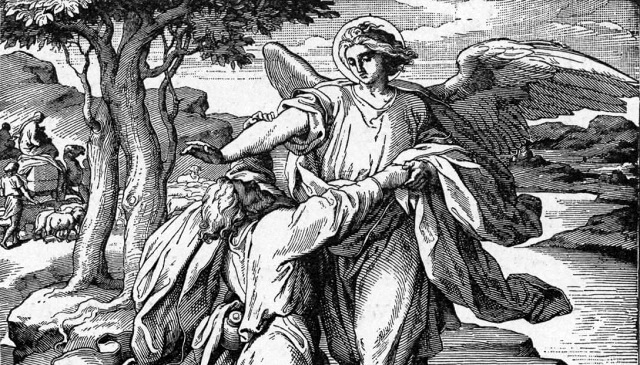
Illustration image: Jacob Wrestled with an Angel, Foster (1897)

Avraham’s Universalism
Avraham’s original name, “Avram,” means “father of Aram.” Since Avraham needed to widen his horizons and look beyond the welfare of his own people, he was renamed “Avraham” — “the father of many nations.” This new name indicated that Avraham should work towards the betterment of all peoples. In fact, it was forbidden to use his former name. Doing so would imply that God’s unique relationship with Abraham stemmed from some special concern for the nation of Aram.

While Avraham belonged to all humanity, he was also the beginning of a separate, distinct people. His son Isaac similarly combined these two qualities: universal concern for all nations, and separation to safeguard his special holiness for future generations.

In Yizchak’s twin sons, however, these traits were separated. Esav was a “man of the field,” an outgoing personality who integrated with the rest of the world. Yaakov, on the other hand, was a scholar who kept to himself. He was “a quiet man, dwelling in tents” of Torah study.

Yaakov’s Special Identity
The name Yaakov refers to his grasping Esav’s heel (eikev) when they were born. From the very start, Jacob tried to hold back Esav’s drive to integrate and assimilate. To maintain his special identity, Yaakov held Esav back with his hand. The hand is a metaphor for the practical (“hands-on”) aspect of mitzvot which distinguish and separate the Jewish people from other nations.

As long as the world has not sufficiently advanced, and the true purpose of the mitzvot is concealed, Jacob will retain his original name. The mitzvot enable him to inhibit the Esav-tendencies towards assimilating into the rest of humanity.

In the future, the Torah’s light will radiate over Yaakov. Esav will recognize that his approach of assimilation before its time led him to be lost and corrupted.1 And Yaakov will no longer need to “hold back Esav’s heel.” The primary function of mitzvot will no longer be to prevent assimilation among the nations. When the triumphant splendor of greatness will shine on Israel, and the nations will be drawn to follow the light of his Torah, how could he lower himself from his elevated stature? Yaakov will be recognized as Yisrael — “he will lead” (from the Hebrew word sar, meaning “leader”). All will recognize that it is suitable for Am Yisrael to remain apart, just as a leader must maintain distance in order to lead and instruct.

But even then, the name Yaakov will not be discarded. Even in the Messianic Era, the mitzvot will still serve to “hold back Esav’s heel.”

“Many nations will go, saying, let us rise up to the mountain of God, to the house of Yaakov’s God” (Yishayahu 2:3).

(Adapted from Midbar Shur, pp. 200-209 by Rav Chanan Morrison)
_____________________________________________________________________________________

1 Here, Esav is a metaphor for Christianity. In his work Orot, Rav Kook criticizes Christianity as an offshoot of Judaism which made the critical mistake of assuming that Israel’s spiritual potential was already fully realized and the time was ripe to convert all of humanity.


Guarding the Honor of Israel

by HaRav Zalman Baruch Melamed
Rosh HaYeshiva, Beit El

Some people ask if it is permitted to endanger oneself for the sake of the honor of the People of Israel. It seems from this week's Torah portion that the answer is yes.

The Torah recounts that a wicked man named Shechem ben Hamor took and defiled Yaakov Avinu's daughter Dina, causing irreparable harm to her and her family. The response of Dina's brothers Shimon and Levy was seemingly disproportionate: They killed Shechem and his townspeople. [The topic of this column is not the morality of this response, though we will relate to it incidentally as well. Rather,] we can conclude from this that it was permitted – and perhaps obligatory – for them to endanger themselves and their family over a matter of honor. Let us explain.

Yaakov's response to Shimon and Levy was not an approving one: "You have brought trouble upon me, bringing hatred/a bad reputation upon me in the eyes of the Canaanite and Prizite inhabitants here; I am few in number and they can gather against me and destroy my entire family" (B'reshit 34,30).

The brothers' defense was simply this: "Should he have been allowed to treat our sister as a prostitute?" That is, "Can we possibly agree to the defilement of the honor of a daughter of Israel, even if it brings danger upon us?"

It is interesting, and worthwhile, to see the Holy Ohr HaChaim's explanation to this story. He asks: How does the response of Shimon and Levy address Yaakov's concern?

The Or HaChaim explains that they meant the following: "If we had fallen upon and attacked the town with no pretext, you would be right, our actions would have been quite dangerous for our family, for the peoples would unite against us in war. But we definitely had a reason for what we did, and they see that we were justified; on the contrary, had we not responded as we did to this terrible provocation by Shechem, they would have all thought that we are weak and vulnerable – and that itself would have caused them to attack us. What we did was precisely the safest thing for us to do, so that they will fear us and leave us in peace!"

In this connection, I would like to recount what happened after the Yom Kippur War, when I brought the IDF Commander of the division in which I served to visit my rabbi, Rav Tzvi Yehuda HaCohen Kook of saintly blessed memory. This officer was the highest-ranking officer to be captured by the Egyptians during the war. He asked Rav Tzvi Yehuda, "Is the national honor of Israel something that an officer must fight to the end for, and not allow himself to be taken prisoner? Or, if he sees that there is no chance, may he, or must he, not allow himself to be killed for no purpose?" Rav Tzvi Yehuda answered simply: "Nu, King Sha'ul."

He was referring to the first King of Israel who did not want to be taken captive, and asked his aides to kill him so that he would not fall into enemy captivity.

Later, the Rav related that during murderous Arab pogroms in various places in the Land of Israel during the period of the British Mandate, the British army did not protect the Jews. Some people came to Rav Kook - Rav Tzvi Yehuda's father and Chief Rabbi of the Land at the time - and asked him to go to the British High Commissioner and ask/demand that the British act resolutely to prevent the riots. Rav Kook sent his son Rav Tzvi Yehuda and another man to update the National Council, which was akin to the Jewish government in the Land at the time.

But when Mr. Usishkin – head of the Jewish National Fund – heard this, he firmly stood and demanded that Rav Kook not go to "beg" the High Commissioner for anything. "This is not in keeping with the Rav's honor, nor with the Jewish People's honor," he said. "Even if danger is involved, we cannot debase Israel's honor."

The way Rav Tzvi Yehuda told this, it was understood that he identified with what Usishkin said. The honor of Israel is not a private matter, and no individual, nor even a sector, is permitted to forego it.

The reason in the state of Israel

by Rabbi Dov Berel Wein

The Navi of Israel, describing what can unfortunately be characterized as the usual situation in Jewish life, states that it is comparable to one who flees from the lion and finds one's self in the embrace of a bear. Our father Yaakov, who barely escapes from the treachery of Lavan, soon finds himself confronted by the deadly mob of his brother Eisav.

Yaakov, in his confrontation with Lavan, chooses the option of flight as he removes himself from the territory controlled by Lavan and his sons. But this option of flight is no longer possible in his contest with Eisav. Yaakov is in his own land, the land of his ancestors, the land promised to him personally by God Himself, to be his rightful residence. As such, Yaakov has nowhere to run.

As taught to us by Midrash and quoted by Rashi, his only options were to stand and fight, to buy Eisav off with monetary tribute, and/or to pray. The option of fleeing does not enter the equation in any fashion. This is perhaps the basis for the well-known Talmudic dictum severely limiting the right of a Jew to leave the Land of Israel cavalierly.

Polish Jewish history, from biblical times to the present, shows us that exile from the Land of Israel on a collective basis never occurred voluntarily. The most mobile, wandering people in the history of civilization never left their homeland of their own volition. In this they were following the example of their father Jacob, who never considered fleeing from the Land of Israel in order to avoid the long expected and dreaded confrontation with his aggressive and volatile brother.

In our long and winding road of exile, over the past two millennia, when one country closed down for us because of economic, social or religious reasons, the Jewish people moved on elsewhere. But as we have discovered, we have run out of places to go in the world. There are no new undiscovered continents on the face of the globe, no seemingly safe havens left for escape.

This is part of the reason for the establishment of the State of Israel and its phenomenal growth and inexplicable stability. Even though it has been provoked by errors of policy and with concessions to its neighbors, it is as though the Jewish people, like their ancestor Yaakov, declared that this is where they will make their stand.

Prayer is a constant in current Israeli life, even for those who do not deem themselves to be observant of Jewish law and tradition. But in spite of all of the troubles, problems, and the myriad challenges that living in our country poses, flight in a collective sense is a nonexistent possibility.

Unable to defeat us militarily or economically, even though diplomatically they have wounded us severely, our enemies openly declare their intent to make us leave our homeland. But that is a very unrealistic policy. The children of Yaakov, in the state that bears his name, certainly will follow his example until it finally brings quieter times and better relations.

Jew-Hunting: Open Season in the West

by Guy Millière
  • "We have become the Gaza of Europe. I will NOT accept that. NEVER. The authorities will be held accountable for their failure to protect the Israeli citizens. Never again". — Dutch MP Geert Wilders, X, November 8, 2024.
  • In Europe, saying that one is for the Palestinians has become the politically correct way of saying one loathes Israel and Jews.
  • So long as courageous politicians like Geert Wilders are pushed to the margins, the situation in Europe can only get worse. European political leaders are afraid of Muslim unrest and of losing potential votes. They have commensurately become increasingly anti-Israel. French President Emmanuel Macron urged completely stopping arms deliveries to Israel.
  • "Offering to negotiate with Islamic terrorists is a statement of weakness. Jihadists only offer to negotiate out of fear, weakness or to entrap us, and they assume we do the same thing. Nothing would ever convince them that we genuinely want to live in peace with them, or that we prefer alternatives to violence. So any time we offer to negotiate, they see it as weakness or a trick. If our diplomats ever understood this cultural reality, they would stop being baffled when the negotiations fall apart." — Daniel Greenfield, Gatestone Institute, December 2, 2024.

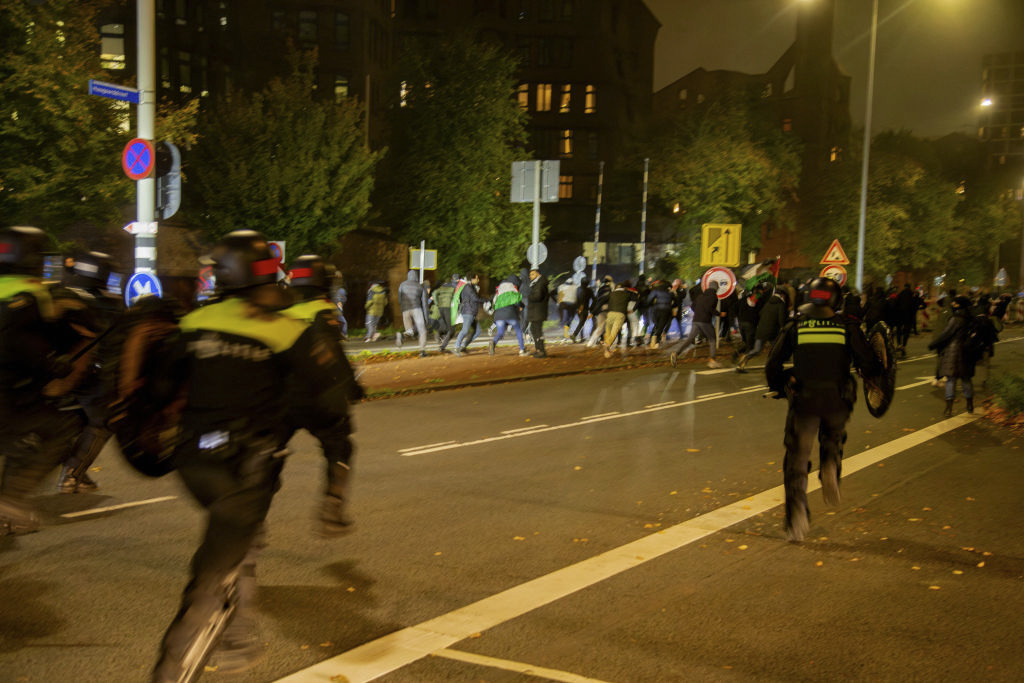
On November 7 in Amsterdam, visiting Israeli soccer fans were chased through the streets, beaten, thrown to the ground, punched, kicked, stabbed, and thrown into the icy water of the city's canals. While the attackers shout anti-Semitic slurs, the victims, in an attempt to escape, shout back that they are not Jewish. No one was arrested during or after the pogrom. The attackers were only put on buses and dropped off on the outskirts of the city. Pictured: Police officers chase rioters who attacked Jews and Israelis in Amsterdam on November 7, 2024. (Photo by Wahaj Bani Moufleh/Middle East Images/AFP via Getty Images)

November 7. Amsterdam. As soon as a soccer match between the Netherlands' AFC Ajax, a Dutch soccer club, and Israel's Maccabi Tel Aviv ends, Maccabi supporters who came from Israel and several European countries to attend the match, are attacked. Many are chased through the streets, beaten, thrown to the ground, punched, kicked, stabbed, and thrown into the icy water of the city's canals. While the attackers shout anti-Semitic slurs, the victims, in an attempt to escape, shout back that they are not Jewish.

The attackers film what they do, then post the videos on social networks. Five Israelis are hospitalized; dozens of others, some wounded, lock themselves for hours in their hotel rooms. The Israeli government sends planes to rescue the Jews. A jihadi pogrom has just taken place in the city where Anne Frank and her family hid until they were turned over to the German occupiers and sent to death camps.

Continue Reading Article

Saturday, December 07, 2024

Make Persia Great Again

by Majid Rafizadeh
  • Unlike Iran's regime, the country's people are overwhelmingly pro-American and pro-Jewish -- sentiments rooted in a historical alliance that made Iran the closest ally of both Israel and the United States before the mullahs came to power. The regime's anti-American and antisemitic stance is an affront to the true nature of its citizens, who yearn for peace and global partnership.
  • Without the oppressive ruling mullahs, Iran could once again be a force for good, both domestically and globally. Freed from their brutal rulers, the Iranian people could channel their immense talent and potential into rebuilding their nation as a thriving hub of innovation, culture and prosperity. This revival would not only uplift Iran but also finally bring peace and stability to the Middle East and beyond, setting an example of what a liberated, flourishing nation can achieve.
  • Finally, there should be no negotiations, deals or trades with the regime. Such engagements only empower and legitimize the mullahs while undermining the people's struggle for freedom.
  • The time has come to support the cause of the Iranian people and ensure that this great nation, with its rich history and boundless potential, rises once more – without mullahs.


Without the oppressive ruling mullahs, Iran could once again be a force for good, both domestically and globally. Freed from their brutal rulers, the Iranian people could channel their immense talent and potential into rebuilding their nation as a thriving hub of innovation, culture and prosperity. Pictured: Iranians protest the murder of 22-year-old Mahsa Amini, murdered by police while in custody, in Tehran on September 21, 2022. (Photo by AFP via Getty Images)

Historically known as Persia, Iran stands as one of the most illustrious civilizations in human history. For centuries, it was a beacon of cultural, scientific and political advancements, earning respect and admiration across the globe. This legacy of greatness persisted until 1979, when a group of Islamic fundamentalists, obsessed with religion, hijacked a revolution that drastically altered the nation's trajectory.

The mullahs seized control, installing a theocratic Islamist regime that has since ruled with an iron fist — arguably one of history's most brutal and oppressive reigns. The proud heritage of a nation that once symbolized enlightenment and progress has been overshadowed by a reign marked by suppression, regression and fear.

Continue Reading Article

Friday, December 06, 2024

Biden’s Ceasefire for Israel Started a War in Syria

by Daniel Greenfield

After months of fighting, Israel had devastated Hezbollah, capturing enemy fortresses and weapons depots, and taking out much of its leadership along with over 3,500 of its terrorists.

Biden responded by using a weapons embargo on Israel to force an end to the war, but instead of ending the war, his administration had actually managed to restart a much deadlier war.

Israel’s campaign against Hezbollah led to less than 4,000 deaths in Lebanon, while the Syrian Civil War that the Biden administration restarted has racked up over 600,000 deaths so far.

Not only hasn’t the fighting with Israel ended, but a much bloodier war has begun all over again.

The false pursuit of peace with terrorists in the Middle East has once again brought on a war by diplomats who support terrorists and do not understand how the Muslim world works.

The ceasefire that Biden falsely described as a “permanent cessation of hostilities” has not actually ended the fighting with Israel, but it has allowed Hezbollah to regroup and return to areas that the Islamic terrorist group had been driven out of at a high cost for Israeli soldiers. Even while the Biden administration was taking its victory lap, Hezbollah terrorists were once again setting up rocket launchers and Israel was once again taking them out.

After the ceasefire announcement, Hezbollah’s Shiite population flooded back into the war zone, waving yellow Hezbollah flags, while much of Israel’s displaced population did not return knowing that they could put no trust in the same failed promises from the ‘international community’ that the rocket attacks on their homes and schools would come to an end.


The Biden administration had ensured that Israel would not be able to enjoy the fruits of victory, nor would Lebanon’s Christian population which continues to live under Islamist domination.

Instead, Islamic Sunni and Shiite terrorists became the only beneficiaries of the ceasefire.

Once Biden got his ‘ceasefire’, Turkey and its allied Sunni Jihadists, some aligned with Al Qaeda, decided to exploit Hezbollah’s vulnerability by launching a bid for Syria. The Biden administration had used every available tool, including reportedly threats of an UN arms embargo, to force Israel to stop attacking Hezbollah, but did nothing to stop Turkey.

Nor did it offer a word of criticism about Turkey’s relationship with Al Qaeda terrorists.

Within hours of the ceasefire officially taking effect, Sunni Jihadis launched the largest campaign in years that has now allowed them to enter the Syrian city of Aleppo. The Jihadis, backed by Turkey’s Islamist government, did not intend to let the opportunity pass without a new war.

The Biden administration had bought Hezbollah and Iran crucial time to regroup, but Turkey and its Islamic terrorist allies knew that they had a limited window before Hezbollah regrouped.

The clash between Shiite and Sunni Jihadists in Syria would not have been possible without the ‘ceasefire’ imposed on Israel. Turkey had to wait until the ceasefire to avoid appearing to be allied with Israel. Once there was a ceasefire, Turkey could unleash its Jihadis on Syria.

Unlike Israel’s campaign of self-defense against Hamas and Hezbollah, there have been no objections to Turkey’s Jihad in Syria. The various Islamist factions, some allied with Al Qaeda, had previously enjoyed American and European support under the Obama administration.

And now some of the same diplomats and media outlets that denounced Israel for fighting Hezbollah cheer when they see Al Qaeda fighting Hezbollah. No arms embargoes have been threatened against Turkey and no mobs are protesting in the streets against its regime.

The only ones allowed to legitimately fight Islamic terrorists are other Islamic terrorists.

Iran’s obsession with destroying Israel had opened the door to the new phase of the Syrian Civil War. Tehran’s Islamic regime had pressured Hezbollah to launch a campaign against Israel in support of Hamas. Those attacks had led to an Israeli response that crippled Hezbollah and exposed the Assad regime to a Turkish and Islamist insurgency. Assad’s backers in Tehran and Moscow had failed to rebuild the regime’s military, all the better to use him as a puppet.

But with Russia bleeding in Ukraine and Hezbollah in Lebanon, Assad was now exposed.

The Oct 7 campaign against Israel had been backed by both Iran and Turkey, but the moment the Shiites were weakened, the Sunnis struck, proving once again that Islamic terrorist allies will always stab each other at the back at the first sign of weakness. Hezbollah had bled to try and save its Sunni brothers in Hamas. Turkey took in Hamas and then went to war against the Shiites who had been protecting it.

The original Syrian Civil War had broken the Iranian alliance with Hamas and Hezbollah that made Oct 7 possible. Hamas had joined its Muslim Brotherhood brethren on the Sunni side in Syria until they were decimated by the Al Qaeda factions. It took a great deal of money and inter-terrorist diplomacy to repair Iran’s relationship with Hamas and execute the Oct 7 attack.

Turkey’s new campaign to take over Syria and Hezbollah’s agreement to a ceasefire apart from Hamas has ripped open the Sunni-Shiite Islamic terrorist alliance all over again. Some Sunni Islamists argue that Hezbollah’s separate ceasefire was a betrayal of Hamas and the alliance.

Either way the last possible thing to come from the Biden administration’s ceasefire was peace.

The new phase of the Syrian civil war also fractures the overseas alliance between the Muslim Brotherhood and the leftist Russia-Iran-Syria axis that had consolidated opposition to Israel in rallies in American and European cities. And in a mass propaganda campaign on campuses. Members of the different factions are now once again screaming at each other on social media.

None of this was an intentional part of the Biden administration’s campaign for a ceasefire.

Biden, along with France’s Macron, the UK’s Starmer and other Islamist useful idiots, had blamed Israel for the fighting and were obsessed with forcing an end to the war before Trump, whom they feared would pursue a pro-Israel foreign policy, would take office.

The Biden arms embargo led to the deaths of unknown numbers of Israeli soldiers, and the ceasefire broke Israel’s momentum which might have not only liberated Lebanon from Hezbollah, but might have broken Iran’s power in the region. The ceasefire betrayed Lebanon’s Christians and saved Iran’s biggest proxy while undermining the incoming Trump administration.

And it also touched off a whole new war.

What Western diplomats refuse to understand is that the Muslim world is a series of tribal societies that are engaged in a forever war with each other and the rest of the world.

Peace is not possible. The end of one war brings on another. A temporary ceasefire reshuffles alliances, exposes weaknesses and then leads to yet another round of fighting.

Crippling Israel’s campaign against Israel terrorists just set off a much worse war.

The White House should have supported an Israeli victory in Lebanon, but instead it chose to side with Sunni and Shiite Islamic terrorists, with Iran, Turkey and Qatar in the name of peace.

But peace in Islam means war.

Sunday, December 01, 2024

Charging Netanyahu with War Crimes Shows the ICC Is Illegitimate and Not Fit for Purpose

by Con Coughlin 
  • [T]he International Criminal Court (ICC)... should be defunded, dismantled, or both.

  • [By] law, the ICC is precluded from prosecuting any country that already has a valid judiciary system. This stipulation is the based on the treaty upon which the ICC was founded.

  • Another option that should be considered is for the incoming Trump administration's new Department of Government Efficiency (DOGE), to establish whether maintaining US funding for bodies such as the United Nations and its affiliates, the ICC and ICJ, all of which display a strong anti-Israeli bias, is in Washington's best interests. Certainly, without the lavish funding these bodies receive from Western governments, their ability to pursue their own twisted agenda will at least be severely curtailed.

The decision by the International Criminal Court (ICC) to issue arrest warrants for Israeli Prime Minister Benjamin Netanyahu and former Defence Minister Yoav Gallant on unsubstantiated war crimes charges, shows that the body is unfit for purpose, and should be defunded, dismantled, or both. Pictured: The ICC building in The Hague, Netherlands. (Photo by Nicolas Guyonnet/Hans Lucas//AFP via Getty Images)


The decision by the International Criminal Court (ICC) to issue arrest warrants for Israeli Prime Minister Benjamin Netanyahu and former Defence Minister Yoav Gallant on unsubstantiated war crimes charges, shows that the body is unfit for purpose, and should be defunded, dismantled, or both.

First, by law, the ICC is precluded from prosecuting any country that already has a valid judiciary system. This stipulation is the based on the treaty upon which the ICC was founded.

US defence attorney Alan Dershowitz is assembling a "legal dream team" to contest the charges. He emphasized that it would base its argument on the ICC's lack of jurisdiction.

Continue Reading Article