by Rabbi Steven Pruzansky
by Chaim Silberstein and Rabbi Steven Pruzansky, Esq.
President-elect Donald Trump’s first term was noted for its remarkable accomplishments in stabilizing the Middle East, strengthening Israel’s strategic position, and especially embracing creative thinking and policies that transformed the reality on the ground. Decisions such as recognizing Jerusalem as Israel’s capital and moving the American embassy to Jerusalem paved the way to the historic breakthrough of the Abraham Accords. All this was achieved largely to the consternation and even dismay of the foreign policy establishment, whose reassertion of traditional diplomacy in the last four years has contributed to the outbreak of violence in this region and other parts of the world.
The proposed nominees for the critical positions that will determine US foreign policy in the coming four years have gratified supporters of Israel. Marco Rubio, Mike Walz, Mike Huckabee and others have been steadfast supporters of a strong Israel that is a genuine friend and trusted ally of the United States. While the plate of any new administration is full, and the most pressing matters in Israel today concern the need for decisive defeats of Hamas and Hezbollah and the return of all Israeli hostages, there are several items worthy of the new administration’s agenda that can solidify the advances made in the first Trump administration and further promote peace and security in the region.
These proposals focus on securing the future of Jerusalem. It should be lost on no one that Hamas called its invasion of Israel on October 7, 2023, the “Al-Aksa Flood,” as it and all Israel’s enemies perceive the conquest of Jerusalem as the ultimate objective. What can be done to reinforce Israeli sovereignty over Jerusalem? There are five proposals, some merely restoration of Trump policy in his first term, others a blueprint for preserving Jerusalem into the future.
First, shutter (again) the US Office of Palestinian Affairs (OPA) in Jerusalem. The OPA functions in violation of American, Israeli, and international law as a quasi-diplomatic mission in the heart of Israel’s capital that deals exclusively with the Palestinian Authority and Palestinian residents of Jerusalem, Judea and Samaria. It reports not to the US Embassy in Jerusalem but directly to the State Department. This mission was closed by President Trump after the embassy was moved to Jerusalem but was reopened by President Biden shortly after he assumed office in 2021 notwithstanding Israel’s objection and denial of recognition.
The OPA encroaches on Israel’s sovereignty and, by bypassing the serving US ambassador to Israel, undermines his effectiveness and the integrity of his mission. As was demonstrated during the first Trump term, handling Palestinian affairs from the US Embassy in Jerusalem is efficient, proper, and comports with international law and diplomatic norms. The OPA should be closed and its activities subsumed by the Embassy.
Second, restore “Jerusalem, Israel,” as an official place of birth on American passports. For decades, American citizens living in Israel whose children were born in Jerusalem could not register their child’s place of birth as “Jerusalem, Israel,” due to the State Department’s claim that Jerusalem’s status as part of Israel was disputed. The place of birth was simply recorded as “Jerusalem.”
The US Embassy website in Israel notes: “Applicants born in Jerusalem are able to request either “Jerusalem” or “Israel” as their place of birth (POB) on U.S. passports …. If you write “Jerusalem, Israel” as the POB on the passport, consular staff will ask you whether you prefer the U.S. passport to be printed with a POB of either “Jerusalem” or “Israel.”
This, too, purports to undermine Israeli sovereignty in Jerusalem and contradicts the spirit of the US recognition of Jerusalem’s as Israel’s capital city. This policy should be repudiated, and US citizens who so desire should be allowed to have their place of birth recorded as “Jerusalem, Israel.”
Third, President Trump should immediately defund UNRWA, as he did in his first term. UNRWA has long outlived its usefulness – it is the only refugee relief organization that seeks to perpetuate refugee status among its beneficiaries – and has been justly accused of being part of the Hamas terror network. Some UNRWA staff members participated in the atrocities of October 7, 2023, and many UNRWA facilities in Gaza harbored terrorists and concealed terror infrastructure. An Israeli court ordered UNRWA’s eviction from its facility in Jerusalem which UNRWA illegally occupied. The United States should support that eviction, halt (again) its funding of UNRWA, and urge the disbandment of the organization and the reassignment of its duties to the UN High Commissioner for Refugees.
Fourth, support the construction of new Jewish neighborhoods within the existing municipal boundaries of Jerusalem especially in the eastern section. The physical footprint of Jerusalem needs to grow in order to accommodate a growing population. There are several areas in Jerusalem’s environs that are available for Jewish residence and the development of new neighborhoods. Examples are Givat Hamatos to the east, Givat Hashaked to the south, and Atarot to the north. There are thousands of dunams available for development that can create housing for hundreds of thousands of new residents.
All these neighborhoods are within Jerusalem’s municipal boundaries. Given the housing crisis in Israel, it is wrong that they remain vacant and undeveloped. President-elect Trump, a real estate maven, can take the lead in supporting these plans and enabling Israel to fulfill its vision for Jerusalem.
Fifth, support Israel’s consideration of the Greater Jerusalem Metropolis Plan. Jerusalem is today’s Israel’s most populous city, and urban and economic expansion are a national priority to ensure the capital’s economic, political and demographic security.
Today Jerusalem is geographically trapped with expansion options limited – Ramallah is to the north, Bethlehem is to the south, there is a ‘green’ ecosystem to the west. So far, the options are to expand vertically in existing expensive neighborhoods. That does not solve the severe problem of lack of affordable housing. Increasing the supply through expanding the municipal borders and establishing large new neighborhoods would significantly reduce prices and, together with increasing job opportunities, help reverse the negative immigration from Jerusalem. Over the past 30 years, over 400,000 Jews have left Jerusalem because of lack of affordable housing and job opportunities.
Incorporating the satellite cities surrounding Jerusalem will be a benefit for all the residents in both areas. It will free up hundreds of thousands of dunams for development of residential, commercial, tourism and leisure industries. Today Jews constitute approximately 60% of the population. Expanding the municipal borders will also contribute to securing its Jewish majority by adding over 200,000 residents to the city. The Greater Jerusalem proposal would include the city of Maalei Adumim to the east of Jerusalem and Gush Etzion to the south, Givat Zeev to the north and possibly also Mevaseret Zion to the west.
Note that none of the proposals displace even one Arab and essentially just redraw Jerusalem’s municipal boundaries in a way that bolsters Jerusalem as Israel’s capital. Expanding Jerusalem’s municipal boundaries need not impede the final status negotiations that have been a goal of American diplomacy for decades. Similarly, the mere prospect of future negotiations should not leave Jerusalem in permanent limbo unable to develop and flourish because of the veto power over negotiations exercised by Israel’s enemies. This logjam can be broken by creative diplomacy and a diplomatic green light by the US to Israel to pursue the expansion of Jerusalem.
These proposals will be to the immense benefit of all the residents of Jerusalem, Jews, Muslims and Christians and ensure Jerusalem remains the eternal capital of Israel and the Jewish people with a free, secure and flourishing future.
The implementation of these proposals would be a natural continuation of the policies of the first Trump administration and secure his historic legacy of support for the State of Israel and transformation of the Middle East.
Chaim Silberstein is founder and president of the Jerusalem Center for Applied Policy, where Rabbi Steven Pruzansky, Esq, serves as Senior Research Associate.
Wednesday, December 25, 2024
How the International Community Can Best Help the Palestinians
by Khaled Abu Toameh

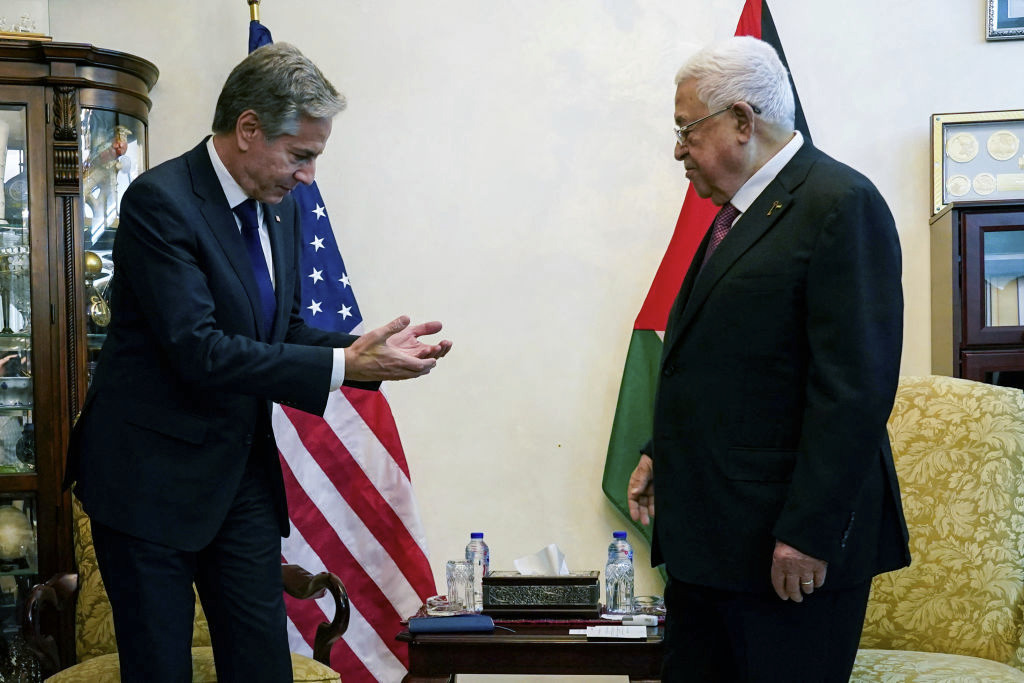
Had the international community held the Palestinian Authority (PA) accountable for financial and administrative corruption after the signing of the Oslo Accords 30 years ago, the Iran-backed Hamas terrorist group would not have gained popularity among Palestinians. The current PA leadership is just not seen by many Palestinians as a better alternative to Hamas. That is because the US, EU and other donors are not banging on the table and demanding an end to the PA's authoritarian and corrupt conduct. Pictured: US Secretary of State Antony Blinken meets with PA President Mahmoud Abbas in Amman, Jordan on October 13, 2023. (Photo by Jacquelyn Martin/Pool/AFP via Getty Images)
Had the international community held the Palestinian Authority (PA) accountable for financial and administrative corruption after the signing of the Oslo Accords 30 years ago, the Iran-backed Hamas terrorist group would not have gained popularity among Palestinians. Hamas became so popular that its representatives won the last elections for the Palestinian Legislative Council (PLC), in 2006. The Hamas-affiliated Change and Reform list received 44.45% of the vote and won 74 of the 132 seats in the PLC.
Although many Palestinians support Hamas's policy of rejecting Israel's right to exist, the Islamist group's victory greatly reflected the desire of the Palestinian public to end corruption in the PA government and institutions.
Justin Curtis wrote in Harvard University's Exposé Magazine in 2016:
Continue Reading Article
- Had the international community held the Palestinian Authority (PA) accountable for financial and administrative corruption after the signing of the Oslo Accords 30 years ago, the Iran-backed Hamas terrorist group would not have gained popularity among Palestinians.
- Although many Palestinians support Hamas's policy of rejecting Israel's right to exist, the Islamist group's victory greatly reflected the desire of the Palestinian public to end corruption in the PA government and institutions.
- The most common forms of corruption seem to be the offenses of favoritism, nepotism, embezzlement of public funds, breach of trust, abuse of power, bribery and money laundering.
- The best way to undermine Hamas and help the Palestinians is by offering the people a better alternative to the Islamist movement. The current Palestinian Authority leadership is just not seen by many Palestinians as a better alternative to Hamas. That is because the United States, European Union and other donors are not banging on the table and demanding an end to the PA's authoritarian and corrupt conduct.

Had the international community held the Palestinian Authority (PA) accountable for financial and administrative corruption after the signing of the Oslo Accords 30 years ago, the Iran-backed Hamas terrorist group would not have gained popularity among Palestinians. The current PA leadership is just not seen by many Palestinians as a better alternative to Hamas. That is because the US, EU and other donors are not banging on the table and demanding an end to the PA's authoritarian and corrupt conduct. Pictured: US Secretary of State Antony Blinken meets with PA President Mahmoud Abbas in Amman, Jordan on October 13, 2023. (Photo by Jacquelyn Martin/Pool/AFP via Getty Images)
Had the international community held the Palestinian Authority (PA) accountable for financial and administrative corruption after the signing of the Oslo Accords 30 years ago, the Iran-backed Hamas terrorist group would not have gained popularity among Palestinians. Hamas became so popular that its representatives won the last elections for the Palestinian Legislative Council (PLC), in 2006. The Hamas-affiliated Change and Reform list received 44.45% of the vote and won 74 of the 132 seats in the PLC.
Although many Palestinians support Hamas's policy of rejecting Israel's right to exist, the Islamist group's victory greatly reflected the desire of the Palestinian public to end corruption in the PA government and institutions.
Justin Curtis wrote in Harvard University's Exposé Magazine in 2016:
Continue Reading Article

Thank You, Israel, for Saving the World, Defending Freedom and Reshaping the Middle East
by Majid Rafizadeh

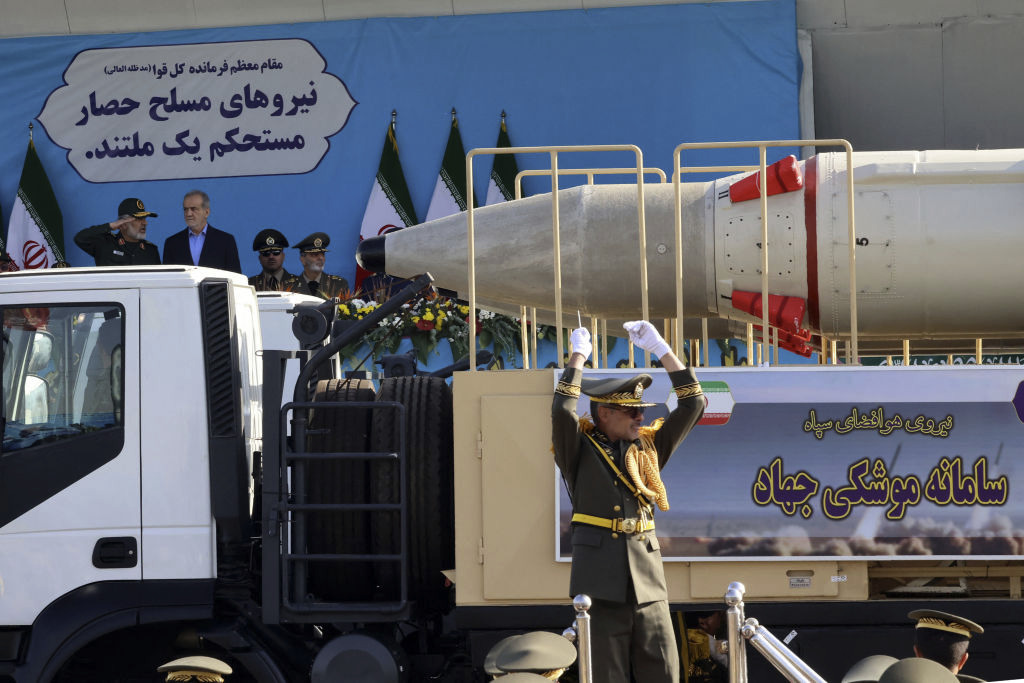
When it comes to national security, appeasement is not an option. Bribing aggressors only finances their militaries for attacks on the West in the future. Israel's approach to combating terrorism has always been characterized by thoroughness and determination -- for which is usually put through the tortures of hell by the very countries it is working to save. Pictured: Iranian President Masoud Pezeshkian and commander of the Islamic Revolutionary Guard Corps' Aerospace Force Amir Ali Hajizadeh look on as a Jihad missile is displayed at a parade in Tehran on September 21, 2024. (Photo by Atta Kenare/AFP via Getty Images)
After Hamas carried out its horrific October 7, 2023 massacre by invading Israel, murdering hundreds of people and kidnapping individuals from various countries, Israel reached a breaking point. This act of terrorism ignited a wave of decisive actions across the Middle East that catalyzed remarkable developments, aimed at countering and eliminating terror networks.
For decades, the region has been plagued by violence and instability, but Israel's response marked a significant turning point, showcasing its resolve to confront terrorism head-on and help usher in a new era of security.
Continue Reading Article
- When it comes to national security, appeasement is not an option. Bribing aggressors only finances their militaries for attacks on the West in the future. Israel's approach to combating terrorism has always been characterized by thoroughness and determination -- for which is usually put through the tortures of hell by the very countries it is working to save.
- With a vision of ultimately fostering peace, harmony, security and prosperity throughout the region, as in the Abraham Accords, Israel expanded its military operations beyond Hamas... reshaping the Middle East into a region free of the grip of terror... Make Persia Great Again!
- So long as Iran's regime remains in power, brutalizing its people and making plans for global expansion, there can be no chance for peace in the region.
- Removing the regime... would bring lasting security and prosperity to the Middle East and beyond.... One could then set about subduing Turkey and its terrorist proxies in Syria.

When it comes to national security, appeasement is not an option. Bribing aggressors only finances their militaries for attacks on the West in the future. Israel's approach to combating terrorism has always been characterized by thoroughness and determination -- for which is usually put through the tortures of hell by the very countries it is working to save. Pictured: Iranian President Masoud Pezeshkian and commander of the Islamic Revolutionary Guard Corps' Aerospace Force Amir Ali Hajizadeh look on as a Jihad missile is displayed at a parade in Tehran on September 21, 2024. (Photo by Atta Kenare/AFP via Getty Images)
After Hamas carried out its horrific October 7, 2023 massacre by invading Israel, murdering hundreds of people and kidnapping individuals from various countries, Israel reached a breaking point. This act of terrorism ignited a wave of decisive actions across the Middle East that catalyzed remarkable developments, aimed at countering and eliminating terror networks.
For decades, the region has been plagued by violence and instability, but Israel's response marked a significant turning point, showcasing its resolve to confront terrorism head-on and help usher in a new era of security.
Continue Reading Article

Everything in the Middle East Means the Opposite
by Daniel Greenfield
Even as Islamic Jihadists are taking over Syria, ethnically cleansing Kurds and terrorizing Christians, the media is hailing the new “inclusive” regime which “liberated” Syria.
The regime is indeed inclusive if you consider bearded men with assault rifles to be the measure of inclusivity. And terrorizing minorities to be the exciting new diversity.
“This victory, my brothers, is a victory for the entire Islamic nation,” Abu Mohammad al-Jawlani, the leader of Hayat Tahrir al-Sham (HTS), a former Al Qaeda and ISIS allied group, declared in the Umayyad Mosque. The mosque is a symbol of the old Caliphate and it echoed the speech given by his old friend, the former ISIS Caliph Abu Bakr al-Baghdadi, in Mosul’s Great Mosque of al-Nuri declaring his own caliphate. But it will no doubt be a most inclusive caliphate.
As Jawlani had previously said, “some people limit the issue of implementing the rule of the sharia to just imposing some of the Hudud punishments, chopping off hands, stoning whomever, whipping someone who drinks alcohol, and so on. But this is a very basic part of the very big concept of implementing the rule of the sharia.” There’s a lot more to Sharia Islamic law than just chopping off hands but you have to work on the basics of hand chopping before going big.
Syria’s newly appointed Prime Minister Mohammad al-Bashir appeared in front of a white Jihadist flag with the Islamic declaration that rejects all other religions except Islam. Bashir’s credentials include a degree in Sharia Islamic law and membership in the Muslim Brotherhood’s ‘Syrian Salvation Government’. After saving Syria from Assad, who will save it from the saviors?
Secretary of State Blinken is going on a tour to persuade the Turks and their Jihadis to establish an “inclusive” government in Syria. But inclusivity now means Sunni Jihadis backed by Turkey repressing and killing everyone else. This will be a fundamental liberating change from the old order in which Shiite Jihadis backed by Iran repressed and killed everyone else.
Words in the Middle East however have a way of meaning different things than they do over here. It’s not just “inclusive” that has a whole other dictionary entry.

Turkey bombing and displacing Kurds in Syria is considered “inclusivity”, but Israel bombing Hamas and Hezbollah terrorists in Gaza and Lebanon is termed “genocide”.
The Islamist regime in Turkey, which has maintained an actual occupation of popular areas in Syria, before using proxies to seize the entire country, has accused Israel of “occupation” for expanding a security zone that it used to hold on an uninhabited mountain over 9,000 feet up.
The only possible victims of this ‘occupation’ might be the goats in the region who will likely appreciate and personally benefit from this long overdue ‘change of management’.
‘Occupation’ was a term widely used to describe Israel’s lack of presence in Gaza from which it had withdrawn back in 2005. But the simple fact that Israel was not in Gaza did not dissuade activists, journalists and the UN from accusing Israel of occupying land it wasn’t even on.
But ‘occupation’, like ‘inclusivity’, means the opposite of what it does in the Middle East.
Another popular accusation was that Israel was conducting a ‘siege’ of Gaza by refusing to let Hamas terrorists through its borders to kill and rape their way across Israel. By that definition any border with an enemy nation is a ‘siege’ and by locking your own door at night you’re besieging all the people outside who might want to break into your house.
“Genocide” is another of those many words that have different meanings in the New Middle East Dictionary. Amnesty International has come under fire for changing the definition of “genocide” in order to be able to accuse Israel of it.
Amnesty’s report is headlined, “‘You Feel Like You Are Subhuman”. If you feel like it’s genocide, well then it’s genocide. Amnesty decided that its definition of genocide should not use the traditional definition of “acts committed with intent to destroy, in whole or in part, a national, ethnical, racial or religious group” because, as it explained on Page 101 of its report, it “considers this an overly cramped interpretation of international jurisprudence and one that would effectively preclude a finding of genocide in the context of an armed conflict.”
War becomes genocide. But only in the case of Israel. Meanwhile actual genocidal efforts by Hamas on Oct 7 and Turkey in Syria to target ethnic groups are redefined as “liberation”.
Probably inclusive liberation.
Gaza’s population actually grew which makes it a very unique form of genocide indeed. But after a year of claiming that there was no food in Gaza (despite social media videos of the Arab Muslim population stuffing itself during its annual Islamic festivities), “starvation” was also redefined. So was ‘famine’ which is defined as 2 per 1,000 people dying of heart attacks.
Over 1 million tons of food have entered Gaza since Oct 7. That’s half a ton for every terrorist supporter. Half a ton of food for every man, woman and children is to ‘starvation’ as population growth is to ‘genocide’ and as Jihad is to an ‘inclusive’ government in Syria.
But the New Middle East Dictionary has plenty of room for lots of Newspeak revisions.
The Arab Spring redefined Islamist takeovers as “democracy movements”. Egyptian Washington Post columnist Shadi Hamid of Qatar’s Brookings Institute, recently charged that, “the U.S. has actively undermined democratic movements in the Arab world for decades — one of the great moral stains on America.” By democratic movements, he means the Muslim Brotherhood. And democracy then becomes Islamic theocracy and political terror.
But probably inclusive theocracy and political terror.
Arabic is written from right to left and sometimes things mean the opposite of what they do, but the problem is that we’ve adopted the Middle Eastern habit of dealing with the region by making words mean the opposite. When our political elites call genocide ‘liberation’ and liberation ‘genocide’, when they stigmatize any resistance to Islamic terror while calling terror ‘inclusive’, they’re not only reversing the moral polarities of our foreign policy, but killing the truth.
And making it impossible to understand what is really going on in the Middle East.
Initially we changed the definitions of words to fool the terrorists only to end up fooling ourselves. Efforts to avoid calling ISIS the “Islamic State” and to redefine Islamic terrorism as “violent extremism” or worse still “man-caused disasters” didn’t end up dissuading any Muslims from joining ISIS (whose I’s don’t stand for ‘inclusive’) and didn’t make us any safer.
The entire narrative of ‘radicalization’ tried to gate off some forms of Islam as legitimate and others as illegitimate as if there were an Islam out there that didn’t follow the same Koran. Under Obama, a “countering violent extremism” program was deployed to convince Muslims that Islamic terrorism of the kind practiced beginning with Mohammed was ‘un-Islamic’.
We didn’t fool any Muslims but we did fool ourselves. In 2024, all Islam is good. It’s inclusive. Especially when its bearded thugs are inclusively chopping off someone’s hands. And any resistance to it is bad. When Muslim Jihadis commit genocide, it becomes liberation. And when anyone fights back against them, it’s genocide. If they kill terrorists, it’s a war crime, and if they don’t kill them, it’s famine, siege and starvation no matter how fat the starving terrorists get.
Redefinition makes everything in the Middle East factually opposite to make it morally opposite.
The common paraphrase of Burke is wrong. All that is required for the triumph of evil is not for good men to do nothing, but for them to believe that evil is good and therefore good is evil.
Making everything morally opposite is truly all that is required for the triumph of evil.
The regime is indeed inclusive if you consider bearded men with assault rifles to be the measure of inclusivity. And terrorizing minorities to be the exciting new diversity.
“This victory, my brothers, is a victory for the entire Islamic nation,” Abu Mohammad al-Jawlani, the leader of Hayat Tahrir al-Sham (HTS), a former Al Qaeda and ISIS allied group, declared in the Umayyad Mosque. The mosque is a symbol of the old Caliphate and it echoed the speech given by his old friend, the former ISIS Caliph Abu Bakr al-Baghdadi, in Mosul’s Great Mosque of al-Nuri declaring his own caliphate. But it will no doubt be a most inclusive caliphate.
As Jawlani had previously said, “some people limit the issue of implementing the rule of the sharia to just imposing some of the Hudud punishments, chopping off hands, stoning whomever, whipping someone who drinks alcohol, and so on. But this is a very basic part of the very big concept of implementing the rule of the sharia.” There’s a lot more to Sharia Islamic law than just chopping off hands but you have to work on the basics of hand chopping before going big.
Syria’s newly appointed Prime Minister Mohammad al-Bashir appeared in front of a white Jihadist flag with the Islamic declaration that rejects all other religions except Islam. Bashir’s credentials include a degree in Sharia Islamic law and membership in the Muslim Brotherhood’s ‘Syrian Salvation Government’. After saving Syria from Assad, who will save it from the saviors?
Secretary of State Blinken is going on a tour to persuade the Turks and their Jihadis to establish an “inclusive” government in Syria. But inclusivity now means Sunni Jihadis backed by Turkey repressing and killing everyone else. This will be a fundamental liberating change from the old order in which Shiite Jihadis backed by Iran repressed and killed everyone else.
Words in the Middle East however have a way of meaning different things than they do over here. It’s not just “inclusive” that has a whole other dictionary entry.

Turkey bombing and displacing Kurds in Syria is considered “inclusivity”, but Israel bombing Hamas and Hezbollah terrorists in Gaza and Lebanon is termed “genocide”.
The Islamist regime in Turkey, which has maintained an actual occupation of popular areas in Syria, before using proxies to seize the entire country, has accused Israel of “occupation” for expanding a security zone that it used to hold on an uninhabited mountain over 9,000 feet up.
The only possible victims of this ‘occupation’ might be the goats in the region who will likely appreciate and personally benefit from this long overdue ‘change of management’.
‘Occupation’ was a term widely used to describe Israel’s lack of presence in Gaza from which it had withdrawn back in 2005. But the simple fact that Israel was not in Gaza did not dissuade activists, journalists and the UN from accusing Israel of occupying land it wasn’t even on.
But ‘occupation’, like ‘inclusivity’, means the opposite of what it does in the Middle East.
Another popular accusation was that Israel was conducting a ‘siege’ of Gaza by refusing to let Hamas terrorists through its borders to kill and rape their way across Israel. By that definition any border with an enemy nation is a ‘siege’ and by locking your own door at night you’re besieging all the people outside who might want to break into your house.
“Genocide” is another of those many words that have different meanings in the New Middle East Dictionary. Amnesty International has come under fire for changing the definition of “genocide” in order to be able to accuse Israel of it.
Amnesty’s report is headlined, “‘You Feel Like You Are Subhuman”. If you feel like it’s genocide, well then it’s genocide. Amnesty decided that its definition of genocide should not use the traditional definition of “acts committed with intent to destroy, in whole or in part, a national, ethnical, racial or religious group” because, as it explained on Page 101 of its report, it “considers this an overly cramped interpretation of international jurisprudence and one that would effectively preclude a finding of genocide in the context of an armed conflict.”
War becomes genocide. But only in the case of Israel. Meanwhile actual genocidal efforts by Hamas on Oct 7 and Turkey in Syria to target ethnic groups are redefined as “liberation”.
Probably inclusive liberation.
Gaza’s population actually grew which makes it a very unique form of genocide indeed. But after a year of claiming that there was no food in Gaza (despite social media videos of the Arab Muslim population stuffing itself during its annual Islamic festivities), “starvation” was also redefined. So was ‘famine’ which is defined as 2 per 1,000 people dying of heart attacks.
Over 1 million tons of food have entered Gaza since Oct 7. That’s half a ton for every terrorist supporter. Half a ton of food for every man, woman and children is to ‘starvation’ as population growth is to ‘genocide’ and as Jihad is to an ‘inclusive’ government in Syria.
But the New Middle East Dictionary has plenty of room for lots of Newspeak revisions.
The Arab Spring redefined Islamist takeovers as “democracy movements”. Egyptian Washington Post columnist Shadi Hamid of Qatar’s Brookings Institute, recently charged that, “the U.S. has actively undermined democratic movements in the Arab world for decades — one of the great moral stains on America.” By democratic movements, he means the Muslim Brotherhood. And democracy then becomes Islamic theocracy and political terror.
But probably inclusive theocracy and political terror.
Arabic is written from right to left and sometimes things mean the opposite of what they do, but the problem is that we’ve adopted the Middle Eastern habit of dealing with the region by making words mean the opposite. When our political elites call genocide ‘liberation’ and liberation ‘genocide’, when they stigmatize any resistance to Islamic terror while calling terror ‘inclusive’, they’re not only reversing the moral polarities of our foreign policy, but killing the truth.
And making it impossible to understand what is really going on in the Middle East.
Initially we changed the definitions of words to fool the terrorists only to end up fooling ourselves. Efforts to avoid calling ISIS the “Islamic State” and to redefine Islamic terrorism as “violent extremism” or worse still “man-caused disasters” didn’t end up dissuading any Muslims from joining ISIS (whose I’s don’t stand for ‘inclusive’) and didn’t make us any safer.
The entire narrative of ‘radicalization’ tried to gate off some forms of Islam as legitimate and others as illegitimate as if there were an Islam out there that didn’t follow the same Koran. Under Obama, a “countering violent extremism” program was deployed to convince Muslims that Islamic terrorism of the kind practiced beginning with Mohammed was ‘un-Islamic’.
We didn’t fool any Muslims but we did fool ourselves. In 2024, all Islam is good. It’s inclusive. Especially when its bearded thugs are inclusively chopping off someone’s hands. And any resistance to it is bad. When Muslim Jihadis commit genocide, it becomes liberation. And when anyone fights back against them, it’s genocide. If they kill terrorists, it’s a war crime, and if they don’t kill them, it’s famine, siege and starvation no matter how fat the starving terrorists get.
Redefinition makes everything in the Middle East factually opposite to make it morally opposite.
The common paraphrase of Burke is wrong. All that is required for the triumph of evil is not for good men to do nothing, but for them to believe that evil is good and therefore good is evil.
Making everything morally opposite is truly all that is required for the triumph of evil.
Monday, December 23, 2024
Ireland Is Committing Genocide Against Itself
by Daniel Greenfield
The obsession of the Irish government with falsely accusing Israel of genocide is only equaled by its determination to commit an actual genocide against the Irish people.
In its latest move, the Irish government has called for watering down the definition of genocide to be able to apply it to the Jewish State, but there is no need to water down the formal definition, the “intent to destroy, in whole or in part, a national, ethnical, racial or religious group”, to charge Ireland’s government with ‘self-genocide’ or ‘autogenocide’ against its own people.
In the last 20 years, Ireland, a small nation of millions, has been overwhelmed by a mass migration of 1.6 million people. In 2023, there were 54,678 births in the Republic of Ireland and 141,600 immigrants. Birth rates dropped 5% in 2023 (hovering at 1.5 births per woman well below replacement rate) but the number of immigrants grew by 31%. And will grow further.
The most popular name for boys was Jack, among Irish parents, while the most popular name among non-European immigrant parents was ‘Mohammed’.
Churches are closing across Ireland and mosques are opening in their place. There were only 400 Muslims in all of Ireland in 1991. That shot up to 19,000 in 2002 and 83,000 in 2023. 3% of Ireland’s children are Muslim now and the numbers are increasing every year.

Some Muslims are impatient with those numbers and have been trying to hurry them along.
In November, an Algerian Arab began stabbing children outside a Catholic school in Dublin. A five and six-year-old girl suffered severe injuries. When a crowd gathered to protest the latest act of Muslim violence, a ruthless police and media crackdown quickly ensued.
Taoiseach Leo Varadkar, the son of an Indian father, scolded that the Irish protesters had “brought shame on Dublin, brought shame on Ireland and brought shame on their families and themselves.” No shame was brought on those who had allowed Riad Bouchaker and a legion of foreign invaders like him to occupy Ireland, slaughter and displace the native population.

Media accounts emphasized that the Algerian Muslim stabber, Bouchaker, who needed an Arabic translator in court, was really an “Irish citizen” and condemned bigotry against him.
No mention was made in the media that Gaelscoil Choláiste Mhuire, the Catholic school attended by the children, was four blocks away from the ‘Dublin Mosque’ and the headquarters of the ‘Islamic Foundation of Ireland’ which had formerly been the Donore Presbyterian Church.
And no questions were asked about what this proximity to the largest mosque in the city might have had to the attack. Such questions, according to the government, are “disinformation”.
Bouchaker was only doing to Ireland’s children what the Dublin Mosque had done to a church.
One cannot fault the current Irish government for its Jihad over Israel. It’s really treating the Jews no worse than it treats the Irish. And if it expects Israel to lie down and die rather than stand up to Islamic terrorists that is the exact expectation that it (and not just it) has for Ireland.
And perhaps the Irish government is jealous that the Israelis refuse to follow in its footsteps.
The modern rebirths of Israel and Ireland were linked by common rebellions against British rule. Isaac Herzog, the president of Israel is the grandson of the Chief Rabbi of Ireland. His father, Chaim Herzog, Israel’s sixth president, was born in Belfast. His grandfather, Yitzhak HaLevi Herzog, was both an enthusiastic Irish nationalist and Zionist. Rabbi Herzog became known as the ‘Sinn Fein Rabbi’ despite Sinn Fein being founded by Arthur Griffith who hated the fairly small Jewish community in Ireland so much that he had cheered on the Limerick pogrom.
The ideological heirs of those who prided themselves on driving the Jews out of Limerick have welcomed in Limerick’s multiple mosques. Muslims are now the second largest religion in Limerick. And history shows it will only be a matter of time until the second will become the first.
Israel and Ireland as modern states arose from 19th century nationalist movements seeking to restore the glorious past of diaspora peoples. Animated by writers, artists, linguists and poets determined to revive what many saw as dead languages and the dead past, Zionism and Celtic nationalism seemed to have much in common. But the outcomes have been very different.
Half the Jewish diaspora lives in Israel while the vast majority of the Irish diaspora still lives abroad. Israel is a technological pioneer while Ireland serves as a Big Tech tax shelter. Israel has fought and won wars against Muslim invaders while Ireland shamefully kneels to them.
The revival of Israel is an object of pride to Jews around the world, but Ireland remains little more than a tourist stop with little about its state to take pride in as a modern day nation.
And most damningly, Israel’s birth rate is double that of the Irish birth rate.
Israel could very easily have ended up like Ireland: a kleptocracy run by crooked club socialists doling out just enough social welfare to keep the population voting for them, a cafe cultural establishment whose literary and linguistic experiments had soured into a club of worthless worthies, and plenty of history for scholars to look back on but no future to look forward to.
And if the Israelis hadn’t spent the last century fighting for their lives, maybe it would have.
If Israel had been living next door to some dying socialist republics with nothing to aspire to beyond wrangling about their share of EU subsidies, maybe it would have also become a failed experiment with Labor and Likud as its Fianna Fail and Fine Gael, Amos Oz as its Joyce, and people who don’t bother with the national language, but just want to move to Europe.
Unfortunately (or fortunately) the Jews were cursed or blessed with their enemies.
Mediocre decline was never an option for Israel. More than the Jews, it is their enemies who will not allow Zionism to die out. And so Israel is in yet another war for the Irish government to deplore. The Irish were allowed to stop fighting while the Jews can never have any respite.
And so paradoxically they can also never die out.
The Jews and the Irish are both a little mad, self-destructive and prone to endless infighting. We ought to understand each other better, but true to form we do not when we most need to.
Israel is what the Irish nationalists once dreamed of before they became small petty men.
The poet warriors who go off to die for their homeland are not historical figures in Israel, they are friends and neighbors. Everyday life is a struggle for survival against enemies out to kill you. Each child born is a triumph. Keeping a shop going while serving in the war is heroic. And so everyone takes a break from the infighting and pulls together because life means something.
Ireland once had that. It no longer does. And by the time it does again, it may be too late.
Where the Irish government allows Arab Muslim invaders to murder their children, the Israelis refuse. The Irish government calls this genocide: the Israelis call it survival. The Irish nationalists have sold out their homeland and their people, and resent those who won’t.
A generation hence the Israelis will have sons in their homeland while the sons of Ireland will be everywhere but in Dublin, mourning a homeland lost once again to foreign invaders and traitors.
Ireland is facing its own genocide. And few dare to talk about it. In Ireland, hating the Jews is safe, but opposing Muslims is a crime. Israel is not Ireland’s problem: instead it ought to be Ireland’s model. And yet accuse Israel of genocide and you’re a national treasure, but accuse the Irish government of genocide and you’ll face smear campaigns and criminal charges.
There’s a genocide problem in Ireland. The blood of Irish children stains a nation. Israel’s worst enemies are outside it, but Ireland’s worst enemies are inside its own government.
In its latest move, the Irish government has called for watering down the definition of genocide to be able to apply it to the Jewish State, but there is no need to water down the formal definition, the “intent to destroy, in whole or in part, a national, ethnical, racial or religious group”, to charge Ireland’s government with ‘self-genocide’ or ‘autogenocide’ against its own people.
In the last 20 years, Ireland, a small nation of millions, has been overwhelmed by a mass migration of 1.6 million people. In 2023, there were 54,678 births in the Republic of Ireland and 141,600 immigrants. Birth rates dropped 5% in 2023 (hovering at 1.5 births per woman well below replacement rate) but the number of immigrants grew by 31%. And will grow further.
The most popular name for boys was Jack, among Irish parents, while the most popular name among non-European immigrant parents was ‘Mohammed’.
Churches are closing across Ireland and mosques are opening in their place. There were only 400 Muslims in all of Ireland in 1991. That shot up to 19,000 in 2002 and 83,000 in 2023. 3% of Ireland’s children are Muslim now and the numbers are increasing every year.

Some Muslims are impatient with those numbers and have been trying to hurry them along.
In November, an Algerian Arab began stabbing children outside a Catholic school in Dublin. A five and six-year-old girl suffered severe injuries. When a crowd gathered to protest the latest act of Muslim violence, a ruthless police and media crackdown quickly ensued.
Taoiseach Leo Varadkar, the son of an Indian father, scolded that the Irish protesters had “brought shame on Dublin, brought shame on Ireland and brought shame on their families and themselves.” No shame was brought on those who had allowed Riad Bouchaker and a legion of foreign invaders like him to occupy Ireland, slaughter and displace the native population.

Media accounts emphasized that the Algerian Muslim stabber, Bouchaker, who needed an Arabic translator in court, was really an “Irish citizen” and condemned bigotry against him.
No mention was made in the media that Gaelscoil Choláiste Mhuire, the Catholic school attended by the children, was four blocks away from the ‘Dublin Mosque’ and the headquarters of the ‘Islamic Foundation of Ireland’ which had formerly been the Donore Presbyterian Church.
And no questions were asked about what this proximity to the largest mosque in the city might have had to the attack. Such questions, according to the government, are “disinformation”.
Bouchaker was only doing to Ireland’s children what the Dublin Mosque had done to a church.
One cannot fault the current Irish government for its Jihad over Israel. It’s really treating the Jews no worse than it treats the Irish. And if it expects Israel to lie down and die rather than stand up to Islamic terrorists that is the exact expectation that it (and not just it) has for Ireland.
And perhaps the Irish government is jealous that the Israelis refuse to follow in its footsteps.
The modern rebirths of Israel and Ireland were linked by common rebellions against British rule. Isaac Herzog, the president of Israel is the grandson of the Chief Rabbi of Ireland. His father, Chaim Herzog, Israel’s sixth president, was born in Belfast. His grandfather, Yitzhak HaLevi Herzog, was both an enthusiastic Irish nationalist and Zionist. Rabbi Herzog became known as the ‘Sinn Fein Rabbi’ despite Sinn Fein being founded by Arthur Griffith who hated the fairly small Jewish community in Ireland so much that he had cheered on the Limerick pogrom.
The ideological heirs of those who prided themselves on driving the Jews out of Limerick have welcomed in Limerick’s multiple mosques. Muslims are now the second largest religion in Limerick. And history shows it will only be a matter of time until the second will become the first.
Israel and Ireland as modern states arose from 19th century nationalist movements seeking to restore the glorious past of diaspora peoples. Animated by writers, artists, linguists and poets determined to revive what many saw as dead languages and the dead past, Zionism and Celtic nationalism seemed to have much in common. But the outcomes have been very different.
Half the Jewish diaspora lives in Israel while the vast majority of the Irish diaspora still lives abroad. Israel is a technological pioneer while Ireland serves as a Big Tech tax shelter. Israel has fought and won wars against Muslim invaders while Ireland shamefully kneels to them.
The revival of Israel is an object of pride to Jews around the world, but Ireland remains little more than a tourist stop with little about its state to take pride in as a modern day nation.
And most damningly, Israel’s birth rate is double that of the Irish birth rate.
Israel could very easily have ended up like Ireland: a kleptocracy run by crooked club socialists doling out just enough social welfare to keep the population voting for them, a cafe cultural establishment whose literary and linguistic experiments had soured into a club of worthless worthies, and plenty of history for scholars to look back on but no future to look forward to.
And if the Israelis hadn’t spent the last century fighting for their lives, maybe it would have.
If Israel had been living next door to some dying socialist republics with nothing to aspire to beyond wrangling about their share of EU subsidies, maybe it would have also become a failed experiment with Labor and Likud as its Fianna Fail and Fine Gael, Amos Oz as its Joyce, and people who don’t bother with the national language, but just want to move to Europe.
Unfortunately (or fortunately) the Jews were cursed or blessed with their enemies.
Mediocre decline was never an option for Israel. More than the Jews, it is their enemies who will not allow Zionism to die out. And so Israel is in yet another war for the Irish government to deplore. The Irish were allowed to stop fighting while the Jews can never have any respite.
And so paradoxically they can also never die out.
The Jews and the Irish are both a little mad, self-destructive and prone to endless infighting. We ought to understand each other better, but true to form we do not when we most need to.
Israel is what the Irish nationalists once dreamed of before they became small petty men.
The poet warriors who go off to die for their homeland are not historical figures in Israel, they are friends and neighbors. Everyday life is a struggle for survival against enemies out to kill you. Each child born is a triumph. Keeping a shop going while serving in the war is heroic. And so everyone takes a break from the infighting and pulls together because life means something.
Ireland once had that. It no longer does. And by the time it does again, it may be too late.
Where the Irish government allows Arab Muslim invaders to murder their children, the Israelis refuse. The Irish government calls this genocide: the Israelis call it survival. The Irish nationalists have sold out their homeland and their people, and resent those who won’t.
A generation hence the Israelis will have sons in their homeland while the sons of Ireland will be everywhere but in Dublin, mourning a homeland lost once again to foreign invaders and traitors.
Ireland is facing its own genocide. And few dare to talk about it. In Ireland, hating the Jews is safe, but opposing Muslims is a crime. Israel is not Ireland’s problem: instead it ought to be Ireland’s model. And yet accuse Israel of genocide and you’re a national treasure, but accuse the Irish government of genocide and you’ll face smear campaigns and criminal charges.
There’s a genocide problem in Ireland. The blood of Irish children stains a nation. Israel’s worst enemies are outside it, but Ireland’s worst enemies are inside its own government.
Friday, December 20, 2024
Igrot Hare’aya – Letters of Rav Kook: Alternatives to Gymnasium and Grafted Etrogim
#286
Date and Place: 18 Adar II, 5670 (1910), Yafo
Recipient and Background: The offices of the Mizrachi Center in Frankfurt. This is a response to their letter with questions.
Body: [First I will respond] regarding the gymnasium (Gymnasium Herzliya, an influential irreligious high school in what became Tel Aviv). I do not see benefit from opposing it publicly, as long as it will be only negative opposition. In other words, we would first need to be able to present to the community a school that is equivalent to the gymnasium, so that the only difference between the schools will be that they break the covenant with Hashem and our school will hold with great strength the banner of the light of Hashem and His Torah. The Tachkemoni school, although I, thank G-d, have great regard for it and its leaders, still cannot compete with the gymnasium in several cultural topics. Therefore, we have to be somewhat patient and work unceasingly for the school’s improvement, as we have begun to do, until it is able to provide all that those who choose the gymnasium yearn for. Then we can boldly proclaim that there is no difference between Tachkemoni or our gymnasium and between their gymnasium, other than that the latter uproots our nation’s tree of life, i.e., belief, from the hearts of its students, whereas the former crowns itself in the honor of belief. Then our campaign’s words will be heard. We must immediately prepare our strength for this holy battle, because there is endless benefit from each moment we can do this earlier.
The matter of etrogim is very complicated as I explained in “Etz Hadar.” If we make a general advertisement for the etrogim of Eretz Yisrael without distinction, it will not promote the proper fulfillment of the mitzva because there are very many (actually a great majority of the market from Eretz Yisrael), grafted etrogim from non-Jewish orchards in Eretz Yisrael. Kosher etrogim are available only from a small number of our brothers from the moshavot, which are under rabbinical supervision to ensure they are free from grafting. If it would be possible to publicize that not any etrog from Eretz Yisrael is desirable but only the supervised ones from our brothers from the moshavot, then we would attain the goal of strengthening the purity of the mitzva at a time that there is concern that it will unfortunately be lacking because of the many grafted etrogim.
Furthermore, it does not suffice to publicize [that not all etrogimfrom Eretz Yisrael are kosher] but to also tell all that the consensus of leading rabbis has always been that it is better to spend a lot of money for an etrog that does not look beautiful externally but is unquestionably not grafted than to buy a beautiful grafted etrog. If this truth is publicized, then the matter of kosher etrogim will be strengthened along with the development of the Jewish community of Eretz Yisrael, as Jews will plant etrog orchards when they see that people will buy their produce.
This ongoing work needs constant activity. I have already seen a public advertisement to encourage people to plant kosher etrog orchards and also let our brethren in the Diaspora know the truth about this dear mitzva, which has been slipping from Jewish hands due to the laxness in encouraging Jews to plant their fields with etrogim. I have just held up on publicizing this encouragement because this year is Shemitta, and it is definitely wrong to encourage a project that includes a lot of agricultural work.
As far as buying supervised etrogim during this Shemitta year, certainly the etrogim are not worse than wine and other produce of the Holy Land, regarding which we are compelled to rely on the leniency of selling the land, thus relying on the opinion that Shemitta does not apply to that which is owned by non-Jews. On the other hand, I will not take steps to expand marketing during the Shemitta year. It is more proper to begin with administrative work, which will come to fruition in future years. We are interested in things that are of value in the longer scheme of eternity, not within hours or years.
Recipient and Background: The offices of the Mizrachi Center in Frankfurt. This is a response to their letter with questions.
Body: [First I will respond] regarding the gymnasium (Gymnasium Herzliya, an influential irreligious high school in what became Tel Aviv). I do not see benefit from opposing it publicly, as long as it will be only negative opposition. In other words, we would first need to be able to present to the community a school that is equivalent to the gymnasium, so that the only difference between the schools will be that they break the covenant with Hashem and our school will hold with great strength the banner of the light of Hashem and His Torah. The Tachkemoni school, although I, thank G-d, have great regard for it and its leaders, still cannot compete with the gymnasium in several cultural topics. Therefore, we have to be somewhat patient and work unceasingly for the school’s improvement, as we have begun to do, until it is able to provide all that those who choose the gymnasium yearn for. Then we can boldly proclaim that there is no difference between Tachkemoni or our gymnasium and between their gymnasium, other than that the latter uproots our nation’s tree of life, i.e., belief, from the hearts of its students, whereas the former crowns itself in the honor of belief. Then our campaign’s words will be heard. We must immediately prepare our strength for this holy battle, because there is endless benefit from each moment we can do this earlier.
The matter of etrogim is very complicated as I explained in “Etz Hadar.” If we make a general advertisement for the etrogim of Eretz Yisrael without distinction, it will not promote the proper fulfillment of the mitzva because there are very many (actually a great majority of the market from Eretz Yisrael), grafted etrogim from non-Jewish orchards in Eretz Yisrael. Kosher etrogim are available only from a small number of our brothers from the moshavot, which are under rabbinical supervision to ensure they are free from grafting. If it would be possible to publicize that not any etrog from Eretz Yisrael is desirable but only the supervised ones from our brothers from the moshavot, then we would attain the goal of strengthening the purity of the mitzva at a time that there is concern that it will unfortunately be lacking because of the many grafted etrogim.
Furthermore, it does not suffice to publicize [that not all etrogimfrom Eretz Yisrael are kosher] but to also tell all that the consensus of leading rabbis has always been that it is better to spend a lot of money for an etrog that does not look beautiful externally but is unquestionably not grafted than to buy a beautiful grafted etrog. If this truth is publicized, then the matter of kosher etrogim will be strengthened along with the development of the Jewish community of Eretz Yisrael, as Jews will plant etrog orchards when they see that people will buy their produce.
This ongoing work needs constant activity. I have already seen a public advertisement to encourage people to plant kosher etrog orchards and also let our brethren in the Diaspora know the truth about this dear mitzva, which has been slipping from Jewish hands due to the laxness in encouraging Jews to plant their fields with etrogim. I have just held up on publicizing this encouragement because this year is Shemitta, and it is definitely wrong to encourage a project that includes a lot of agricultural work.
As far as buying supervised etrogim during this Shemitta year, certainly the etrogim are not worse than wine and other produce of the Holy Land, regarding which we are compelled to rely on the leniency of selling the land, thus relying on the opinion that Shemitta does not apply to that which is owned by non-Jews. On the other hand, I will not take steps to expand marketing during the Shemitta year. It is more proper to begin with administrative work, which will come to fruition in future years. We are interested in things that are of value in the longer scheme of eternity, not within hours or years.
To Increase The Light
by HaRav Dov Begon,
Rosh HaYeshiva, Machon Meir
We customarily read the episodes about Yosef on the Shabbat that falls out on Chanukah, and that is no coincidence. The miracles performed for Yosef were akin to those performed for Israel during the Second Temple Period. Yosef was thrown into a pit full of snakes and scorpions, and he was saved. He lived in Egypt among corrupt people who were at the bottom of the forty-nine rungs of impurity - yet he remained righteous. He was in prison, and he rose to greatness, even becoming viceroy of Egypt.
In the same way, Israel, during Bait Sheini were ruled over by the Greeks. They had no political independence. The Greeks and the Jewish Hellenists longed to swallow up Israel within the Greek Empire, to blur their Jewish identity and to make them forget their holy Torah and its mitzvoth. Israel was like a person sitting in a dark pit, with snakes and scorpions all around him. Yet a miracle was performed, and the Hasmoneans beat the Greeks. The few vanquished the many and the weak vanquished the strong. At the end of the war they lit the menorah in the Temple, thereby demonstrating for all to see that they had emerged from darkness to light. And the light of Israel continues to shine forth from Jerusalem.
Today, we are grateful not just for the miracles performed for us in those days, but also - despite the hardships - for those miracles performed for us now. We have to open our spiritual eyes and see how G-d performs miracles for us, and how He brings salvation and comfort. After two thousand years, we have emerged from the “pit” of the dark exile, which was full of snakes and scorpions. The Jewish People lives on, despite countless attempts by the nations of the world and their religions to bite and to sting us, to poison the nation’s soul.
And just like Yosef, we have climbed out of a deep pit and ascended to a high roof, from Holocaust to Rebirth, from a poor country, governed by austerity at its creation, to a country that by the world’s standards is economically and militarily strong. Yet it is not enough to be strong economically and militarily. We have a duty to become stronger from a spiritual and moral standpoint, for: “where there is no vision, the people perish” (Proverbs 29:18).
Certainly we have faith in the Israel's eternity and no effort will succeed in blurring our identity, uniqueness, and purpose as an eternal people intent on bringing light to the world. Particularly in these days, we must remind ourselves - and each other - that no people will succeed in extinguishing the lamp of Israel. In addition, our duty is to increase the light - the light of Torah, the light of love, the light of faith. We have to learn to recognize our identity and destiny down through the generations. By such means we will be privileged to see a new light shine over Tzion, speedily in our day, Amen.
Shabbat Shalom and BeSorot Tovot,
Looking forward to complete salvation,
With the Love of Am Yisrael and Eretz Yisrael.
In the same way, Israel, during Bait Sheini were ruled over by the Greeks. They had no political independence. The Greeks and the Jewish Hellenists longed to swallow up Israel within the Greek Empire, to blur their Jewish identity and to make them forget their holy Torah and its mitzvoth. Israel was like a person sitting in a dark pit, with snakes and scorpions all around him. Yet a miracle was performed, and the Hasmoneans beat the Greeks. The few vanquished the many and the weak vanquished the strong. At the end of the war they lit the menorah in the Temple, thereby demonstrating for all to see that they had emerged from darkness to light. And the light of Israel continues to shine forth from Jerusalem.
Today, we are grateful not just for the miracles performed for us in those days, but also - despite the hardships - for those miracles performed for us now. We have to open our spiritual eyes and see how G-d performs miracles for us, and how He brings salvation and comfort. After two thousand years, we have emerged from the “pit” of the dark exile, which was full of snakes and scorpions. The Jewish People lives on, despite countless attempts by the nations of the world and their religions to bite and to sting us, to poison the nation’s soul.
And just like Yosef, we have climbed out of a deep pit and ascended to a high roof, from Holocaust to Rebirth, from a poor country, governed by austerity at its creation, to a country that by the world’s standards is economically and militarily strong. Yet it is not enough to be strong economically and militarily. We have a duty to become stronger from a spiritual and moral standpoint, for: “where there is no vision, the people perish” (Proverbs 29:18).
Certainly we have faith in the Israel's eternity and no effort will succeed in blurring our identity, uniqueness, and purpose as an eternal people intent on bringing light to the world. Particularly in these days, we must remind ourselves - and each other - that no people will succeed in extinguishing the lamp of Israel. In addition, our duty is to increase the light - the light of Torah, the light of love, the light of faith. We have to learn to recognize our identity and destiny down through the generations. By such means we will be privileged to see a new light shine over Tzion, speedily in our day, Amen.
Shabbat Shalom and BeSorot Tovot,
Looking forward to complete salvation,
With the Love of Am Yisrael and Eretz Yisrael.
Compromise
by Rav Binny Freedman
Compromise: such a challenging word; ranging from the very noble, to the very naïve. How does one know, truly, when compromise is called for, and even laudable, and when, on the other hand, it is actually a tragic mistake?
In the military, compromise can be a dangerous thing, and orders, once received, must out of necessity be carried out to the letter. There is no room for variance. But sometimes, when orders contravene principals, following those orders may be an unacceptable compromise, and the challenge becomes how to know where the line one cannot cross actually lies.
In all the years I served in the Israeli army, I only once knowingly and willfully refused a direct order, because a commander of mine drew a line in the sand I was not willing to cross; it was a compromise I could not and would not accept.
For some reason, when I arrived at the Armored Corps Tank commanders’ course, all the challenges I had faced till then were apparently not enough, and G-d must have decided to give me one more. As it turned out this one was a whopper, and it appeared in the visage of one eighteen-year-old baby-faced commander by the name of Avichai.
I had joined the army only after a couple of years of post-High School study, so by the time I got to Sergeants course I was already twenty-one, which may have been part of the reason this commander seemed to have issues with me, or maybe it was because I was the ‘religious’ guy with the kippah on his head, and Avichai, who had grown up on a religious kibbutz, had dropped his kippah somewhere deep into his locker, along with his tefillin and any other vestige of a religious upbringing. But whatever the reason, all the guys agreed that this sergeant had it in for me. Somehow, I was always being ‘volunteered’ for extra KP duty, or being spot checked for knowing the material or being on top of my maneuvers. Finally, one Friday, Avichai went too far.
We were stuck on base for Shabbat, and Friday was spent servicing and cleaning the tanks we had been training on all week. All day we cleaned out the shell casings, serviced, checked, and cleaned the machine guns, greased the tank treads, and completed the long checklist of items that would make each tank battle-worthy again after a week of maneuvers.
The sun was getting lower in the sky, and I took comfort in the fact that nothing could stop the sun from setting, and Shabbat was coming. In the Israeli army, there are no training maneuvers on Shabbat, only tasks related to actual military preparedness, so when you are in a course, everything pretty much stops on Shabbat, save for a little bit of guard duty. I was really looking forward to a nice long shower and a chance to catch up on sleep, of which one gets very little in sergeants’ course, and it took me a while to realize all the other guys had finished up and I was the only one left on the tank platform, along with Sergeant Avichai.
Every time I thought we were done, he would come up with another seemingly critical task that would not let me go. The tanks were all done, Shabbat was fast approaching, and I was still stuck in the belly of my tank, checking and re-checking things we had finished hours early, and I finally started to realize that Avichai was trying to make some kind of point at my expense.
“Organize the tool bins (bins on the sides of the tank containing all the equipment for working on the tanks) and make sure they are done”.
“Check that all the tread wheels have been greased.”
“Let’s run a spectronics (fire extinguishing system) test.”
Now, in addition to the fact that all these tests and tasks had already been done that day, each one was a particularly tiring task. Checking the tread wheels meant crouching into the tank treads and finding the grease nozzle for each of fourteen tread wheels and being sure grease had poured out which showed they were fully greased.
And checking the tool bins meant climbing all the way back up on the tank, climbing in to turn on the 24-volt batteries and rotating the turret to allow each bin to be opened, one at a time.
But the dead give-a-way that he was just having ‘fun’ with me, was the expression on his face, almost daring me to argue or complain, and taking obvious pleasure in the frustration that must have showed on my face.
Finally, with about fifteen minutes left till Shabbat, having finished the last of his sadistic orders, I jumped off the tank, ready to trot back up to the base and get showered. He waited till I jumped down, picked up my gun and turned towards the base and, timing it perfectly, and pretending to look the other way (as if not noticing that I wanted to head back to shower) yelled out:
“Binny! Check the battery in the driver’s night vision equipment”.
Now, this meant climbing back up onto the tank, turning the 24 volt back on, turning the turret aside where I could slide into the tiny driver’s compartment, maneuvering myself into the seat and closing the hatch, and then releasing the night scope from its tied up spot, removing it from its encasement, opening the battery and flipping it over, then inserting the night scope into its proper slot in the hatch and seeing if the battery worked and whether the appropriate green light in the scope indicated it was functioning properly, after which I would have to reverse all these procedures before leaving the tank as it was meant to be left, all of which would take longer than the fifteen minutes I had left, not to mention the fact that I would be forced to enter Shabbat without a hot shower, covered in oil and grease.
Now recall that this boy was from a religious kibbutz, so I imagined he had to know when candle-lighting was, and that he was pushing the limits here. I turned back around prepared, finally, to argue with him and explain that I would not make Shabbat on time; I realized it would be a waste of time.
So, I simply looked at him and said:
“Lo’ Yachol, ha’mefaked.” “I can’t do it sir.” And then I turned and walked away.
It was at this point that he started screaming at me, demanding that I return and fulfill his orders, warning me I would be thrown out of the course, and asking me if I knew the consequences of disobeying a direct order. At which point I turned around, looked him square in the eye, and yelled back: “Me’tzapeh la’mishpat.” “I look forward to the (court-martial) trial.”
Interestingly enough, I never heard a subsequent word about that incident, and after that Avichai never bothered me again.
The question for me later on, was not whether it was the right thing to do; clearly there are principles one has to stick to and lines one cannot cross. The real question is how one knows when that point comes? How do we decide when to compromise, and when to hold the line?
This week’s portion, Vayeshev, may actually present us with the case par excellence of the compromise gone wrong, thus allowing us to consider the parameters for compromises in general.
The story of Compromise and his brothers is certainly one of, if not the saddest chapter in Jewish history. Indeed, this is actually the first instance of a transgression between a man and his fellow (chet bein adam le’chaveiro’) ever to occur amongst Jews, which may explain why, nearly four thousand years later, we still struggle with what actually went wrong.
In fact, some commentaries suggest that on Yom Kippur, the two central sacrifices are meant to gain forgiveness for the two central sins in Jewish history: the calf (par) for the sin of the Golden calf, which marks the first instance the Jewish people rebel against G-d (chet bein adam la’makom), and the goat (sair) for the sin wherein the ten sons of Ya’acov dipped Yosef's ketonet pasim in the blood of the goat in order to cover the heinous act of selling their own brother into slavery. One of the reasons there is so much to learn from this story is precisely because it is the first time such a transgression ever occurs in the Torah, which, as the Vilna Gaon suggests (in his Even Sheleimah), makes it the paradigm of such occurrences.
Thus, this is not just one more case of a Jew transgressing against his fellow Jew; it is actually the case study for such occurrences in general, and our ability to understand what went wrong, and particularly Jewish tradition’s perception of the mistakes made here, may help us to better avoid such errors in the future.
Now, there are many different levels to this story, and in the past, we have taken the view most closely associated with the context of the story. But rabbinic tradition has a fascinating viewpoint which bears consideration.
The S’forno (Bereisheet 37: 18), based on the Midrash Rabbah (Bereisheet Rabbah 84:7) suggests that the brothers viewed Yosef as a rodef, which is the halachic (legal) definition of someone who is pursuing someone and threatening their life.
In such an instance (as, for example, if someone is chasing me with a knife, and I believe my life to be in danger) I am actually allowed to kill before being killed, in Jewish tradition. And while the question of how the brothers could come to such an erroneous conclusion is a difficult one and does not imply a halachic (legal) conclusion today, one could certainly understand the brothers’ perception that Yosef’s tale-bearing ways, and his favored position in their father’s eyes as witness the gift of the ketonet passim could lead them to believe that he was edging them out of the family.
In fact, it may be that the debate between Yosef and his brothers was about the future of the fledging Jewish idea, and that just as Avraham had to choose between Yitzchak and Yishmael, and Yitzchak had to choose between Ya’acov and Eisav, so too Ya’acov would soon choose between Yosef and his brothers.
And if history was any indication, whoever was forced out of the family, lost their relationship with Judaism and G-d, such as it were. And again, while we cannot assume legal implications today, certainly the brothers may have assumed that if a threat to one’s physical existence allowed the taking of a life, then certainly when one’s spiritual existence was threatened the same might apply.
All of which leads us to a fascinating question. Put aside how the brothers came to this conclusion, if they did assume this to be so, and consider for a moment the possibility that they actually believed they had a right to kill Yosef.
Indeed, the Midrash (based on Bereisheet 37:19-20) suggests that it was actually Shimon and Levi (whose anger and violence we are familiar with from the story of Dinah’s rape in last week’s portion) who plotted to kill Yosef. And assuming again, that they believed (however mistakenly) they were justified in this action, and that it was not an act of passion, it is equally clear that not everyone agreed with them.
Indeed, of the eleven sons of Ya’acov (aside from Joseph), there were at least three who did not agree that Joseph should be killed.
Binyamin was simply a youngster and was not, apparently, present.
Re’uven, the eldest, clearly believed Yosef to be innocent, or at least not worthy of death, as he was the one to suggest that Joseph should not be killed immediately but thrown into a pit, in order to save him:
“Va’yomer aleihem Re’uven al tishpechu’ dam; hashlichu’ o’to’ el ha’bor ha’zeh asher ‘bamidbar ve’yad al tishlechu’ bo’, le’ma’an hatzil oto’ mi’yadam, le’hashivo’ el aviv.”
“And Re’uven said: “Don’t spill his blood, throw him into this pit in the desert, and do not raise a hand against him”, in order that he might save him from their hands, and return him to his father.” (37:22)
And Yehudah, who also did not want to kill Yosef, suggested instead in a moment forged in time forever, that they sell him to a passing Ishmaelite caravan:
“Va’yomer Yehudah el echav: “Mah’ betzah ki’ na’harog et achinu, ve’chisinu’ et damo’? Lechu’ ve’nimkerenu’ la’Yishmaelim ve’yadeinu’ al tehi bo’, ki’ achinu besareinu’ hu; va’yishmeu’ echav.”
“And Yehudah said to his brothers: “What profit is there in killing our brother and covering his blood? Go and sell him to the Ishmaelites and our hand will not be upon him, for he is our brother and our own flesh”, and his brothers listened (to his words).” (37:26-27)
And it is interesting to note that while Re’uven had in mind to save Yosef, he clearly did not succeed, because subsequent to his suggestion, Yehudah still had to convince them not to kill him, and they seemed to be struggling with the question of whether to actually kill him or leave him in the pit to die.(see 37: 24-26: the brothers actually sit down to eat lunch while Yosef languishes in the pit, which may mean they are so convinced of the correctness of their actions that they can actually sit down and eat lunch!)
So, it seems that the brother who is least culpable in this situation is Yehuda, who at least saves Yosef’s life by affecting the compromise of selling him instead of killing him.
And yet, the Talmud (Sanhedrin 6b) specifically takes Yehuda to task, suggesting that whomsoever praises Yehuda for his ‘compromise’ is actually as good as cursing (or blaspheming) G-d!
And even more difficult is the fact that in the story that follows the selling of Joseph, Yehuda loses two of his sons, and his wife to an early death, and the Midrash learns from this story that:
“Whoever begins a mitzvah and does not see it through (finish it) will bury his wife and children” (Bereisheet Rabbah 85:3)
On what grounds does Yehuda, in the eyes of the Midrash, merit such a severe punishment? Why is it that here and elsewhere, it is Yehuda who seems to bear the brunt of the blame for the tragic mistake of the selling of Yosef? After all, it is Yehuda who ultimately saves his life!
Indeed, Yehuda seems to affect the only compromise possible under the circumstances. Yosef maintains his innocence, and Re’uven wants to return him home, believing that he is not liable of death. But the brothers believe he is threatening their very existence and feel he should indeed be killed. So, Yehuda chooses the middle road, and compromises, neither killing him nor freeing him, instead selling him as a slave, where he will no longer be a threat, and neither will he be dead.
And if compromise is an ideal, then Yehuda should not be castigated, he should be praised!
Indeed, the Talmud (in the same discussion in Sanhedrin 6b) questions whether a judge should ideally do everything in his power to bring the parties to a compromise, or whether:
“Yikov ha’Din et ha’har!” “Let Justice split mountains!”
In other words, maybe a judge is compelled to rule according to the strict letter of the law, as that is the only path to true justice, leaving compromise as a less than ideal solution.
In response to this question, the Talmud rules quite clearly that a judge is obligated to do everything within his power to bring the parties to a compromise. Which leaves us with our question: what was so terrible about Yehuda’s actions, if in the end he actually succeeds in arriving at a compromise the brothers accept?
Rav Avigdor Nevehnsahl in his Sichot Le’Sefer Bereisheet shares an idea that has enormous ramifications not only regarding the lessons to be learned from the story of Yosef, but indeed for the tragic errors we may be making even today, nearly four thousand years later.
A compromise is a beautiful thing and is indeed lauded in Jewish tradition as bringing peace, and even G-d, into the world. But it depends upon how the compromise is reached. A compromise is only of value if it is reached with the agreement of all parties concerned. But when a judge imposes his own compromise which is not accepted by the litigants or even one of the litigants, then it is not really a compromise at all.
As an example, imagine that you buy a used car, and when it is delivered, you find that it has no engine. So you track down the seller, who claims that he made it clear the car had no engine. So you go to the judge, who decides to reach a compromise, and tells the seller to give you half an engine!
So that’s not a compromise, that’s an abomination! And that may well have been Yehuda’s mistake. The brothers, who believe Yosef to be liable of death, are at least consistent: they insist Yosef should be killed.
Re’uven, who believes Yosef to be innocent, at least attempts to return him home to his father. But what does Yehuda believe? If indeed, he believes Yosef is liable then he should be put to death, just like Haman who planned to destroy the Jewish people, though he had not yet actualized his plan.
If Yehuda believes Yosef is innocent, then he should set him free. But when Yehuda compromises by selling Yosef as a slave, his compromise is at Yosef’s expense. If Joseph is innocent, and Yehuda believes this to be a possibility, how can he ‘compromise’ by allowing him to be sold into slavery?
Indeed, immediately after the selling of Yosef, the Torah tells us (38:1)
“And Yehuda went down from amongst his brothers.”
And Rashi there points out that the brothers no longer view Yehuda as their leader, he has lost their respect, because they would have listened to him had he insisted that Yosef be returned to his father.
In other words, Yehuda’s responsibility was to convince the brothers to set Yosef free. And perhaps the reason Jewish tradition takes Yehuda to task is because as terrible as the brothers’ actions were, at least they were acting according to their principles and beliefs, however mistaken they may have been. But Yehuda, who was compromising with what he knew in his heart to be right, was making a mistake of much graver proportions.
When we ignore what we know deep in our hearts to be right, especially when we impose compromises that conflict with those ideals, at the expense of others, and even with disregard for their pain, then we are not bringing peace into the world, we are inviting destruction and anarchy. We are no longer spreading love and light; we are fomenting hatred and allowing darkness.
And of course, this is why, as heinous as Shimon and Levi’s intentions were, they were not as vilified here for their actions as was Yehuda, because at least they were acting upon their beliefs, and behaving in a fashion consistent with their understanding.
It is, as a final point, interesting to note, that there is one way a judge can actually impose his own compromise even without the litigants’ agreement, and that is when his compromise is only at his own expense.
Here too, the Talmud in Sanhedrin gives us the example of Dovid HaMelech of whom it was said:
“Va’yehi David oseh’ tzedkah u’mishpat le’chol amo’.”
“And Dovid would make righteousness (tzedakah) and justice (mishpat) for all his people.” (Shmuel II 8:15)
And the Talmud explains that when judging a case where one of the litigants was poverty stricken, and the other wealthy, he would ignore his natural inclination to be merciful to the poor fellow, and find against him if the case so dictated, because that was the law, and justice had to be served. But once the verdict was given, he would often pay the poor fellow’s debt out of his own pocket as an act of tzedakah.
And it is interesting, as Rav Avigdor points out, that this trait, this ability to affect a compromise at his own expense is actually something Dovid inherits from none other than Yehuda!
Perhaps the greatness of Yehuda was his ability to learn from, and ultimately rectify his mistakes. Many years later, when Yosef is already the Viceroy of Egypt, and Binyamin is caught ‘stealing’ the royal goblet, Yosef (who as far as the brothers are concerned is an Egyptian) demands his imprisonment, which for all intents and purposes is a death (or at least a life) sentence. Yet, Binyamin correctly maintains his innocence. And Yehuda once again, in a replay of the tragic error of his youth stands forward to make the case. Only this time, the compromise Yehuda suggests is not at the expense of Binyamin, but at his own expense alone.
Twenty-two years later, Yehuda offers himself a as slave in place of Binyamin, and in that moment the future Royal line is born as Yehuda the outcast reclaims his place as the leader of the Jewish people.
In the end, true Kingship, and the nature of Royalty in Judaism is all about the willingness to take responsibility for one’s subjects and people, and even for the world, under the most difficult of circumstances. And while there are lines we cannot cross, sometimes we have to be willing to pay the price for helping others not to cross them.
As individuals, we often struggle with this duality: where we need to compromise, such as in our relations with our fellow human beings and the opportunity to compromise at our own expense, we often stand on principle, refusing to budge. “Let Justice split mountains!” we say and refuse to initiate peace or to be flexible enough to allow someone else to save face.
And when we are faced with moments where we cannot, and perhaps even dare not compromise, we sometimes find it all too easy to give in, and ignore our principles, whether in our relationship with G-d or with fellow human beings, such as our ability to witness injustice in the world with no more than a sad expression or a sigh.
And this is not only true on an individual level, but it exists on a National level. If we are to learn anything from the tragedy of the brothers’ selling of Joseph, it is that until we succeed in working together, we will end up working ourselves apart.
May we all be blessed with the strength of knowing when and where the “Justice has to split mountains“, and when we need to overturn those mountains in order to find a compromise we can all, really all of us, live with, as individuals, and together as a people and a as world community.
Shabbat Shalom.
In the military, compromise can be a dangerous thing, and orders, once received, must out of necessity be carried out to the letter. There is no room for variance. But sometimes, when orders contravene principals, following those orders may be an unacceptable compromise, and the challenge becomes how to know where the line one cannot cross actually lies.
In all the years I served in the Israeli army, I only once knowingly and willfully refused a direct order, because a commander of mine drew a line in the sand I was not willing to cross; it was a compromise I could not and would not accept.
For some reason, when I arrived at the Armored Corps Tank commanders’ course, all the challenges I had faced till then were apparently not enough, and G-d must have decided to give me one more. As it turned out this one was a whopper, and it appeared in the visage of one eighteen-year-old baby-faced commander by the name of Avichai.
I had joined the army only after a couple of years of post-High School study, so by the time I got to Sergeants course I was already twenty-one, which may have been part of the reason this commander seemed to have issues with me, or maybe it was because I was the ‘religious’ guy with the kippah on his head, and Avichai, who had grown up on a religious kibbutz, had dropped his kippah somewhere deep into his locker, along with his tefillin and any other vestige of a religious upbringing. But whatever the reason, all the guys agreed that this sergeant had it in for me. Somehow, I was always being ‘volunteered’ for extra KP duty, or being spot checked for knowing the material or being on top of my maneuvers. Finally, one Friday, Avichai went too far.
We were stuck on base for Shabbat, and Friday was spent servicing and cleaning the tanks we had been training on all week. All day we cleaned out the shell casings, serviced, checked, and cleaned the machine guns, greased the tank treads, and completed the long checklist of items that would make each tank battle-worthy again after a week of maneuvers.
The sun was getting lower in the sky, and I took comfort in the fact that nothing could stop the sun from setting, and Shabbat was coming. In the Israeli army, there are no training maneuvers on Shabbat, only tasks related to actual military preparedness, so when you are in a course, everything pretty much stops on Shabbat, save for a little bit of guard duty. I was really looking forward to a nice long shower and a chance to catch up on sleep, of which one gets very little in sergeants’ course, and it took me a while to realize all the other guys had finished up and I was the only one left on the tank platform, along with Sergeant Avichai.
Every time I thought we were done, he would come up with another seemingly critical task that would not let me go. The tanks were all done, Shabbat was fast approaching, and I was still stuck in the belly of my tank, checking and re-checking things we had finished hours early, and I finally started to realize that Avichai was trying to make some kind of point at my expense.
“Organize the tool bins (bins on the sides of the tank containing all the equipment for working on the tanks) and make sure they are done”.
“Check that all the tread wheels have been greased.”
“Let’s run a spectronics (fire extinguishing system) test.”
Now, in addition to the fact that all these tests and tasks had already been done that day, each one was a particularly tiring task. Checking the tread wheels meant crouching into the tank treads and finding the grease nozzle for each of fourteen tread wheels and being sure grease had poured out which showed they were fully greased.
And checking the tool bins meant climbing all the way back up on the tank, climbing in to turn on the 24-volt batteries and rotating the turret to allow each bin to be opened, one at a time.
But the dead give-a-way that he was just having ‘fun’ with me, was the expression on his face, almost daring me to argue or complain, and taking obvious pleasure in the frustration that must have showed on my face.
Finally, with about fifteen minutes left till Shabbat, having finished the last of his sadistic orders, I jumped off the tank, ready to trot back up to the base and get showered. He waited till I jumped down, picked up my gun and turned towards the base and, timing it perfectly, and pretending to look the other way (as if not noticing that I wanted to head back to shower) yelled out:
“Binny! Check the battery in the driver’s night vision equipment”.
Now, this meant climbing back up onto the tank, turning the 24 volt back on, turning the turret aside where I could slide into the tiny driver’s compartment, maneuvering myself into the seat and closing the hatch, and then releasing the night scope from its tied up spot, removing it from its encasement, opening the battery and flipping it over, then inserting the night scope into its proper slot in the hatch and seeing if the battery worked and whether the appropriate green light in the scope indicated it was functioning properly, after which I would have to reverse all these procedures before leaving the tank as it was meant to be left, all of which would take longer than the fifteen minutes I had left, not to mention the fact that I would be forced to enter Shabbat without a hot shower, covered in oil and grease.
Now recall that this boy was from a religious kibbutz, so I imagined he had to know when candle-lighting was, and that he was pushing the limits here. I turned back around prepared, finally, to argue with him and explain that I would not make Shabbat on time; I realized it would be a waste of time.
So, I simply looked at him and said:
“Lo’ Yachol, ha’mefaked.” “I can’t do it sir.” And then I turned and walked away.
It was at this point that he started screaming at me, demanding that I return and fulfill his orders, warning me I would be thrown out of the course, and asking me if I knew the consequences of disobeying a direct order. At which point I turned around, looked him square in the eye, and yelled back: “Me’tzapeh la’mishpat.” “I look forward to the (court-martial) trial.”
Interestingly enough, I never heard a subsequent word about that incident, and after that Avichai never bothered me again.
The question for me later on, was not whether it was the right thing to do; clearly there are principles one has to stick to and lines one cannot cross. The real question is how one knows when that point comes? How do we decide when to compromise, and when to hold the line?
This week’s portion, Vayeshev, may actually present us with the case par excellence of the compromise gone wrong, thus allowing us to consider the parameters for compromises in general.
The story of Compromise and his brothers is certainly one of, if not the saddest chapter in Jewish history. Indeed, this is actually the first instance of a transgression between a man and his fellow (chet bein adam le’chaveiro’) ever to occur amongst Jews, which may explain why, nearly four thousand years later, we still struggle with what actually went wrong.
In fact, some commentaries suggest that on Yom Kippur, the two central sacrifices are meant to gain forgiveness for the two central sins in Jewish history: the calf (par) for the sin of the Golden calf, which marks the first instance the Jewish people rebel against G-d (chet bein adam la’makom), and the goat (sair) for the sin wherein the ten sons of Ya’acov dipped Yosef's ketonet pasim in the blood of the goat in order to cover the heinous act of selling their own brother into slavery. One of the reasons there is so much to learn from this story is precisely because it is the first time such a transgression ever occurs in the Torah, which, as the Vilna Gaon suggests (in his Even Sheleimah), makes it the paradigm of such occurrences.
Thus, this is not just one more case of a Jew transgressing against his fellow Jew; it is actually the case study for such occurrences in general, and our ability to understand what went wrong, and particularly Jewish tradition’s perception of the mistakes made here, may help us to better avoid such errors in the future.
Now, there are many different levels to this story, and in the past, we have taken the view most closely associated with the context of the story. But rabbinic tradition has a fascinating viewpoint which bears consideration.
The S’forno (Bereisheet 37: 18), based on the Midrash Rabbah (Bereisheet Rabbah 84:7) suggests that the brothers viewed Yosef as a rodef, which is the halachic (legal) definition of someone who is pursuing someone and threatening their life.
In such an instance (as, for example, if someone is chasing me with a knife, and I believe my life to be in danger) I am actually allowed to kill before being killed, in Jewish tradition. And while the question of how the brothers could come to such an erroneous conclusion is a difficult one and does not imply a halachic (legal) conclusion today, one could certainly understand the brothers’ perception that Yosef’s tale-bearing ways, and his favored position in their father’s eyes as witness the gift of the ketonet passim could lead them to believe that he was edging them out of the family.
In fact, it may be that the debate between Yosef and his brothers was about the future of the fledging Jewish idea, and that just as Avraham had to choose between Yitzchak and Yishmael, and Yitzchak had to choose between Ya’acov and Eisav, so too Ya’acov would soon choose between Yosef and his brothers.
And if history was any indication, whoever was forced out of the family, lost their relationship with Judaism and G-d, such as it were. And again, while we cannot assume legal implications today, certainly the brothers may have assumed that if a threat to one’s physical existence allowed the taking of a life, then certainly when one’s spiritual existence was threatened the same might apply.
All of which leads us to a fascinating question. Put aside how the brothers came to this conclusion, if they did assume this to be so, and consider for a moment the possibility that they actually believed they had a right to kill Yosef.
Indeed, the Midrash (based on Bereisheet 37:19-20) suggests that it was actually Shimon and Levi (whose anger and violence we are familiar with from the story of Dinah’s rape in last week’s portion) who plotted to kill Yosef. And assuming again, that they believed (however mistakenly) they were justified in this action, and that it was not an act of passion, it is equally clear that not everyone agreed with them.
Indeed, of the eleven sons of Ya’acov (aside from Joseph), there were at least three who did not agree that Joseph should be killed.
Binyamin was simply a youngster and was not, apparently, present.
Re’uven, the eldest, clearly believed Yosef to be innocent, or at least not worthy of death, as he was the one to suggest that Joseph should not be killed immediately but thrown into a pit, in order to save him:
“Va’yomer aleihem Re’uven al tishpechu’ dam; hashlichu’ o’to’ el ha’bor ha’zeh asher ‘bamidbar ve’yad al tishlechu’ bo’, le’ma’an hatzil oto’ mi’yadam, le’hashivo’ el aviv.”
“And Re’uven said: “Don’t spill his blood, throw him into this pit in the desert, and do not raise a hand against him”, in order that he might save him from their hands, and return him to his father.” (37:22)
And Yehudah, who also did not want to kill Yosef, suggested instead in a moment forged in time forever, that they sell him to a passing Ishmaelite caravan:
“Va’yomer Yehudah el echav: “Mah’ betzah ki’ na’harog et achinu, ve’chisinu’ et damo’? Lechu’ ve’nimkerenu’ la’Yishmaelim ve’yadeinu’ al tehi bo’, ki’ achinu besareinu’ hu; va’yishmeu’ echav.”
“And Yehudah said to his brothers: “What profit is there in killing our brother and covering his blood? Go and sell him to the Ishmaelites and our hand will not be upon him, for he is our brother and our own flesh”, and his brothers listened (to his words).” (37:26-27)
And it is interesting to note that while Re’uven had in mind to save Yosef, he clearly did not succeed, because subsequent to his suggestion, Yehudah still had to convince them not to kill him, and they seemed to be struggling with the question of whether to actually kill him or leave him in the pit to die.(see 37: 24-26: the brothers actually sit down to eat lunch while Yosef languishes in the pit, which may mean they are so convinced of the correctness of their actions that they can actually sit down and eat lunch!)
So, it seems that the brother who is least culpable in this situation is Yehuda, who at least saves Yosef’s life by affecting the compromise of selling him instead of killing him.
And yet, the Talmud (Sanhedrin 6b) specifically takes Yehuda to task, suggesting that whomsoever praises Yehuda for his ‘compromise’ is actually as good as cursing (or blaspheming) G-d!
And even more difficult is the fact that in the story that follows the selling of Joseph, Yehuda loses two of his sons, and his wife to an early death, and the Midrash learns from this story that:
“Whoever begins a mitzvah and does not see it through (finish it) will bury his wife and children” (Bereisheet Rabbah 85:3)
On what grounds does Yehuda, in the eyes of the Midrash, merit such a severe punishment? Why is it that here and elsewhere, it is Yehuda who seems to bear the brunt of the blame for the tragic mistake of the selling of Yosef? After all, it is Yehuda who ultimately saves his life!
Indeed, Yehuda seems to affect the only compromise possible under the circumstances. Yosef maintains his innocence, and Re’uven wants to return him home, believing that he is not liable of death. But the brothers believe he is threatening their very existence and feel he should indeed be killed. So, Yehuda chooses the middle road, and compromises, neither killing him nor freeing him, instead selling him as a slave, where he will no longer be a threat, and neither will he be dead.
And if compromise is an ideal, then Yehuda should not be castigated, he should be praised!
Indeed, the Talmud (in the same discussion in Sanhedrin 6b) questions whether a judge should ideally do everything in his power to bring the parties to a compromise, or whether:
“Yikov ha’Din et ha’har!” “Let Justice split mountains!”
In other words, maybe a judge is compelled to rule according to the strict letter of the law, as that is the only path to true justice, leaving compromise as a less than ideal solution.
In response to this question, the Talmud rules quite clearly that a judge is obligated to do everything within his power to bring the parties to a compromise. Which leaves us with our question: what was so terrible about Yehuda’s actions, if in the end he actually succeeds in arriving at a compromise the brothers accept?
Rav Avigdor Nevehnsahl in his Sichot Le’Sefer Bereisheet shares an idea that has enormous ramifications not only regarding the lessons to be learned from the story of Yosef, but indeed for the tragic errors we may be making even today, nearly four thousand years later.
A compromise is a beautiful thing and is indeed lauded in Jewish tradition as bringing peace, and even G-d, into the world. But it depends upon how the compromise is reached. A compromise is only of value if it is reached with the agreement of all parties concerned. But when a judge imposes his own compromise which is not accepted by the litigants or even one of the litigants, then it is not really a compromise at all.
As an example, imagine that you buy a used car, and when it is delivered, you find that it has no engine. So you track down the seller, who claims that he made it clear the car had no engine. So you go to the judge, who decides to reach a compromise, and tells the seller to give you half an engine!
So that’s not a compromise, that’s an abomination! And that may well have been Yehuda’s mistake. The brothers, who believe Yosef to be liable of death, are at least consistent: they insist Yosef should be killed.
Re’uven, who believes Yosef to be innocent, at least attempts to return him home to his father. But what does Yehuda believe? If indeed, he believes Yosef is liable then he should be put to death, just like Haman who planned to destroy the Jewish people, though he had not yet actualized his plan.
If Yehuda believes Yosef is innocent, then he should set him free. But when Yehuda compromises by selling Yosef as a slave, his compromise is at Yosef’s expense. If Joseph is innocent, and Yehuda believes this to be a possibility, how can he ‘compromise’ by allowing him to be sold into slavery?
Indeed, immediately after the selling of Yosef, the Torah tells us (38:1)
“And Yehuda went down from amongst his brothers.”
And Rashi there points out that the brothers no longer view Yehuda as their leader, he has lost their respect, because they would have listened to him had he insisted that Yosef be returned to his father.
In other words, Yehuda’s responsibility was to convince the brothers to set Yosef free. And perhaps the reason Jewish tradition takes Yehuda to task is because as terrible as the brothers’ actions were, at least they were acting according to their principles and beliefs, however mistaken they may have been. But Yehuda, who was compromising with what he knew in his heart to be right, was making a mistake of much graver proportions.
When we ignore what we know deep in our hearts to be right, especially when we impose compromises that conflict with those ideals, at the expense of others, and even with disregard for their pain, then we are not bringing peace into the world, we are inviting destruction and anarchy. We are no longer spreading love and light; we are fomenting hatred and allowing darkness.
And of course, this is why, as heinous as Shimon and Levi’s intentions were, they were not as vilified here for their actions as was Yehuda, because at least they were acting upon their beliefs, and behaving in a fashion consistent with their understanding.
It is, as a final point, interesting to note, that there is one way a judge can actually impose his own compromise even without the litigants’ agreement, and that is when his compromise is only at his own expense.
Here too, the Talmud in Sanhedrin gives us the example of Dovid HaMelech of whom it was said:
“Va’yehi David oseh’ tzedkah u’mishpat le’chol amo’.”
“And Dovid would make righteousness (tzedakah) and justice (mishpat) for all his people.” (Shmuel II 8:15)
And the Talmud explains that when judging a case where one of the litigants was poverty stricken, and the other wealthy, he would ignore his natural inclination to be merciful to the poor fellow, and find against him if the case so dictated, because that was the law, and justice had to be served. But once the verdict was given, he would often pay the poor fellow’s debt out of his own pocket as an act of tzedakah.
And it is interesting, as Rav Avigdor points out, that this trait, this ability to affect a compromise at his own expense is actually something Dovid inherits from none other than Yehuda!
Perhaps the greatness of Yehuda was his ability to learn from, and ultimately rectify his mistakes. Many years later, when Yosef is already the Viceroy of Egypt, and Binyamin is caught ‘stealing’ the royal goblet, Yosef (who as far as the brothers are concerned is an Egyptian) demands his imprisonment, which for all intents and purposes is a death (or at least a life) sentence. Yet, Binyamin correctly maintains his innocence. And Yehuda once again, in a replay of the tragic error of his youth stands forward to make the case. Only this time, the compromise Yehuda suggests is not at the expense of Binyamin, but at his own expense alone.
Twenty-two years later, Yehuda offers himself a as slave in place of Binyamin, and in that moment the future Royal line is born as Yehuda the outcast reclaims his place as the leader of the Jewish people.
In the end, true Kingship, and the nature of Royalty in Judaism is all about the willingness to take responsibility for one’s subjects and people, and even for the world, under the most difficult of circumstances. And while there are lines we cannot cross, sometimes we have to be willing to pay the price for helping others not to cross them.
As individuals, we often struggle with this duality: where we need to compromise, such as in our relations with our fellow human beings and the opportunity to compromise at our own expense, we often stand on principle, refusing to budge. “Let Justice split mountains!” we say and refuse to initiate peace or to be flexible enough to allow someone else to save face.
And when we are faced with moments where we cannot, and perhaps even dare not compromise, we sometimes find it all too easy to give in, and ignore our principles, whether in our relationship with G-d or with fellow human beings, such as our ability to witness injustice in the world with no more than a sad expression or a sigh.
And this is not only true on an individual level, but it exists on a National level. If we are to learn anything from the tragedy of the brothers’ selling of Joseph, it is that until we succeed in working together, we will end up working ourselves apart.
May we all be blessed with the strength of knowing when and where the “Justice has to split mountains“, and when we need to overturn those mountains in order to find a compromise we can all, really all of us, live with, as individuals, and together as a people and a as world community.
Shabbat Shalom.
Thursday, December 19, 2024
Learning from past mistakes
by Rabbi Pinchas Winston
THERE IS THIS joke about a woman who cried the first time she read the story about Yosef’s kidnapping and how he suffered. But her son noticed how she didn’t cry when she read the story again the following year, and he asked her, “Not sad for you anymore?” She answered, “It is, but I can’t cry for someone who doesn’t learn his lesson the first time!”
Year after year we come back to the story of Yosef and his brothers, and suffer through his flaunting of his dreams, his brothers’ hatred and jealousy of him and finally, his sale to Arab merchants. We can’t expect Yosef or his brothers to learn from their past mistakes because they’re long gone. But what about us?
The Torah reports that:
They took him and cast him into the pit. The pit was empty there was no water in it. And they sat down to eat a meal… (Bereishis 37:24-25)
Really? They sat down to eat after their deed? Wasn’t that kind of callous of them? And even if true, why tell us?
This has led some commentators to rationalize their actions, because we do not like to assume anything about the Shevatim that paints them in an unfavorable, mundane light, even though the Torah itself seems to. Rather, they acted as any Sanhedrin did when making life and death judgments, fasting until judgment and only eating after as part of the procedure.
Whether true or not, it is only in Parashas Mikeitz, when Yosef, a.k.a. Viceroy of Egypt, tightens the screws on the brothers and accuses them of being spies, that we retroactively get a better look at the emotional side of what happened:
They said to one another, “We are guilty for our brother because we witnessed his distress and did not listen [to his pleas]. That is why this trouble has come upon us.” Reuven told them, “Didn’t I tell you, ‘Do not sin against the boy,’ but you did not listen? His blood, too, is being demanded!” (Bereishis 42:21-22).
It is not for no reason that the Torah did that, showing us what happened in this week’s parsha only next week in Parashas Mikeitz, when the brothers themselves were feeling the heat. It reveals to us how much a person can allow themself to get away with, as long as no one challenges them. They know they are doing something unacceptable at the time, but out of weakness they do it anyhow and, this is the important part, they stifle feelings of remorse to feel less bad.
Had the brothers felt completely confident that selling Yosef had been the undisputed will of God, they would not have felt remorse after being accused by Yosef of being spies. The fact that they immediately attributed their own troubles to the sale of Yosef means that they had carried their guilt around with them for decades, especially since they saw that their father refused to let go of what happened.
Believe it or not, that says something good about the brothers. Even though they had acted as they had thought they should by ridding Jewish history of Yosef, they still harbored a sense of doubt and regret. True, it took Yosef masquerading as their accuser to expose it, but as the Midrash says, one of the main reasons they had come to Egypt was to find Yosef and bring him back home.
The Gemora says that one of the key differences between a tzaddik and a rasha is that a tzaddik falls seven times and gets up each time. A rasha falls once and stays down. Amazingly, the Gemora is saying that we should not think tzaddikim are people who never err. They err plenty. But whereas a rasha accepts his failings and incorporates them into his life view, tzaddikim never do. They allow themselves to feel bad about their mistake in order to try and avoid it the next time around. And they don’t wait for a period of negative Divine Providence to bring it to the surface.
One of the main things that makes a sociopath a sociopath is, their apparently inability to feel any remorse about anything bad they do. Whether it is the result of some mental deficiency or some trauma they may have suffered, they lack the ability to feel bad about anything. This makes the most heinous acts run of the mill for them.
But there are plenty of people today doing despicable things and feeling little or no remorse about it. Their brains are just fine, physically. Their emotions are not. They have uncontrollable hatred, or unchecked levels of jealousy. They are too lazy to find out the truth or just don’t want to know what it is because it will undo their plans and make them feel bad. Or worse, their brains seem to have “melted” due to technology and social media, and they just believe what they want because no one challenges them.
For now. It took 22 years for Yosef’s brothers to meet their match and pay their dues. Oh, but the damage that occurred in the meantime! Likewise, justice will come when God says it must, and whereas some will find vindication, many others will find out that the truth hurts when you make a point of avoiding it. Better to take stock of your life now, feel the remorse if you should immediately, and align with the God-given truth in the present. It might be a lonely approach in the short run, but the only safer and rewarding one in the long run.
Year after year we come back to the story of Yosef and his brothers, and suffer through his flaunting of his dreams, his brothers’ hatred and jealousy of him and finally, his sale to Arab merchants. We can’t expect Yosef or his brothers to learn from their past mistakes because they’re long gone. But what about us?
The Torah reports that:
They took him and cast him into the pit. The pit was empty there was no water in it. And they sat down to eat a meal… (Bereishis 37:24-25)
Really? They sat down to eat after their deed? Wasn’t that kind of callous of them? And even if true, why tell us?
This has led some commentators to rationalize their actions, because we do not like to assume anything about the Shevatim that paints them in an unfavorable, mundane light, even though the Torah itself seems to. Rather, they acted as any Sanhedrin did when making life and death judgments, fasting until judgment and only eating after as part of the procedure.
Whether true or not, it is only in Parashas Mikeitz, when Yosef, a.k.a. Viceroy of Egypt, tightens the screws on the brothers and accuses them of being spies, that we retroactively get a better look at the emotional side of what happened:
They said to one another, “We are guilty for our brother because we witnessed his distress and did not listen [to his pleas]. That is why this trouble has come upon us.” Reuven told them, “Didn’t I tell you, ‘Do not sin against the boy,’ but you did not listen? His blood, too, is being demanded!” (Bereishis 42:21-22).
It is not for no reason that the Torah did that, showing us what happened in this week’s parsha only next week in Parashas Mikeitz, when the brothers themselves were feeling the heat. It reveals to us how much a person can allow themself to get away with, as long as no one challenges them. They know they are doing something unacceptable at the time, but out of weakness they do it anyhow and, this is the important part, they stifle feelings of remorse to feel less bad.
Had the brothers felt completely confident that selling Yosef had been the undisputed will of God, they would not have felt remorse after being accused by Yosef of being spies. The fact that they immediately attributed their own troubles to the sale of Yosef means that they had carried their guilt around with them for decades, especially since they saw that their father refused to let go of what happened.
Believe it or not, that says something good about the brothers. Even though they had acted as they had thought they should by ridding Jewish history of Yosef, they still harbored a sense of doubt and regret. True, it took Yosef masquerading as their accuser to expose it, but as the Midrash says, one of the main reasons they had come to Egypt was to find Yosef and bring him back home.
The Gemora says that one of the key differences between a tzaddik and a rasha is that a tzaddik falls seven times and gets up each time. A rasha falls once and stays down. Amazingly, the Gemora is saying that we should not think tzaddikim are people who never err. They err plenty. But whereas a rasha accepts his failings and incorporates them into his life view, tzaddikim never do. They allow themselves to feel bad about their mistake in order to try and avoid it the next time around. And they don’t wait for a period of negative Divine Providence to bring it to the surface.
One of the main things that makes a sociopath a sociopath is, their apparently inability to feel any remorse about anything bad they do. Whether it is the result of some mental deficiency or some trauma they may have suffered, they lack the ability to feel bad about anything. This makes the most heinous acts run of the mill for them.
But there are plenty of people today doing despicable things and feeling little or no remorse about it. Their brains are just fine, physically. Their emotions are not. They have uncontrollable hatred, or unchecked levels of jealousy. They are too lazy to find out the truth or just don’t want to know what it is because it will undo their plans and make them feel bad. Or worse, their brains seem to have “melted” due to technology and social media, and they just believe what they want because no one challenges them.
For now. It took 22 years for Yosef’s brothers to meet their match and pay their dues. Oh, but the damage that occurred in the meantime! Likewise, justice will come when God says it must, and whereas some will find vindication, many others will find out that the truth hurts when you make a point of avoiding it. Better to take stock of your life now, feel the remorse if you should immediately, and align with the God-given truth in the present. It might be a lonely approach in the short run, but the only safer and rewarding one in the long run.
Tuesday, December 17, 2024
Rav Kook's Ein Ayah: The Perception of Hashem and His Tefillin
(based on Ein Ayah, Berachot 1:76)
Gemara: “I will remove My hand, and you will see My back” (Shemot 33:23). This teaches us that Hashem showed Moshe a knot of tefillin.
Ein Ayah: Regarding abstract intellectual attainments, especially relating to the Divine, there are two elements of truth to investigate:
Gemara: “I will remove My hand, and you will see My back” (Shemot 33:23). This teaches us that Hashem showed Moshe a knot of tefillin.
Ein Ayah: Regarding abstract intellectual attainments, especially relating to the Divine, there are two elements of truth to investigate:
1) the true innate essence of the matter, as we do for all sense-based investigation;
2) the truth as it relates to the value of the matter in the conception of the one who perceives it.
In truth, the entire Torah is presented according to the ability of its recipients to perceive it. This is because all of the ethical good flows only from perceiving this relative truth. The abstract absolute truth goes beyond the intellectual capabilities of the one who investigates the matter and is thus unperceivable. This is what Hashem meant when he told Moshe: “For man cannot see Me and live” (ibid.:20).
This is why Chazal used the metaphor of Hashem’s tefillin. They contain matters of wisdom, the words of the Living G-d. However, they do not relate to man by themselves. Rather, it is the knot of the tefillin that enables the tefillin to impact on man. Thus, the abstract concept is referred to as tefillin or totafot. The conception that is attainable to human intellect is represented by the knot. One should go deeper into the matter and realize that the abstract conceptions certainly have a known value for their truth from their own perspective along with their truth in relation to the perceiver. The special level of Moshe Rabbeinu of blessed memory was that Hashem informed him even regarding the relation and connection that these levels of conceptions have to each other, and how they are arranged one next to the other. However, the actual abstract conception of objective Divine truth was not able to be grasped even by Moshe, as the pasuk said: “My face shall not be seen” (ibid.:23).
In truth, the entire Torah is presented according to the ability of its recipients to perceive it. This is because all of the ethical good flows only from perceiving this relative truth. The abstract absolute truth goes beyond the intellectual capabilities of the one who investigates the matter and is thus unperceivable. This is what Hashem meant when he told Moshe: “For man cannot see Me and live” (ibid.:20).
This is why Chazal used the metaphor of Hashem’s tefillin. They contain matters of wisdom, the words of the Living G-d. However, they do not relate to man by themselves. Rather, it is the knot of the tefillin that enables the tefillin to impact on man. Thus, the abstract concept is referred to as tefillin or totafot. The conception that is attainable to human intellect is represented by the knot. One should go deeper into the matter and realize that the abstract conceptions certainly have a known value for their truth from their own perspective along with their truth in relation to the perceiver. The special level of Moshe Rabbeinu of blessed memory was that Hashem informed him even regarding the relation and connection that these levels of conceptions have to each other, and how they are arranged one next to the other. However, the actual abstract conception of objective Divine truth was not able to be grasped even by Moshe, as the pasuk said: “My face shall not be seen” (ibid.:23).
"He Sent him from the Depth of Chevron"
by HaRav Mordechai Greenberg
Nasi HaYeshiva, Kerem B'Yavneh
Rashi, based on the Midrash, comments (Bereisheet 37:14):
He sent him from the depth of Chevron. But Chevron is on a hill! ... Rather, from the deep plan of that tzaddik (Avraham Avinu) who is buried in Chevron, to fulfill what was said to Avraham in the covenant between the pieces (brit bein habetarim), "Your offspring shall be aliens in a land not their own."
Clearly, Chazal do not mean that Yaakov knew where this errand would lead. Yaakov very much feared the descent to Egypt, and when he set out to meet with Yosef, G-d had to encourage him, "Have no fear of descending to Egypt." (Bereisheet 46:3) Rather, Chazal hint here to an important principle in Jewish philosophy. The Divine master plan is preordained, just that its implementation is generally carried out by man, through his own free will. Divine Providence often makes use of human actions to advance its plans, and sometimes it even leads man, in a hidden way, so that he will advance its goals.
The exile in Egypt was the result of the hatred and jealousy between brothers. Chazal warn us: "A person should never favor one child amongst the children. Because of two selaim's worth of fine material (for the striped cloak) that Yaakov gave Yosef more than the rest of his sons, his brothers became jealous of him, one thing led to another, and our forefathers descended to Egypt." (Shabbat 10b) Everyone knows, though, that this process does not begin in Parshat Vayeishev, but rather in Parshat Lech-Lecha, in the decree of bein habetarim. We wait to see how the Divine plan will materialize. Indeed, Chazal say that Yaakov deserved to go down in iron chains (i.e., by Divine decree), but G-d had compassion on his honor and brought his son down as King of Egypt, so that Yaakov would descend in honor. They give the metaphor of a cow that does not want to go to slaughter, so a calf is led before her, and she is drawn after it.
Indeed, the tribes complained about the fact that they were involved against their will in the execution of the Divine plan. On the pasuk, "Why Hashem do you let us stray from Your paths, letting our hearts become hardened from fearing You: Return for the sake of Your servants, the tribes of Your heritage" (Yeshaya 63:17), Chazal comment: When You wanted to -- you placed love in their hearts; and when you wanted to -- you placed hatred in their hearts. (Bereisheet Rabbah 84:17) The Netziv explains: To love -- in the episode of Dina; and to hate -- in the episode of Yosef. In these two episodes they sinned and were punished, despite the fact that they were not worthy of such action, were it not that Divine Providence desired that it should be so. Therefore, He aroused in their hearts at that time a great hatred and a great love.
Chazal express this idea vividly on our parsha (Midrash Tanchuma Vayeishev #4):
"Yosef was brought down to Egypt." (Bereisheet 39:1) That is what Scripture states, "Go and see the works of Hashem, He is awesome in deed (`alilah) toward mankind." (Tehillim 46:9) R. Yehoshua b. Karcha says: "Even the awesome deeds that you bring upon us you bring with a pretext (`alilah)...
What is this comparable to? To a man who wanted to divorce his wife. When he planned to go to his house, he wrote a Get and entered his house with the Get in his hand. He sought a pretext to give her the Get. He said to her, "Pour me a cup to drink!" She poured for him. When he took the cup from her, he said to her, "Here is your Get!" She said to him, "What did I do wrong?" He said to her, "Leave my house, because you poured me a lukewarm cup." She said to him, "Did you know beforehand that I would pour you a lukewarm cup that you wrote a Get and brought it with you?!"
Similarly, it says about Yosef, "His brothers saw that it was he whom their father loved most," etc. G-d sought to fulfill the decree of "Know with certainty," and brought as pretext all these things, so that Yaakov should love Yosef, his brothers would hate him, they would sell him to the Yishmaelites, who would take him down to Egypt, and Yaakov would hear that Yosef is alive in Egypt, and he would go down with the tribes -- and they would be subjugated there.
This indicates that the brothers' hatred was not the cause for Israel's descent to Egypt, but the opposite is true. The need to descend to Egypt caused that the brothers should hate Yosef. "He sent him from the depths of Chevron -- from the deep plan of that tzaddik who is buried in Hebron.
This principle brings us to the difficult issue of the contradiction between Divine knowledge and free choice. Yet, the Netziv writes about this (Ha'amek Davar 3, 14):
This wonder is the famous question regarding knowledge and free choice. The well-known resolution is G-d's statement: "My thoughts are not your thoughts, and your ways are not My ways." (Yeshaya 55:8) Thus, not everything that we find incomprehensible is incomprehensible to Him. It is clear that this is so.
Nasi HaYeshiva, Kerem B'Yavneh
Rashi, based on the Midrash, comments (Bereisheet 37:14):
He sent him from the depth of Chevron. But Chevron is on a hill! ... Rather, from the deep plan of that tzaddik (Avraham Avinu) who is buried in Chevron, to fulfill what was said to Avraham in the covenant between the pieces (brit bein habetarim), "Your offspring shall be aliens in a land not their own."
Clearly, Chazal do not mean that Yaakov knew where this errand would lead. Yaakov very much feared the descent to Egypt, and when he set out to meet with Yosef, G-d had to encourage him, "Have no fear of descending to Egypt." (Bereisheet 46:3) Rather, Chazal hint here to an important principle in Jewish philosophy. The Divine master plan is preordained, just that its implementation is generally carried out by man, through his own free will. Divine Providence often makes use of human actions to advance its plans, and sometimes it even leads man, in a hidden way, so that he will advance its goals.
The exile in Egypt was the result of the hatred and jealousy between brothers. Chazal warn us: "A person should never favor one child amongst the children. Because of two selaim's worth of fine material (for the striped cloak) that Yaakov gave Yosef more than the rest of his sons, his brothers became jealous of him, one thing led to another, and our forefathers descended to Egypt." (Shabbat 10b) Everyone knows, though, that this process does not begin in Parshat Vayeishev, but rather in Parshat Lech-Lecha, in the decree of bein habetarim. We wait to see how the Divine plan will materialize. Indeed, Chazal say that Yaakov deserved to go down in iron chains (i.e., by Divine decree), but G-d had compassion on his honor and brought his son down as King of Egypt, so that Yaakov would descend in honor. They give the metaphor of a cow that does not want to go to slaughter, so a calf is led before her, and she is drawn after it.
Indeed, the tribes complained about the fact that they were involved against their will in the execution of the Divine plan. On the pasuk, "Why Hashem do you let us stray from Your paths, letting our hearts become hardened from fearing You: Return for the sake of Your servants, the tribes of Your heritage" (Yeshaya 63:17), Chazal comment: When You wanted to -- you placed love in their hearts; and when you wanted to -- you placed hatred in their hearts. (Bereisheet Rabbah 84:17) The Netziv explains: To love -- in the episode of Dina; and to hate -- in the episode of Yosef. In these two episodes they sinned and were punished, despite the fact that they were not worthy of such action, were it not that Divine Providence desired that it should be so. Therefore, He aroused in their hearts at that time a great hatred and a great love.
Chazal express this idea vividly on our parsha (Midrash Tanchuma Vayeishev #4):
"Yosef was brought down to Egypt." (Bereisheet 39:1) That is what Scripture states, "Go and see the works of Hashem, He is awesome in deed (`alilah) toward mankind." (Tehillim 46:9) R. Yehoshua b. Karcha says: "Even the awesome deeds that you bring upon us you bring with a pretext (`alilah)...
What is this comparable to? To a man who wanted to divorce his wife. When he planned to go to his house, he wrote a Get and entered his house with the Get in his hand. He sought a pretext to give her the Get. He said to her, "Pour me a cup to drink!" She poured for him. When he took the cup from her, he said to her, "Here is your Get!" She said to him, "What did I do wrong?" He said to her, "Leave my house, because you poured me a lukewarm cup." She said to him, "Did you know beforehand that I would pour you a lukewarm cup that you wrote a Get and brought it with you?!"
Similarly, it says about Yosef, "His brothers saw that it was he whom their father loved most," etc. G-d sought to fulfill the decree of "Know with certainty," and brought as pretext all these things, so that Yaakov should love Yosef, his brothers would hate him, they would sell him to the Yishmaelites, who would take him down to Egypt, and Yaakov would hear that Yosef is alive in Egypt, and he would go down with the tribes -- and they would be subjugated there.
This indicates that the brothers' hatred was not the cause for Israel's descent to Egypt, but the opposite is true. The need to descend to Egypt caused that the brothers should hate Yosef. "He sent him from the depths of Chevron -- from the deep plan of that tzaddik who is buried in Hebron.
This principle brings us to the difficult issue of the contradiction between Divine knowledge and free choice. Yet, the Netziv writes about this (Ha'amek Davar 3, 14):
This wonder is the famous question regarding knowledge and free choice. The well-known resolution is G-d's statement: "My thoughts are not your thoughts, and your ways are not My ways." (Yeshaya 55:8) Thus, not everything that we find incomprehensible is incomprehensible to Him. It is clear that this is so.
Rav Kook on Parashat Vayeishev: Tamar's Sacrifice
Perhaps the most astonishing aspect of the story of Yehuda and his daughter-in-law Tamar took place after Yehuda was informed that the young widow had behaved loosely and was pregnant. Yehuda meted out a harsh punishment for her promiscuity: “Take her out and have her burned” (Ber. 38:24).
Confronted with such a severe sentence, Tamar could have easily pointed an accusing finger at Yehudah. After all, it was Yehuda who had made her pregnant, not knowing the true identity of the “prostitute” he had met on the road to Timna. Incredibly, Tamar chose to be silent. Only as she was led out to be executed did Tamar remark enigmatically, “I am pregnant by the man who is the owner of these articles” (Ber. 38:25). When Yehuda heard that cryptic message, he immediately realized that her pregnancy was not the result of promiscuity, but a form of yibum, which Tamar had only been able to consummate through deception.
Why didn’t Tamar save her life by openly identifying her father-in-law — and judge — as the person responsible?
The Gemara derives an amazing lesson from Tamar’s selfless act:
“It is better to throw oneself into a fiery furnace than to shame another person in public.” (Berachot 43b)
This remarkable statement raises two questions. First of all, is honor really such an important thing? Did Chazal not teach (Avot 4:21) that the pursuit of honor and fame is an undesirable trait that can “drive one from the world”?
Secondly, there are only three crimes — murder, idolatry, and illicit relations — so grievous that it is preferable to die rather than transgress them. Why was Tamar willing to die rather than embarrass her father-in-law?

Illustration image: Judah and Tamar (Rembrandt’s school, 1620-1700)
Confronted with such a severe sentence, Tamar could have easily pointed an accusing finger at Yehudah. After all, it was Yehuda who had made her pregnant, not knowing the true identity of the “prostitute” he had met on the road to Timna. Incredibly, Tamar chose to be silent. Only as she was led out to be executed did Tamar remark enigmatically, “I am pregnant by the man who is the owner of these articles” (Ber. 38:25). When Yehuda heard that cryptic message, he immediately realized that her pregnancy was not the result of promiscuity, but a form of yibum, which Tamar had only been able to consummate through deception.
Why didn’t Tamar save her life by openly identifying her father-in-law — and judge — as the person responsible?
The Gemara derives an amazing lesson from Tamar’s selfless act:
“It is better to throw oneself into a fiery furnace than to shame another person in public.” (Berachot 43b)
This remarkable statement raises two questions. First of all, is honor really such an important thing? Did Chazal not teach (Avot 4:21) that the pursuit of honor and fame is an undesirable trait that can “drive one from the world”?
Secondly, there are only three crimes — murder, idolatry, and illicit relations — so grievous that it is preferable to die rather than transgress them. Why was Tamar willing to die rather than embarrass her father-in-law?

Illustration image: Judah and Tamar (Rembrandt’s school, 1620-1700)
Superficial Honor versus Inner Worth
To answer the first question, we must distinguish between two types of honor. The first is an illusory honor based on external acquisitions — wealth, position, fame, and so on. Pursuing this type of honor is certainly a negative trait, a mindset which can cause one to lose his way and squander his time on inconsequential matters.
There is, however, a nobler form of honor. This honor is based on our awareness of our true inner worth as human beings created in God’s image. Recognition of our innate dignity, and an aversion to ignominy, has the opposite effect to the pursuit of superficial honor. This awareness is the very foundation of morality. It enables one to value the nobility of a life rooted in ethical and spiritual ideals.
In an essay describing our generation’s need to deepen its appreciation of the spiritual side of the universe, through the study of the Torah’s esoteric teachings, Rav Kook noted a decline in humanity’s awareness of inner values:
“As the world advances in its superficial culture, it simultaneously declines in its inner worth. This deterioration is due to the phenomenon that, with the advance of society’s external values, the eye is increasingly captivated by superficialities and learns to belittle inner awareness. Due to this process, humanity’s true worth continually dwindles. The world’s redemption is dependent upon the revival of our inner perceptions.” (Orot HaKodesh vol. I, p. 96)
Human life has value only when it is accompanied by recognition of one’s inner worth and dignity. It is preferable to forfeit life in this world rather than publicly shame another person, permanently disgracing him and ruining his honor. Such a public defaming will bring about the loss of all value in living, a slow and degrading demise.
In practice, however, it seems that one should not take such a drastic step. With time, a life lived fully can heal and restore lost honor. Nonetheless, those with a noble and sensitive soul should feel that their own will to live is weakened if their own survival must come at the expense of another’s public disgrace and humiliation.
For this reason, Chazal did not write, “One is required to throw oneself into a fiery furnace,” but rather, “It is better.” This is how one should feel, even if in practice it does not come to that.
(Sapphire from the Land of Israel. Adapted from Ein Eyah vol. II, p. 191 by Rav Chanan Morrison)
To answer the first question, we must distinguish between two types of honor. The first is an illusory honor based on external acquisitions — wealth, position, fame, and so on. Pursuing this type of honor is certainly a negative trait, a mindset which can cause one to lose his way and squander his time on inconsequential matters.
There is, however, a nobler form of honor. This honor is based on our awareness of our true inner worth as human beings created in God’s image. Recognition of our innate dignity, and an aversion to ignominy, has the opposite effect to the pursuit of superficial honor. This awareness is the very foundation of morality. It enables one to value the nobility of a life rooted in ethical and spiritual ideals.
In an essay describing our generation’s need to deepen its appreciation of the spiritual side of the universe, through the study of the Torah’s esoteric teachings, Rav Kook noted a decline in humanity’s awareness of inner values:
“As the world advances in its superficial culture, it simultaneously declines in its inner worth. This deterioration is due to the phenomenon that, with the advance of society’s external values, the eye is increasingly captivated by superficialities and learns to belittle inner awareness. Due to this process, humanity’s true worth continually dwindles. The world’s redemption is dependent upon the revival of our inner perceptions.” (Orot HaKodesh vol. I, p. 96)
Human life has value only when it is accompanied by recognition of one’s inner worth and dignity. It is preferable to forfeit life in this world rather than publicly shame another person, permanently disgracing him and ruining his honor. Such a public defaming will bring about the loss of all value in living, a slow and degrading demise.
In practice, however, it seems that one should not take such a drastic step. With time, a life lived fully can heal and restore lost honor. Nonetheless, those with a noble and sensitive soul should feel that their own will to live is weakened if their own survival must come at the expense of another’s public disgrace and humiliation.
For this reason, Chazal did not write, “One is required to throw oneself into a fiery furnace,” but rather, “It is better.” This is how one should feel, even if in practice it does not come to that.
(Sapphire from the Land of Israel. Adapted from Ein Eyah vol. II, p. 191 by Rav Chanan Morrison)
Yosef and His Brothers / The National Religious and the Left
by HaRav Zalman Baruch Melamed
Rosh HaYeshiva, Beit El
It seems as if the relationship between the left-wing and the Jewish population of Judea and Samaria (Yesha) is like that between the first ten sons of the Patriarch Yaakov and their young brother Yosef. Yosef is a dreamer, dreaming of royalty, of redemption, of Messianic times. He dreams of grain sheaves, in which those of his brothers bow down to his own. This is reminiscent of the Song of Redemption (Shir HaMaalot B'shuv), which states both "When G-d returned [us] to Zion, we were like dreamers" and "he will come with joy, carrying his grain sheaves." Yosef dreams that he has a senior role and a great mission, and this causes his brothers jealousy and even hatred.
The Yesha settler community, too, dreams of Israel's Redemption - Messianic dreams - and there are those on the left wing of the political and philosophical spectrum who hate them and their dreams. Yosef is critical of his brothers, he has high ethical standards, and for this purpose he speaks to his father about their shortcomings. Yosef's father loves him, and his brothers hate him. The residents of Yesha are also pioneers, they are idealistic, they are willing to sacrifice for the nation and the Land; they are people of values – and this is what brings about jealousy, even among brothers, and hatred. The hatred is so deep that the Torah tells us, "they couldn't speak to him in peace" (B'resheet 37,3). The left feels so strongly against the residents of Yesha that they are unable to open channels of dialogue with them. Yosef's brothers are so resentful that they wish to simply be rid of him. They throw him into a pit teeming with snakes and scorpions. They ultimately take him out and sell him to passing Ishmaelite traders, and say cynically, "Let's see now what his dreams what will be!"
The left, too, acts this way towards us. Many of them are unfortunately willing to endanger the settlers, and "sell" us to the Ishmaelites/Arabs, giving us over to their rule – and then say, "Let's see your dreams now." But just like in the story of Yosef, who said that though his brothers' intentions were originally bad, G-d arranged the entire situation for good. And just like Yosef's dreams came true, our dreams today will also come true, dreams of Redemption and Mashiach.
Before the arrival of the Davidic Mashiach, Mashiach ben David, the Mashiach ben Yosef will prepare the way. The Gaon of Vilna says that Yosef expresses the process of Moshiach ben Yosef in all generations and in the generation of Redemption. It is said of Yosef [when his brothers came to Egypt to buy food], "Yosef knew his brothers, but they did not recognize him" (B'resheet 42,8). This is the story in all generations: Yosef's role is not recognized or understood. This is the work of Satan, who conceals from our sight the function of the Messiah ben Yosef, causing us to scorn him and his mission.
The Gaon of Vilna also cites this verse: "they [Your enemies] disgraced the footprints of Your anointed" (Tehilim 89, 52). He writes that it is known that the enemies of G-d and Israel seek to thwart the activities of Atchalta D'Geula, the beginning of Redemption, which are: building the Holy Land, settling it, and fulfilling the commandments that are dependent on it. It is incumbent upon us, then, to rely on G-d, Whose desire it is that we should do our part in this world – a concept known as it'aruta d'ltata – and stand up against all those who condemn us.
With this exhortation by the Vilna Gaon, let us be strong, and everything will turn out for the best, as it was with Yosef.
The plan of Yaakov
by Rabbi Dov Berel Wein
Modern writers and commentators have found the biblical narratives of the book of Berisheet irresistible in their penchant for psychoanalyzing people described in terms of modern understanding and current correctness. In so doing they do a great disservice to Jewish tradition and present a distorted picture of the message that the Bible is attempting to convey.
The narrative regarding Yosef and his brothers has engaged mankind for millennia. In it is represented all of the personality characteristics of nobility, self-justification, blindness and deception throughout history. The narrative stands by itself and needs no "deeper" exposition or analysis. It is what it is and that is how Jewish tradition has always viewed it.
The tendency to "understand" the characters of the people presented in the Torah narrative leads to all sorts of weird ideas that serve to undermine Jewish values and traditions instead of strengthening them. In all of the narratives that appear in this holy book the unseen hand of Heaven, so to speak, is present and active. And that part of the story is not subject to any psychological or personal analysis or perspective.
Rashi points this out in his opening comment to this week's Torah reading. The plan of Yaakov is to enjoy a leisurely retirement in his later stage of life but Heaven interferes as the story of Yosef and his brothers unfolds. No matter how you will analyze the motivations of the characters in this biblical narrative, we still will not know the entire story. It is always the inscrutable hand of Heaven that governs the story and mocks our pretensions.
One of the great differences between the traditional commentators and the more modern versions of this genre is this God factor. Midrash, Talmud, and the great medieval and later commentators that created the framework for understanding the narrative of the Torah, also delved deeply into the personalities and motives of the people represented in the Torah. They were always careful not only to include but also to emphasize that ultimately it was the will of Heaven that was guiding events towards Divine purposes.
The Bible is not a psychodrama or rebuke of history and psychology. It is a book of fire and holiness and one has to be careful in handling it. But modern commentators – even those who are observant and scholarly – many times insert currently faddish values and interpretations into its eternal words. Keeping this in mind in dealing with the great narrative regarding Joseph and his brothers, one of the key narratives in the entire Torah, we should do so with caution and tradition.
To do otherwise, is a great disservice to the text of the story itself and to the value system that Jewish tradition has assigned to it. The dispute between Yosef and his brothers has heavenly and historic consequences and still hovers over Jewish life today. To treat it as a matter of sibling rivalry is a misunderstanding of the entire purpose of the Torah narrative.
The narrative regarding Yosef and his brothers has engaged mankind for millennia. In it is represented all of the personality characteristics of nobility, self-justification, blindness and deception throughout history. The narrative stands by itself and needs no "deeper" exposition or analysis. It is what it is and that is how Jewish tradition has always viewed it.
The tendency to "understand" the characters of the people presented in the Torah narrative leads to all sorts of weird ideas that serve to undermine Jewish values and traditions instead of strengthening them. In all of the narratives that appear in this holy book the unseen hand of Heaven, so to speak, is present and active. And that part of the story is not subject to any psychological or personal analysis or perspective.
Rashi points this out in his opening comment to this week's Torah reading. The plan of Yaakov is to enjoy a leisurely retirement in his later stage of life but Heaven interferes as the story of Yosef and his brothers unfolds. No matter how you will analyze the motivations of the characters in this biblical narrative, we still will not know the entire story. It is always the inscrutable hand of Heaven that governs the story and mocks our pretensions.
One of the great differences between the traditional commentators and the more modern versions of this genre is this God factor. Midrash, Talmud, and the great medieval and later commentators that created the framework for understanding the narrative of the Torah, also delved deeply into the personalities and motives of the people represented in the Torah. They were always careful not only to include but also to emphasize that ultimately it was the will of Heaven that was guiding events towards Divine purposes.
The Bible is not a psychodrama or rebuke of history and psychology. It is a book of fire and holiness and one has to be careful in handling it. But modern commentators – even those who are observant and scholarly – many times insert currently faddish values and interpretations into its eternal words. Keeping this in mind in dealing with the great narrative regarding Joseph and his brothers, one of the key narratives in the entire Torah, we should do so with caution and tradition.
To do otherwise, is a great disservice to the text of the story itself and to the value system that Jewish tradition has assigned to it. The dispute between Yosef and his brothers has heavenly and historic consequences and still hovers over Jewish life today. To treat it as a matter of sibling rivalry is a misunderstanding of the entire purpose of the Torah narrative.
Israel's Biggest Enemy: How Netanyahu Is Thanked for Disabling Iran, Terrorist Groups
by Bassam Tawil

Some might view the judicial escapade against Israeli Prime Minister Benjamin Netanyahu, in cases of trumped-up charges, as political payback for the prime minister's having tried to reform the judicial system after he was last re-elected in 2022. The judicial reforms are desperately needed. Do these judges actually want Israel to lose the war just so they can keep their absolute power? Pictured: Netanyahu enters the district court in Tel Aviv at the start of his hearing on December 10, 2024. (Photo by Menahem Kahana/Pool/AFP via Getty Images)
Israeli Prime Minister Benjamin Netanyahu deserves an award for successfully leading the war against Iran's "Axis of Resistance" in the Middle East. He has not earned the title "The Churchill of the Middle East" for nothing.
Since the October 7, 2023 Hamas-led attack on Israel, during which 1,200 Israelis were murdered and thousands injured, Israel has destroyed most of the terror group's military capabilities in the Gaza Strip and eliminated its top political and military leaders, including Ismail Haniyeh and Yahya Sinwar.
Continue Reading Article
- [Israeli Prime Minister Benjamin Netanyahu] has not earned the title "The Churchill of the Middle East" for nothing.
- What is lethal for the country is that the judges ruled that Netanyahu must appear in court three times a week for at least six consecutive hours each time. All this when the prime minister is preoccupied with the multi-front war against Israel by Iran, its terror proxies, and now Turkey, which no doubt sees its proxy-invasion of Syria as a pathway to Turkish Prime Minister Recep Tayyip Erdogan's long-term dream to "liberate Jerusalem from the Jews."
- Some might view this judicial escapade, in cases of trumped-up charges, as political payback for Netanyahu's having tried to reform the judicial system after he was last re-elected in 2022. The judicial reforms are desperately needed, but would diminish the absolute power that Supreme Court judges arrogated to themselves starting in the 1990s, and which they appear autocratically determined to keep.
- Do these seemingly vindictive judges really think that Netanyahu's cigars and champagne are not more important than Israel's war against Iran's "Axis of Resistance"?
- There is no reason for the prime minister to spend several hours a day in court now, when Israel is at war and he is successfully protecting his people from enemies seeking his country's destruction and the murder of all Jews.
- Do these judges actually want Israel to lose the war just so they can keep their absolute power?

Some might view the judicial escapade against Israeli Prime Minister Benjamin Netanyahu, in cases of trumped-up charges, as political payback for the prime minister's having tried to reform the judicial system after he was last re-elected in 2022. The judicial reforms are desperately needed. Do these judges actually want Israel to lose the war just so they can keep their absolute power? Pictured: Netanyahu enters the district court in Tel Aviv at the start of his hearing on December 10, 2024. (Photo by Menahem Kahana/Pool/AFP via Getty Images)
Israeli Prime Minister Benjamin Netanyahu deserves an award for successfully leading the war against Iran's "Axis of Resistance" in the Middle East. He has not earned the title "The Churchill of the Middle East" for nothing.
Since the October 7, 2023 Hamas-led attack on Israel, during which 1,200 Israelis were murdered and thousands injured, Israel has destroyed most of the terror group's military capabilities in the Gaza Strip and eliminated its top political and military leaders, including Ismail Haniyeh and Yahya Sinwar.
Continue Reading Article

Sudden and Extreme Changes
BS”D
We have troops in Lebanon, which is situated on the soil of the two tribes of Asher and Naftali.
We have troops in Syria which is in the tribe of Menashe.
In total, there are Israelis today in the areas of ten of the twelve Biblical tribes that constitute Am Yisrael. Excluded are the tribes of Reuven and Gad, which are in the central and southern regions of Jordan.
Ten is nice but it’s not 12; and just like water, history seeks its natural level.
The last time Jews were in control in the areas of all the 12 tribes was in 722 BCE when Hoshea ben Ella, last king of the northern 10 tribes, was exiled by the Assyrian king Shalmaneser. That is 2746 years that Jews have not been present and in control in the areas of all 12 tribes at the same time!
The involvement of Iran in Jordan will necessitate our seizing large parts of Jordan, including the areas of Reuven and Gad, thereby closing the historical circle of 2746 years when Am Yisrael is again in control of all the land areas of all the 12 tribes.
This does necessarily mean that the Mashiach is about to arrive. In fact, it is quite possible that the era of pre-Mashiach struggle could continue with ups – and downs – for many more years; but the direction is the increasing admiration for the Jewish nation among the rational family of nations.
Megillat Ta’anit, or “Scroll of (not) Fasting,” is a compendium of miraculous events which occurred during the 420 years of the second temple period. It lists the days the rabbis prohibited fasting and eulogizing in order to commemorate with joy those days of miracles when HaShem intervened to save the Jewish nation. After the Temple’s destruction by the Romans, the Megillah was rescinded and those days of thanks were no longer relevant as holidays, except for two which retained their special status – Chanuka and Purim to this day. Why these two?
Chanukah
I suggest: Our rabbis knew that Chanuka and Purim would be relevant in future Jewish history, specifically to the events of our time, as follows:
Chanuka, which we will be celebrating during the next two weeks, commemorates the military achievements of the Maccabim who defeated the Seleucid ruler Antiochus IV. His capital was Antioch in what is today’s southern Syria, and then we reconsecrated the defiled Temple of Jerusalem.
It took the Maccabees 33 years to achieve victory (167 BC to 134), but today our soldiers are walking freely in southern Syria without having fired even one shot. And if our government desired, we could capture all of the strategic areas of Syria.
It is now Chanuka plus.
Baruch… Shehechiyanu
Purim
Purim and the Megillah teach us important lessons:
1- The Megillah relates that when Haman told his wife Zeresh of the demeaning manner in which he had been treated by having to lead Mordechai on a horse through the city, his wife replied (Megillah 613):
… אם מזרע היהודים מרדכי אשר החלות לנפל לפניו לא תוכל לו כי נפול תפול לפניו
If Mordecai, before whom your downfall has started, is of Jewish origin, you cannot stand against him. You will surely come to ruin!
And the reverse is true regarding the Jewish nation. “If your enemies before whom your greatness has begun to show are of Yishmael origin, you will rise from victory to victory without end.
2) After the astonishing turn of events in the 127 regions in the Persian empire when the citizens were preparing to murder all the Jews in one day on the 13th of Adar, and the Jews defended themselves, killing 75,000 across the land and another 800 in the city of Shushan, the reaction of the Persians was:
וּבְכָל מְדִינָה וּמְדִינָה וּבְכָל עִיר וָעִיר מְקוֹם אֲשֶר דְבַר הַמֶלֶךְ וְדָתוֹ מַגִיעַ שִמְחָה וְשָשׂוֹן לַיְהוּדִים מִשְתֶה וְיוֹם טוֹב וְרַבִים מֵעַמֵי הָאָרֶץ מִתְיַהֲדִים כִי נָפַל פַחַד הַיְהוּדִים עֲלֵיהֶם.
In every province and in every city to which the edict of the king came, there was joy and gladness among the Jews, with feasting and celebrating. And many people of other nationalities became Jews because fear of the Jews had seized them.
If the chain of miraculous current events continues, we could be seeing great numbers of gentiles the world over leaving their religious beliefs in order to become Jews, as stated by Yirmiyahu the prophet (16,19):
…אליך גוים יבאו מאפסי ארץ ויאמרו אך שקר נחלו אבותינו הבל ואין בם מועיל:
…the nations will come from the ends of the earth and say, our ancestors bequeathed us false gods, worthless idols that bring no benefit.
Conclusion
Something big is happening now in our world; changes which are on a Biblical scale.
As it appears, the destiny of Am Yisrael in Eretz Yisrael is to achieve inter-national and religious recognition of which we have been deprived of for 2000 years.
All mankind will be affected. Some by wars, others by natural calamities, while others will undergo spiritual transitions. Our destiny is to return home and restore that which was lost to us by our not fulfilling the functions of HaShem’s chosen people.
We might soon prove to be the greatest generation in Jewish history!!!!
Shabbat Shalom,
Nachman Kahana
Copyright © 5785/2024 Nachman Kahana
Parashat Vayeishev 5785
by HaRav Nachman Kahana
It has been reported, that following the fall of the Asad regime in Syria, the head of IDF military intelligence and the head of Shabak (internal security) met in Jordan with their counterparts to discuss the real possibility that Iran would attempt to undermine the government of Jordan and send in Iranian troops to the border with Israel.
Let’s discuss this.
The changes in our region are so sudden and extreme that political analysts, commentators, as well as rabbis who have to prepare Shabbat drashot cannot keep up with events. And the only way to be relevant is to begin by appraising events beyond the present and then waiting for reality to set in.
I suggest that just as the Asad regime of Syria was overthrown, so too, by the will of HaShem in His plan for Am Yisrael, there will be a revolt and civil war in Jordan, with King Abdulla begging for refuge in Israel. This will necessitate our army seizing large areas within Jordan, if not all of that country.
Behind and energizing all that is happening in and around Eretz Yisrael are the tectonic changes in HaShem’s relations with Am Yisrael. They could be headlined “End of galut and beginning of the advent of the Mashiach”, meaning:We have troops along the width and length of the Gaza strip, which is part of the two biblical tribes of Yehuda and Shimon.
by HaRav Nachman Kahana
It has been reported, that following the fall of the Asad regime in Syria, the head of IDF military intelligence and the head of Shabak (internal security) met in Jordan with their counterparts to discuss the real possibility that Iran would attempt to undermine the government of Jordan and send in Iranian troops to the border with Israel.
Let’s discuss this.
The changes in our region are so sudden and extreme that political analysts, commentators, as well as rabbis who have to prepare Shabbat drashot cannot keep up with events. And the only way to be relevant is to begin by appraising events beyond the present and then waiting for reality to set in.
I suggest that just as the Asad regime of Syria was overthrown, so too, by the will of HaShem in His plan for Am Yisrael, there will be a revolt and civil war in Jordan, with King Abdulla begging for refuge in Israel. This will necessitate our army seizing large areas within Jordan, if not all of that country.
Behind and energizing all that is happening in and around Eretz Yisrael are the tectonic changes in HaShem’s relations with Am Yisrael. They could be headlined “End of galut and beginning of the advent of the Mashiach”, meaning:We have troops along the width and length of the Gaza strip, which is part of the two biblical tribes of Yehuda and Shimon.
We have troops in Lebanon, which is situated on the soil of the two tribes of Asher and Naftali.
We have troops in Syria which is in the tribe of Menashe.
In total, there are Israelis today in the areas of ten of the twelve Biblical tribes that constitute Am Yisrael. Excluded are the tribes of Reuven and Gad, which are in the central and southern regions of Jordan.
Ten is nice but it’s not 12; and just like water, history seeks its natural level.
The last time Jews were in control in the areas of all the 12 tribes was in 722 BCE when Hoshea ben Ella, last king of the northern 10 tribes, was exiled by the Assyrian king Shalmaneser. That is 2746 years that Jews have not been present and in control in the areas of all 12 tribes at the same time!
The involvement of Iran in Jordan will necessitate our seizing large parts of Jordan, including the areas of Reuven and Gad, thereby closing the historical circle of 2746 years when Am Yisrael is again in control of all the land areas of all the 12 tribes.
This does necessarily mean that the Mashiach is about to arrive. In fact, it is quite possible that the era of pre-Mashiach struggle could continue with ups – and downs – for many more years; but the direction is the increasing admiration for the Jewish nation among the rational family of nations.
Megillat Ta’anit, or “Scroll of (not) Fasting,” is a compendium of miraculous events which occurred during the 420 years of the second temple period. It lists the days the rabbis prohibited fasting and eulogizing in order to commemorate with joy those days of miracles when HaShem intervened to save the Jewish nation. After the Temple’s destruction by the Romans, the Megillah was rescinded and those days of thanks were no longer relevant as holidays, except for two which retained their special status – Chanuka and Purim to this day. Why these two?
Chanukah
I suggest: Our rabbis knew that Chanuka and Purim would be relevant in future Jewish history, specifically to the events of our time, as follows:
Chanuka, which we will be celebrating during the next two weeks, commemorates the military achievements of the Maccabim who defeated the Seleucid ruler Antiochus IV. His capital was Antioch in what is today’s southern Syria, and then we reconsecrated the defiled Temple of Jerusalem.
It took the Maccabees 33 years to achieve victory (167 BC to 134), but today our soldiers are walking freely in southern Syria without having fired even one shot. And if our government desired, we could capture all of the strategic areas of Syria.
It is now Chanuka plus.
Baruch… Shehechiyanu
Purim
Purim and the Megillah teach us important lessons:
1- The Megillah relates that when Haman told his wife Zeresh of the demeaning manner in which he had been treated by having to lead Mordechai on a horse through the city, his wife replied (Megillah 613):
… אם מזרע היהודים מרדכי אשר החלות לנפל לפניו לא תוכל לו כי נפול תפול לפניו
If Mordecai, before whom your downfall has started, is of Jewish origin, you cannot stand against him. You will surely come to ruin!
And the reverse is true regarding the Jewish nation. “If your enemies before whom your greatness has begun to show are of Yishmael origin, you will rise from victory to victory without end.
2) After the astonishing turn of events in the 127 regions in the Persian empire when the citizens were preparing to murder all the Jews in one day on the 13th of Adar, and the Jews defended themselves, killing 75,000 across the land and another 800 in the city of Shushan, the reaction of the Persians was:
וּבְכָל מְדִינָה וּמְדִינָה וּבְכָל עִיר וָעִיר מְקוֹם אֲשֶר דְבַר הַמֶלֶךְ וְדָתוֹ מַגִיעַ שִמְחָה וְשָשׂוֹן לַיְהוּדִים מִשְתֶה וְיוֹם טוֹב וְרַבִים מֵעַמֵי הָאָרֶץ מִתְיַהֲדִים כִי נָפַל פַחַד הַיְהוּדִים עֲלֵיהֶם.
In every province and in every city to which the edict of the king came, there was joy and gladness among the Jews, with feasting and celebrating. And many people of other nationalities became Jews because fear of the Jews had seized them.
If the chain of miraculous current events continues, we could be seeing great numbers of gentiles the world over leaving their religious beliefs in order to become Jews, as stated by Yirmiyahu the prophet (16,19):
…אליך גוים יבאו מאפסי ארץ ויאמרו אך שקר נחלו אבותינו הבל ואין בם מועיל:
…the nations will come from the ends of the earth and say, our ancestors bequeathed us false gods, worthless idols that bring no benefit.
Conclusion
Something big is happening now in our world; changes which are on a Biblical scale.
As it appears, the destiny of Am Yisrael in Eretz Yisrael is to achieve inter-national and religious recognition of which we have been deprived of for 2000 years.
All mankind will be affected. Some by wars, others by natural calamities, while others will undergo spiritual transitions. Our destiny is to return home and restore that which was lost to us by our not fulfilling the functions of HaShem’s chosen people.
We might soon prove to be the greatest generation in Jewish history!!!!
Shabbat Shalom,
Nachman Kahana
Copyright © 5785/2024 Nachman Kahana
Subscribe to:
Posts (Atom)