Date and Place: 11 Adar I 5668 (1908), Yafo
Recipient: Rabbi Pinchas Hakohen Lintup, rabbi of the Chassidic community of Birzai, Lithuania. Rabbi Lintup was a respected friend and reportedly a chavruta of Rav Kook for the study of Kabbala. Rabbi Lintup was a Zionist, fluent in academic spheres, and yet also a fighter of the influence of the outside world on traditional Judaism.
Body: The dear pamphlet “Binyan Hauma” (the Building of the Nation – about steps to take to strengthen observance of mitzvot) came to my hands, and I have read it with internal happiness. I thank Hashem for bringing me to this time, when the greatest of rabbis begin to deal with existential national questions based on Torah sources with a scientific approach in a way that they need not be embarrassed to present the ideas before (philosophical) enemies and friends in the gates (based on Tehillim 127:5).
However, I am unable to hide from my honorable friend, that you need to seriously fix the style of writing in future editions, and especially be as careful as possible to avoid noticeable grammatical mistakes. This brings people of small intellectual stature, which is most people, to scorn not only the language but even the lofty content of the work. I am confident that you will take my advice, and it is something very easy to do. Before each pamphlet is published, give it for editing to someone who is proficient at Hebrew grammar, and he will fix the matters that are most noticeable.
I will have even enough gall to request of you to be careful to avoid all elements of drush (less rigorous homiletic ideas) and things of that nature at the time that we are dealing with questions that are of the highest level of importance. There should always be a guarded boundary between one world of Torah topic and another. Extrapolating on minutia should not mix in with investigation of crucial matters.
In any case, these blemishes are like spots on the face of the clear sun in the sky, which are not comparable to the great light which you reveal to us through your wonderful books, when they become available to the world.
I will tell my honorable, beloved friend that I have no criticism for the valuable general ideas in the pamphlet. It is full of new and old pure gold, and it is influenced by the sanctity of the internal (mystical) elements of the Torah. This is what I would expect based on my knowledge of you and your drashot. You have recently increased in ideas and lessons, which you have incorporated through the sparks of sanctity that you brought up from the depths of the “peels,” by using many new tools from the world of modern literature. May you be blessed with strength, for this a phenomenon that is appropriate and actually required.
[We will skip a paragraph on Rav Kook’s suggestions regarding technical help in publishing.]
I want to point out that we need to actively invest in building our nation in the Holy Land rather than getting overly involved in criticizing those who have little faith and use their imagination to limit the extent of Hashem’s Hand. As the Ba’al Shem Tov said, we have to serve Hashem in all ways. We also have to look toward national liberation, which is one of the foundations of the service of Hashem, about which we are asked on our day of judgment (see Shabbat 31a). There are different ways to do this, and they are not mutually exclusive. We just need to “prepare the road,” removing the thorn bushes and stumbling stones, whereas all the roads themselves lead to the goal. The closer the goal is the less important the impediments are.
Friday, September 02, 2022
Thursday, September 01, 2022
The Yishai Fleisher Israel Podcast: The Complex Laws of Simplicity
SEASON 2022 EPISODE 35: Rabbi Yishai is joined by Malkah for the first day of Israeli school - yay! They discuss meeting Hebron Arab school kids and the pictures of terrorist heroes they carry. Then, Ben Bresky celebrates 125 years since the First Zionist Congress in Basil, Switzerland. And finally, Rav Mike Feuer on the Torah portion of Shoftim and the tension between the commandment to anoint a Jewish king and yet stay rooted in simple faith to the One Above.
What really, is a judge, and how are we to relate to the concept of being judged?
by Rav Binny Freedman
Court – a system any healthy society needs, but no one really wants to visit. Just like a judge: someone you want as a friend, but not someone you want to meet at work all too often. A date in court is not something most people look forward to, and the feelings such a visit generates range from frustration and trepidation, all the way to outright fear and terror.
The army has its own system of courts and judges, and military court, like any other court in the world, it is not somewhere you really want to be. In the field, it is most often the office of the commander, and, depending on the issue involved, it is usually the battalion commander who deals with the more serious issues.
When I was in the regular army, I was in the 195th battalion of the 500th armored division, and our battalion commander, a legend in his own right, gave new meaning to the fear of ‘going to court’. His name was Shimon Ben Maimon, though he was known by his nickname (the acronym of his name) “Shabam’, and a court martial with him was known as a ‘Mishpat Shabam’ (a Shabam trial or sentence).
All of us thought he was a little bit mad, though he was as loved as he was feared, and his men would have followed him anywhere.
In the Lebanon war, when the 195th got stuck trying to cross the Awali river, he jumped out of his tank, under fire, and waded into the river yelling to his tank driver to follow, leading the tanks to the right crossing, while seemingly oblivious to the heavy fire he was under. This, along with various other stories earned him the reputation of being fearless, as well as being ‘off his rocker’.
He had a colorful reputation, to say the least, and his court-martials were no exception. Every Thursday night, the soldiers who had committed some offense, whether real or imagined, waited outside his office through the night as he ‘held court’ to determine guilt or innocence and handed out sentences. This experience, known as lailah lavan (or ‘white night’, because you stayed up all night), was unique to the 195th.
More than often than not, the offenders were cooks or mechanics who had snuck home or gone AWOL for a few days hoping to get away with it. Shabam had no patience for the normal system of confinement to base, days in the brig, or hard labor around the base, and often he conducted what we liked to call a ‘mishpat mahir’ or ‘quick sentencing’. He would excuse everyone else from the office save the offender, and you could hear his screams and shouts out in the courtyard which more often than not ended with a loud bang or thump, after which the offenders would exit the office limping, or nursing a black eye. (He knew an official verdict would go on the soldier’s record, and even delay their release from the army, so he would close the issue with a more direct system). Rare was the man who repeated the offense and risked ending up back in his office a second time.
This ‘system’ probably wouldn’t fly in today’s army, but the men actually admired it in a perverse sort of way, and proudly boasted of it when meeting men from other battalions. I still remember the raw fear you would see on a soldier’s face when he was out there waiting for his trial, listening the shouting and banging coming from inside the office while those before him were ‘tried’.
To this day, I am convinced that Shabam left his window open on purpose and had a clever system to make sure the more serious offenders waited outside for longer, to heighten the fearful experience. I can still recall the one time I was forced, while still a Private, to experience a ‘Mishpat Shabam’, for the heinous crime of leaving my post on guard duty for a moment, in order to relieve myself. The screams and the yelling, and his face up close to mine, demanding an explanation as to why I felt my own needs to be greater than the entire base, the brigade, the Israeli army, and the entire Jewish people, is something I still recall with total clarity. And I wonder sometimes, how different society and life would be if everyone had the same fear of ‘the judge’ that the men of the 195th carried for the ‘mishpat Shabam’.
All of which leaves one wondering: is this the feeling we are meant to have as we approach Rosh Hashanah, the ‘Day of Judgement’?
This week we celebrated Rosh Chodesh, the beginning of the new month of Elul, the month that leads up to Rosh Hashanah. In four weeks, we will stand before G-d in judgment, and we will ask for a good year. The Rosh Hashanah liturgy is full of our requests for a year of life and blessing, peace and prosperity, as well as an intense awareness of the pitfalls of life.
One of the central prayers of the day make abundantly clear the fact, that on this day, at the beginning of the new year, our fate is determined:
“Who will live and who will die? Who in their time and who in an untimely (young?) manner? Who (will die this year) by fire and who by water? Who by earthquake and who by plague…?
“Like the shepherd whose flock pass beneath His staff, (G-d) passes His sheep (us) beneath his rod (club?)…”
And in the days and weeks preceding this awesome day, we begin to offer special prayers beseeching G- d for forgiveness, and hoping to repent and mend our ways, in time, before our ‘day in court’.
Is this really the relationship we are meant to have with Hashem (G-d) and this special day? If indeed G- d is ‘The Judge’ as described in the Rosh Hashanah Machzor (prayer book), what does this mean in terms of our relationship with G-d? Who would want a relationship with a G-d that insists on ‘bringing us to court’ and standing over us in judgment? Does G-d want us to fear Him? Does Hashem get some perverse form of pleasure out of our trembling?
After all, everywhere else in the world, anniversaries are opportunities for celebration and parties; why are we standing in judgement instead of celebrating the birthday of the world?
Not only does this seem to be a major theme of Rosh Hashanah, but also part of the entire focus of the month of Elul (preceding Rosh Hashanah). Witness the fact that this week’s portion, Shoftim,(literally: “Judges“) always falls in the first week of Elul.
This week, as Moshe continues his farewell soliloquy to the Jewish people prior to their entering the land of Israel, the Torah tells us that one of the principal responsibilities of the Jewish people in creating a just society, is to appoint Judges. Moshe teaches them to appoint judges in all the cities and communities that they build in the land of Israel.
” Shoftim ve’shotrim ti’ten lecha’ be’chol she’arecha’, asher Hashem Elokechah’ noten lecha’ lish’vatechah’, ve’shaftu’ et ha’am mishpat tzedek.”
“Place for yourselves judges and officers in all your gates that Hashem (G-d) gives you, for your tribes, and they shall judge the people with righteous judgment.” (Devarim 16:18)
What really, is a judge, and how are we to relate to the concept of being judged? It is interesting that in this month of Elul, the month when we prepare to meet the judge, we have the custom of blowing the Shofar, the ram’s horn every morning, in preparation for Rosh Hashanah whose central mitzvah is indeed, the blowing of the Shofar. The Sefer ha’minhagim (book of customs) suggests that the idea of hearing the Shofar blown every day (during the month of Elul) is:
“… In order to instill fear (“yirah”) and trembling (“re’adah”) in us, at the approaching of the days of awe (the “Yamim Nora’im”). Just as the Shofar was blown before the high court sat to justice, so too we, who prepare for judgement, hear the Shofar and tremble in anticipation of the day of judgement (Yom haDin) which approaches….”
What does the Shofar have to do with judgement, and why is this the central theme of this day? Perhaps a closer look at the nature of the Shofar will allow us some insight into the nature of Rosh Hashanah in general, and the theme of judgement in particular.
The Talmud tells us that the experience that forms the backbone of the origins of the Jewish people’s relationship with the Shofar, is the story of the binding of Isaac.
G-d tells Avraham to take his only son, whom he loves so much (Bereisheet 22; 2), and “offer him up as an offering” (ibid.). Some commentaries suggest that in the three days it takes Avraham to journey to the land of Moriah, he must contemplate exactly what Hashem meant in giving him this command. All too often, we want so desperately to understand what it is that Hashem wants of us; but life is usually not quite so accommodating, and we struggle to understand which decisions are the right ones, and whether the path we have chosen is really the path we are meant to be on.
The conclusion of this story is one of the most dramatic moments in Jewish history, and could not have been scripted better in Hollywood: at the last possible moment, with his knife raised high over his beloved son Yitzchak’s head, Abraham hears the voice of an angel telling him: “Do not send forth your hand against the lad, and do nothing to him….” (22:12)
And at this point the text tells us that: “Avraham lifted his eyes and saw, and behold, there was a ram caught in the underbrush by its antlers….” (22:13)
And so, Avraham takes this as a sign, and offers up the ram in place of his son. Four thousand years later, we blow the ram’s horn on Rosh Hashanah to remind G-d as it were, of the merit of our forefather Abraham, whose faith was so pure that he was even willing to offer up his only son Yitzchak in service of G-d.
But take a moment to consider the implications of all this: we are blowing a horn in a few weeks (and indeed every day this month) to remember that our forefather was willing to perform child sacrifice four thousand years ago? How can we relate to this today? And even more puzzling, if this is the basis of our relationship with the Shofar on Rosh Hashanah, then the last thing we should be using as a symbol, is the ram’s horn, which represents the decision (albeit at the behest of an angel) not to sacrifice Yitzchak; instead, one would have expected we should hold up a piece of wood symbolizing the altar Abraham built for his son, or a length of rope to recall his willingness to tie Yitzchak down; why the Shofar?
And a closer look at this story leaves us even more puzzled: if Hashem really wanted Avraham to offer the ram in place of his son, then why does Avraham have to “raise his eyes” and see the ram, caught ‘coincidentally’ in the brush? Why doesn’t G-d just magically drop the ram straight onto the altar? (After all, if you’re going to do a miracle, do a miracle!)
And for that matter, where is G-d at the end of the story? Why is it an angel discoursing with Avraham now, instead of G-d, who directly command Abraham to go in the first place?? (Where is G-d when you need Him?!)
And why does the Torah take pains to make it appear as though the ram just coincidentally got caught in the brush (“ve’hineh” “and behold” a ram was caught…)?
If indeed whatever happens in this world is straight from G-d, then why make it appear (especially to no less than Abraham himself) that it is some great cosmic coincidence?
In truth, the story of the binding of Isaac is not only the essence of Rosh Hashanah and the month of Elul, but indeed of life itself.
Most people struggle with how G-d could ‘command’ Avraham to offer up his son, and in truth this is no different from the struggle any modern-day Avraham and Sarah experience here, in the State of Israel, when confronted with the decision of ‘offering’ up their sons to the Israeli army.
As much as living in the land of Israel in our generation is a tremendous privilege, it is also a painful responsibility.
As much as I love this land, and as overjoyed as I am to be able to once again sit in our garden overlooking the same mountains of Judea Abraham walked on his way to Mount Moriah, this privilege comes with a price, which all too often is painfully paid due.
The decision to join the army myself twenty years ago and even the reality of returning to reserve duty is really not all that big a deal. But the thought that my sons, whom I love so dearly, had to don the same green uniform and head off to the battlefield, is one that fills me with pain; like most parents, I just don’t let myself go there. And in truth, I can understand any parent who cannot bring him or herself to come home because of that difficult decision.
And now, just like then, the right and the wrong of it are not quite as clear as we would like, because life was never meant to be black and white.
The Ishbitzer suggests that G-d gives Avraham three days precisely because Hashem wants him to struggle with this question. Rashi, points out here that Hashem does not actually tell Avraham to slaughter Yitzchak, but rather to offer him up; an ambiguous term, to say the least. What exactly does G-d mean? Is he meant to kill Yitzchak, or transform him into a living offering to G-d? Indeed, G-d could have woken Avraham up, demanding an instantaneous offering; yet He tells Avraham to journey with this question for three days, which for Abraham must have been three very long days indeed. Because for three days Avraham must struggle with understanding what G-d meant, and even second-guessing himself as to whether G-d really meant what he thought G-d meant.
Note that as the story progresses, once Hashem has communicated to Avraham the initial command, there is no further communication from G-d to further clarify what Avraham is meant to actually do!
Perhaps this is because life is not about G-d telling me what to do; it is much more about me struggling with what G-d wants me to do, and more, who He wants me to be.
Again and again in this story, Avraham faced with difficult decisions, must reach deep into himself to try and intuit what the correct path really is, and perhaps the greatest example of this, is that moment, with a knife in his hand, and his son stretched out before him, upon hearing the voice of an angel (‘did I really hear that, or did I just want to hear that…?’), looks up and sees the ram caught in the brush.
The Meshech Chochmah (see our Tastings of Torah, Vayera 02), actually goes so far as to suggest that Avraham actually failed the test, and passed it all at the same time, because while he did demonstrate what in society was the willingness to make the ultimate sacrifice for G-d, Hashem really wanted to teach him (and through him the world) that the true goal in this world is not to die for G-d, but to live for G-d.
Which may be why G-d does not put the ram in Abraham’s hands or command him to sacrifice it in place of Yitzchak. Perhaps the Torah is telling me that I have to be willing to take that ram by the horns. If G-d had deposited the ram directly onto the altar, then it wouldn’t have been Avraham making this critical decision, it would have been G-d.
And this is the essence of the Shofar; it represents our willingness to be partners with G-d in making the decisions, often-difficult ones, in partnership with G- d in making a better world.
Indeed, the Pri Tzaddik (Rav Tzadok Ha’Kohen of Lublin) points out that when we were first created, the Torah tells us that Hashem literally blew the soul of life into our nostrils (see Bereishit 2:7). On a certain level, what this means is that we ourselves were actually the first Shofar, and if the blowing of that first ‘Shofar’ (us) represents our creation, and the potential of all we are meant to achieve, then our blowing of the Shofar on Rosh Hashanah, the anniversary of that first ‘Shofar’ blowing, represents what we choose to give back to G-d.
All of which brings us back to Judges and the portion of Shoftim.
In truth Judaism does not necessarily view judgement as a negative experience, because Judgement is a statement that things really matter. When we are judged, it means that what we do matters, and that we are accountable for our actions. But, even more, it means that what we do actually makes a difference.
If someone can judge me, it means that they care, because if they didn’t care, why would they bother passing judgement? Indeed, the people we judge the most, are the people we love the most. And this is the essence of Rosh Hashanah: on this day Hashem tells us, each of us, that we really matter, and that He really cares.
This is why discipline and judgement, in the proper proportions, are so critical in relationships, indeed, it is so sad to see children sometimes who never get judged, because often the message they take away is that no-one really cares….
And this is very much part of why Judaism takes such issue with the idea of Pan-creationism (the idea that G-d created the world and then moved on), because (aside from the illogical nature of a G-d that does not know (the minimum of involvement Judaism must assume from G-d) as being limited) a G-d that is not involved, is a G-d that does not care.
And more than anything else, Hashem is the judge on Rosh Hashanah precisely because what we do, indeed, whatever we do, really does make a difference.
And of course, a critical part of this process is not just how we are judged, or even how we judge others, but how we judge ourselves. This does not have to mean that we need necessarily be harsh on ourselves, but at the very least means that what we do matters to us, and that we think we are worth being judged.
Taking stock of where I am, and judging myself in terms of how I can improve, means that I matter to myself, (and have self-worth), such that I not only want to be better, but I am actually worth the effort and investment in becoming better.
And that is the essence of this week’s portion. We need to ‘appoint’ judges at all our ‘gates’ and take a good hard look at where we are at, and how much we are worth improving.
May we all find the strength, as the sounds of the Shofar echo daily from Synagogue windows, to dream of the many ways we can become better, and to recognize that we are worth that effort.
And when we begin to see the value and the worth not only in improving ourselves, but in how much everything and everyone around us is worth that investment, then we will have come a long way towards bringing about the blowing of that ultimate Shofar, heralding a new era of peace and brotherhood, love and harmony.
Who knows? Maybe this year will finally be that year?
Shabbat Shalom from Yerushalayim.
Our Destiny 5783
BS”D
Parashat Re’eh and Shoftim 5782
By HaRav Nachman Kahana
At the quickly approaching new year 5783, we all are apprehensive at what might be in store for world Jewry and Medinat Yisrael: global anti-Semitism, Islamic hatred, the flip-flop policies of the US, and more.
It is my fervent belief that during this coming year we will witness a meaningful advance in our destiny to the final geula and the restoration of our classic Torah-centered society in the Holy Land.
As the day for signing the agreement with the false, cunning, deceptive, fraudulent, Islamic Republic of Iran approaches, there is a feeling of apprehensiveness in the air. Our political and military leaders are uneasy at the pettiness that the US displays at the stated threat by Iran to nuke the State of Israel.
Evil’s Destruction
In last week’s parasha, Re’eh, the age-old, ethical-philosophic problem of defining right and wrong and what is good and what is bad is unequivocally and unambiguously resolved:
See (acknowledge), I am setting before you today a blessing and a curse; The blessing if you obey the commands of the LORD your God that I am giving you today; and the curse if you disobey the commands of the LORD your God and turn from the way that I command you today to follow false deities which you have not known.
“Good” is defined as “the commands of the Lord your God,” and “bad” is the negation of those commands. I suggest a corollary to this definition of good vs. bad. Any act that benefits the Jewish people is “good”; an anti-Semitic act is “bad”. Any act that supports what the Torah (Bible) says is good; an anti-Bible one is bad. An activity or resolution intended to foster the Jewish people’s return to all the lands as promised in the Torah is “good”; an act intended to distance the Jewish people from re-establishing our sovereignty over the Holy Land is, by definition, “bad”. Any person or nation that supports “bad” acts or policies is by definition “bad”.
During the last several years, we have been witnessing the sudden and dramatic downfall of many evil anti-Jewish, anti-Israel leaders – many of them by the hand of their equally evil citizens. It makes for fascinating news.
The Torah states (Bereishiet 25:16)
אלה הם בני ישמעאל ואלה שמתם בחצריהם ובטירתם שנים עשר נשיאם לאמתם
These were the sons of Yishmael, and these are the names of the twelve tribal rulers according to their settlements and camps.
Yishmael’s rise to power was through his twelve children, each of whom ascended the throne of some country in the area of Eretz Yisrael.
We are witnessing today the dramatic and, in historical terms, “sudden” inability of twelve hostile and malevolent Yishmaelic states to engage Israel in military aggression. Iraq and Syria are cannibalizing their own people. Egypt is a bankrupt state with one million more mouths to feed every eight months. Lebanon is a bad joke. Jordan depends on the hundred million cubits of water that we supply them every year. Yemen is bleeding to death. Saudi Arabia, Libya, Algeria, Turkey and Morocco are each in turn vying to enter into agreements with Israel. And very shortly, Iran/Persia as the twelfth hostile and malevolent Yishmaelic state will go the way of Achashverosh and Haman. How HaShem will do it makes for fascinating theories.
It has all the trappings of a Divine production where HaShem, as the ultimate playwright, brings the global audience to the edge of their seats in eager anticipation of the next scene.
However, moving as these events appear to be on the front pages of newspapers and on TV screens, they are only the shadow of what is actually transpiring. The real story is as follows.
The prophet Yeshayahu says (24-21,22):
והיה ביום ההוא יפקד ה’ על צבא המרום במרום ועל מלכי האדמה על האדמה; ואספו אספה אסיר על בור וסגרו על מסגר ומרב ימים יפקדו
In that day the LORD will punish the powers in the heavens and the kings on the earth below. They will be herded together like prisoners bound in a dungeon; they will be shut up in prison and be punished after many days.
The 12th-century renowned Bible commentator, RaDaK (Rabbi David Kimchi of Narvona, France) echoes earlier sources (including the Zohar, midrashim and many more) that prior to HaShem’s destruction of evil leaders and evil nations, He destroys the heavenly spiritual forces that empower those entities (guardian angels, if you wish).
In chapter 7 of the Book of Daniel, it is recorded (in Aramaic):
In the first year of Belshazzar King of Babylon, Daniel had a dream and visions passed through his mind as he was lying in bed. He wrote down the substance of his dream.
Daniel said: “In my vision at night, I looked and there before me were the four winds of heaven churning up the great sea. Four great beasts, each different from the others, came up out of the sea. The first was like a lion and it had the wings of an eagle. I watched until its wings were torn off and it was lifted from the ground so that it stood on two feet like a human being, and the mind of a human was given to it.
And there before me was a second beast, which looked like a bear. It was raised up on one of its sides, and it had three ribs in its mouth between its teeth. It was told, ‘Get up and eat your fill of flesh!’
After that, I looked and there before me was another beast, one that looked like a leopard. And on its back, it had four wings like those of a bird. This beast had four heads, and it was given authority to rule.
After that, in my vision at night, I looked and there before me was a fourth beast terrifying and frightening and very powerful. It had large iron teeth; it crushed and devoured its victims and trampled underfoot whatever was left. It was different from all the former beasts, and it had ten horns…
As I looked, thrones were set in place, and the Ancient of Days (HaShem) took His seat. His clothing was as white as snow; the hair of His head was white like wool. His throne was flaming with fire, and its wheels were all ablaze. A river of fire was flowing, coming out from before Him. Thousands upon thousands attended Him; ten thousand times ten thousand stood before Him. The court was seated, and the books were opened…
Then I continued to watch because of the boastful words the horn was speaking. I kept looking until the beast was slain, and its body destroyed and thrown into the blazing fire.
Avraham Ibn Ezra, in his commentary to the Book of Daniel, explains the meaning behind the dream.
The fearfully strange animals refer to the descendants of Yishmael. And Ibn Ezra writes:
אגלה קצת סוד המלאכים הקדושים לאשר יבינו: והנה ראה כי השם יעשה משפט וישפוט כל הארץ והספרים יהיו פתוחים לפניו כדרך מספרך אשר כתבת ויכתב בספר זכרון לפניו ועם דבר המלאכים אדבר על זה והנה פירש שראה די קטלת חיותא שתאבד כל מלכות ישמעאל רגע אחד בימים מועטים
I will reveal a little of the secrets surrounding the heavenly angels. HaShem will make judgment on the world. The great books that recall all human actions will be open before Him. And an angel revealed to me that Daniel was shown how, in future times, HaShem will destroy Yishmael in a very short period of time.
The Islamic cry of praise of “AlaHu Akbar” for their fictitious god, when beheading someone unfortunate enough to fall into their hands, is the absolute negation of what a human being was created for. The leaders of Islam, beginning with the illiterate Muhammad, use what they call “ala” to further their political-military interests as a soldier uses a weapon.
The time will eventually come when the descendants of Yishmael, who have sown and reaped so much evil over these many centuries, will pass from the world.
May we merit to see it speedily in our time.
With Authority Comes Responsibility
A parent must be an example to his children; a rabbi to his community; a mayor towards his city, and a president to his nation. A nation that deems itself to be the world’s leader must certainly maintain high ethical principles. So, let’s go “beyond the horizon” to discover why the United States is in the downward spiral in which it now finds itself.
Like everything else in this material world, earthquakes have a scientific explanation, while the real reasons are to be found in the spiritual world.
The Talmud Yerushalmi (end of chapter 1 of Berachot) states that one of the causes of earthquakes is homosexuality. That is, as a reaction to human beings’ unnatural patterns of behavior, the earth reacts in an extremely unnatural way.
There are an increasing number of states in the US that have approved, or are in the process of approving, same sex marriages – the latest one being New York.
A seismograph or Richter Scale can tell us the magnitude of an earthquake, but only the Torah traditions are able to inform us of the magnitude of HaShem’s wrath caused by human misbehavior.
The other misfortune to have fallen on the United States, as the leader of the western world, is the economic downturn. The economic indicators can measure the severity of the catastrophe and can even explain what brought it about in economic terms (such as housing mortgages, etc.), but that again is the superficial appearance of what is really causing the misery.
As I have previously written, it is happening because the US is the world’s leader in pressuring the Jewish people to refrain from building and developing the lands promised to us by the Creator. The misery will continue and even worsen, if they do not reverse their anti-HaShem policy of tying our hands in Eretz Yisrael.
It is vital for the United States and the western world that this message be brought to the attention of their political movers and shakers. It is even more vital for them than for the people of Israel, because as in the words of Mordechai to Esther when she hesitated to do what was necessary for the survival of the Jewish nation (chapter 4,14):
For if you remain silent at this time, relief and deliverance for the Jews will arise from another place, but you and your father’s family will perish. And who knows but that you have come to your royal position for just such a time as this?”
HaShem has brought the United States to the position of a world leader; but if it turns its back on the people of the Bible, we Jews in Eretz Yisrael shall find “relief and deliverance” from wherever HaShem will choose as the western world will decline and fall.
Shabbat Shalom
Nachman Kahana
Copyright © 5782/2022 Nachman Kahana
A Deal Based on Lies: The Iran Nuclear Agreement Will Make War More Likely
by Richard Kemp

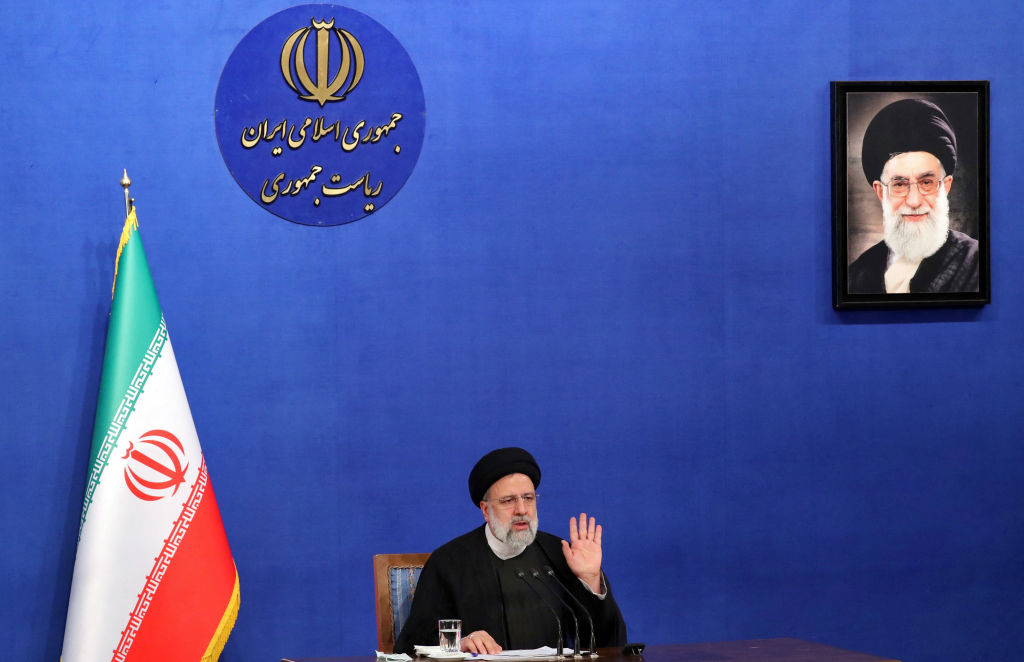
Under the proposed renewed nuclear deal, Iran can legitimately commence operation of advanced uranium enrichment centrifuges in two years, all the while working flat out to develop nuclear-capable ballistic missiles that, along with its terrorist activities, are not covered at all in the agreement. Pictured: Iranian President Ebrahim Raisi speaks during a press conference in Tehran on August 29, 2022. (Photo by STR/AFP via Getty Images)
As Western governments quake in the face of Russian nuclear threats, they are on the verge of striking a deal that will give Iran that same power over them.
Even after six months of war in Europe, they cannot seem to grasp the parallels between the two. Putin risked invading Ukraine because of Western weakness and appeasement, naively welcoming Russia back into the family of nations after it devoured large parts of Ukraine in 2014, while at the same time filling its war chests with ever more billions of euros from energy exports to Europe.
Continue Reading Article
- These are the effects of the proposed nuclear deal brokered by the EU, Russia and China. Why is it brokered by the EU, Russia and China? Because the United States was outrageously banned from direct negotiations by Tehran. It is not outrageous that Iran demanded it, but that the US tolerated its own exclusion.
- [T]he deal that is about to emerge will be even worse [than the 2015 deal]. The argument of the "bad" dealers is that it buys time for the West, with Micawberish optimism that "something will turn up". This thinking is clear from President Biden's preposterous hope that he can "lengthen and strengthen" the deal once it has been struck.
- While in office, Obama declared that Iran would not be allowed to build nuclear weapons on his watch. He must have known that the only way to prevent that was through military action or perhaps crippling sanctions, but was unwilling to do either and the result was the JCPOA, which kicked the problem down the road onto someone else's watch.
- Tehran can legitimately commence operation of advanced uranium enrichment centrifuges in two years, all the while working flat out to develop nuclear-capable ballistic missiles that, along with Iran's terrorist activities, are not covered at all in the agreement.
- The "buying time" argument, and indeed an argument for anyagreement, only works if you do not understand Iran and are naive enough to believe the regime will honor what it agrees to.
- The reality that the optimistic and the unschooled fail to grasp is that the regime in Tehran will ignore constraints imposed by the deal that it does not like.
- Tehran will continue to develop the nuclear capability that it sees as its right — deal or no deal — at the speed it wants until it is physically stopped from doing so. Whatever shape Biden's deal takes there are only downsides for the West and the Middle East and only upsides for Tehran.
- More than that, according to Israeli prime minister Yair Lapid, Tehran will receive $100 billion a year as a result of lifted sanctions.
- Released from sanctions, Iran will be used as an economic refuge by Moscow to evade its own international sanctions.
- Under the draft deal, Iran will be able to retain the uranium that it has been illicitly producing since the original JCPOA, enriched beyond any requirements for a peaceful nuclear programme.... [I]t seems likely that Russia — despite its own repeated nuclear threats — will be handed control of this existing uranium stockpile.
- This chilling scenario — for which the world will pay a very high price — is about to be made more likely by the ill-judged actions of governments in America and Europe, which lack the resolve and courage to apply sufficient economic pressure and military deterrence to put a stop to Iranian nuclear ambitions. Instead, as they did in response to Russian aggression, they are again opting for appeasement, the opium of the faint-hearted.

Under the proposed renewed nuclear deal, Iran can legitimately commence operation of advanced uranium enrichment centrifuges in two years, all the while working flat out to develop nuclear-capable ballistic missiles that, along with its terrorist activities, are not covered at all in the agreement. Pictured: Iranian President Ebrahim Raisi speaks during a press conference in Tehran on August 29, 2022. (Photo by STR/AFP via Getty Images)
As Western governments quake in the face of Russian nuclear threats, they are on the verge of striking a deal that will give Iran that same power over them.
Even after six months of war in Europe, they cannot seem to grasp the parallels between the two. Putin risked invading Ukraine because of Western weakness and appeasement, naively welcoming Russia back into the family of nations after it devoured large parts of Ukraine in 2014, while at the same time filling its war chests with ever more billions of euros from energy exports to Europe.
Continue Reading Article

Wednesday, August 31, 2022
Elul the Tractor Beam
by Rabbi Pinchas Winston
Friday Night
It’s like getting off a moving sidewalk. While you’re on it, you move quite quickly even if you walk slowly. But the walkway beyond it doesn't move at all, so when you get off and walk on normal floor, it feels like you're going slow no matter how fast you are walking.
Elul is a lot like that too. The rest of the year is like the moving sidewalk which moves quite quickly. I mean, can you believe that we’re already just a month before Rosh Hashanah? It not for the addition of L’Dovid and the daily shofar blowing, we’d probably be at the doorstep of the Yemai Norayim wondering how we got there so fast. The Sephardim have already begun saying Selichos as well.
It’s also like a tractor beam from the world of science fiction. That’s a gravitational beam that can lock on objects within a certain distance and pull them in. Rosh Hashanah may be 30 days away, but L’Dovid locks on us now, and like a tractor beam, it pulls us towards Rosh Hashanah, Yom Kippur, all the way to Shemini Atzeres. The average person would probably prefer to not think about Rosh Hashanah until it comes. Halachah compensates for that yetzer hara by changing up our dovening and making life feel more serious than it does the rest of the year.
The rest is up to us. You can lead the horse to water but you can't make it drink. In our case, God could make us “drink,” but He’s not going to because it defeats the whole purpose. We’re being judged on our choices, not His. We can choose to be real with the opportunity of Rosh Hashanah, or to take it lightly.
I used to think that only meant rising to the occasion for 40 days, from Rosh Chodesh Elul until Motzei Yom Kippur. I used to think that all God expected from us was to push ourselves for 40 days to be in our best spiritual form for the final evaluation, after which we would gradually descend once again to our yearly behavior, albeit somewhat better. Apparently I was not alone in that thinking.
Then I realized that tzaddikim get judged for life the moment Rosh Hashanah comes in, and evil people, for death. They really don’t need the next 10 days of teshuvah since the tzaddik is already where they need to be spiritually, and the evil person isn't interested in doing teshuvah anyhow.
That part I already knew for years. What was new to me was the idea that if I am doing what I am supposed to be doing the rest of the year, then I would not need Rosh Hashanah to decide my fate in the upcoming one. The judgment of the 10 days is for the beinoni, the person whose life says that they can go either way, in the direction of the righteous person, or the other direction, God forbid. If that is where my previous year has left me, then what kind of year was it? Was that the path I was choosing for myself from the outset? Wasn't that itself a statement about how serious I took life?
Shabbos Day
IT'S OKAY TO be average, if that is the way God made you. According to Sha’ar HaGilgulim, it is possible. It says there that different souls have different potentials, some to be Torah scholars, some not. God never faults us for not being things we were not made to be. He only faults us for being less than we already can be. He gave us very specific potential. It's up to us to figure out what it is, and how best to actualize it.
That’s a lot easier physically. You can just look at a body and see if it will be strong or weak, athletic or the opposite. Intelligence is also something that seems to naturally show up early in life. A soul however is invisible, and may be a lot “bigger” and “stronger” than the body that houses it. Many of the most spiritually accomplished people in history have been some of the physically weakest in their generation.
Not only this, but I have seen people who, if you had asked me a year before they became a ba’al teshuvah, if they could ever be Torah observant, I would answer no flat out. There was just nothing about them that said they could ever be interested in or handle such a 180-degree change of life. Then they proved me flat out wrong. Oftentimes they have even surprised themselves.
Equally surprising can be someone who seems so spiritual and ready for Torah but who does not go the distance. They’re intellectual there, they’re spiritually there, but they’re blocked for the time being. It might be an emotional block, like a fear of losing a connection to past friends and family, or it can be a spiritual block because they’re still fighting to drag themself out of the Klipos from which all souls begin.
After Adam HaRishon sinned with the Aitz HaDa’as, the Tree of Knowledge, all the souls that were previously a part of his and destined to become ours later on, fell into the realm of spiritual impurity, the Klipos. The greater the soul, the deeper it fell into the Klipos, and the harder it is for it to “leave.” It may still have a propensity to sin in ways that “simpler” people do not even consider to be a challenge.
And of course, there are stories like that of the Rambam, who was written off at an early age as someone who would never advance very far in Torah learning. But he wanted to, very badly. So he poured his heart out to God in front of an open Aron HaKodesh, and never had to look back. He became one of the most accomplished and influential gedolim of the last 2,000 years. There are other stories just like the Rambam’s, though less well known.
So how does a person figure out their spiritual potential? The same way engineers figure out the physical potential of their inventions. They test drive them and push them to the limits to see what those limits are. A person has to do the same thing spiritually, by putting themselves into situations that push their spiritual limits.
In increments, of course. Even the engineers don’t test things all out at first. They do it in stages and levels. If they succeed at one level, then they move on to test their product at the next level, until they get to a point that it is clear that only failure will result.
That’s where spiritual “product” testing and physical product testing can differ dramatically. There’s not a whole lot of reason for God to bend the laws of physics just to make some product more marketable. But He will bend them for someone who wants to spiritually advance beyond their means to do so, perhaps like the Rambam did initially. As the Gemora concludes: Someone who sanctifies themself a little, Heaven sanctifies them a lot (Yoma 38b).
The Rambam did, and look where it got him.
Shalosh Seudot
IF THE ONLY thing we had to battle against was ignorance, it might not be so bad. But it’s not. We have a yetzer hara, our own personal klipah that shadows like, well, a shadow. As the Arizal says, it “moved in” after Adam’s sin, and took over our lives like it is the ba’al habayis, the owner of the “home.”
So much of that resistance to spiritually grow comes from the yetzer hara that loves comfort more than life because it thinks that these are one and the same thing. Or at least it tries to convince us of this in order to stunt our spiritual growth and leave command over our lives in its hands, all the while making people believe that they are the ones in control.
But just wait and see what happens when the yetzer hara is no more. Wait and see how spiritually buoyant you will feel, and driven to accomplish great spiritual things. You will look back and wonder how you never felt that way earlier, while there was still time to use that energy to be spiritually greater. A tzaddik is “just” someone who understands this and makes the effort now while they can. They don’t strive to be righteous. They just strive not to be spiritually mediocre.
This week’s parsha starts out about this as well. On the surface of it, it is simply talking about setting up a complete legal system to keep people honest. On a deeper level, the commentators say that it is talking to each individual, that they should set up their own system of self-evaluation to judge their spiritual progress. They should police their yetzer hara and, when necessary, do something drastic to bring it back in line.
Part of the problem is that the yetzer hara is tricky, clever, and a “man” of many disguises. Amazingly, the most dangerous enemy a person will ever have to face passes as a friendly next-door neighbor who we’re convinced couldn’t harm a fly. Hardly. The yetzer hara inside of us is constantly conspiring against our spiritual growth and greatness, and doesn’t mind losing a few battles along the way to ultimately win the war.
And what is victory for the yetzer hara? It’s duking it out with the person until they’re too old to fight back and accomplish very much meaningful. The yetzer hara knows it’s going down too, but it has the satisfaction of taking their host down with them along the way. Victory is when the person reaches the point of realization that they should have, and could have, done more with their life spiritually, but didn’t.
Therefore, we have Elul Zman. It’s like a boxer who has taken a beating but gets to sit down and regroup in-between rounds. It gives you a chance to look at the enemy from a distance, to see it for it really is. Which is?
(I have returned to giving a Thursday night class online, b”H. To get the link and notified of an upcoming class, write to: yehudisschamroth@gmail.com.)
Ain Od Milvado, Part 16
ONE OF THE most difficult things to do is to square the Sitra Achra with Ain od Milvado. He’s an angel too, and he works for God. So why does it always seem like the Sitra Achra works for himself, and against God?
It’s a little like when you ask someone who seems down, “Is everything okay?” and they answer, “Ya, sure, everything is fine,” in a not so convincing way. The question is, do they want to throw you off and move on, or are they really saying, “If you really want to know, you’ll ask again and insist on the true answer”?
Sometimes people want to complain but do not want to seem like complainers. So, they try to get people to pull the complaint out of them, as if they’re saying, “Well, I really didn’t want to say anything, but since you insist on knowing…”
Right. People who really don’t want to complain fake their happiness well enough to fool everyone else around them. People who act in a way that tells me that something is not quite right really want to talk about it with people who are willing to listen.
Likewise, God runs history in a way that looks normal, except for a few things here and there that make the onlooker wonder, “Is something else going on here?’ Like the Sitra Achra for example.
Some people just find it simpler to not ask the questions, and put the contradictions under the category of, “The Lord works in mysterious ways.” There is God and there is the Sitra Achra. We have to do our best to please God and block the Sitra Achra. The only problem is that sometimes this can lead to a way of thinking that might fall into the category of believing in false powers.
What God is really saying with all the mystery, “Catch Me if you can.” He is saying, “If you really want to know the truth about Me and how I run the world, you’ll ask further, investigate more deeply, and develop a more sophisticated understanding of hashgochah pratis.”
It’s like tracing a family tree. At the bottom of the tree. you’ll find all kinds of relatives are a very different from each other living in different parts of the world. But as you go up the tree, the number of relatives will decrease and the number of places they are living in will be less. Eventually everyone will be living in one place because they are only one family.
Likewise, if you trace all creations, including the Sitra Achra, back to their Original Source, there is only God. But you have to want to trace everything back to God, and be willing to make the effort. And to make that possible, God created many different instruments of His will, to challenge us to see how everything does work for God. Ain od Milvado.
The Shamrak Report: Walk Away from Nuclear Deal and more..
Walk Away from Nuclear Deal
by Bradford Betz
Israel said it would make no further concessions to Iran and would continue to do everything in its power to prevent them from obtaining nuclear weapons.
Israeli Prime Minister Yair Lapid said Israel opposes a return to the Iran nuclear deal, and would not be obligated by such an agreement.
A senior Israeli official said: "The time has come for a new, stronger strategy to stop Iran from getting a nuclear bomb. Iran's terrorist regime should be treated as the tyrannical, extremist, and oppressive regime. The money they get from this deal will go directly into funding terrorism."
In current deal, Iran is poised to rake in an estimated $275 billion in the first year and balloon to an estimated $1 trillion by the early 2030s.
Military Option is the Only One Left
(israelnationalnews.com)
Former top intelligence officials warn that the military option is the only one left once the superpowers sign the nuclear deal.
"Iran is a major strategic threat to the state of Israel. You have to understand that we aren't just talking about a vision; the Iranians are investing a lot of resources to acquire very threatening abilities. According to foreign reports, they have 150 rockets pointed at Israel in Lebanon, long-range missiles, cyber and terror abilities, and worst of all they're on the brink of going nuclear," said Amos Gilad, former National Security Council chief.
If Iran achieves a nuclear weapon," he adds, "they will terrorize the whole Middle East, and the whole area will be forced into a nuclear arms race. Our advantage is that we seem to have strategic abilities, and we will be looked at differently in a nuclear middle east." (On the other hand, the continuation of the 'negotiations will also help Iran to achieve its nuclear ambition.)
Food for Thought
'Palestinians' do not Understand what Peace is
The anti-Semitic world closes its eyes and is not ready to look at reality as it is, because the Palestinian Authority encourages terrorism and the Palestinians glorify the murderers of Jews and make the murderers into heroes. Enemies of Jews and Israel do not understand the concept of peace at all, and their main desire is to eliminate the State of Israel and the Jews who live in it.
Israel is Reducing the Threat from the North
Airstrikes in Syria were attributed to Israel and struck a factory converted by Iranian forces into ammunition warehouses. Russia's removal of S-300 batteries from northwest Syria clears way for Israel's strikes on arms depots and Hezbollah in Syria. An Israeli airstrike on the western Syrian city of Masyaf on Thursday destroyed more than 1,000 Iranian-made missiles.
What does Iran Hide?
Iranian president Ebrahim Raisi said there won't be nuclear deal with world powers if IAEA inspectors continue to investigate man-made uranium particles found at undeclared sites in the country. President Ebrahim Raisi also issued threats against Israel.
Biden Snubs Lapid
The National Security Council has been working in recent days to facilitate a telephone conversation between Prime Minister Yair Lapid and US President Joe Biden as the renewal of the nuclear deal with Iran appears imminent. US officials have denied Lapid's request with the explanation that Biden is on vacation. We have made it clear to everyone: if a deal is signed, it does not obligate Israel. We will act to prevent Iran from becoming a nuclear state, Lapid said. (Israel has no other options but to deal with Iran on its own. 'There is nobody in the White House.)
Erdogan Supports the 'Palestinian Cause'
Turkish President Recep Tayyip Erdogan said that Turkey s reconciliation efforts with Israel will in no way diminish its support for the Palestinian cause . Erdogan made the comments during a visit by Palestinian Authority (PA) chairman Mahmoud Abbas, who arrived in Ankara just one week after Turkey and Israel announced their decision to restore full diplomatic relations and reappoint ambassadors for the first time since 2018. Erdogan said. On the contrary, our Palestinian brothers also express that these steps will contribute to a solution to the Palestinian issue and improve the situation of the Palestinian people. (That means that Turkey is supporting the destruction of Israel - this is the only goal the enemies of Israel have in mind)
Russia Removed S-300 from Syria
Russia has shipped its advanced S-300 air defense system in Syria back home amid its invasion of Ukraine. The S-300 system stationed near the city of Masyaf in north-western Syria had been taken apart in recent weeks and loaded onto a Russian ship bound for the Black Sea port of Novorossiysk. In recent years, Israel and Russia established a so-called de-confliction hotline to keep the sides from getting tangled up and accidentally clashing over Syria.
Israeli F-35s Penetrated Iranian Airspace
Israeli F-35 stealth fighters penetrated Iranian airspace on multiple occasions in the last two months, a Saudi-run news outlet reported. The jets successfully evaded Russian and Iranian radars during the exercises. Drones and mid-air refuelling tankers were also reported to have participated in the massive drills.
Quote of the Week:
Complete horse manure. The Iran nuclear deal is designed to let the Ayatollah cheat his way to a nuclear arsenal. These so-called most rigorous and intensive inspections failed in the last deal - and will be even weaker this time. -Senator Ted Cruz (R-TX)
The US Friendship and Jewish Assertiveness
by Steven Shamrak
Quite often an idea is expressed that the United States is a strong supporter of the State of Israel and Jewish people. Many Jews feel quite nervous when the United States is criticised by Jews and US friendship toward Israel is questioned.
I would like to state clearly and without any reservation: I am a strong admirer of US democracy. I spent half of my life living in the Soviet Union. Therefore, the notion of equality of every individual, freedom of speech and self-expression are very dear to me. I even appreciate the American government s selfishness, as they put the interests of their own country and people first.
If Israel is to become a true democracy, I can only hope that the purity of all these principles will be adopted by the Jewish State.
But let us be truthful and face the reality of historical facts:
1. Knowing the German policy toward Jews before WW2, Jews were not permitted to immigrate to America. The US state department reprimanded and scared Hollywood Jewish producers by accusing them of War mongering . It was Charlie Chaplin, a non-Jew, who broke the taboo by making the comedy The Great Dictator exposing fascism. Not a single bomb was dropped on concentration camps, railroad lines, or bridges leading to them. After the war, American officials were actively involved in providing safe passage to Nazi criminals.
2. The United States supported the UN embargo of arms sales to the region after Israel declared independence in 1948. In the 50's, the US abandoned Israel. And Israel was forced to find new masters' - France and UK - and fought the Sinai War on their behalf.
3. Consistent sabotage of Israel's military successes through the years effectively perpetuated the Arab-Israeli conflict and prevented Israel from attaining decisive victory over her enemies. Past pressure on Israel by President Bush and Condoleezza Rice was just another symptom of the same old sickness (nothing has changed since same is during Obama and Biden presidency, but with more disrespect).
I have stated many times that being pro-Jewish does not make me anti-anything. I am not against Arabs or Christians, nor against USA or Europe. I strongly believe that the Jewish people, in Israel and the Diaspora, must be united in pursuit of their own National Goal: The right of Jews to live in peace on all Jewish land.
This goal is completely justifiable morally, historically, religiously and even legally. We must not pay any attention and disregard what the anti-Israel demagogues and spin-masters are saying or fabricating. Their interests are in conflict with Jewish goals and should not be our concern! For too long, Jews have been accommodating and pleasing others with the detrimental effect to their own needs and interests. It is time to become assertive and give high priority and consideration to Jewish national aspirations. History teaches us that nobody else did, does or will do.
Israeli Prime Minister Yair Lapid said Israel opposes a return to the Iran nuclear deal, and would not be obligated by such an agreement.
He also warned that the revised offer will pave the way for significant investment to flow into Iran s terrorist network and to strengthening the Iranian military.
A senior Israeli official said: "The time has come for a new, stronger strategy to stop Iran from getting a nuclear bomb. Iran's terrorist regime should be treated as the tyrannical, extremist, and oppressive regime. The money they get from this deal will go directly into funding terrorism."
In current deal, Iran is poised to rake in an estimated $275 billion in the first year and balloon to an estimated $1 trillion by the early 2030s.
Military Option is the Only One Left
(israelnationalnews.com)
Former top intelligence officials warn that the military option is the only one left once the superpowers sign the nuclear deal.
"Iran is a major strategic threat to the state of Israel. You have to understand that we aren't just talking about a vision; the Iranians are investing a lot of resources to acquire very threatening abilities. According to foreign reports, they have 150 rockets pointed at Israel in Lebanon, long-range missiles, cyber and terror abilities, and worst of all they're on the brink of going nuclear," said Amos Gilad, former National Security Council chief.
"This is a bad deal and it's good that Israel stated clearly that they aren't bound by it," added Amidror. "Once the Americans decided that they will work towards a deal at almost any cost, the diplomatic 'options' were exhausted. I don't see any way to convince the Iranians other than force since Iran isn't being stopped by diplomatic or financial pressure. This obligates us to ensure that we're ready for a military option".
If Iran achieves a nuclear weapon," he adds, "they will terrorize the whole Middle East, and the whole area will be forced into a nuclear arms race. Our advantage is that we seem to have strategic abilities, and we will be looked at differently in a nuclear middle east." (On the other hand, the continuation of the 'negotiations will also help Iran to achieve its nuclear ambition.)
Food for Thought
by Steven Shamrak
Quite often I see postings: "ISRAEL HAS THE RIGHTS TO DEFEND ITSELF". I am sure they are made, most of the times with good intentions, but not by some Israel-loving Western politicians. Stop stating the obvious - all countries have this right! Why is Israel singled out?
'Palestinians' do not Understand what Peace is
The anti-Semitic world closes its eyes and is not ready to look at reality as it is, because the Palestinian Authority encourages terrorism and the Palestinians glorify the murderers of Jews and make the murderers into heroes. Enemies of Jews and Israel do not understand the concept of peace at all, and their main desire is to eliminate the State of Israel and the Jews who live in it.
Israel is Reducing the Threat from the North
Airstrikes in Syria were attributed to Israel and struck a factory converted by Iranian forces into ammunition warehouses. Russia's removal of S-300 batteries from northwest Syria clears way for Israel's strikes on arms depots and Hezbollah in Syria. An Israeli airstrike on the western Syrian city of Masyaf on Thursday destroyed more than 1,000 Iranian-made missiles.
What does Iran Hide?
Iranian president Ebrahim Raisi said there won't be nuclear deal with world powers if IAEA inspectors continue to investigate man-made uranium particles found at undeclared sites in the country. President Ebrahim Raisi also issued threats against Israel.
Biden Snubs Lapid
The National Security Council has been working in recent days to facilitate a telephone conversation between Prime Minister Yair Lapid and US President Joe Biden as the renewal of the nuclear deal with Iran appears imminent. US officials have denied Lapid's request with the explanation that Biden is on vacation. We have made it clear to everyone: if a deal is signed, it does not obligate Israel. We will act to prevent Iran from becoming a nuclear state, Lapid said. (Israel has no other options but to deal with Iran on its own. 'There is nobody in the White House.)
Erdogan Supports the 'Palestinian Cause'
Turkish President Recep Tayyip Erdogan said that Turkey s reconciliation efforts with Israel will in no way diminish its support for the Palestinian cause . Erdogan made the comments during a visit by Palestinian Authority (PA) chairman Mahmoud Abbas, who arrived in Ankara just one week after Turkey and Israel announced their decision to restore full diplomatic relations and reappoint ambassadors for the first time since 2018. Erdogan said. On the contrary, our Palestinian brothers also express that these steps will contribute to a solution to the Palestinian issue and improve the situation of the Palestinian people. (That means that Turkey is supporting the destruction of Israel - this is the only goal the enemies of Israel have in mind)
Russia Removed S-300 from Syria
Russia has shipped its advanced S-300 air defense system in Syria back home amid its invasion of Ukraine. The S-300 system stationed near the city of Masyaf in north-western Syria had been taken apart in recent weeks and loaded onto a Russian ship bound for the Black Sea port of Novorossiysk. In recent years, Israel and Russia established a so-called de-confliction hotline to keep the sides from getting tangled up and accidentally clashing over Syria.
Israeli F-35s Penetrated Iranian Airspace
Israeli F-35 stealth fighters penetrated Iranian airspace on multiple occasions in the last two months, a Saudi-run news outlet reported. The jets successfully evaded Russian and Iranian radars during the exercises. Drones and mid-air refuelling tankers were also reported to have participated in the massive drills.
Quote of the Week:
Complete horse manure. The Iran nuclear deal is designed to let the Ayatollah cheat his way to a nuclear arsenal. These so-called most rigorous and intensive inspections failed in the last deal - and will be even weaker this time. -Senator Ted Cruz (R-TX)
The US Friendship and Jewish Assertiveness
by Steven Shamrak
Quite often an idea is expressed that the United States is a strong supporter of the State of Israel and Jewish people. Many Jews feel quite nervous when the United States is criticised by Jews and US friendship toward Israel is questioned.
I would like to state clearly and without any reservation: I am a strong admirer of US democracy. I spent half of my life living in the Soviet Union. Therefore, the notion of equality of every individual, freedom of speech and self-expression are very dear to me. I even appreciate the American government s selfishness, as they put the interests of their own country and people first.
If Israel is to become a true democracy, I can only hope that the purity of all these principles will be adopted by the Jewish State.
But let us be truthful and face the reality of historical facts:
1. Knowing the German policy toward Jews before WW2, Jews were not permitted to immigrate to America. The US state department reprimanded and scared Hollywood Jewish producers by accusing them of War mongering . It was Charlie Chaplin, a non-Jew, who broke the taboo by making the comedy The Great Dictator exposing fascism. Not a single bomb was dropped on concentration camps, railroad lines, or bridges leading to them. After the war, American officials were actively involved in providing safe passage to Nazi criminals.
2. The United States supported the UN embargo of arms sales to the region after Israel declared independence in 1948. In the 50's, the US abandoned Israel. And Israel was forced to find new masters' - France and UK - and fought the Sinai War on their behalf.
3. Consistent sabotage of Israel's military successes through the years effectively perpetuated the Arab-Israeli conflict and prevented Israel from attaining decisive victory over her enemies. Past pressure on Israel by President Bush and Condoleezza Rice was just another symptom of the same old sickness (nothing has changed since same is during Obama and Biden presidency, but with more disrespect).
I have stated many times that being pro-Jewish does not make me anti-anything. I am not against Arabs or Christians, nor against USA or Europe. I strongly believe that the Jewish people, in Israel and the Diaspora, must be united in pursuit of their own National Goal: The right of Jews to live in peace on all Jewish land.
This goal is completely justifiable morally, historically, religiously and even legally. We must not pay any attention and disregard what the anti-Israel demagogues and spin-masters are saying or fabricating. Their interests are in conflict with Jewish goals and should not be our concern! For too long, Jews have been accommodating and pleasing others with the detrimental effect to their own needs and interests. It is time to become assertive and give high priority and consideration to Jewish national aspirations. History teaches us that nobody else did, does or will do.
Monday, August 29, 2022
Rav Kook on Parashat Shoftim: The Sorcerer and the Gidufi
Which is worse: a sorcerer or an idolatrous heretic?
Theoretical Knowledge
Concerning sorcery, the Torah warns:
“When you come into the land that God is giving you, do not learn to do the repulsive practices of those nations.” (Devarim 18:9)
What are these “repulsive practices”? The Torah enumerates divination, witchcraft, incantations, communicating with the dead, and so on. These forms of sorcery were an integral part of the idolatrous culture of the Canaanites.
Yet the Sages read this verse with care. The Torah text does not say, “Do not learn their repulsive practices,” but “Do not learn to do them.” Study — with the intent of practicing sorcery — is forbidden. But one is permitted to study witchcraft “in order to understand and judge,” i.e., to correctly determine who is a sorcerer and should be punished accordingly (Shabbat 75a).
However, the Torah’s sanction to acquire theoretical knowledge of sorcery is not a blanket authorization. The Talmud contrasts the sorcerer with a far worse category: the Gidufi. A Gidufi is a fervent believer in idolatry who constantly proselytizes for his idol worship. “One who learns even one thing from a Gidufi is punishable by death.” Unlike the sorcerer, this fanatical heretic has nothing to teach us.
Why is the idolatrous Gidufi so much worse than the sorcerer?

Sorcery — Penetrating Evil
Rav Kook explained that the sorcerer’s motivation is an attempt to reconcile the fundamental conflict between the animalistic and Divine aspects of the human soul. The sorcerer’s solution to this constant struggle is to suppress the Divine nature of the soul. This frees the base instincts to rule over the individual, and society in general.
The means and techniques by which the sorcerer achieves his goal are complex. Some aspects of his knowledge may also be utilized for the good. Recognition of evil means awareness of the negative side of creation, which can grant deeper understanding of the positive side.
Heresy — Rejecting Truth
The sorcerer gains his knowledge by focusing his mental powers on the essence of evil. But the idolatrous Gidufi is much worse. His methods do not reveal any hidden knowledge, not even with regard to the realm of evil. The Gidufi simply rejects good and truth. He offers us no new understanding. His path is based on stubbornness, to fill the heart with doubts and intoxication.
Deeper awareness of evil, of hidden aspirations to promote evil in the world, entails spiritual dangers. But it has the potential to prepare the soul, and all of society, to define and refine evil, and to purify it from its baseness.
(Adapted from Ein Eyah vol. IV, pp. 138-139 by Rav Chanan Morrison)
Theoretical Knowledge
Concerning sorcery, the Torah warns:
“When you come into the land that God is giving you, do not learn to do the repulsive practices of those nations.” (Devarim 18:9)
What are these “repulsive practices”? The Torah enumerates divination, witchcraft, incantations, communicating with the dead, and so on. These forms of sorcery were an integral part of the idolatrous culture of the Canaanites.
Yet the Sages read this verse with care. The Torah text does not say, “Do not learn their repulsive practices,” but “Do not learn to do them.” Study — with the intent of practicing sorcery — is forbidden. But one is permitted to study witchcraft “in order to understand and judge,” i.e., to correctly determine who is a sorcerer and should be punished accordingly (Shabbat 75a).
However, the Torah’s sanction to acquire theoretical knowledge of sorcery is not a blanket authorization. The Talmud contrasts the sorcerer with a far worse category: the Gidufi. A Gidufi is a fervent believer in idolatry who constantly proselytizes for his idol worship. “One who learns even one thing from a Gidufi is punishable by death.” Unlike the sorcerer, this fanatical heretic has nothing to teach us.
Why is the idolatrous Gidufi so much worse than the sorcerer?
Sorcery — Penetrating Evil
Rav Kook explained that the sorcerer’s motivation is an attempt to reconcile the fundamental conflict between the animalistic and Divine aspects of the human soul. The sorcerer’s solution to this constant struggle is to suppress the Divine nature of the soul. This frees the base instincts to rule over the individual, and society in general.
The means and techniques by which the sorcerer achieves his goal are complex. Some aspects of his knowledge may also be utilized for the good. Recognition of evil means awareness of the negative side of creation, which can grant deeper understanding of the positive side.
Heresy — Rejecting Truth
The sorcerer gains his knowledge by focusing his mental powers on the essence of evil. But the idolatrous Gidufi is much worse. His methods do not reveal any hidden knowledge, not even with regard to the realm of evil. The Gidufi simply rejects good and truth. He offers us no new understanding. His path is based on stubbornness, to fill the heart with doubts and intoxication.
Deeper awareness of evil, of hidden aspirations to promote evil in the world, entails spiritual dangers. But it has the potential to prepare the soul, and all of society, to define and refine evil, and to purify it from its baseness.
(Adapted from Ein Eyah vol. IV, pp. 138-139 by Rav Chanan Morrison)
Teshuva - Fear and Joy
by HaRav Mordechai Greenberg
Nasi HaYeshiva, Kerem B'Yavneh
"Judges and officers you shall appoint in all your cities." (Devarim 16:18) The simple meaning of this verse is the obligation to appoint judges to rule between man and his friend and to teach G-d's laws and His Torah. However, there is an additional meaning that the Mussar masters talk much about. A person is commanded to be a judge of his own matters and to review himself at all times with discernment; thus, a person judges himself. It is not for naught that this parsha is always read at the beginning of the month of Elul, because the time of judgment is approaching, and therefore a person must place himself before the seat of judgment, before G-d does so on the Day of Judgment. The very fact that a person judges himself and appoints himself a judge is the beginning of the teshuva process.
However, every criticism causes a person discomfort. "My sin is before me always" (Tehillim 51:5) places the person before himself in a negative light. It leads to an attempt to escape and puts the person into depression. Therefore, Teshuva is always viewed as something burdensome, depressing and not natural.
In truth, though, Rav Kook zt"l writes in Orot HaTeshuva (15:9):
The upset thought, which comes through the connection to the depths of teshuva, is the source of joy. The basic nature of teshuva is the contemplation of the greatness of the supreme perfection of Divine spirituality. Through this, the sins stand out very much. "You have set our iniquities before Yourself, our immaturity before the light of your countenance." (Tehillim 90:8) And since we sense, as the sensation of sin is any case comes from the Divine shining on the soul, this idea itself fills with infinite joy and greatness. The delight of happiness increasingly strengthens simultaneous with the submission of the heart, which stands at the level of teshuva.
It is through closeness to G-d a person's sins are highlighted more. The sins depress the person, but the closeness to G-d leads to happiness.
"Teshuva does not come to make life bitter, but rather to make it pleasant." (ibid 16:7) Even though the person is still caught in the mud and does not know how to escape it, nonetheless, the very aspiration to free oneself from sin leads to a sense of satisfaction. Rav Kook further writes:
At the time that [a person] thinks all about the burning thought of full regret for all of his sins, at the time that his soul dotes with love for the beauty of sanctity and perfection, longs for her Lover, Creator ... even though he ponders much how to extricate himself from the mud of the sins, even thought it is not at all clear to him how to repair the entire past, even though the ways of action are not at all paved before him, and they are full of stumbling rocks - however, the desire to be good - this is the spirit of G-d's Gan Eden, which blows in the soul and fills it with unlimited satisfaction, so that even the fire of Gehenom of deep suffering, also turns into a river of pleasure.
In a letter that Rav Kook wrote in the month of Elul to one of his disciple, he writes:
I would like to encourage the diligent, may there be many like them in Israel, and to remind you the basic ideas of the means of preparation that we should be involved in, for our true perfection at the year's end, and to prepare ourselves for the light of the holy days ... the Day of Remembrance (Rosh Hashana), the days of Teshuva, and the holy day Yom Kippur, and the days of happiness, the Festival of Succot and Simchat Torah that are coming upon us for good, G-d willing.
The preparations of the month of Elul come not only to impart trepidation and fear, but instead, from the fear of closeness to G-d to reach joy; from the days of Elul, the days of Teshuva, to reach the peak - Simchat Torah. The Chasidim say that all the days of Elul, Rosh Hashana, Yom Kippur, and Chag Succot are only a preparation for "Ata Hor'eta" of Simchat Torah night.
Choose Your Fear
by HaRav Shaul Yisraeli, zt"l
Rosh HaYeshiva, Mercaz HaRav
Rosh Kollel, Eretz Hemdat
Chaver, Beit Din HaGadol Yerushalayim
"[The king] shall read from [his personal sefer Torah] all the days of is life, so that he shall learn to fear Hashem" (Devarim 17:19). There is no amount of time after which we can say that we have learned enough Torah. It requires a concentration of all our time – all our life – no less. Study of how to fear Hashem is a course that requires a lifetime, not just for people on a low level, but even for people on the highest level.
There are two types of fear, both of which appear in our parasha: one is desirable, the other is undesirable. The fear of Hashem that comes with study of Torah throughout life is obviously desirable. Later on we read about the man "who is fearful and has a soft heart," who has to "go and return to his house" (ibid. 20:8), instead of taking part in the nation’s battle. Just as one has to toil to create the desirable fear, so must one toil to rid himself of the undesirable fear. Furthermore, the two fears are opposed and contradictory – when one possesses the proper fear, it destroys the improper one.
Yeshaya asks: "Who are you that you fear a person who is destined to die?" (Yeshaya 51:12). Fear is present not only at times of war but even in times of peace. Most of our actions and our energies are actually motivated by mundane fears. We are afraid of what we will have to eat tomorrow and into the future. It seems to be the work of the Satan that a person wants to make shoes that will last him for seven years when he is not sure that he will live more than seven days, so that the Satan can then laugh at us. We are afraid of those who are far away from us and those who are close to us, lest they encroach on our space and take that which we were wanted for ourselves. Why do we work so hard for things that we do not need but are there just to glorify us, such as nice clothes and fancy drapes? All that hard work, which is motivated by a fear of what others will think, is a fear of people who are destined to die.
The Torah teaches us not to bow to pressure, but to realize what it means to be a free person. The Torah says about the king: "He shall learn to fear Hashem," and the Rabbis point out that this is referring to the king who has no one above him other than Hashem (Horiyot 11a). Let us remember that, in essence, all of Israel are the sons of kings (Bava Metzia 113b). If someone lacks fear of Hashem then he will have the fear of every leaf that falls off the tree. Only the significant, positive fear will straighten our spine; lowering our posture before Hashem can straighten our stature when it comes to other people.
The soldier who is fearful and soft of heart, say Chazal, is "one who is fearful because of the sins in his hand" (Mishna, Sota 8:5). This is the one who ‘shoots arrows up at Hashem,’ and kicks with a callous heart everything that is holy and pure, with the chutzpa of one who says that he has no Master. He does not know that when he denies his one Master, he is really creating for himself hundreds of thousands of human masters to fear.
Standards of Justice
by Rabbi Dov Berel Wein
This week's Torah reading envisions for us an efficient, organized system of law and order, justice, and fairness. The Torah set a very high bar regarding the selection of judges and police. They are to be free of prejudice, bias and personally held agendas and social ideals. They are literally to be blind, without knowledge as to the nature and personalities of the litigants who appear before them and whose cases they must decide. The judges must be free of any form of corruption, from open graft to simple courtesy.
The Talmud records for us that the great Mar Shmuel, the head of the Academy of third century, Nehardea in Babylonia, was walking across a narrow bridge when the person coming towards him honorably made way so that the Rabbi could pass. Later in the day, this very same person appeared as a litigant before Mar Shmuel in a case before his court. Afraid of being influenced by the courtesy extended to him by this person, by allowing him to pass first on the narrow bridge, Mar Shmuel disqualified himself from judging the matter.
While such standards of justice that are outlined in this week's reading are almost impossible for human beings to achieve, we all are influenced by great and small things that occur to us, and by previous prejudices that have been instilled into us by events and societies. Though justice may be blind, the justices themselves rarely, if ever, are able to obtain the necessary level of fairness that the Torah seems to demand. Yet, we are aware that the Torah was not granted to angels, but rather, to human beings, and human beings are never perfect and always have, within themselves, prejudices and preconceived ideas regarding policies and judgments.
The Torah set standards for us to try and achieve. It never demands the impossible from human beings. So, the requirements set forth in this week's reading are the goals that we must try to achieve. We must pick the best, wisest, least prejudice, most honest people of integrity, that we can find in our midst, and appoint them as judges and police. Yet, the Torah reminds us that ultimate justice belongs to the Lord.
Mistakes that we make here on earth, in the long run of time and eternity, are always rectified by Heaven. We should be comforted by this. The Talmud teaches that a judge can only judge what he sees and understands, with the human condition appearing before him. Heaven, however, has the ability to see everything, in terms of eternity, in terms of ultimate justice and fairness to all. It is without limited knowledge, therefore, that we are to do our best, and realize that ultimate justice is not done here on earth, but, rather, subject to the guidelines of Heaven. We can only attempt to create the best system of justice that is possible, within the constraints of human behavior and society.
Still More Dangerous New Concessions by Biden Administration for a Nuclear Deal with Iran's Mullahs
by Majid Rafizadeh

The Biden administration's policy towards the Iranian regime has been one of capitulation and giving concessions, and it appears determined to enrich and empower what the State Department has called "the world's top state sponsor of terrorism," whose core policy since its Islamic Revolution in 1979 has been to "export the revolution," as anchored in "Death to America" and "Death to Israel". Pictured: A member of the Islamic Basij volunteer militia burns an American flag in Tehran, Iran, on July 16 2022. (Photo by Atta Kenare/AFP via Getty Images)
Since assuming office, the Biden administration's policy towards the Iranian regime has been one of capitulation and giving concessions to the ruling Islamist mullahs of Iran. So far, they include suspending some of the anti-terrorism sanctions on Iran-backed Houthis, then revoking the designation of Yemen's Houthis as a terrorist group; disregarding Iran's oil sales to China; shipping oil to Syria, Lebanon's Hezbollah and Venezuela in direct violation of US sanctions; ignoring the Iranian regime's crackdown on protesters, smuggling weapons to the Houthis and Venezuela; attempting to murder US former officials and citizens on American soil, and taking more foreign hostages.
Continue Reading Article
- Newly leaked information from inside Iran, obtained by Iran International, reveals that the Biden administration has made even more concessions to revive the nuclear deal, which have not been revealed to the public. According to the report, "the US guarantees that its sanctions against IRGC would not affect other sectors and firms: e.g. a petrochemical company shouldn't be sanctioned by US because of doing business with IRGC."
- The Biden administration seems to have been bragging that Iran's leaders have dropped a key demand: removing the Islamic Revolutionary Guard Corps (IRGC) from the US foreign organizations terrorist list. But if other sectors that are linked to the IRGC can freely do business under the nuclear deal, then the designation of the IRGC as a terrorist organization, as well as the sanctions against the IRGC, are merely cosmetic.
- The IRGC has a large stake in almost every industrial sector in Iran, which includes the energy sector, mining, telecommunications, gold, shipping and construction. Private sector competitors are not permitted in these sectors because the more closed the economy, the more easily the IRGC can monopolize it.
- As a result, any economic growth in these sectors will directly benefit Iran's military, the IRGC and its elite Quds Force branch, and Iran's militia and terror groups across the Middle East. Since Iran's economy is predominantly controlled by the IRGC or the state, additional revenues will likely be funneled into the treasury of the IRGC and the office of Supreme Leader Ayatollah Ali Khamenei.
- The other critical concession being reportedly made is that "the participants note the firm commitment of the US President [without mentioning Joe Biden by name] for returning to JCPOA compliance as long as Iran remains committed to the deal." This probably means that future US presidents are obliged to continue with the implementation of the nuclear deal. But why should the US guarantee the implementation of the nuclear deal if it is not even a legally binding treaty, approved by two-thirds of the Senate, in accordance with Article II, section 2 of the US Constitution? In addition, it is illegal for any president to commit future presidents to anything that has not been approved as a formal treaty by two-thirds of the Senate.
- This is a much worse deal than the 2015 nuclear deal. Because, first, the US or EU3 (France, the United Kingdom and Germany) cannot call for reinstating sanctions on Iran unilaterally even if they believe that the Iranian regime is violating the nuclear deal. In the previous nuclear deal, at least, any single party to the deal could unilaterally trigger the snap-back sanctions clause. In addition, with the new deal, restrictions on the regime's nuclear program could be lifted only two years after the agreement is signed; and the Iranian regime will not be obliged to reveal its past nuclear activities, which had military dimensions; and Russia will be trusted to store Iran's enriched uranium, a task for which Moscow will be paid.
- Reportedly, another concession that the Biden administration has made to Iran is that the IAEA is expected to halt its investigation into the regime's past nuclear activities.
- "This shift to appeasement was never going to solve any of the world's issues with the Islamic Republic. The regime's problem with the West is the West's very existence, which obstructs its path to a global caliphate." — Reza Pahlavi, eldest son of Shah Mohammad Reza Pahlavi and an advocate of secular democracy for Iran, Wall Street Journal, August 8, 2022.

The Biden administration's policy towards the Iranian regime has been one of capitulation and giving concessions, and it appears determined to enrich and empower what the State Department has called "the world's top state sponsor of terrorism," whose core policy since its Islamic Revolution in 1979 has been to "export the revolution," as anchored in "Death to America" and "Death to Israel". Pictured: A member of the Islamic Basij volunteer militia burns an American flag in Tehran, Iran, on July 16 2022. (Photo by Atta Kenare/AFP via Getty Images)
Since assuming office, the Biden administration's policy towards the Iranian regime has been one of capitulation and giving concessions to the ruling Islamist mullahs of Iran. So far, they include suspending some of the anti-terrorism sanctions on Iran-backed Houthis, then revoking the designation of Yemen's Houthis as a terrorist group; disregarding Iran's oil sales to China; shipping oil to Syria, Lebanon's Hezbollah and Venezuela in direct violation of US sanctions; ignoring the Iranian regime's crackdown on protesters, smuggling weapons to the Houthis and Venezuela; attempting to murder US former officials and citizens on American soil, and taking more foreign hostages.
Continue Reading Article
A Mass Murderer of Jews Goes to Berlin
by Daniel Greenfield
Abbas earned his doctorate for his Holocaust denial thesis from the USSR's Patrice Lumumba University: created to train third world assets for a Communist war on free nations, . The KGB reportedly recruited the "Palestinian" terrorist leader, gave him the code name "mole" and put him to work under the man who now serves as Putin’s special representative the region.
When Abbas wasn't working for the Communists, he was being inspired by the Nazis. Edy Cohen, an Israeli researcher who wrote a book on Hitler’s Mufti, warned that Abbas' Holocaust denial thesis was "inspired by and based on the work of Adolf Eichmann, the architect of the Holocaust." Abbas and Eichmann had both made killing Jews and lying about it their life’s work.
31 years after the visit by Hitler's Mufti, Abbas and the "Palestinians" made their grand bid to replace the Nazis with the Munich Massacre of Israeli Jewish athletes.
The Munich Olympics were meant to show off the new Germany. And they did. In the new Germany, the job of killing Jews had been outsourced to Muslim 'guests'.
German authorities had refused to provide security because it would clash with the country's image makeover and so the Muslim terrorists were able to freely operate in the Olympic Village.
The unarmed Israeli coaches and athletes fought the 8 armed Muslim terrorists for their lives. Some were killed outright, one was castrated, while others were taken hostage. Germany rejected Israeli pleas to allow them to send a hostage rescue team. Shortly after the massacre was over, it began secret negotiations with the terrorists to cut a deal to recognize the PLO.
After the massacre, the bodies of deceased terrorists were sent back where they were buried with full honors. Those terrorists who were arrested, were shortly released. The Olympics refused to initially even postpone the games and made no reference to the massacre. It took over 40 years for the Olympics to officially commemorate the dead athletes and coaches.
Abbas was one of the senior officials who planned the massacre and provided the money to carry it out. Despite that, Chancellor Scholz decided to hold a joint press conference with a Holocaust denier responsible for the worst post-Holocaust massacre of Jews on German soil.
Was he really surprised or disgusted? And will there be any consequences?
As Stephen M. Flatow, an American father whose daughter Alisa was brutally murdered in a bus bombing in Israel, wrote in a recent JNS editorial that, “Germany sent the Palestinian Arabs $199 million last year.”
“Let’s not lose sight of the incredible hypocrisy of governments that shed crocodile tears over the Munich massacre, and then send hundreds of millions of dollars to a man who helped perpetrate it,” he writes.
The German representative in Ramallah repeatedly boasts of all the money flowing from Berlin to the terrorist territories. None of that money will stop. No diplomatic relations will be cut.
In the past few months, Abbas has met with Biden, France's Macron and Romania's Klaus Iohannis where the Islamic terrorist leader was decorated with the “Star of Romania”.
The only country to turn down a visit by Abbas was the Saudi Kingdom.
When Hungarian Prime Minister Viktor Orban, often accused of anti-Semitism by the Left, visited Israel in 2018, he "broke protocol" by not scheduling a visit with Abbas. That was a rare exception to the world leaders who have hugged and shaken hands with the terrorist boss.
Biden, Putin and Xi Jinping have all paid tribute to Abbas and to the notion that Israel's existence on its own land represents some sort of "occupation" when the only occupation is the one carried on by the Arab Muslim colonists who terrorize Israel’s indigenous Jewish population.
Despite clamoring about the occupation, Abbas promised Xi Jinping to stand with China in its occupation of Hong Kong and the repression of fellow Muslims in Xinjiang. He endorsed Russia’s invasion of Ukraine. Not surprising for a dictator who was last elected in 2005.
Mahmoud Abbas, President of the Palestinian Authority, an imaginary place that never existed and still doesn't, claims to represent the equally imaginary Palestinian people. Whom does he actually represent? A poll of the Arab Muslim settlers living in the terrorist-occupied territories in Israel earlier this year revealed that 73% want Abbas to resign and that he would lose any election. So there isn’t going to be an election and the big lie of “Palestine” will keep on going.
Abbas is a terrorist who doesn’t represent anyone except his armed minions and state sponsors. A “Palestinian” state is as historically legitimate as ISIS, and its leader is as legitimately in office as Adolf Hitler. The only thing that the murderous leadership of a fictional terror state have ever given the world is international terrorism.
Despite these indisputable facts, Chancellor Scholz chose to welcome Abbas. And the rest of the world’s leaders will go on welcoming the Holocaust denier and former KGB agent the way that Berlin once welcomed Hitler’s Mufti. What was once the ugliness of the Nazi regime has become the multinational human rights consensus of the international community.
The Mufti of Jerusalem and Mahmoud Abbas had a simple message. Hitler invited the Mufti of Jerusalem because he agreed with his call to kill the Jews. The only reason that the leaders of the world community continue to invite Abbas over is because they agree with his message.
It would be undiplomatic of them to say so. They invite him to say it for them instead.
At a press conference with German Chancellor Olaf Scholz, Abbas refused to apologize for his Munich Massacre of Jews and falsely claimed that Israel had carried out "50 holocausts" against the Arab Muslim settlers occupying Israel.
Scholz, Merkel's successor, said nothing at the joint press conference, but later tepidly condemned the remarks. “I am disgusted by the outrageous remarks made by Palestinian President Mahmoud Abbas,” he tweeted. Why should he be? This is who Abbas is.
After a Muslim settler recently opened fire at a bus stop and shot a number of Israelis and American tourists, including a pregnant woman who was hit in the stomach, Abbas' Fatah celebrated the attack, posting on Facebook, "Praise to the rifle muzzles."
In 1929, years before Hitler took power, the Hevron massacre by the Muslim settler population brutally killed the local Jewish men, women and children, mutilated their bodies and scattered limbs and organs. Every year, the Palestinian Authority honors three of the killers as "martyrs".
One of the PA's martyrs, Muhammad Jamjoum, confessed to murdering five Jews. Another, Ataa Al-Zir, murdered three innocent people back when Hitler could only dream of killing Jews.
The “Palestinian” cause is the modern standard bearer of the Nazis. The terrorist group whose representative was invited to Berlin has killed more Jews than anyone since the Nazis.
And has spent more time lying about it than any ordinary Holocaust denier in Germany.
Abbas earned his doctorate for his Holocaust denial thesis from the USSR's Patrice Lumumba University: created to train third world assets for a Communist war on free nations, . The KGB reportedly recruited the "Palestinian" terrorist leader, gave him the code name "mole" and put him to work under the man who now serves as Putin’s special representative the region.
When Abbas wasn't working for the Communists, he was being inspired by the Nazis. Edy Cohen, an Israeli researcher who wrote a book on Hitler’s Mufti, warned that Abbas' Holocaust denial thesis was "inspired by and based on the work of Adolf Eichmann, the architect of the Holocaust." Abbas and Eichmann had both made killing Jews and lying about it their life’s work.
31 years after the visit by Hitler's Mufti, Abbas and the "Palestinians" made their grand bid to replace the Nazis with the Munich Massacre of Israeli Jewish athletes.
The Munich Olympics were meant to show off the new Germany. And they did. In the new Germany, the job of killing Jews had been outsourced to Muslim 'guests'.
German authorities had refused to provide security because it would clash with the country's image makeover and so the Muslim terrorists were able to freely operate in the Olympic Village.
The unarmed Israeli coaches and athletes fought the 8 armed Muslim terrorists for their lives. Some were killed outright, one was castrated, while others were taken hostage. Germany rejected Israeli pleas to allow them to send a hostage rescue team. Shortly after the massacre was over, it began secret negotiations with the terrorists to cut a deal to recognize the PLO.
After the massacre, the bodies of deceased terrorists were sent back where they were buried with full honors. Those terrorists who were arrested, were shortly released. The Olympics refused to initially even postpone the games and made no reference to the massacre. It took over 40 years for the Olympics to officially commemorate the dead athletes and coaches.
Abbas was one of the senior officials who planned the massacre and provided the money to carry it out. Despite that, Chancellor Scholz decided to hold a joint press conference with a Holocaust denier responsible for the worst post-Holocaust massacre of Jews on German soil.
Was he really surprised or disgusted? And will there be any consequences?
As Stephen M. Flatow, an American father whose daughter Alisa was brutally murdered in a bus bombing in Israel, wrote in a recent JNS editorial that, “Germany sent the Palestinian Arabs $199 million last year.”
“Let’s not lose sight of the incredible hypocrisy of governments that shed crocodile tears over the Munich massacre, and then send hundreds of millions of dollars to a man who helped perpetrate it,” he writes.
The German representative in Ramallah repeatedly boasts of all the money flowing from Berlin to the terrorist territories. None of that money will stop. No diplomatic relations will be cut.
In the past few months, Abbas has met with Biden, France's Macron and Romania's Klaus Iohannis where the Islamic terrorist leader was decorated with the “Star of Romania”.
The only country to turn down a visit by Abbas was the Saudi Kingdom.
When Hungarian Prime Minister Viktor Orban, often accused of anti-Semitism by the Left, visited Israel in 2018, he "broke protocol" by not scheduling a visit with Abbas. That was a rare exception to the world leaders who have hugged and shaken hands with the terrorist boss.
Biden, Putin and Xi Jinping have all paid tribute to Abbas and to the notion that Israel's existence on its own land represents some sort of "occupation" when the only occupation is the one carried on by the Arab Muslim colonists who terrorize Israel’s indigenous Jewish population.
Despite clamoring about the occupation, Abbas promised Xi Jinping to stand with China in its occupation of Hong Kong and the repression of fellow Muslims in Xinjiang. He endorsed Russia’s invasion of Ukraine. Not surprising for a dictator who was last elected in 2005.
Mahmoud Abbas, President of the Palestinian Authority, an imaginary place that never existed and still doesn't, claims to represent the equally imaginary Palestinian people. Whom does he actually represent? A poll of the Arab Muslim settlers living in the terrorist-occupied territories in Israel earlier this year revealed that 73% want Abbas to resign and that he would lose any election. So there isn’t going to be an election and the big lie of “Palestine” will keep on going.
Abbas is a terrorist who doesn’t represent anyone except his armed minions and state sponsors. A “Palestinian” state is as historically legitimate as ISIS, and its leader is as legitimately in office as Adolf Hitler. The only thing that the murderous leadership of a fictional terror state have ever given the world is international terrorism.
Despite these indisputable facts, Chancellor Scholz chose to welcome Abbas. And the rest of the world’s leaders will go on welcoming the Holocaust denier and former KGB agent the way that Berlin once welcomed Hitler’s Mufti. What was once the ugliness of the Nazi regime has become the multinational human rights consensus of the international community.
The Mufti of Jerusalem and Mahmoud Abbas had a simple message. Hitler invited the Mufti of Jerusalem because he agreed with his call to kill the Jews. The only reason that the leaders of the world community continue to invite Abbas over is because they agree with his message.
It would be undiplomatic of them to say so. They invite him to say it for them instead.
Friday, August 26, 2022
Rav Kook's Igrot Hare’aya: Questions about Religious Services in Eretz Yisrael – #111 – part V
Date and Place: 2 Adar I 5668 (1908), Yafo
Recipient: Rabbi Yitzchak Isaac Halevi, author of Dorot Harishonim.
Body: I will do my best to answer your questions. First, I will quote your question, and then I will answer.
Question #6: Which colonia (settlement) is the most prepared to begin with [regarding starting the desired new type of religious school]?
My answer: In this matter I cannot make a clear decision, for each is very much in need of it. The influence of the [secular] schools is destroying Eretz Yisrael, and the religious schools have still not reached their goals because they have not supplemented themselves with the necessary worldliness. The main reason this has not been accomplished is the limited resources of the organizers, in addition to the habit of hating everything that is new. However, if we will join together wise people who are well-entrenched in Torah and fear of Heaven, we can remedy many things, with Hashem’s help.
It would still seem to me to give precedence to those settlements that don’t have any religious school, and only later to turn to those settlements that have religious schools, just that they are not set up well. I am not familiar with the settlements of the Galilee region. But closer to the region of Judea, the settlement of Samarin (Samaria) is the one which should be saved first. There the French style of education has taken hold and the destructive forces have come along with it, and it is far away from any of the holy cities. On the other hand many of the people who live there would be interested in straightforward, accepted education with true fear of Heaven, if it is well-supplemented with matters of the ways of life.
One of the bigger remedies for the settlements is that I will humbly be making rounds from time to time in the settlements to take a look at the general religious situation and to make public addresses on matters of ethics and life lessons. However, this requires a significant outlay of money because we need to present the rabbinate in an honorable manner. All the more so, we must not degrade the rabbinate by receiving any compensation from those upon whose paths we want to shine a light of sanctity. Therefore, I need to have at my constant disposal a carriage so that I can travel among the more than 30 settlements that are scattered throughout Judea and Samaria and have no one looking after their [religious situation]. I know the extent to which these travels in an honorable manner with discussions and public addresses are highly impactful. However, this requires an appropriate budget. Perhaps, Hashem will arrange this, so that a new light will begin to shine in the Holy Land in the new Yishuv, to tie them with ropes of love for Torah and fear of Hashem, so that the righteousness of the actions will be complete and they will give hope to many future generations.
When Hashem will grant us the ability to bring the plans for the yeshiva to fruition it will be an opening of hope for all, for rabbis to ask, for teachers to ask, and for the honor of Torah and [authentic] Judaism in the new Yishuv. It will be a source of permanent and internal connection between the new and old Yishuv, and the two of them together with the entirety of the Diaspora communities.
May Hashem grace our ideas and be with us in all that we do …
Subscribe to:
Posts (Atom)