Friday, January 05, 2024

A Bush that Burns but Is Not Consumed

by HaRav Dov Begon
Rosh HaYeshiva, Machon Meir

Moshe’s great vision of a bush that burned but was not consumed hints to us about Am Yisrael’s situation in Mitzrayim. Despite the fact that among the Jews there were gossips and slanderers, alluded to by the sneh, the Midat HaDin, alluded to by the fire, still did not consume them.

Although Am Yisrael in Egypt had sunk to the forty-ninth level of impurity, they still emerged from Egyptian slavery to eternal freedom. This is the axiom of Jewish eternity, that the bris between G-d and Am Yisrael shall never cease, despite Am Yisrael’s sometimes lacking merit. Or, as the Chachamim put it, “The covenant of the brit will never cease even after our ancestral merit has ceased.” All this is hinted at by the burning bush that is not consumed.

Right now we must learn to recognize and understand this great principle, that no fire can consume the Jewish People. Even the fire of the terrible Holocaust which annihilated one third of our nation, and even the fire of assimilation which is consuming large portions of our people in the Diaspora, and certainly the savagery of Hamas cannot destroy the Jewish People. How much more so that our enemies, who secretly scheme against us, will be unable to overcome the Jewish People. As Dovid, Melech of Am Yisrael said, “Why are the nations in an uproar; why do the peoples utter vain words against the L-rd and His anointed?…. You shall smash them with an iron rod; You shall dash them to pieces like a potter’s vessel” (Tehilim 2:1-2,9).

This glorious, awesome spectacle of Am Yisrael’s survival over thousands of years, despite all that they experienced, alluded to by the burning bush, must stand before our eyes during these times as well, when we are returning to our land, and the bush, which was full of thorns in Egypt, is producing more and more pretty leaves and blossoms. The day is not far off when the thorn bush will become a tree that brings life both to us and to the whole world.

BeSorot Tovot,
Looking forward to complete salvation,
With the Love of Am Yisrael and Eretz Yisrael,
Shabbat Shalom,
Chodesh Tov.

Our trust in HaShem and our own responsibility to act

by Rav Binny Freedman

It was late in the day, and dark had fallen; people were headed home after a long work day, and Theodore was headed back to his hotel room with a few hours work ahead of him on the portable typewriter he had brought with him from Vienna to cover the events of the trial. There was much to write about, and the events of the day had made him extremely uncomfortable, though he could not quite put his finger on it. He was covering the espionage trial of a young Captain in the French army’s staff headquarters accused of passing top secret information to the Germans.

The winds of war were blowing once again in Europe in December 1894, and tensions were high. All eyes were on the trial, which Theodore Herzl’s paper had dispatched him to cover. The French had suspected for some time that there was a high placed leak in the French army staff and recent events had confirmed this. The trial should have been all about whether there was evidence to suggest Dreyfus was indeed the spy; his cultural heritage should have been germane to the issue at hand. But Herzl had begun to notice far too much attention being paid in the court to the fact that Dreyfus was in fact Jewish. And it was beginning to make him extremely uncomfortable.

Interestingly, neither Dreyfus nor Herzl, both Jewish, viewed themselves as Jews first; Judaism was to them simply a cultural heritage thy possessed; an accident of birth which played little role in who they were or who they wanted to be. But the French crowds did not seem to see it that way.

As he walked along the Parisian avenue that evening he noticed a few fellows, dressed clearly in religious Jewish garb walking along across the avenue. A few Frenchmen walking towards them noticed them as well, and began to taunt them with anti-Jewish epithets. Joined quickly by more people, a crowd soon gathered, surrounding the hapless Jews and shouting “Mort aux Juifs!”; “Death to the Jews!”

More than the screaming, pushing and shoving that ensued as he watched the helpless Jews pushed down and beaten, what shocked Herzl most was how many of the Frenchmen in that mob seemed like middle class well-dressed French citizens. In that moment as he would later recall, Herzl finally understood there was no future for the Jews of Europe. And in that moment, a dream was born; it was time for the Jews to have a state of their own; it was time for the Jews to come home.

Most people would have left it there, but Herzl began a world-wide campaign to see the creation of a Jewish Homeland in the territory then known as Palestine. It would take fifty years and untold tragedy and horror for the Jews of Europe before his dream would finally be realized, and one wonders what might have been had the Jews actually listened to Herzl half a century earlier.

Someone once remarked to me that if Herzl had been religious, we might not yet have a state of Israel, because he would simply have walked home with a heavy heart that night trusting in HaShem eventually save the Jewish people. Where lies the balance between our trust in Hashem and our own responsibility to act; to make a difference?

This week’s portion of Shemot offers a fascinating opportunity to consider this question against the backdrop of the challenging dialogue that takes place between Moshe and G-d at the burning bush.

Moshe escaped Egypt under threat of death after killing an Egyptian taskmaster who was beating a Jewish slave. Just like Theodore Herzl, Moshe the Egyptian Prince discovered all too quickly that to the rest of the world he was just a Jew. For near on forty years, he had found an idyllic life as a shepherd married into an illustrious Midianite family, until one day, out in the desert with his flock he spied something unusual in the distance: a bush was burning but somehow it was not being consumed.

It is interesting that this symbol represents the beginning of Moshe’s journey back from being a shepherd in the desert of Midian to becoming the savior of the Jewish people and the greatest prophet that ever lived.

G-d could have set an entire mountain range on fire to make His point, why a lowly burning bush? Perhaps the message of a lowly bush that will not be consumed was more to the point: the Jewish people, no matter how downtrodden and how seemingly on the verge of destruction, will never be consumed. And for Moshe himself, perhaps as well a message that deep inside there is a fire that still burns, of injustice; of the knowledge that, having seen the suffering of the Jewish people held in indescribable suffering as an enslaved people, something needs to be done.

All of which leads us to the dramatic and confounding dialogue that takes place between G-d and Moshe at the burning bush. Put simply, G-d tells Moshe it is time at last for the Jewish people to be redeemed, and Moshe is G-d’s choice to be their redeemer. G-d tells Moshe to leave Midian behind and journey back down to Egypt to redeem the Jewish people.

And, incredibly, Moshe … disagrees!?

For twenty-nine verses (Shemot 3:11-4:17) Moshe literally debates G-d! And G-d, surprisingly, goes along with the discussion responding to each of Moshe’s challenges, until the fourth one.

Moshe’s fourth and final explanation as to why he need not (should not?) be the one to redeem the Jewish people is pretty straightforward: Moshe points out that he is a man with a speech impediment:

“…I am not a man of words…for I am heavy of speech and tongue” (ibid 4:10)

So Hashem responds (ibid. v. 11-12) “Who has made man’s mouth? … Now go! …I will be with your mouth and teach you what to say! ”

To which Moshe logically responds: “Send whoever you decide…” (Which some suggest is a reference to Aharon who is already in Egypt).

And at this point, G-d finally gets ‘angry’:

“And G-d displayed anger against Moshe: ‘Is not Aaron the Levi your brother? I know that he knows how to speak…!” (ibid. v. 14)

A bizarre dialogue to say the least! In truth, Moshe would seem to be logically correct: Moshe has no doubt that Hashem can perform miracles allowing Moshe despite his stutter to speak eloquently. But in that case, why does Hashem need Moshe at all? If G-d’s miracles are the vehicle through which the Jews will be released why is anyone necessary? Certainly Moshe is not critical to the task; whether the Jewish people will be redeemed is entirely dependent on G-d’s will, so why is Hashem so insistent?

One might even suggest that this dialogue is really about a much larger question: why are we here at all? Why does G-d need anything we do?

Ever wonder how the greatest leader the Jewish people had ever known could just put his people’s suffering aside and retire to Midian for an idyllic life as a shepherd?

How could he run from Egypt simply because Paraoh sentenced him to death? Where was Moshe’s faith? Truth be told, perhaps Moshe had a little too much faith?

What if Moshe, upon seeing that he was sentenced to death assumes that maybe G-d wants him to leave Egypt! After all, if Hashem wants to redeem the Jewish people he certainly does not need Moshe! And there is no reason for Moshe to worry or make an effort for his brethren enslaved and suffering in Egypt, because when G-d is ready to set them free he will!

Sound familiar? What need is there for us to work for a living, or serve in the Israeli army? If Hashem wants the state to be born and our borders to be protected, does He really need our help?

And now, nearly forty years later, Moshe even in his dialogue with Hashem (or the G-dly voice within himself?) is still having the same dialogue? Why am I even necessary? Hashem will redeem the Jewish people with or without my help!

This is the fatal flaw in Moshe’s position, because Hashem wants us to know how much we actually do matter. Just because Hashem can perform miracles does not mean we are meant to depend on them! If we are meaningless before G-d then why are we here at all?

G-d clearly wants us to be partners in making a better world, and only when we have done our bit have we earned the right to depend on Hashem’s miraculous salvation.

(Interestingly, Moshe is almost killed by G-d for not circumcising his son (ibid. 4:24-26) and the circumcision represents the idea that we are created incomplete, and are meant to be partners in making a better world; perhaps Moshe is still struggling with this very question?)

Maybe this is why G-d entertains this entire ‘debate’ with Moshe: because Moshe is finally standing up and recognizing Hashem wants us to struggle with what we can do, and our voice matters!

Hidden in this dialogue is the secret to Hashem’s greatest desire for us: to be His partners.

Way back in the story of creation the Torah has Hashem say:

“…Let us make man in our image…” (Bereisheet 1:26),

And one wonders: to whom is G-d speaking?

Rav Soleveitchik suggests that Hashem is speaking to man himself! Every day, Hashem is saying to each and every one of us:

‘I want you to be a partner with me, in the creation of you, every single day…’

Theodore Herzl understood that while the task may be great, and the work hard and long, we are not; are never; free to desist from our part in getting the job done.

Moshe’s role in the redemption of the Jewish people challenges all of us to ask ourselves: how will we be partners in redeeming our own world today, so that our children will inherit a better one tomorrow?

Something to think about…

Shabbat Shalom from Jerusalem.

Thursday, January 04, 2024

A Hamas Terror Network in Europe

by Daniel Greenfield

Hamas have been described as Nazis and recent arrests shows that the Islamic terror group tried to live up to the name by planning to kill Jews in Berlin.

The first warning that Hamas, an arm of the Muslim Brotherhood known as the Islamic Resistance Movement, was preparing to deploy its international capabilities came when Sami Abu Zuhri, a senior Hamas spokesman, called for “violent acts against American and British interests everywhere, as well as the interests of all the countries that support the occupation.”

The question of whether this was anything more than empty rhetoric was settled when 7 Muslim terrorists were arrested across Germany, Denmark and the Netherlands. While Islamic terrorist plots are nothing new in Europe, these arrests reveal that Hamas has built an international terrorist network across a number of nations in preparation for carrying out attacks.

The official release from Germany’s Federal Public Prosecutor’s Office revealed that four of the Muslim men arrested “have been longstanding members of HAMAS and have participated in HAMAS operations abroad.”

It revealed that Hamas had set up “an underground weapons cache in Europe… created in the past in a conspiratorial manner.” This weapons cache had been set up well before the Oct 7 atrocities committed by the Islamic terror group and the terrorists were activated and told to search for it “no later than spring 2023” making it clear that this was not an attack planned in response to Israel’s bombing of Hamas targets in Gaza, but long before the Oct 7 attacks.

The spring 2023 timetable makes sense as Hamas had originally planned its butchery for Passover. The spring attack was aborted when Israeli intelligence learned of the plans. Hamas then became paranoid and proceeded in greater secrecy. Israeli intel viewed the Passover attack as a false alarm and then failed to take the High Holy Day attack plan seriously.

The European operation suggests that Hamas had prepared for a Passover attack beyond Israel. Its European cell tried to locate its underground weapons cache and the “weapons were due to be taken to Berlin and kept in a state of readiness in view of potential terrorist attacks against Jewish institutions in Europe.” But the terror cell had trouble finding its cache.


It is unclear why exactly the Hamas operation in Europe had lost track of its underground weapons cache leading the four terrorists to travel around searching for it, but it’s likely that Israeli attacks on the terrorist group took out vital links in the chain so that the location was lost.

An underground weapons cache also suggests that Hamas was planning something bigger than just a shooting. Despite what some Americans think, guns are not that hard to come by in Europe for criminals and terrorists. And this might have been why the trail of the Hamas cell led to Denmark and the Netherlands in search of the weapons they needed to massacre Jews.

The Copenhagen arrests were linked to Loyal to Familia. A Front Page Magazine article recently profiled the high level of Muslim gang violence in Sweden and Copenhagen which includes heavy firepower and hand grenades. These groups control drug smuggling routes and have ties to Islamic terrorism. They would have also had the weapons that Hamas needed.

Loyal to Familia’s Muslim thugs have terrorized Copenhagen while claiming that they’re suffering from Islamophobia. Weapons stockpiles held by the Muslim gangs in Denmark have included not only actual machine guns, but grenades and mortar shells. If anyone could get Hamas what it needed in Europe, it would have been the Loyal to Familia Muslim drug gang.

The arrests of members of Hamas and Islamic gang members links immigrant organized crime and Islamic terrorism in a way that poses a serious threat to Europe and ties it to Iran.

The European Hamas operation was being run out of Lebanon where the Islamic terror group has been able to operate safely under the protection of Hezbollah and its Iranian allies. Beyond the “political leadership”, Hamas has a terrorist operation in Lebanon which has launched raids and rocket attacks into Israel after Oct 7. But Hamas in Lebanon was also reaching into Europe.

In November, Israel took out Khalil Hamed Al Kharraz, the deputy commander of the Hamas forces in Lebanon, along with three other terrorists in an airstrike on their car. The strike was timely, but not timely enough because Al Kharraz had been talking to the European cell.

The European Hamas attacks were being run by top Hamas figures out of Lebanon.

Abdelhamid, the apparent leader of the European Hamas cell, was Lebanese born and was taking “orders from HAMAS leaders in Lebanon”. Another, Ibrahim, was also from Lebanon. A third, Mohammed, was from Egypt. While Hamas is generally portrayed as a “Palestinian” group with “ceasefire” supporters who oppose further attacks refusing to even say its name and chanting only in support of “Palestine” or “Gaza”, in reality it’s a regional terrorist group.

The Hamas members arrested in Europe reflect the reality that the “Palestinians” are a myth and that their cause is just the familiar Arab and Islamic nationalism of the regional majority.

It’s unknown exactly how far along the Hamas terror plot was, but while members frantically searched for their underground weapons cache, Ibrahim, the other Lebanese Hamas member, had taken up residence in Berlin near the Jewish Museum. Such an apartment could have been an ideal staging ground for attacks on the museum and any Jewish targets in the area.

More significant than the actual plot is the revelation of a Hamas cell operating in Europe.

The Lebanon section of Hamas closely coordinates with Hezbollah and shares a joint operations room with it. The growing Islamic influence over Hamas in the wake of the failed Syrian Civil War appears to have pushed the group toward grander schemes like the Oct 7 attack and now, under Iranian influence, apparently to expand its terror plans into Europe.

By backing Hamas, Iran not only secured a terrorist force inside Israel, but one that is capable of expanding and recruiting across Europe. Al Qaeda’s current leader is already operating out of Iran. Now the Islamic regime in Tehran wants another large scale Sunni Islamic terror group that can operate not only in Israel or the Middle East, but that will be able to strike around the world.

The international migration of Sunni Arab Muslims from Israel, Lebanon, Egypt, Jordan and elsewhere has created a large ‘Palestinian’ base that Iran can use Hamas to recruit. While few Iranian immigrants actually want to support the regime and carry out attacks, the same is not true for Arab Muslims who tend to be fanatical, tribal, devout and xenophobic.

The European terror network shows that Hamas poses a threat not only to Israel, but to Europe and America. A senior Hamas spokesman has called for attacks against America and the UK. A Hamas cell was operationalized in Germany to carry out attacks there. As a branch of the Muslim Brotherhood, Hamas can call on support from Brotherhood front groups, including CAIR and MPAC in America, as well as many others in Europe, giving it a solid base of allies.

The Oct 7 attacks were meant to go beyond Israel and position Hamas as a rival to ISIS: an Islamic terror group capable of achieving what ISIS and Al Qaeda had not. The European arrests show that Hamas has a network, operations and ambitions that go beyond Israel.

But this is true of all Islamic terror groups. Al Qaeda operations had brought together Jihadists in the Philippines, Pakistan, Afghanistan and Europe and America. Despite the claims of its apologists, Islamic terrorism is never truly local, it is not a response to the “oppression” of some Christian, Jewish or insufficiently Muslim government, it is aimed at a global Islamic agenda.

“The day will come, within several years, when this world will change, submitting to the Arab Islamic will, Allah willing,” former Hamas leader and co-founder Khaled Mashal had predicted.

“Tomorrow, our nation will sit on the throne of the world. This is not a figment of the imagination, but a fact. Tomorrow we will lead the world,” he warned.

Former Hamas Minister of the Interior Fathi Hammad had predicted that “Jerusalem will be the capital city of the Islamic Caliphate” that will rule the world under a “global Islamic civilization”.


“Very soon, Allah willing, Rome will be conquered, just like Constantinople was,” a Hamas cleric predicted. “Today, Rome is the capital of the Catholics, or the Crusader capital, which has declared its hostility to Islam… this capital of theirs will be an advanced post for the Islamic conquests, which will spread through Europe in its entirety, and then will turn to the two Americas, and even Eastern Europe.”

“The entire 510 million square kilometers of Planet Earth will come under [a system] where there is no injustice, no oppression, no Zionism, no treacherous Christianity,” top Hamas official Mahmoud Zahar had boasted.

Hamas, like ISIS and like every Muslim terrorist group, envisions and works for the Islamic conquest of the world. The struggle against Hamas is not just an issue for Israel, but for the entire world. Much as the struggle against Islamic terrorists in India, America, Europe, Russia, China or anywhere else is also a matter for the entire world. This is a world war. And it is probably the truest world war that there ever was with an enemy aimed at world conquest.

The Hamas terror network in Europe shows that the terror group won’t stay in Israel. And that the war against Hamas and every Islamic terror group is a fight for the survival of the world.

Why The Palestinian Authority Is No Better than Hamas

by Bassam Tawil
  • The Biden administration has yet to spell out what it means when it talks about a "revitalized" Palestinian Authority.
  • If the Biden administration is hoping that the PA leadership will halt its ongoing campaign of incitement against Israel in the mosques, media and the rhetoric of Palestinian officials, it is living in a dream world. If the Biden administration believes that the PA, as part of a "revitalization" process, will cease its endless glorification of terrorists and systematically rewarding them with monthly stipends for murdering Israelis, it is also in for a rude awakening.
  • The Biden administration... can continue to dream about "revamping" the PA, but... every Palestinian child knows that this will never happen as long as Palestinian leaders continue to pay handsomely for the murder of Jews and call for the elimination of Israel.
  • As the Biden administration doubtless knows, replacing Hamas with the PA will change nothing in the Gaza Strip.

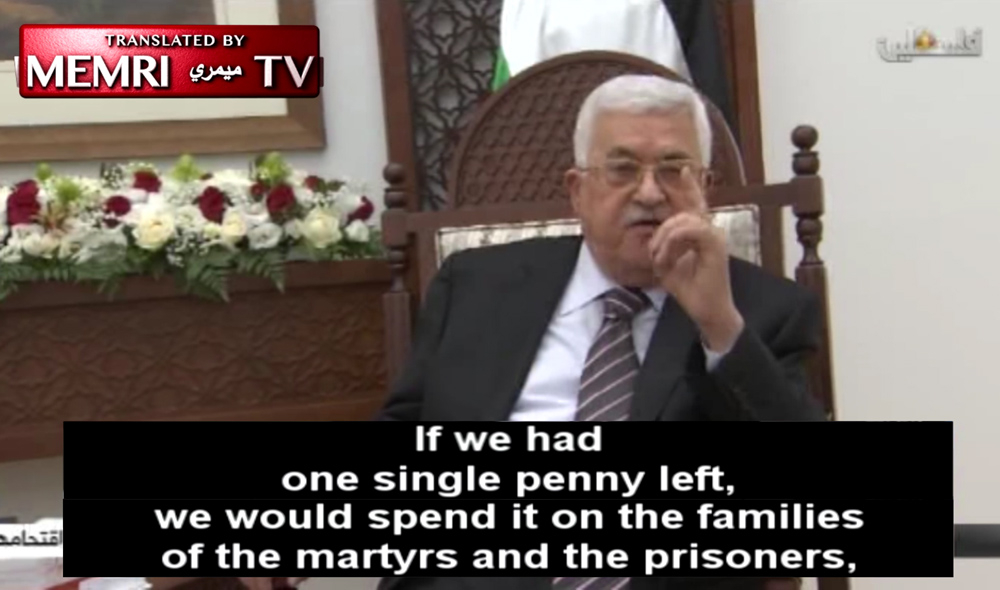
The Biden administration... can continue to dream about "revamping" the PA, but... every Palestinian child knows that this will never happen as long as Palestinian leaders continue to pay handsomely for the murder of Jews and call for the elimination of Israel. Pictured: On July 23, 2018, at a ceremony honoring Palestinian terrorists, Palestinian Authority President Mahmoud Abbas said: "We will neither reduce nor withhold the allowances of the families of martyrs, prisoners, and released prisoners... if we had one single penny left, we would spend it on the families of the martyrs and the prisoners." (Image source: MEMRI)

As the Biden administration continues to promote the idea of having a "revitalized" Palestinian Authority (PA) govern the Gaza Strip the day after the current Israel-Hamas war, PA leaders are again proving why they are not much different from the Iran-backed Islamist terrorists who want to destroy Israel and murder Jews.

After the January 2 assassination in Beirut, Lebanon, of Saleh al-Arouri, deputy head of the Hamas "political bureau," who was behind countless terroir attacks against Israelis over the past decade, PA leaders were quick to praise him as a "martyr" and a "hero" and condemn Israel for allegedly killing the top Hamas terrorist. This glorification of an arch-terrorist is nothing less than a full endorsement of Hamas's Jihad (holy war) on Israel, as outlined in its 1988 charter, which states that "Jihad is its path and death for the sake of Allah is the loftiest of its wishes." (Article 8)

Continue Reading Article

Wednesday, January 03, 2024

Politicians in Robes

by Rabbi Steven Pruzansky

(First published at Israelnationalnews.com)

The abrogation of the Knesset’s “Reasonableness Law” by Israel’s Supreme Court was expected, given its ideological bent, although the thin margin that voided a Basic Law should give pause to any reasonable jurist. It seems lost on the majority of justices that the law that passed 64-0 was considered too narrow to meet the Court’s standards but the overturning of the law by an 8-7 majority must be, to the Court, a landslide. Suffice it to say that self-awareness is not the Court’s strength.

It further escapes the Court – or perhaps it does not – that the Oslo II agreement, as well as other significant pieces of legislation, passed the Knesset with even thinner majorities. And, like this decision for which the 8th vote in the majority was provided by an Arab Muslim justice, both Oslo Accords were passed without a Jewish majority voting for it. Of course, the difference as always comes down to ideological and political preferences, not law or justice. The Court finds rationales to sustain anti-democratic legislation and policies it favors and negates democratic legislation and policies it disdains. The justices are essentially politicians in robes, unelected and part of self-perpetuating oligarchy, claiming to be preserving democracy while evidently mocking it.

The decision legalizing same-sex adoption is of the same character. Its ban in Israel reflected Jewish tradition and the Torah’s ideal conception of a family and parenting, with mother and father raising children. Perhaps more importantly from a technical perspective, current law already accommodated same sex adoption, as can be seen from the Knesset Speaker’s family. Why, then, would the Court (again) usurp the Knesset’s power of legislation to coerce an unnecessary law? It would be only to flex its muscles by (again) poking a stick in the eye of Jewish tradition. It did, only because it could, because it has no restraints, no guardrails, no limiting principle.

The justices are not defenders of democracy; they are mockers of democracy, purveyors of pluralism and contempt for Jewish tradition, engineers of social justice rather than arbiters of the law. A child of nine could read in the current adoption law the words “a man and his wife” and understand their meaning. A progressive justice reads those same words and sees something else entirely - not a new interpretation of a Knesset law but an opportunity to usurp the voice of the people and implement what the court perceives as a desirable social policy.

Whatever that is, it is not democracy, as anyone but far left activists would understand the term. Our votes literally mean nothing. We don’t get to choose electors who propose laws with which we agree and thwart others with which we disagree - of whatever political persuasion that voter is. The judicial activists and their acolytes who fear the loss of democracy actually fear democracy itself. And a Jewish state that is not rooted in Jewish values rests on a shaky foundation.

Where does it end?

Well, where did it begin?

The great economist and political thinker Thomas Sowell recently published (at age 93, in fact!) a book entitled “Social Justice Fallacies” in which he discusses, among many other concepts, the development of judicial dictatorships, now well over a century old. It is rooted in the idea that the masses know little and need to be ruled and controlled by a cadre of elites who uniquely possess the “consequential knowledge” that affords them, and only them, the capacity to make correct decisions for everyone. And then, too, it was done under the false façade of democracy.

Its political patron was Woodrow Wilson, who posited (even before he became America’s 28th president) that consequential knowledge was concentrated in “experts,” whereas the people were “selfish, ignorant, timid, stubborn or foolish.” Wilson deplored the “error of trying to do too much by vote” (Chapter 5).

Roscoe Pound, the long serving Dean of the Harvard Law School, aggressively promoted this notion, among other progressives.

Professor Sowell continued (ibid): “Roscoe Pound set forth principles of judicial activism— going beyond interpreting the law to making social policy— that would still be dominant, more than a hundred years later, and on into the present. One of the rationales for such an expanded role for judges has been the claim that the Constitution is too hard to amend, so that judges must amend it by “interpretation,” to adapt it to changing times.”

“Like so much that has been said and repeated endlessly by elites with the social justice vision, this rationale is contradicted by readily available facts. The Constitution of the United States was amended 4 times in 8 years— from 1913 through 1920 — during the heyday of the Progressives, who claimed that it was nearly impossible to amend the Constitution. When the people wanted the Constitution amended, it was amended. When the elites wanted it amended, but the people did not, that was not a “problem” to be “solved.” That was democracy, even if it frustrated elites convinced that that their superior wisdom and virtue should be imposed on others.”

“Why judges and sociologists should be making social policy, instead of people elected as legislators or executives, was not explained…Whether in law or in other areas, one of the hallmarks of elite intellectuals’ seeking to preempt other people’s decisions— whether on public policy or in their own private lives— is a reliance on unsubstantiated pronouncements, based on elite consensus, treated as if that was equivalent to documented facts… Supreme Court Justices with lifetime tenure are classic examples of elites who institutionally pay no price for being wrong— no matter how wrong, and no matter how high the price paid by others.”

Professor Sowell was not, but could have easily been, defining and excoriating Israel’s judiciary, which has far exceeded even Wilson and Pound’s wildest fantasies in its contempt for the people. And that has become the bottom line in Israel’s Supreme Court – not merely the trampling of democratic norms but also the sheer hubris in thinking that they are better, wiser, and superior to the rest of us, that we the people are rubes who cannot be trusted with any decision and that even our votes should not count for much. In a nutshell, that is the essence of the Court’s nullification of the “Reasonableness Clause.” It is a keen distrust of the people and the people’s voice. Knesset members – the people’s voice – can and should pay a price for bad policies. The Court pays no price at all, ever; no matter the harm it inflicts on the people, it marches merrily along wrapped in the robes of its sanctimony.

Thus, the Court comes alive when a right-wing government is in power and sits quietly when a left-wing government rules. It is less a Court that defends democracy than a star chamber that endows its own decisions with sanctity and certitude, is convinced of its inerrancy, and protects its prerogatives at all costs.

That the Court chose to release these decisions at such a perilous time in our history underscores how disconnected it is from the rest of us. Granted, the internal regulatory bookkeeping mandated, it will claim, the publication of these decisions. But since when was this Court bound by anything in writing, by tradition, or by legislation? Surely it could have found a better way than to sow disunity in wartime.

This is especially true because of, arguably, the Court’s own complicity in the catastrophe of Shemini Atzeret, as its ruling in years past that prohibited the IDF from opening fire on hostile elements approaching the Gaza border fence could have inhibited the preparations and response of the army. And we will likely never know because this Court will insist on controlling the formation of any commission of inquiry after the war – to protect its power and to influence the conclusions.

The Court’s pronouncements make our country less Jewish, less democratic, and less safe. For how long will that be tolerated? What can be done? The answers to these questions will literally determine the spiritual and physical future of our State.

So many people seem to love to hate the Jews, including many Jews themselves

by Rabbi Pinchas Winston

Friday Night
THE ARMENIANS TRIED to get the same kind of attention for the genocide they suffered during World War I at the hands of the Turks, as the Jews did after the Holocaust. But most people who saw the signs hanging around the Armenian Quarter in the Old City recalling it probably just moved on, barely wondering what they were talking about, or who the Armenians are.

To begin with, “only” one million Armenians marched to their deaths, as opposed to six million Jews. Second of all, who are the Armenians? It’s not as if they have a history of being persecuted everywhere they have gone for thousands of years now like the Jews. In fact, had they not posted their signs I would never have known about what happened to them, and most people today still do not. They seem only important to themselves.

Not the Jews, though. Not everyone may have the right impression of them, but just about everyone has some impression of them. For a tiny people, they have attracted far more world attention than they have deserved proportionally, or even wanted. And for a people that has contributed so much good to society and so little bad (other than Hollywood), they’re sure hated a lot. Whether we’re talking about straight up hatred, or jealousy masquerading as hatred, so many people seem to love to hate the Jews, including many Jews themselves.

Many might defend themselves by claiming that they are not being anti-Semitic, just anti-Israel. They claim that it is Israeli policy towards the Palestinians that compels them to take up the Arab cause. But they do not also feel compelled to learn the truth of the situation that has led Israel to such policies, or what Israel has done to reach a compromise with an uncompromising people. If they did, they would find out that they’re on the wrong side, and this would expose them as the true anti-Semites they really are.

In fact, no startup people have had a better opportunity to succeed as a nation than the Palestinians. They were give prime real estate for free at the cost of many honest and hard working Israeli families. They were pumped full of enough foreign cash to build up at least three countries their size. The world has been begging to be allowed to provide the technical knowhow and equipment to help to make Gaza thrive among the family of nations.

Instead, the place remains a dump and unprofitable. The people are impoverished and stunted. The leaders are multi-billionaires, while the Palestinians remain the destructive terrorists they have always been.

Yet, the world sees none of that, turning a very blind eye to the facts on the ground. They’re just too busy examining every last move of the Israelis, who have come by their success honestly, with much hard work, and tremendous bloodshed. Clearly it is not so much that anti-Semites love our enemies as much as they just hate us. Why? Don’t they have anything better to do with their minds and emotions?

Shabbos Day
WE COULD ASK the same question about the Egyptians in this week’s parsha. Thanks to Yosef, they had survived the famine. Years of prosperity and building followed. Had they simply ignored the Jews in their time, Egypt would have done just fine.

We know already from Yosef’s time that Egyptians did not like Jews, and found it disgusting to dine with them, even with a Jew as important to Egypt as Yosef. But it is one thing to not want to share a meal with someone you don’t like, and something altogether different to treat them like sub-humans. Is it a logical procession, or something beyond human logic?

Judging by the way so many Jews deal with growing anti-Semitism, we’d have to assume that there is some logic to it. Otherwise, why ignore it? Why try to fight it with logic and words if there is nothing logical to fight against? Aside from being a big waste of breath, it would be an even bigger waste of life by staying in harm’s way.

Judging by history, we’d have to say that anti-Semitism is not logical or “natural.” It has happened when we have fit well into our hosts’ societies, and when we have not at all. It has occurred when we have been very similar to our enemies, and very different, whether we were rich and the cause of jealousy, or poor and pitiful. In short, though there are natural laws to explain racism, but there are none that explain anti-Semitism.

Rashi hints to this in this week’s parsha, in Pharaoh’s appeal to his people:

“Come, let us deal shrewdly with them, in case they increase and war happens to us, and they join our enemies and wage war against us and depart from the land.” (Shemos 1:10)

“And depart from the land…Our Rabbis interpreted [i. e., depicted Pharaoh] as a person who curses himself but ascribes his curse to others.” (Rashi)

In other words, there was no truth to Pharaoh’s fear. There never is. The Jews were doing well in Egypt, grateful for their success, loyal to the government, and had absolutely no plans to fight against Egypt or throw them out. Ditto Germany in the 1930s. Ditto Jews in America today. And yet…

There are two ways to look at it. Either anti-Semitism goes away for periods of time, and only reawakens when something historical happens to arouse it, like a tanking economy or similar. Or it is always there, and only seems to go away when the perpetrators are temporarily distracted, like because of a booming economy or world destruction.

If Ya’akov Avinu’s reaction to Lavan’s changed demeanor (Bereishis 31:2) is meant to teach us anything, it is probably that anti-Semitism belongs to the second category. It is always in the world and will be until Moshiach comes and the yetzer hara goes. All those times when it seems to disappear are the anomalies of history, usually God holding back our enemies so we can do what we’re meant to do while living among them.

It’s like being born with a dangerous birth defect, R”L. A person may live for one year, or for many years, but each year they do live will feel like a gift (as it should for all of us). For such a person, it’s never a question of “Will I die young?” but of, “How young?” For a Jew, it is never a question of, “Will anti-Semitism return?” but a question of, “How soon?”

Oh, and of, “Do I know what to do once it does?”

Shalosh Seudot
THE GEMORA POINTS this out too. Have you ever wondered by Mt. Sinai is called Mt. Sinai? Me neither. The Gemora did however (Shabbos 89a), but I think it was just looking for a venue to teach something else, the source of anti-Semitism. Sinai, the Gemora explains, comes from the word “sinah,” which means hatred, because Sinai is the origin of Jew hatred.

The explanation has different layers. Cutting to the chase, the giving and receiving of the Torah cut an eternal deal between God and the Jewish people. Once we “signed” on the dotted line, we accepted upon ourselves a mission that we cannot choose to reject. As the prophet Yeshayahu told the exiles to Babylonia, there is no divorcing God or Torah.

But Torah is not the goal so that we automatically get punished for breaking it. Torah is the means to a more ultimate goal, and breaking it is like spending hard earned money you were saving to buy a house for your family on bets at some Casino. Talk about being your own worst enemy.

Torah and mitzvos are like a car meant to take us to our dream destination. Every time you stop and get out you lose precious time that you will have to later make up by speeding and driving more recklessly. Every time the Jewish people get bogged down in the here and now, and forget about the ultimate destination of the world, we have to later make up for it in far less desirable ways.

Even worse, some people just won’t get back into the car again. So before we even get an opportunity to make up for lost time, we have to get people back on board. As the Gemora says:

“Rebi Yehoshua said to him, ‘If they do not repent they will not be redeemed?! Rather, The Holy One, Blessed is He, will cause a king to arise who will make decrees as difficult as Haman’s, and Israel will [be forced to] repent and return to the right path.’” (Sanhedrin 97b)

Anti-Semitism is rising? It is becoming less comfortable to be a Jew in public in the Diaspora? Don’t write your congressperson. Don’t march down Main Street in protest. That might work if anti-Semitism was only racism. But it’s not. It’s God’s way of telling the Jewish people one thing and one thing only: Exile is ending, redemption is coming. Get ready, or get lost along the way.

Acharis K’Reishis, Part 2
LAST WEEK’S TRANSLATION explained that redemption of the Jewish people begins with something called pekidah, a “remembering.” At some point during an exile, something happens in the direction of redemption, even though it may be small or short-lived, like Koresh (Cyrus) letting the Jews go back to Eretz Yisroel after only 52 years of exile to begin construction on the Second Temple.

In recent times, the pekidah could easily have been the UN vote in 1948 to officially accept the Jewish people’s declaration of statehood, especially given the amazing Divine Providence that led to it (see my books, especially Drowning in Pshat and, Preparing For Redemption, available through Thirtysix.org and Amazon). Using this information, the sefer continues:

WE CAN UNDERSTAND something else from this regarding many other places that the Chachamim elucidate verses, saying that they have to do with the future redemption. [For example,] like [the story] in the Gemora at the end of Maseches Makkos, where it says Rebi Akiva said:

“This is why I laugh, because it is written, ‘I will take to Me faithful witnesses to attest: Uriah HaKohen, and Zechariah ben Yeverechyahu’ (Yeshayahu 8:2). Now, what connection is there between Uriah and Zechariah? Uriah was [prophesying] during the First Temple, and Zechariah was [prophesying] during the Second Temple. Rather, the verse [has] made the prophecy of Zechariah dependent on the prophecy of Uriah. Regarding Uriah it says: ‘Therefore, because of you, Tzion will be plowed as a field, etc,’ (Michah 3:12). It says in Zechariah (8:4): ‘There will yet be elderly men and elderly women sitting in the streets of Jerusalem.’ Until the prophecy of Uriah was fulfilled I was afraid that the prophecy of Zechariah would not be fulfilled. Now that the prophecy of Uriah has been fulfilled, I know that the prophecy of Zechariah will [also] be fulfilled.” (Makkos 24b)

There seems to be a contradiction. It begins by saying that the prophecy of Zechariah was regarding the Second Temple, after they returned from exile in Bavel. If so, why did Rebi Akiva laugh in anticipation of the fulfillment of the prophecy [if at the time] it was [already] after the destruction of the Second Temple? Rather, they had a tradition that the order of the building of the Second Temple will also apply to the [building of the] Third Temple [as well].

Eliminating Evil

BS”D
Parashat Shemot 5784
by HaRav Nachman Kahana


Shlomo King of Yisrael wrote in Kohelet 3,8:

עת לאהב ועת לשנא עת מלחמה ועת שלום

“… a time to love and a time to hate; a time for war and a time for peace.”


Jewish Messages
Jewish messages, even very serious or tragic ones, are often encased in humor, to ensure that the message will be remembered.

Years ago, I wrote a column for a popular religious publication. In one of my contributions, I added a humorous story because of its important message. It bothered one of the readers who began a campaign to have me released from contributing to this publication by writing to its financial sources explaining the implications of my remaining a contributing author. I understood the financial reasons of the directors for releasing me and we remain very close friends to this day.

The following is the humorous but very serious piece that this leftist found disturbing. How do I know that he is a leftist? Because he left Jewish saychel (intelligence) and witty Jewish humor.

An Arab entered a bank just as the automatic mechanism closed the safe, until the following morning. In reply to his boisterous demands to receive cash, the teller told him that the safe could not be opened until eight AM.

The Arab became very nasty, even threatening the life of the teller. At this point, the manager approached and physically threw the Arab into the street.

While the Arab was nursing his wounds, the teller approached him saying: “Didn’t I tell you that the safe is closed until tomorrow morning?” The Arab turned to the teller and replied, “Yes. You told me, but he explained it”.

The moral of the story: It is not sufficient to tell most Arabs; it must be explained to them.

Another serious Jewish message which has a humorous core
The local Mafia leader passed away. His brother requested a priest to officiate at the funeral and eulogize the deceased while emphasizing that he was a righteous man. The priest explained the irrationality of the request and that it was beyond what a priest does. The brother took out $10,000 and placed it on the altar as a donation for the church. The following morning at the chapel, the priest concluded his eulogy by saying: “The deceased was of questionable character; he violated all the rules of law, order and decency. However, when compared to his brothers he was a righteous man”.

I will return to this.

The Ustasha
In the 2010 book titled “The Farhud: Roots of The Arab-Nazi Alliance in the Holocaust”, author Edwin Black discusses the most heinous killers of the holocaust: THE MUSLIM-CATHOLIC USTASHA.

The Farhud referenced in this book was the heinous pogrom carried out against the Jewish population of Bagdad, Irag on June 1st and 2nd in 1941. (Learn more at the Holocaust Encyclopedia site.)

Ustaša and plural Ustaše (anglicized as Ustasha) means insurgence. It was a Croatian fascist and ultranationalist movement from 1929 – 1945 (ref: Britannica).

In the hierarchy of Hell that created the Holocaust, one group of killers stands out as more vicious, murderous, and bloodcurdling than all others. Who were they? Where did they plow their killing fields? How and why did they come together to bear a chronicle of atrocities a magnitude worse than Auschwitz?

The answer: None were more savage than the Ustasha of Yugoslavia, a Muslim-Catholic alliance of Nazi killers so gruesome and beastly that even Berlin shrank in horror at the slaughter. This berserk army of ghastly murderers, the Ustasha, and three related crack divisions of Arab-Nazi Waffen SS comprised of tens of thousands of Muslim volunteers, terrorized people of all faiths in Yugoslavia. In large measure, these murder machines emerged through the efforts of the Grand Mufti of Jerusalem, Hajj Amin al-Husseini. The Grand Mufti was on a mission to accelerate the extermination of all Jews everywhere. His partner was Adolf Hitler personally.

The epic story of this alliance of horror and hate is one that begins (with the Mufti) in Jerusalem, moves to Baghdad, culminates in the killing fields of the Balkans, and ultimately spreads across all Europe.

In many ways, the scene was set centuries ago by the Medina Extermination of 627. Medina was a largely Jewish city. When its 500-600 Jews refused to convert to the new Muslim religion, madman Muhammad mass-murdered them in a protracted ceremony, beheading the Jewish faithful one by one. This massacre became a glorious iconic event in Islamic history.

[From 1921 to 1937] The leader of the Palestinians [Arabs living in Palestine] was the Grand Mufti of Jerusalem, Amin al-Husseini. The Nazi-Arab alliance had been aggressively sought by the Arabs of Palestine since the Third Reich’s first moments in 1933.

[From his 1937 exile] From Iran the Mufti and his cohorts escaped to Berlin to meet Hitler personally…

In Berlin, a pact was sealed to provide Arab oil and battlefield military assistance sufficient to help the Nazis push into Russia in exchange for recognizing an Arab national state and exterminating the Jews. Arab military units formed from Paris to Palestine. Arabs and Muslims worldwide, on the radio and in newspapers, incessantly and openly called for the extermination of the Jews. The rallying cry was: “In Heaven, Allah is your master. On Earth is Adolf Hitler.”

When Heinrich Himmler needed to fight the partisans of Yugoslavia to protect German supply lines, the Mufti visited the region and helped organize tens of thousands of Muslims and Arabs into three Waffen SS divisions… Concomitantly, a Nazi murder militia, known as Ustasha, was created from a legion of Catholic and Muslim killers.

The Diet legislature passed a sequence of genocidal decrees… outlawing Serbian and Jewish existence in Croatia, the looting of Serbian and Jewish property, and the systematic regimentation of Serbian and Jewish citizens into death camps and merciless killing fields. Catholic priests commonly operated the concentration camps, enforcing the most degrading of slaughter rituals.

President Ante Pavelić declared early on, “This is now the Ustasha and Independent State of Croatia. It must be cleansed of all Serbs and Jews. There is no room for any of them here. Not a stone upon a stone will remain of what once belonged to them.” He later assured, “The Jews will be liquidated within a very short time”. To this end, more than 20 Ustasha concentration camps were established for the killing process, manned by combined Catholic and Muslim forces. The most notorious of these camps was the hellish complex known as Jasenovac, considered by many to be more sadistic than Auschwitz by an immeasurable magnitude. Gas chambers were not needed. All death was personally inflicted.

The Ustasha’s barbaric methods for exterminating Jews and Serbs included sadistic group killing by cracking heads open with hammers until the cranial cavity was exposed. That was for adults. Children were commonly marched into the forest, where their heads were crushed with long mallets. Sometimes children were thrown live into flaming furnaces. Decapitation or dismemberment with giant lumber saws was frequent. These Ustasha atrocities were not committed in fits of mad rage, but for sport, with the gleeful perpetrators smiling for the camera over the helpless victims waiting to be brutalized. Mass throat-slittings at great velocity were achieved with a small hand blade wrapped tight to the wrist and dubbed the “Serbcutter”. They were specially designed and manufactured for the purpose. One night, guards at Jasenovac wagered amongst themselves to see who could cut the most throats with their Serb cutters. Guard Petar Brzica, a Franciscan priest, was determined to prove his skill, which he did by slicing the throats of an estimated 1,360 defenseless inmates.

German General Edmund Glaise von Horstenau, the commanding officer of the region headquartered in Zagreb, reported back to Berlin, “According to reliable reports from countless German military and civil observers during the last few weeks, the Ustasha have gone raging mad.” He added, “The Ustasha camps … are the ‘epitome of horror!” In revulsion, Glaise von Horstenau wrote, “The most wicked [concentration camp] of all must be Jasenovac, where no ordinary mortal is allowed to peer in.”

Hermann Neubacher, Hitler’s personal assistant for the Balkans, called the Ustasha exterminations “a crusade that belongs among the most brutal mass-murder undertakings in the entire history of the world.”

Eventually, the Nazis fell. Their allies in the Ustasha, and the three Waffen SS divisions faced post-war justice in some cases. But too many melted into the turbulent history of the Cold War. The Mufti escaped to become a revered icon of the Palestinian people. But the Third Reich fell. And those in the Arab-Nazi movement went on to form the post-war geopolitical Middle East that prevails in the current century.

The author writes “The most notorious of these camps was the hellish complex known as Jasenovac, considered by many to be more sadistic than Auschwitz by an immeasurable magnitude”.

After reviewing reports of the 1929 pogroms in Chevron and other cities here in Israel, and the history of Islam, I can truthfully state that the Nazi murder militia known as Ustasha, created from a legion of Catholic and Muslim killers descended to the pits of human barbarism: but compared to Hamas and their tens or even hundreds of millions of supporters in our time, the Ustasha were righteous men.

For the future of mankind these devils in Gaza, Tehran, Yemen, and all around the Middle East have to be destroyed. If they remain alive their acts will be repeated in the Christian cities of Europe, the US and elsewhere. The choices are clear: either back Israel in our war to exterminate Hamas today or prepare to experience similar atrocities on your sons and daughters tomorrow.

My only concern is that although we Jews have the capacity to love, we might not have the necessary capacity “to hate” (as stated by King Shlomo) that is needed to cleanse our land of all its evil individuals.

Shabbat Shalom,
Nachman Kahana
Copyright © 5784/2024 Nachman Kahana

Tuesday, January 02, 2024

Man of the Year: The IDF Soldier

by Daniel Greenfield

In a bad year when the civilized world seems stuck in a pattern of endless retreat, he is fighting back.

(This article originally appeared at Front Page Magazine)

Under Biden’s leadership, America has been invaded by hordes of millions of migrants, and Europe continues to stagger under an endless wave of migration from the Muslim world. That’s why American and European cities are being torn apart by rioting mobs supporting Hamas.

But after Israel was invaded on Oct 7, it fought back. The men on the front lines are not the politicians or the generals, they’re among the 360,000 reservists activated in a nation with a Jewish population of 7 million who left behind their homes, families and jobs to go and fight.

The Israeli military was unprepared for both Oct 7 and a call-up of this size. The soldiers were fed, clothed, and equipped by the people. While the media reports on the fighting, the truly incredible unreported story is how civilian volunteers have become the supply and support (the ‘tooth-to-tail’) of the Israel Defense Forces or the IDF.


In a small country, volunteers have been bringing food every day, they have provided clothes, shipped in body armor and even showed up with washing machines on pickup trucks to do the laundry. Some civilian volunteers have been wounded and even killed while delivering food. Israeli housewives have formed the Baking Battalion to make cookies, a cooking school produces meals for the troops and restaurants operate free food trucks. Others have stepped in to harvest crops and run the shops of the reservists who have been called up to serve in Gaza.

When the government and the leaders failed, the ordinary Israeli stepped up.

Some armies call themselves the “people’s army”: IDF soldiers really are. They’ve gone into Gaza knowing that the country stands behind them, not as an ideal, but as an everyday reality. Israel is a small country and everyone knows someone who died, came under attack, is among the 200,000 who left their homes to be out of range of the terrorist attacks, or in the ranks of those who are fighting or who have already fallen in defense of their nation.

Israel today reminds me of New York City after September 11 where for a brief shining moment everyone except the worst leftists pulled together against a common enemy. That spirit may well pass in Israel as it did in America, but while it lasts, it is something to admire and emulate.

Islamist mobs rampage around Manhattan and our elites celebrate Hamas, but the Israelis woke up after one terrible day and decided that they wouldn’t take it anymore. They rejected the dogma that fighting doesn’t work and they went to war. And far more than their own country is riding on the outcome. Nation after nation has surrendered to the Jihad, appeased it, and accepted the lie that Islamic terrorists can’t be defeated and fighting back only radicalizes them.

America accepted Islamic terrorism as the new normal, now we’ve accepted Muslim mobs smashing up our cities as the new normal. What new horror will we accept next?

The Israeli soldier is in the field fighting against this corrosive mainstreaming of evil. He is at war not only with the reality of Islamic terror but the idea that we are defenseless against it. That is why we all have a stake in what happens thousands of miles away. Gaza is not a territory: it’s a state of mind. There are Gazas in the ‘no-go zones’ of England and France, forming in Michigan and emerging in New York City. It is not a question of whether our war will come, but when.

For now we can still pretend that a 7th century madman’s book doesn’t affect us.

American soldiers in Afghanistan and Iraq all too often had to ask why they were there, no Israeli soldier in Gaza ever has to ask that question. Such questions end when the war comes home.

We’ve become used to wars that are abstractions, geopolitical policy decisions to change a regime or protect the international order, but that’s not what wars are like in Israel.

It’s a one hour drive from the hyper dense Tel Aviv metropolitan area to Kibbutz Be’eri where Islamic terrorists carried out some of the worst atrocities on Oct 7. The thousands of Jihadis, some on pickup trucks with mounted machine guns, had orders to keep going until they reached Tel Aviv. They didn’t get that far, but they did make it to Sderot, a town of 27,000 and they attacked Yad Mordechai just down the road from the city of Ashkelon.

It’s a six hour trip along Israel. On the narrowest points, it’s walkable. In wartime, there is no ‘over there’ in Israel, it’s all ‘over here’. IDF soldiers are not fighting for the international order or to nation build anything: they’re traveling hours to the north to protect their homes.

The Biden administration, the international community and the rest of the foreign policy ‘blob’ are obsessed with nation building in Gaza. They keep demanding a ‘day after’ plan from Israel. Conspiracy theorists claim that the lack of a ‘day after’ plan proves that Israel intends to expel all the Arab Muslim settlers from Gaza. The truth is that Israel doesn’t care about the same nation building nonsense that failed in every single Muslim country it’s been tried in 30 years.

When the madman across the street just butchered your family, you don’t plan out a rehab program or discuss his prison sentence while exchanging fire with him. That sort of madness is reserved for international foreign policy experts with no clue or skin in the game. The same goes for the obsession with “proportionate responses” or “winning the hearts and minds” of Hamas.

Instead of the nonsense that wasted so many of our lives, Israel is focused on winning the war.

Buried in the CNN and MSNBC reports, which are virtually indistinguishable from Al Jazeera’s Hamas propaganda barrage of bombing videos, is the fact that Israeli soldiers accomplished what the Biden administration’s military experts believed was impossible in record time.

Secretary of Defense Austin had urged Israelis to use his fight against ISIS in the Iraqi city of Mosul as a model. The fighting in Mosul took 9 months and led to over 1,000 casualties among the anti-ISIS coalition. Two weeks after the beginning of ground operations, Israel was in the heart of Gaza City. Now, IDF leaders say they’re close to having operational control over the north.

As of now, 164 IDF soldiers have fallen in the fighting against over 8,000 Hamas terrorists. Those approximate, but improve on, the casualty rates of American forces fighting against ISIS (then known as Al Qaeda in Iraq) and Iranian militias during the peak of the 2007 ‘Surge’. But the Israelis don’t have any Muslim allied forces fighting alongside them in urban battles.

Oct 7 heavily damaged the myth of the IDF, but the myth was always based on a misconception of what the Israel Defense Forces are. The IDF has its origins in groups of volunteer guards who were trained by Major General Orde Wingate, a devout Christian Zionist highly unpopular within the British military, in the unconventional doctrines that he would apply in WWII. The IDF is excellent at offensive operations, but poor at defensive ones except when individual soldiers launch desperate last stands of the kind that helped turn the tide in a few crucial battles.

The strength of the IDF has never been in its generals, though like the U.S. military it had some capable old school celebrity generals, now long gone, but in the character of the average fighting man. Strategy and leadership are crucial, but the IDF was built on the resilience of the ordinary soldier. Nations don’t make peoples and generals don’t make armies: it’s people who make nations and armies. That’s as true in Israel as it is in America.

Unlike the Islamic Jihadists they are battling, IDF soldiers don’t go to war fueled by meth or promises of 72 virgins, they go knowing that the lives of their friends and families depend on them. The politicians and the generals may fail them, but they do what needs to be done.

In Gaza now, they make beds among the rubble, put in earplugs and try to sleep while bombs and bullets shatter the night, and then, when it is time, they rise and fight. They are not superhuman or infallible: only ordinary men who know what is at stake. But they don’t know everything that is at stake. They see only their homes and the children they said goodbye to.

What they don’t see is a thousand year Jihad, the rafts bringing invaders to Europe and planes carrying them to America. They see only their small corner of the sky and earth to protect, but they are fighting a small battle that will shape the outcome of the greater civilizational war.

That is why the IDF soldier is Front Page Magazine’s ‘Man of the Year’. In a year of defeatism, he is still fighting. Even though all the experts say he should stop, he does not give up.

Those of us who see the big picture are often prone to despair, but the Israelis never look at big pictures. Israelis, unlike American Jews, have little interest in the big questions because, also unlike American Jews, they are religious in a mostly matter-of-fact way. When they look in the mirror, they don’t see insecurity, they see a fallible human being and when they look at the sky, they don’t see existential questions, they see G-d. That is why they have hope, not woke.

These are important because they not only encourage us to hope, but tell us how.

The IDF soldier is the reflection of a nation that has learned to live in the face of impossible threats by focusing on what needs to be done today. That lack of vision is a weakness, but it is also a strength. We too can turn from worrying about tomorrow and ask what we can do today.

The ordinary Israeli is in the field, or making cookies, washing khaki clothes and harvesting crops. He does not think about the unlikelihood that a nation of millions can survive the hatred of over a billion fanatics who believe that their only path to paradise is through genocide. He or she does what needs to be done, without despair or rage, but with the inner strength of purpose.

Israel is a nation at war with our enemies. The Islamists and leftists, the professional racists and deranged woke armies march through the streets of our cities calling for Israel’s destruction. It is not only a physical war, but a spiritual war, a cultural war and a moral war. It is a war that encompasses all of us, our homes, our families and our futures, but at the moment only one group of men is fighting that war, not just with words or elections, but with bullets.

Their fight gives us hope. Their fight shows us how to fight. Their fight shows us the future.

Monday, January 01, 2024

Rav Kook's Ein Ayah: The Danger of Accusing Scholars of Ulterior Motives

(based on Berachot 3:28)

Gemara: What is an example of one who speaks negatively about a talmid chacham (Torah scholar) after his death? It is as is found in a mishna: He [Akavya ben Mehalalel] said: The special sota waters are not administered to a convert or a freed slave. The Rabbis said that they are administered. They brought a proof from the story whereby a freed maid servant from Karakamit had sota waters administered to her by Shmaya and Avtalyon. Akavya answered: doogma they gave her to drink. They placed a ban on him, and he died with the ban upon him.

Ein Ayah: Rashi explains that doogma means that they gave her to drink because they were similar to her (they were from the families of converts).

The idea of speaking negatively about deceased talmidei chachamim refers to cases where someone assumes a suspicion that certain rulings of rabbis were motivated not by the depth of their understanding of the Torah’s laws or the true traditions they received but by personal interests, Heaven forbid. Actually, even if the critics were right, we would still be obligated to follow their rulings, for the Torah was not given to angels. Once someone is a decisor of Torah and his words were accepted by the rabbinical courts of the time, the Torah law to not stray from the words of the Rabbis applies. It is not for us to decide whether their intentions were pure from the outset regarding the case and whether the ruling was purely to get to the truth, which is certainly the case, or whether there was a matter of interest that sways the intellect. In any case, once the halacha is set, it becomes an entire element of Torah and woe unto us if we destroy it and weaken the hands of those who hold the tree of life [that the Torah is]. Rather we must fulfill with love and with holy trepidation all the words of the Rabbis and the fine inferences that the scholars make.

However, in the area of general morals, this bad [critical approach toward the Rabbis] makes many breaches by removing the foundation of the element of respect and honor for great people according to their holy and exalted value. This is along the situation that the prophet bemoans: “the youngster will be insolent to the elder” (Yeshaya 3:5).

Any society in which this phenomenon exists stands to be ruined even in the short term. This is certainly the case for the “vineyard of the house of Israel,” which is totally “planted” and reliant upon the foundations of Torah and wisdom, and the spirit of Hashem is forever its strength. The only source from which one can draw knowledge and fear of G-d is the wellspring of wisdom that comes from the scholars, who explained the Torah in a literal and in an expansive manner to set the path of life base on wisdom and fear of Hashem. Thus, one who attributes their words to personal inclinations or self-interest weakens the recognition of the lofty value and honor that should be attributed to the Rabbis and their rulings and sayings. Doing so will bring on an immediate moral loss and a weakening in practice and action over time as well.

This is why the gemara explains the foundation of speaking negatively about a deceased scholar by giving the case of accusing Shmaya and Avtalyon of giving a woman sota water to drink because she was similar to them. This would be an example of mixing in concern for their own dignity [by not distinguishing between their lineage and that of standard Jews] into their Torah rulings.

How out of hand is our generation in this regard of accusing the Rabbis of ulterior motives! May Hashem purify our wayward impulses and see to it that Hashem sees to our salvation, so that we will recognize the greatness of the fathers of our national goals, as the pasuk says: “Eating too much honey is not good, but the more one uncovers the honor [of the wise] is honorable” (Mishlei 25:27) [There are many explanations of this difficult pasuk; we hope we provided the one Rav Kook intended].

The War Inside and Outside

by HaRav Mordechai Greenberg
Nasi HaYeshiva, Kerem B'Yavneh

There are two ways that the nations of the world fight against Israel. One way is through physical might, by attempting to destroy and annihilate them. The second is through religious and cultural conflict. The Rambam discusses this in his "Iggeret Teiman," and declares that the nations' attempts will not succeed! He interprets in this vein the pasuk in Yeshaya (54:17), "Any weapon sharpened against you will not succeed, and any tongue that will rise against you in judgment, you will condemn," which mentions both the war of the weapon and the word of the tongue. The war of the sword may cause many casualties, but, at least, its intentions are clear and overt. However, the second type of war is fought with a hidden agenda, and since its insidious impact is not immediately noticeable, it can have a more devastating effect, much like the venom of a snake.

The exile began when Yosef was thrown into a pit that had no water in it, "but had snakes and scorpions in it." (Shabbat 22a) A snake bites with intention to damage, as opposed to a scorpion which stings with its tail, without intention. On the other hand, a snakebite is limited because the snake has less venom after it bites, and cannot immediately continue its attack, whereas a scorpion can continuously sting. These reflect the two dangers of exile. The scorpion's sting is much more dangerous, because it operates in an indirect and protracted manner and is harder to take precautions against. This corresponds to the poisonous cultural influences that affect us throughout our stay in galut.

Still, the worst affliction of exile is the "sinat chinam" (baseless hatred) among us, which is the cause for the continuation of our exile. This is what Moshe noted when he saw that there were informers among the Jews: "Indeed, the matter is known!" (Shemot 2:14) I now know the matter that I had wondered about. In what way did Yisrael sin more than other nations to be afflicted with such hard work? Now I see that they deserve it! (Rashi ibid., quoting Midrash)

There are some that believe that in order to lessen the sting of external hatred of Yisrael, we should not express our differences, but should highlight our similarities with the nations. Already in Egypt Bnei Yisrael tried to remove the fence between themselves and the Egyptians by neglecting the mitzvah of Brit Mila, but the outcome was the opposite of their intention, as it says, "He turned their hearts to hate His nation." (Tehillim 105:25) The Netziv comments on the pasuk, "Behold, it is a nation that will dwell in solitude and not be reckoned among the nations" (Bamidbar 23:9), that the ideal situation for Am Yisrael is "to dwell in solitude," and through this separation, security will come. However, if Yisrael attempts to mingle with the nations, they will "not be reckoned among the nations" -- Hashem will cause them to be hated. The Gemara says in Sanhedrin (104a): G-d said, 'Thus Israel shall dwell secure, solitary,'" that their solitude will lead to security. But now -- when Yisrael tries to mingle with the nations - "Alas -- she sits in solitude" (Eicha 1:1), against their will they will sit solitary in exile. Therefore, Yaakov and Yosef wanted to settle their family in the land of Goshen, apart from their neighbors, in order to remain free from outside influence.

In order to overcome the afflictions of galut, we must protect our distinct national character and counteract sinat chinam. Yisrael is compared in Tanach to fire, and the nations to water, as the pasuk in Shir Hashirim (8:7) says, "Much water can not extinguish the love [of G-d and Israel]." Water impacts on the fire and extinguishes it, but only when they come into direct contact. If there is a separation between them, however, such as a pot of water on the fire, the opposite occurs -- the fire impacts the water and warms it. Only direct contact between Israel and the nations causes us harm. To counteract the affliction of sinat chinam, we should increase ahavat chinam. The Netziv comments on the phrase, "he shepherded the stone of Israel" (49:4), that Yisrael in exile is compared to dust, and the nations are compared to water which washes away the dust. However, when the individual pieces of dust consolidate to become stone, the water has no affect on it.

"In the merit of four things Bnei Yisrael were redeemed from Egypt: they didn't change their names; they didn't change their language; they didn't speak "lashon hara"; and they did not commit acts of immorality." (Vayikra Rabbah 32:5) In these ways they were careful about loving their fellow Jews, by not speaking lashon hara, and they kept their national character, by not changing their names and language, so as to maintain their distance from the Egyptians.

The Nation of Israel is called, "Beit Yaakov," the House of Yaakov. There are two functions of a house-- to unite the family within it, and to protect the family from outside dangers. When Bnei Yisrael went down to Egypt, "Each man and his household came." (Shemot 1:1) The preparation for exile requires "building houses" -- that is, keeping out the influences of foreign nations, and uniting the family within. Ultimately, in the future, everyone will recognize the value of the house and will say, "Come, let us go up to the Mountain of Hashem, to the House of the G-d of Yaakov, and He will teach us of His ways and we will walk in His paths." (Yeshaya 2:3)

Rav Kook on Parashat Shemot: Moshe's Love for Am Yisrael

Was Moshe's complaint appropriate?

When his initial efforts to free Am Yisrael only resulted in Paraoh issuing even harsher decrees, Moshe complained bitterly to God:

“God, why do You mistreat Your people? Why did You send me? From when I came to Paraoh to speak in Your name, he made things even worse for these people. You have not rescued Your people!” (Shemot 5:22-23)

The Midrash says that Middat haDin (the Attribute of Justice), sought to punish Moshe for his harsh words. But God saw that Moshe only spoke for the sake of the Jewish people, and he was not punished (Shemot Rabbah 5:27).

What exactly was Moshe's sin that he deserved to be punished? And what did God ’see’ that determined Moshe was not in the wrong?

The Sick Friend
Rav Kook explained the incident with the following parable:

Once there were two good friends, but one friend was seriously ill. His doctor determined that he could only save his life by performing a very painful operation.

During surgery, the doctor did not hold it against the patient when he moaned and wept. The poor man was in great pain, and his response was to be expected.

But when his healthy friend also wailed and cried out — the doctor ordered him to quiet down. The doctor interpreted his cries as a lack of faith in his medical skill, and even questioning the need for the painful procedure.


Feeling Their Pain
Am Yisrael as slaves in Egypt, Rav Kook explained, were like the ill patient. Divine providence decreed that the Jewish people needed to undergo Paroah’s harsh decrees in order to be redeemed, like a painful operation necessary to save the patient’s life. When the Am Yisrael cried out under the oppression and persecution of Egypt, that was understandable.

But Moshe — why was he complaining? Did he not have faith in God’s ability to redeem Am Yisrael? The Middat haDin objected to Moshe's complaints; this lack of faith should be rebuked and punished.

But the One who “searches the heart and examines the mind” saw into the depths of Moshe's heart. Moshe was like a dear friend who cannot help but share in his friend’s pain. When the doctor operated on his friend, he felt as if the knife was slicing his own flesh.

“ Moshe is speaking for the Jewish people,” God pronounced. He did not deserve to be punished. The “faithful shepherd” cried out spontaneously, in his great love for his people.

This is the model for a true leader. The people are not a stepping stone to attain high office. They are the goal of public service.

As chief rabbi, Rav Kook was keenly aware of his duty to serve the people. Often he would sign his letters, עבד לעם קדוש — “servant to a holy nation.”

(Adapted from Mo'adei HaRe’iyah, pp. 233-234 by Rav Chanan Morrison)

God - let me know who you are

by HaRav Zalman Baruch Melamed
Rosh HaYeshiva, Beit El 

In our weekly portion, God sends Moshe to free the Jews from Egypt. Afterwards, Moshe asks God how to answer the people of Israel when they ask him who sent him. The obvious question is: "What is he asking?!" The answer is clear: "God has sent me!"

We have to look deeper and realize that the question 'Who sent you?' doesn't mean "What is His name?" When we say 'Tell me about Him.' we are asking to find out about his essence. Similarly, here, the people of Israel are going to ask Moshe 'Who is the God who sent you, because it feels as though you are not talking about the same God, whom we know/feel. The God we know, decided to punish us so who is the God that you are speaking about, who decided that it's time to get us to freedom?" 

God answers: "My name is the God who is now God and I will keep being God in the future too. Of course, this is also a very unclear answer, but now, when we understand that the subject of the conversation does not concern names but is all about the characters behind the name, we may explain the answer that God gave Moshe: "God does everything., He meted out the punishment and in the same way, he would later free the People of Israel.

We are familiar with these types of answers. We give our children answers like them and explain to them that even though we give them a punishment, we do it because we care about them and our goal is to teach them a new lesson so that that they learn from it.

This what God tells them. He sent Moshe to tell them that there was a reason for their suffering and it is because he had a special plan for them which was much bigger than they thought and this was why they did not yet recognize it. But now Moshe was coming to make the change and what they had to do is keep trusting God and they would see that God was more than what that they had imagined and not to be underestimated!

The Divine Hand

by Rabbi Dov Berel Wein

The Torah leaves us basically unprepared for its description of the events that are recorded for us in this week’s parsha. When we last left the family of Israel at the conclusion of last week’s parsha of Vayechi, the Jews found themselves comfortable, affluent, protected and settled well in the land of Goshen.

The Torah does not describe to us the process by which this situation so radically changed into becoming a slave state for the Jews. It only tells us of a new king who didn’t know Yosef and, for reasons not explicitly mentioned in the Torah, became a hater and persecutor of the Jews.

The Torah seems to indicate that this is almost a natural state of affairs – to be expected. The Egyptian exile begins on a high note, deteriorates into abject sorrow and attempted genocide and ends with miraculous redemption. The Torah does not dwell upon any motives for the occurrence of this pattern of events. What did the Jews do wrong? Why was the Pharaoh such a hater? What were the economic or social factors of the time that allowed for such a dramatic worsening of the Jewish position in Egypt?

The Torah addresses none of these issues. It is almost as if the Torah wishes us to understand that these things happen blindly in human history. And, particularly in Jewish history, that the attempts of historians and sociologists to explain these irrational events and behavior patterns are really useless.

As has been often pointed out, all subsequent Jewish exiles – Babylonia, Spain, France, Germany, Eastern Europe, the Moslem Middle East – all seem to eerily conform to this original Egyptian template. As usual the Torah leaves us with more questions than it provides answers for. In effect, that is why the Torah is called the book of human life.

We are also unprepared to recognize the savior of Israel in the person of Moshe. We are told how he was miraculously saved from the crocodiles of the Nile by the daughter of the Paraoh and raised in the royal court. He sympathizes with the brutalized Jewish slaves, defends them, and is forced to flee from Egypt.

We hear nothing regarding Moshe for the next sixty years until he reemerges as a shepherd in Midian, married to the daughter of Yitro, the local religious chief who, at this time, is still a pagan. Hardly the resume’ that one would expect for the leader of Israel, the greatest of all prophets and the teacher of all human kind.

Where did his holiness and greatness stem from, how was it developed, who were his mentors and what were his experiences over those long decades of separation from his people? The Torah gives us no clue or answer to these questions. It effectively points out that greatness oftentimes comes from unexpected sources and from people and leaders who operate outside of the usual establishment circles.

All of life is a mystery and certainly the Jewish story remains in its base an inexplicable one. This sets the stage for everything else that will now follow in the Torah. It is why the Jewish people, when accepting the Torah pledge to God that "we will do and then perhaps try to understand," if we wish to understand first we will never come to do. The Divine hand guides us but it is never subject to our rational thoughts and explanations.

'Dark Money Nightmare': How Qatar Bought the Ivy League

by Robert Williams
  • "At least 100 American colleges and universities illegally withheld information on approximately $13 billion in undocumented contributions from foreign governments, many of which are authoritarian.... Speech intolerance—manifesting as campaigns to investigate, censor, demote, suspend, or terminate speakers and scholars—was higher at institutions that received undocumented money from foreign regimes." — ISGAP report, "The Corruption of the American Mind," November 2023.
  • Qatar makes it possible for Ivy League universities to claim that they receive no funds from the Qatari state, because the donations are funneled through the Qatar Foundation for Education, Science and Community Development, a not-for-profit organization established in 1995 by the Emir of Qatar. This ensures that the foundation can identify itself as a private organization, which enables Qatar to conceal its state funding as private donations.
  • "At the time of writing, the State of Qatar contributes more funds to universities in the United States than any other country in the world, and raw donation totals omit critical, concerning details about the nature of Qatar's academic funding." — ISGAP report, "Networks of Hate," December 2023.
  • "We would pay them [journalists]... Some of them have become MPs now. Others have become patriots.... We would pay [journalists] in many countries. We would pay them every year. Some of them received salaries. All the Arab countries were doing this. If not all, then most of them." — Former Qatari Prime Minister Hamad bin Jassim, February 2022.

The hapless testimony by three Ivy League university presidents from Harvard, MIT and the University of Pennsylvania before the U.S. House Committee on Education and the Workforce can be traced to Qatar and its insidious campaign to buy itself influence in US academia. Pictured L-R: Claudine Gay, President of Harvard University, Liz Magill, then-President of University of Pennsylvania, Professor Pamela Nadell of American University, and Sally Kornbluth, President of Massachusetts Institute of Technology, testify before the U.S. House Committee on Education and the Workforce on December 5, 2023. (Photo by Kevin Dietsch/Getty Images)

The hapless testimony by three Ivy League university presidents from Harvard, MIT and the University of Pennsylvania before the U.S. House Committee on Education and the Workforce can be traced to Qatar and its insidious campaign to buy itself influence in US academia.

Qatar, oil-rich and with an estimated population of only 2.5 million, is the largest foreign donor -- that we know about -- to American universities, with at least $4.7 billion donated between 2001 and 2021. Many of those billions went unreported to the Department of Education, according to research done by the Institute for the Study of Global Antisemitism and Policy (ISGAP). Under federal law, colleges and universities that receive donations from foreign sources that total at least $250,000 must disclose such transactions to the Department of Education.

Continue Reading Article