Date and Place: 2 Adar I 5668 (1908), Yafo
Recipient: Rabbi Yitzchak Isaac Halevi, author of Dorot Harishonim. We have featured various letters to him in the past few months.
Body: I will do my best to answer your questions. First I will quote your question, and then I will answer.
Question #1: “Is it good and important to try to have rabbis in all settlements, just as there are in every Jewish community in Russia, in order to give strength to the Torah and all elements of every detailed aspect of Judaism?”
My answer: In Russia, the rabbi’s role can be broken up into three main parts: rendering rulings on halachic, religious questions; monetary jurisprudence; involvement in communal needs. There is a fourth part that applies to some rabbis, and that is giving public addresses on Torah and inspirational matters.
In regard to rendering halachic rulings, it would bring great advantage, given the religious situation in the moshavot (agricultural settlements), to have a rabbi [in each community] who was rendering such rulings.
Regarding the second matter, of monetary issues, things are very different in Eretz Yisrael. All matters of dispute are under the jurisdiction of beit din, and it is sometimes necessary to coerce a party to submit to their authority. This is necessary because the Jewish community on a national level depends on the power of its judicial system. For that reason, it is an absolute necessity that the power of the judiciary be as strong as it can be. Since the general rabbinate in our holy city is strengthened by the police force, and the moshavot in the area of Judea accept their directives, thank G-d, it is not worthwhile that anything should be done to weaken the foundation of the system. It would also be very difficult to incorporate a judicial body in each individual moshav in a manner that would not damage its tranquility and welfare. Therefore, it is better presently to leave matters as they are. It is also worthwhile to take the necessary steps to connect the additional moshavot, especially in the Gallil, to the leadership of the Chief Rabbinate, so that the authority of the laws of the Torah in the Holy Land be organized and national.
Regarding the matter of communal needs, the matter is also very different in the moshavot. From their establishment, the moshavot have been lead by representative councils, and these councils are involved in all of the public, communal affairs. They deal with all of the elements of communal life in a very proper manner, considering the resources available, like the best governmental apparatuses in Europe. So, this is not an area in which the rabbi needs to make an impact.
If Hashem will give us the success to attract rabbis who are also truly gifted orators, people who are truly imbued with fear of Hashem, and they have a desire to raise the standing of authentic Judaism in the Holy Land, then I believe that they can accomplish a tremendous amount in the moshavot.
We will move on to the next question next time.
Friday, July 22, 2022
The urgent need for Jewish Leadership
It's time Jews told their diaspora leaders to wake up
by Melanie Phillips
Diaspora Jews worry about how to deal with the current tsunami of antisemitism that is washing through the world.
They also worry about how to deal with the anti-Zionism and demonisation of Israel that are now the default position for “progressives” in the west.
Most painful of all, they observe with horror that Jews themselves are increasingly involved in the onslaught against Israel.
However, there’s a problem that’s even more fundamental to the wellbeing of the Jewish people. It’s that diaspora Jews are increasingly turning away from and even against Judaism itself.
Throughout the diaspora, Jewish communities are dwindling in number as assimilation takes its toll. Nowhere is this more acute in America, where it takes a particularly baleful form.
Many American Jews haven’t just become detached from Judaism. They have embraced the sectarian ideologies of “social justice” that are in fact inimical to Judaism — but which they nevertheless tell themselves are Jewish values.
They call these “tikkun olam”, claiming they accord with the Jewish concept of repairing the world. In fact, they profoundly distort “tikkun olam,” which is premised on the belief in God that these liberal Jews generally dismiss as irrelevant or an impediment to social progress.
Core Jewish principles involve putting others’ interests before your own, respecting every human being and observing moral codes based on right and wrong. By contrast, the social justice agenda places the individual at the centre of existence so that objective truths are replaced by subjective opinions, feelings trump moral codes and duties are replaced by rights.
Britain’s Jewish community, which is dwindling more gently, is different. Although many British Jews are socially liberal, they have never claimed the social justice agenda as a Jewish moral code. In general elections, moreover, the majority actually vote Conservative.
This is even though most British Jews who arrived from eastern Europe in the early twentieth century brought with them, just like their American cousins, a deep attachment to labour movement and even communist politics.
And just as American Jews came to identify the Republican party with antisemitism, British Jews formerly regarded the Conservative party as prejudiced against Jews while Labour was seen for decades as their natural home.
So why the difference over Jewish values? Maybe the reason is that, despite the antisemitism that always bubbles below the surface in any western society, America was a salad of cultures and ethnicities.
Unlike Britain, whose indigenous and ancient culture meant that — however assimilated Jews became — they always felt themselves at some level to be outsiders, American Jews believed they were as American as anyone else.
Since the essence of Jewish identity is to be distinct from everyone else, this laid the groundwork for an existential conflict between Jewishness and Americanness. For the majority, this would only be resolved by hollowing out their Jewishness into a cosmetic but meaningless shell.
I discussed this neuralgic issue on this week’s JNS podcast with Rabbi Cary Kozberg, a Reform rabbi who has broken with the Reform movement over what he considers to be its embrace of the anti-Jewish values of the social justice agenda.
Although Conservative Judaism now marches to a similar tune, Kozberg believes that the onslaught on Jewish principles has been driven by Reform.
What worries him so much is that we’ve seen all this before.
Around the time of the destruction of the Second Temple, Greek culture — or Hellenism — attracted many Jews tempted by the opportunity to embrace hedonism and pagan decadence. Worse still, this caused divisions between Jews that fatally weakened the community and made it vulnerable to its external enemies who wanted the Jewish people gone.
Kozberg’s deepest fear is that American Jews are repeating this baleful history. The tragedy is that they don’t realise it because they don’t actually know the history of their own people.
This ignorance isn't confined to progressive Jews. Among the young, even those who come from orthodox backgrounds and have been through Jewish day schools and Jewish camps and so on are often astonishingly ignorant of what is necessary to keep the generational Jewish show on the road.
They tend to be taught from a narrow template of rabbinical texts and halachic ordinances. Whether orthodox or progressive, the young aren’t generally taught much Jewish history, nor how Jewish moral principles can enrich their own personal lives and help surmount the pressures of modern existence.
They aren’t taught that Jewish precepts are absolutely foundational to western values such as freedom, compassion and even rationality.
They aren’t taught why the Jewish emphasis on making distinctions between things is so vital to a moral sense, and how this runs directly counter to prevailing secular orthodoxies of equity and non-discrimination.
They aren’t taught about the importance and centrality of Jewish uniqueness, and that what drives certain Jews to turn against the Jewish people is their anxiety to erase that uniqueness from their identity and sign up instead to the prevailing consensus.
They aren’t taught that Judaism is joyous and life-enhancing, so that it can make their own lives more satisfying and optimistic.
In short, young diaspora Jews are taught precious little about what has kept Jews together as a people despite overwhelming pressures, and why this is so valuable and important for these young Jews themselves.
Two things need to change if the Jewish people is properly to defend itself. Jews need to be taught better about their own people, culture and history. And there needs to be a more effective strategy to fight their enemies by getting off the defensive back foot and onto a pro-active and aggressive front foot.
Precious little of this is done at present because the diaspora leadership is woefully inadequate: timid, servile and anxious to fit in.
In Britain, Jewish leaders publicly fought the far-left Labour party leader Jeremy Corbyn because they felt safe in the knowledge that most people in the country reviled him as a dangerous extremist.
But they refuse to fight Muslim antisemitism for fear of being called “Islamophobic”. Nor will they declare the demonstrable legitimacy of Israeli residency in the disputed territories of Judea and Samaria — not least because so many of these leaders are ignorant of this themselves.
In America, Jews are increasingly living in a state of siege. Jews have been murdered in Pittsburgh, San Diego and Jersey City. Visibly Jewish pedestrians are beaten regularly in the streets of American cities and towns.
Jewish students are bullied and harassed on campus. The Democratic party exhibits either indifference to all this or even tolerates the virulent anti-Jewish prejudice in “The Squad” of congresswomen.
American Jewish leaders either lend support to such people and their ideologies, or else behave like rabbits frozen in the headlights. Now a grassroots movement has just launched to hold their feet to the fire
The Jewish Leadership Project has a ten-point “action list” to mobilise a more effective Jewish defence. It demands that major Jewish organisations “cease subordinating the safety and welfare of the Jewish-American community to partisan ideology”.
The project’s co-founder, Avi Goldwasser, said: “Many once-venerable Jewish organisations have primarily become front groups for progressive political interests. The significant danger the Jewish community faces today is an indictment of these institutions and their leadership.”
All over the west, people have been left left demoralised and disillusioned by an entire political establishment that appears determined to send western civilisation off the edge of the cliff.
They’ve been rising up against this using whatever opportunities come their way. In Britain, it was Brexit; in America, it was the election of former president Donald Trump.
It’s time the Jewish people told their own diaspora leaders “enough is enough”, and demand they start properly to defend the Jewish people rather than their own exalted positions.
Thursday, July 21, 2022
For the love of the Land
by Rav Binny Freedman
Nineteen hundred and fifty-two years ago, this past week, (on the 17th day of the Hebrew month of Tammuz) the end finally began. After two and a half years of siege, the Roman Legions broke through the ancient walls of Jerusalem and began their savage rampage of pillage and looting through the streets of Jerusalem. Although the walk from the city walls to the temple mount is a short ten-minute stroll, it would take the Romans three weeks to actually set fire to the Temple and end the battle for Jerusalem. Amidst the fire and destruction, Rav Yochanan Ben Zakkai smuggled himself out of the city, realizing the war was lost, and preferring to begin the long and tortuous process of assuring the Jewish people’s survival in the exile.
Nineteen hundred years later, the Jews of Jerusalem again faced that most awful of challenges: to stay and fight or leave and live to fight another day.
In her book Forever My Jerusalem, Puah Shteiner describes the awful moment as a child, when her parents decided they could no longer risk their children’s lives for the sake of their own ideals. Perhaps they too saw the writing on the wall. Surrounded by tens of thousands of Arabs, the two hundred Jewish fighters, defending fourteen hundred civilians inside the Old City, were in desperate straits. Out manned, outgunned, and completely surrounded, it no longer seemed a matter of whether; it was only a matter of when.
On the 28th of May, in 1948, just two weeks after the declaration of the State of Israel, the Jewish quarter finally surrendered, and as the Jewish community was led out of the Old City, Rav Goetz, who would one day return to become the rabbi of the Kotel, turned and saw the beautiful Tiferet Yisrael Synagogue in flames. Falling to the ground in agony he cried out the age-old adage: “If I forget thee Oh Jerusalem, let my right arm wither….”
And for nineteen years, again, the Old City walls mourned her Jews, who could not come home.
Today, Jewish children once again play and laugh amidst the walls of a rebuilt Jewish quarter, and one wonders how it is that we have merited this miraculous return. Perhaps it is because the Jewish people’s longing for Jerusalem and the land of Israel has never been about land and acquisition. Perhaps there is something much deeper at the heart of it all….
This week’s Torah portion, Pinchas, includes an interesting story regarding the daughters of Tzlafchad.
There are two major lines of inheritance in the Jewish people: our Jewish identity, which follows the mother (Jewish tradition teaches that only if the mother is Jewish, are the children born as Jews), and the tribal lineage, which follows the father (one’s tribal identity follows the tribe of the father).
The story of the daughters of Tzlafchad seems to be all about the laws and the principle of the individual inheritance of the land of Israel, which apparently follows the tribal lineage from son to son. Tzlafchad’s daughters are concerned with their rights to inherit a portion of the land of Israel, given that their father had no sons.
It is interesting to note that inheritance might just as easily have followed the lineage of Jewish identity, apportioning sections of the land of Israel to every Jew based on his Jewish lineage. Yet, somehow, it is important for the Jewish people to inherit the land of Israel as tribes.
This story, at first glance seems to be all about a few people wanting the opportunity to ‘get their fair share’, not exactly the stuff of inspiration. One wonders why the Torah takes the time, then, to include this vignette.
It is interesting to note that the Torah uses the phrase:
“Va’Tikravna’ Benot Tzlafchad”
“And then came forward (close) the daughters of Tzlafchad” (27:1),
– but does not finish the sentence. We do not discover whom they came close to, or why they are coming forward until after an interruption of tribal lineage.
Further, why the need to mention the entire lineage of these women all the way back to Yoseph? Even if it were necessary to note what tribe they are from, would it not have been enough to say they were from the tribe of Menashe? Why the need to mention Yoseph? Not only is the question of their inheritance of the land a function of their being of the tribe of Menashe and nothing to do with Yoseph (the Torah does not mention that Yoseph was the son of Yaakov), but also we hardly need to be reminded that Menashe was the son of Yoseph!
The tribe of Menashe was unique, in that its portion straddled land on the both sides of the Jordan River. Indeed, the tribes of Gad and Re’uven chose to live on the Eastern side of the Jordan (see next week’s portion Bamidbar 32:1-42), rather than enter the land of Israel due to its rich farm and grazing land, and the prospect of economic prosperity.
And as a result of the granting of their request, Moshe ultimately splits the tribe of Menashe, with half the tribe residing on either side of the Jordan River. Generally, the rabbis view this as an assurance that the two sides of the Jordan River will remain part of one people. And the tribe of Menashe, which had no intention of living outside of the land, would also be an influence for maintaining the love of the land of Israel even on that side of the Jordan River.
Ultimately then, the daughters of Tzlafchad had the opportunity to receive rich land on the other side of the Jordan, where all the technical conditions of inheritance in the land of Israel based on tribal lineage did not apply.
Perhaps then, the real motivation of the daughters of Tzlafchad was a burning love for the land of Israel. Indeed, this was their true tribal inheritance. Joseph, despite spending most of his life in Egypt, dies with one wish in his heart: to be buried in the land of his forefathers, the land of Israel. Perhaps this is why these women’s tribal lineage is listed back to Yoseph. And Menashe is in fact the first Jew born in the exile. Yet, even as a child born in Egypt, he never gives up on the dream of returning home. Indeed, it is the tribe of Menashe whose members, according to the Midrash (Rabbinic legend) miscalculate the end of the exile, and in their zeal, attempt to conquer the land of Israel too soon, a story that ends in disaster.
The daughters of Tzlafchad represent then, this same idea, namely a case that has value because the motivations were pure. Perhaps for this reason it was important for this case to come as a result of their desire to see their struggle through. “Va’Tikravna’”, “And they came close” It was precisely because they decided that they wanted to live in the land of Israel and be close amongst the people that this story is so important. In order for them to eventually arrive before Moshe, they had to go up through the entire system of the courts until they finally arrived before Moshe. Only a burning love for the land of Israel motivated them to such a high degree.
Today, thousands of years after Yoseph’s bones were brought home and the daughters of Tzlafchad merited building homes in the land of Israel, we are still struggling for our right to live and love in the land of Israel.
For two thousand years we wandered the face of the globe and today, ours is the generation that has merited the privilege to put our real motivations to the test. Each of us, in our own way, has to decide what this country and this magnificent city mean to us.
Who we are as a people is a function of what we do and why we do it. And where we choose to be, and why we choose to be there, will ultimately determine whether we become who we are meant to be.
Shabbat Shalom from Jerusalem.
"The Lord will not cast off His people, nor will He forsake His inheritance"
by HaRav Dov Begon
Rosh HaYeshiva, Machon Meir
“If you do not drive out the land’s inhabitants before you, those who remain shall be barbs in your eyes and thorns in your sides, causing you troubles in the land that you settle” (Bamidbar 33:55).
Rashi explains that those nations will be like “pins which prick out your eyes,” forcing Israel to hide behind fences such that no one can leave or enter, and our enemies will torment us.
What is the idea behind metaphors in which the eyes are threatened? It is known that the eyes symbolize wisdom and understanding. Therefore, the leaders and wise men of the people are called “the eyes of the people” (see Bamidbar 15:24).
From here we learn that if we leave a foreign people in our land, our leaders’ eyes will be “pricked out,” i.e., they will lose their wisdom and understanding...
Ohr HaChaim adds, “Not only will your enemies take hold of part of the Land, but even in the part that you have settled, ‘your enemies will cause you trouble,’ saying, ‘Get up and leave the Land!"
The crystal clear words of our holy Torah and the unequivocal explanations of Rashi and Ohr HaChaim regarding the harsh results of a foreign people ruling over part of our land require us to wake up and open the eyes of our leaders and of the Jewish masses. We must rise as one man with one heart against the counsel of our enemies who wish to banish us from our land, and from Jerusalem the nation’s heart. Then we will be living in the fulfillment of Bamidbar 34:2: “This land shall fall to you as your inheritance, the Land of Canaan to its borders.” Rashi explains, “G-d cast down from heaven the angelic princes of the seven nations of Canaan and placed them in fetters before Moses.
G-d said to Moshe, ‘See, there is no more strength in them.’” We shall see with our own eyes how “there are many devices in a man’s heart, but it is G-d’s counsel that shall endure” (Mishlei 19:21), for “the L-rd has chosen Zion, He desired it for His habitation” (Tehilim 132:13). Moreover, “The L-rd will not cast off His people, nor will He forsake His inheritance” (Tehilim 94:14).
Looking forward to salvation.
With Love of Israel,
Shabbat Shalom.
Israel – from a strategic liability to a strategic asset
by Ambassador (ret.) Yoram Ettinger
"Israel did not grow strong because it had an American alliance. It acquired an American alliance because it had grown strong” (Prof. Walter Russell Mead, a leading historian of US foreign policy).
In 1948, Israel was misconstrued by the State Department as a burden upon the US, too feeble to withstand an all-out Arab military offensive, jeopardizing US ties with the Arab World and potentially pro-Soviet.
However, since 1967, Israel has emerged as the most effective, reliable and democratic ally of the US, and a formidable force-multiplier for the US.
For example:
*The June 1967 Israeli military victory devastated the pro-Soviet Egyptian military, while Egypt was on its way to become the pan-Arab leader, aiming to topple the pro-US regimes of the Arab oil-producing countries, at a time when the US was heavily dependent upon the Persian Gulf oil. The resounding Israeli victory spared the US a huge economic and national security setback, and denied the USSR a dramatic geo-strategic gold mine.
*25 US military experts went to Israel to study the lessons of the 1967 Six Day War, and to examine the captured Soviet military systems. Their findings upgraded the performance of the US armed forces and defense industries.
*As a result of the benefits derived by the US, a team of 50 experts arrived in Israel following the 1973 War, collecting information, which benefited the US militarily and industrially, bolstering the US defense of Europe in the face of Soviet threats.
*The December 1969 "Operation Rooster 53" highlighted Israel's unique intelligence and battle tactic capabilities, which were shared with the US. An Israeli commando unit snatched from Egypt an advanced Soviet P-12 radar system, which was stationed throughout the world. The Soviet radar was studied by Israel and transferred to the US, as were additional Soviet military systems, enhancing the capabilities of the US intelligence, special operations forces and the US defense industries.
According to the late Senator Daniel Inouye, who was the Chairman of the Appropriations and Intelligence Committees, the value of the Soviet radar to the US defense industries and armed forces was around $3bn. He added that the scope of intelligence shared with the US, by Israel, exceeded the intelligence shared with the US by all NATO countries combined.
*In 1966 and 1989 Israel acquired MIG-21 and MIG-23 Soviet combat planes through defecting Iraqi and Syrian pilots. The planes were shared with the US, impacting the global balance of power, and enhancing the performance of the US Air Force and the aerospace industries.
*In 1970, Israel manifested its pro-US posture of deterrence by forcing - through its military presence on the Golan Heights - a pull-back of the pro-Soviet Syrian invasion of pro-US Jordan. Israel spared the US either a loss of an Arab ally, or the need to get involved militarily in an intra-Arab war, while it was bogged down in Southeast Asia.
Moreover, the toppling of the pro-US Jordanian regime would have threatened the existence of the pro-US oil-producing regimes in the neighboring Persian Gulf, while the US was heavily dependent upon Persian Gulf oil. Thus, Israel spared the US a major economic and national security blow, and denied the USSR a geo-strategic bonanza.
*The lessons of the July 4, 1976 Entebbe Rescue Operation – which underscored Israel as a role model of pro-active, daring and innovative counter-terrorism – were shared with the US intelligence and special operations forces.
*The 1981 Israeli destruction of Iraq's nuclear reactor – in defiance of fierce US opposition – spared the US the potential devastation of a nuclear confrontation during the 1991 Gulf War. It saved the pro-US oil-producing Arab regimes from the jaws of Saddam Hussein.
*In the October 1982 "Operation Mole Cricket 19," Israel's Air Force destroyed 29 Soviet surface-to-air missile batteries operated by Syria, perceived to be impregnable. It was the first time that a Western-equipped air force destroyed a Soviet-built surface-to-air missile network. In the process, during the biggest air battle since the Korean War, the Israeli Air Force downed 82 Soviet MIG combat planes without a single loss to Israel's Air Force. The game-changing Israeli battle tactics, including jamming technologies, were shared with the US armed forces, bolstering the US military edge over the USSR.
*The 2007 Israeli destruction of the Syria-North Korea-Iran nuclear reactor, spared the region and the globe a potential nuclearized civil war in Syria.
*In 2022, against the backdrop of the highly-vulnerable pro-US Arab regimes, the growing vacillation of Europe, and the intensifying threat of the anti-US Sunni and Shiite terrorism, Israel stands out as "the largest US aircraft carrier," which does not require a single American soldier on board, sparing the US the need to deploy to the Mediterranean and the Indian Ocean additional aircraft carriers and ground divisions.
*In 2022, Israel's posture of deterrence plays a key role in preventing the collapse of the pro-US Arab regimes and the dominance of the anti-US Iran's Shiite Ayatollahs and the anti-US Sunni Islamic terrorism in the Middle East, which is crucial to global trade, the war on anti-US terrorism and the US-Russia-China balance of power.
*To paraphrase Prof. Walter Russell Mead's observation: Israel's posture of deterrence is not growing stronger due to the recent peace accords with Arab countries. Arab countries concluded peace accords with Israel due to the fact that Israel's posture of deterrence is growing stronger.
The Yishai Fleisher Israel Podcast: Ben Shapiro and CPAC in Tel Aviv
SEASON 2022 EPISODE 29: Yishai and Malkah Fleisher go down to Tel Aviv to the the big CPAC event and meet with amazing folks including Rabbi Yehoshua Pfeffer, MK Amichai Shikli, and Rabbi Shlomo Katz - and connect with the one and only Ben Shapiro. Ben's talk at event, included in the podcast, is a must listen.
Why No One Cares When Palestinians Kill Palestinians
by Bassam Tawil

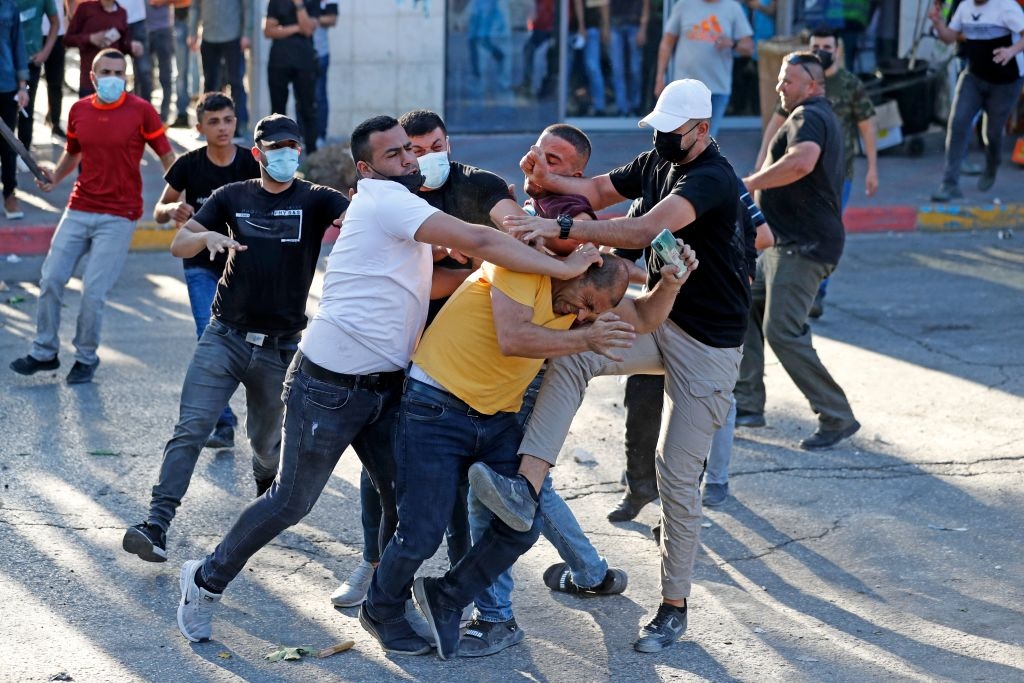
The failure to hold the Palestinian Authority (PA) to account over the murder of Nizar Banat while incessantly bashing Israel over the death of Shireen Abu Akleh is yet another example of the double-standards and deep racism of the Biden administration, the international community and the media, who continue to single out Israel as part of a campaign to delegitimize Israel and demonize Jews. Pictured: Plain-clothed PA security officers beat a man in Ramallah on June 26, 2021, during a demonstration to protest the death of Banat while in the custody of PA security forces. (Photo by Ahmad Gharabli/AFP via Getty Images)
Case 1: Nizar Banat was a prominent Palestinian human rights activist from the Hebron area in the West Bank. In June 2020, Banat was beaten to death by Palestinian security officers who came to arrest him because of his frequent criticism of corruption in the Palestinian Authority (PA).
Case 2: Shireen Abu Akleh was a Christian Palestinian-American reporter working for the Qatari-owned Al-Jazeera TV network. In May 2022, Abu Akleh was killed while she was covering armed clashes between the Israeli army and gunmen from the Iranian-backed Palestinian Islamic Jihad organization in the West Bank city of Jenin.
Although more than a year has passed since the brutal murder of Banat, important mainstream media outlets in the West have not conducted any investigation into his case.
Continue Reading Article
- "There needs to be a civilian trial following international standards, not just a smokescreen to protect those higher up. It is essential that the individuals who gave orders to arrest Nizar Banat for no lawful reason, and who oversaw the assault, are also held to account. The Palestinian Authority must immediately transfer this case to the civilian justice system, to ensure that proceedings are independent of those involved in the crime. The judicial process resembles a farce." — Heba Morayef, Amnesty International's Regional Director for the Middle East and North Africa, amnesty.org, June 24, 2022.
- The failure to hold the Palestinian Authority to account over the murder of Nizar Banat while incessantly bashing Israel over the death of Shireen Abu Akleh is yet another example of the double-standards and deep racism of the Biden administration and the rest of the international community and the media, who continue to single out Israel as part of a campaign to delegitimize Israel and demonize Jews.

The failure to hold the Palestinian Authority (PA) to account over the murder of Nizar Banat while incessantly bashing Israel over the death of Shireen Abu Akleh is yet another example of the double-standards and deep racism of the Biden administration, the international community and the media, who continue to single out Israel as part of a campaign to delegitimize Israel and demonize Jews. Pictured: Plain-clothed PA security officers beat a man in Ramallah on June 26, 2021, during a demonstration to protest the death of Banat while in the custody of PA security forces. (Photo by Ahmad Gharabli/AFP via Getty Images)
Case 1: Nizar Banat was a prominent Palestinian human rights activist from the Hebron area in the West Bank. In June 2020, Banat was beaten to death by Palestinian security officers who came to arrest him because of his frequent criticism of corruption in the Palestinian Authority (PA).
Case 2: Shireen Abu Akleh was a Christian Palestinian-American reporter working for the Qatari-owned Al-Jazeera TV network. In May 2022, Abu Akleh was killed while she was covering armed clashes between the Israeli army and gunmen from the Iranian-backed Palestinian Islamic Jihad organization in the West Bank city of Jenin.
Although more than a year has passed since the brutal murder of Banat, important mainstream media outlets in the West have not conducted any investigation into his case.
Continue Reading Article

Wednesday, July 20, 2022
Will You Stay, or Will You Go?
BS”D
Parashat Matot 5782
By HaRav Nachman Kahana
Almost all conscious Jews ask themselves what does HaShem have in store for His people? And we can add, what does this have to do with parashat Matot?
I submit:
Firstly, we have to be aware that the Creator is neither timid nor shy. As the ultimate being, He does not have to answer to anyone.
When Adam and Chava sinned in Gan Eden, HaShem declared that from that time on all living entities including humans would ultimately die. HaShem certainly gave thought to the implications that the sin of one man and one woman would cause the death of billions of human beings yet to be born.
When the generation of Noach crossed the red line of misconduct, HaShem did not hesitate to destroy all the flora, fauna, and mankind, saving but a minute remnant for future sinning.
HaShem did not hesitate to destroy the flourishing societies of Sodom and Amora and their three sister cities, after examining their perverted legal systems.
HaShem did not waver before the millions of Egyptian firstborn and heads of families, when He sent the Angel of death to their homes; nor did He hesitate to crash down the thrashing waters of the Red Sea on the army of Paro.
HaShem showed no favoritism to the sinner when He destroyed the generation of Jews who joined with the Meraglim (scouts) who refused to enter the holy land of Eretz Yisrael.
After stretching the midat harachamim (the quality of mercy) to its elastic limits, HaShem destroyed the two Ba’tai Mikdash (Temples) and exiled His sons and daughters to the four corners of the planet.
HaShem is righteous and merciful in all He does, but history has proven that there are limits to His patience.
With our ability to review Jewish history, with all its convolutions and contradictions, we can say in hindsight that a process of spiritual winnowing has always been in effect. The object of this filtering is that at a precise time known only to HaShem, He will have before Him a generation of the ‘spiritually fittest’, which will be capable of fulfilling the purpose for which He created the world.
Assimilation through inter-marriage is a major part of this process. Was the Shoah with its over seven million (latest estimate) murdered Jews part of the filtering process? I don’t know!
A major stage of this pruning process of the spiritually fittest is the decision to leave the galut of one’s birth and return home to our land, albeit beset with difficulties and threatened by enemies.
But the process does not stop at the doorstep of Eretz Yisrael. It continuous even here. The Hebrew word for one who leaves the land is yored (one who has descended), when in reality the appropriate word is murad (one who was taken down), in keeping with HaShem’s process of screening.
Events of the near future will create an environment of apprehension bordering on trepidation. All those who do not possess an irrational love for Eretz Yisrael will find reason to leave. The 350,000 non-Jews who entered the country from eastern Europe under the absurd Law of Return, will return to Russia and elsewhere.
Arabs who value their lives will run away, as they did in 1948.
Many bnei Torah will leave because the tension will interfere with their learning. I was witness to this phenomena during the three-week period prior to the Six Day War while living in Kiryat Sanz, in Netanya, when taxi after taxi would drive up to whisk families away to the safety of the land of the upheld torch, beckoning to all who are afraid and “yearning (earning) to be free”.
Those who will merit to remain and be partners in HaShem’s greatest miracles are those who have within them the gift of courage and idealism forged through 3500 years of Jewish experience.
This is what incited Moshe Rabbeinu’s wrath toward the tribes of Reuven and Gad when they requested that their homestead be in the eastern side of the Jordan River. The eastern side is as much a part of Eretz Yisrael as is the western side, but a bit inferior with regard to certain mitzvot. Indeed, had Re’uven and Gad requested their homestead in any area of what is today Lebanon, Syria, most of Iraq or the Sinai Peninsula, they would have been in Eretz Yisrael. Moshe’s anger was directed at what he thought to be the tribes’ reluctance to participate in the military effort to liberate the western side of the river, as he requested from them:
(Bamidbar 32:6)
ויאמר משה לבני גד ולבני ראובן האחיכם יבאו למלחמה ואתם תשבו פה:
And Moshe said to the children of Gad and to the children of Reuven, “shall your brothers go out to war and you will stay here?!”
Moshe then made the fulfillment of their request dependent on the condition that they serve as the first line fighters in the battles to liberate the western side.
This is the criterion for the future. Those who endanger themselves for the good of the nation will merit to inherit the land. Those who circumvent and elude their responsibilities will be expelled and not permitted to share in the future.
We human beings, whose lives are as long as a fleeting bird or the wisp of a cloud, may say to ourselves, “Yesterday was a bad day, tomorrow will be better.” We can even say, “Last week was not so good, next week will be better.” But no rational person would say seriously, “The past 10 years were not so good, the next 10 years will be better”. However, HaShem who according to the Zohar, creates and destroys universes says, “this generation is not up to par, the next one will be better.”
This is the reality we see in our lives – a winnowing of people and generations, until the appropriate one is born.
The right generation is the one that is comprised of People who feel great love and gratitude to HaShem, to His Torah, and mitzvot. People dedicated to settling the land, of integrity and righteousness whose love of fellow Jews is unquestionable. People who are willing even to give their lives for the integrity of HaShem’s promise that this land belongs to the sons and daughters of Avraham, Yitzchak and Ya’akov. People who stand up at the sound of the siren on our holy soldiers’ Memorial Day and visit the military cemeteries to say kaddish and reunite with the memories of fathers, brothers, sons, uncles and brothers who gave their lives.
Look around. You will see them with their knitted kipot, with M16s over their shoulders, returning at night from a shiur by the rosh yeshiva, who also happens to be a senior officer in Tzahal.
Rarely, if ever, has the Jewish nation brought forth a quality generation like this. Sons and daughters who, after 2000 years of galut and the unspeakable Shoah, declare in word and deed, that whatever HaShem, in His unbounded wisdom brings upon us, their faith in the avowed destiny of our nation, as expressed by the holy prophets, will never be in doubt.
Shabbat Shalom.
Nachman Kahana
Copyright © 5782/2022 Nachman Kahana
Mother Nature?
by Rabbi Pinchas Winston
Friday NightRECENTLY I HEARD a scientist describe how remarkably the brain is set up to give a child immeasurable potential to do almost anything they want in life. They said, “Mother Nature has done a remarkable job at setting up the brain, etc.”
Mother Nature? Who is she? Where does she live? Where are her headquarters?
Naaaaaa, she’s not a person…and she’s certainly not a god. She’s…she’s…what we call the thing responsible for something only God could have done, but we don’t want to say God did it. She’s a person’s way of acknowledging that something other than man is responsible for the universe without having to consider what we don’t know, what we don’t appreciate, and certainly what we don’t want to serve.
It may sound safe, but it is not safe at all. How would you feel if someone referred to you by someone else’s name? How would you feel if you were supporting someone and they referred to you with someone else’s, or something else’s name? Wouldn’t you feel like cutting them off, cold turkey?
Of course, God doesn’t work that way. The Gemora says that He brings disaster to the world once every 70 years to rid the world of the mamzerim, children born from most of the relationships forbidden by the Torah and which are punishable with excision or capital punishment. But He also allows it to kill non-mamzerim as well, so that no one will notice what He is really doing.
Why not? Wouldn’t it be better if people knew that God follows up on the things He forbids in the Torah? That would put the fear of God in them and stop people from sinning. If He covers up His response to sin, won’t that just embolden people to keep sinning…to keep attributing His masterful work to some imaginary monarch of the forest?
Yaaah, but He lets it happen anyway. Why? For people like Pinchas ben Elazar ben Aharon HaKohen. For people to have a chance to do this:
Pinchas ben Elazar ben Aharon HaKohen has turned My anger away from the Children of Israel by his zealously avenging Me among them so that I did not destroy the Children of Israel because of My zeal. (Bamidbar 25:11)
God could zap anyone He wants at any time He wants, and people would learn to fear Him. But where’s the fun in that? God’s not after obedience. He’s after relationship, and any good relationship produces obedience on its own. When you love someone, you respect their rules. If you really love them, then their rules become your own rules, if only to reflect the love you feel for them.
And though there have not been a lot of Pinchases throughout history, the few that have risen have made it worth it for God to suffer the insults of outrageous fortune, including letting Mother Nature take credit for His handiwork.
Shabbos Day
THE DAUGHTERS OF Tzelofchad are the other reason. They weren’t jealous for God, but of those who had a portion in Eretz Yisroel. Their father, who would have inherited a family portion in Eretz Yisroel was given capital punishment for breaking Shabbos at the end of Parashas Shlach. Brotherless, it seemed as if their family inheritance was going to go to another relative instead.
Chazal make it clear that the Bnos Tzelofchad weren’t only interested in having a place to live. Anyone they would have married would have given that to them. It was their love of Eretz Yisroel that drove them to make a claim in the land to Moshe Rabbeinu, which was validated by God Himself right in the Torah.
The truth is, the Gemora says, the actual halachah that Bnos Tzelofchad brought out was destined to be told by God to Moshe Rabbeinu. But God held off telling it to him to give the Bnos Tzelofchad their day in the sun, the opportunity to show how much all of us should love Eretz Yisroel. Like Pinchas right before them in the parsha, they were zealous about something God cares very much about, and their action was considered to be taking action on His behalf.
There is another element to this discussion. Chananyah, Mishael, and Azariah, descendants of the Jewish royal family had been taken captive by Nebuchadnezzar and brought back to Babylonia. Eventually, Nebuchadnezzar set up a huge golden statue and ordered everyone, including all the ministers and courtiers of his entire empire to assemble around it. Chananyah, Mishael, and Azariah were there as well. It was announced that all present would have to fall on their faces before the statue and that anyone who disobeyed would be burned to death in a furnace.
Everyone complied, except of course for Chananyah, Mishael, and Azariah. Infuriated, the king had them thrown into a fiery furnace, where they were miraculously saved by the angel Gavriel. When Nebuchadnetzar, along with the myriads present, witnessed the spectacle for himself, he praised the three instead and criticized all the other Jews who had bowed down to the idol. “You have a god like this,” he chastised them, “and you bowed down to an idol instead?!”
The only thing is that the three were supposed to have died in the fire that day. At least that is what they had been told by Daniel. He had told them, on behalf of God, that if they went into the fiery furnace, a miracle would not happen for them and they would die. When the miracle did happen for them, they were just as surprised as everyone else there.
They didn’t wonder what went wrong.
They wondered, what went right?
The answer is Avraham and Haran.
Not too far from where Chananyah, Mishael, and Azariah were tested was Ur Kasdim, the place where Avraham long ago had been tested by Nimrod in the same way, and saved in the same way. He had rejected Nimrod as a god, and entered the fiery furnace to die instead to make his point.
When Haran, Avraham’s brother, saw Avraham emerge from the furnace unscathed, he decided to follow suit once he assumed that a miracle would happen for him as well. It didn’t, and he was burned alive. He hadn’t understood that the key to such a miracle was in willingly going to your death to sanctify the name of God, just as Chananyah, Mishael, and Azariah had done. Ironically, you have to be willing to die to live.
Sometimes. The truth is, the Midrash says that Avraham was going to be burned alive that day and would have, had it not been that Ya’akov had to eventually be born from his son, Yitzchak. So, it wasn’t just Avraham’s willingness to die for God that saved his life. It was his future grandson that did that. And that’s not a merit that too many people have had over the years, which is perhaps why their self-sacrifice was not enough to get them the miracle they needed to survive. Now what?
Shalosh Seudot
THE TEN MARTYRS answer that question. They died Al Kiddush Hashem, even though they had the power to avert the situation altogether. It was only because the angel Gavriel told Rebi Yishmael that their deaths were necessary to save the world that they allowed themselves to be tortured and killed by the Romans. History had required it and they had complied in the most noble way possible.
The Gemora recounts that the son of Rebi Yehoshua ben Levi, Rav Yosef, became ill and momentarily died (Pesachim 50a). Once he recovered, he told his father the following:
Rav Yosef added: And I heard that they were saying in that world…“Those executed by the government enjoy such an exalted status that no one can stand in their enclosure.”(Pesachim 50a)
Rav Yosef referred to the Ten Martyrs. While on the other side, he heard certain secrets about this world and the next one, one of which was the result of dying for the sake of God with a full heart. Such a person is the closest possible to God in the next world, and everyone else cannot reach that level. Nothing is more meaningful than this in the next world and therefore, in this world.
This is what the mishnah is trying to prepare us for with this:
This world is like a corridor before the World-to-Come. Rectify yourself in the corridor to be able to enter the banquet hall. (Pirkei Avos 4:16)
What does this mean? I have a story that makes the point.
Once I had to travel from New York to Los Angeles to speak and was booked on a redeye flight to arrive early the next morning. Concerned that I would be overly tired the next day, I used my points to book business class so I could at least sleep. I usually don’t sleep well on planes, and I thought that a reclining seat might help with that.
Part of the deal was better food, which makes a big difference when it comes to Glatt Kosher food. An upgrade from a TV dinner is usually pretty impressive since it has to kind of match the upgrades the non-kosher eating folk gets.
Once the dinner service began, it was clear that everyone was going to be eating well that flight, restaurant-quality food on real dishes. The meat looked really good, and I wondered what I would be getting.
They finally brought me my tray, which was quite large in size but consisted only of a dairy meal of bagels, lox, and cream cheese. I contained my surprise and tried to look content, but I really wasn’t. As I surveyed my tray, I thought to myself that it was good enough, especially since I love bagel, lox, and cream cheese. There were some great side dishes and a nice desert. It wasn’t as fancy as everyone else’s dinner, but I decided it was all I needed and happily ate.
By the time I was finished, I was more than content. I reclined in my chair while I waited for my tray to be cleared away. I was tired and wanted to sleep already. Stomach full, eyes closed, I could hear the clanging of cups and cutlery in the background as the staff removed the empty trays. That’s when a stewardess said, “Mr. Winston, your dinner.”
What? I opened my eyes to a whole new tray of food placed in front of me, this one filled with all kinds of fancy meats, rolls, implements, you name it. Apparently, my first main course had only been my appetizer. This was my main entree, and all I could do was stare at it, wondering how much of it I could consume before causing the plane to fly at a lower altitude. I was proud of myself that I had been happy with my previous portion, but now I wondered how much I would have to send back to the kitchen. If only someone had told me earlier what to expect…I had eaten my fill in the “corridor” when much better had waited for me in the “banquet hall.”
Ain Od Milvado, Part 9
TRUST IN GOD is the ultimate measure of how real a person is with Ain Od Milvado. It doesn’t just reveal how much a person sees God behind all that happens. It also reveals how much a person believes that God can do anything.
A person might argue and say, “I believe God is behind all that occurs. I believe God can do anything He wants. I just don’t believe that He will do anything I want! Why should He? For me, not relying upon God is not a statement of what I think God can do for me, but of how unworthy I am that He should!”
What are we talking about here? No one can expect God do to everything they want for them, especially if it is something meaningless or selfish. Sometimes He might just do it to teach us a lesson or two, but usually not. Why waste merits on the small stuff and insignificant stuff?
We can only be talking about legitimate needs, those things that God would agree we need. It can be something small but important, or it can be huge, like a major personal redemption of some sort. It can be a momentary thing or something long-lasting. If we have done our part to accomplish what we must, even if that may still fall short, then bitachon—trust in God says rely upon God for the rest—regardless of our personal worthiness.
The Leshem says that the bitachon itself is the merit to having a miracle happen when we sincerely need one. He says nothing stands in the way of bitachon, meaning that if a person truly believes in their heart Ain Od Milvado, it will trigger the miracle. His words, not mine.
The operating words here are “really believes.” I’ve seen many people (including myself) profess to have bitachon, only to act in just the opposite manner when tested by divine providence. That shouldn’t surprise us since the Chovos Levovos says that bitachon is really a middas tzaddikim, something only the righteous have mastered.
That doesn’t mean that a less righteous person can’t rise to the occasion and reach that level, if only for a moment. But if it is the right moment, it can bring that miracle we so desperately need. The countless stories of such miracles happening for people who did rise to the occasion testify to just how true this is.
But why wait for such moments, especially since we don’t always recognize on time, and miss an opportunity to reach such a level and invoke such a miracle.
Ain Od Milvado. From the moment you wake up in the morning until the moment when you go to sleep. It’s not a level to reach from time to time, but a way of life from start to end.
Biden Administration Funds Anti-Israel Curricula, Hate Messages
by Bassam Tawil

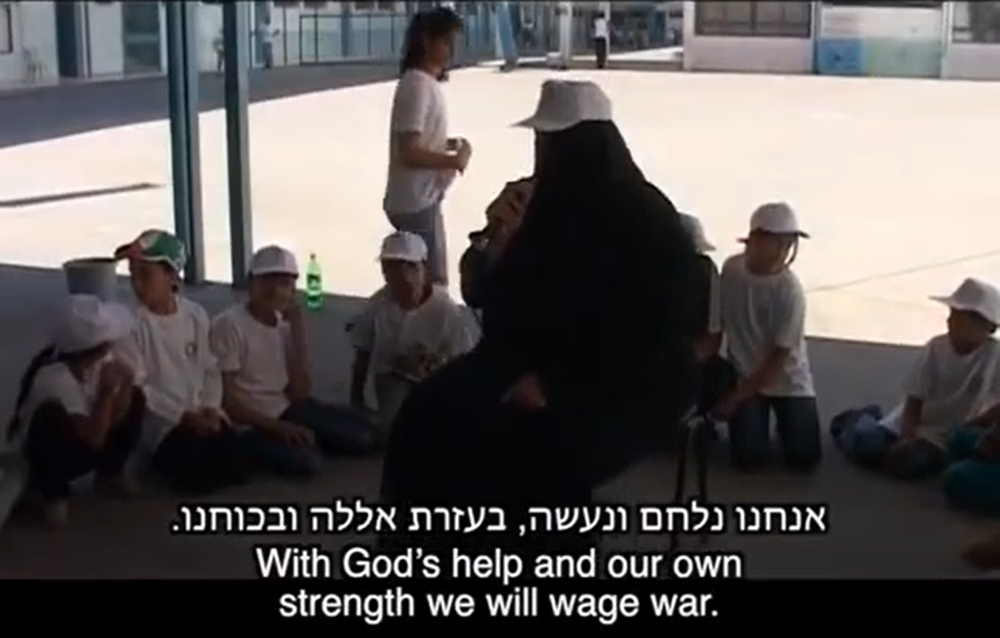
US taxpayer money, thanks to the Biden administration, is now once again going directly to the United Nations Relief and Works Agency for Palestine Refugees (UNRWA), an agency that promotes messages of hate against Israel and denies its right to exist. Pictured: A still shot from the documentary film "Camp Jihad," featuring a summer camp in Gaza sponsored and funded by UNWRA.
The Biden administration has decided to resume financial aid to the United Nations Relief and Works Agency for Palestine Refugees (UNRWA), even though the agency's school books continue to incite violence and erase Israel's existence from their maps. This means that US taxpayer money, thanks to the Biden administration, is now once again going directly to an international agency that promotes messages of hate against Israel and denies its right to exist.
The resumption of the financial aid to UNRWA will also help to perpetuate the problem of the Palestinian refugees and their descendants.
Instead of helping the "refugees" move on with their lives and seek a better future for themselves and their children, UNRWA will continue to encourage them to remain in refugee camps by providing them with various services, including education and healthcare. Why would any Palestinian want to leave a refugee camp when he or she is receiving free education and healthcare?
Continue Reading Article
- US taxpayer money, thanks to the Biden administration, is now once again going directly to an international agency that promotes messages of hate against Israel and denies its right to exist.
- The claim that the UNRWA services contribute to maintaining regional stability is not only false, but, sadly, ridiculous.
- On the contrary, most of the refugee camps have since become hotbeds for extremist and terrorist groups and individuals, especially in the West Bank, Gaza Strip, Lebanon and Syria.
- A study published earlier in early July.... found that children attending UNRWA schools are exposed to textbooks that include references to violence, martyrdom, overt antisemitism, jihad (holy war), rejection of the possibility of peace with Israel, and the complete omission of any historical Jewish presence in the region.
- "[W]e found material that does not adhere to international standards and that encourages violence, jihad and martyrdom, antisemitism, hate, and intolerance...." — IMPACT-se study, July 2022.
- Instead of pressuring UNRWA to change its policies and stop the anti-Israel incitement in its schools, the Biden administration has decided to reward the agency for encouraging hate, violence, martyrdom and the delegitimization and demonization of Israel and Jews.
- The Biden administration, in short, has just sent a message to the Palestinians and all the Israel-haters that it supports their efforts and shares their dream of obliterating Israel.
- Those who fund school textbooks that glorify terrorists and deny Israel's right to exist are complicit in the global jihad against Israel.

US taxpayer money, thanks to the Biden administration, is now once again going directly to the United Nations Relief and Works Agency for Palestine Refugees (UNRWA), an agency that promotes messages of hate against Israel and denies its right to exist. Pictured: A still shot from the documentary film "Camp Jihad," featuring a summer camp in Gaza sponsored and funded by UNWRA.
The Biden administration has decided to resume financial aid to the United Nations Relief and Works Agency for Palestine Refugees (UNRWA), even though the agency's school books continue to incite violence and erase Israel's existence from their maps. This means that US taxpayer money, thanks to the Biden administration, is now once again going directly to an international agency that promotes messages of hate against Israel and denies its right to exist.
The resumption of the financial aid to UNRWA will also help to perpetuate the problem of the Palestinian refugees and their descendants.
Instead of helping the "refugees" move on with their lives and seek a better future for themselves and their children, UNRWA will continue to encourage them to remain in refugee camps by providing them with various services, including education and healthcare. Why would any Palestinian want to leave a refugee camp when he or she is receiving free education and healthcare?
Continue Reading Article

Monday, July 18, 2022
Rav Kook on Parashat Pinchas: Genuine Zealotry
“Pinchas... zealously avenged My cause among the Israelites.... Therefore, tell him that I have given him My covenant of peace.” (Bamidbar 25:11-12)
Why did God present Pinchas, the archetypical zealot, with a covenant of peace? What was the nature of this covenant?
The Prayer of Shemul HaKatan
The Talmud (Berachot 28b) recounts that Rabban Gamliel, who headed the Sanhedrin in Yavneh after the destruction of Jerusalem, saw the need to make an addition to the daily prayer. The Jewish people needed heavenly protection against heretics and informers. But Rabban Gamliel had trouble finding a scholar capable of composing such a prayer.
In the end, Shemuel HaKatan (‘Samuel the modest’) agreed to formulate the prayer, called Birkat HaMinim. Why was it so difficult to find a scholar to author this prayer? What made Shemuel HaKatan so qualified for the task?
By its very nature, prayer is a medium of harmony and understanding, full of kindness and love. Any scholar on an appropriate spiritual level is capable of writing prayers that are fitting for a holy and wise nation.
A prayer decrying slanderers and heretics, however, touches upon powerful emotions of hostility and anger. We naturally feel hatred towards our foes and the enemies of our people. To compose a fitting prayer against enemies requires an individual who is utterly pure and holy, one who has succeeded in eliminating all hatred and petty resentments from his heart. In order that such a prayer will be pure, its sole intention must be to limit the damage and correct the evil caused by the wicked, as they impede the world’s spiritual and ethical progress. It is for the sake of this pure, unselfish motive that we plead that God vanquish the wicked and foil their evil plans.
Even though one’s initial motives are pure, if he is subject to even the slightest feelings of animosity that are naturally aroused when one feels attacked, his thoughts will be tainted by personal hatred, and his prayer will deviate from the true intent. Only Shemuel HaKatan was a suitable candidate to compose this difficult prayer. His life’s motto was “Do not rejoice when your enemy falls” (Avot 4:24). Shemuel succeeded in removing all feelings of enmity from his heart, even for personal enemies. Only this saintly scholar was able to compose a prayer against slanderers that would convey the feelings of a pure heart, expressing the soul’s inner aspirations for complete universal good.

Refining Zeal
From Shemuel HaKatan we see that zealotry is not a simple matter. Zeal must be carefully refined to ensure that it is truly for the sake of heaven. As Rav Kook explained in Orot HaKodesh (vol. III, p. 244):
“We need to refine the attribute of zeal, so that when it enters the realm of the holy, it should be a pure zeal for God. Since zealotry often contains some slight influence of human failings, our powers of self-examination must determine its primary motive. We must ensure that it is not based on personal jealousy, which rots one’s very bones, but rather a zeal for God, which provides a covenant of peace.”
When God gave Pinchas a covenant of peace, He affirmed that Pinchas’ act of zealotry — defending the Jewish people from idolatrous influences — was performed with pure motives. Only God could testify as to the purity of Pinchas’ zeal, that he had acted solely for the sake of Heaven, without any admixture of pettiness or personal animosity. Pinchas’ zeal was the product of his burning love for God, an expression of his desire to bring true peace (shalom) and perfection (shleimut) to the world.
(Gold from the Land of Israel, pp. 275-277. Adapted from Olat Re’iyah vol. I, p. 278 by Rav Chanan Morrison)
Why did God present Pinchas, the archetypical zealot, with a covenant of peace? What was the nature of this covenant?
The Prayer of Shemul HaKatan
The Talmud (Berachot 28b) recounts that Rabban Gamliel, who headed the Sanhedrin in Yavneh after the destruction of Jerusalem, saw the need to make an addition to the daily prayer. The Jewish people needed heavenly protection against heretics and informers. But Rabban Gamliel had trouble finding a scholar capable of composing such a prayer.
In the end, Shemuel HaKatan (‘Samuel the modest’) agreed to formulate the prayer, called Birkat HaMinim. Why was it so difficult to find a scholar to author this prayer? What made Shemuel HaKatan so qualified for the task?
By its very nature, prayer is a medium of harmony and understanding, full of kindness and love. Any scholar on an appropriate spiritual level is capable of writing prayers that are fitting for a holy and wise nation.
A prayer decrying slanderers and heretics, however, touches upon powerful emotions of hostility and anger. We naturally feel hatred towards our foes and the enemies of our people. To compose a fitting prayer against enemies requires an individual who is utterly pure and holy, one who has succeeded in eliminating all hatred and petty resentments from his heart. In order that such a prayer will be pure, its sole intention must be to limit the damage and correct the evil caused by the wicked, as they impede the world’s spiritual and ethical progress. It is for the sake of this pure, unselfish motive that we plead that God vanquish the wicked and foil their evil plans.
Even though one’s initial motives are pure, if he is subject to even the slightest feelings of animosity that are naturally aroused when one feels attacked, his thoughts will be tainted by personal hatred, and his prayer will deviate from the true intent. Only Shemuel HaKatan was a suitable candidate to compose this difficult prayer. His life’s motto was “Do not rejoice when your enemy falls” (Avot 4:24). Shemuel succeeded in removing all feelings of enmity from his heart, even for personal enemies. Only this saintly scholar was able to compose a prayer against slanderers that would convey the feelings of a pure heart, expressing the soul’s inner aspirations for complete universal good.
Refining Zeal
From Shemuel HaKatan we see that zealotry is not a simple matter. Zeal must be carefully refined to ensure that it is truly for the sake of heaven. As Rav Kook explained in Orot HaKodesh (vol. III, p. 244):
“We need to refine the attribute of zeal, so that when it enters the realm of the holy, it should be a pure zeal for God. Since zealotry often contains some slight influence of human failings, our powers of self-examination must determine its primary motive. We must ensure that it is not based on personal jealousy, which rots one’s very bones, but rather a zeal for God, which provides a covenant of peace.”
When God gave Pinchas a covenant of peace, He affirmed that Pinchas’ act of zealotry — defending the Jewish people from idolatrous influences — was performed with pure motives. Only God could testify as to the purity of Pinchas’ zeal, that he had acted solely for the sake of Heaven, without any admixture of pettiness or personal animosity. Pinchas’ zeal was the product of his burning love for God, an expression of his desire to bring true peace (shalom) and perfection (shleimut) to the world.
(Gold from the Land of Israel, pp. 275-277. Adapted from Olat Re’iyah vol. I, p. 278 by Rav Chanan Morrison)
Whoever is Merciful on the Cruel
by HaRav Mordechai Greenberg
Nasi HaYeshiva, Kerem B'Yavneh
"Harass the Midianites and smite them." (Bamidbar 25:17) Chazal say about this in the Midrash (Bamidbar Rabbah 21:5):
Even though I wrote, "When you draw near to a city to wage war against it, you shall call out to it for peace" (Devarim 20:10) – for these (the Midianites) do not do so – "You shall not seek their peace or welfare, all your days, forever." (Devarim 23:7)
Chazal learn a lesson for generations from here: "You find that one who deals with them with the trait of mercy, in the end comes to disgrace, battles, and troubles. Who is this? David." (Midrash ibid.) Namely, when David escaped from Shaul, he and his father's entire household went to Moab. Afterwards the king of Moav killed all of David's family, and only one remained, who found refuge by Nachash, King of Ammon, where he hid until David arrived. When Nachash dies and his son Chanun took the throne, David said, "I shall do an act of kindness for Chanun son of Nachash." (Shmuel II 10:2) The Midrash continues:
G-d said: You are violating My words? I wrote, "You shall not seek their peace or welfare," and you do acts of kindness with them? "Do not be overly righteous" – a person should not add beyond the Torah. This one sends to console Ammon and to do kindness with him, in the end comes to disgrace – "Chanun took David's servants and shaved off half of their beards and cut their garments in half." He also came to war with Aram Naharayim and the kings of Zova and the kings of Ma'achah and with Ammon, four nations, and it says, "Yoav saw that the battle faced him from the front and from the rear, etc." (And there was great trouble for Israel until Hashem saved them.) Who caused David all this? That he sought to do good with what those about whom G-d said, "You shall not seek their peace or welfare." That is why it says, "Harass the Midianites."
The attempt to find favor in the eyes of a nation that hates Israel, to find the way to their heart to form a peace treaty with them, with the thought of sparing war, is a mistaken thought. "Whoever is merciful on the cruel, in the end is cruel on the merciful." In the end, he does not prevent the war and also gets disgraced.
It seems that any further talk on the application to our generation is superfluous.
The Chasidim relate that R. Zusha and R. Elimelech were once in an inn at the time of their wandering. At night they both slept on a high bed. R. Zusha turned to his brother with a suggestion to fall for the sanctification of Hashem's name. R. Elimelech refused, while R. Zusha fell on the floor groaning with pain. The inn owner heard the sound of his falling, and ran into the room. He saw one on the floor, agonizing in his pain, and the second on his bed. Convinced that it was he who threw R. Zusha, he beat R. Elimelech soundly, and in the end rolled him off the high bed to the floor. R. Zusha said to him: "R. Elimelech, my brother, would it not have been worthwhile from the beginning to fall for the sanctification of G-d's name? In the end you also fell!
The Parameters of Pinchas' Zealotry
by HaRav Zalman Baruch Melamed
Rosh HaYeshiva, Beit El
Beyond Intellect and Emotion
Our portion opens with the Torah's praise for the "jealousy" - or more appropriately - "zealotry" - of Pinchas: "Pinchas the son of Elazar the son of Aharon the Cohen turned back My anger from the Children of Israel; I am therefore awarding him with My Covenant of Peace." What's the meaning of this zealotry, what is its source, and why is Pinchas deserving of such an exceptional Divine reward?
One's intellect is the source of his moral character: and personality. Only after one appreciates that that which is good is truly good, does he begin to yearn for it - and as a result act towards achieving that end. Human intellect is beyond emotion; in fact, it actually guides and even directs emotion. An act of "jealousy" on behalf of God, however, does not stem from the intellect. Man possesses a quality even higher than the intellect: it exists on the subconscious level, in the depths of one's spirit; it constantly strives to reveal itself and to appear via the intellect and emotion. The role of intellect and emotion is to neutralize those factors that block the manifestation of zealotry. [This model is used by Rabbi Avraham Yitzchak Kook (of blessed memory) to explain the phenomenon of Emunah , or faith. He stresses that emunah exists on a plane above and beyond intellect and emotion].
It is from these depths that jealousy must spring; this jealousy - or zealotry - reveals itself once one puts aside all factors that inhibit the manifestation of his inner cleaving to the Creator of the Universe. This zealotry responds to any even slight manifestation of Hillul Hashem , or desecration of God's name. Zealotry that has its roots in an understanding of the Divine - inspires the "zealot" to reach a state of completion - or Sheleimut : "Behold, I am giving him My covenant of Peace ( Shalom )."
In Tractate Sanhedrin, our sages enumerate the deeds, which, if done by a Jew, warrant "Zealots smiting him." For example, "One who steals a vessel for use in the Temple... one who has relations with a Gentile woman..." and - even a Cohen who serves in the Temple while in a state of ritual impurity - are legitimately attacked and killed by zealots. The reason for Torah-sanctioned vigilance in these kinds of cases? The direct offense committed by the transgressor, who himself has stricken at the heart of the bond between the Children of Israel and the Holy One, Blessed be He.
Our sages explain that true zealotry may be defined as a situation in which the zealot does not inquire of a scholar how to act in the case at hand; in fact, should he make such an inquiry, a scholar would be bound not to instruct him to take action. Why? The very question as to how to respond indicates that the person has not internalized the level of zealotry required to permit his unilateral action. True zealotry flows naturally, from an inability of the person to tolerate the desecration of God’s name. A well-known Torah dictum states that in situations of desecration to God’s name, one does not allot honor even to a Rabbi."
A Dearth of Halachot
The Shulchan Aruch, or Code of Jewish Law, does not detail the laws associated with Torah-approved zealotry. Author of the work "Chelkat Michokek" questions the reason for this omission. A possible approach to this question: it is inappropriate to write down such halachot, since after all, the laws of zealotry - though they are compulsory - do not serve as the basis of actual halachic rulings. Thus, though Pinchas’ zealotry is aptly discussed in the Beit Midrash (study hall) - it is inappropriate to engage in it in the framework of normative halachic codes.
Of Torah or Rabbinic Origin?
What is the source of the halacha that "zealots strike at offenders"? The great medieval sage, Rabbeinu Nissim ("Ran") maintains that it is a "Halacha L’Moshe M’Sinai" - namely, an oral tradition dating back to the giving of the Torah on Mt. Sinai. His insistence that it is not rabbinic in origin stems from his view that the Sages do not have the power to initiate rabbinic death penalties outside of one-time emergency situations; they do not, says Ran; have the right to rule in this manner for generations to come.
A support for Ran’s approach appears in the midrash: Pinchas approaches Moshe and says to him: "This is what you told us when you descended from atop Mt. Sinai: ‘One who has relations with a Gentile woman is justifiably attacked by zealots’".
In his book of responsa, the great rabbi known as "Radbaz" argues that the permissibility of unilateral acts of zealotry is rooted in rabbinic law. Ran’s point doesn’t faze Radbaz, since, according to the latter, the Sages did not rule that one should kill an offender outside of the framework of the law; rather, they ruled that one should not punish a zealot who takes unilateral action and kills an offender outside of the framework of the law .
Why? Our sages understood that a person filled with love of Hashem to the point at which, out of zealotry, he kills another Jew guilty of desecrating God’s name - is simply unable to conquer the holy emotions within him. It is thus improper to punish him.
Zimri's Right to Self-Defense
Our sages, writing in the Talmudic tractate of Sanhedrin, maintain that if Zimri had turned on Pinchas and killed him, he (Zimri) would have been exempt from punishment. This statement seems to clash with another halachic principle:namely, that one may kill a person whom he sees in pursuit of another person; here, it is permissible, and even a mitzvah, to kill the rodef (pursuer) since one "should not idly stand by the blood of his neighbor." Nevertheless, if the rodef turns around and kills the one who is trying to kill him, he (the rodef) is deserving of death. The obvious reason for this ruling: one who is on the verge of killing a " rodef " is about to fulfill a mitzvah; thus, the " rodef " himself has no permission to kill the one pursuing him.
How should we resolve the above principle with the rabbis' observation that, had Zimri killed Pinchas, Zimri would have been exempt from the death penalty? It must be that Pinchas, as the one who killed Zimri, was not fulfilling a mitzvah! For if killing Zimri were to have been a mitzvah, Zimri would not have had permission to defend himself.
A Lesson Learned
From this discussion, the Mishneh L’Melech on the Rambam, offers another observation: It is known that a relative of a manslaughter victim, may halachically kill that manslaughterer should the latter leave his "city of refuge".
What would be the ruling if the (accidental) murderer turned around and killed the vengeful relative? Mishneh L’Melech maintains that the halacha in this instance may be learned from Zimri: It is not a positive mitzvah to kill one who committed manslaughter; the latter's punishment is exile to a city of refuge, and not death. However, the Torah understood the heart and mindset of the grieving relative, and ruled that it is improper to punish him for killing the person who killed his relative.
Since, then, the relative is not fulfilling a mitzvah in his killing of the murderer, he, the relative, is a " rodef ". Thus, the pursued murderer is permitted to defend himself by killing his "pursuer".
A zealous person such as Pinchas is a type of "blood avenger" - not on behalf of a dead relative - but on behalf of God. He is so identified with God, that he is unable to suffer any affront, so to speak, to Hashem. This is why he stands up and acts out of his zeal. The fact that the zeal is not obligatory, but only permissible, does not detract from its value. Just the opposite is true: the value of this "jealousy" is so great, that it is impossible to mandate every person to reach his level...
Justifiable Homicide
by Rabbi Dov Berel Wein
There were extremely negative murmurings within the people of Israel in objection to the actions of Pinchas for his zealousness in slaying Zimri together with the lecherous princess of Midian, Kozbi bat Tzur. Many attributed the violence of his act to the fact that his mother that his mother was a Midianite and that he was descended from a priest of Midian himself.
There are those amongst us who abhor violence at all costs, in all circumstances. There is no such thing as a justifiable homicide as far as they are concerned. Human life is so precious that even the most evil of people must be protective so that no harm should befall them. Apparently, these murmurings against Pinchas, the grandson of Aharon, who was the most beloved of all leaders of the Jewish people, were so strong that the Lord had to "intervene" to defend Pinchas and highlight the justification and necessity of his act.
In theory, pacifism is a noble idea. However, the contentious and dangerous world that human beings are forced to live in becomes a certain recipe for disaster, and the triumph of tyranny and evil. Justice is a messy business to put into practice. The effect of the immorality of Zimri on the general Jewish society was so detrimental that the Lord indicates that a plague of enormous consequences would have been loosed on the Jewish people were it not for the actions of Pinchas.
One of the basic questions in ethical literature, and it appears as a basic question in Halacha, debates the morality of sacrificing one's life in order that many lives will be saved and spared. It is not my purpose in this article to develop this into a complex issue, but to point out that in this very instance, a moral dilemma of human beings was addressed by the statement of the Lord in defense of the actions of Pinchas.
Nevertheless, even with the apparent endorsement of Heaven for this act of zealotry, Judaism shies away from all forms off fanaticism. There is no other person in the holy writings of Scripture whose zealotry is condoned by Heaven. In fact, a great prophet Eliyahu is rebuked by Heaven itself for the zealotry that he displayed against the Jewish people. There is no question that the people were sinners and idolaters, and we can feel and empathize with the pain and loneliness of Eliyahu, seeing how disastrously Israel had wandered from their core beliefs and mission. Nevertheless, Eliyahu is instructed that until he removes that attitude of zealotry from his relationship with the people of Israel, he cannot remain the instrument of God's will to communicate with Israel.
At that moment in his life, Eliyahu is transformed from an avenging angel into the angel of generational covenant, the messenger of the tidings of redemption, and the comforting presence that has accompanied the Jewish people throughout the world over its long and painful journey of exile. So, we are brought full circle in dealing with vengeance and zealotry, and we are reminded not to be unrealistic pacifists at the same time.
Friday, July 15, 2022
Rav Kook's Igrot Hare’aya: Supporting an Israeli Winery and Choice of Profession
Supporting an Israeli Winery - #106
Date and Place: 29 Tevet 5668 (1908), Yafo
Recipient: Rabbi Naftail Hakohen Adler, the Chief Rabbi of London and the nations (British Empire)
Body: On behalf of the love of the desired land (Eretz Yisrael) and the dear mitzva to support its builders and those who work the holy land with great toil, I have come to make a request of you, great scholar.
In the agricultural village of Rechovot, which is near here, the farmers met and founded a guild of vineyard owners and a few years ago built a winery. Everything is handled according to the highest standards of kashrut, as the Torah requires, as they fulfill the land-based mitzvot and all the details of kashrut for all year long and for Pesach.
These people have gone to great lengths [to do things properly], and their undertaking is fit to be well-known and lauded, for they have helped build and improve Eretz Yisrael. They do this not through donations and philanthropic support but with their strength and power in a proper and distinguished manner.
Therefore, I believe that the love of the sanctity of Eretz Yisrael is fit to prepare the leaders of the nation to lend their moral support to these people. In one of the great cities of the world (London), one of the members of the guild, Mr. Moshe Weinschreiber opened a business to sell the wine of the guild. I saw it as a personal obligation to lend my help by turning to the Chief Rabbi, that he [i.e., you] should show them kindness and present them a shining face, with your holy help in whatever way your excellency and pure heart and love for Eretz Yisraelsees fit.
May the merit of the mitzva to settle the Holy Land stand by you to lengthen your life in pleasantries, and may you merit to see when Hashem returns the remnant of His nation to His holy mountain.
Choice of Profession - #108
Date and Place: 18 Shevat 5668 (1908), Yafo
Recipient: Moshe Zeidel, a young student of Rav Kook from his days in Boisk, and a frequent correspondent of his.
Body: … I will now respond to your inquiry as to a choice of a profession for you. If I had enough time to investigate more exactly the results of those who graduated from different courses of study and the way they chose their life path, I would be very happy to share my opinion, which would of course focus on the spiritual element of the choice. Since it is difficult for me to clarify the matter, I cannot give you practical advice.
I will just share with you my inclination, that there are three professions that someone as special as you, full of wisdom and pure fear of Hashem, might choose to bring spiritual gains to our nation, in addition to any personal gain. I believe that the fields are philosophy, Semitic languages and literature, and national economics.
My logic is that our generation is very confused, and the confusion finds its way to the field of economic theory, and this is influenced by philosophy. These matters find their way to the Jewish people as national and racial tendencies. All of this is connected to Semitic literature, as this is the quarry from which our nation was hewn.
My hope is that if we can produce students who are full of talent and earnestness in these fields, they will be able to increase light through their personal work, which will channel the world properly in these fields of study, uncover fundamental truths, and help heal the confusion of the generation. Of course, one cannot complete a scientific course of study without knowledge of hidden treasures in other sciences, but I think the fields I raised are the most important fields.
Thursday, July 14, 2022
Do we choose to model ourselves as Bilaam, or in the footsteps of Moshe?
by Rav Binny Freedman
5th January, 1895; the sharp sound of the sword broken over a soldier’s knee reverberated across the Morlan Court of the Military academy in Paris. The captain stood at attention, but the sound made him flinch with the symbolic breaking of his sword and the even more painful and humiliating tearing of his rank-epaulettes off his shoulders, Captain Alfred Dreyfus’ life was now broken. Accused of treason, he was sentenced to life imprisonment on the infamous Devil’s Island, never again to hold his beloved children in his arms and or feel the caress of his wife’s loving embrace.
The French command knew there was a traitor in their midst and as the enmity between them and the Germans grew in the period leading up to World War I, they were determined to find the person leaking secrets to the German High Command. Dreyfus, a Jewish Captain in the artillery assigned to the French High Command, was the natural scapegoat. It would take fifteen years before his defenders would be able to prove his innocence.
The real spy appears to have been Emil Esterhazy who framed Dreyfus; but it was the latent anti-Semitism of the day that allowed the courts, the military, and even much of the public to overlook the obvious discrepancies in the case and find Dreyfus guilty. (It would take over a decade for Dreyfus to eventually be fully exonerated and re-instated though no-one could ever return to him the years of his life he had lost, nor make up for the suffering he had endured…)
But Dreyfus did not suffer in vain, he was the catalyst for a momentous sea-change in Jewish history. France was one of the epicenters of European anti-Semitism, and as the mobs shouted, “Mort aux Juifs” (death to the Jews) a journalist assigned to cover the case realized that Jews would never be accepted as citizens of Europe. It was this terrible experience, this small trickle of Jewish independent idealism that would ultimately give birth to the nascent Zionist movement that would eventually become a raging river of determination ultimately giving birth to the State of Israel.
Alfred Dreyfus was ultimately the symbol that finally inspired the beginning of the Jewish people’s return home, after two thousand years of wandering.
Incredibly though, Dreyfus never fully comprehended the role he had played, remaining a fully secular Jew until his death, feeling himself a wronged Frenchman rather than a targeted Jew.
There is a fascinating story in this week’s portion of Balak. Bilaam, on his way to (he hopes) curse the Jewish people at the behest of Balak, the King of Moab, is confronted by a stubborn and rebellious donkey who seemingly refuses to obey his master’s commands. Unaware that an Angel has blocked his path Bilaam begins to beat the donkey with his stick, until G-d opens the mouth of the donkey who actually has the chutzpah to talk back at his master. (Bamidbar 22: 27-30)
What is this story all about?
Interestingly the Mishna in Avot (5:1) cites the mouth of Bilaam’s donkeys as one of the miracles created by G-d in the last moments of the six days of creation. Of course this raises some obvious questions: If prophecy in and of itself is a miracle then why was the donkey’s mouth specifically designated as requiring G-d to transcend the laws of nature as part of creation; why for example does the Mishna not suggest that Moshe’s prophecy was created by G-d as well?
Indeed, it is fascinating to note that Judaism juxtaposes the prophecy (and persona?) of Bilaam with that of Moshe:
Our Rabbis said:
“No prophet like Moses has risen in Israel” (Devarim 34:10)
There did not arise one in Israel, but among the nations there did arise one, and who was that? Bilaam. (Midrash Rabbah)
Yet Moshe was considered the most humble man that ever lived whereas Bilaam is widely considered by Jewish tradition to have been extremely arrogant.
Moshe in fact eschewed a need for material things even claiming (Bamidbar 16: 15) “… I have not taken so much as a donkey from them…”
Yet Bilaam clearly desired wealth, swayed as he was by Balak’s offer of immeasurable financial reward. So how can humble Moshe be compared to arrogant Bilaam? And how could Bilaam have achieved the level necessary for prophecy as compared to Moshe Rabbeinu?
Perhaps the clue to understanding this episode is precisely in noting that Bilaam’s donkey’s ability to speak required a G-dly intervention; without a miracle a donkey could not speak, much in the way Bilaam could not, as an arrogant personality, have achieved prophecy were it not for Hashem’s will and intervention causing a result outside the natural course of events.
Although many commentators disagreed with his position regarding the nature of prophecy, the Rambam believed (Moreh Nevuchim 2:32), that prophecy is received by an individual who has perfected both his intellectual and imaginative faculties.
The intellect is defined as seeing and understanding what is.
The imaginative faculty (Koach hadimayon) is the intuitive ability to see what is not visible to the intellect.
In the Maimonidean model, G-d is always sending messages; human beings must refine their spiritual faculties in order to receive them. Additionally, in order to achieve the level of prophet, a person has to develop themselves to an ethical excellence that was the apex of the human experience.
Clearly, a donkey could not have achieved such a level, lacking as it does the personality and spirituality necessary (according to Rambam) to be a vehicle for communicating G-d’s word; as such it must be that Hashem intervened as it were and utilized the donkey simply as an empty vessel to make a point.
Hashem had to intervene and undermine the fabric of creation to allow this to happen. Bilaam was being told that despite his not having achieved such a level he was being used as a vessel to make a point; sadly, Bilaam, blinded by his own arrogance, never really gets it; he is a tragic, even evil messenger who misses his own message.
Much like Dreyfus, he has no idea of the role he played in the history of the world. What fundamentally separates Bilaam and Moshe is not just what they do, but who they are. Moshe is deeply impacted by the word of G-d, and the experiences that surround him change him, and are a part of the process whereby he becomes a model of how a human being can come closer to the Divine, as well as have an enormous impact on the people and the world around him.
Balaam on the other hand, is like the donkey who, even after communicating the word of G-d remains nonetheless, a donkey. Bilaam is like a radio that transmitted a broadcast but when turned off remains the same radio. Despite the impact of his magnificent prophecy the one least affected by the prophecy of Bilaam, is Bilaam. (He will ultimately die as the protagonist in introducing the immorality and idolatry of the daughters of Midian…)
Prophecy changed Moshe forever, because Moshe changed himself in the journey that allowed him to receive prophecy. But prophecy washed right over Bilaam …
Bilaam who described himself as “He who knows the intentions of the Most High.” was arrogant and thus was no better than his own donkey. Moshe however, was “the most humble man that ever lived …” epitomizing the Rambam’s approach of a human being who refined his character to such a high level as to be able to see G-d ‘face to face’.
Bilaam is so full of Bilaam that nothing remains of G-d’s word; he remains unaffected by the revelation he received. Moshe on the other hand created a vacuum by containing his ego such that there was room for his being filled with the presence of G-d.
Three thousand years later, do we choose to model ourselves as Bilaam, or in the footsteps of Moshe?
Are we cognizant of the incredible times in which we live? And are we aware that if we are too full of ourselves, we lose the opportunity to make room for others in our lives? Something to think about …
Shabbat Shalom from Jerusalem.
The Yishai Fleisher Israel Podcast: Biden & Biblical Leadership
SEASON 2022 EPISODE 28: Biden is in Jerusalem and doing the old superpower patron thing - is there anything good that can come of it? Malkah Fleisher joins Yishai to about the Presidential visit and antisemitism on campus. Then, Rav Mike Feuer on the new generation of leadership in the Torah portion of Pinchas.
Subscribe to:
Posts (Atom)