Friday, December 22, 2023

The Tree

by HaRav Dov Begon
Rosh HaYeshiva, Machon Meir

Yosef tells his brothers, “Do not get angry on the way” (Bereisheet 45:24). Rashi explains: Yosef was worried lest they quarrel along the way, blaming one another over who was responsible for his being sold.

Right now, the Jewish People are “on the way.” We have not yet reached our final destination. We still face harsh struggles over our survival and security and we must do all we can to preserve the unity in our midst - be it right now or in the face of the challenges that lie ahead.

The Jewish People are like a tree, since, just like a tree has branches, roots, and a trunk, so, too, a nation. At the branches, the tree appears to split into many different parts, but at the trunk and roots, it becomes unified. Therefore, the way to unify and strengthen the nation is by returning to its roots.

How should we do this? First of all, we must learn, teach, and deepen our Jewish identity. We must ask what has made us unique since we became a nation at Yitziat Mitzrayim and set out on our two thousand-year-long journey of self-sacrifice to Yerushalayim. We must not only learn what makes us unique, and fathom the essence of the nation G-d chose from among all others, but we must inform ourselves, our children, and all of mankind, what is our historic, eternal mission to all the nations. We are not returning to our land just for ourselves. We are doing so to fulfill our universal destiny, to proclaim G-d’s name to the world, to all mankind, as in G-d’s promises to Avraham, “You shall become a blessing... All the families of the earth will be blessed through you” (Bereisheet 12:2,3). Let us strengthen our roots and send forth branches and flowers. Then we will reap delicious fruits.

BeSorot Tovot,
Looking forward to complete salvation,
With the Love of Am Yisrael and Eretz Yisrael,
Shabbat Shalom.

Rabbi Ari Kahn on Parashat Vayigash: Seeds of Antisemitism (video)

The Yishai Fleisher Israel Podcast: THE WAKE UP CALL

SEASON 2023 EPISODE 50: Yishai Fleisher sits in a jeep on IDF reserve duty and yearns for a Jewish national wake up call. Ben Bresky on the alternative meanings of the Fast of the 10th of Tevet. And finally, Josh Waller calls on the nations to take part in the fight for Judea.

Making the decisions that aren't so simple

by Rav Binny Freedman

It should have been one of the most powerful and exciting days of my life; I can still see all the guys, in their dress uniforms, preparing for the final ceremony; instead, it was one of the most depressing. After eight of the longest, most grueling months I had ever experienced, I was three days away from receiving my officer’s bars. A month-long test (navigation, desert survival, weapons proficiency etc.) to enter infantry officer training, followed by nearly four months of infantry officer’s training in the desert, best described as hell on earth, and then the most difficult four months I have ever experienced; tank officer’s course. Averaging three hours sleep a day for 18 weeks, under intense pressure; this was where tank commanders were trained by the IDF to become platoon leaders.

And then, three days before I was meant to receive my bars, I was told by the battalion commander that for me, there wasn’t going to be any ceremony. I wasn’t ready, there would be no bars. I was out of the course.

They had given me every opportunity. The company commander had reviewed one of my maneuvers himself, and then even the battalion commander had decided he would attend one of my maneuvers, just to be sure. The decision to fail a cadet so close to the end of the course was certainly not taken lightly. But in the end, the responsibility of sending someone out to command a platoon of tanks in the field means only the best, and I just wasn’t ready.

Normally, once a person fails out of Officer’s course there is no second chance, but in my case, because there was no disciplinary measure involved (mostly it was about my struggle with Hebrew), I was told I could repeat the entire Tank officer’s course again, but I only had one week to think about it, as the next course was beginning in 5 days.

The depression, of watching all your buddies practicing for the final ceremony, as you head out into the desert to try and catch a ride back to civilization, is beyond description.

How does one make such a decision? Should I head back to Yeshiva, and begin the studies I had already decided were ahead of me to become a Rabbi? Could I let go and accept having practically wasted a year of my life? I had, after all, given it my best shot. Wasn’t that good enough? And if I went back, was it really about serving my people, and the State of Israel, or was it all just a big ego trip?

How do you make the decisions that aren’t so simple? The Torah does not always give us the answers. If I want to decide whether to eat a piece of meat, or listen in on a conversation, Jewish tradition has very clear parameters as to what the acceptable norms of behavior are. But what if I can’t decide whether to be a doctor or a lawyer? Judaism does not tell me what to do. It will tell me how to ensure that I remain an ethical lawyer, but as to whether I actually become one, that is, in the end, all up to me. So how does one decide?? What if I am making the wrong decision?

Perhaps this question lies at the root of a rather strange exchange in this week’s portion, Vayigash.

Yaakov, after twenty-two long years of believing his beloved son Joseph dead, discovers he is after all alive, and has even become the second in command of Egypt, the mightiest empire on earth.

No words could possibly do justice to what Yaakov must have felt at that moment.

“ Vatechi Ruach Yaakov” “ And the spirit of Yaakov lived.” (Bereisheet 45:27)

If your son has died, a part of you dies with him. A part of Yaakov has been dead for twenty-two years. Now, he is, in a sense, reborn. And so:

“…Yosef B’ni Chai, Elcha Ve’erenu be’terem Amut”
‘My son Joseph lives! I will go and see him before I die.’

“Vayisa Yisrael…”
‘And Yisrael (Yaakov) journeys, with the entire family, (south towards Egypt, from the hills of Hebron), and arrives in Be’er Sheva, where he offers sacrifices (presumably of thanksgiving and gratitude) to “the G-d of his father Isaac”.

The stage seems to be set for an incredible moment. A long-lost son and his beloved father will re-unite and re-discover the love they thought lost forever. And then, out of the blue, G-d steps in. (46:2-4)

“And G-d appeared to Yisrael (Yaakov) in the night saying ‘Yaakov, Yaakov. And he (Yaakov) responded: ‘Hineni’ (Here I am).

“And He (G-d) said: ‘I am the G-d of your father; do not fear going down to Egypt, for I will make of you there a great nation…”

Why does G-d interject with this reassurance? It seemed obvious that Yaakov was quite ready to head down to Egypt and was anticipating a moment he had not thought would ever be possible.

And what is the meaning of G-d’s promise to make his offspring into a great nation in that place? Is that why Yaakov is going to Egypt? To build a Nation? Yaakov just wants to see his beloved long-lost son! And why does Yaakov offer sacrifices of thanksgiving ‘to the G-d of Yitzchak his father’. What of Abraham his father? And for that matter, why not just offer up to G-d? What is the G-d of his father?

The key may lie with G-d’s calling to Yaakov in the night.

‘Yaakov, Yaakov. And he (Yaakov) responded: ‘Hineni’ (Here I am).

Does G-d have to wake Yaakov up? What does ‘here I am’ mean? Is G-d confused? What could possibly lie behind Yaakov telling G-d he is there? That would seem to be a rather superfluous statement to say the least! Obviously, G-d always knows where I am. The question is, do I know where I am?

Hineni is one of the most powerful words in the entire Torah. It is a word full of enormous potential. It is a word that does not refer to physical arrival, but to acceptance of a spiritual journey.

It is the same word Avraham used in response to G-d’s overwhelming request at the binding of Yitzchak (Bereisheet 22:1) and the same word Moshe responds with at the Burning Bush.

Here I am; I am ready. It is a response that signifies a much deeper understanding. Not only where I am, but why I am really here, and what it is all about. I am finally ready to be what I was meant to be.

It is a word Yaakov may well have learned from his father Yitzchak, who responds ‘Hineni’ to Yaakov, when, disguised as Esau; he is ready to be blessed. Yitzchak there (Bereisheet 27:18) understands that this is not just a blessing; it is the continuation of a journey. In fact, in many ways, Yitzchak’s entire purpose was to create Yaakov. Yitzchak, after all, has only one son who carries on the tradition. It will be Yaakov who will ultimately have the twelve sons that will form the Jewish people. So, the word ‘Hineni’ may well signify Yitzchak’s recognition of the fact that passing on the blessings to Yaakov is really his mission and the reason he is in this world.

It is worth noting that after Yitzchak blesses Yaakov, he disappears from the scene. The Biblical narrative shifts immediately to the story of Yaakov who now occupies center stage. Yitzhak, in the word Hineni, signifies that he understands and embraces this as his purpose in this world.

Perhaps, somehow, in offering sacrifices to the G-d of his father Yitzchak, Yaakov is struggling to find his place in the continuation of the dream that will one day become the Jewish people. Perhaps in order to accomplish all that I can in this world, I need to know where I come from. That is, after all, a part of who I am.

It is interesting to note that in the same story (27:24) Esav’s response to Yitzchak’s query of whether he is there is not Hineni, but ‘Ani’ which basically means ‘it is I’. Esau isn’t about ‘here I am to serve my purpose’. Esav’s purpose is Esav. Indeed, Esav has no interest in the birthright, all about responsibility, which he sells to Yaakov for a pot of soup. His interest lies only in the blessings and what they can do for him.

One wonders what might have been if Adam had responded with this simple word so long ago in Gan Eden. Hineni may well have been the answer G-d so desperately wanted in response to His question to Adam: ‘Where are you?’ (“Ayekah”). G-d obviously wasn’t asking where Adam was; he was asking where Adam was at. And Adam could have changed the course of history by simply saying ‘Hineni’: here I am. I want only to live up to the gift of life that you have given me, to have meaning in this world. But Adam, after eating of the fruit of the Eitz HaDaas, just wasn’t there anymore. How can I really be here to fulfill all that I was created for, if I am doing exactly what I know my creator hopes I will not do?

So why does Yaakov respond to G-d with this same word, Hineni?

Perhaps this was really Yaakov’s struggle. Yaakov desperately wants to go down to Egypt to once again see his son Yosef. But he stops in Be’er Sheva. Is this, in the end about Yaakov? Is this what I am meant to be doing? We live in a society that often suggests that if it feels good, it must be good. But sometimes you stop and ask yourself: why am I really here? Is this what I am meant to be doing in this world? Often, the answer is not so simple. You can’t look it up or ‘ask the Rabbi’. You have to ask yourself: where am I, really?

Perhaps this is why Yaakov is praying to the G-d of Yitzchak. It is Yitzchak who, in the grips of terrible famine, thinks to follow in the path of his father Avraham, and go down to Egypt. But G-d tells Yitzchak not to go. (Bereisheet 26:2). Yitzchak never leaves the land of Israel. He represents the point in the development of the Jewish people that needs to be in Israel.

So, what about Yaakov? Is he ready to go back into exile? It seems as though everything he has been building is now about to be undone. How will living in Egypt, the center of paganism in the ancient world, affect the children of Israel?

What this conversation represents, perhaps, is the struggle we sometimes have to ‘do the right thing’. The willingness to do whatever it is G-d wants of me, if only I could figure out what that is.

So how do I resolve these questions in my life?

The Vilna Gaon suggests (in his Even Sheleimah) that the struggle really is trying to be sure that whatever I end up doing, is really for the right reasons. Ultimately, if I make the wrong decision, but I do it for the right reasons, it will end up being all right. But if I make the right decision, objectively, but for the wrong reasons, it will always end up wrong.

It may be that a person is struggling as to whether to become a doctor or a social worker. Objectively, it may well be that they would be better suited and could do much more good in the world as a doctor. But if the decision emanates purely from a desire to earn more money, then it will somehow end up wrong.

Four months later, having decided to go back and do tank officer’s school all over again, the right day finally came. And there is one moment that will stand out forever in my mind. It wasn’t the berets thrown in the air, nor the impressive tank parade, or even the special salute from the Chief of Staff of the Israeli Army.

It was a moment with Yuval Azulai. Yuval was a legend in the Officer’s corps. He was brilliant and knew everything there was to know about tanks and armored warfare. One of those men always thirsty for knowledge, you could not stump him. Laser technology, thermal imagery, shell trajectories, enemy weaponry; he knew it all. Which was why he was one of the Officers responsible for training Officers in the Armored Corps.

A week into my repeat course he found me, late at night, working on my tank. He had heard I had come back and wanted to know what had made me do it all over again. I thought Israel needed motivated officers, and I didn’t want to spend the rest of my life wondering if I should have tried. From that day, he took me under his wing. When everyone else was finally getting their two or three hours sleep, he would pull me aside and quiz me brutally on everything we were learning. He demanded excellence and told me he would make sure I didn’t fail again. He took it as his personal mission to ensure that I became what an Officer was meant to be. He absolutely terrorized me, and I dreaded his surprise arrivals. One day he took over our platoon’s maneuvers so he could personally oversee mine and rip it to shreds. By the time our final exams arrived at the end of the course, they were a breeze.

And on the day of the ceremony, fresh bars on my shoulders, before the traditional slam on the back, he asked me:

“So, how does it feel now that you’ve become an Officer?”

I answered with a smile: ‘It feels pretty darned good.’

And he looked at me and said: “You don’t get it at all. You aren’t even close to becoming an Officer. Being an officer isn’t about the training. That’s just the introduction. The real question is, can you become the man whose men will follow him anywhere, even up a hill under fire?”

And he walked away. And I finally got it.

Yaakov wanted to be sure that it wasn’t about Yaakov. And that is our greatest challenge: To be sure, in all that we do, that it isn’t about me, but about everyone else, which is really why we are all here to begin with.

May Hashem bless us all, as individuals, and as a people, to experience the joy of discovering what we are really meant to do in this world, and to find the strength to go and do it, for all the right reasons.

Shabbat Shalom.

Thursday, December 21, 2023

Daily Jihad in France

by Guy Millière
  • From the murder of Sébastien Sellam in 2003 to that of Mireille Knoll in 2018, all murders of Jews in France have been committed by radicalized Muslims.
  • Shouting "we are coming to kill white people", they attacked, murdering Thomas Perotto, aged 17, who had his throat slit. Seventeen other people were wounded, some seriously. Criminologist Xavier Raufer, asked about the attack, replied that raids like that take place throughout the country every week.
  • Although the prosecutor in charge of the case received multiple testimonies that the attackers said they were "coming to kill white people," authorities maintain that the motive for the attack is "unknown".
  • 74% of Muslims between the ages of 18 and 25 in France say they place Islamic sharia law above the laws of the French Republic.
  • Television journalist Christian Malard, who had access to the results of confidential inquiries carried out for the French Ministry of the Interior, said they show that more than half of the imams in France proclaim the superiority of Islam over Western culture and the need to Islamize France, even if that means using force.
  • The anti-Jewish atrocities by Hamas on October 7 reinforced a distrust of Islam, and for the first time in years, a majority of French people support Israel's fight in the ongoing war.

An Islamist shouting "Allahu Akbar" on December 2 stabbed a German tourist to death near the Eiffel Tower. The murderer, again shouting, "Allahu Akbar!", then attacked two more people, seriously wounding them. Pictured: Police forensic experts at the scene of the murder on December 2, 2023. (Photo by Dimitar Dilkoff/AFP via Getty Images)

Paris, December 2, 2023. 9 pm. A man shouting "Allahu Akbar!" ("Allah is the greatest!") stabbed a German tourist walking along the Seine near the Eiffel Tower, an area considered safe. On the way to the hospital, the victim died. The murderer, again shouting, "Allahu Akbar!", attacked two more people, seriously wounding them, before the police arrested him. A government press release quickly mentioned that the killer was a French citizen, born in France, with the exceedingly French first name of Armand.

Continue Reading Article

Wednesday, December 20, 2023

Yeshivat Machon Meir: VaYigash - Ya'akov's Children in Goshen (video)

God and the Coin Flip

by Rabbi Pinchas Winston

Friday Night
THERE IS A certain football team that has won some very important championship games, one being the Super Bowl, in overtime because they won the coin toss. Until recently, the first team to score a touchdown in overtime won the game, so winning the toss was crucial.

It was the same person each time who picked the toss, being a captain, and he always chose “Heads,” and each time in these crucial games that’s what it ended up being. As a result, they got the ball first and went down the field to score and win the game. Most people did not think much of it, the coin toss that is, and just chalked it up to good luck.

I found out that some time ago, the captain was interviewed and asked why he always chose “Heads.” He said that, “Heads” reminded him of God, to Whom he was grateful for all of his success, or something like that. Apparently, he is a believer and makes a point of keeping God front row and center in his success, and it seems to have served him well.

That’s what I think and others who believe in God and Hashgochah Pratis. Others would argue that there is no proof that what he said or believes, has anything to do with his team’s good fortune. Anything improbable that did happen, they would argue, was just coincidence. They too have no proof of that, just a default logic that comes from not believing in the supernatural.

So, if someone tells you that you cannot affect the outcome of a coin toss, the answer would be, it depends what you believe. If you don’t believe in God, or at least that He is willing to “interfere” in the events of history based upon the decisions of man, then you have to say that life is random and so is a coin toss.

But if you do believe that God does direct history based upon the actions of man, right down to a coin toss, then there is certainly good reason, or rather God reason, for why a God-fearing football player might enjoy a little more success because of it. We might not be able to prove it, but it definitely makes sense from that perspective.

The fact that someone can’t see how that is, or how it can be true, does not negate the reality. Wisdom is not a function of the mind only. It is function of the heart as well. Once a person subtracts God from the equation, they are forced to come up with all kinds of “interesting” variables to fill the gaps.

Shabbos Day
WHAT DOES ANY of this have to do with this week’s parsha? Everything, of course. The brothers had been so sure of their view of reality, and had completely rejected Yosef’s view as preposterous when they sold him into slavery. Since then however, as their world slowly crumbled over the decades since Yosef’s “disappearance,” they seemed to have reconsidered. By the time the “Viceroy of Egypt” accused them of being spies, and then later caught Binyomin with the “stolen” goblet, they seemed to “sing” about their terrible offense from the past.

Nevertheless, it wasn’t until Yosef revealed himself to them that they finally felt the full impact of their error in judgment. That is when they realized they had not only been wrong to sell their brother, but about everything about him. “The stone that the builders rejected became the cornerstone” (Tehillim 118:22), as has so often been the case in history, especially Jewish history.

How could they have been so wrong? They were so many (10 of them), so intelligent, and knew so much. And that is why, had we been there too, we would have sided with them. Given the choice between the 10 older brothers and the one Yosef, who incidentally seemed to be into himself a bit too much, we would have chosen their side. It would have been the most obvious and logical choice, given what we saw and knew at the time. We too would have been one of the shocked ones when Yosef later revealed himself as Viceroy of Egypt.

Amazingly, it was not the last time that such a fiasco happened in Jewish history. Dovid HaMelech, who penned the words, “The stone that the builders rejected became the cornerstone” (Tehillim 118:22), wrote them about his own murky rise from obscurity and rejection to the role of king over the Jewish people. He too had been rejected by his brothers, even his father, all of whom had assumed he was a mamzer.

Even the great prophet Shmuel HaNavi was shocked to find out that seemingly unfitting Dovid, and not his seemingly worthy brothers, was God’s chosen. It was only once everything was sorted out, including his authentic yichus as a proper son of Yishai, that the true story of Dovid HaMelech was told. Finally all the many misconceptions were cleared up.

This is why we have a mitzvah to judge a person to the side of merit, no matter how guilty they look to us. Perceptions are tricky, constantly fooling people into believing the opposite of what is really true. Add a few personal biases into the mixture, and you can get delusional people, of which there are no shortage today. So often what we thought was the only way for reality to be, ends up being the only thing it wasn’t.

The only thing that is Halachah L’Moshe M’Sinai—Law from Moshe from Sinai—is Halachah L’Moshe M’Sinai. Everything else is simply opinion, no matter how smart and savvy the person telling you about it is. We don’t see what is actually there, but what God wants us to see, because seeing the truth is not patent free. You have to earn the right to see it by first becoming a truth seeker.

Shalosh Seudot
THIS IS WHY so many people have been wrong about life. Einstein was one of the greatest minds to have existed over the last 100 years, and yet he could not come to terms with the existence of God and the truth of Torah. So many people telling us about reality today disregard the most important component of it, God, so how reliable can they really be?

The assumption is that reality is some objective state of existence that anyone can see if they look hard enough. But that’s like to trying to perceive a tapestry by first taking away its background canvas that holds the threads in place to form the picture. All you’re left with is strands of wool that might be somewhat interesting on their own, but far from a reflection of the true big picture.

That is perhaps why the brothers got it so wrong. They had left their father out of the equation, and for that matter, God too. They dealt with the “strands” of history, of which Yosef was one, but lacked the canvas of the tapestry into which to place them. When the big picture was finally shown to them, they could not recognize it all, and were shocked how wrong their previous thinking had been. This was not just the message to Yosef’s brothers, but to all of us throughout the ages.

We have to remember to never be overly certain about our take on reality. Don’t take anything for granted. So little is what it seems to be on the surface. Oh, and don’t forget to ask God to show You the truth about life because, in the end, He is the only one Who can. Ain od Milvado. He is all there is, and if you don’t have Him, you really have nothing at all.

Ain Od Milvado, Part 78
IF YOU ARE looking for a key to something important, and someone tells you that a particular person has it, do you approach that person, or do you ignore them? Ain od Milvado means that God is not the only key to reality, but reality itself. Removing Him from any equation leaves the answer incomplete, no matter how complete it may seem to us.

The verse says, “Secrets of God to those who fear Him” (Tehillim 25:14). This doesn’t mean that non-secrets can go to people who do not fear God. It means that even the most obvious things in life also have secrets to be resolved to fully understand what they mean. Those “secrets” however only go to the people for Whom God is literally reality.

This can happen in a number of ways. It could be that a person gets an insight that no one else has, or that they experience something at just the right moment in just the right way to reveal something. God has many messengers, and many ways to get His point across to the people He wants to know it.

Yosef knew this. This is why he kept giving his brothers clues to his identity, as if to test the waters of their worthiness. He may not have known what level of secrets they merited, but God did, and He would have to be the One to clue the brothers in to what he was hinting.

As we see, it had never been Yosef’s intention to publicly shame his brothers, and quite frankly, it was a Chillul Hashem their story unfolded. It may have been one big happy family reunion for Ya’akov’s family, but you can just imagine what everyone else was saying behind their backs.

But alas, it was not to be a private affair, though Yosef made sure to send all Egyptian personnel out of the room for the big reveal. The brothers seemingly had not merited to work out Yosef’s secret on their own, and had to be subjected to his shock revelation. According to the Midrash, many will have to undergo something similar on their final day of judgment if they don’t merit to know God’s secrets while in the world now.

Diplomatic option toward Iran is self-destructive

by Ambassador (ret.) Yoram Ettinger

*The US State Department’s diplomatic option has facilitated the transformation of Iran from "the American policeman of the Gulf" to “the largest anti-American venomous octopus in the world,” stretching its rogue arms from the Persian Gulf through Africa to Latin America and the US-Mexico border, which it perceives as the soft underbelly of the US.

*The diplomatic option – including a frail US response to sustained Iranian attacks on US installations in the Persian Gulf region - has aggravated Middle East instability, threatening the survival of every pro-US Arab regime, and is inducing anti-US global Islamic terrorism. This is severely eroding US posture of deterrence, benefitting Russia, China and mostly Iran, while undermining US national and homeland security.

*The diplomatic option has suspended most economic sanctions – without Congressional consent - surging Iran’s oil export from 500,000 barrels per day to 2-3 million barrels per day, increasing Iran’s national income by some $100bn, mostly dedicated to bolster Iran’s anti-US rogue operations, increasingly in Latin America, the US’ backyard.

*The diplomatic option has consistently overlooked the decisive power of the Ayatollahs’ imperialistic ideology, and its determination to export the anti-US Islamic Shiite Revolution. Consequently, the State Department has deluded itself into believing that an astounding financial and diplomatic bonanza would induce Iran’s Ayatollahs to accept peaceful coexistence with their pro-US Arab Sunni neighbors, become good-faith negotiators, and abandon their 1,400-year-old religious, fanatic vision, which is enshrined in their Constitution, K-12 school curriculum, Friday mosque sermons and official media.

*However, as expected, the mega-billion-dollar bonanza yielded by the diplomatic option (e.g., the 2015 JCPOA and the current suspension of economic sanctions) has bolstered its global terroristic network, advancing its vision to topple all pro-US Sunni regimes, and bring the “infidel” West to submission, especially the "The Great American Satan," while egregiously oppressing and suppressing Iranian women and religious and ethnic minorities.

*The State Department’s diplomatic option was initiated in 1978/1979, stabbing in the back the pro-US Shah of Iran, and contending that Ayatollah Khomeini was anti-Communist and therefore potentially pro-Western and a stabilizing element geopolitically, “…holding a Gandhi-like position… preoccupied with tractors, not tanks….”

*Has the diplomatic option dumped the Monroe Doctrine?! In 2023, Iran’s Ayatollahs invest mega billions of dollars in fueling civil wars, terrorism, drug trafficking and money laundering throughout the Middle East, Africa and especially in Latin America. There, they collaborate – along with Hezbollah terrorists - with the drug cartels of Mexico, Columbia, Bolivia, Ecuador and Brazil, and train terror organizations. They cooperate with all anti-US governments (especially Venezuela, Cuba, Nicaragua, and Bolivia), testing ballistic missiles, and supplying predator drones, attack boats, anti-ship missiles, and equipment for the construction of underground tunnels along the US-Mexico border, which smuggle drugs and illegal Middle East terrorists into the US.

*The bottom line is: Fool me once, shame on you; fool me twice shame on me! After 44 years of being fooled by the Ayatollahs, critically undermining the strategic posture of the US and its allies, it is time to reassess the diplomatic option, and consider other options, such as regime-change and a credible military threat hovering above the head of the Ayatollahs.

Tuesday, December 19, 2023

Maher: "It's Hard To Negotiate When The Other Side's Position Is - You All Die And Disappear"

Comedian Bill Maher discussed the Israel-Hamas conflict on Friday, suggesting that Palestinians get used to the fact that Israel isn't going anywhere, and there's no way for Israel to negotiate with Palestine in good faith when the other side's position is "you all die and disappear."


"Things change. Countries, boundaries, empires," said Maher, citing various historical instances where other groups of people accepted regional defeat and moved on. "In 1950, the little town of Bethlehem was 86 percent Christian, now it's overwhelmingly Muslim."

While failing to address international calls for Israel to dial back civilian deaths in dealing with Hamas (out of optics, not genuine concern - we assure you), Maher's position is essentially - deal with it.

"After World War II, 12 million ethnic Germans got shoved out of Russia, and Poland, and Czechoslovakia because being German had become kind of unpopular," Maher continued. "People get moved, and yes, colonized. Nobody was a bigger colonizer than the Muslim army that swept out of the Arabian desert and took over much of the world in a single century."

He also noted that there were several missed opportunities for deals with Israel in years past.

"There were deals on the table to share the land called Palestine... And East Jerusalem could have been the capital of a Palestinian state that today might look more like Dubai than Gaza," Maher pointed out, noting that "Arafat was offered 95 percent of the West Bank, and said no."

Maher then used a map to show how the slogan "from the river to the sea" is a call for either the death of all Jews, or at minimum - to move all of them out.


"Look at what Mexico used to own... but no Mexican is out there chanting, 'From the Rio Grande to Portland, Oregon.'"


"Get used to it..."

After laying out historical examples, Maher got to his point - that Israel isn't going anywhere, noting that it's "one of the most powerful countries in the world with the 500-billion-dollar economy, the world's second largest tech sector after Silicon Valley, and nuclear weapons. They're here, they like their bagel with a shmear, get used to it."

Watch:

Strategy to End Iran's Aggression

by Lawrence Kadish


Pictured: The Iran-flagged oil tanker Clavel, docked at Shahid Beheshti Port in Chabahar, Iran on February 25, 2019. (Photo by Atta Kenare/AFP via Getty Images)

History continues to offer lessons and strategy to Washington if only the Biden Administration had the wisdom to hear it.

Eighty years ago, the allies quickly realized that both Nazi Germany and Imperial Japan fed their war machines on oil. In the Pacific, American submarines sank every enemy tanker on sight, choking off the crucial petroleum desperately needed by Japan. It would be part of a ground, naval and air strategy that ultimately brought surrender. In Europe, our air forces went after the refineries and the rail networks that were fueling the German military. At the end of that conflict, there were probably more disabled Tiger tanks from lack of fuel than from bazookas.

Let us be clear who today's enemy is in the Middle East.

Hamas may be carrying out the atrocities against Israeli civilians, but they are proxies of Iran.

Continue Reading Article

Doctors Without Borders (Médecins Sans Frontières), an Accomplice of Hamas?

The neutrality and independence of the international organization is called into question in Gaza.

by Alain Destexhe
  • Since October 7, MSF, which is extremely active on X, has not made a single tweet denouncing the crimes against humanity and war crimes committed by Hamas on October 7, including the abduction of over 240 Israelis and others who have been held in Gaza as hostages, and the use of hospitals as barracks or human shields. MSF has constantly denounced Israel in virulent terms, but never the violations of humanitarian law committed by Hamas.
  • The information provided by MSF, which often repeats without proof the words of its local Palestinian employees, should therefore be no more credible than that of Hamas.
  • MSF must be irreproachable and neutral in its work. This is clearly not the case in Gaza.

Pictured: A vehicle belonging to Doctors Without Borders (Médecins Sans Frontières) outside the gate of the Rafah border crossing with Egypt in the southern Gaza Strip on November 1, 2023. (Photo by Mohammed Abed/AFP via Getty Images)

The public statements since October 7 of Doctors Without Borders (Médecins Sans Frontières, MSF) and its employees, on the ground in Gaza, show a systematic bias in favor of Hamas and hostility to Israel. MSF has failed in its humanitarian purpose and violated its own charter, which proclaims "assistance... irrespective of race, religion, creed or political convictions."

MSF has been present in the Gaza Strip since 1989. It now plays a leading role there, with at least 300 staff members, and works closely with local hospitals on a number of projects, either directly or indirectly with the Hamas "Ministry of Health".

MSF is often quoted by the international media and is seen by public opinion as an objective, neutral and independent observer of the conflict in the region. Because of the history of the organization, which in 1999 was awarded the Nobel Peace Prize, the French and international media have blind faith in MSF when it comes to reporting what it states.

Continue Reading Article

Monday, December 18, 2023

Rav Kook's Ein Ayah: National Jealousy and The Significance of a Name

National Jealousy

(based on Ein Ayah, Berachot 1:79)

Gemara: [Regarding the name,] Reuven, Leah said: “See the difference between my son and the son of my father-in-law. My father-in-law’s son, even though he knowingly sold his status of firstborn, what does it say about him? ‘Eisav hated Yaakov.’ In contrast, my son, even though Yosef took his status of firstborn, still he was not jealous of him.”

Ein Ayah: Reuven is the firstborn of Israel; therefore, he is representative of all of Israel. Israel’s attribute in relation to the other nations parallels Reuven’s relation to his brothers. Thus, Israeltaught the world the good trait of forgiving and doing good to those who cause one anguish.

In this way we see the difference between Israel and the nations of the world, who are jealous of Israel because of its advantage over them. The main advantage is only in the realm of the spirit, which mainly comes from the good choice to act in a straight manner. Therefore, those [who choose differently] are the ones who sell their own status of firstborn. Why are they steeped in desires? That is why they are not elevating themselves in degrees of intellectualism, while Israel succeeds when it sets out on the path of wisdom. Despite this fact, “Eisav hated Yaakov.”

In contrast, they pursue us, forcibly take our firstborn status, and have pushed us out of the desired Land and plastered us with false libels. Nevertheless, are eyes are looking forward that Hashem should open up the eyes of all inhabitants of the world to follow the path of Hashem, to know Him and to serve Him. Our eyes do not at all wait for revenge. We end off our prayers: “… that all the evil of the land shall turn to You, all of those who inhabit the universe should recognize and know that to You does every knee bow…”

The Significance of a Name

(based on Ein Ayah, Berachot 1:80)

Gemara: How do we know that a name affects matters? R. Elazar says: “It is as the pasuk says, ‘Go see the doings of Hashem, who places shamot (destruction) in the land’ (Tehillim 46:9). Do not read it as shamot but as sheimot (names).”

Ein Ayah: The scholars of the truth have taught us that there is no such thing as complete coincidence. This is particularly true in regard to man, his intellect, and his speech. Therefore, things will not occur by coincidence, and the general harmony [of Divine providence] encompasses the past, the present, and the future. Therefore, even though a name is basically given to a person by chance, that chance is not free but is suited to the future. On rare occasions, specifically in regard to impactful people from whom emanate broadly based outcomes, the matter will be very noticeable. Regarding more private individuals, the matter is not as noticeable.

The way the Rabbis learned it out from “who places shamot” is marvelous, for one can always attribute deterioration and destruction to chance, which you cannot do for improvements and building. However, when we see that there is not utter destruction, for actually the most fearful turns of events sprout forth the biggest positive outcomes, then we know from the outset that the doings of Hashem include the shamot. Similarly, when the name is well-suited to the distant events of the future, we should realize that there was an invisible connecting factor that made the name fit that which it will demonstrate in the future. In that way, the imprint of the name and that which it demonstrates will be a help to bring the hidden powers to fruition at the appointed time.

All That Hashem Does is For the Good

by HaRav Mordechai Greenberg
Nasi HaYeshiva, Kerem B'Yavneh


"On that day Hashem will be One and His Name will be One." (Zechariah 14:9) Is this to say that nowadays Hashem is not One? R. Acha b. Chanina says: The world to come is not like this world. In this world, on good tidings one says the bracha of "hatov vehameitiv" (the One who is good and does good), and on bad news one says "dayan ha'emet" (the true Judge). In the world to come, everything is "hatov vehameitiv." (Pesachim 50a)

The commentators explain that in the future, not only will everything be good, but we will also realize that everything for which we had said "dayan ha'emet" in the past, thinking it was bad, was in reality good, as well. We will realize that everything that Hashem does is truly for the good.

The exile of the Jews in Egypt was an event of awesome proportions, and because of this Chazal tried to determine what sin caused such a harsh punishment. One of the possibilities, which bears a relevant message for us, is the severity of "sin'at chinam" (baseless hatred) between the brothers and Yosef. However, in truth, the exile was already predestined at the "brit bein habetarim." Yosef's errand to his brothers at Dotan, the immediate cause leading up to the exile, was guided by Divine intervention to bring about the fulfillment of His master plan. Chazal say that Yaakov should have been brought to Egypt in iron chains, but Hashem had mercy on him and brought him to Egypt in an honorable way to meet his son, the viceroy to the king. He was like a cow that does not want to walk to the slaughterhouse because she subconsciously senses her fate, so her calf is led ahead of her, and she follows it to her death.

In our world, where everything occurs through cause and effect, it is not always possible to discern the Divine plan. Even Yaakov did not discern it, and said to his sons, "Why did you cause evil to me?" (Bereisheet 43:6) To this Hashem responds, "I am making your son a king of Egypt and you say 'Why did you cause evil to me?!'"

In this idea there lies a deeper point. It is obvious that Hashem controls everything that occurs. Moreover, when man tries to counteract Hashem's plan, not only will he be unsuccessful, but also ultimately it will become apparent that the very action is what caused Hashem's plan to be fulfilled. This can be seen from the fact that all of the actions that Yosef's brothers did to counteract his dreams eventually led to the fulfillment of those same dreams. When Yosef said to his brothers, "And now: It was not you who sent me here, but G-d" (45:8), the brothers finally realized their tremendous mistake. Perhaps this is the reason they were unable to answer him, "Because they were left disconcerted before him" (45:3), when they recognized the Divine Truth.

A similar story is recounted in the Gemara in Succah (53a) about two of Shlomo Hamelech's scribes. They were sitting before Shlomo when the Angel of Death sadly approached. Shlomo asked the Angel of Death why he was sad, and he replied, "I was sent to take away these two scribes." Shlomo quickly sent the scribes via demons to Luz, a place where the Angel of Death has no power. When they arrived, however, they died. The next day, Shlomo saw that the Angel of Death was happy. Shlomo asked him why he was so cheerful. The Angel of Death replied, "You sent the scribes to the exact place where I needed them." Shlomo exclaimed, "Man's legs are his guarantors; they bring to the place where he is needed."

Chazal associate the pasuk, "The faith [Emunat] of your times will be the strength of your salvations, wisdom and knowledge; fear of Hashem -- that is [man's] treasure" (Yeshaya 33:6), with the six sections of the Mishna. "Emunah," faith, refers to Seder Zera'im, because belief in Hashem and His laws of nature are necessary before any man will plant. In the planting process, the seed rots, which is seemingly the opposite of the desired effect. Only through faith in G-d does one plant and hope to harvest fruits in the future.

We are told, however, that in the future, "The plowman will meet the reaper" (Amos 9:13), as there will be no time gap between the planting and harvesting. As soon as one plants, he will see the final results of his labor. We will become accustomed to perceive reality from a Divine standpoint, for "Eye to eye they will see, when G-d returns to Zion." (Yeshaya 52:8) Our eyes will perceive as eyes from above, and when we return to Zion we will be "like dreamers," realizing that we have been viewing the past mistakenly. On everything that appeared bad to us we will be able to bless "hatov vehameitiv," and then Hashem will be truly One.

Rav Kook on Parashat VaYigash: The Reunion of Yosef and Yehuda

We all have limited amounts of time and energy and must learn how to apportion these resources wisely. In particular, we need to find a balance between activities that are directed inwardly, for our own personal development, and those directed outwardly, for the benefit of others. As Hillel taught, “If I am not for myself, who will be for me? And if I am only for myself, then what am I?” (Avot 1:14). Both areas are crucial. The difficulty lies in deciding how much of our time and resources should be dedicated to inner growth, and how much for reaching out to others.

The nation as a whole also needs to juggle these two competing spheres. The search for the correct balance was played out in the dispute between Yosef and his brothers. Their struggle corresponded to two different paths within the Jewish people — one stressing the nation’s own spiritual development, and the other emphasizing Israel’s universal responsibility and influence.

Eidut and Torah
The Jewish people are crowned with two qualities, Eidut (testimony) and Torah, as it says: “[God] established testimony in Yaakov; He set down Torah in Israel” (Tehilim 78:5). What are these two qualities?

The essence of Eidut is to accurately report facts as they occurred. Nothing may be added or altered when giving testimony. Torah study, on the other hand, involves chiddush — creative and innovative thought.

This dichotomy of Eidut and Torah is the root of the conflict between Yaakov’s sons. Yosef stressed the concept of Eidut, as it says, “a testimony (eidut) for Yosef” (Tehilim. 81:6). The aspect of Eidut reflects Yosef’s desire to interact with the nations and expose them to the authentic message of monotheism and morality.

On the other hand, the other brothers — and especially Yehuda, their leader — emphasized the Torah and the special holiness of the Jewish people. They sought to develop and cultivate the unique heritage of Israel. Thus it was Yehuda whom Yaakov picked to establish an academy of Torah study in Goshen. Furthermore, the Midrash credits Yehuda with burning the wagons that Paroh sent to bring Yaakov’s family to Egypt. Yehuda ordered that the wagons be destroyed when he saw that they were engraved with idolatrous symbols (Breisheet Rabbah 94:3). This act, introducing the law of destroying idols with fire [later codified in Devarim 7:25], demonstrated Yehuda’s focus on the aspects of purity and innovation in Torah.

The Message of Shema
Yosef and Yehuda, and their paths of Eidut and Torah, were united when Yaakov brought his family down to Yosef in Egypt. The Sages noted a peculiar incident that took place during the family reunion. The Torah relates that Yosef cried on his father’s neck, but is silent regarding Yaakov’s actions at this emotional meeting. What was Yaakov doing? According to the Midrash, he was busy reciting the Shema. What was the significance of the Shema at that particular time?

The Shema’s message is, of course, one of unity. “Listen, Israel: God is our Lord; God is one” (Devarim 6:4). These two phrases refer to two levels (or stages) of God’s unity in the world. The first level is “God is our Lord.” This is God’s unity as it is currently revealed in the world, a world created according to the blueprint of Torah, and through which we can recognize the greatness of the Creator. The second, higher level is “God is one.” This is God’s unity as it will be revealed in the future, a unity that will encompass the entire universe. “After all has ceased to be, the One revered will reign alone” (from the Adon Olam hymn).

Yehuda represents the first level of God’s unity, a unity manifested through the Torah and the special role of the Jewish people. Yosef, on the other hand, sought to sanctify God’s Name among the nations and bring knowledge of one Creator to the entire world. He represents the second level, the universal unity of God. Yaakov’s recitation of the Shema thus encapsulated the combined visions of both Yehuda and Yosef.

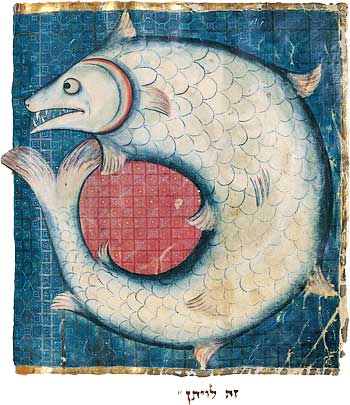
The Scales of the Leviathan
The two paths within Yaakov’s family — Yehuda’s path of particularity and Yosef’s path of universality — split when Yosef was sold as a slave. The brothers’ reconciliation and the unification of these two paths took place in Vayigash, when Yehuda drew near to his brother Yosef (Ber. 44:18).

The Midrash (Breisheet Rabbah 93:2) chose a curious verse to describe the coming together of Yosef and his brothers. The word vayigash (“and he drew near”) also appears in Iyov’s description of the scales of the giant Leviathan: “One is so near (yig’shu) to the other, that no air can enter between them” (Iyov 41:8). What do the Leviathan’s scales have to do with the reunification of Yaakov’s family?

According to the Sages, this fearsome sea creature belongs in a category of its own. All living creatures have both males and females, except the Leviathan (Baba Batra 74b). In other words, while all other creatures reflect a quality of duality and fracture that exists in our imperfect world, the Leviathan retains something of the universe’s original unity. Thus the Talmud describes the Leviathan as being akalton— twisting around and encompassing the entire world (Rashi ad loc). The Zohar (2:179a) teaches that “its tail is placed in its mouth.” In other words, this wondrous creature has neither beginning nor end. Undetected, it surrounds and unites the entire world. This hidden unity will be revealed in the future, when the righteous tzaddikim will feast on the Leviathan (Baba Batra 74b).


Illustration image: Leviathan, North French Hebrew Miscellany manuscript (1278-1298)

The future will reveal the underlying oneness of the universe, the ideal balance of Torah and Eidut, of Yehuda and Yosef, of our inwardly and outwardly directed efforts, of the particular and the universal. The two paths will be united like the scales of the Leviathan, magnificently arranged “one so near to the other that no air can enter between them.”

(Sapphire from the Land of Israel. Adapted from Shemuot HaRe’iyah, vol. 10 (1930) by Rav Chanan Morrison)

Fathers and Sons

by HaRav Zalman Baruch Melamed
Rosh HaYeshiva, Beit El 

Approaching the Fathers of the Nation
This week's Torah portion, "VaYigash ," depicts the peaceful resolution to the episode of the selling of Yosef. Recently, a student approached me with the following question: "How does one go about teaching the story of Yosef and his brothers to youngsters? True, our Torah commentators have given all sorts of interpretations, yet upon sitting down and reading the plain, unadorned text of the Bible, one receives a most appalling impression of the brothers and becomes very apprehensive of their behavior."

The question, of course, extends far beyond the episode of the selling of Yosef. There was once a teacher at one of our religious public schools who asked: "How can we even compare the behavior of, say, Rav Yisrael Meir Kagen, the "Hafetz Haim," a personage of outstanding moral stature, with that of..." - It is forbidden to even repeat his words - "Dovid HaMelech." I bring this statement only for the sake of addressing it. In truth it is forbidden to even consider such a comparison. "Dovid HaMelech lives on," says the Talmud. Dovid HaMelech composed the Book of Tehillim. Dovid HaMelech was the greatest Torah authority of his generation. The daily practices of King David are related to us by our Sages: how he constantly poured over the Torah, rose up early in the morning to study Jewish law, and busied himself composing songs of praise to the Creator.

Indeed, one who reads the Scriptures alone, without studying the words of our Sages, runs the risk of understanding things incorrectly.

When dealing with Yosef and his brothers it is important to remember that they were moral giants. The same is true of Dovid HaMelech. The Torah did not find it necessary to teach us this obvious point. Later, though, when the Rabbis detected that the passage of time was giving rise to mistaken impressions, they found it necessary to teach us that, "Anybody who thinks that Dovid sinned is mistaken."

The dispute between the brothers was a deep and penetrating one. We are not trying to claim that what took place here was justified, for the Sages themselves inform us that the famous "Ten Martyrs" were put to death as a result of the selling of Yosef. Still, one must possess the fundamental understanding that we are dealing here with the fathers of the nation . The fact that our nation has managed persevere for so many generations, and with such distinction, is, in itself, testimony to the greatness of the forefathers. "There were," in actuality, "only three forefathers," says the Talmud - Avraham, Yitzchak, and Yaakov. After these forefathers came Yaakov's sons: the fathers of the Twelve Tribes and the heads of the nation in the wake of the forefathers. The entire nation stems from them. Everything that has transpired, right up until today, goes back to these very roots. The remarkable history of our people teaches us that the roots - the forefathers - were mighty indeed.

The twelve brothers grow up together in Yaakov's house where they lead a deeply spiritual life. Because of this intensely spiritual environment, because of the great ideals and weighty responsibility bound up in it, tension arises between Yosef and his brothers. Their dispute is the result the great responsibility that they bear - the responsibility to uphold and preserve the spirit of the House of Yaakov.

Understanding the Dispute of the Brothers
a. Yosef the Idealist
It is possible to approach the dispute between Joseph and his brothers from a number of different angles. It is possible to see Joseph is an idealist, dreaming dreams of redemption and salvation, as the Sages teach, "Come and see: All that befell Yosef befell Tzion as well... It is written concerning Joseph, 'And Joseph had a dream ' (Bereisheet 37:5), and it is written concerning Tzion, 'When God will return the captivity of Tzion , we will be like dreamers '" (Tehilim 126). Yosef dreamed, for he had great ideals. True, he brings a bad report to his father concerning his brothers, but this is only because he makes such great behavioral demands of them; he feels that they are capable of more. Because of the weighty implications involved he sees no other course than informing his father, Yaakov, concerning the behavior of his brothers. The brothers, on the other hand, take a different approach - they are more realistic, more pragmatic.

It is possible to view this conflict in light of our present-day situation - for, are we not, after all, the great grand children of the forefathers? And just as Yosef was despised for being a dreamer who longed for the redemption, so too today hatred is often fostered towards those who yearn for the redemption of Israel. They go misunderstood and are often accused of dragging the nation into imminent danger or self destruction. People believe that these dreamers want the unattainable, and the hatred is at times so great that, "They could not say a peaceful word to him" (Bereisheet 37:4).

It is told, in the name of the Vilna Gaon , that all those who exert themselves settling the Land of Israel, reestablishing the Holy City of Yerushalayim, and advancing the redemption - those who strive to secure Jewish control over the Land of Israel, possess something of "Mashiach ben Yosef," the Moshiach from the line of Yosef. They continue in the spirit of Yosef, and they - like Yosef - go misunderstood. The true validity of their approach goes unrecognized, as it is written, "Yosef recognized his brothers, but they did not recognize him" (ibid. 42:8),

Yosef possesses a great and deep vision, and others do not succeed in understanding him. If only they were willing to recognize Yosef's leadership, says the Vilna Gaon, redemption would come immediately.

b. Yosef the "Internationalist"
Rav Kook explains the dispute between Joseph and his brothers in a different manner. They disagreed concerning the correct way to spread God's light in the world. Joseph believed that the best way for the Jewish People to make their impact felt in the world was by creating a "new Middle East", through attempting to influence the entire world. By associating freely with everybody, strengthening our ties with the other nations and overlooking differences, we will, Yosef felt, succeed in bringing everybody close to God. This, of course, does not imply the complete denial of all differences; rather, it means overlooking them for the sake of maintaining good relations. It means not behaving like a "nation that dwells alone," elevating itself above others. The approach of Yosef calls on the People of Israel to go out and associate with all the other nations of the world, thus influencing them.

The rest of the tribes - Yehudah at their head - thought differently. Their approach calls on the Jewish People to build themselves up from the inside - to ascend, sanctify themselves, and set themselves apart. Only after reaching a high level perfection, only then, as a unique people standing aloof, are we able to serve as a light unto the nations. Not through proselytizing or through a downplaying our uniqueness, but through banding together, joining forces and striving to attain inner perfection.

In our generation, as well, there exist different approaches when it comes to education. Lubavitch Hasidism teaches that one who knows "alef, bet" should go out and teach "alef bet." If one knows a little, one teaches a little. The more one learns, the more one teaches - whatever you've got: Give! There is another approach, though, that says that before one goes out to influence others, one must himself be full to the brim with knowledge. The more a person is overflowing himself, the greater his capacity to affect others, for his knowledge is not of a superficial character, but deep-seated and genuine.

Yosef views the Jewish People as possessing enough strength to influence the rest of the world. We have nothing to fear by going out, interacting and developing relations with the rest of humanity. They will be receptive to our message, and we will not come out any worse. The truth of the matter is, though, that this is slightly more complicated than it sounds. Rav Kook mentions the passage: "Ephraim amongst the nations assimilates," explaining that the disciples of this approach are not always successful. Sometimes there are failures and crises. It is not uncommon that one goes out with the intention of influencing - and returns influenced. Yet, if a basic inner foundation is firmly established, allowing us to rise up to great and elevated heights, afterwards, it is possible to influence the entire world.

It may appear as if we are simply projecting all sorts of profound ideas upon the dispute between Joseph and his brothers. Yet this is not the case. In the course of our long history we find these tendencies reoccurring in the Jewish People.

The Sages of the Talmud teach us: "Yosef, for sanctifying God's name in a hidden, private manner, was rewarded by having a letter from God's name (the Tetragrammaton - YHVH) added to his own." The Hebrew Yosef later became Y'hosef , an additional 'Heh,' or 'h' being added - taken, as it were - from God's own name. "Yehuda," the Talmud continues, "for sanctifying the name of God openly, publicly, merited receiving a name that was made up entirely of the letters of God's name." The Hebrew Yehuda contains, albeit rearranged somewhat, all of the letters of God's name. The above appears to be in keeping with what we have been saying up till now. Yosef is an introspective type. He possesses inner spiritual might. He is not afraid to go out and gather followers because he possesses unseen inner strengths. Therefore. Yehuda, on the other hand, sanctifies God's name openly, this is the appearance of the Kingdom of Israel.

Yosef opens up channels - "gets the ball rolling," so to speak; such is the nature of "Mashiach ben Yosef." "Mashiach ben David," The Mashiach of the house of Dovid, comes along and completes the work. There are those who possess the might, the courage and the bravery to initiate, yet they don't possess the qualities needed to finish the job - this is not their strong point. Such is the nature of Yosef. Yehuda, on the other hand, represents culmination, completion. These, in essence, are the roots of two distinct approaches that afterwards appear and reappear throughout Jewish history. We are called upon, each one of us, to approach the sons of Jacob, the fathers of the Twelve Tribes of Israel, with an appreciation for their true greatness, and in so doing, to learn whatever possible from the significant courses that they followed.

The Centrality of the "Bet HaMidrash"
The Midrash explains, regarding the words of the Torah, "He (Yaakov) sent Yehuda on ahead of him to make preparations... [in the Goshen district of Egypt]" (Bereisheet 46:20), that the purpose of this mission was to establish a house of gathering so that there be a place for Jacob to teach Torah, and for his offspring to study, upon their arrival in Egypt. Yehuda, then, was sent on ahead in order to establish a "Bet-Midrash," a study hall. The first thing that must be done is to secure a Bet-Midrash .

Here in the settlement of Bet-El, this rule held true. When we came to settle Bet-El, more than twenty years ago, we lived, initially, in the near-by army base. When we were finally given the land needed in order to build the settlement, even before a city plan was drawn up, we approached an architect with the request that he prepare a blueprint for the building of the Bet-Midrash. His immediate response was, "You can't begin building a thing until you have a city plan. What if your Bet-Midrash turns out to be in the middle of where a road ought to be? First draw up a city plan, then decide where you want to put this study hall of yours." We told him, "It's written in the Shulhan Aruch that the Bet-Midrash has to be situated at the highest point in the city, and so that's where we plan on building it. The roads will have to be planned out according to the position of the Bet-Midrash, and not the Bet-Midrash according to the roads." This we learned from the behavior of Yehuda, our father, when he sent Yehuda on ahead "to make preparations . And that is exactly what we did. We began by building our Bet-Midrash - the first stone structure built in Judeah and Samaria after the Six Day War. The Bet Midrash takes precedence above all else.

"Shema Yisrael"
The Sages teach that when Jacob finally reunites with Joseph he cries out, "Shema Yisrael." He had not seen his son for so many years - finally, they meet again. Yosef hugs his father and kisses him, yet Yaakov recites the "Shema." What sort of a response is that? Could Yaakov find a no more appropriate time for his daily recitation of the Shema prayer?

The truth of the matter, though, is that the moment of Jacob's reunification with Yosef is a most appropriate time for reading the Shema. That moment of joy and elation is the best of all possible times, for it allows Yaakov to elevate all his joy to its true source.

Many years ago I went to visit my grandfather at his home, and I was told that he went to the synagogue to pray. I went to look for him there. I entered the synagogue and my grandfather caught sight of me while in the middle of the recital of the Kaddish prayer. Suddenly I heard his voice rise up above all the others, "Yehe Shmeh Rabbah..." Afterwards, when he met me he told me the reason that he raised his voice so. "I was reminded," he said, "of the story of Yaakov and Yosef, how Yaakov recited the Shema upon seeing his long lost son. The Hassidic Rabbis say that he desired to elevate his joy to its true heavenly source. Therefore, when I saw you, I shouted for joy, in order to infuse my prayer with the personal joy I was experiencing.

It is incorrect to view the forefathers as detached, emotionless types, completely out of touch with the physical world of reality. Rather, existence itself was, for the forefathers, elevated to an altogether higher plane. The recital of the Shema at the precise moment of Jacob's reunion with Yosef was an indication of the true content of the joyous atmosphere of the reunion.

The Sages, of course, describe these events according to their own viewpoint and understanding. We, through studying their books and wisdom, see things primarily according to their perspective. We learn how the Sages understood the attitude and behavior of Jacob: his giving precedence to the Bet-Midrash, his crying out "Shema." We recognize this to be the approach of the Sages. Their outlook, of course, is the result of their greatness of Torah. Whether it was the "Shema" that Yaakov recited or something else - some other type of spiritual elation - is not the point. What interests us is the overall approach, the approach that asks the question: "On what sort of spiritual plane did the forefathers exist?"

We continue this very same spiritual course. This means striving to reach a level on which we exist in a world of Torah that is not detached from day to day life. It means making Torah an essential part of life, part of the spirit of life within, a living and breathing Torah. The wording of the blessing: "For they (the commandments of the Torah) are our life and the length of our days," is not a mere figure of speech that we recite in prayer. These words are the expression of an actual concrete inner reality that resides in the deepest recesses of the Jewish People: The Torah and life are one. May it be God's will that we merit to internalize these lessons, and to walk in the ways of the forefathers.

Did He Know?

by Rabbi Dov Berel Wein

As the story of Yosef and his brothers reaches its dramatic climax in this week’s Torah reading, we are left with many unanswered questions regarding this unique narrative. One unanswered question is how much did our father Yaakov really know about the events previously described in the Torah readings? 

There are various streams of thought regarding this matter. Rashi and the Midrash seem to believe that Yaakov, by the end of his life, certainly was aware of the entire drama and of the participants in the story. He indirectly refers to it on his deathbed, especially regarding Shimon and Levi, for their aggressive behavior towards Yosef.

Yaakov also seemingly complements Yehuda for his original moderation in dealing with Joseph, and for his later courage and heroism in defending Benjamin and confronting Yosef. It is, perhaps, safe to say that even if Yaakov was unaware of all the details of the story, he knew the general facts of the narrative, and was able to piece it together for himself.

Yaakov’s reaction is seen in the blessings he gives to his children, his final words to all the participants in this drama. It is difficult to believe that Jacob would not have asked Joseph how he came to live in Egypt, and how he rose to such a prominent position of power and influence. One of the hallmarks of the relationship between Yaakov and Yosef was the fact that, more so than the usual relationship between parent and child, they understood each other, and were sensitive to all the nuances of character that they possessed

There are other sources and commentators that seem to feel that Jacob never really knew the entire story that led Yosef "to cover the eyes of Yaakov with his hand" so that he would never know the rift in the family, and the consequences that eventually brought the children of Israel to the exile in Egypt.

All parents know that there are things about their children and their progeny that they do not wish to be informed about. Sometimes, in family matters, ignorance is truly bliss, and in his golden years, surrounded by family, Yaakov felt comforted. There also is a natural tendency among children to attempt to hide unwelcome news, evil tidings, and unnecessary aggravation from their parents.

Now that the family has been reunited in Egypt and is living in the land of Goshen in comfort, if not even luxury, of what purpose would there be to retell the bitter story of family discord? The Torah seems to indicate that the last 17 years of Yaakov's life were truly his golden years, surrounded by family, and respected and honored by the society it in which he now found himself living. Why burden the old man with a story that would only reopen wounds and create unnecessary anxiety and even regret?

Yaakov will go to his final resting place emotionally whole, reconciled even with his brother Eisav, and certainly at peace with his children and family. Whichever of the narratives we choose to follow, the Torah has told us all we need to know about Joseph and his brothers and the descent of the Jewish people into Egyptian society, and their eventual slavery and their redemption.

Assaulting Women is the New Feminism

by Daniel Greenfield

Last year, Payton McNabb, a teenage girl, was seriously injured while playing in a high school volleyball game against a transgender male athlete in North Carolina. A year later she’s still struggling with partial paralysis and constant headaches, and has trouble learning.

If Payton expected feminist groups to side with her, she was disappointed. Instead the Feminist Majority Foundation, the nonprofit that publishes Ms. Magazine, denounced the “Fairness in Women’s Sports Act” bill meant to protect teenage girls like her.

The Feminist Majority Foundation, along with Feminist Campus, Equal Rights Advocates, Girls Inc, Women’s Legal Defense and Education Fund, Trust Women, United State of Women, and the National Organization for Women, and numerous feminist groups signed a letter attacking the federal ‘Protection of Women and Girls in Sports Act’ for daring to protect women from suffering the way that Payton and other female athletes had.

A dozen organizations with “women”, “girl” or “feminist” in their names were dedicated to the proposition that womens’ sports should be eliminated and that any women or girls who play should be ready to suffer catastrophic injuries from 220-lb. ‘transgender’ male athletes.

Beating women and denying their existence is the new feminism. So is raping women.

In the wake of the Hamas rapes during the invasion of Israel on Oct 7, some have wondered where the feminist organizations are. The answer is that they’re supporting the rapists.


Feminist Front coordinated a statement claiming that “Palestine” was a “feminist issue” and complaining that “Palestinian boys and men have been falsely portrayed as bloodthirsty terrorists, rapists, and savages”. The statement was signed by the Global Women’s Strike, Feminist Uprising, Black Feminist Future, HEART: Women and Girls and other socialist organizations.

When feminist groups weren’t outright supporting the rapists, they were ducking the issue.

The few feminist groups that addressed the Hamas sexual assaults either offered generic statements, such as the National Organization of Women’s press release condemning, without any specifics, “the use of rape as a weapon of war”, or tried to split the difference, like Women for Women International equating the Hamas rapes and murders of Israeli women, to Muslim women suspected of carrying bombs being strip searched by Israeli authorities.

The Global Fund for Women “unequivocally” denounced “all forms of sexual and gender-based violence worldwide” including in “Israel and Palestine”, condemned Hamas and Israel for “the violent bombardment of Gaza” and demanded an investigation into “sexual and gender-based violence committed against Israeli and Palestinian women.”

Some feminist organizations parroted the leftist line calling for an end to Israeli attacks on Hamas. The Women’s Environment & Development Organization (WEDO), established by former Rep. Bella Abzug, the first Jewish congresswoman, republished a statement from AWID titled “feminist demand: stop the massacre in Gaza” and called for “decolonization”. WEDO issued no statement about the massacre and rape of Israeli women by Hamas Jihadists.

Anyone still surprised had not been paying attention to the trajectory of a movement that denies women exist and upholds the right of men who claim to be women to beat and even sexually assault women.

Feminist groups demand that transgender sex offenders should be locked up together with women and champion “non-carceral” and “restorative justice” solutions for rapists.

“Palestine” is a feminist issue. So are “decarceration” programs that put rapists right back on the street along with transgender sports. What isn’t a feminist issue anymore is protecting women. Asserting that women, as opposed to “bodies with vaginas”, “pregnant people” or “bleeders”, exist is now a radical position from a marginalized group of ‘TERFs’.

Feminism didn’t just turn its back on Israeli women: it turned its back on women.

Most feminist groups shifted away from criticizing the Islamic abuse of women after 9/11. And those who did not were accused of Islamophobia. It’s now routine in socialist circles to decry the “weaponization of women’s rights by the far right”. By that they mean any reference to not only Islamic misogyny, but transgenderism, crime and any issue except abortion and pay parity.

Legitimizing rape became a feminist cause long before Oct 7. Especially when perpetrated by certain groups. Social service workers and law enforcement personnel who tried to investigate Muslim sex grooming gangs in the UK were denounced as “Islamophobes.”

End Violence Against Women, a British coalition of feminist groups, for example argued that the “depiction of some forms of gender-based violence, especially FGM, as exceptionally ‘barbaric’, is similarly driven by a white supremacist worldview.” The basic position that mutilating young girls is wrong is now white supremacy leads to FGM becoming feminism.

Critics correctly note that feminism failed Israeli rape victims, but whom didn’t it fail?

Feminism now means demanding that men in dresses should have access to battered women’s shelters. There is talk among feminist scholars about opposing Title IX, the foundation of womens’ sports, because it excludes transgender men. Apart from relentlessly campaigning for abortion, what does the feminist movement even do anymore that’s related to women?

A feminist movement that won’t protect battered women, trafficked girls in Europe or womens’ sports in America is certainly not going to stick its neck out for women assaulted by Hamas.

Why should a movement that lets its own daughters be beaten care about Israeli women?

What happened to the feminist movement is fairly similar to what happened to liberal Jewish organizations in America. The particular cause was traded for the general one and groups abandoned their origins and responsibilities to chase after the latest trend in the leftist movement. There are many organizations with “Jewish” or “Women” in their name, but few that actually advocate for Jews or women. Most of these groups just use the pretzel logic of intersectionality to explain why the cause they’re fighting for, which has nothing to do with Jews or women, and is sometimes dangerous to them, is actually a Jewish or feminist cause.

And that is how you end up with Jews for Hamas and Feminists for Rape.

Vulnerable groups provide a certain cachet to a movement, but movements by design are also likely to perpetrate the same abuses that those groups were fighting against. Misogyny and antisemitism were always bound to resurface in a mass movement. The acid test was whether feminist and liberal Jewish groups would remain loyal to their mission or the movement.

They chose the movement.

The rise of Islam inverted the roles of victim and perpetrator. Anyone attacked by Islam became an oppressor. And since women and Jews are both targets of Islamic abuses, the movement accepted the moral inversion that rape and genocide were progressive, and that the oppressors were anyone who complained about terrorism and female genital mutilation.

The feminist movement let down Israeli women, American women, European women and most women. It exists now to campaign for abortion, the hijab, men entering the ladies room and the moral superiority of people from cultures where women have no rights and no freedoms.

Assaulting women is the new feminism. The real feminists are the brave and stunning men in dresses and Islamic rapists and groomers. Feminism is Hamas terrorists breaking into Israel. It’s Steve spiking a ball into a teenage girl’s face. It’s calling women “bleeders”.

You’ve come a long way, baby.

The Curious Case of the Biden Administration and Hamas

by Bassam Tawil 
  • Hamas is currently fighting to keep on ruling Gaza and the opportunity to regroup, rearm and destroy Israel -- which is why it is pleading for a ceasefire. Hamas's eyes are now set on the Biden administration and the United Nations, which they hope will prevent Israel from stopping the Hamas reign of abuse.
  • Did anyone call for a ceasefire when the US was routing ISIS in Syria and Iraq, or demanded that the US end its military campaign by a certain date?
  • The Hamas official... is saying that Palestinian terrorism pays -- even the US administration is turning against Israel.
  • The grotesque irony, of course, is that -- no matter how careful Israel is to avoid civilian casualties -- the more the West blames Israel for civilian deaths, and the more Hamas will place civilians in the line of fire in order to keep the international community blaming Israel.
  • The Biden administration should be telling Hamas, not Israel, to minimize the number of civilian casualties. The real cause of these casualties, besides Hamas, is therefore actually the Biden administration, the United Nations and the international community: they incentivize Hamas to place their own people in harm's way to be killed -- the more the better -- so that everyone can then accuse Israel. The act of blaming Israel for the casualties that were orchestrated by Hamas is, in fact, what is causing them. Hamas can only be looking around and saying to themselves, "Hey, it's working! So let's keep on doing it!"
  • If Israel were engaged in "indiscriminate bombing," it would not have asked Palestinian civilians to move to safe zones. If this were a war against the Palestinian population, Israel would have bombed the Gaza Strip only from the air, without risking the lives of its soldiers.
  • The message Biden is sending to the terrorists is: Hold on, we are with you and we want to remove Netanyahu and his government from power.
  • [T]he mounting pressure by the Biden administration on Israel to end the war is a sign that the US does not want to see Hamas destroyed. Hamas is undoubtedly hoping to be rewarded for their October 7 carnage with an independent, Iran-backed Islamist Palestinian state right next to their "mark," Israel.
  • Is it appropriate for a foreign leader to demand that the Israeli prime minister replace his democratically-elected coalition partners while Israel is in the midst of a war, or even if it were not? Has Biden ever demanded from any Arab leader, including Palestinian Authority President Mahmoud Abbas, to make changes in his cabinet?
  • The Biden administration also doubtless understands that the war on Hamas cannot be conducted with a stop-watch or a certain timeline. The war to destroy Hamas and remove its threat to Israel could take additional weeks or months. As with routing ISIS or Al-Qaeda, the timing should not be a consideration at all. The Biden administration might please stop meddling in the war effort.
  • Instead of issuing deadlines for ending the war, the Biden administration should be voicing full support for Israel's war on Iran's terrorist proxies. Israel is fighting to defeat terrorism and preserve freedom for all of us in the free world. Israel is sacrificing its heroic citizens so that we will not have to. Instead of hampering Israel, we should be thanking it and doing all we can to help.
  • Hamas already recently broke two ceasefires in two months; there is no reason to think they would not break a third, fourth and fifth. As they keep openly admitting, their chief goal is to murder Jews and wipe Israel off the map. How is it, one wonders, that Hamas has the right to pursue its declared aim of destroying Israel while Israel is not entitled to battle those who seek its destruction?

Hamas is currently fighting to keep on ruling Gaza and the opportunity to regroup, rearm and destroy Israel -- which is why it is pleading for a ceasefire. Hamas's eyes are now set on the Biden administration and the United Nations, which they hope will prevent Israel from stopping the Hamas reign of abuse. Pictured: Hamas terrorists on a pickup truck "escort" trucks carrying humanitarian aid that they intend to loot, near the Rafah border crossing with Egypt in the southern Gaza Strip on December 10, 2023. (Photo by Mohammed Abed/AFP via Getty Images)

As Israel is waging war on the Iran-backed Hamas terrorist group, whose members murdered more than 1,200 Israelis and kidnapped 240 others to the Gaza Strip on October 7, the Biden administration appears to be doing its utmost to sabotage Israel's efforts to defend itself against terrorism.

Iran and its proxies, including Hamas, Hezbollah, Palestinian Islamic Jihad and the Houthis, can only be ecstatic about the Biden administration's new restrictions, especially the pressure it is reportedly exerting on Israel to end the war in the coming weeks.

Hamas is currently fighting to keep on ruling Gaza and the opportunity to regroup, rearm and destroy Israel -- which is why it is pleading for a ceasefire. Hamas's eyes are now set on the Biden administration and the United Nations, which they hope will prevent Israel from stopping the Hamas reign of abuse.

Continue Reading Article

Saturday, December 16, 2023

The persistent "two-state" delusion


If the west wants to solve the Middle East conflict, it must take a long look in the mirror
 
US Secretary of State Antony Blinken meets Palestinian Authority president Mahmoud Abbas, October 13 2023

The simmering tensions between Israel and the Biden administration over the plan for post-war Gaza have now come to the boil.

The US is doubling down on its insistence that Gaza must be run by a revamped Palestinian Authority. The Americans are still obsessed with a “two-state solution” to the conflict between Israel and the Palestinian Arabs.

This week, US President Joe Biden told a White House Chanukah reception that there had to be a Palestinian state in the future and that Israel’s Prime Minister Benjamin Netanyahu needed to make an effort to strengthen, change and “move” the PA.

Netanyahu riposted that Israel would permit neither Hamas nor the PA to rule Gaza. Israel, he said, would not repeat the “mistake of Oslo,” a reference to the 1993 Oslo Accords between Israel and the terrorist Palestine Liberation Organisation under which control of Gaza and parts of the disputed territories of Judea and Samaria were handed over to the newly-created PA.

The previous day, Netanyahu had caused outrage by stating that the Oslo Accords caused as many deaths as the October 7 Hamas massacre, “though over a longer period”.


His enemies immediately claimed that the comparison was invidious, that he was seeking to shrug off any blame for Israel’s vulnerability to the Hamas pogrom and that he was already campaigning to win the general election that many assume will follow the war.

Whether or not such criticisms are well-founded, they are irrelevant to the key point at issue. Giving the PA control of Gaza and establishing a Palestine state would expose much more of Israel to atrocities similar to those that took place on October 7— and worse.

The idea that the P. would suddenly turn into a reliable guarantor of peaceful co-existence with the Jewish state is for the birds. Currently, Israel is locked in a desperate struggle in Judea and Samaria to contain a huge spike in terrorism by Hamas and other armed groups, which have vastly expanded in scope and weaponry under PA administration.

In fierce firefights in these territories, the IDF has arrested hundreds of terrorists, killed others, seized weapons and destroyed weapons labs, terrorist command centres and terrorist tunnel shafts. Just like in Gaza.

Officials in the PA’s ruling party, Fatah, have gloated over the slaughter of October 7 and pledged there will be more.

The Biden administration says the PA must change. But how is that remotely feasible given that it has indoctrinated its people with Nazi-style antisemitism, teaching them to regard Jewish people as the devil incarnate and that the highest goal is to murder them and steal their land in order to turn the whole of Israel into a “state of Palestine”?

This week, polling results published by the Palestinian Center for Policy and Survey Research revealed that no fewer than 82 per cent of Judea and Samaria residents and 72 per cent of Gazans approve of the October 7 pogrom.

If there were an election in the disputed territories, Hamas would win hands down. Support for Hamas in these territories has more than tripled compared to three months ago. In Gaza, such support has also increased. The overwhelming majority in both areas want to see Israel destroyed.

If the Palestinian Arabs are to govern themselves, they must go through the equivalent of the de-Nazification that was carried out in Germany after World War II. That clearly cannot be done by the rejectionist, Jew-hating and despotic PA.

In Britain, whose government is marching in lockstep with the US, Defence Secretary Grant Shapps has stated that the PA is the best vehicle for governing post-war Gaza and that the British Support Team, a military unit that has been training the PA’s security forces for many years, should play a vital role with its “capacity” enhanced.

This is similarly deluded. In 2018, the British Foreign Office awarded itself an official score of “A+”, claiming the PA’s training had “exceeded expectations” for developing “accountable and responsive security and justice services” and that, as a result, “citizens have been empowered … to hold authorities to account”.

Yet as David Rose observed in The Jewish Chronicle, in 2021 14 members of those same PA security forces raided the home of Nizar Banat, the leading anti-corruption, pro-democracy campaigner in Judea and Samaria, kidnapped him and savagely beat him to death.

Moreover, the Palestinians have been repeatedly offered a state of their own and turned it down, resorting instead to violence against Israel every time.

The west’s obsession with a two-state “solution” is therefore a type of madness. The core reason for this is the west’s refusal to recognise that the most important factor in this never-ending conflict is the behavior of the west itself.

This started in the 1930s, when Britain tore up its treaty obligation under the 1922 Mandate for Palestine to settle the Jews throughout what is now Israel, Judea and Samaria, and Gaza, and instead offered the Arabs a state within that land. This was the original “two-state solution”. It was based on a repudiation of international law and a reward to the Arabs for their murderous aggression.

Ever since then, Britain, America and the Europeans have continued to incentivise and reward the Palestinian Arabs for their exterminatory agenda by bestowing upon them global status, funding and support.

Western leaders have never acknowledged the bogus nature of Palestinian identity that writes the Jews out of their own history. Nor have they acknowledged the PA’s gross Jew-hatred; nor the way the Palestinian refugee agency UNRWA, funded by the west, weaponised equally bogus Palestinian refugee status to turn the world against Israel.

As for the Oslo Accords, midwifed by the Clinton administration, they unleashed three decades of terrorism causing thousands of Israelis to be murdered and injured. Former PLO leader Yasser Arafat bragged that he had signed the accords as a ruse to bring back terrorism to Israel from Tunis, where he had been exiled, and that the “two-state solution” was a “first stage” in Israel’s destruction.

Whether through their dependence on the Arab world, anti-Jewish prejudice or the liberal fantasy that all conflict can be ended through compromise, western governments told themselves that the Arab war against Israel was no more than a fight over land boundaries. Since it was actually a genocidal cause, successive Israeli governments — other than at Oslo — have balked at concessions that would have signed the death warrant of the Jewish state.

Netanyahu’s overriding concern has always been to prevent a Palestinian state because of the mortal threat it would pose to Israel. That’s why he tolerated the rule of Hamas in Gaza: to divide the Palestinians, and thus forestall the establishment of another terrorist entity.

The October 7 pogrom exposed this as a catastrophic error of judgment for which he should deservedly pay a high political price.

But people must look beyond their loathing of Netanyahu to where Israel’s interests lie. Is it in its interests for the PA to run Gaza? No. Is it in its interests for Israel to run Gaza? No. Is a “two-state solution” in Israel’s interests? No.

So who should run Gaza?

That question cannot be answered in a way that protects Israel’s interests unless the whole paradigm shifts, and the western world stops supporting the Palestinians’ agenda of extermination and starts treating them as the pariahs they should be. At a stroke, their cause would collapse.

That won’t happen unless the world finally decides to accept — as it did in 1922, but then chose to forget — that the Jews are the only people, as a people, who are legally and morally entitled to inhabit Israel, their own ancestral homeland.