Thursday, November 21, 2024

Regime-Change: Prerequisite for Iran’s Policy-Change

by Ambassador (ret.) Yoram Ettinger

According to the State Department’s annual human rights report on Iran: “Iran’s restrictions on human rights worsened in a number of areas during the year....[For instance], transnational repression against individuals, femicide, forced sterilization, early and forced marriage, trafficking in persons, recruitment of child soldiers, worst forms of child labor, violence targeting ethnic minorities [e.g., Shiite Arabs, Sunni and Shiite Kurds and Sunni Balochis], severe restrictions on freedom of expression and religion [e.g., Sunnis, Baha’is, Jews], criminalizing lesbian, gay, bisexual, transgender, queer, and intersex persons, enforced disappearance, torture or other cruel, inhuman, or degrading treatment or punishment by the government....”

The UN High Commissioner of Human Rights adds: ”Human rights violations by Iran... amounting to crimes against humanity.... Women and girls subjected to rape and other forms of sexual and gender-based violence, including gang rape, rape with an object, electrocution of genitalia, forced nudity and groping.... State authorities at the highest levels encouraged, sanctioned and endorsed human rights violations through statements justifying the acts and conduct of the security forces....”

*Since its February 1979 violent rise to power, the Ayatollahs’ regime has been intensely committed to its 1,400-year-old fanatical vision, as documented by its Constitution, school curriculum, mosque sermons and the daily enforcement of its Islamic Revolution, domestically and globally. The Ayatollahs’ vision – which transcends financial and diplomatic considerations – has transformed Iran from “The American Policeman of the Gulf” to the leading global epicenter of anti-US terrorism, drug trafficking, money laundering and the proliferation of advanced military systems.

*Notwithstanding Western appeasement, generous financial and diplomatic gestures and occasional crippling economic sanctions, the Ayatollahs have adhered to their ideology, rejecting the Western notion of “Money Talks.” The Ayatollahs have systematically defied peaceful coexistence, good-faith negotiation and tolerance, which contradict the core of their own Islamic Revolution. They have evolved into a role model of ruthless despotism and imperialism, driven by an ideology, which mandates subjugation and degradation of internal and external opponents, such as domestic dissidents, ethnic and religious minorities, women, “apostate” Sunni regimes, the “infidel” West (religiously, culturally and strategically), “The Great American Satan” and “the illegitimate Zionist entity, the vanguard of the US in the Middle East.”

*The Ayatollahs have been totally committed to intolerant violence at home and abroad. Their rogue domestic conduct has reflected and bolstered their rogue external conduct.

*Contrary to US policy makers, who consider negotiation as a means to advance their goal of reconciliation, the Ayatollahs have always viewed negotiation as a means to advance their goal of subjugation, leveraging the US diplomatic option to bolster their anti-US capabilities, surging from a secondary/tertiary power in 1979 to global prominence in 2024.

*President Trump’s first term featured “maximum pressure” economic sanctions, crippling the Ayatollahs’ economy, and constraining their capability to bolster terrorism and wars. However, as demonstrated by the 2021 suspension and softening of the sanctions, economic sanctions are reversible by a succeeding President. They temporarily reduce/delay the wrath of war and terrorism, but do not induce the Ayatollahs to abandon their ideology, and reform their conduct, domestically and globally. Moreover, the Ayatollahs have perfected their sanctions-evasion techniques...

*On the other hand, regime-change is irreversible, eliminates the threat, and cannot be restored by a succeeding President. Moreover, it would bolster the US’ strategic stature (including in Latin America, the US’ soft underbelly), by removing the Ayatollahs’ machete from the throats of all pro-US Arab regimes, eliminate the chief global destabilizer and supporter of Islamic terrorism, and induce Saudi Arabia and Oman (and possibly Kuwait, Indonesia and additional Moslem countries) to join the Abraham Accords.

*Therefore, the Ayatollahs’ 45-year-old track record attests that they should not be partners to negotiation, nor a target for maximum pressure economic sanctions, but a target for regime-change. The potential cost of regime-change would be dwarfed by the cost of an Ayatollahs’ success to topple the regimes of Jordan (transforming Jordan into a volcanic arena of Islamic terrorism) and the highly-vulnerable Arab oil-producing countries (gaining control of 48% of global oil reserves), as well as the horrific cost of facing a nuclear Iran.

Wednesday, November 20, 2024

From a laugh to a cry

by Rabbi Pinchas Winston

LAST WEEK’S PARSHA was a laugh. This week’s parsha is to cry for. It’s never easy losing a spouse you love, especially if you had something to do with it. In Avraham’s case, it was the Akeidah that caused Sarah’s death, even though she ended up dying precisely at the moment she was meant to die from the day she was born. We all do.

But as the Gemora says, righteous people, even after they have died are considered alive (Brochos 18a). So the parsha is appropriately called “The Life of Sarah” and not “The Death of Sarah” because, though her body died, her spirit lives on and continues to do so through every Jew that descends from her.

You have to also appreciate the irony of the situation. The son that made her laugh and others with her, whose very name is a reflection of all her joy was the means to take it away from her. The potential loss of her beloved son cost Sarah her life (she died from the shock of the Akeidah), and denied her the chance to stand under the chupah of her son, or see any grandchildren from him.

But that’s life, and that’s laughter. Life is the ongoing daily reality that usually includes some pain or another. There is a reason why anti-depressants are so popular today, be they actual medication or just distracting forms of entertainment. It’s as if something pain-causing is always lurking in the shadows waiting for the right moment of vulnerability to pounce.

Laughter is the opposite. It is not continuous and can be difficult to generate. That’s why “good” comedians make so much money and are so in demand. And even if we do manage a hearty laugh from time to time, it is usually short lived. Even more ironic is how we’re able to manage ongoing pain, but we could never manage continuous laughter. People have died laughing.

But that’s the way it is meant to be. God made the world He did so that man could exist and have free will. This necessitated good and evil, cause and effect, pain and relief. Pain is an integral part of this stage of history because it is the main way a person is pushed to make a choice in one direction or another, to reveal their moxie or spiritual weakness.

It works, as long as it does not kill hope. Hope is that all-important state of mind that drives us in life to accomplish meaningful things and inspires us to get out of bed each morning. If hope goes, so does a person, and few things kill hope more completely than prolonged pain.

But a funny moment? It has the power to restore hope in seconds, like rising above the clouds on a stormy day into the calm, sunny world above. You can’t stay up there for very long, but having been there for even a short while can leave a long, lasting impression, sometimes even years later.

This idea however is even more powerful than most think, something we learn from the holiday of Purim.

On a simple level, Purim celebrates how history for the Jewish people went from being bleak to promising all within a short time. One moment, the Jews of Mordechai’s and Esther’s time were facing genocide, and the next moment they had the king’s permission to fight back. Everything got turned on its head.

The New Axis of Tyrannies vs. the West: A Mighty Clash of Titans

by Nils A. Haug
  • The reason for the axis's actions appears to be a desire for a new world order with themselves at the helm. They seem to believe that through their combined effort, America's unipolar global leadership in the political, economic and military spheres can be upended.
  • [T]he driving forces underlying this developing clash of major powers have many facets, one of which appears to be religion, always a convenient pretext as so much can never be proven.
  • [I]n autocratic or totalitarian regimes comes the imperative to forcefully assert the regime's idea of religion, of its "truth," often upon an unwilling populace. Associated with such systems is the intention of ultimately establishing global compliance with their beliefs, which sometimes appear to be a "religion" of state supremacy.
  • Standing in Iran's path is the Jewish state of Israel, whose inhabitants inconveniently refuse to vacate it. To many Islamists, continual jihad appears to go hand-in-hand with the need for acquiring land.
  • "Fight those who believe not in Allah nor the Last Day," the Quran commands Muslims in Surah 9:29.
  • To this effect, the February 2024 issue of the Urdu-language al-Qaeda publication Nawa-i-Ghazwa-e-Hind indicates, "Allah has declared Jihad as the path for the enforcement of religion." In plain words, jihad is required to forcibly establish Islam as the one "true" faith – a global religion.
  • Hamas's primary concern, however, does not appear to be an independent state for Palestinians -- as it identifies with the Muslim Brotherhood -- but a Sharia-based global Islamic Caliphate through jihad. For Hamas, as for the Muslim Brotherhood, a Palestinian state would be merely the first-step in a wider agenda.
  • The Muslim Brotherhood is the catalyst movement behind the modern global jihadist movement, and should rightly be designated a Foreign Terrorist Organization. Its founder, Hassan al-Banna, said, "it is the nature of Islam to dominate, not to be dominated, to impose its law on all nations and to extend its power to the entire planet.
  • Hassan Nasrallah espoused the same idea: "We won't stop until every country on Earth is ruled by the law of Allah and the people of Islam, like our prophet promised."
  • The West, meanwhile, due to a variety of weak and compromised political decisions, has tried to prevent Israel from acting alone in direct conflict with jihadists, whether Hamas, Hezbollah or Iran itself. All the same, the nation of Israel, despite nearly 4,000 years of unremitting challenges to its existence, appears to be enduring just fine.

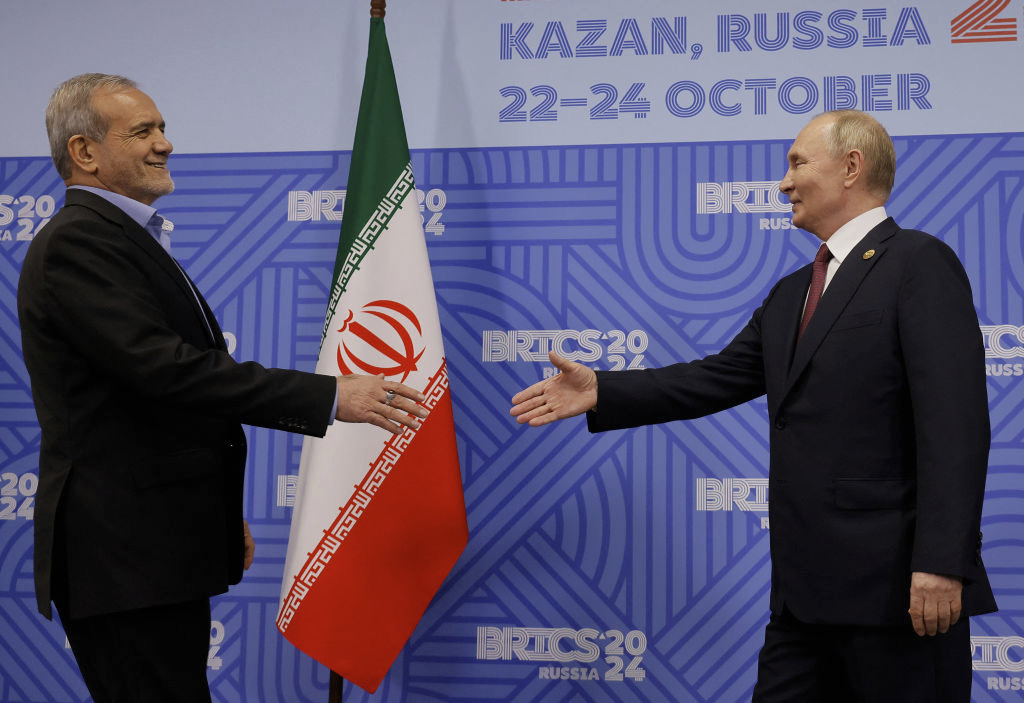
Driven by disparate ideologies, a new axis of hegemonic dictatorships includes Russia, with imperialist aims over vast regions, Slavic and otherwise; China, with a desire for world domination; Iran, striving for a global Islamist Caliphate; and North Korea, apparently intent on seizing the Korean peninsula, for a start. Pictured: Russian President Vladimir Putin meets with Iranian President Masoud Pezeshkian at the BRICS summit in Kazan, Russia on October 23, 2024. (Photo by Maxim Shemetov/Pool/AFP via Getty Images)

The volatile world political order currently reflects a clash between an axis of hegemonic dictatorships flexing their increasing military prowess, and an alliance of Western nations, including Israel, the West's sole democratic partner in the Middle East.

Driven by disparate ideologies, the axis includes Russia, with imperialist aims over vast regions, Slavic and otherwise; China, with a desire for world domination; Iran, striving for a global Islamist Caliphate; and, to a lesser degree, North Korea, apparently intent on seizing the Korean peninsula, for a start.

The reason for the axis's actions appears to be a desire for a new world order with themselves at the helm. They seem to believe that through their combined effort, America's unipolar global leadership in the political, economic and military spheres can be upended.

Continue Reading Article

Rabbi Daniel Glatstein on Parashat Chayei Sarah: Powerful Segulos To Find a Shidduch (video)

Igrot Hare’aya – Letters of Rav Kook: Involving Baron Rothschild in Religious Efforts

#278 

Date and Place: 14 Adar 5670 (1910), Yafo

Recipient and Background: Rabbi Professor Yisrael Levi of France. Rabbi Levi, who spent most of his life in Paris, and later became the Chief Rabbi of France, was apparently close at that time with an important Jewish Parisian – Baron Edmond Rothschild.

Body: I feel an obligation to express my thanks and blessing to your honor, who showed me favor by fulfilling my request about the dear Rabbi Zev Bernstein, who lives in the moshava Petach Tikva. I would be so pleased if it will be possible to continue helping him in the days to come, as he is a very honorable man.

Similarly, I would be grateful to your honor if you would say a good word about the book Shabbat Ha’aretz (Rav Kook’s work on the Laws of Shemitta). I will be very happy if it finds favor in the eyes of a Torah scholar such as you. May you be blessed if you carry out my request to give the copy I sent to the honorable “Generous Baron” (Rothschild).

As I speak, it would be an honor if I can say further matters. Perhaps Hashem will be with us, and we can do positive things on behalf of religious concerns for the New Yishuv (which the Baron significantly helped finance). Of course, my whole interest is to connect religion to the emergence of a strong settlement movement. We see with our own eyes that it is impossible for a settlement to thrive and be sustained without there being respect for and vitality of religious life. It would be very appropriate if the revered Baron, who has done so much for the Yishuv, will pay attention to the invigorating of the Yishuv’s soul, i.e., its spirit of religion. To promote this, we must adopt the idea of a Yishuv-wide rabbinate (editor’s note - it is unclear if Rav Kook, who was considered the rabbi of the moshavot in the vicinity of Yafo, already fit that role) and make it possible to hold regular trips to the broad Yishuv, in Judea and the Galilee, in order to fortify the stature of religion.

Additionally, we need to strengthen the local rabbinates, in every agricultural settlement. In Ekron, a rabbi was already installed according to my approval and choice, and thank G-d he is distinguished, and his actions have left a good mark on the moral and religious character of the moshava. However, he is very downtrodden, and his livelihood is minimal. It would be wonderful if it would be possible to support him with a set salary.

It is also very necessary for the Yishuv-wide rabbinate to have a literary platform, i.e., a special newspaper that will come out at least on a monthly basis. This can bolster the status of religion and clarify the many questions that affect the whole Yishuv, on the practical and theoretical level and on that which emerges from it.

It is especially necessary to have a central yeshiva for the New Yishuv, a yeshiva in the proper spirit of Israel, capable of producing wonderful rabbis for the Yishuv. They should be educated in culture and understanding the world and practical life, in addition to their Torah and philosophy. They should also be gifted speakers who capture the interest of many with the veracity of their ideas.

All of these matters need to be fulfilled in practice. The Yishuv will be thankful if your honor will bring these ideas close to the ear of the respected Generous Baron. This would cause all of the acts of charity that he has undertaken on behalf of the Holy Land to shine in a lofty beam of light.

I have begun the yeshiva on a small scale with Hashem’s help. However, when we have sufficient wherewithal, we are prepared to embellish and expand activities in a very desirable manner. This will enable the inhabitants of Eretz Yisrael to influence Jewish communities in the Diaspora.

I hope that your honor will kindly agree to answer all of my questions and try as you can to support the good things that I intend to establish for the benefit of our nation and our Holy Land.

Tuesday, November 19, 2024

Rav Kook on Parashat Chayei Sarah: Princess of Her People and the Entire World

Universal Message
God changed both Abraham and Sarah’s names: Avram to Avraham, and Sarai to Sarah. What is the significance of this name change? The Talmud in Berachot 13a explains that both changes share a common theme.

The name Avram means “father of Aram.” At first, Avraham was only a leader of the nation of Aram, but in end, he became a spiritual leader for the entire world. Thus, he became Avraham — “Av hamon goyim,” the father of many nations.

The name Sarai means “my princess.” In the beginning, she was only a princess for her own people. In the end, though, she became Sarah — “the princess” — the princess of the entire world.

In other words, the teachings of Avraham and Sarah were transformed from a local message to a universal one. Yet the Talmud tells us that there was a fundamental difference in these name changes. One who calls Abraham by his old name has transgressed a positive commandment. No such prohibition, however, exists for using Sarah’s old name. Why?

Avraham’s Thought, Sarah’s Torah
Rav Kook distinguished between the different approaches of these two spiritual giants. Avraham’s teachings correspond to the philosophical heritage of Judaism. He arrived at belief in the Creator through his powers of logic and reasoning, and used arguments and proofs to convince the people of his time. As Rambam (Hilchot Avodah Zara 1:9,13) wrote, “The people would gather around him and question him about his words, and he would explain to each one according to his capabilities, until he returned him to the way of truth.”

The Torah of Sarah, on the other hand, is more closely aligned with good deeds, proper customs, and practical mitzvot. Thus, the Midrash (Bereisheet Rabbah 60:15) emphasizes the physical signs of her service of God — a cloud hovering at the entrance to the tent, a blessing in the dough, and a lamp burning from one Shabbat eve to the next.


The philosophical content of Judaism is universal in nature. Avraham’s ideals — monotheism, chesed, helping others - are relevant to all peoples. It is important that Avraham be recognized as a world figure in order to stress the universal nature of his teachings. He must be called Avraham, “the father of many nations.”

Practical mitzvot, on the other hand, serve to strengthen and consolidate the national character of the Jewish people. From Sarah, we inherited the sanctity of deed. These actions help develop the unique holiness of the Jewish people, which is required for the moral advancement of all nations. In this way, Sarah’s Torah of practical deeds encompasses both the national and universal spheres. Sarah, while “the princess” of the world, still remained “my princess,” the princess of her people.

(Gold from the Land of Israel pp. 51-52. Adapted from Ein Eyah vol. I, p. 69 by Rav Chanan Morrison)

Yerushalayim and Me'arat Hamachpela

by HaRav Mordechai Greenberg
Nasi HaYeshiva, Kerem B'Yavneh


In the beginning of Parshat Va'era, Rashi cites the Midrash that after Moshe complained to G-d, "Why have You done evil to this People" (Shemot 5:22), G-d said: "Woe to those who are lost and no longer found. I have what to regret over the death of the patriarchs ... When Avraham sought to bury Sara, he did not find a plot, until he bought it at great cost ... and they did not question My ways. But you say, 'Why have You done evil?'"

The question arises: Is it possible to compare Moshe's complaint about the difficult exile to Avraham's acceptance that he has to expend a sum of money to purchase a burial plot? What difficult trail did Avraham have when he had to purchase the field?

Moreover, R. Yona, in his commentary to Pirkei Avot, writes that the purchase of Me'arat Hamachpela was the final trial, and this was more difficult than the trial of the akeida! How can this be?

Pirkei D'Rabbi Eliezer describes Avraham's connection to Me'arat Hamachpela. When Avraham prepared the feast for the three angels:

He ran to bring a calf, and the calf ran away from him and entered Me'arat Hamachpela, and [Avraham] entered after him there. He found Adam and Chava lying on beds and sleeping, with candles burning over them, and a fragrant aroma upon them. Therefore, Avraham desired Me'arat Hamachpela for a burial site.

He spoke to the people of Yevus to purchase Me'arat Hamachpela from them for a full price with gold and an eternal deed as a burial site. Were they Yevusim; were they not Chittim? Rather, they were called after the city Yevus (Yerushalayim), and the people refused. He began bowing to them, as it says, "Avraham bowed before the people of the land." They said to him: We know that G-d is destined to give you and your descendents all of these lands. Seal with us an oath that Bnei Yisrael will not take over the city of Yevus without the agreement of the children of Yevus. Afterwards, Avraham purchased Me'arat Hamachpela for a full sale and in writing forever as an eternal heritage, as it says, "Avraham listened to Ephron..."

What did the people of Yevus do? They made idols of copper and placed them in the city streets and wrote Avraham's oath on them. When Israel entered the Land, they wanted to enter the Yevusite city, but were not able to enter, because of the sign of the covenant of Avraham's oath, as it says, "The children of Binyamin did not drive out the Yevusite, inhabitants of Yerushalayim, so the Yevusite dwelt with the children on Binyamin, in Yerushalayim, until this day." (Shoftim 1:21)

Pirkei D'Rabbi Eliezer continues to describe all the delays in the conquest of the city of Yevus until David purchased the plot from Aravna the Yevusite. This entire delay was caused by Avraham's oath to the people of Chet, as the Yevusites said to David, "You cannot enter the Yevusite city until you remove these idols that have Avraham's oath written on them."

This was the great trial of Avraham. Sara's burial came a few days after descending from Mt. Moriah, after the trial of the akeida, in which he was promised the great future of this mountain: "Hashem will see; as it is said this day, on the mountain Hashem will be seen." (Bereisheet 22:14) Now he fell from great heights to great depths, and he cannot bury Sara in the place he so much wanted, unless he would forego Yerushalayim.

Who knows G-d's secret ways, and how can we understand the many delays in the capture of Yerushalayim from the days of Avraham to our days, with the declaration, "The Temple mount is in our hand!" - and it is still not completely.

The issue is deep and complex; we will explain only briefly. Chazal say: "Netzach is Yerushalyim, and hod is the Temple." Rav Kook zt"l explains that netzach indicates struggle and victory (nitzachon). For Yerushalayim, the kingdom of Israel, we must struggle, and we will be victorious. However, the Temple itself will ultimately be recognized by the nations themselves, without a struggle, as the place of the Divine Presence, from which all human culture and ethics emanate. We do not force this upon the nations of the world. They will ultimately recognize the splendor of this place, and will come and call, "Come, let us go up to the Mountain of Hashem ... From Zion Torah will go forth." (Yeshaya 2:3) Only after we appreciate the splendor of the place will we have full control over the place: "Hod - this is the Temple."

Sarah’s wisdom and fortitude

by Rabbi Dov Berel Wein

In truth, our mother Sarah, like many other mothers past and present in Jewish life, has not quite received her due. Rashi, quoting Midrash in describing Sarah’s life, states that all the years of Sarah’s life were "for good." He must mean "for good" in a spiritual and holy sense, for in her physical worldly life there was little good that she experienced. Wandering over the Middle East by following her visionary husband to a strange and unknown destination; being forced into Pharaoh’s harem; being unable to conceive children; having her maidservant Hagar marry Avraham and attempt to usurp her position in the household; kidnapped by Avimelech, the king of the Philistines; seeing her precious son’s life threatened by an aggressive and violent step-brother, Yishmael; and passing away almost fifty years before her husband – this does not make for a happy resume of a life that was "all good." In fact, it raises the eternal question of why bad things happen to good people.

But powerless as we are to really answer that question cogently and logically, we should, in retrospect, view our mother Sarah with a renewed sense of awe and appreciation. Lesser people would have been crushed by such a cascade of events in one’s lifetime. The Mishna speaks of the ten tests in life that befell Avraham - and that he rose above all of them. We should also make mention of the tests in life that our mother Sarah endured in her existence and that she too rose above them. "The wisdom of women builds their home," said King Solomon. That certainly must be said of the house of Avraham, the founding home of the Jewish people. It was Sarah’s wisdom and fortitude that was the foundation of that home.

In everyone’s life there are moments of danger, frustration, disappointment and even tragedy. Who amongst us can say in truth that all the years of our life were "all good?" This being the case we must revert to the understanding that since the "all good" in the life of our mother Sarah must perforce be interpreted in a spiritual sense – in a sense of continual service to God and man and a commitment to a higher level of living than mere physical existence and an optimistic frame of mind – so too must we search for such an "all good" interpretation in our individual lives as well. The striving for finding such an "all good" approach to life is the essence of Torah and Jewish ritual. I once had to attend a rabbinical court here in Israel in order to register as being married. As often happens in government offices here the wait to be serviced was long and the ambience was not very pleasant. The clerk handling the matter was rather surly and disinterested in my problem.

Finally a wonderful rabbi came out of his inner office and took care of me and my need expeditiously and warmly. When I was foolish enough to begin to complain to him about the long wait and the less than forthcoming clerk, the rabbi gently shushed me and said: "Here in the Land of Israel all is good!" And when one is on that level of spiritually that is certainly true.

Four Eulogies: On the 34th Yahrzeit (18th of Cheshvan) of my brother Ha’Rav Meir David Kahana Z.L.

BS”D
Parshat Chayei Sarah 5785
by HaRav Nachman Kahana

The Talmud (Megilla 3a) makes reference to the Bible translation composed by the Mishnaic sage Rabbi Yonatan ben Uziel, the most important disciple of Hillel (Succah 28a).

The Talmud quotes a problematic verse in Zecharia 12:11: “On that day, the eulogy in Jerusalem shall be as great as the eulogy over Hadad Rimmon in the plain of Megiddon.” Yet where in Scripture do we find a man named Hadad Rimon being eulogized in the plain of Megiddon?

Yonatan ben Uziel rendered this verse, “On that day, the eulogy in Jerusalem shall be as great as the eulogy of Achav bar Omri who was killed by Hadad Rimon ben Tav Rimon in Ramot Gilad, and the eulogy of Yoshiyahu ben Amon who was killed by Paro Chagira in the Valley of Meggido.”

How did Achav and Yoshiyahu merit such impressive eulogies that they were used as examples of great eulogies which will be held in the future in Yerushalayim?

The problem is compounded regarding Achav, one of three kings regarding whom the Mishna in Sanhedrin 90a states that they forfeited their portion in the World to Come, together with Yeravam ben Nevat and Menashe ben Chizkiyahu.

Achav and his Phoenician wife Izevel hunted down and murdered HaShem’s prophets, all but one hundred who were hidden away in caves by the righteous Ovadia (I Malachim 18:4), and in addition Achav implanted idolatry in every Jewish home. Yet, despite all his evils his subjects respected him and staged a mass eulogy because he brought his people wealth, waged the wars of Israel and expanded their land boundaries.

The circumstances of his death illustrate his greatness as a leader. Achav took part in his last battle, against Aram (today’s Syria). Standing tall in his command chariot, an Aramean soldier named Na’aman shot at random an arrow in the air that penetrated Achav’s armor. The king could have left his command post to receive medical aid, but he refused, lest his absence weaken his soldiers’ determination, and he bled to death. Achav was a beloved, admired king, but he was far from being a man of Torah.

King Yoshiyahu, by contrast, was righteous. In his lifetime, he initiated and supervised the renovation of the Temple, worked long and hard to eradicate idolatry, and renewed pilgrimages to Jerusalem at Pesach time. The Bible describes how in his day the Pesach celebrations achieved heights not seen since the times of Yehoshua bin Nun.

Yoshiyahu, like Achav, was a faithful son of the Land of Israel. He was killed at Megiddo, while attempting to prevent the King of Egypt from traversing the Land on his way to fight Assyria, on his understanding that the Torah’s promise that “a sword shall not pass through your land” (Vayikra 26:6) referred even to an allied sword.

We learn in Bava Kama that when Yoshiyahu’s body was returned to Jerusalem, 36,000 people took turns holding the coffin on the way for burial. The Gemara there asks, “Wasn’t the same done for Achav?” and replies that a Torah scroll was placed on Yoshiyahu’s coffin and everyone called out, “This one fulfilled what is written in here!” an act not performed for Achav. Yoshiyahu, who feared HaShem, and Achav, the heretic, were beloved kings who fought for the glory of their people and Land.

The Prophet Zecharia foresaw that in the future two funerals would be held in Jerusalem whose eulogies would be on a par with those of Yoshiyahu and Achav.

Since the destruction of the Second Temple, the City of Jerusalem has not known such impressive funerals as those of my brother, Rabbi Meir Kahana, and of Yitzchak Rabin, Prime Minister of Israel.

Rabin was not Achav, and my brother was not Yoshiyahu, but in their lives we can identify patterns resembling those of the two kings.

Yitzchak Rabin was far removed from Torah and mitzvot, but like Achav, he dedicated his life to defending the Land of Israel. He was a leader whom many people respected, and they showed that respect by accompanying him to his final resting place.

My brother, Rav Meir, hy”d, was a Torah scholar and a leader. He brought the problem of Soviet Jewry into the headlines, contributed greatly to the collapse of that wicked regime and to the opening of its gates to allow Jews to move to Israel. He learned Torah constantly and gave generously to charity. The number of participants at his funeral was estimated at over two hundred thousand people.

Rav Meir and Yitzchak Rabin represented disparate world views, and the circumstances of their leaving this world attest to their lives.

Rabin was murdered on a Saturday Night following Parashat Lech Lecha. Rav Meir was murdered a few days after the following Parasha – Vayera.

In Parashat Lech Lecha, Avraham asks HaShem, “May it be granted that Yishmael should live before You” (Bereishiet 17:18). Avraham defended his son Yishmael, born to him by his wife Hagar. In Parashat Vayera, Sarah demanded that Avraham expel Yishmael, saying, “‘Drive away this maid servant together with her son. The son of this maid servant will not share the inheritance with my son Yitzchak!” (ibid., 21:10).

Sarah discerned wickedness and licentiousness in Yishmael, and she knew her son Yitzchak could never coexist peacefully with him. HaShem commanded Avraham to honor Sarah’s request – Yitzchak and Yishmael would, indeed, never live together in peace.

Rabin, who was murdered near Parashat Lech Lecha, advocated Avraham’s stance of “May it be granted that Yishmael should live before you.” He believed that these two nations could coexist side by side. To achieve that goal, he imported thousands of P.L.O. murderers from Tunisia, equipping them with lethal weaponry.

Rav Meir, hy”d, advocated Sarah’s approach, that the souls of Yitzchak and Yishmael were forged from disparate worlds. Yitzchak was a Torah scholar, worthy to be brought as a sacrifice to HaShem. Yishmael, by contrast, was a wild man, who praised and extolled death over life, and Rav Meir was murdered just after Parashat Vayera which records the words of Sarah: “Drive away this maid servant together with her son. The son of this maid servant will not share the inheritance with my son Yitzchak!” (ibid., 21:10).

History has proven that the message of parashat Vayera, that Yitzchak and Yishmael cannot coexist, is the dominant one.

Yitzchak Rabin was wrong, and we are now paying the price of his errors.

Rav Meir Kahana was right.

Shabbat Shalom,
Nachman Kahana
Copyright © 5785/2024 Nachman Kahana

Friday, November 15, 2024

Igrot Hare’aya – Letters of Rav Kook: The State of Religion in Eretz Yisrael –part II

#277 – part II 

Date and Place: 9 Adar I 5670 (1910), Yafo

Recipient and Background: Rav Meir Lerner, Rabbi of Altona (Germany). Rav Lerner had meant to share a public pronouncement about religious improvement, which Rav Kook did not receive. He also asked Rav Kook about the state and needs regarding Judaism in the “colonies” of Eretz Yisrael. Rav Kook broke issues into sections. We will not elaborate on Rav Kook’s approach on the issues that we have featured in recent weeks.

Body: 4. Tours of the country – From my perspective, I must make “road trips” a few times a year to various places throughout the Yishuv and stay a few days in each moshava, to see how to fix the situation regarding religion and Torah at each place, and how to remove every spiritual pitfall. Every such trip in the Holy Land, which is still, in our great sins, [physically] desolate and does not have railways that make such trips comfortable and inexpensive, requires expending great toil and significant monetary expenditure. This requires a special fund, in order to carry it out in an appropriately dignified enough manner.

5. A yeshiva to train new rabbinic leaders who are fit for the challenges of the time – [This is a topic that has come up several times, and therefore we will not see Rav Kook’s presentation of the matter.]

6. NPO to promote religious growth – In general we should found a special, sacred, large organization for the purpose of and with the name of “… for the Strengthening of Judaism that is Loyal to Hashem and His Torah in the New Yishuv in Eretz Yisrael.” It needs to establish a central office in one of the important cities in the Diaspora. This organization should be the driving force for all of the practical steps that we want to take, with Hashem’s good grace, in order to elevate the stature [of authentic Judaism] in the spirit of Hashem on holy soil.

7. A publication for the NPO – When such an organization will be established, with Hashem’s help, it will undoubtedly require a mode of public expression set aside for its use in whatever language that is most capable of influencing the surroundings in which it will begin to operate and need to show its abilities. However, on this point, there is still time to discuss the matter until the time that at least the significant beginnings of those steps that rightly precede it will take place, based on what we have explained.

With this, I have revealed for your honor a small amount of the matters I think about. I pray that your spirit and heart will be with us, and together we will elevate Hashem’s Name. May Hashem’s light and salvation appear upon us, bringing salvation to His pride, Israel, from Zion, may it happen speedily in our days.

“The Son of This Slave Will Not Share the Inheritance With My Son Yitzhak”

by HaRav Dov Begon,
Rosh HaYeshiva, Machon Meir

“Sarah saw the son that Hagar had born to Avraham, playing” (Beresheet 21:9). The Matriarch Sarah saw that Yishma'el was shooting arrows at her son, Yitzhak, and that he had the intention of murdering him” (Rashi). She knew through her divine intuition that Yishma'el’s goal was to dispossess Yitzhak of his inheritance, Eretz Yisra'el. She therefore turned to Avraham with an unequivocal demand: “Drive away this slave together with her son. The son of this slave will not share the inheritance with my son Yitzhak” (21:10). It is true that this demand was difficult from Avraham, but G-d told him: “Do not be troubled because of the boy and your slave. Do everything that Sarah tells you. It is through Yitzhak that you will gain posterity” (21:12).

Avraham heeded Sarah's words, sending Hagar and her son, Yishma'el, out into the desert. He became an expert archer. He would sit in the desert and steal from passersby, as it says, “His hand will be against everyone, and everyone’s hand will be against him” (16:12). “Everyone hated him and provoked him” (Rashi, Ibid.).

Our ancestors’ deeds presage our own. The Yishma'elites continue to shoot at us. They have only replaced their bows with rifles. Likewise, their goals have remained the same - to dispossess the Jewish People from Eretz Yisra'el, the inheritance bequeathed to us by Avraham. They have the same methods and the same goals. “The same dame in a different cloak.”

Likewise, Sarah’s words - “Drive away this slave together with her son. The son of this slave will not share the inheritance with my son Yitzhak” - as a response to Yishma'el’s attempts at murder, is a message that resounds in our own time. The day is not far off when we will see with our own eyes how the divine command to Avraham is fulfilled: “With everything that Sarah tells you, listen to her voice,” regarding which Rashi comments, “The voice of her divine intuition. Avraham was second to Sarah in prophecy.”

BeSorot Tovot,
Looking forward to complete salvation,
With the Love of Am Yisrael  and Eretz Yisrael,
Shabbat Shalom

Yeshivat Machon Meir: Yitzhak and the Meaning of Laughter (video)

Dare to do the impossible

by Rav Binny Freedman

I can still remember that night; it was the loneliest, most depressing night of my life. After almost a year of training, with only a couple of days to go before getting my bars and finishing officer’s course, I had been ordered to stand before a tribunal headed by the base commander along with my battalion and company commanders and summarily told I would not be graduating.

I could not blame them; my maneuvers had not been tight enough, my command not sharp enough; I was not ready. And my commanders did not feel, in good conscience that they could send me out to command men in battle. But it was devastating. With all my fellow cadets giving in their gear and practicing for the final ceremony on the parade ground, I was told I was free to go and was dismissed.

We were on a base in the middle of the Negev desert and it was nine o’clock at night, but I could not bear to stay on the base, so I packed up my gear and walked a couple miles from the main gate to the highway, hoping for a ride… to anywhere. I sat on that highway for nearly six hours until a truck finally saw me and mercifully picked me up at 3am headed north.

Because of the extra time I had been in Officer’s training, and because my obligation to serve longer was dependent upon my being an officer, I was actually free to put in my discharge papers and leave the army. But the last sentence I was told before being dismissed was still ringing in my ears. Just before I was dismissed, I was told that given the fact that I was a lone soldier volunteer, and that I had not done anything wrong, they were willing to allow me to return for the beginning of the next Officer’s course and repeat the course all over again if I wanted to be an Officer. (Normally a cadet dismissed from Officer’s course can never go back…) The catch was, I had until Sunday to decide, and it was Wednesday morning.

So, what do you do? The sweet taste of freedom beckoned, and the idea of repeating the most grueling course I had ever experienced all over again, seemed impossible. Why did they have to make that offer? It would have been so simple to just walk away…

This week we read the story of Avraham and the binding of Yitzchak, the Akeidat Yitzchak. On the one hand the story seems absurd: why would G-d ask Avraham to offer up his only son who was born so miraculously? On the other hand, it also seems simple: if you know Hashem (G-d) is asking you to do something, then you do it, right? Especially if you are an Avraham! So, what is the test here? Why do we consider this to have been Avraham’s greatest achievement, the pinnacle of his spiritual ascent?

A careful look at the story, however, reveals it was not so simple. Hashem tells Avraham to offer him up (his son Yitzchak) and Rashi points out it says, ‘offer him up’; it does not say ‘slaughter him’. Indeed, Avraham has three days journey till he arrives at the Mountain; why doesn’t G-d have Avraham sacrifice his son immediately? It would seem (certainly according to Rashi) that Avraham is not at all clear on what Hashem wants of him; he has to struggle with whether what he thinks G-d is asking, is really what G-d is asking. And this is a pattern we see often in the Torah.

When there is a famine in the land, immediately after Avraham arrives in Israel at G-d’s command, the verses do not tell us how Avraham knows what to do; he has to decide on his own to journey with his entire camp, down to Egypt.

The real challenge of life is actually to figure out what Hashem really wants of us. In fact, there are three basic questions a person is meant to ask themselves in every minute of every day:
What do I want?
Why do I want it?
Do I think Hashem wants me to want it?

It is remarkable how many people in this world have no idea what they want. And when they do know what they want, they have often not thought through at all why they want it. Judaism believes ultimately, we need to ask ourselves what Hashem really wants of us: is this what I am meant to be doing?

Four thousand years ago, Hashem asks of Avraham the impossible: despite having been promised that the Jewish people would descend from Yitzchak, Avraham believes Hashem is asking him to offer up his son, which makes no sense. It seems impossible. And if Avraham had said to G-d: ‘but that’s impossible!’ G-d would have responded: ‘yes, it is, now go do it.’ And Avraham was willing to take a leap of faith, even though it made no sense.

Indeed, one might suggest Hashem came to the Jewish people in 1948 and said: ‘I want you to build a Jewish State; it’s time to come home. And the Jewish people, hearing this, should have said: ‘But that’s impossible!’ With a third of the Jewish people turned into ashes over the skies of Europe, and hundreds of thousands of survivors wallowing in the DP camps, who could build a Jewish State? And for those Jews in Israel, surrounded by six mighty Arab armies, outnumbered fifteen to one, with no tanks, no planes, and no artillery, it should have been madness! And allegorically, G-d would have said; ‘You’re right! Now go do it!”

That was the greatness of Avraham, and it is how we began: we were taught to dream and do the impossible. Because faith begins where logic ends. And when we take that leap and dare to do the impossible, simply because we feel that it is what Hashem wants of us, then somehow the impossible becomes possible.

This is not to say we abrogate reason, or that we are not meant to struggle with our part of the puzzle. But at a certain point the Torah is teaching us, through the story of Avraham, that logic will only get us so far; eventually we all need to take a leap of faith.

Wishing all a Shabbat shalom, from Yerushalayim.

The Yishai Fleisher Podcast: LIBERATION NATION

SEASON 2024 EPISODE 41: Is Israel meant to liberate Iran? Hear Prime Minister Netanyahu talk directly to the people of Persia. Then, was there a pogram in Amsterdam? Shraga Evers of Shivat Zion is brining Jews home from there. Also, Jewish comedy is both funny and educational - stand up comic Yohay Sponder teaches us! Finally, Ben Bresky on Israel's Chief Rabbinate, and Table Torah on the Binding of Isaac.


Thursday, November 14, 2024

Virtue and Deficiency

BS”D 
Parashat Vayera 5785
by HaRav Nachman Kahana


Several places in the Gemara quote the following principle:

מגלגלים זכות על ידי זכאי וחובה על ידי חייב

“Virtue is transferred through the virtuous, and deficiency through the deficient.”


When the heavenly court deems that a righteous individual is deserving of a reward, it will be bestowed upon him through the medium of another righteous person. Conversely, for one who is destined to be punished, it will be through the actions of another evildoer.

Water
In Hebrew, two nouns can be very similar in spelling and pronunciation but worlds apart in meaning. For example: oheiv (אוֹהֵב) meaning an endeared person vs. oyev (אוֹיֵב) meaning an enemy.

Too often in life, we encounter people who view the enemy as beloved, and the loved one as hated! One example: a Jew who is enamored of his gentile surroundings and the decorum and solemnity in the local church but feels repulsed when anything Jewish is discussed.

There are similar words which abound in the discourse of current events, for example Holland vs. Holyland. One distinction deals with water, 27% of Holland is below sea level with the threatening waters of the North Sea held back from the population by dikes and dunes. In contrast to the Holyland and its holy people regarding which the prophet Yeshayahu (55,1) says:

הוי כל צמא לכו למים

Let everyone who thirsts go to water…


Interpreted by Chazal to mean whoever thirsts for spirituality, “let him go to the Torah which is likened to water in many ways”.


Holland and The Jews
Why did HaShem now choose Holland to be the opening shot of today’s Jews being driven out of Europe?

Answer: Holland played a large role in the efforts to annihilate European Jewry. The Jewish community of Holland was delivered to the Gestapo by the Dutch government with great energy and delight.

The government collaborated with the Nazis during the entire war. They implemented Nazi policies, including the registration and identification of Jews, up to and including the deportation to concentration camps.

A significant portion of the Dutch population remains passive and even hostile towards Jews, maintaining virulent anti-Semitic sentiments.

Therefore, it should not come as a surprise that the International Court of Justice (ICJ), the principal judicial organ of the United Nations established to resolve legal disputes between states, is located in The Hague, Netherlands. Nor is it surprising that the ICJ is in the process of prosecuting the State of Israel. The International Criminal Court (ICC) an intergovernmental organization and international tribunal that investigates and tries individuals charged with the gravest crimes of concern to the international community: genocide, war crimes, crimes against humanity, and the crime of aggression, is also located in The Hague, Netherlands. The following is a quote from the decision of chief ICC Prosecutor Karim A.A. Khan:

“Today I am filing applications for warrants of arrest before Pre-Trial Chamber I of the International Criminal Court in the Situation in the State of Palestine…

On the basis of evidence collected and examined by my Office, I have reasonable grounds to believe that Benjamin NETANYAHU, the Prime Minister of Israel, and Yoav GALLANT, the Minister of Defence of Israel, bear criminal responsibility for the following war crimes and crimes against humanity committed on the territory of the State of Palestine (in the Gaza strip) from at least 8 October 2023.”
(source)

As stated above:

מגלגלים זכות על ידי זכאי וחובה על ידי חייב

“Virtue is transferred through the virtuous, and deficiency through the deficient.”

Stages in the Redemption Process
This new phase in our redemption process will be followed by similar antisemitic actions across the western world and beyond. What transpired in Amsterdam is a prologue of what to expect in the near future in Paris, London, Rome, Lisbon, Madrid, and on the other side of the Atlantic – north, central and south.

This is a ‘subtle’ message sent by HaShem for the stages of redemption:
In the preliminary (first) stage, to make the Jews in galut feel uncomfortable.
The second stage will involve letters and pressure on political officials to pass legislation banning anti-social acts intended against any ethnic group in the country.
While the problems become more severe, the third stage will involve Jews contacting the Israeli consulate officials for help.
Then the fourth stage will be making contact with real-estate agents in an effort to liquidate assets in galut.
The fifth stage will be getting one’s papers in order, including permission from the local draft board for the teenage children to leave the country.
And when there is no more hope left for a Jew to remain in galut, the last stage will be turning out the lights and making aliyah.

However, a star has now appeared to brighten the lives of Jews in the galut, President-elect Trump and his cabinet will quench the fires of anti-Semitism – at least during his term in office. So, no need to panic for now, as in the game of Monopoly, you may “return to Go” to repeat the cycle and delay the inevitable.

Shabbat Shalom,
Nachman Kahana
Copyright © 5785/2024 Nachman Kahana

Wednesday, November 13, 2024

Rabbi Ari Kahn on Parashat Vayera: Condemnation by Love (video)

Rav Daniel Glatstein on Parshas Vayeira: The Akeida Is Not The Real Reason Hashem Loves Us (video)

Laughter

by Rabbi Pinchas Winston

THEY SAY THAT laughter is the best medicine. Though it is definitely not always the best medicine in every situation, it is certainly a good one in the right place, at the right time. Who doesn’t feel healthier after a good, hearty, endorphin-stimulating laugh?

Personally, I not only enjoy a good laugh, I really enjoy causing one. There is something very gratifying in making someone else laugh, especially when the humor is clean. Crude language and rude humor are just a result of a lack of self-dignity, evidence that a person is far more body-oriented than soul-oriented. As the Zohar says, “You can tell the quality of a person by how they speak.”

It is interesting how something seemingly as trivial as laughter should play such an important role in life, and in Jewish history. The name of our second forefather, Yitzchak, is chosen by God and based upon it. The announcement of his impending birth by God was met with laughter from his father and mother, albeit for different reasons. And later in the parsha, when Lot tries to warn his sons-in-law about Sdom’s impending doom, the Torah says that Lot seemed more like a comedian to them (Bereishis 19:14). Even God is said to laugh on occasion.

When Sarah Imeinu explains the meaning of her long-awaited son’s name, she says:

God has made laughter for me; whoever hears will rejoice over me. (Bereishis 21:6)

Laughter is both obvious and mysterious. It’s such an integral part of life, and yet so few people understand why. The’ll spend good money to have a comedian crack them up for an hour, but spend little time using laughter to get through life. That’s part of the mystery.

What is even more ironic is that Yitzchak represents the concept of humor, and yet he is the least humorous of the three Avos. He comes off being so straight and serious, and represents the trait of Gevurah which seems antithetical to the kind of laid-backness that humor seems to promote. But there is this one story that involves Yitzchak that kind of turns all of that on its head:

In the future, The Holy One, Blessed is He, will say to Avraham. “Your children have sinned against Me.” He will answer Him, “Master of the Universe! Let them be wiped out to sanctify Your Name!” He (God) will say, “I will tell this to Ya’akov who experienced the pain of rearing children, and maybe he will ask for mercy for them.” He (God) will say to him (Ya’akov), “Your children have sinned,” but he [too] will answer Him, “Master of the Universe! Let them be wiped out to sanctify Your Name!” He [God] will say, “There is no logic in old men, and no counsel in children!” So He will say to Yitzchak, “Your children have sinned against Me.” He will answer, “Master of the Universe! Are they my children and not Your children? When [receiving the Torah] they said ‘We will do’ before ‘we will listen’ before You, You called them, ‘Yisroel my son, my firstborn.’ And now they are my sons, and not Your sons?! Besides, how much have they [really] sinned? How many years does a person live? Seventy. Subtract [the first] twenty for which You do not punish a person, [and] fifty remain. Subtract twenty-five [years] for the nights, [and] twenty-five remain. Subtract twelve-and-a-half [years used] for prayer, eating, and personal needs, [and] twelve-and-a-half [years] remain [for sinning]. If You will bear all of it, then good. If not, half can be on me and half on You. And should You say they must all be upon me, I [already] offered myself up before You [at the Akeidah]!” (Shabbos 89b)

The piece of aggadata from the Gemora is interesting for a number of reasons, but at least two of them are how both Avraham, who challenged God on behalf of the wicked people of Sdom, and Ya’akov, who had risked everything to build his family, had been ready to let God destroy their descendants without even a fight. The other surprising thing is how Yitzchak Avinu, who never made light of anything while in this world, seems to make light of God’s willingness to wipe out his descendants in order to save them. Talk about a reversal of roles!

Laughter seems a lot like pain, except with the opposite effect. We automatically feel pain to warn us about situations that can harm us so we can avoid them. Laughter is also an automatic physiological response to specific stimuli and it says, “This is good. We should get more of this.”

The other thing about pain is that it focuses a person on the negative, and maybe even cause fear as well. Laughter makes life seem positive and results in a sense of calm. Pain makes a person forget about the good in life, and can make people lose their dignity and desire to continue. Laughter makes people feel good about life and themselves.

Interestingly enough, irony plays a central role in both pain and laughter. Irony, in its broadest sense, is the juxtaposition of what on the surface appears to be the case and what is actually the case or to be expected, to a person’s upsetting or uplifting surprise.

When the irony is negative, like Eisav when he later lost his blessings because he earlier willingly sold his birthright, pain results. When the irony is positive, like when Avraham and Sarah parented Yitzchak past the age for usually doing so, a person laughs. Many of the best jokes take advantage of such positive irony. But the real advantage of laughter, and its Divine importance, will have to wait until next week’s parsha, b”H…

Tuesday, November 12, 2024

Israel: The Way Forward

by Nils A. Haug
  • Fortunately for Israel, former US President Donald J. Trump was just re-elected to serve a second term. Within hours, Hamas indicated that now might be a good time to talk about peace. Qatar, perhaps concerned that its days of double-dealing might be coming to an end, announced it would be "stalling" its role as a mediator between the US and Hamas. The landslide victory of Trump in the US election this week appears finally to be restoring deterrence.
  • Israel's society is politically and ideologically split. On one side are Israelis who understandably want their relatives back, and have been hoping for a ceasefire. Sadly, they are probably unaware that Iran, Qatar and Hamas, are loath to relinquish the only bargaining chip they have, and will undoubtedly drag out releasing even one hostage as long as they can.
  • [A]fter 13 months of futile ceasefire negotiations, many Israelis appear to have trouble realizing that if Hamas and its backers, Iran and Qatar, so wished, the hostages would be home by now.
  • If the priority of Israeli progressives were to rescue the hostages, they would demand that Hamas release them. "The slogan for freeing the hostages," wrote British journalist Douglas Murray, "... should never have been 'Being them home.' It should be 'Give them back.' Now."
  • Murray has also noted that for years, the Biden administration has put all its efforts into trying to oust Netanyahu when it would probably have been better off putting all its efforts into ousting the Iranian regime.
  • Israel's progressives would also have called on the international community to pressure Iran and Qatar, rather than hector their own prime minister. Sadly, these Israelis, some of them in desperation to see their loved ones again, are playing into the hands of Hamas. Its leaders must be delighted to see a divided Israel turn against itself. Painfully, Israeli activists are doing damage to both their country and the hostages.
  • Among Israel's most vocal protestors are prominent Israeli politicians, backed -- and some funded -- by the Biden administration. The US appears to desire someone more malleable in Israel's number-one spot: a person, one assumes, willing to do whatever the US dictates.
  • The Biden administration's goal appears to be establishment of a terrorist Palestinian state on Israel's border. In addition, Iran will soon be able to produce nuclear weapons with which to bomb Israel to oblivion. This monumentally destabilizing objective was proposed by the Obama administration in its illegitimate 2015 "Iran nuclear deal," officially known as the Joint Comprehensive Plan of Action. (JCPOA)...
  • As American journalist Daniel Greenfield points out: "The appeasement lobby only has one big idea when it comes to Islamic terrorists and any other enemies: 1. Give them land..."
  • Evidence shows that, unfortunately, this strategy does not work. The failure of the Oslo Accords only emphasizes that fact. The "ceiling" of each offer becomes the "floor" of the next one, as each concession is pocketed in the expectation of more.
  • Meanwhile, in the USA, President-elect Donald J. Trump is already creating seismic global changes within days, long before his inauguration on January 20, 2025.

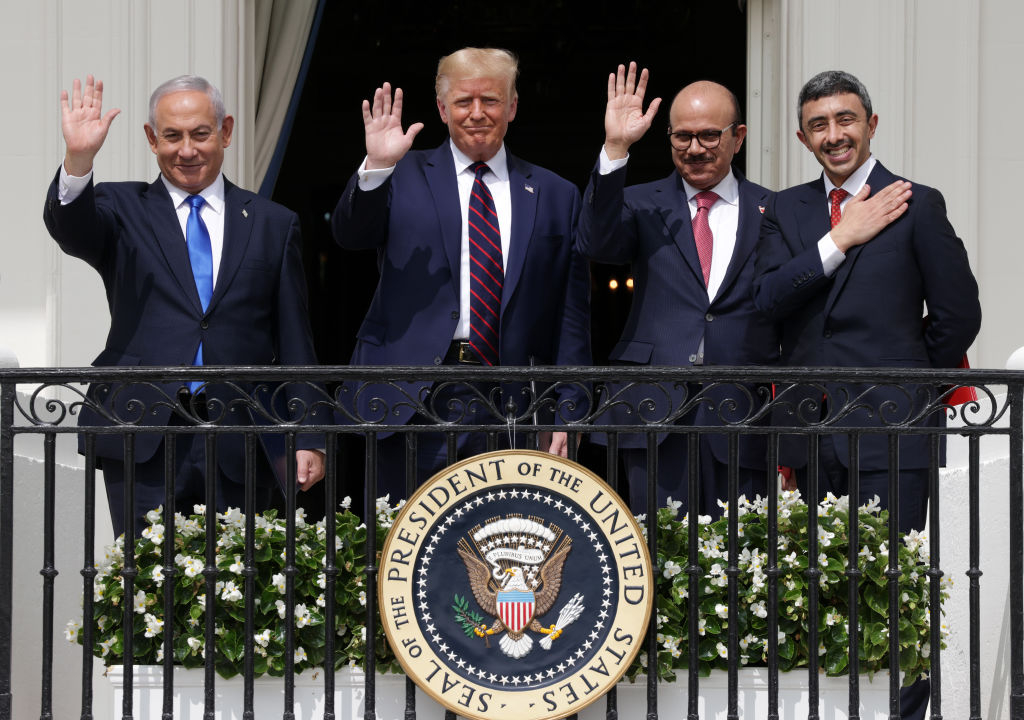
Fortunately for Israel, former US President Donald J. Trump was just re-elected to serve a second term. Trump is already creating seismic global changes within days, long before his inauguration on January 20, 2025. Pictured from left to right: Israeli Prime Minister Benjamin Netanyahu, then US President Donald Trump, Bahraini Foreign Minister Abdullatif bin Rashid Al Zayani and UAE Foreign Minister Abdullah bin Zayed bin Sultan Al Nahyan at the signing ceremony of the Abraham Accords at the White House on September 15, 2020 in Washington, DC. (Photo by Alex Wong/Getty Images)


Israel, under the heroic but much criticized statesman, Prime Minister Benjamin Netanyahu – a leader praised by historian Andrew Roberts as "The Churchill of the Middle East" – appears to have brought threats from Hamas in Gaza, and Hezbollah in Lebanon, under control and can now focus Israel's attention and military forces on other fronts.

Incomprehensibly, at this crucial period in Israel's existence, the chaotic domestic political situation has been cooking up unnecessary problems for the nation's security. Internal turmoil in Israel just serves to stimulate the hope for victory in its enemies, and less hope for the quick release of Israeli and other hostages Hamas is holding. "Hamas," wrote JNS editor-in-chief Jonathan Tobin, "views the unrest inside the Jewish state as an asset."

Continue Reading Article

President Trump’s Middle East challenges: Reversible economic sanctions or irreversible regime-change?

by Ambassador (ret.) Yoram Ettinger

“I’m not going to start wars, I’m going to stop wars,” proclaimed President-elect Trump in his November 6 victory message.

*Bolstering the US’ posture of deterrence is the most critical prerequisite for stopping/minimizing wars and terrorism. The US’ posture of deterrence is reflected by the size and structure of the US’ defense budget, avoiding appeasement of rogue entities, and dwelling on reality (as frustrating as it is) rather than alternate reality.

*The US’ posture of deterrence has been undermined by the State Department, which was evicted from the center stage of foreign policy formulations during President Trump’s first term. Trump opposes Foggy Bottom’s multilateral/cosmopolitan state of mind, which prefers a coordinated policy with the UN, international organizations and Europe, rather than a unilateral, independent US national security and foreign policy. The State Department has also subordinated Middle East reality to its own alternate reality, which has led to its systematic failure in the Middle East (e.g., the 1978-9 stabbing the Shah in the back, and facilitating the Ayatollahs’ rise to power; the embrace of Saddam Hussein until his 1990 invasion of Kuwait; the 1993 cuddling of Arafat and ushering him to the Nobel Peace Prize; the 2009 betrayal of the pro-US Mubarak and the courting of the anti-US Moslem Brotherhood; the 2010 reference to the Arab Tsunami on the Arab Street, as if it were an Arab Spring and Facebook Revolution; the 2011 military offensive on Qadhafi, which transformed Libya into a major arena of anti-US Islamic terrorism; and pressuring Israel to conclude a series of accords with – and refrain from demolishing – Hamas, which bolstered Hamas’ terrorism and led to the October 7 atrocities).

*The US’ posture of deterrence has been severely undermined by the State Department’s policy toward Iran’s Ayatollahs regime, which has been transformed – since the February 1979 toppling of the Shah – from “the American Policeman of the Gulf” to an arch anti-US venomous octopus, stretching its tentacles from the Persian Gulf through the Middle East and Africa into Latin America and the US soil. The Ayatollahs have become the major global epicenter of anti-US wars, terrorism and drug trafficking, threatening the US homeland and the survival of all pro-US Arab regimes, especially the Arab oil producers. The Ayatollahs aspire to control 48% of global oil reserves and key routes of global trade, which would deal a major blow to Western economy.

*The US’ posture of deterrence has been severely undermined by the delusion that the diplomatic option/negotiation, supplemented with mega-billion-dollar-gestures could induce the Ayatollahs to abandon their 1,400-year-old fanatical vision, conduct good faith negotiations and accept peaceful coexistence. The architects of the diplomatic option have ignored the fact that rogue regimes bite the hands that feed them, as documented by the Ayatollahs, who took over the US Embassy – a few months following the US support in toppling the Shah - held 50 American hostages for 444 days, and emerged as a leading threat to the US, globally and domestically.

*Thus, the 45-year-old diplomatic option has dramatically bolstered the capabilities of Iran’s Ayatollahs as the chief epicenter of global anti-US terrorism, drug trafficking, proliferation of advance military systems and mega-billion-dollars of money laundering. Just like the Moslem Brotherhood, Hezbollah, Hamas and the PLO/PA, Iran’s Ayatollahs have been driven by a fanatical vision, which transcends monetary considerations. Moreover, this vision has been codified by their Constitution, education system and mosque sermons.

*The Ayatollahs’ fanatical vision mandates the elimination of enemies, such as the “apostate” Sunni regimes, the “infidel” West, the “Great American Satan,” and the “illegitimate” Zionist entity, which they view as the US’ vanguard in the Middle East.

*The Ayatollahs consider negotiation as a means to advance their anti-US vision, and not as a means to advance reconciliation with the US.
*Therefore, the Ayatollahs should not be partners to negotiation, but a target for regime-change. The potential cost of regime-change would be dwarfed by the cost of facing a nuclear Iran.

*At the same time, a series of peace accords ended the state of war between Israel and Egypt, Jordan, the United Arab Emirates, Bahrain, Morocco and South Sudan, because – unlike the Ayatollahs, Hamas, the PLO/PA and Hezbollah - the national vision/aspiration of each Arab country does not mandate the elimination of Israel. In fact, the Saudi “Vision 2030” considers Israel as a partner, militarily, technologically and agriculturally.

*President Trump’s first term featured “maximum pressure” economic sanctions, which crippled the Ayatollahs’ economy, and constrained their capability to bolster terrorism and wars. However, as demonstrated by the 2021 suspension and softening of the sanctions, economic sanctions are reversible by a succeeding President. They reduce/delay the wrath of war and terrorism, but do not eliminate the threat.

*On the other hand, regime-change is irreversible, eliminates the threat, and cannot be restored by a succeeding President. Furthermore, it would significantly bolster the US’ strategic stature (including in Latin America, the US’ soft underbelly), by removing the Ayatollahs’ machete from the throats of all pro-US Arab regimes, eliminate the chief supporter of global Islamic terrorism, and induce Saudi Arabia and Oman (and possibly Kuwait, Indonesia and additional Moslem countries) to join the Abraham Accords.

*The Abraham Accords were conceived by ignoring the State Department’s preoccupation with the Palestinian issue and focussing on the national interests of the individual Arab country, as was done with Israel’s prior peace treaties with Egypt and Jordan. Contrary to the State Department’s conventional wisdom – which produced a litany of peace proposals that failed to produce peace - the Abraham Accords came to fruition, because they bypassed the Palestinian issue, denying the Palestinians a veto power over the peace process. The Abraham Accords validate that the State Department has been wrong to assume that the Palestinian issue is the crux of the Arab-Israeli conflict, the crown-jewel of the Arabs and a root cause of Middle East turmoil.

*While the State Department has been obsessed with a proposed Palestinian state, all pro-US Arab countries have limited their support of the proposed Palestinian state to talk, while their walk has been indifferent-to-negative. Arab leaders pay more attention to the Palestinian rogue walk than to the Palestinian moderate talk. Therefore, they consider the Palestinians as a role model of intra-Arab subversion, terrorism and treachery, due to Palestinian terrorism against their hosts in Egypt (1950s), Syria (1960s), Jordan (1968-70), Lebanon (1970-82) and Kuwait (1990). In addition, they are aware of the Palestinian collaboration with Nazi Germany, the Soviet Bloc, Ayatollah Khomeini, international terror organizations, Moslem Brotherhood terrorists, North Korea, Venezuela, Cuba, Russia and China. Therefore, they have concluded that a Palestinian state west of the Jordan River would add fuel to the Middle East fire, toppling the pro-US Hashemite regime east of the River, transforming Jordan into an arena of anti-US Islamic terrorism, triggering rogue ripple effects in the Arabian Peninsula (as well as in the US), threatening every oil-producing Arab regime and Egypt. This would be a bonanza for the Ayatollahs, Russia and China and a blow to the US economy and homeland security.

*On the other hand, Israel has emerged as a unique force and dollar multiplier for the US, and a leading innovation center for the US commercial and defense high-tech sectors (e.g., 250 US high tech giants operate research and development centers in Israel). Israel is the “Triple-A-Store” of the US defense and aerospace industries (increasing US export), and the leading battle-tested laboratory of the US defense industries (saving many years of research and development), Armed Forces (enhancing battle tactics), the intelligence community, counter-terrorism agencies and the FBI. Israel has been the largest US aircraft carrier (as stated by General Alexander Haig, a former NATO Supreme Commander and Admiral Elmo Zumwalt, a former Chief of Naval Operations), which does not require Americans on board, deployed in a critical area between the Mediterranean, the Red Sea, the Arabian Sea, the Indian Ocean and the Persian Gulf, sparing the US the need to manufacture and deploy (to the Middle East) a few more real aircraft carriers along with a few ground divisions, which would cost the US taxpayer $15-$20BN annually.